
Skip to content

Why Loop Engineering is the Next Big Thing in Enterprise AI?

Featured Image

Executive Summary

Loop Engineering is an emerging AI engineering discipline focused on building systems that continuously plan, execute, evaluate, learn, and improve through structured feedback loops. Unlike Prompt Engineering or Context Engineering, which optimize individual interactions, Loop Engineering designs the complete execution lifecycle by combining goal definition, context assembly, orchestration, evaluation, persistent memory, and iterative improvement. As enterprises adopt AI-native applications and autonomous agents, Loop Engineering provides a scalable architectural approach for creating adaptive, reliable, and outcome-driven AI systems. This article explores its core engineering primitives, enterprise applications, and why it represents the next evolution of AI system design.

“You shouldn’t be prompting coding agents anymore. You should be designing loops that prompt your agents.” – Peter Steinberger, Creator of OpenClaw.

Over the past year, I’ve watched the AI engineering conversation evolve at an incredible pace.

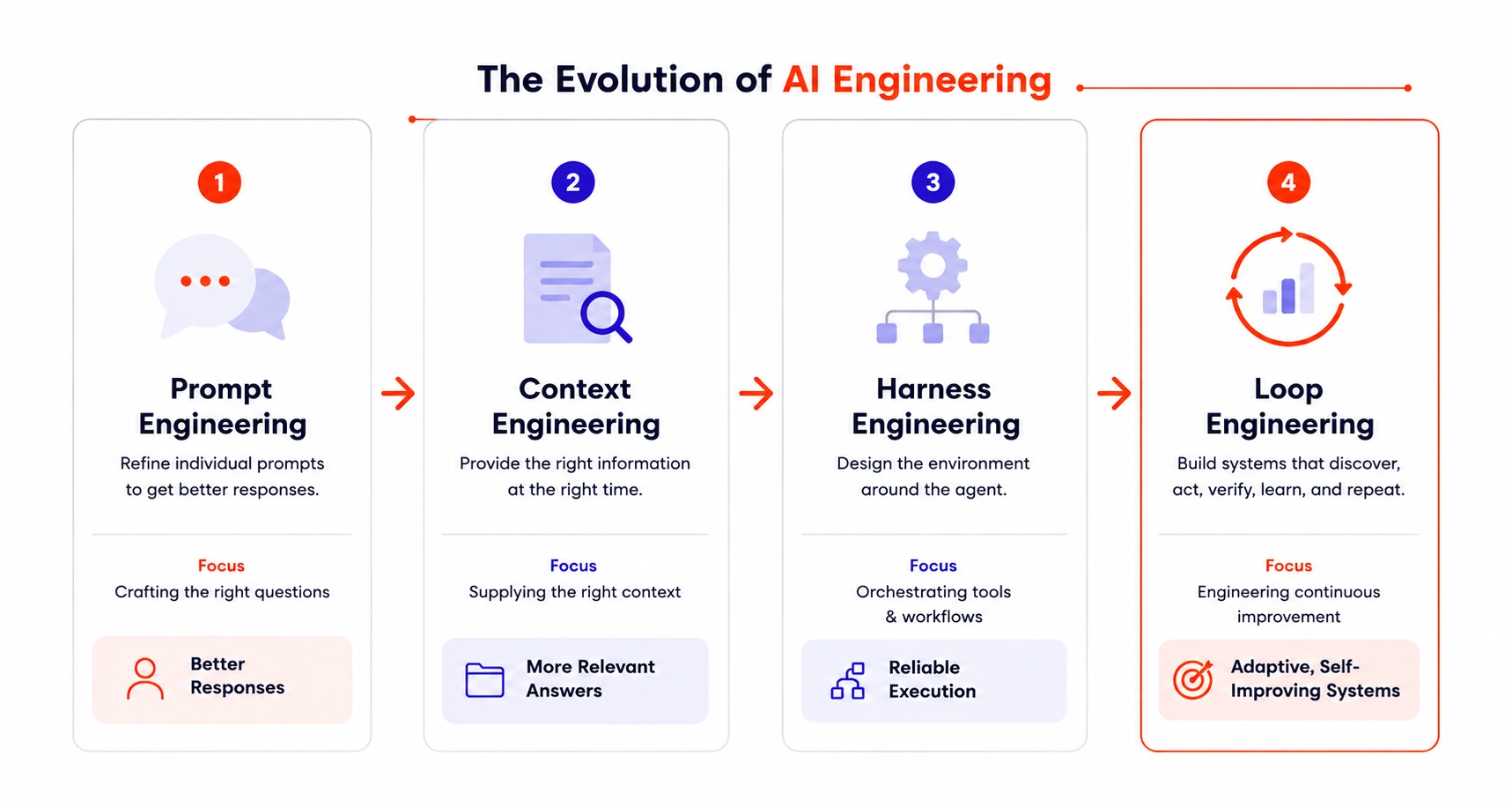
We started with prompt engineering, shifted toward context engineering, and then explored harness engineering as AI systems became more capable.

Today, another idea is gaining momentum across engineering communities: Loop Engineering.

I don’t see Loop Engineering as another buzzword. I see it as a reflection of how we are beginning to build (and enhance) AI-native systems.

The most successful AI applications no longer rely on a single prompt followed by a single response.

They operate through continuous cycles of planning, execution, evaluation, and refinement. The quality of these loops increasingly determines the quality of the outcome.

Loop Engineering is About Designing Systems, Not Conversations

Prompt engineering taught us how to communicate with AI.

Context engineering taught us how to provide the right information.

Loop Engineering asks a different question altogether: How do you engineer an AI system that can continuously improve while working toward a defined objective?

The shift may sound subtle, but it fundamentally changes how AI applications are built.

Instead of optimizing a single interaction, Loop Engineering focuses on the entire execution lifecycle. Every decision made by the system creates new information. That information becomes an input for the next iteration.

Evolution of AI Engineering

A well-designed loop doesn’t simply execute a task. It continuously answers questions such as:

→ Did the agent choose the right tool?

→ Was the retrieved knowledge relevant?

→ Did the output satisfy the success criteria?

→ Should another iteration begin?

→ Has something new been learned that should persist beyond this execution?

Rather than treating every request as an isolated event, Loop Engineering turns every execution into an opportunity to improve the next one.

From an engineering perspective, the AI application gradually becomes more predictable, more reliable, and increasingly aligned with business objectives.

The Six Engineering Primitives of Enterprise Loop Engineering

Every successful loop is built on a set of engineering primitives that work together.

Individually, each component solves a specific problem. Together, they create AI systems that can continuously adapt, evaluate, and improve while working toward a business objective.

While implementation details differ across platforms, I believe enterprise Loop Engineering consistently comes down to six foundational layers.

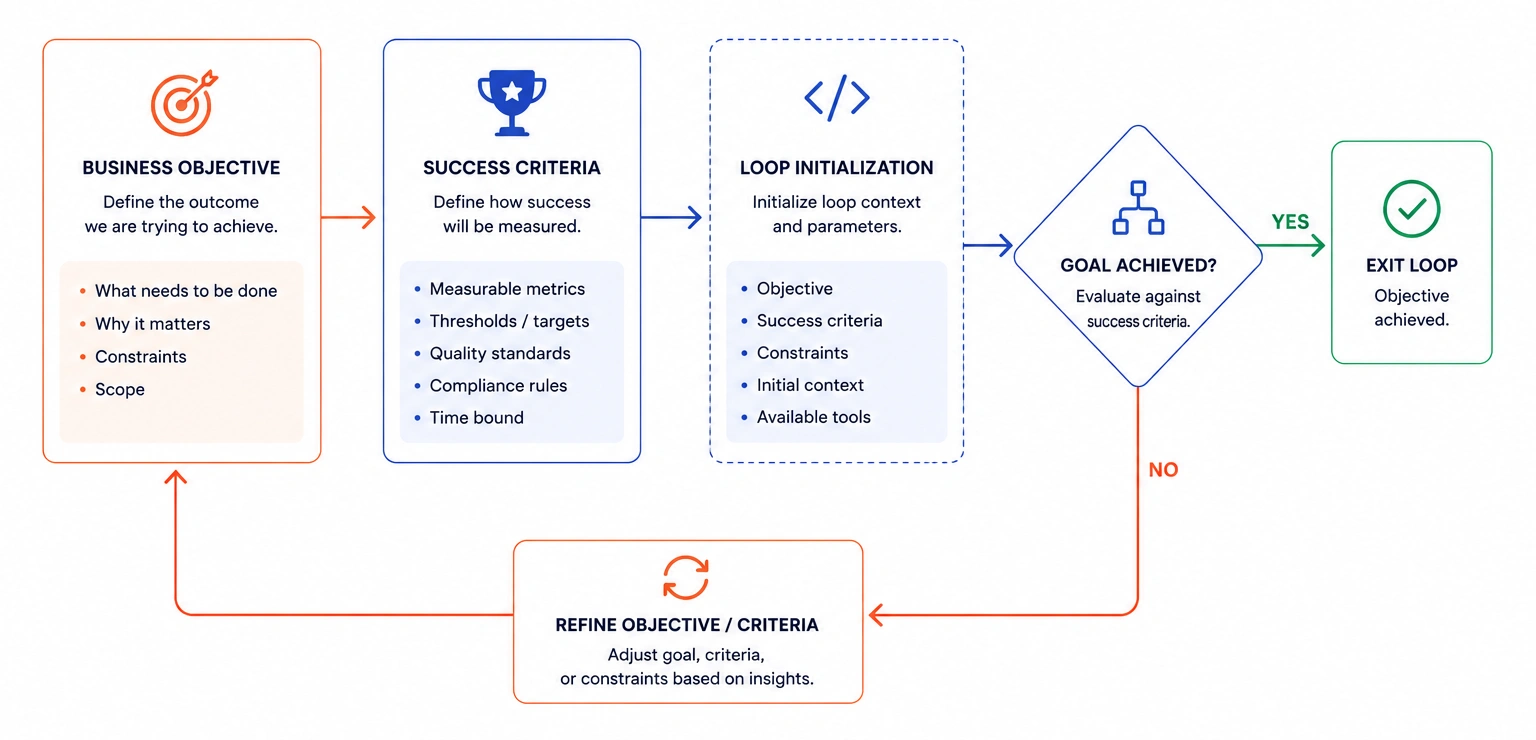
1. Goal Definition

Every loop begins with an objective rather than a predefined workflow.

Traditional software follows instructions. Loop-based systems pursue outcomes.

Goal Definition in Loop Engineering

For example, a customer support agent doesn’t simply answer a ticket. Its objective may be to resolve the issue within company policy while maintaining customer satisfaction above a defined threshold.

The objective remains constant. The execution path adapts based on what happens during each iteration.

Without a clearly defined goal, an AI system generates responses. With one, it continuously works toward a measurable outcome.

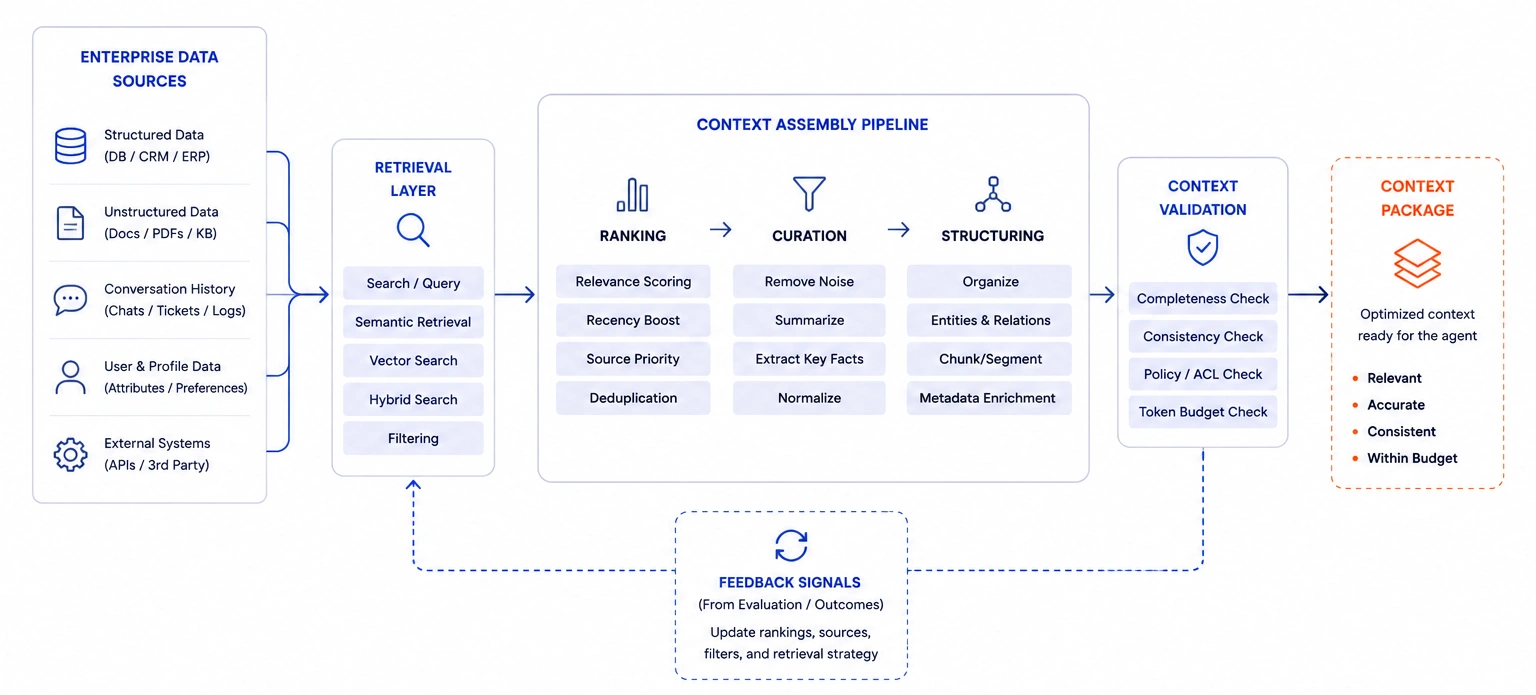
2. Context Assembly

AI models don’t make decisions in isolation. Every iteration depends on the quality of the context available at that moment. 

Context Assembly in Loop Engineering

Instead of relying on a single prompt, enterprise loops continuously assemble context from multiple sources, including knowledge bases, CRM systems, ERP platforms, APIs, vector databases, business policies, and historical interactions. 

This makes context dynamic rather than static. 

As new information becomes available, the loop rebuilds its understanding before taking the next action. 

Context engineering determines what the AI knows. Loop Engineering determines how that knowledge evolves throughout execution.

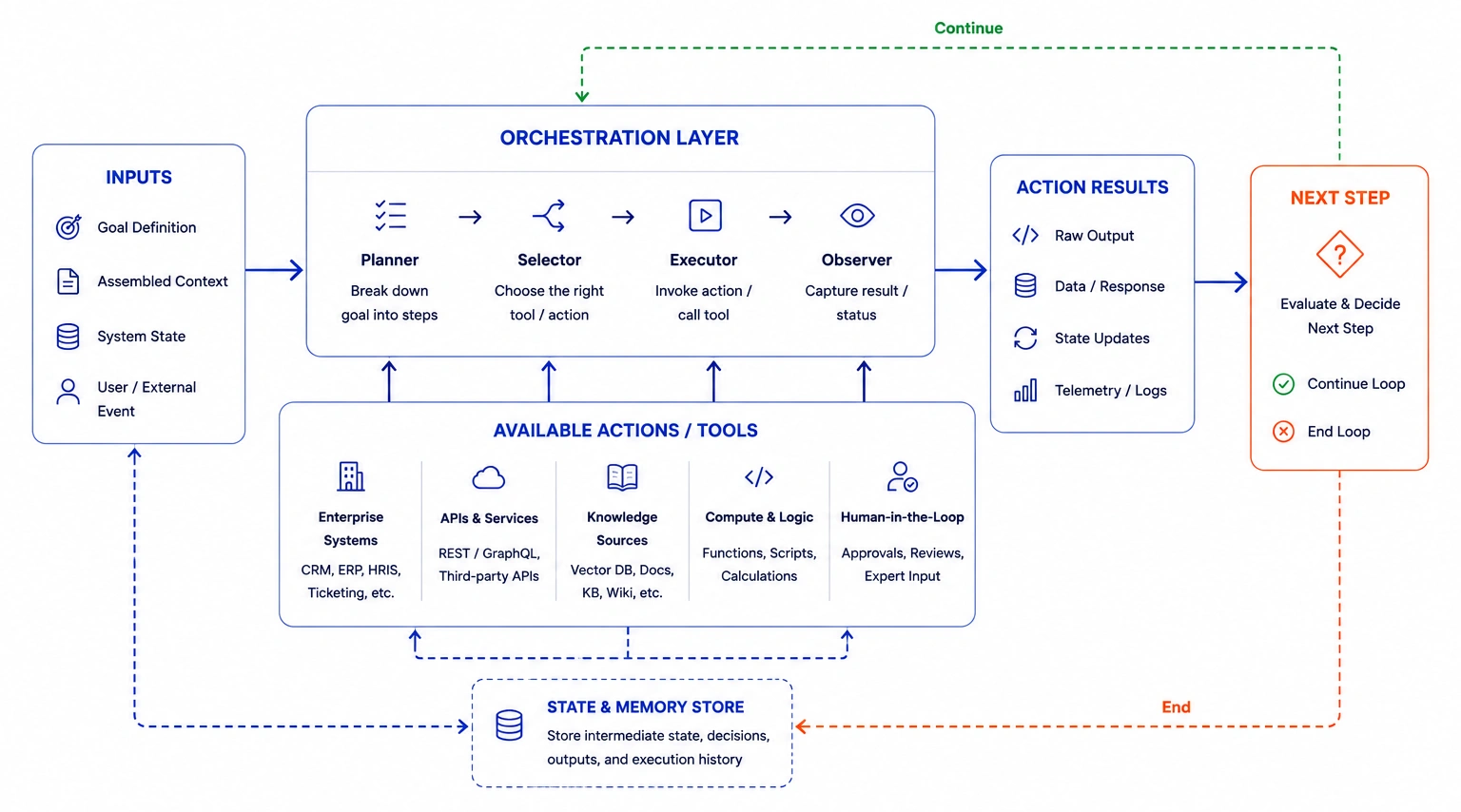
3. Action and Orchestration

Once the objective and context are established, the system begins execution.

Depending on the objective, an agent may retrieve information, invoke enterprise APIs, trigger workflows, update records, generate code, schedule tasks, or collaborate with specialized agents.

An orchestration layer coordinates these activities.

It determines which agent should act next, which tool should be called, whether another iteration is required, and when execution should pause for human approval.

Here’s a simple demonstration of this.

Action and Orchestration in Loop Engineering

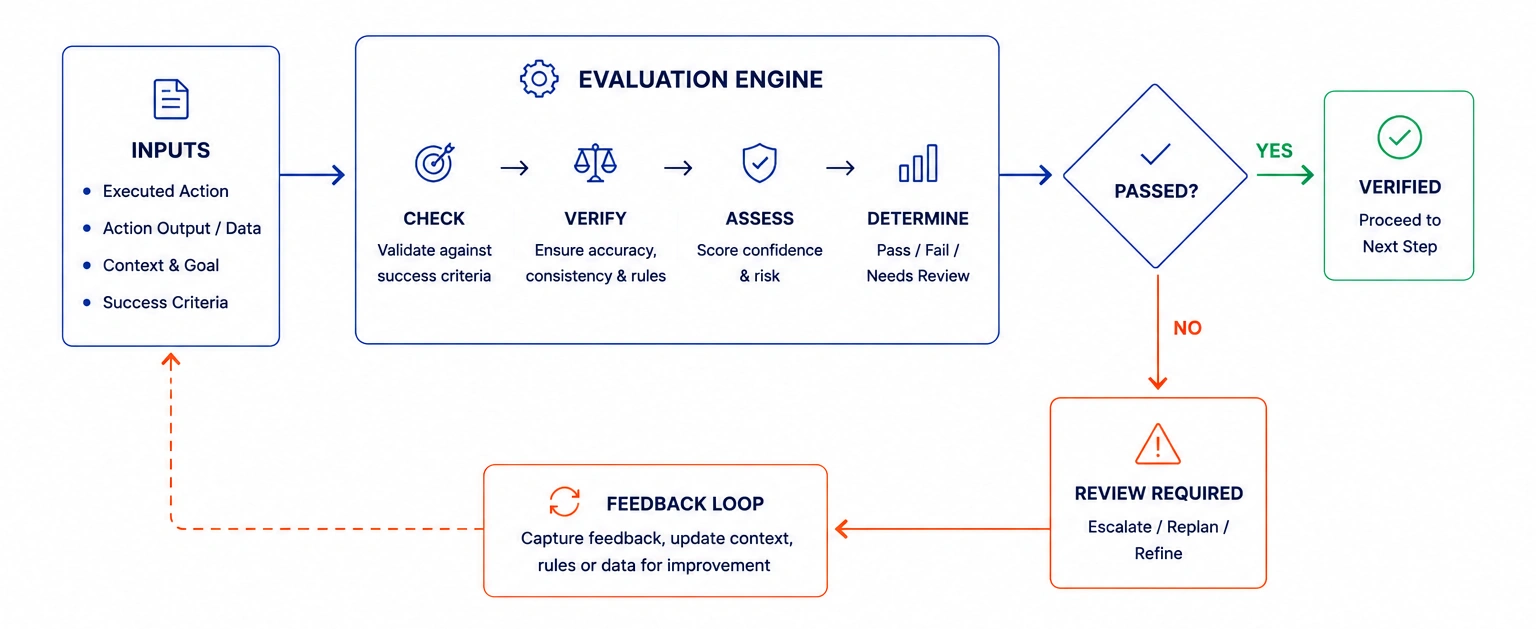
4. Evaluation and Verification

This is the layer that separates AI automation from Loop Engineering.

Every execution produces evidence.

The question is whether that evidence satisfies the objective.

Evaluation and Verification in Loop Engineering

Instead of trusting its own output, the system continuously evaluates every iteration using business rules, automated tests, policy engines, LLM-as-a-Judge, domain-specific validators, or human review.

Evaluation becomes part of execution rather than a step that happens afterward.

Only verified outcomes move the loop forward.

Everything else becomes feedback for the next iteration.

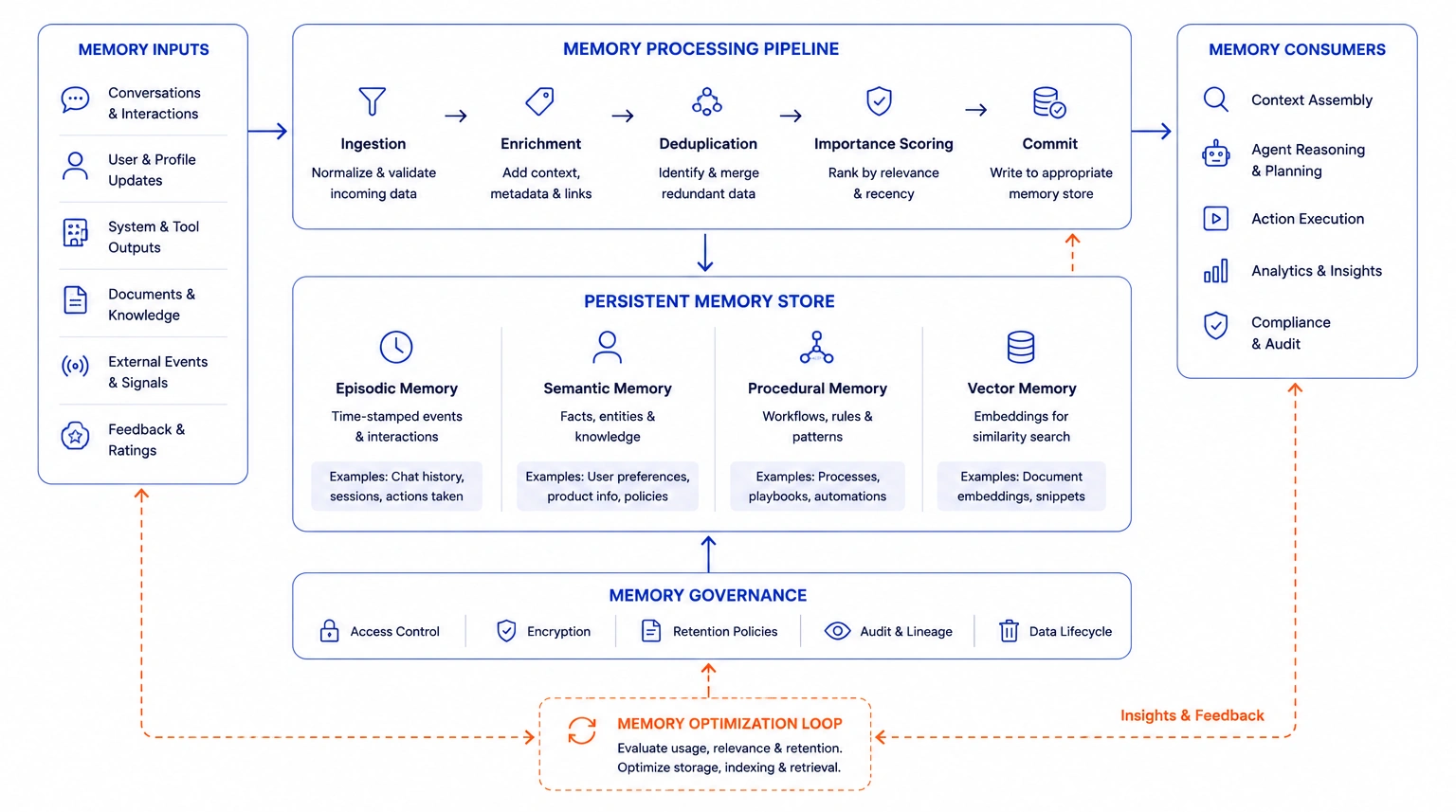
5. Persistent Memory

Loop Engineering treats memory as infrastructure.

Persistent Memory in Loop Engineering

Execution history, customer preferences, successful workflows, business policies, retrieved knowledge, and previous decisions all live outside the model and remain available for future iterations.

This persistent memory allows every cycle to build upon the last instead of starting from zero.

Over time, the system compounds operational knowledge instead of repeatedly rediscovering it.

6. Continuous Improvement

The final layer closes the loop.

→ Evaluation generates feedback.

→ Memory stores what matters.

→ The orchestration layer decides the next action.

→ The system executes again.

Every iteration contributes new signals that improve prompts, retrieval quality, agent coordination, workflow design, and business outcomes.

This creates a self-improving architecture where learning emerges from execution rather than periodic retraining.

That’s why I believe Loop Engineering represents a shift in how enterprise AI systems are built.

Loop Engineering is Bigger than Coding

Most conversations around Loop Engineering today revolve around coding assistants.

They’re a natural starting point because software development makes iterative execution easy to observe. An agent writes code, runs tests, fixes failures, and repeats the cycle until the objective is achieved.

The underlying architecture, however, isn’t limited to software engineering.

The same engineering primitives can power AI systems across the enterprise.

Consider a customer support agent. The objective isn’t simply to answer a question. The loop retrieves customer history and relevant knowledge, executes actions such as updating a CRM or processing a refund, evaluates whether the issue has been fully resolved, stores the outcome, and uses those signals to improve future interactions.

Across every industry, the workflow changes. The engineering principles remain the same.

That’s why I believe Loop Engineering should be viewed as an enterprise architecture pattern rather than a capability built exclusively for coding agents.

Organizations that engineer reliable feedback loops across data, tools, workflows, and human expertise will create AI systems that improve through execution instead of relying on periodic redesigns.

Why I Believe Loop Engineering is the Future of Enterprise AI?

Every few years, software engineering adopts a new abstraction that changes how systems are designed.

Microservices changed how we built distributed applications.

Cloud-native architectures changed how we deployed them.

Today, I believe Loop Engineering represents a similar shift for AI-native systems.

As AI agents become increasingly capable, the challenge won’t be finding a better model. It will be engineering systems that can reliably plan, execute, evaluate, learn, and improve while operating within enterprise constraints.

That’s where Loop Engineering earns its place.

It’s an engineering discipline that brings together orchestration, memory, evaluation, enterprise integrations, governance, and continuous feedback into a single operating model.

These capabilities already exist individually. Loop Engineering connects them into a repeatable architecture for building adaptive AI systems.

The terminology may continue to evolve, but the underlying engineering principles are already taking shape. Organizations that embrace these principles early will build AI systems capable of adapting alongside changing business requirements, user expectations, and operational complexity.

The future of enterprise AI won’t be defined by the intelligence of a single model. It will be defined by the quality of the loops we engineer around it.

Get Consultation
Ready to Build Enterprise AI That Learns Over Time?
Partner with Azilen to engineer adaptive AI systems powered by agentic AI.

FAQs: Loop Engineering

1. What is Loop Engineering in AI?

Loop Engineering is an engineering approach for building AI systems that continuously plan, execute, evaluate, learn, and improve while working toward a defined objective. Instead of treating every AI interaction as an isolated request, it creates structured feedback loops that help systems adapt over time using evaluation, memory, orchestration, and enterprise context.

2. How is Loop Engineering different from Prompt Engineering?

Prompt Engineering focuses on crafting better instructions for an AI model. Loop Engineering focuses on designing the entire system around the model, including context retrieval, workflow orchestration, evaluation, memory, and continuous improvement. It shifts the emphasis from optimizing responses to engineering adaptive AI systems.

3. Is Loop Engineering the same as Context Engineering?

No. Context Engineering determines what information an AI agent receives before taking an action. Loop Engineering builds on that foundation by managing the complete execution lifecycle, including planning, action, verification, memory, and iterative improvement. Context becomes one component within a larger engineering architecture.

4. Why is Loop Engineering important for enterprise AI?

Enterprise AI systems interact with business applications, customer data, workflows, and governance policies that continuously evolve. Loop Engineering enables these systems to adapt through structured feedback instead of relying on static workflows, helping organizations improve reliability, accuracy, and long-term business outcomes.

5. What are the key components of Loop Engineering?

A robust Loop Engineering architecture typically includes goal definition, context assembly, action orchestration, evaluation and verification, persistent memory, and continuous improvement. Together, these components allow AI systems to learn from execution while remaining aligned with business objectives and governance requirements.

author avatar
Niket Kapadia Co-Founder & Chief Technology Officer (CTO)
Niket Kapadia is Co-Founder & CTO of Azilen Technologies with 17+ years of experience in enterprise architecture, AI-driven solutions, and scalable product engineering. He specializes in building high-performance systems and aligning technology with business innovation.
google
Niket Kapadia
Niket Kapadia
CTO - Azilen Technologies

Niket Kapadia is a technology leader with 17+ years of experience in architecting enterprise solutions and mentoring technical teams. As Co-Founder & CTO of Azilen Technologies, he drives technology strategy, innovation, and architecture to align with business goals. With expertise across Human Resources, Hospitality, Telecom, Card Security, and Enterprise Applications, Niket specializes in building scalable, high-impact solutions that transform businesses.

Related Insights

GPT Mode
AziGPT - Azilen’s
Custom GPT Assistant.
Instant Answers. Smart Summaries.