



Skip to content

Step-by-Step NeoCloud Migration Roadmap for Large Enterprises

Featured Image

Executive Summary

NeoCloud Migration is helping large enterprises move away from rigid cloud environments and toward AI-ready, GPU-powered, high-performance cloud ecosystems. However, migration is not just about moving workloads. It is about rebuilding infrastructure for scalability, resilience, cost optimization, and faster innovation.

This blog explains a practical NeoCloud Migration Roadmap for large enterprises.

If your enterprise infrastructure still struggles with latency, rising cloud bills, AI workload limitations, or vendor lock-in, this roadmap will help you understand the next move.

Your Hyperscaler Bill Just Became a Business Problem

Large enterprises are spending millions on AI infrastructure. However, most hyperscaler cloud platforms were not designed for today’s GPU-heavy AI workloads.

Running AI model training, inference, and large-scale data pipelines on AWS, Azure, or Google Cloud often leads to very high compute costs. In many cases, enterprises pay far more for GPU resources than necessary.

That is why NeoCloud migration is growing rapidly.
NeoCloud Migration Roadmap

NeoCloud providers offer AI ready infrastructure with high performance GPU environments, faster scalability, and more cost efficient compute for modern enterprise workloads.

As enterprises modernize cloud strategies for AI and high performance computing, NeoCloud adoption is growing rapidly. Traditional cloud migration is no longer enough.

Businesses now need infrastructure built specifically for AI, distributed systems, and modern workloads.

So what is NeoCloud migration, and how do enterprises build a successful NeoCloud migration roadmap?

What is NeoCloud Migration?

NeoCloud Migration Roadmap Journey

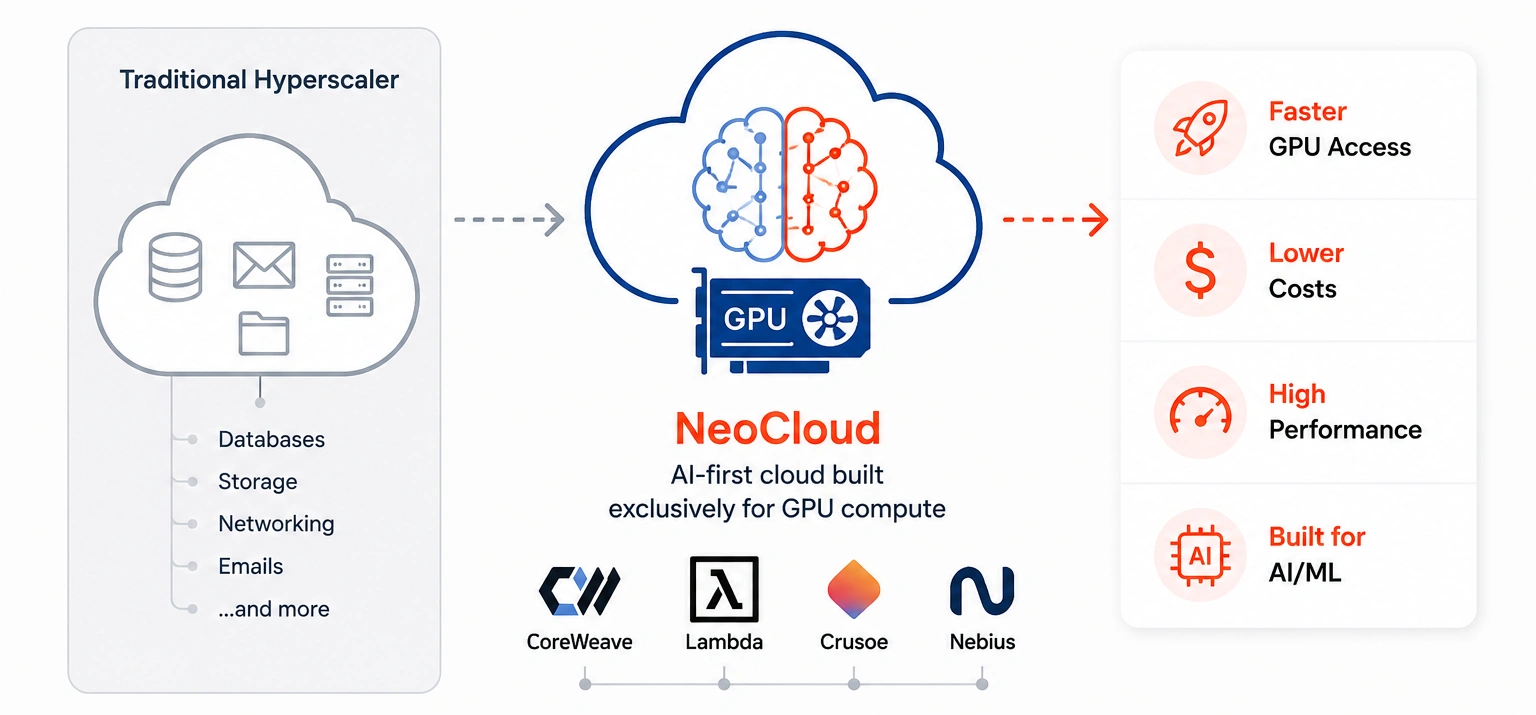
A NeoCloud is a specialized, AI-first cloud provider built specifically around GPU infrastructure.

Unlike traditional hyperscalers (AWS, Azure, GCP) that handle everything from databases to storage to emails, NeoCloud providers focus on one thing: delivering high-performance GPU compute for AI and ML workloads.

Leading NeoCloud providers today include:

CoreWeave: the market leader, already generating $5B+ in annual revenue

Lambda Labs: known for developer-friendly, fast-provisioning GPU clusters

Crusoe: focused on sustainable, renewable-energy-powered AI data centers

Nebius: a strong choice for enterprises with EU data residency needs

NeoCloud Migration is the process of moving your AI and ML workloads from a hyperscaler environment to one of these specialized providers. The goal is simple: faster GPU access, lower costs, and infrastructure purpose-built for AI.

Who is This Roadmap For?

This guide is for:

→ CTOs and cloud architects planning 2025–2026 AI infrastructure strategy

→ FinOps leaders seeing GPU costs spiral out of control

→ Engineering teams running LLM training, inference, or large-scale ML pipelines

→ IT decision-makers evaluating a hybrid or multi-cloud AI approach

If you are running any serious AI workload and have not evaluated NeoCloud options, you are almost certainly overpaying.

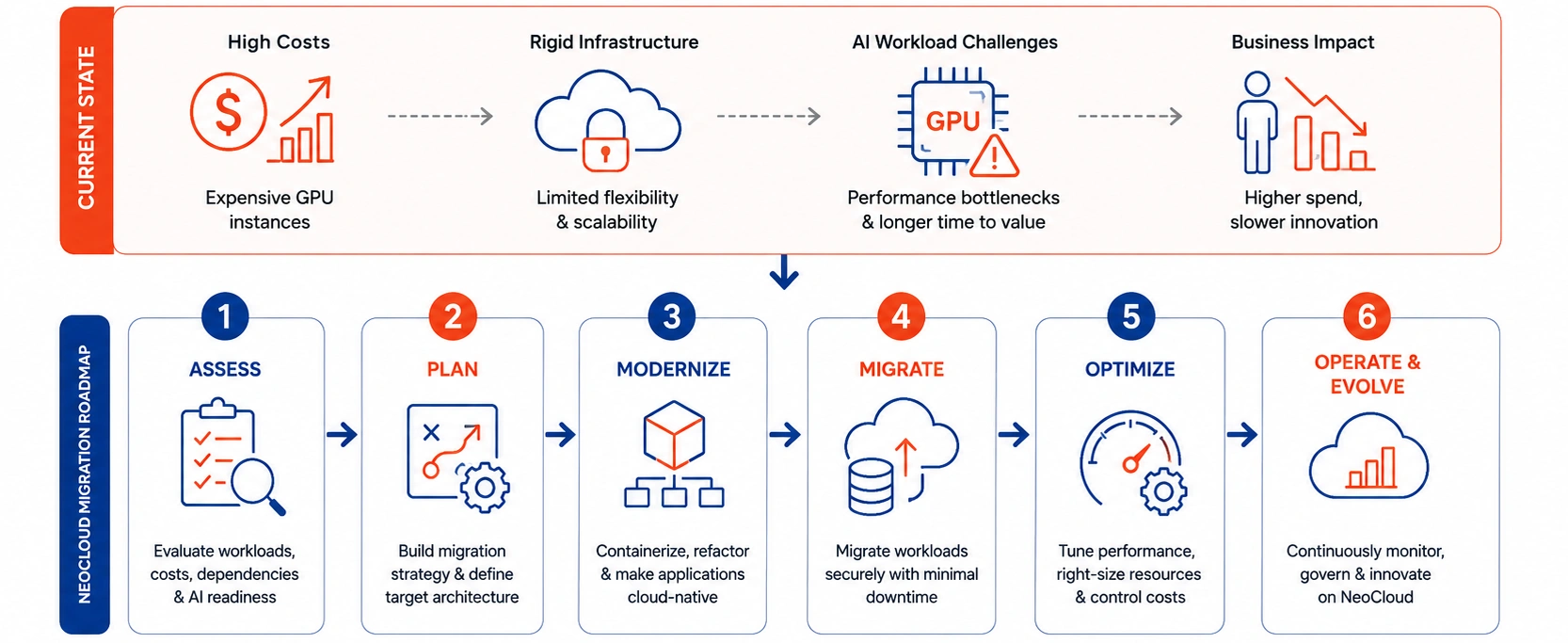
6 Essential Steps in a Successful NeoCloud Migration Roadmap

Step 1: Audit and Assess Your Current Cloud Environment

Step 1 Audit and Assess Your Current Cloud Environment

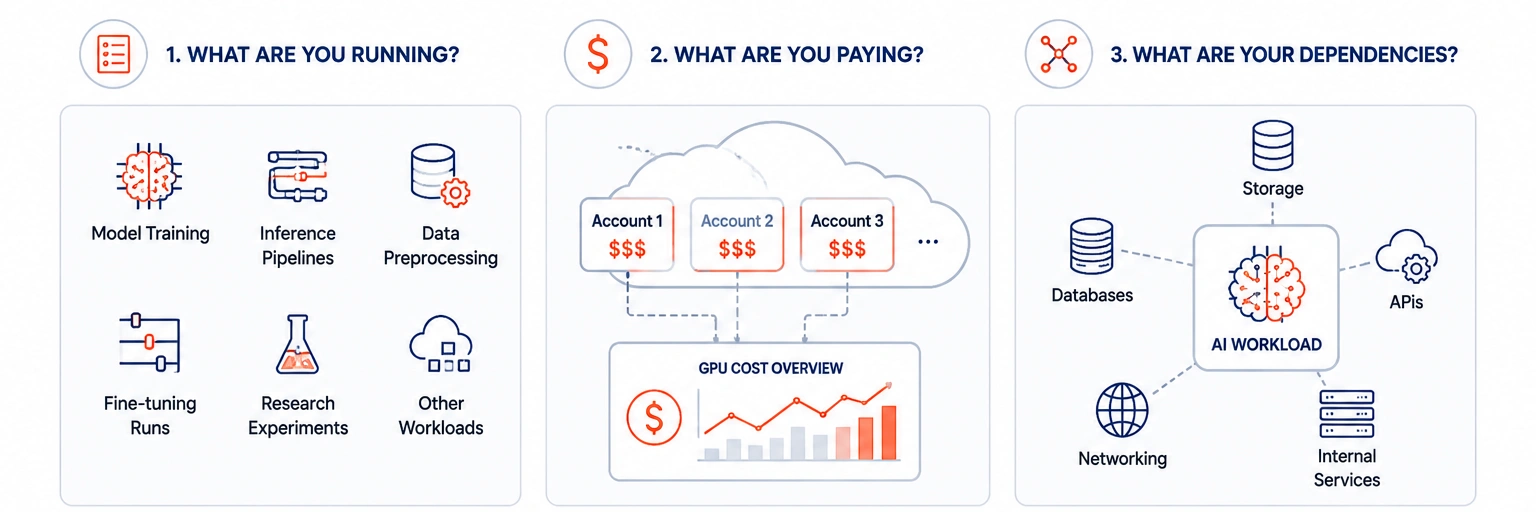
This step is about discovery. Specifically, you are answering three questions:

What are you running? List every AI/ML workload: model training jobs, inference pipelines, data preprocessing, fine-tuning runs, research experiments. Separate them from general enterprise workloads like CRM, ERP, or collaboration tools.

What are you paying? Pull your GPU compute invoices line by line. Most enterprises are shocked by what they find. GPU compute costs are often buried across multiple teams, projects, and cloud accounts. Bring it into one view.

What are your dependencies? Map out what each workload connects to. Storage, databases, internal APIs, networking setup. This matters a lot in Step 5 when you actually start moving things.

Step 2: Define Your NeoCloud Migration Strategy

Step 2 Define Your NeoCloud Migration Strategy

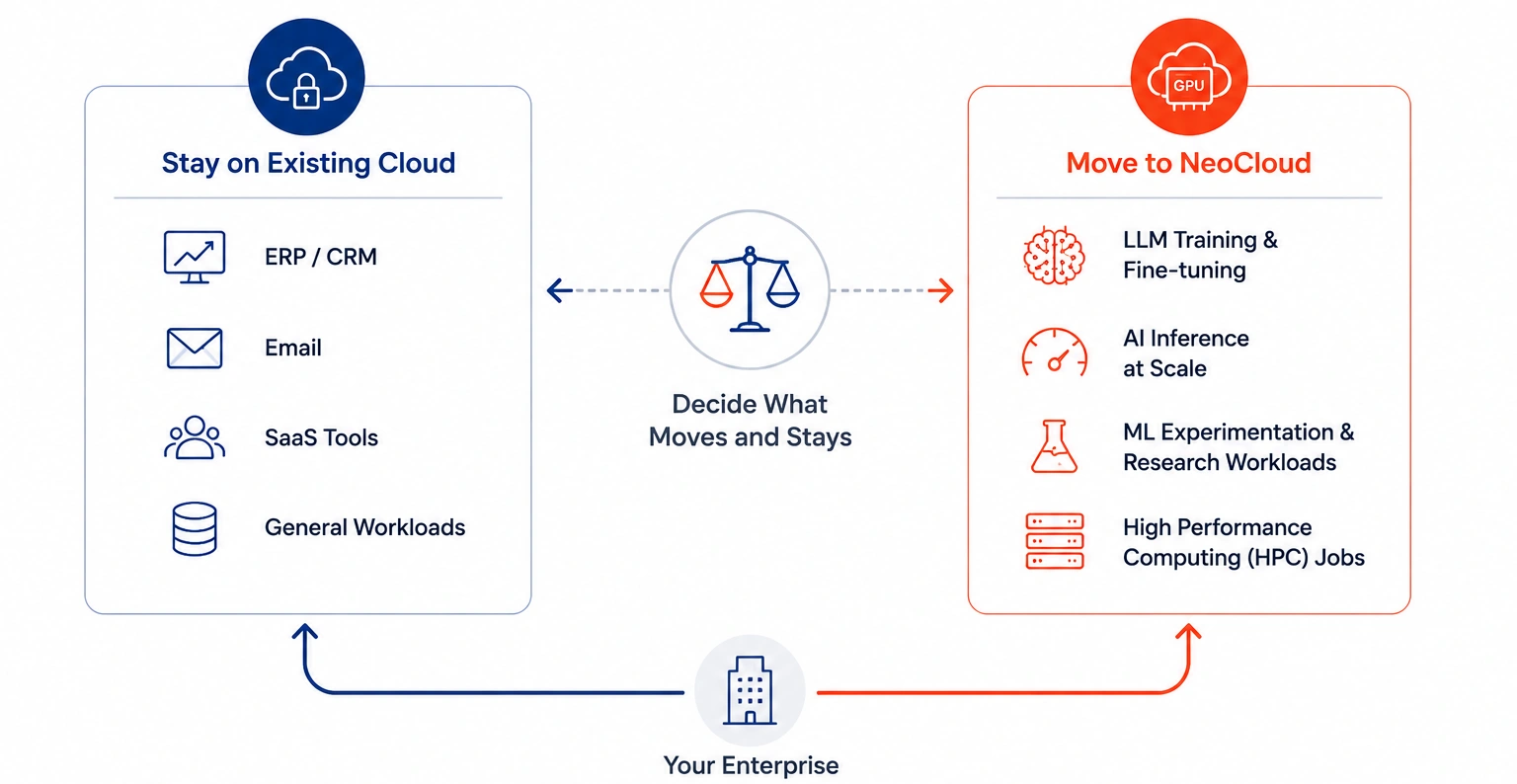
Now that you know what you have, it is time to decide what to do with it.

Not every workload should move to a NeoCloud. That is an important point. NeoCloud providers are purpose-built for AI compute, they are not general-purpose clouds.

Your ERP, your SaaS tools, your email infrastructure, those stay where they are.

What typically moves to a NeoCloud:

→ LLM training and fine-tuning runs

→ AI inference at scale

→ ML experimentation and research workloads

→ High-performance computing (HPC) jobs

Step 3: Evaluate and Select Your NeoCloud Vendor

Step 3 Evaluate and Select Your NeoCloud Vendor

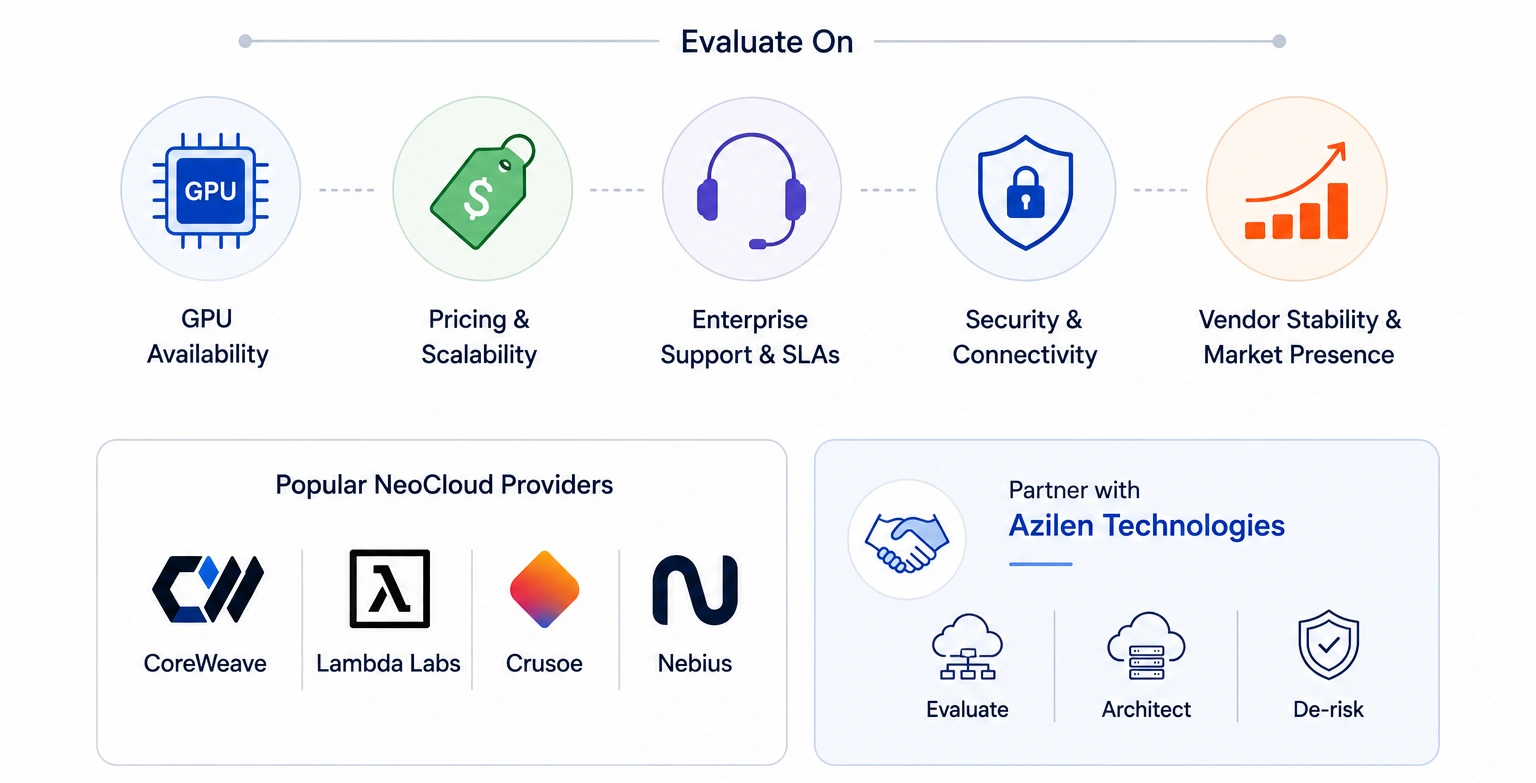
A successful NeoCloud Migration Roadmap depends on choosing the right NeoCloud provider.

Today, many NeoCloud vendors exist. However, only a few support enterprise-scale AI infrastructure in the US market.

Before selecting a provider, enterprises should evaluate:

→ GPU availability and performance

→ Long-term pricing and scalability

→ Enterprise support and SLAs

→ Security and connectivity options

→ Vendor stability and market presence

This is also where enterprises often work with partners like Azilen Technologies
to evaluate NeoCloud vendors, design AI-ready architecture, and reduce migration risks before deployment.

Step 4: Run a Pilot Migration


Step 4 Run a Pilot Migration

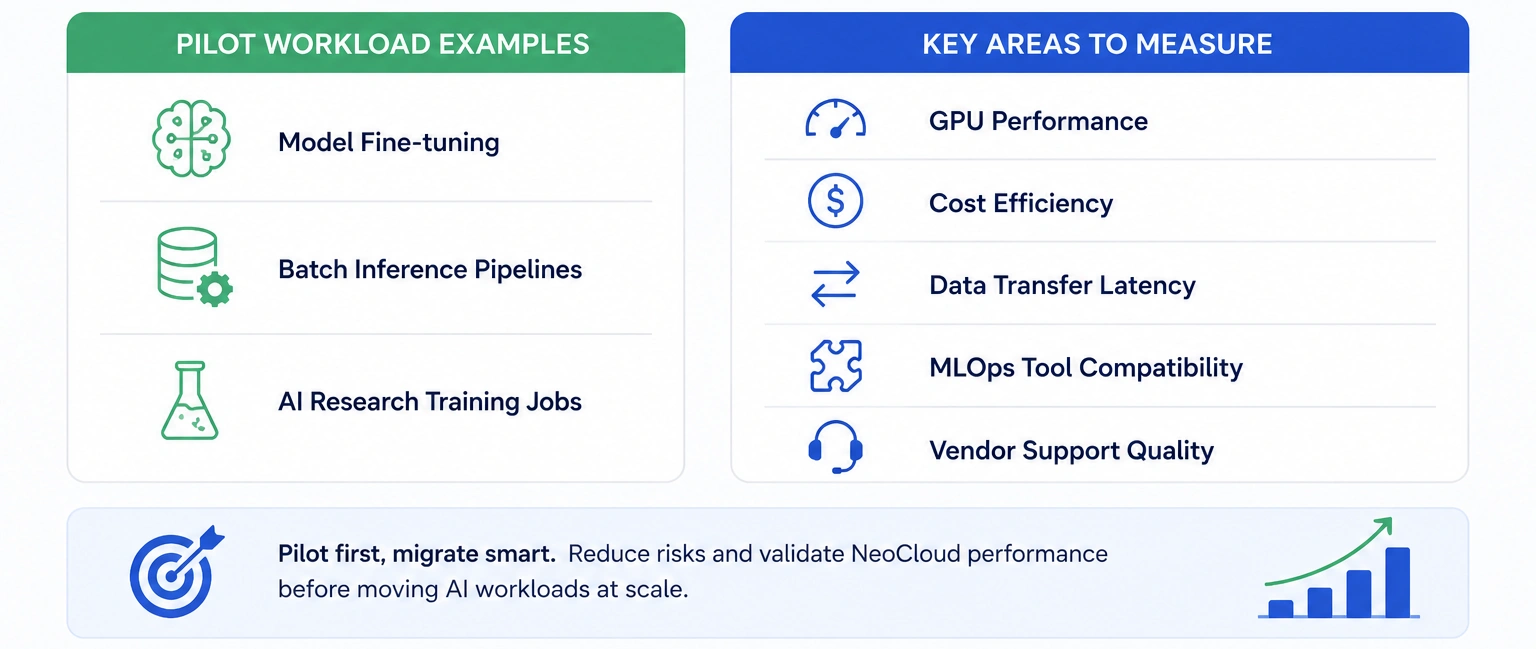
A successful NeoCloud Migration Roadmap should always start with a pilot migration before full deployment.

Instead of moving critical AI workloads immediately, enterprises should first test smaller GPU-intensive workloads in the NeoCloud environment.

Good pilot workloads include:

→ Model fine-tuning

→ Batch inference

→ Research training jobs

Step 5: Execute the Full-Scale NeoCloud Migration

Step 5 Execute the Full-Scale NeoCloud Migration

Your pilot worked. The numbers make sense. Now it is time to scale your NeoCloud Migration Roadmap.

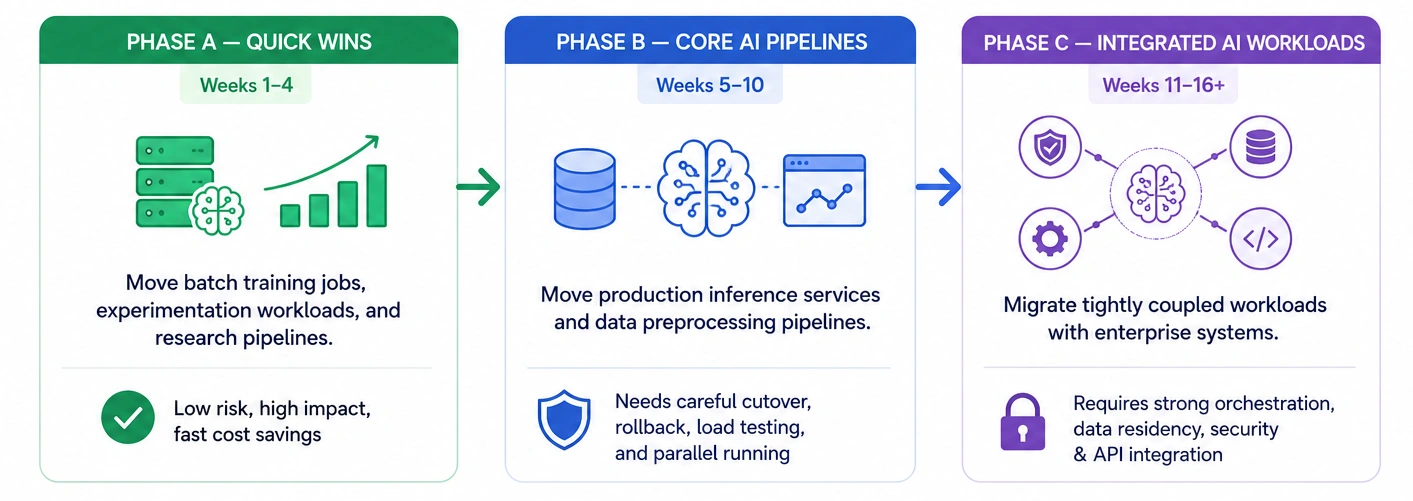
For large enterprises, migration is never a single cutover. It happens in phases based on workload priority, risk, and dependencies.

Phase A: Quick Wins 

Move batch training jobs, research workloads, and model experimentation pipelines. These workloads are easier to migrate and deliver faster GPU cost savings.

Phase B: Core AI Pipelines

Migrate production inference services and data preprocessing pipelines. This stage requires rollback planning, load testing, and parallel deployment.

Phase C: Integrated AI Workloads 

Move workloads connected with enterprise systems, APIs, and sensitive data environments. These migrations require stronger security, compliance, and orchestration planning.

Step 6: Optimize, Govern, and Scale


Step 6 Optimize, Govern, and Scale

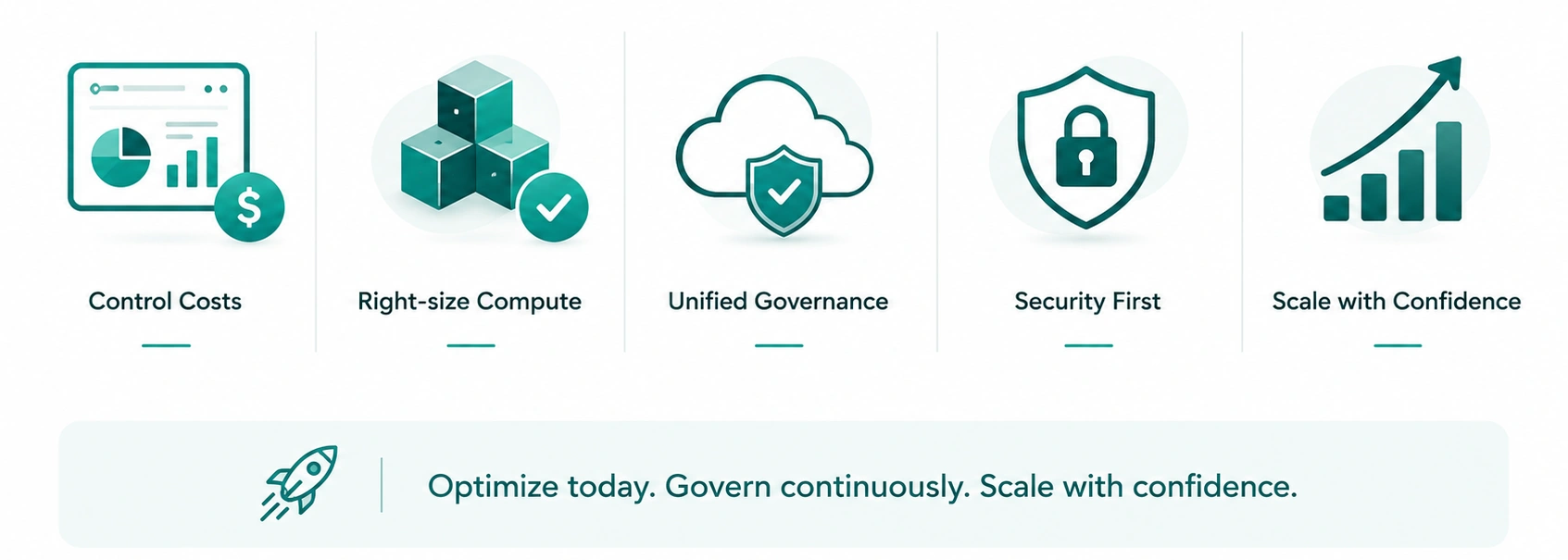
A successful NeoCloud Migration Roadmap does not end after migration. This is where long-term optimization begins.

Once workloads move to NeoCloud infrastructure, enterprises should focus on:

→ Monitoring GPU costs and usage

→ Optimizing compute resources

→ Managing multi-cloud environments

→ Strengthening security and compliance

→ Avoiding vendor lock-in risks

Real-World Example: How Enterprises Are Moving to NeoCloud

How Enterprises Are Moving to NeoCloud

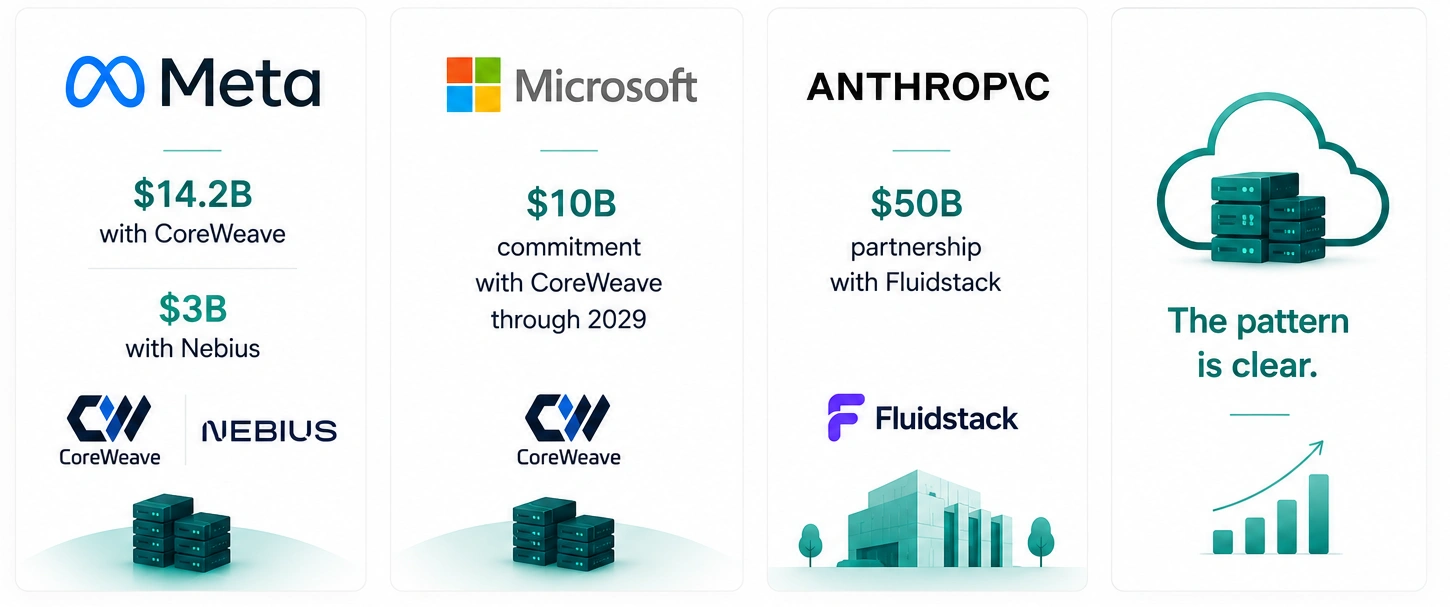
Large enterprises are already making major NeoCloud infrastructure investments.

Meta AI Infrastructure Investments committed billions to providers like CoreWeave and Nebius to support growing AI and GPU compute demands.

At the same time, Microsoft also signed large long-term agreements with CoreWeave for AI infrastructure capacity.

Even Anthropic, partnered with Fluidstack to build large AI-focused data centers in the US.

The message is clear: Enterprises are no longer relying only on traditional hyperscalers for AI workloads. Instead, they are using NeoCloud providers for high-performance, GPU-intensive AI infrastructure at scale.

Why NeoCloud Migration is a 2026 Priority

The rise of NeoCloud Migration is being driven by three major shifts in the enterprise AI market.

→ GPU demand is growing faster than hyperscaler capacity. Many enterprises still face long wait times for AI-ready GPU infrastructure, while NeoCloud providers offer much faster provisioning.

→ AI inference is becoming the biggest enterprise AI workload. Enterprises are moving inference pipelines to NeoCloud for better performance and lower infrastructure costs.

→ The NeoCloud market is still early and highly competitive. Many providers are offering flexible pricing and enterprise-friendly terms as the market continues to grow.

This is why more enterprises are accelerating their NeoCloud Migration Roadmap to build scalable and cost-efficient AI infrastructure.

How Azilen Supports Your NeoCloud Migration Roadmap

At Azilen Technologies, we act as an Enterprise AI Development Partner for organizations planning long-term NeoCloud Migration and AI infrastructure modernization.

NeoCloud migration is not just about moving workloads. It is about building scalable, secure, and AI-ready infrastructure that performs reliably at enterprise scale.

Our teams work across AI engineering, cloud architecture, platform modernization, DevOps, and enterprise systems to help organizations modernize infrastructure without disrupting existing operations.

We help enterprises:

✔️ Assess AI workloads and define the right NeoCloud Migration Roadmap

✔️ Design scalable GPU-ready cloud architecture for AI and ML workloads

✔️ Optimize Kubernetes, containers, and cloud-native infrastructure

✔️ Build secure multi-cloud and hybrid cloud environments

✔️ Improve GPU utilization and reduce infrastructure costs

✔️ Integrate MLOps, monitoring, and workload orchestration systems

✔️ Strengthen governance, security, and enterprise compliance controls

✔️ Scale AI infrastructure with long-term flexibility and reduced vendor lock-in

If your enterprise is planning a NeoCloud Migration, Azilen helps you move forward with clarity, reduce migration risks, and build infrastructure designed for long-term AI growth.

IoT App Development
Start Your NeoCloud Migration Journey
Understand how we modernize, optimize, and scale AI-ready NeoCloud infrastructure 👇

FAQs: NeoCloud Migration

1. What is NeoCloud Migration?

NeoCloud Migration is the process of moving AI, ML, and GPU-intensive workloads from traditional cloud platforms to specialized AI-first cloud providers known as NeoClouds. These platforms are designed for high-performance GPU computing, faster AI workload scaling, and better infrastructure efficiency.

2. Why are enterprises moving to NeoCloud providers?

Large enterprises are adopting NeoCloud providers to reduce GPU infrastructure costs, improve AI workload performance, and gain faster access to high-demand GPU resources. NeoCloud platforms are built specifically for AI and machine learning operations at scale.

3. What workloads should move during a NeoCloud Migration?

The best workloads for a NeoCloud Migration Roadmap usually include:

→ AI model training
→ LLM fine-tuning
→ AI inference pipelines
→ Machine learning experimentation
→ High-performance computing (HPC) workloads

General enterprise applications like ERP, CRM, and email systems typically remain on traditional cloud infrastructure.

4. How long does a NeoCloud Migration take for large enterprises?

NeoCloud migration timelines depend on workload complexity, security requirements, and enterprise architecture. Most large enterprises follow a phased migration approach that can take anywhere from a few weeks to several months.

5. How does Azilen help with NeoCloud Migration?

Azilen Technologies acts as an Enterprise AI Development Partner for organizations planning NeoCloud Migration and AI infrastructure modernization. Azilen helps enterprises design scalable AI-ready architecture, optimize GPU infrastructure, improve cloud governance, and reduce migration risks during large-scale cloud transformation initiatives.

Glossary

→ NeoCloud: A specialized AI-first cloud platform built mainly for GPU-intensive workloads like AI training, inference, and machine learning operations.

→ NeoCloud Migration: The process of moving AI and ML workloads from traditional cloud environments to NeoCloud infrastructure for better performance and scalability.

→ GPU (Graphics Processing Unit): A high-performance processor designed to handle AI, machine learning, and parallel computing workloads efficiently.

→ AI Inference: The process where a trained AI model makes predictions or generates outputs using real-time or stored data.

→ Kubernetes: An open-source platform used to automate the deployment, scaling, and management of containerized applications.

→ MLOps (Machine Learning Operations): A set of practices used to manage, deploy, monitor, and automate machine learning models in production environments.

→ Multi-Cloud Environment: A cloud strategy where enterprises use services from multiple cloud providers instead of relying on a single platform.

→ GPUaaS (GPU as a Service): A cloud-based service that provides on-demand access to GPU infrastructure for AI and high-performance computing workloads.

→ Cloud-Native Architecture: A modern software architecture designed specifically for cloud environments using containers, microservices, and automated scaling.

→ FinOps (Financial Operations): A cloud cost management practice that helps enterprises monitor, optimize, and control infrastructure spending across cloud environments.

google
Manas Borthakur
Manas Borthakur
Senior Business Development Manager • Sales

Manas works closely with CTOs and CIOs as a trusted customer advisor, helping organizations shape and execute their digital transformation agendas. He collaborates with clients to align business goals with the right mix of GenAI, Data, Cloud, Analytics, IoT, and Machine Learning solutions. With a strong focus on advisory-led selling, Manas bridges strategy and execution by translating complex technology capabilities into clear, outcome-driven roadmaps. His approach is rooted in partnership, ensuring long-term value rather than one-time solutions.

Related Insights

GPT Mode
AziGPT - Azilen’s
Custom GPT Assistant.
Instant Answers. Smart Summaries.