



Skip to content

How to Connect IoT Devices to Headless CMS Content for Scalable Digital Experiences

Featured Image

Executive Summary

Connecting IoT devices to headless CMS content enables a centralized system where structured content flows through APIs and reaches devices such as smart displays, industrial panels, and connected applications in real time. This approach uses an API-first architecture, lightweight data formats, and optional edge layers to ensure fast, consistent content delivery across distributed environments. A typical setup includes a headless CMS, API layer, IoT devices, and middleware or messaging systems that handle communication through protocols like HTTP or MQTT. With clear content models, secure API access, and either polling or event-driven delivery, organizations achieve reliable IoT content synchronization, scalable deployment, and efficient device-level content management across use cases such as digital signage, retail, manufacturing, and healthcare.

What It Means to Connect IoT Devices to Headless CMS Content

It means that content lives in a central system and travels through APIs to different devices that use that particular content in their own way.

A headless CMS stores structured content such as text, images, configurations, and rules. IoT devices such as smart displays, kiosks, sensors, or dashboards request that content through APIs and use it to show information or trigger actions.

The flow stays simple:

→ Content sits inside the CMS

→ API exposes that content

→ IoT device requests it

→ Device shows or uses it

This setup supports headless CMS for IoT because each device reads the same content but applies it based on its own capability. A smart display shows visuals, while a sensor-based system may trigger alerts using the same content structure.

This also builds a strong foundation for IoT device content management, where teams manage content in one place and deliver it across many connected environments.

Architecture Required to Integrate IoT Devices to Headless CMS Content

A clear architecture helps every part communicate without friction. Each component plays a defined role.

Core Components in Headless CMS Integration with IoT Devices

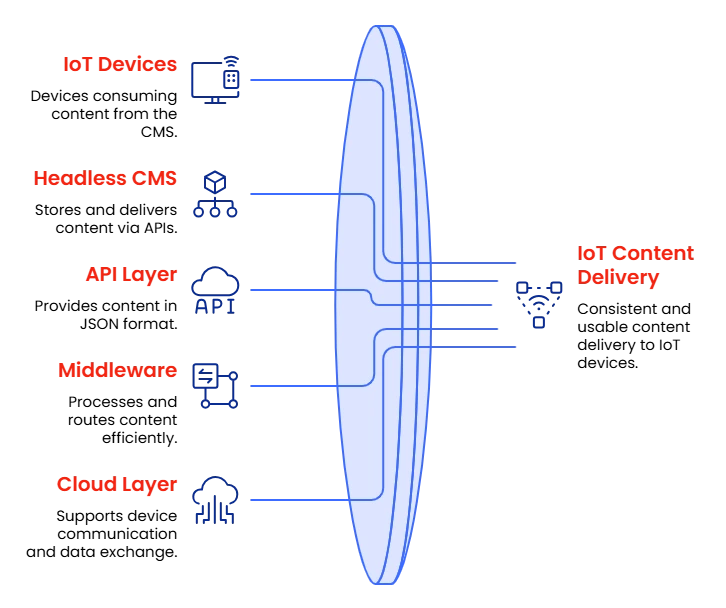
A working IoT headless CMS integration includes:

IoT Devices: Devices such as smart screens, industrial panels, or connected machines that consume content.

Headless CMS: A backend system that stores structured content and exposes it through APIs.

API Layer: REST or GraphQL APIs that deliver content in JSON format.

Middleware or Edge Layer: A processing layer that handles transformation, caching, or routing when required.

Cloud or Messaging Layer: Systems such as MQTT brokers or event streams that support communication across devices.

Core Components in Headless CMS Integration with IoT Devices

This forms the base of an IoT content delivery architecture where an API-first CMS IoT model ensures that every device receives content in a consistent and usable format.

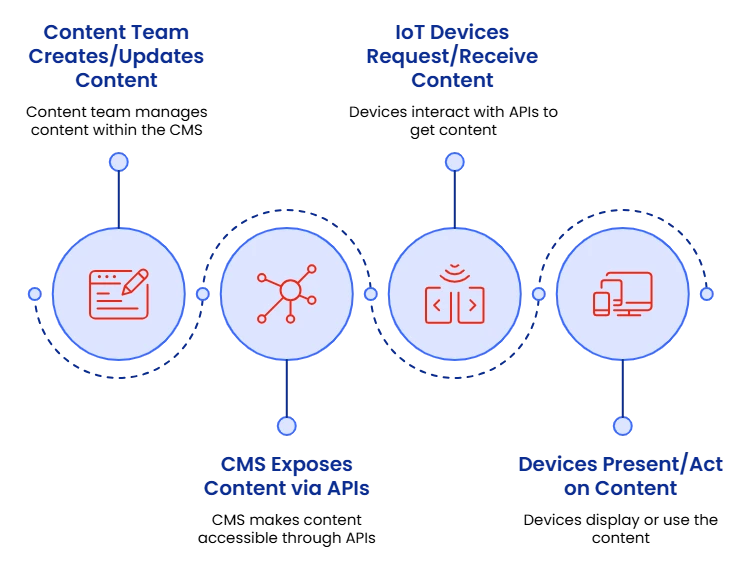
Data Flow When You Integrate IoT Devices to Headless CMS Content

A clear data flow helps teams design predictable systems.

1. A content team creates or updates content inside the CMS

2. The CMS exposes that content through APIs

3. IoT devices request or receive that content

4. Devices present or act on that content

Data Flow When You Integrate IoT Devices to Headless CMS Content

Two common patterns shape this flow:

Polling Model: Devices request content at fixed intervals

Event-Driven Model: CMS sends updates through webhooks or messaging systems when content changes

For real-time content delivery, event-driven systems provide faster updates. For stable environments, polling gives control over frequency.

To maintain consistency across many devices, teams apply IoT content synchronization using caching and version control.

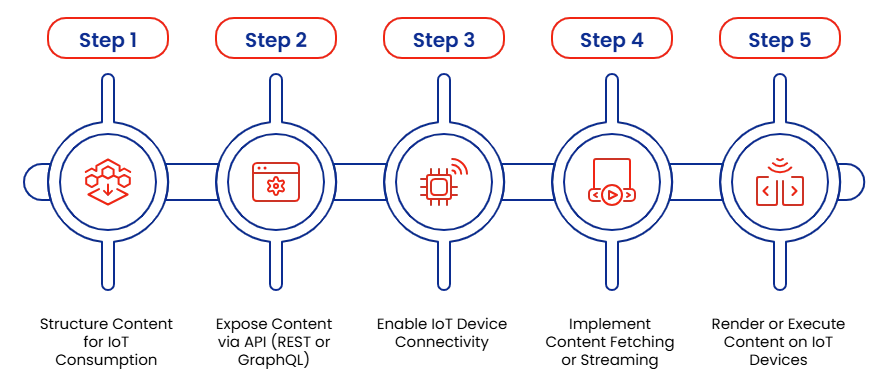
Step-by-Step Guide to Connect IoT Devices to Headless CMS Content

This section focuses on direct execution. Each step builds on the previous one.

Guide to Connect IoT Devices to Headless CMS Content

Step 1 – Structure Content for IoT Consumption

Content needs a format that devices can easily read.

Teams define schemas in JSON format. Each content type includes fields such as title, message, image URL, or configuration value.

For example:

→ A retail display content model may include – product name, price, image, promotion text, etc.

→ An industrial dashboard model may include – alert message, threshold value, timestamp, etc.

This step shapes IoT device content management and ensures that every device receives only the required data in a clean format.

Step 2 – Expose Content via API (REST or GraphQL)

The CMS must provide API access so devices can retrieve content.

Teams configure:

→ API endpoints

→ Authentication methods such as API keys or tokens

→ Response formats in JSON

This step directly supports connecting IoT to the CMS API. Devices send requests to the CMS and receive structured responses that they can process.

GraphQL helps when devices need specific fields. REST works well for standard use cases.

Step 3 – Enable IoT Device Connectivity

Devices need a reliable way to communicate with the CMS or middleware.

Common IoT protocols include:

→ HTTP or HTTPS for direct API calls

→ MQTT for lightweight messaging

→ WebSockets for continuous communication

In large systems, devices connect through a gateway or edge layer. This setup supports edge IoT CMS integration, where the edge layer handles requests and reduces direct load on the CMS.

Step 4 – Implement Content Fetching or Streaming

Devices must receive content in a consistent way.

Two approaches exist:

Pull Approach: Devices request content at regular intervals

Push Approach: CMS sends updates through events or messages

For real-time content delivery for IoT, push-based systems give faster updates. Edge caching also improves speed and reduces repeated API calls.

Step 5 – Render or Execute Content on IoT Devices

Once devices receive content, they use it based on their purpose.

→ A smart display shows images, text, or videos

→ A kiosk presents interactive content

→ A sensor-based system uses content to trigger alerts or actions

This step completes the loop where content moves from CMS to device and creates a usable experience.

Common Challenges When You Connect IoT Devices to Headless CMS Content

Every system faces practical challenges during scale and operation.

Latency in Content Delivery: Slow networks or distant servers can delay updates

Device Constraints: Limited memory or processing power affects performance

Connectivity Issues: Intermittent networks affect content access

Content Version Control: Devices may run different versions of content

Security Risks: Unauthorized access to APIs or devices

A right approach to headless CMS integration with IoT devices addresses these areas early in the design stage.

Best Practices for Integrating IoT Devices to Headless CMS

Clear practices help teams maintain performance and reliability.

→ Use an API-first CMS IoT approach from the start

→ Keep payloads lightweight and structured

→ Apply caching through CDN or edge layers

→ Use event-driven systems for scale

→ Secure APIs with authentication and encryption

→ Maintain fallback content for offline scenarios

These practices strengthen the overall IoT content delivery architecture.

Tools and Technologies for Headless CMS Integration with IoT Devices

A successful setup depends on selecting the right combination of CMS, IoT platforms, communication protocols, and processing layers. Each layer supports a specific role in the overall system.

Headless CMS: Contentful, Strapi, Sanity, Adobe Experience Manager (Headless), Hygraph

IoT Platforms: AWS IoT Core, Microsoft Azure IoT Hub, Google Cloud IoT (via partners), IBM Watson IoT Platform

→ API Layer: REST APIs, GraphQL

Middleware / Backend: Node.js, Express.js, Serverless (AWS Lambda, Azure Functions)

Communication Protocols: HTTP / HTTPS, MQTT, WebSockets, CoAP

Edge & Gateway: AWS Greengrass, Azure IoT Edge, Edge gateways (industrial IoT gateways)

Messaging & Streaming: Apache Kafka, RabbitMQ, AWS Kinesis, Azure Event Hub

Caching & CDN: Cloudflare, AWS CloudFront, Fastly

Security & Access: OAuth 2.0, API Keys, JWT (JSON Web Tokens), TLS / HTTPS

Data Formats: JSON, Protocol Buffers (Protobuf)

When to Use Edge Layer While Integrating IoT to Headless CMS

An edge layer improves performance in specific scenarios.

→ Large number of connected devices

→ Need for low-latency responses

→ Environments with unstable connectivity

With edge IoT CMS integration, content processing happens closer to the device. This reduces response time and improves reliability.

Real-World Example: Smart Displays Powered by Centralized Content and APIs

A strong example of how organizations connect IoT devices to headless CMS comes from Azilen’s work on a large-scale smart display ecosystem.

About Client

The client is a dedicated visual digital entertainment company committed to developing, manufacturing, marketing, and supporting well-known branded TV, Smart Display, and Audio products across Europe, LATAM, and APMEA regions.

Challenges

→ Managing content and interactions across thousands of devices

→ Delivering fast, real-time responses on connected displays

→ Supporting multiple languages across regions

→ Maintaining a consistent experience across distributed devices

How We Helped

→ Built a centralized, API-driven system for device communication

→ Enabled real-time content and response delivery to smart displays

→ Designed a headless, decoupled backend for scalable device support

→ Integrated external data sources (news, weather, etc.)

Result

→ 10,000+ Smart displays deployed

→ Sub-2-second response time

→ 95%+ Multilingual accuracy supporting LATAM regional dialects

→ 1 Million+ Concurrent monthly voice interactions supported

For detailed insights, read the full case study: Smart Displays with Generative AI-Driven Voice Intelligence

Need Help to Connect IoT Devices to Headless CMS at Scale?

Azilen supports organizations with engineering-led IoT and CMS integration.

What we help with:

✔️ Architecture design for IoT and headless CMS integration

✔️ API and middleware development

✔️ Edge computing setup for faster delivery

✔️ Scalable deployment across devices

Talk to our IoT + Headless CMS experts to build a system that fits your use case and scale.

IoT App Development
Build Scalable IoT Systems with Headless CMS Integration
See how we design, develop, and deploy solutions 👇

FAQs: Headless CMS Integration with IoT Devices

1. Which industries benefit the most when they connect IoT devices to headless CMS content?

Industries with distributed devices and dynamic content need to gain strong value from this approach. Retail uses it for in-store displays and pricing updates, manufacturing uses it for dashboards and alerts, and healthcare uses it for monitoring interfaces. Media, smart cities, and logistics also rely on centralized content delivery across multiple endpoints. This model supports consistency across locations while keeping content control in one place.

2. How does scalability work when connecting thousands of IoT devices to headless CMS content?

Scalability comes from API-first design and distributed architecture. A headless CMS delivers content through APIs, while edge layers and caching systems reduce load on central servers. Messaging systems and event-driven pipelines help manage large device volumes. This setup allows organizations to add new devices without affecting performance or response time.

3. What role does content modeling play in IoT and headless CMS integration?

Content modeling defines how data gets structured for device consumption. Well-designed models ensure that each device receives only relevant and lightweight content. It also helps maintain consistency across different device types, such as displays, kiosks, or dashboards. Clear content structures improve performance and simplify future updates across the system.

4. How do organizations manage updates across devices in different regions?

Regional content delivery works through localization and content segmentation in the CMS. Teams define content variations based on language, geography, or device type. APIs then deliver the correct version to each device. This approach ensures that users in different regions receive accurate and context-specific information without manual intervention.

5. What is the cost impact of connecting IoT devices to headless CMS content?

Costs depend on factors such as device volume, infrastructure, and data transfer frequency. API usage, cloud services, and edge infrastructure contribute to overall expenses. A well-designed system reduces unnecessary API calls and optimizes data flow, which helps control operational costs over time. Efficient architecture planning plays a key role in long-term cost management.

Glossary

1. IoT (Internet of Things): A network of connected devices such as sensors, displays, and machines that collect, share, and act on data through the internet.

2. Headless CMS: A content management system that stores content and delivers it through APIs, allowing any device or application to use that content without a fixed front-end.

3. API (Application Programming Interface): A set of rules that allows systems to communicate with each other. In this context, APIs deliver content from the CMS to IoT devices.

4. IoT Device Content Management: The method of organizing, updating, and delivering content to multiple IoT devices from a central system.

5. IoT Content Delivery Architecture: The overall structure that defines how content moves from the CMS to IoT devices through APIs, middleware, and networks.

google
Manas Borthakur
Manas Borthakur
Senior Business Development Manager • Sales

Manas works closely with CTOs and CIOs as a trusted customer advisor, helping organizations shape and execute their digital transformation agendas. He collaborates with clients to align business goals with the right mix of GenAI, Data, Cloud, Analytics, IoT, and Machine Learning solutions. With a strong focus on advisory-led selling, Manas bridges strategy and execution by translating complex technology capabilities into clear, outcome-driven roadmaps. His approach is rooted in partnership, ensuring long-term value rather than one-time solutions.

Related Insights

GPT Mode
AziGPT - Azilen’s
Custom GPT Assistant.
Instant Answers. Smart Summaries.