



Skip to content

The Rise of “Thinking Infrastructure” Powered by Edge AI Inference

Featured Image

Executive Summary

Edge AI inference enables systems to process data and make decisions directly at the source, removing delays caused by sending data to centralized systems. This shift turns traditional infrastructure into “thinking infrastructure” that can sense, analyze, and act in real time. By reducing latency, lowering bandwidth usage, and improving responsiveness, Edge AI inference helps businesses achieve faster outcomes, more reliable operations, and better user experiences. As organizations move from cloud-dependent models to distributed intelligence, decision-making becomes immediate, scalable, and aligned with time-critical environments.

A factory line producing 1,000 units per hour loses more value in a 200 ms delay than in a full minute of planned downtime.

At that scale, time isn’t measured in seconds – it’s measured in decisions missed.

That’s why adoption of Edge AI inference becomes very important.

Instead of relying on distant processing, decisions are made exactly where the data is generated. Systems can sense, analyze, and act instantly – without waiting for instructions to travel back and forth.

And in environments where timing defines success, that difference becomes impossible to ignore.

What Does a Small Delay Actually Cost?

Let’s quantify what “delay” actually means.

If a system:

→ Processes 500 events per second

→ Each decision is delayed by 150 ms

Then, missed or delayed decisions per second ≈ 75 critical actions

Over a day → 75 × 60 × 60 × 24 = 6.48 million delayed decisions

Even if only 1% matter → 64,800 suboptimal outcomes daily

Edge AI inference reduces this gap by enabling real-time decision-making at the edge.

Is Edge AI Inference a New Idea or an Old Concept Revisited?

The idea isn’t entirely new.

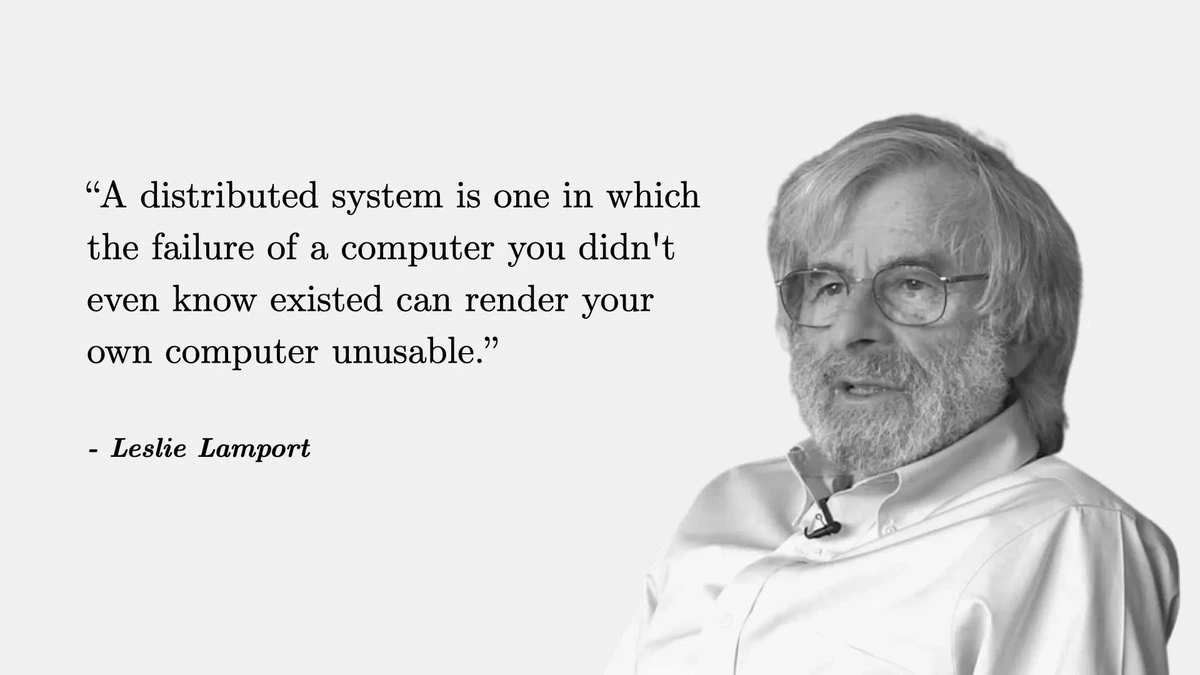
In the 1990s, distributed systems theory (inspired by early work from Leslie Lamport and others) emphasized a simple truth:

Systems that depend on central coordination struggle under time constraints and network uncertainty.

Leslie Lamport

Earlier, the limitation was hardware and compute power.

Today, with compact models and edge computing, Edge AI inference makes local decision-making practical and scalable.

Why is Edge AI Inference Better Than Static Automation?

Why is Edge AI Inference Better Than Static Automation

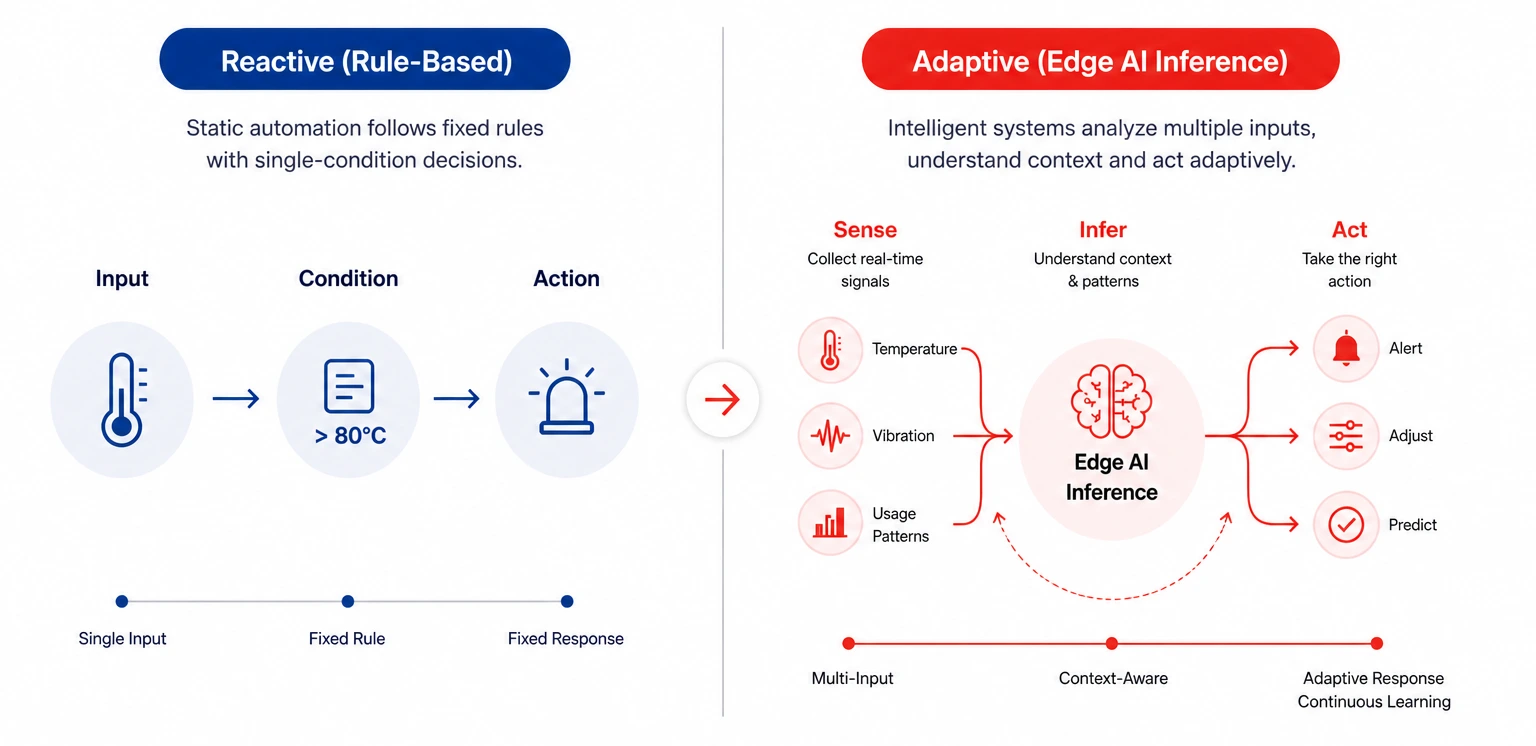
Earlier systems worked on fixed rules: If something happens → take a predefined action

For example:

● If temperature > 80°C → trigger alert

● If motion detected → turn on the light

This approach works when situations are predictable. But in dynamic environments, fixed rules often fall short. They cannot adapt to changing conditions, combine multiple signals, or handle uncertainty.

With Edge AI inference, systems can:

→ Analyze multiple inputs at once (temperature, vibration, usage patterns)

→ Understand context (normal vs unusual behavior)

→ Make decisions based on patterns, not just thresholds

This changes the system from Reactive (rule-based) to Adaptive (intelligent).

With Edge AI inference, decision-making becomes more flexible, more accurate, and better aligned with changing conditions.

The “Decision Half-Life” Concept in Edge AI Inference

Think of every decision as having a short window where it delivers its full value.

In science, Half-life describes how something gradually loses its strength over time. Decisions behave in a similar way.

The moment data is created, there is a brief period where acting on it brings the best possible outcome. As time passes, that value starts to drop.

Simple examples:

● A machine showing early signs of failure → action taken immediately can prevent downtime

● A vehicle detecting an obstacle → action must happen instantly to avoid impact

● A pricing signal in retail → value exists only while demand is active

If the same decision is made later, the system still responds, but the opportunity has already been reduced or passed.

This is what we can call the “decision half-life” – the time window where a decision is most effective.

Traditional systems often miss this window because they rely on sending data elsewhere and waiting for a response.

With Edge AI inference, decisions happen at the exact moment data is generated. This ensures actions are taken within their most valuable time window, not after it.

How Does Edge AI Inference Reduce Data Overload?

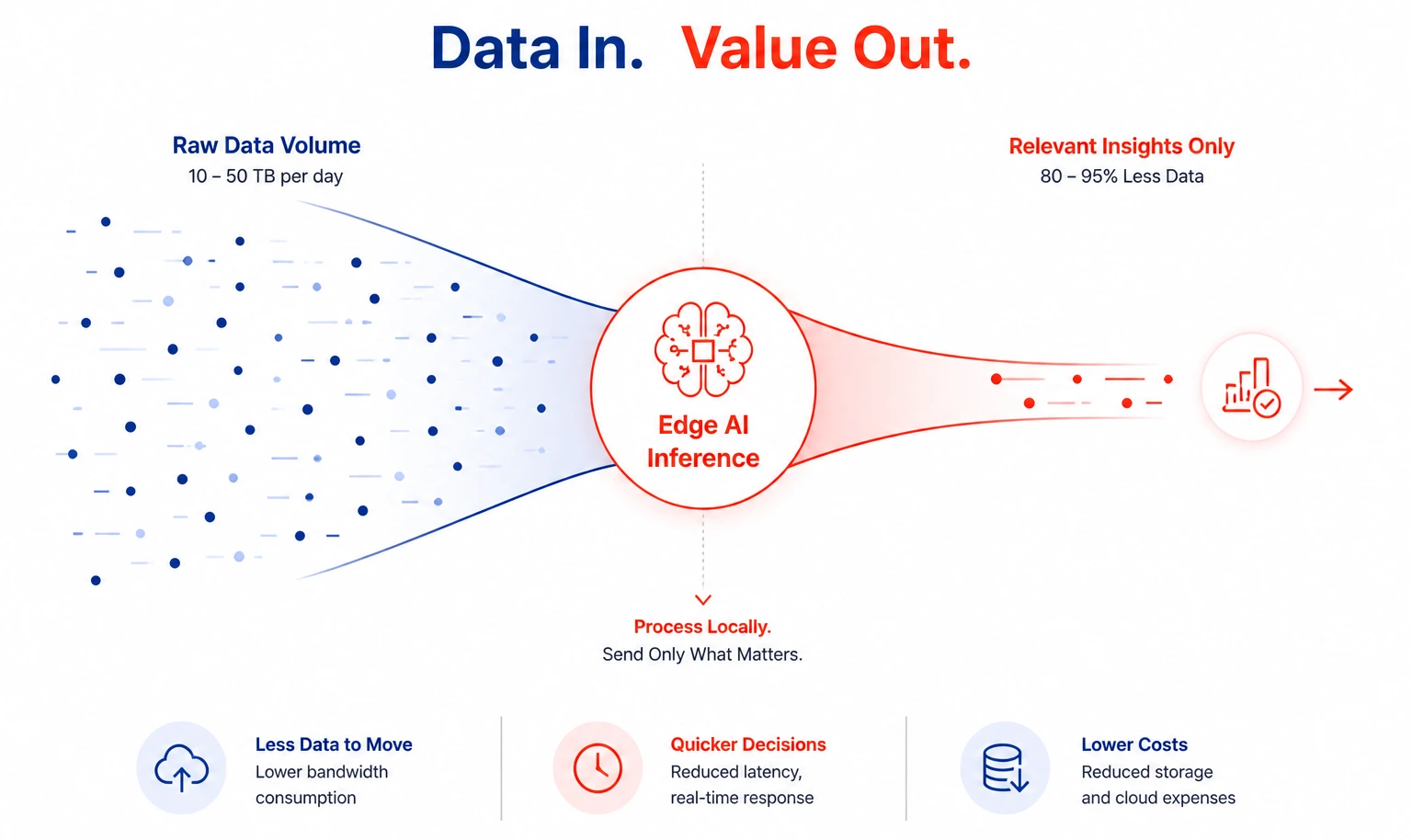
A single HD camera generates around 1–5 Mbps of data.

At scale – say 1,000 devices – that becomes 1 to 5 Gbps, or roughly 10–50 TB of data per day.

Sending all of this to the cloud creates pressure on bandwidth, adds processing delay, and increases storage costs, especially when most of the data has little value.

How Does Edge AI Inference Reduce Data Overload

With Edge AI inference, systems process data locally and send only what matters – like alerts, anomalies, or key events – instead of continuous raw streams.

This reduces data transfer by 80–95%, turning tens of terabytes into a much smaller, manageable volume.

The outcome: less data to move, quicker decisions, and infrastructure that handles scale without strain.

What is Thinking Infrastructure with Edge AI Inference?

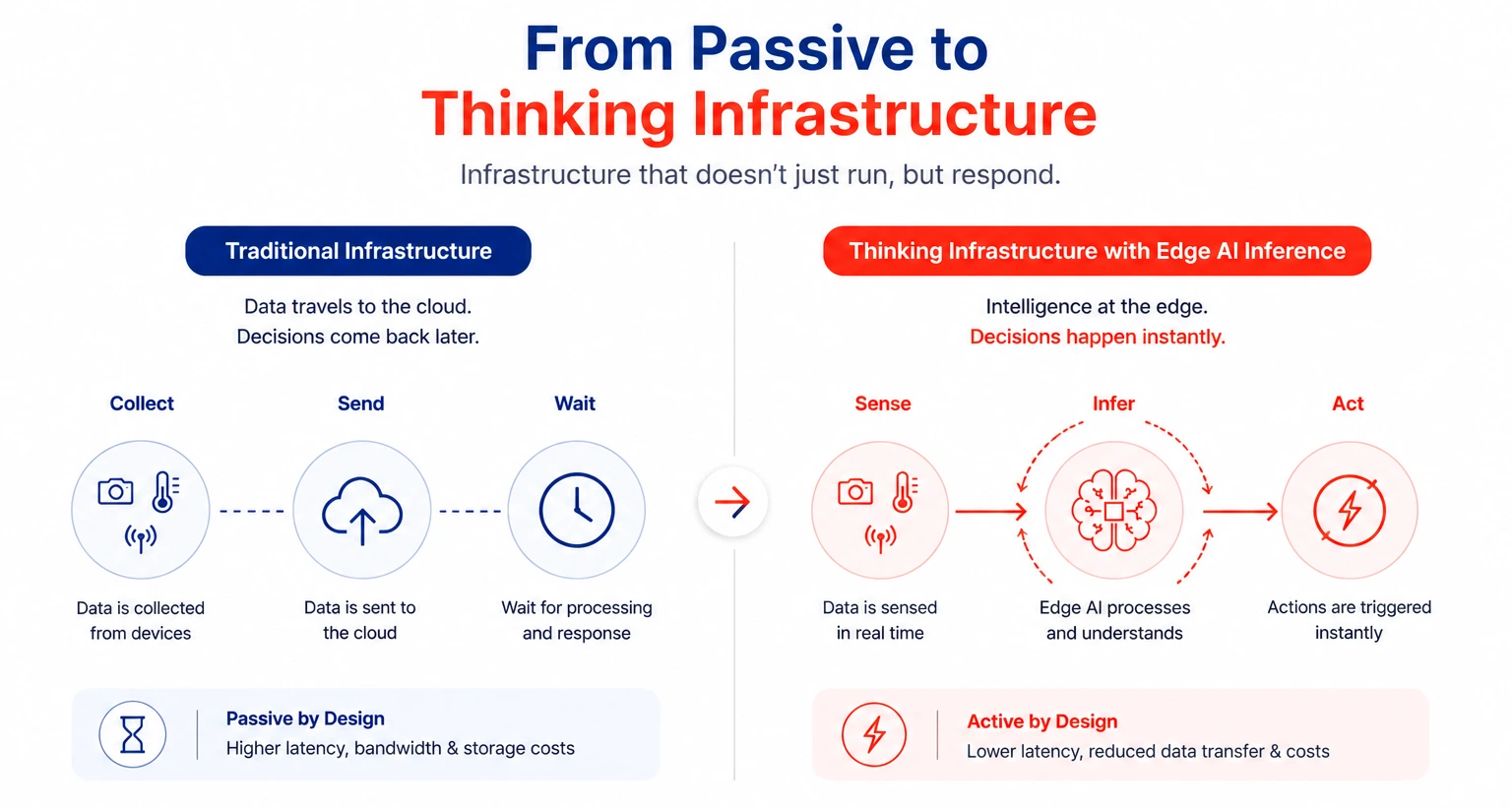
Thinking infrastructure refers to systems that can sense, analyze, and act on their own – without waiting for instructions from a central system.

Traditionally, infrastructure focused on:

→ Collecting data

→ Sending it to the cloud

→ Waiting for a response

With Edge AI inference, that flow changes.

Now, intelligence is built directly into the infrastructure:

→ Data is processed where it is generated

→ Decisions are made instantly

→ Actions are triggered in real time

This turns infrastructure from a passive layer into an active decision-making system.

In simple terms, Thinking Infrastructure = systems that don’t just run, but respond.

Here’s the visual flow for better understanding.

Thinking Infrastructure with Edge AI Inference

What Does the Future of Infrastructure Look Like with Edge AI Inference?

The next phase of infrastructure will not be defined by how efficiently it moves data, but by how effectively it handles decisions at the moment they are needed.

With Edge AI inference, infrastructure begins to behave like a continuous decision layer – spread across devices, environments, and systems.

You’ll see a clear shift:

→ From centralized control to distributed decision-making

→ From delayed response to immediate action

→ From data-heavy pipelines to insight-driven flows

→ From system dependency to operational independence

In essence, it will move from just being “intelligent” to “intelligence that delivers instant impact.”

Build Edge AI Inference Systems with Azilen

We’re an enterprise AI development company.

We connect intelligence with action across distributed environments through clear, execution-ready architectures.

With hands-on expertise across AI, IoT, and distributed systems, we bring a system-level perspective to Edge AI inference.

Here’s how we help:

✔️ Design Sense → Infer → Act architectures for real-time decisions

✔️ Deploy optimized models at the edge for low-latency inference

✔️ Build scalable systems with controlled data movement

✔️ Enable reliable operations across distributed and variable network conditions

✔️ Align edge, cloud, and device layers into a unified decision system

The focus stays on practical execution, ROI, and architectures that support continuous, real-time action across industries.

If you’re looking to turn Edge AI inference into real-time decisions, connect with Azilen to design systems that sense, infer, and act exactly when it matters.

IoT App Development
Move from Data to Action at the Edge
Explore how we deploy, scale & manage intelligent connected devices.

FAQs: Edge AI Inference

1. What is Edge AI inference?

Edge AI inference refers to running AI models directly on devices or local systems where data is generated. Instead of sending data to the cloud, the system processes it at the edge. This enables faster decision-making and reduces dependency on centralized infrastructure. It plays a key role in real-time applications. Edge AI inference helps systems act instantly based on incoming data.

2. How does Edge AI inference work?

Edge AI inference works by deploying trained AI models on edge devices such as sensors, cameras, or gateways. These models analyze incoming data locally and generate outputs in real time. Only relevant insights or results are shared with central systems if needed. This reduces unnecessary data transfer. It ensures faster and more efficient decision-making.

3. Why is Edge AI inference important for real-time systems?

Edge AI inference enables decisions to happen at the moment data is generated. This reduces latency and removes delays caused by cloud communication. In time-sensitive environments, even small delays can impact outcomes. Edge processing ensures immediate response to events. It supports applications where timing is critical.

4. What are the benefits of Edge AI inference?

Edge AI inference offers faster response times by processing data locally. It reduces bandwidth usage since only important data is transmitted. Systems become more reliable as they can operate without constant connectivity. It also improves scalability across distributed environments. Overall, it supports efficient and real-time operations.

5. What is the difference between Edge AI inference and cloud AI?

Edge AI inference processes data locally on devices, while cloud AI relies on centralized servers. Edge focuses on low latency and real-time decision-making. Cloud systems are better suited for large-scale data analysis and model training. Edge reduces dependency on network connectivity. Both can work together in a hybrid architecture.

Glossary

1. Edge AI: Edge AI refers to artificial intelligence that runs directly on local devices such as sensors, cameras, or gateways. It enables systems to process data near its source instead of relying on centralized cloud systems.

2. Inference: Inference is the stage where an AI model applies learned patterns to new data to produce results or predictions. It is the operational phase of AI where decisions are made based on incoming inputs.

3. Edge Computing: Edge computing is a distributed computing approach where data processing happens close to the data source. It reduces latency and bandwidth usage by minimizing the need for centralized processing.

4. Latency: Latency refers to the time delay between data input and system response. Lower latency is critical for real-time systems where immediate action is required.

5. Distributed Systems: Distributed systems consist of multiple interconnected components that operate across different locations. They work together to process data and perform tasks without relying on a single central system.

author avatar
Chintan Shah Associate Vice President – Delivery
Chintan Shah is AVP – Delivery at Azilen Technologies, specializing in enterprise solutions, digital transformation, and scalable software delivery. He focuses on driving operational excellence and high-performance technology execution.
google
Chintan Shah
Chintan Shah
Associate Vice President - Delivery at Azilen Technologies

Chintan Shah is an experienced software professional specializing in large-scale digital transformation and enterprise solutions. As AVP - Delivery at Azilen Technologies, he drives strategic project execution, process optimization, and technology-driven innovations. With expertise across multiple domains, he ensures seamless software delivery and operational excellence.

Related Insights

GPT Mode
AziGPT - Azilen’s
Custom GPT Assistant.
Instant Answers. Smart Summaries.