

Skip to content

Moving Beyond “LLM as God”- Engineering Production-Grade Agentic AI Systems

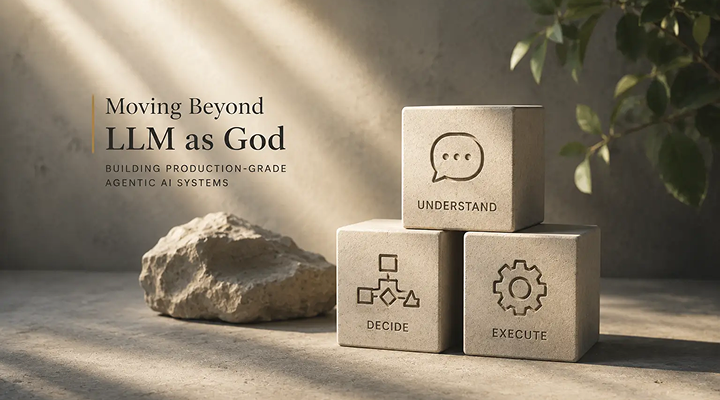
Featured Image
Most enterprise AI systems are being built with the wrong assumption:
that the LLM itself is the system.

It works in demos. It often fails in production.

Because LLMs are fundamentally probabilistic. They are designed to predict the most likely response, not to make deterministic business decisions. Yet many AI systems today allow models to directly drive workflows, execution, and outcomes with very little structural control around them.

That’s where the real problem begins.

The issue is not hallucination alone. The issue is uncontrolled uncertainty entering critical system layers like decision-making, workflow execution, and business logic.

This is why many enterprise AI initiatives show strong early promise but struggle when complexity, scale, and real-world edge cases enter the picture.

The shift AI engineering now needs is architectural.

LLMs should not function as the “god layer” of the system. They should operate as one intelligence layer within a larger deterministic architecture, where:

The "God Layer"
Probabilistic
Architectural
Shift
Intelligence Layer
Understanding
Bounded By
System Engine
Deterministic Rules
Click any stage to explore the architectural shift
The "God Layer" (Flawed)
It works in demos. It often fails in production. Because LLMs are fundamentally probabilistic, allowing models to directly drive workflows, execution, and outcomes introduces uncontrolled uncertainty into critical business logic.

This separation is what transforms AI from an impressive prototype into a reliable production-grade system.

And that’s the core shift this article explores.

LLM is Not a System – It’s a Component

The core mistake is conceptual.

We are treating LLM as the system itself. But LLM is a capability.

It is designed to do a few things extremely well:

→ Understand intent.
→ Interpret context.
→ Generate natural language.

That’s where it excels.

But it is not designed to:

→ Make deterministic decisions.
→ Execute business logic.
→ Control end-to-end workflows.

Those require structure, constraints, and more system-level execution.

Let’s take a simple example.

A user asks: “Can you reschedule my EMI payment to next week?”

User Request
"Can you reschedule my EMI payment to next week?"
"Thanks, that really helped clarify things!"
LLM-First
Engineering-First
In an LLM-first system, the model might:
1
Understand the request
2
Infer intent
3
And directly trigger an action
Sounds efficient. But there's a problem.
What if:
  • The user is not eligible for rescheduling?
  • Are there penalties involved?
  • The account is already in a restricted state?
The engineering-proven approach here is – passing the user request to a structured system:
1
Eligibility is checked
2
Rules are applied
3
Constraints are enforced
4
Only then is the outcome decided.
And finally, the LLM comes back in - to communicate the result in a natural way. Here, we used the same capabilities of LLM, but now bundled with an engineered system.

This is the shift we need to make. From treating LLM as the “brain” of the system, to treating it as one component within a larger architecture.

Azilen’s Approach: Deterministic-First Architecture

If the problem is uncontrolled probability, the solution is not to remove it – but to contain it.

At Azilen, we follow a simple principle:

Design the system to be deterministic by default, and use LLMs selectively where they add value.

This is not about reducing intelligence. It’s about placing it in the right layer.

Think back to the EMI example. The LLM understands the request: “Reschedule my EMI to next week.”

But from that point onward, the system takes over.

The flow becomes structured:

Identify User & Account
Verify identity and load account state
Check Eligibility Rules
Apply business logic and policy checks
Evaluate Penalties
Detect constraints, flags, or restrictions
Decide the Outcome
Route to result based on predefined logic

Here, every step is deterministic. Now, once the decision is made, the LLM comes back into the picture to communicate.

It turns a structured outcome into a natural response:

→ “Your EMI has been successfully rescheduled.”
→ “This request can’t be processed due to eligibility constraints.”

This is how roles get separated:

→ LLM – Understanding and communication
→ System – Decision and execution

In other words, the LLM becomes a thin intelligence layer on top of a strong foundation. Not the foundation itself.

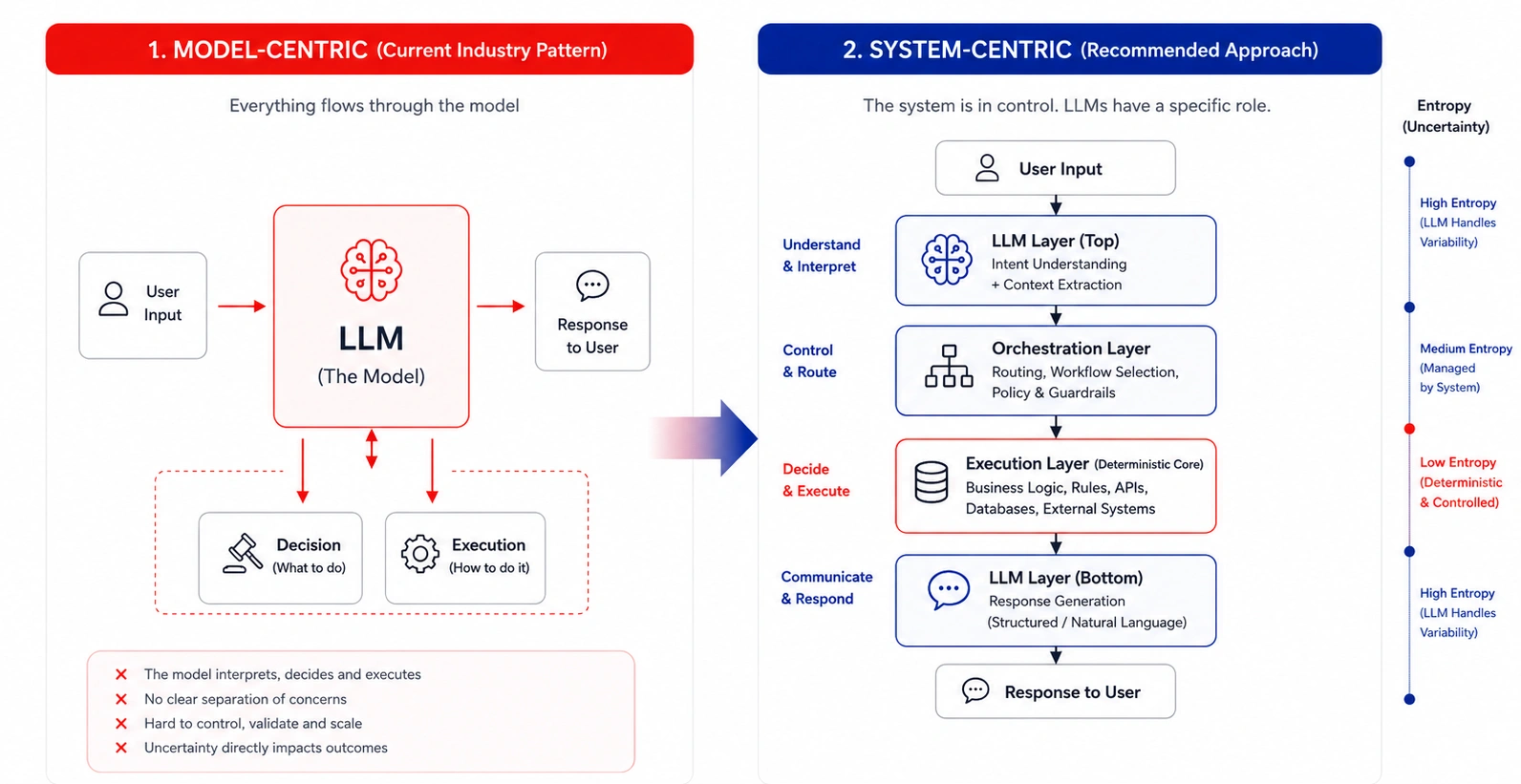
Re-architecting AI: From Model-Centric to System-Centric

Re-architecting AI

Understanding Mathematics Behind Hallucination in Production AI

The uncertainty principle tells us something fundamental: You cannot know both the position and momentum of a particle with perfect precision at the same time.

The Formula
Δx · Δp ≥ 2
Hover to explore
This is often written as
Δx · Δp
2
Where
  • Δx → uncertainty in position
  • Δp → uncertainty in momentum

The key idea is simple: If you reduce uncertainty in one dimension, uncertainty increases in another.

In other words, you’re not removing uncertainty. You’re redistributing it.

Now look at LLMs through the same lens.

An LLM is always balancing between two things:

→ Fluency (natural, high-probability language)
→ Factual precision (strict correctness)

But here’s the trade-off:

→ The more the model optimises for fluent, high-probability responses, the more it depends on patterns instead of verification.

→ The more you enforce strict correctness, the more the model becomes constrained, hesitant, or incomplete.

And the irony is, just like in the uncertainty principle, you cannot maximize both perfectly at the same time.

So, answering the question – “Can we eliminate hallucinations completely?” – No! That’s math. It can’t be, unfortunately, hallucinated like LLMs!

The Real Problem: Uncontrolled Hallucination

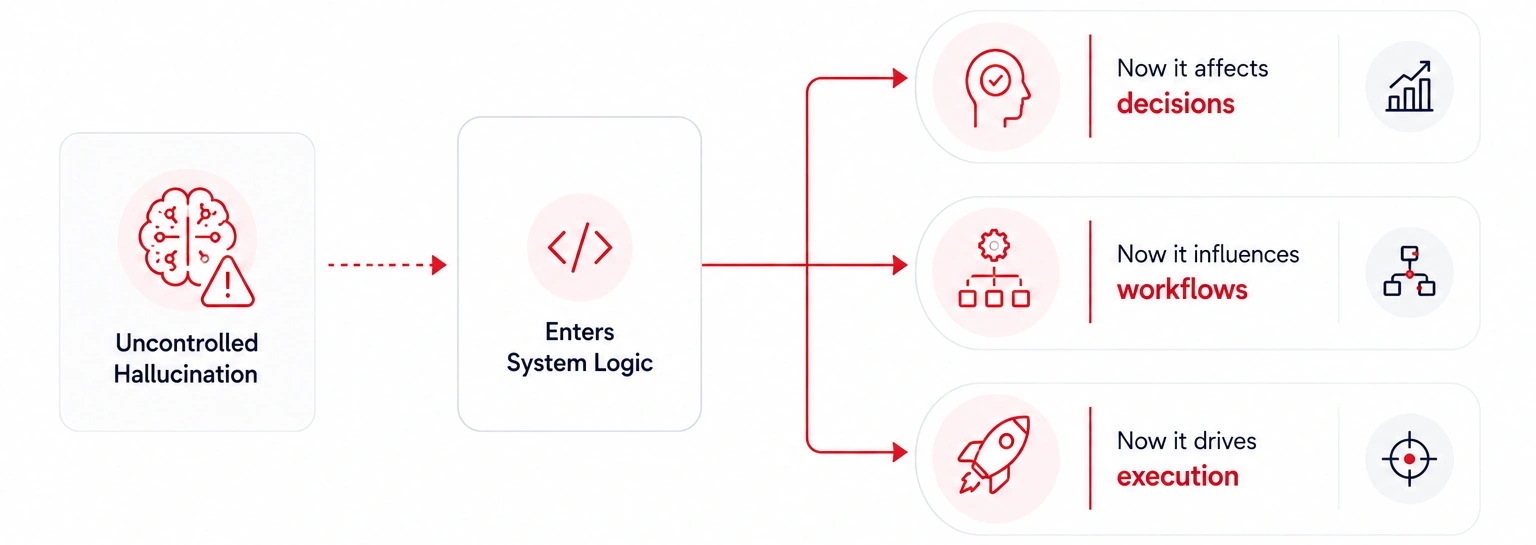
At this point, the problem becomes clear. Hallucination is not the issue. Uncontrolled hallucination is.

We already know that LLMs operate on probability. We already know that some level of hallucination is inevitable.

The mistake is less about using LLMs but more about where we allow them to operate.

When hallucination stays within communication, the impact is limited.

A slightly imperfect sentence. A loosely phrased explanation.

Uncontrolled Hallucination

And that’s where systems become unreliable. Because at this point, you are dealing with outcomes, and not merely languages.

The most practical solution is not to remove hallucination, but rather, to contain it.

Because the moment you separate these layers, the system becomes predictable again.

The Right Design Philosophy

At its core, the system needs a balance between creativity and control.

Every AI system today is dealing with two very different forces:

→ One that expands possibilities

→ One that restricts outcomes

That’s just another way of looking at entropy.

The creative layer increases it. The deterministic layer contains it.

So instead of merging everything into one system, you design for separation.

Expands
Possibilities
CREATIVE LAYER (LLM)
Explore possibilities

Open-ended thinking that expands what's possible — interpreting meaning, handling nuance, and generating rich responses.

Understand Intent
Interpret Ambiguity
Generate Natural Responses
BALANCE
Restricts
Outcomes
DETERMINISTIC LAYER (SYSTEM CORE)
Reduce possibilities

Structured logic that narrows outcomes — enforcing rules, executing workflows, and ensuring consistent, predictable results.

Decision Making
Business Rules
Workflow Execution

The system works only when these two stay in balance.

→ If you remove the creative layer, the system becomes rigid.

→ If you let the creative layer take control, the system becomes unpredictable.

This summarizes into a design philosophy we follow at Azilen – controlled creativity on top, with deterministic foundations underneath to ensure consistency!

Why This Approach Works

Once you separate creativity from execution, the system starts behaving very differently.

Predictability

Decisions are no longer dependent on probability. They are driven by rules and defined logic.

Given the same input, the system behaves the same way – every time. That’s the foundation of trust you build with this approach.

Reliability

Errors don’t propagate silently. A probabilistic response is no longer allowed to directly trigger actions.

It is interpreted, validated, and then executed through controlled paths. This reduces unexpected behavior significantly.

Scalability

What works for 10 users now works for 10,000.

Because the system is not relying on model “good behavior” alone. It is backed by structure.

As complexity increases, the system doesn’t drift; it holds.

Auditability

Every decision is traceable.

→ Why was this action taken?
→ Which rule triggered it?
→ What data was used?

You can answer these questions. Because decisions are not hidden inside a probabilistic model. They are part of a defined system.

Production Readiness

This is the real difference. Most AI systems look good in demos. Very few survive real-world conditions. This approach is built for production from day one. Because it assumes:

→ Inputs will be messy.
→ Edge cases will exist.
→ Uncertainty will show up.

Outcome

You get a system where entropy is deliberately managed – allowed in the layers where flexibility and interpretation are needed, and tightly controlled in the layers where decisions and execution happen.

Uncertainty is no longer driving outcomes. It is guided by structure. And that’s what makes the system consistent, reliable, and scalable.

What Needs to Change: A Necessary Shift in AI System Design

What we’re seeing today is a pattern. Most AI systems are being built model-first.

Start with an LLM. Wrap some prompts around it. Let it handle as much as possible.

It works for demos. It works for early pilots. But it doesn’t hold in production.

The shift that needs to happen is clear.

From
LLM-first systems
where the model is the center of everything
LLM
User
Data
Output
Tools
APIs
To
Engineering-first systems with LLM augmentation
where the system is designed first, and the LLM is applied where it fits
User
System
(Designed First)
LLM
(Applied Where it Fits)
Output
It's a shift in mindset.
Instead of asking:
"What can the model do?"
We need to ask:
"What should the system do deterministically, and where does the model add value?"

Because the future of AI systems will not be defined by:

→ Bigger models
→ Better prompts
→ More capabilities

It will be defined by:

→ Better system design
→ Clear separation of responsibilities
→ Controlled use of probabilistic components

Conclusion: God does play dice with the universe. You don’t do it with LLMs!

Total entropy of the observable universe ≈ 10¹⁰⁴ to 10¹⁰⁶:
(in units of Boltzmann’s constant)..

At that scale, one thing becomes clear.

At a fundamental level – whether it’s the universe or the systems we build – everything operates with uncertainty. With randomness.

The real breakthrough in physics was not in eliminating uncertainty. It was in learning how to build stable systems around it.

We are facing the same challenge in AI.

LLMs introduce entropy into the system. They expand the space of possibilities.

They make systems flexible, adaptive, and expressive. But left unbounded, that same entropy becomes unpredictability.

So the question is not whether to use LLMs.

It is: Where do you allow that uncertainty to live? And where do you not?

Because in the end, it’s not worth it, financially, strategically, and technically, to play dice with LLMs like god does with the universe!

author avatar
Naresh Prajapati Founder
Naresh Prajapati, founder of Azilen Technologies, began his entrepreneurial journey by building a first-of-its-kind hardware-compatible digital menu system. His passion for engineering excellence and innovation continues to drive Azilen’s vision of building impactful technology solutions.
google
Naresh
Naresh Prajapati
Founder at Azilen Technologies

Naresh Prajapati, founder of Azilen Technologies, embarked on his entrepreneurial journey two decades ago by pioneering a first-of-its-kind hardware-compatible digital menu system. While building the product from the ground up, he & team gained deep insights into product engineering challenges, shaping his vision for excellence. This led to the founding of Azilen Technologies, where product engineering is in its DNA. Under his leadership, Azilen thrives on a culture of engineering excellence, innovation, and transformative solutions with a vision to further take the foundation - laid by Generations of Engineers - and create a lasting positive impact on the world around us.

Related Insights

GPT Mode
AziGPT - Azilen’s
Custom GPT Assistant.
Instant Answers. Smart Summaries.