


Skip to content

What Separates Lasting AI Companies From Wrapper Startups

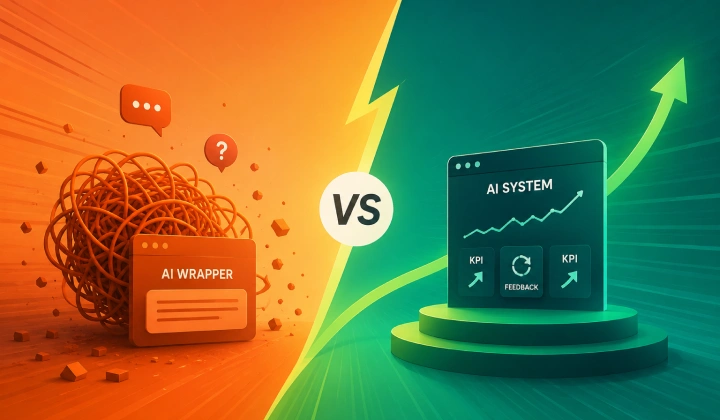
Featured Image

To me, the greatest GitHub repository (repo) is the one from Linux founder Linus Torvald. But what’s even more powerful than his repo is his thinking behind it: “Theory and practice sometimes clash. And when that happens, theory loses. Every single time.”

In theory, the winning operating system (OS) should have been the one with the widest reach, the most users and a polished experience with a minimum learning curve. By that logic, Microsoft’s Windows had already won.

But in practice, developers, enterprises and builders—the ones closest to real problems—kept choosing Linux. It became the underlying system layer for the internet, cloud infrastructure and everything that scaled beyond a single machine.

I believe this contrast reveals something deeper. Interfaces appear to be the product in theory, but in practice, systems are the real product. While interfaces are where users engage, systems determine outcomes. Interfaces can be replicated. Systems compound.

We’re now watching the same pattern repeating in AI, only faster, wrapping capability into clean interfaces and riding on top of existing models. This kind of intelligence is easy to access, easy to demo and easy to adopt, but not easy to compound. These are AI wrappers.

AI Wrappers vs. AI Systems — Value Over Time
Indexed business value growth comparison
AI Systems (KPI-First)
AI Wrappers (Interface-Only)
AI Wrappers vs AI Systems — Value Over Time

But a few lasting AI companies are building AI systems or AI operating systems. The key characteristic of these AI systems is that they work backward from key performance indicators (KPIs) to execution.

KPIs define how intelligence behaves, where it fits into workflows and how it evolves. As the system runs, it keeps learning and improving in real time, constantly pushing workflows closer to the defined KPIs.

​The Illusion Of System Depth In AI Wrappers​

The illusion is real; what looks like capability is often just access to capability. One example is the rise of so-called agentic support tools. These are AI wrappers that consume GPT tokens to answer customer queries, but I find that they do little to improve business KPIs such as resolution rate, cost per ticket or customer retention.

The reason is very clear. Such tools are never built as systems; they are destined to die as interfaces.​ Companies deploying these AI wrappers sit at the point of interaction, not at the point of controlling business KPIs.

It is like being in command of Apollo 13 heading to the Moon, but without mission control on Earth, which handles navigation, calculations and course correction to meet mission objectives, or in our case, business KPIs.

And that’s where the illusion of product depth begins. One way I think of this is in three dimensions.

X — Axis

Interaction Quality

How well the system responds, how fluent or helpful it feels in the moment.

AI Wrappers: Strong

Y — Axis

Business Impact

Whether those interactions actually move KPIs – resolution rate, cost per ticket, retention.

AI Wrappers: Weak

Z — Axis

Learning & Compounding

How the system improves over time through feedback. Where compounding should happen.

AI Wrappers: Almost flat

Most AI wrappers perform strongly only on the X-axis. But they remain weak on Y, where business KPIs move, and they are almost flat on Z, where compounding should happen.

Until we tie intelligence to KPIs, measure it against KPIs and continuously refine it by KPIs, what looks like a product or system is often just an interface—just an AI wrapper.

Performance Comparison

AI Systems vs AI Wrapper — 3 axis evaluation

Drag to rotate  ·  Scroll to zoom
Performance
AI Systems Strong on all three axes
AI Wrapper Strong on X · weak on Y · flat on Z
Axes
  • X Interaction quality
  • Y KPI impact
  • Z Learning & compounding
Interaction Quality
KPI Impact
Learning & Compounding

What Lasting AI Companies Get Right: Three Foundations

Lasting AI companies don’t just make AI usable; they make it foundational to how business workflows run, and eventually impossible to operate without.

The first foundation choice lasting AI companies make is choosing KPI-first design over prompt-first design.

This kind of AI system is designed backward from KPIs, and every layer of intelligence is working toward meeting those KPIs. ​

The second foundation choice lasting AI companies make is to close the loop between action and outcome. They ensure every decision is measured and every result feeds back into the system.

These AI systems constantly ask: Did this interaction resolve the issue? Did this recommendation convert?

Did this decision reduce costs or risk? With each iteration, the system moves closer to the desired KPI. ​

The third foundation choice lasting AI companies make is to place intelligence inside the workflow.

For example, in a voice AI-led outbound campaign, the AI system doesn’t just answer questions or pitch a product but handles edge cases, course corrects, chooses different resolution paths and shrinks the funnel down to the WhatsApp and rich communication services (RCS) that moves raw intent into action.

The Mental Models Of AI Wrapper Builders Versus AI Systems Builders

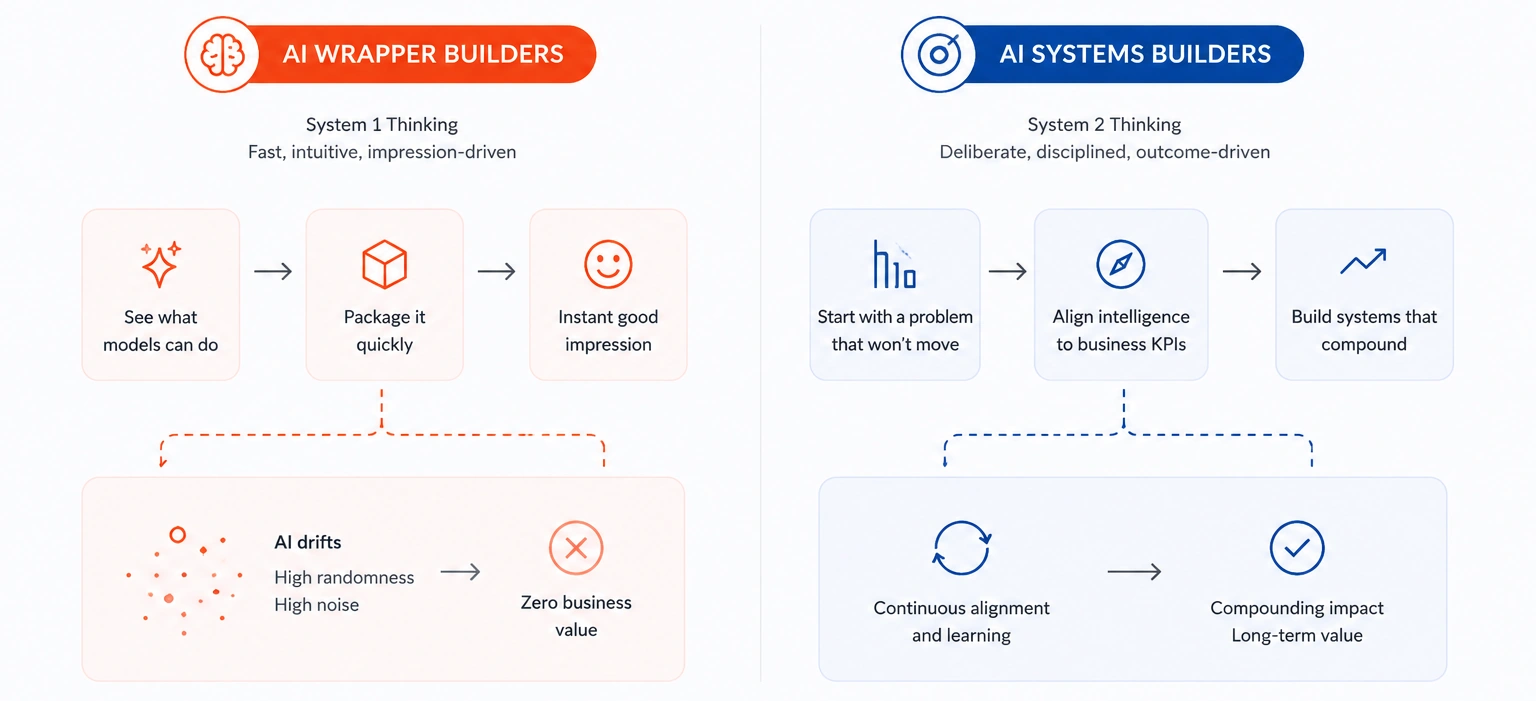
I strongly believe this is not a technology problem, but rather a mindset problem. Both AI wrapper builders and AI systems builders build with the same technology. But underneath, they are operating from very different mental models.

AI wrapper builders seem more influenced by System 1 thinking: fast, intuitive and impression-driven. They see what the model can do and rush to package it. They overvalue what delivers an instant good impression, such as GPT models.

The Mental Models

On the other hand, AI systems builders start with a problem that won’t move—such as a KPI that stays flat, a cost that won’t drop, a process that won’t scale. They aim not to showcase intelligence, but to discipline it.

This mindset reflects the idea of delayed gratification. They ignore quick wins in favor of long-term results. They understand, without continuous alignment of intelligence toward business outcomes, AI drifts toward entropy: high randomness, high noise, zero business value.

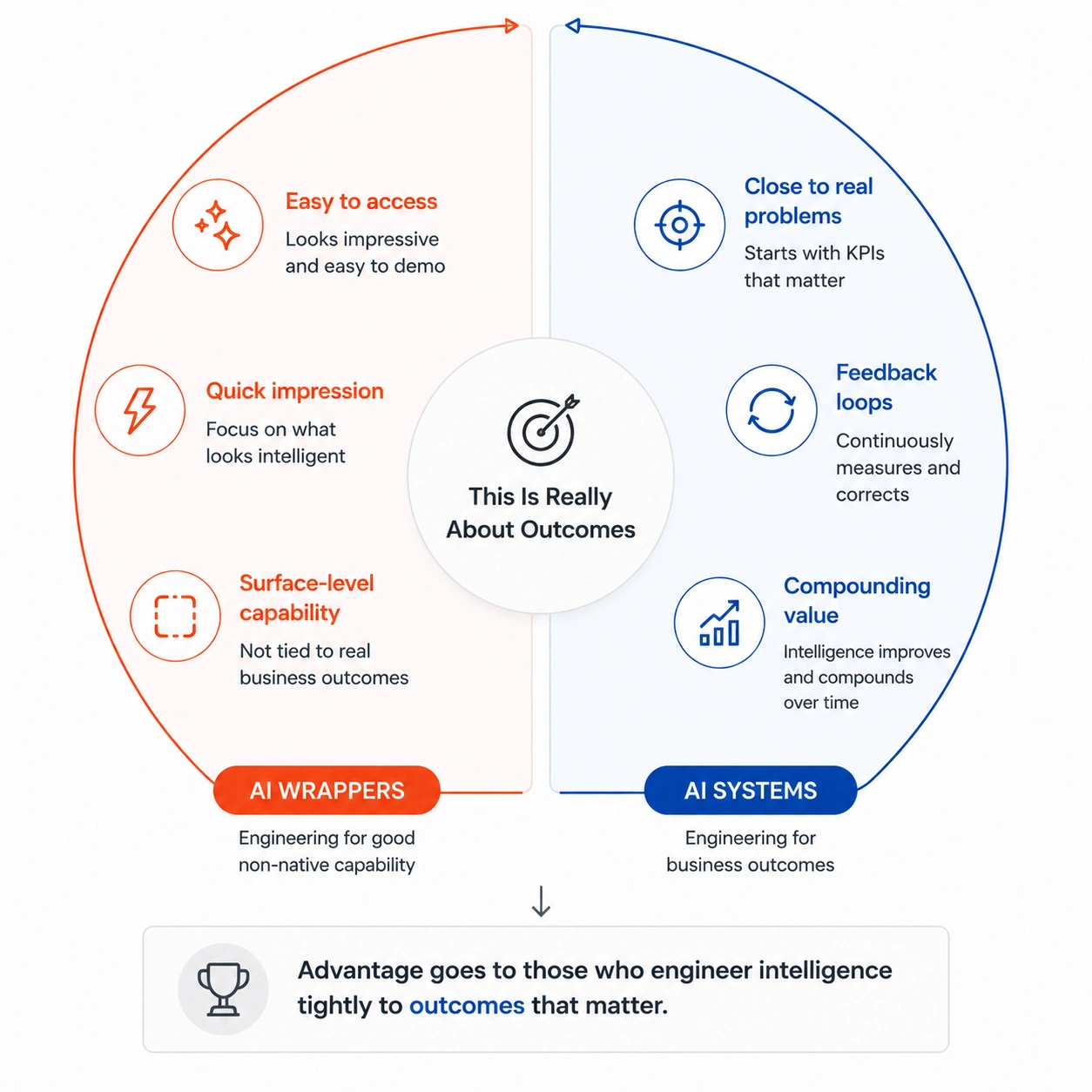
What This Is Really About

In the end, this is neither about Linux versus Microsoft, nor about AI wrappers versus AI systems.

It is about engineering for business outcomes vs engineering for merely good non-native capability. And this matters a lot as the advantage no longer lies in using intelligence, but in how tightly it is engineered to outcomes.

Engineering for business outcomes Result

The companies that last are the ones that make AI compound toward business values with disciplined use of intelligence. They engineer intelligence against KPIs. They build feedback loops that correct it. They embed intelligence into workflows where decisions carry consequences.

Because, in theory, the most accessible AI wins. In practice, as Linus Torvalds knew, the system closest to the real problem always does.

Originally published: Forbes.com

author avatar
Naresh Prajapati Founder
Naresh Prajapati, founder of Azilen Technologies, began his entrepreneurial journey by building a first-of-its-kind hardware-compatible digital menu system. His passion for engineering excellence and innovation continues to drive Azilen’s vision of building impactful technology solutions.
google
Naresh
Naresh Prajapati
Founder at Azilen Technologies

Naresh Prajapati, founder of Azilen Technologies, embarked on his entrepreneurial journey two decades ago by pioneering a first-of-its-kind hardware-compatible digital menu system. While building the product from the ground up, he & team gained deep insights into product engineering challenges, shaping his vision for excellence. This led to the founding of Azilen Technologies, where product engineering is in its DNA. Under his leadership, Azilen thrives on a culture of engineering excellence, innovation, and transformative solutions with a vision to further take the foundation - laid by Generations of Engineers - and create a lasting positive impact on the world around us.

Related Insights

GPT Mode
AziGPT - Azilen’s
Custom GPT Assistant.
Instant Answers. Smart Summaries.