



Skip to content

How to Use Agentic AI in Data Engineering Lifecycle?

Featured Image

TL;DR:

Agentic AI in data engineering enables autonomous data pipelines that ingest, validate, transform, monitor, govern, and optimize resources in real time. By assigning AI agents across each stage of the lifecycle, enterprises gain self-healing pipelines, improved data quality, cost efficiency, and stronger governance. This turns data engineering from an operational task into a strategic driver of speed, resilience, and growth.

The Evolution of Data Engineering

Data engineering has reinvented itself every decade.

2000s – The ETL era: Tools like Informatica powered structured reporting pipelines.

2010s – The Big Data wave: Hadoop and Spark scaled processing for billions of records.

2015–2020 – The Cloud shift: Snowflake, BigQuery, and Databricks brought elastic pipelines and real-time analytics.

2020–2024 – DataOps and automation: Monitoring and ML-assisted tools improved reliability.

Now in 2025, agentic AI in data engineering is taking us into the next era.

Instead of pipelines that wait for humans to troubleshoot, we have autonomous AI agents that manage, optimize, and govern data flows on their own.

What Agentic AI Does for Data Engineering?

Agentic AI gives data engineering a new layer of “intelligence.” Instead of teams constantly watching over pipelines, the system begins to manage itself.

For example,

➜ If a pipeline breaks, it finds the issue and fixes it before reports or dashboards are impacted.

➜ Unusual patterns are flagged early, and gaps are filled so leaders see clean, consistent information.

➜ When new sources or formats appear, the pipeline adjusts on its own.

➜ Resources are scaled up or down in real time to match demand.

➜ Sensitive data is tracked, labeled, and protected automatically.

The result?

A data lifecycle that quietly takes care of itself, while your teams focus on innovation and decision-making.

How to Use Agentic AI in Data Engineering?

Agentic AI fits naturally into every stage of the data engineering lifecycle. But the real value comes from assigning agents with clear responsibilities and allowing them to make operational decisions in real time.

Here’s how to use it effectively:

1. Data Ingestion

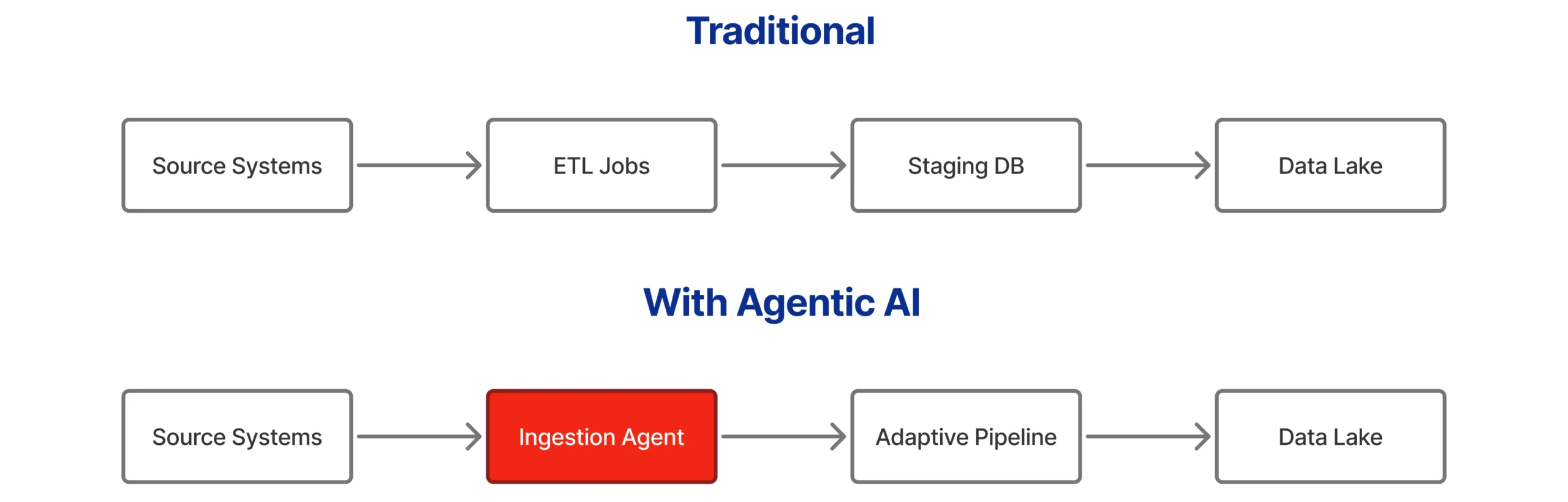
An ingestion agent acts as an autonomous controller for data intake.

Instead of relying on static ETL scripts, it uses event-driven logic and heuristics to decide whether to stream data in real time (via Kafka, Kinesis, or Pub/Sub) or process in batches (via Spark or Snowflake tasks).

It continuously monitors source APIs and file systems, detects schema drift through schema-matching algorithms, and auto-generates transformation mappings.

Data Ingestion with Agentic AI

From a leadership view, this guarantees ingestion pipelines remain resilient, even as new API partners, IoT feeds, or SaaS sources are introduced.

2. Data Quality and Validation

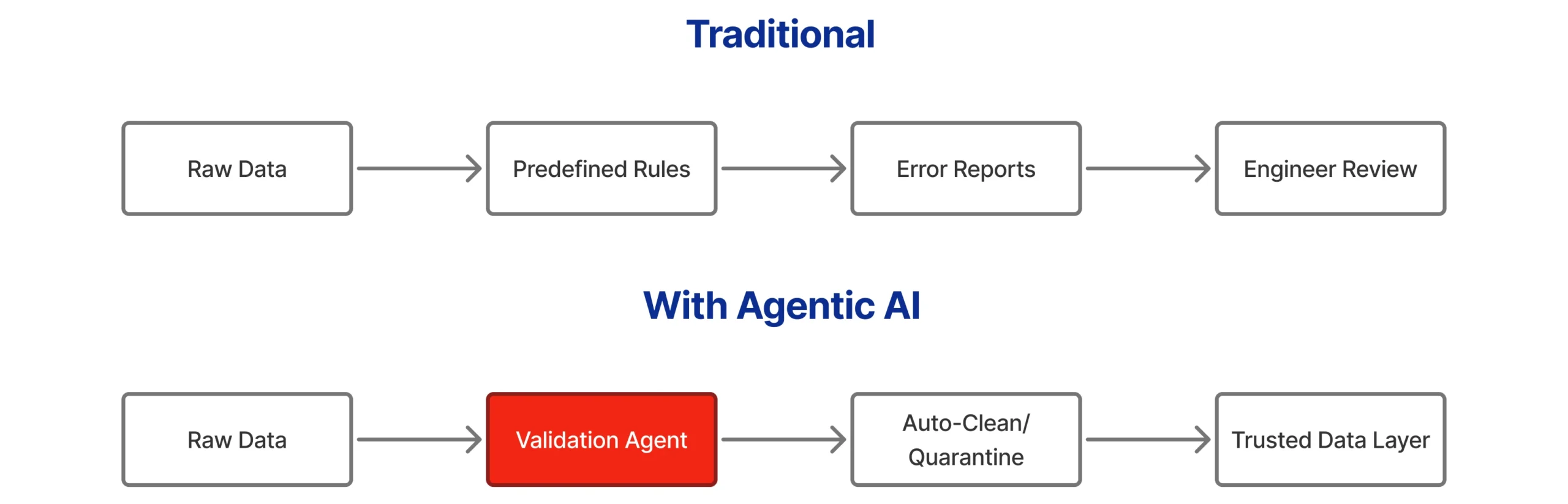
Validation agents leverage anomaly detection models (Isolation Forests, probabilistic models, or seasonal decomposition) to track distributions, correlations, and outliers across incoming data.

When a deviation occurs, the agent decides whether to auto-correct (fill missing values with model-based imputation), quarantine suspect records in a sandbox, or escalate to human review.

This shifts quality checks from being one-time rules to being continuous and adaptive.

For executives, it ensures KPIs and dashboards are fueled by validated data at every stage, not just at ingestion.

Data Quality & Validation with Agentic AI

3. Data Transformation and Preparation

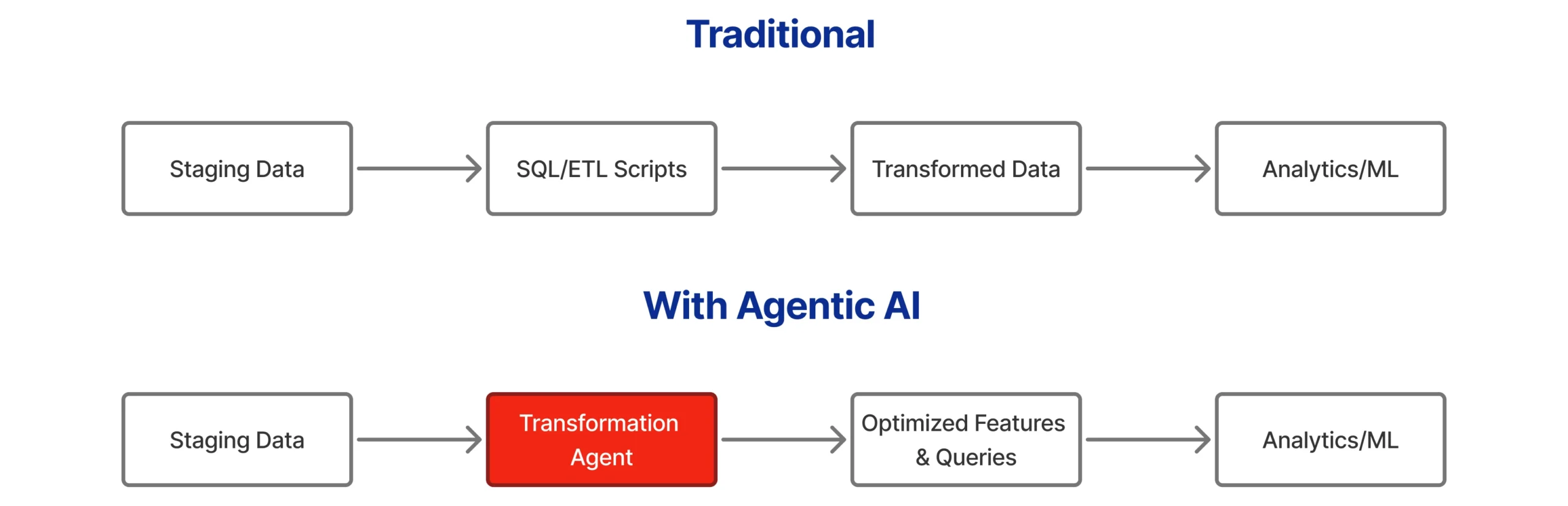
Transformation agents operate inside the data warehouse or lakehouse environment (Databricks, Snowflake, BigQuery). They observe query execution patterns, automatically generate optimized execution plans, and apply adaptive caching.

On the analytics side, they propose transformations that align with business metrics; on the ML side, they auto-generate features, handle dimensionality reduction, and optimize joins across large tables.

Data Transformation & Preparation with Agentic AI

For leaders, this translates into pipelines that shorten time-to-insight, accelerate product cycles, and support real-time decision-making without scaling data teams linearly.

4. Pipeline Orchestration and Monitoring

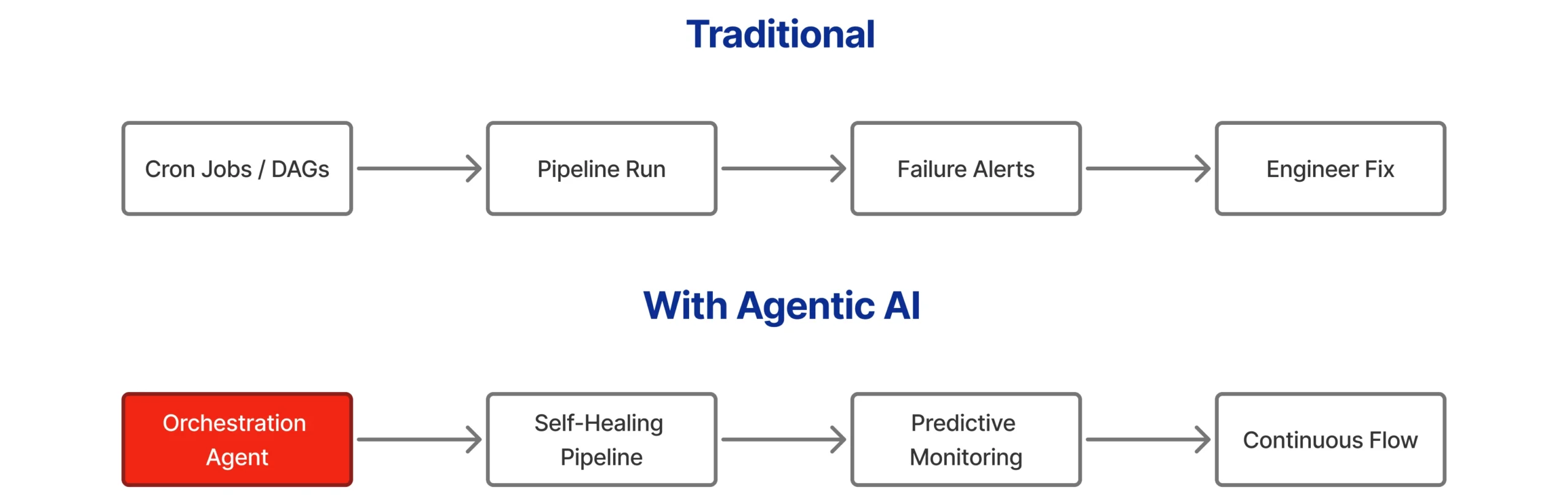
Orchestration agents convert failures into managed recovery processes. They dynamically reschedule failed jobs, route workloads across alternate compute clusters, and trigger horizontal scaling when forecast models predict increased load.

Monitoring agents run side by side, leveraging telemetry (latency, throughput, error logs) and predictive analytics to flag issues before they cascade downstream.

Orchestration & Monitoring with Agentic AI

For business units, this means data pipelines behave like a utility service – always reliable, always performant – without engineers manually putting in efforts at odd hours.

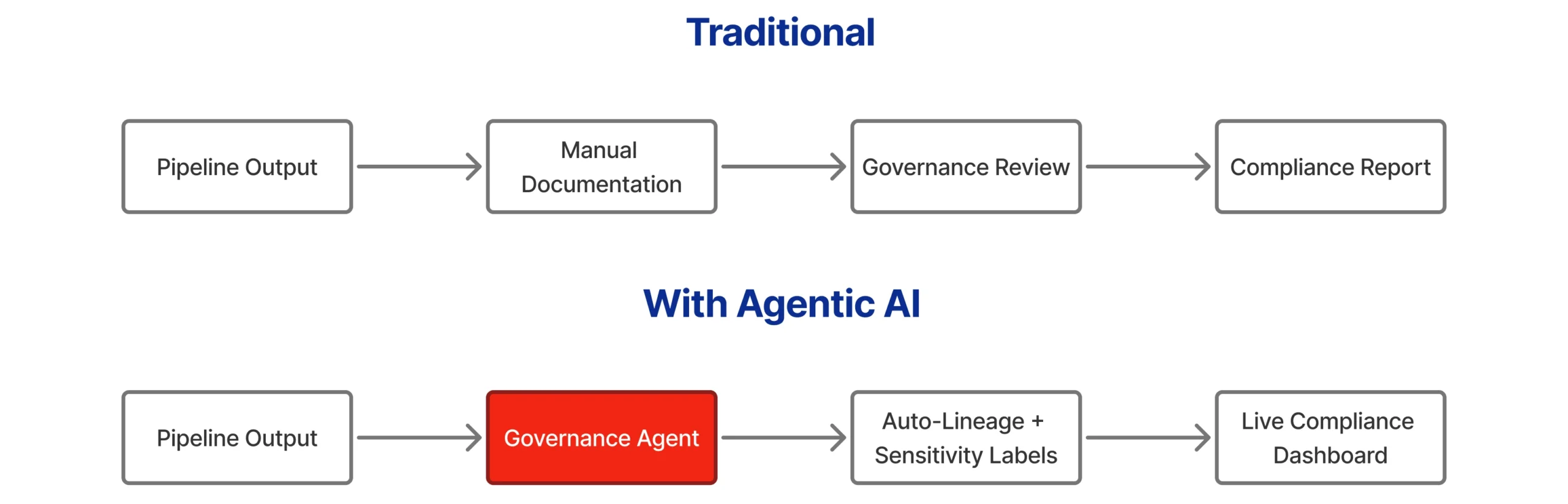
5. Metadata, Documentation, and Governance

Governance agents embed compliance directly into pipelines. Using data classification models, they identify PII and sensitive fields, tag them, and apply masking or encryption policies inline. They auto-generate lineage graphs (via graph-based tracking) and build glossaries of fields and tables as new data sources arrive.

Documentation becomes dynamic: as new sources enter, the agent creates versioned metadata entries, attaches sample queries, and updates data catalogs automatically.

Metadata, Documentation & Governance with Agentic AI

This provides leaders with proactive governance: regulators, auditors, and even partners see evidence of compliance that is active and verifiable in real time.

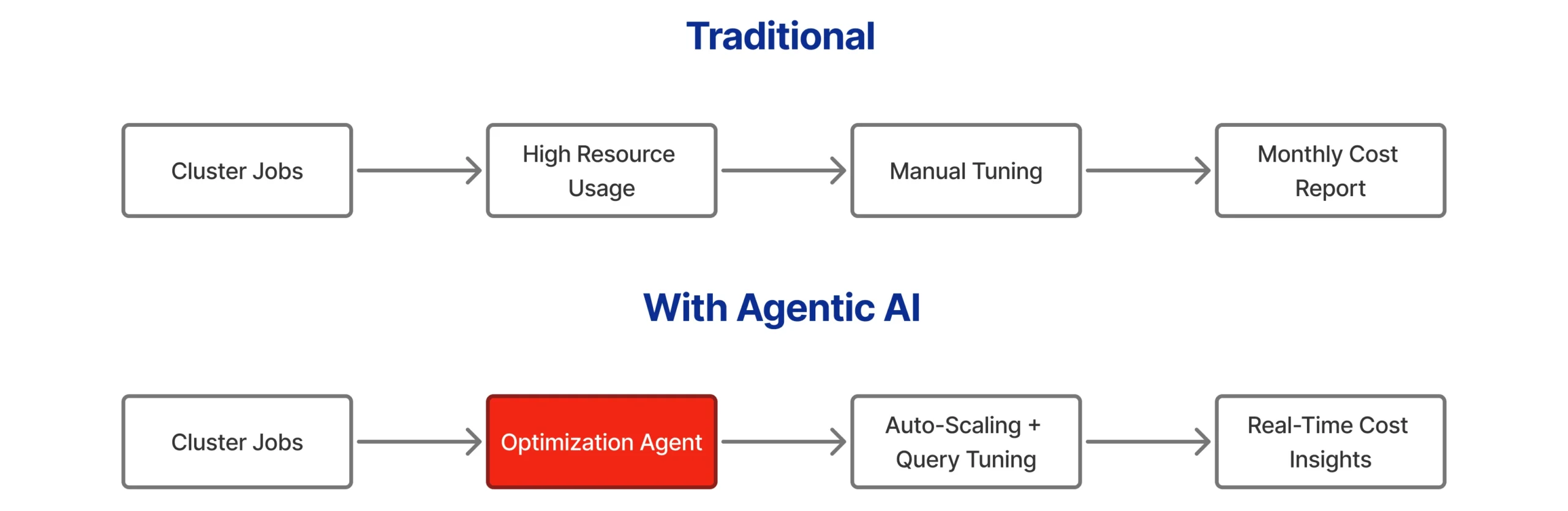
6. Cost and Resource Optimization

Optimization agents run continuously across the compute and storage infrastructure. They analyze execution plans, detect inefficient queries, and rewrite them for performance. When workloads spike (quarter-end reporting or holiday traffic), they proactively scale clusters up and then contract them once demand falls.

Cost & Resource Optimization with Agentic AI

These agents can also re-route high-memory transformations to GPU-enabled nodes or spot instances, which balances performance against cost in real time.

For executives, this turns cloud spending from a fluctuating liability into a controlled, predictable investment.

Data and AI
Bring Agentic AI into Your Data Engineering with Azilen

Roadmap to Adopt Agentic AI for Data Engineering

Adopting agentic AI in data engineering works best when approached as a staged journey. Each stage builds maturity in automation, trust in AI-driven decision-making, and measurable business outcomes.

1. Align with Enterprise Data Strategy

Agentic AI delivers the highest value when tied to business objectives rather than isolated technical fixes.

Begin by mapping where data engineering directly influences outcomes such as real-time decision-making, compliance, or AI/ML readiness.

Prioritize areas where intelligent autonomy strengthens these outcomes.

2. Build a Foundation for Agent Readiness

Before deploying agents, create the conditions they thrive in. For example:

● Unified metadata and cataloguing so agents understand lineage, sensitivity, and dependencies.

● Standardize governance policies so that decision-making by agents aligns with compliance.

● Monitoring baselines so improvements can be quantified.

This step creates the “rules of the game” that allow agents to operate responsibly.

3. Introduce Autonomous Agents into Critical Workflows

Start with workflows that combine high business value with manageable complexity. For instance:

● A compliance-heavy ingestion pipeline for financial data.

● A streaming pipeline where uptime directly impacts customer experience.

4. Scale into Orchestration and Cost Intelligence

Here, agents coordinate entire pipelines, allocate cloud resources dynamically, and continuously tune for efficiency. For example:

● Cloud cost optimization agents can achieve measurable savings.

● Orchestration agents reduce downtime across interconnected pipelines.

This is often the point where leaders notice ROI at the organizational level.

5. Institutionalize Continuous Learning

Agentic AI grows stronger with feedback.

Mature adoption means embedding feedback loops where agents learn from historical pipeline behavior, engineering decisions, and evolving business policies.

Building Smarter Data Systems Together

Enterprises spend millions on pipelines that are often fragile, costly, and slow to adapt. With agentic AI in data engineering, every stage can become autonomous.

At Azilen, our focus is on making this shift measurable.

We combine deep data engineering expertise with practical agentic AI development to help enterprises cut operational friction and turn data infrastructure into a growth enabler.

If you’re ready to explore what this can look like in your organization, we’re here to help you build it.

Take the First Step
Our experts will work with you to design the right agentic AI approach.

Top FAQs on Agentic AI in Data Engineering

Q1. What is agentic AI in data engineering?

Agentic AI in data engineering uses AI agents to plan, execute, monitor, and improve data engineering tasks with varying levels of autonomy. Agents help build data pipelines, investigate failures, validate data quality, and recommend or perform corrective actions. Human oversight remains important for sensitive or high-impact changes.
Why: More precise and realistic about agent autonomy.

Q2. How does agentic AI improve the data engineering lifecycle?

Agentic AI supports data ingestion, transformation, validation, orchestration, and monitoring. Agents help identify pipeline failures, investigate schema changes, generate or repair code, and recommend performance improvements. Validation rules and approval checkpoints help teams control changes before production.

Q3. What are the main use cases of agentic AI in data engineering?

Common use cases include automated pipeline development, data quality monitoring, schema-change detection, ETL modernization, pipeline troubleshooting, metadata management, and workload optimization. The right use case depends on data complexity, infrastructure, and permitted autonomy.

Q4. How do AI agents build and troubleshoot data pipelines?

AI agents use instructions, metadata, data profiles, and connected engineering tools to propose pipeline designs, generate code, validate changes, and investigate failures. Teams should test generated changes and require approval for risky production operations.

Q5. How do you govern agentic AI in data engineering?

Effective governance includes role-based access, least-privilege permissions, data validation, audit logs, and continuous monitoring. Teams should define which actions agents perform independently and which require human approval. Testing and rollback procedures help reduce the risk of incorrect changes and data exposure.

Glossary

1️⃣ Agentic AI: Autonomous AI agents capable of making operational decisions and optimizing workflows.

2️⃣ Data Ingestion: The process of collecting and importing raw data from various sources into a storage or processing system.

3️⃣ Data Validation: The process of checking data for accuracy, completeness, and consistency.

4️⃣ Data Transformation:  Modifying or processing data to make it suitable for analysis or machine learning.

5️⃣ Data Orchestration: Coordinating, scheduling, and managing data workflows across systems.

google
Swapnil Sharma
Swapnil Sharma
VP - Strategic Consulting

Swapnil Sharma is the Vice President - Strategic Consulting at Azilen Technologies, with over 18 years of experience in consulting and presales. He helps organizations find the right AI opportunities and build clear digital roadmaps. He has led AI planning workshops with clients in HRTech, FinTech, and Retail, and has picked and ranked more than 15 AI use cases with a clear return on investment. He has also led work on Agentic AI and IoT use cases, and has set up methods to check whether a company is ready for AI. He has worked with clients across North America, Europe, and EMEA.

Related Insights