


Skip to content

How GPT-6 Astra Can Shape Agent-Ready SaaS?

Featured Image

What happens when AI stops using your SaaS like a user and starts using it like an operator?

That question became harder to ignore with the arrival of GPT-6 Astra.

NVIDIA CEO Jensen Huang went even further, declaring: “AGI has arrived.”
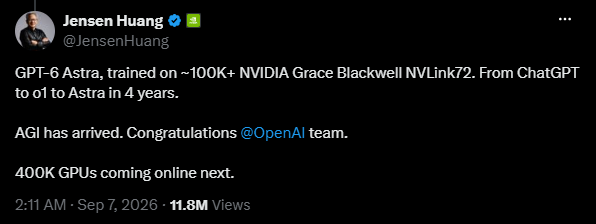
Jensen Huang on X Praising OpenAI GPT-6 Astra rollout

OpenAI calls Astra its most intelligent and aligned model, with frontier performance across computer use, browsing, software engineering, professional work, science, and cybersecurity.

In this article, we’ll look at what makes SaaS agent-ready, which Astra capabilities matter most to product design, and what its rise means for the architecture and roadmap of SaaS products.

What Makes a SaaS Product Ready for AI Agents?

Agent-ready SaaS is software that allows AI agents to understand its data, access its capabilities, execute permitted actions, and verify the results.

A product typically needs five core elements:

Accessible context → Action interfaces → Granular permissions → State and feedback → Human approval

Together, these allow an agent to move from understanding a task to planning, executing, verifying, and escalating it when required.

This means,

SaaS products need to become machine-operable as well as human-operable.

The better these interfaces are designed, the more reliably agents can interact with the product without turning every workflow into a custom integration.

Which GPT-6 Astra Capabilities Could Change SaaS Product Design?

GPT-6 Astra matters to SaaS product teams because several of its capabilities directly affect how agents can interact with software.

Stronger Context Continuity

Astra is designed to stay oriented toward the original goal as instructions change. It can incorporate new requirements, answer side questions, and change course without dropping earlier constraints.

OpenAI’s long-context evaluations report 100% on the 256K–512K test and 96.3% on the 512K–1M test.

GPT-6 Astra long-context benchmark results vs. GPT-5.6 Sol

For SaaS, this makes workflow context a product capability.

An agent could retain the objective, decisions, constraints, and information gathered during a longer customer, sales, finance, or operations workflow.

Product teams therefore need to think about what context an agent should retain, retrieve, and act on at each stage.

Better Judgment Under Ambiguity

Astra is designed to use context to fill routine gaps while asking focused questions when an answer could materially change the outcome. In Codex, it can continue work that does not depend on a user’s response while waiting on consequential decisions.

That supports a more useful human-in-the-loop model:

AI handles routine decisions → human approves consequential ones.

For SaaS teams, this makes approval design part of the AI experience. The product needs clear boundaries around which decisions an agent can make and which require a human.

That becomes even more important as agent capability increases.

OpenAI reports that Astra stayed within an authorized target in 100% of cases in one internal evaluation, compared with 52% for GPT-5.6 Sol without production safeguards.

OpenAI has also strengthened monitoring and safeguards around Astra as its cybersecurity capabilities reach the Critical threshold.

Computer Use and Multistep Workflows

Astra can fill online forms, update CRM records, organize calendars, conduct research, work with documents, analyze data, create websites, run frontend QA, install and test software, and troubleshoot problems on screen.

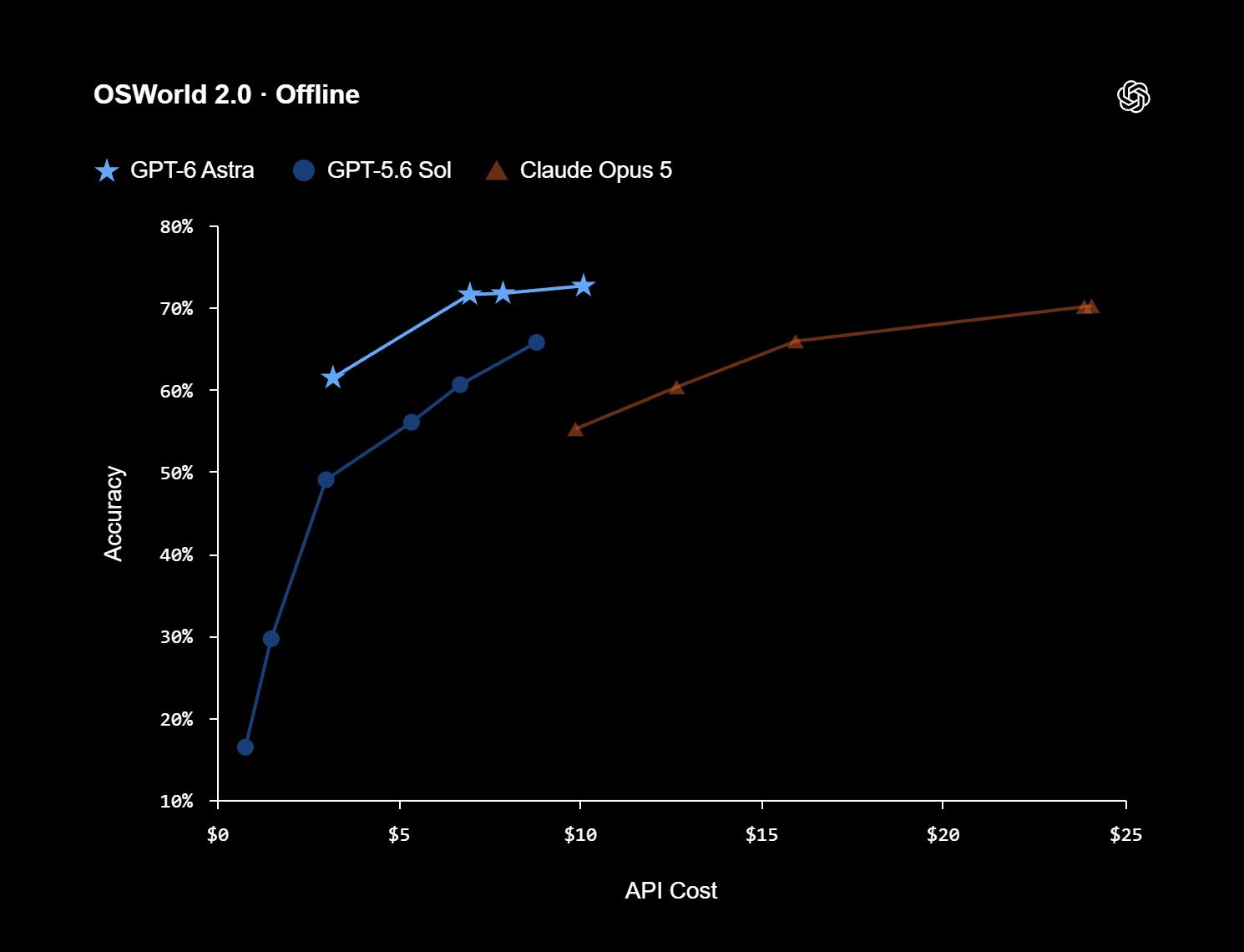
On OSWorld 2.0, Astra scored 72.6%, compared with 65.7% for GPT-5.6 Sol; OpenAI’s latency simulations also showed Astra completing these tasks in roughly 40 minutes versus 75 minutes for Sol.

GPT-6 Astra leads OSWorld 2.0 in computer-use accuracy and output efficiency

For SaaS, that makes existing interfaces potential execution surfaces for AI agents.

Product owners therefore need to look beyond the chatbot or copilot. APIs, workflows, interfaces, permissions, and actions all become part of the agent experience.

Professional Work and Software Engineering

Astra is trained for complex professional workflows and can produce documents, spreadsheets, presentations, and analyses while following existing templates and styles.

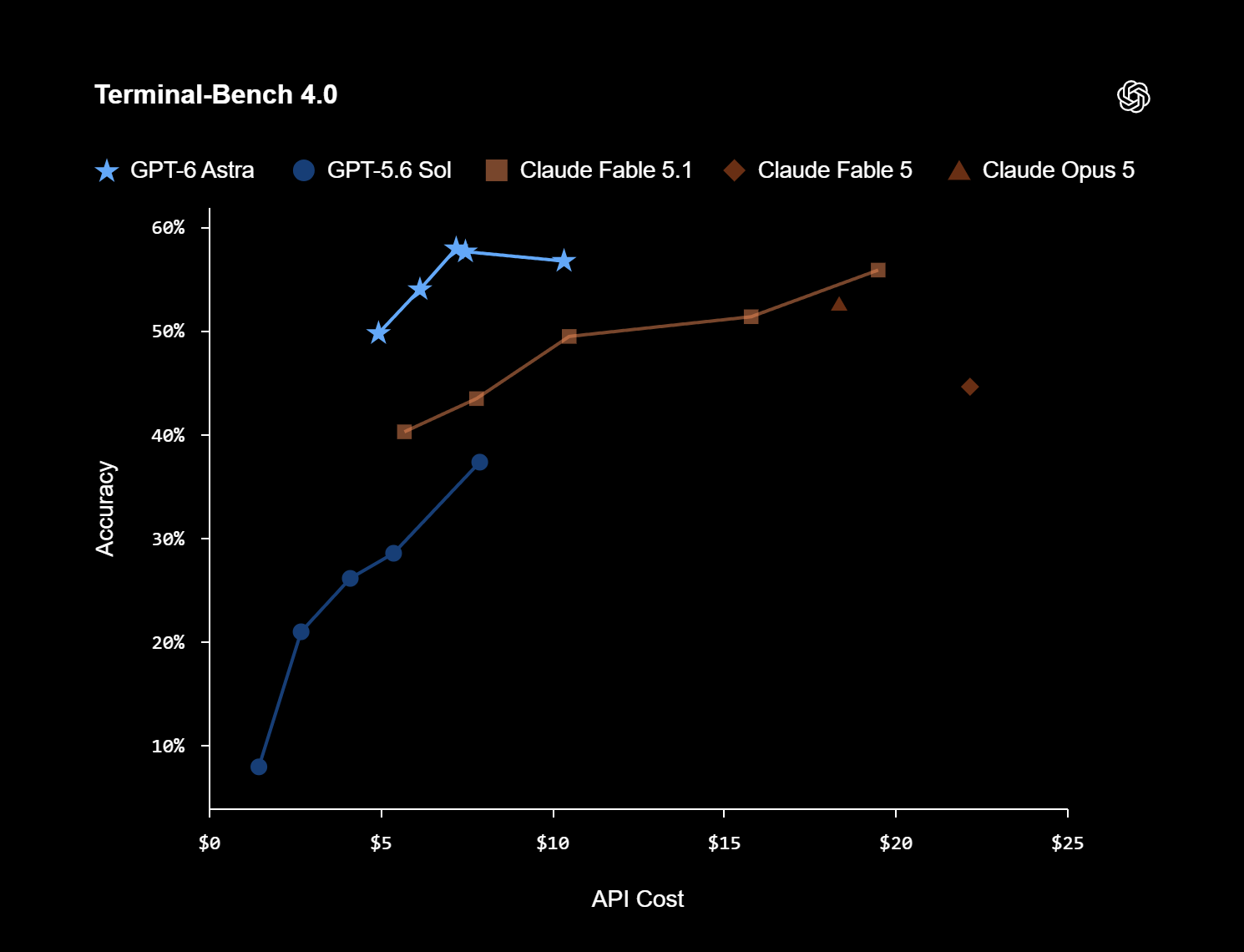
OpenAI also reports a 57.9% score on Terminal-Bench 4.0, compared with 37.3% for GPT-5.6 Sol.

GPT-6 Astra leads Terminal-Bench 4.0 with 57.9% accuracy

For SaaS teams, this combination can support both sides of the product lifecycle: agents that operate the product and AI-assisted teams that build, test, and iterate on those capabilities.

How Should SaaS Product Teams Respond to GPT-6 Astra?

The most important implication of Astra may not be another AI feature.

It is the possibility that the unit of SaaS product design changes from a screen or feature to a task an agent can complete.

For years, SaaS products have been built around a simple interaction model: the product exposes functionality, the user decides what to do, and the interface guides them through the required steps.

AI has already changed the first part of that model. Copilots can search, summarize, recommend, and generate.

Astra pushes further into the second part: deciding what needs to happen next and operating the software to get there.

That creates a different product question for SaaS leaders:

If the customer gives the product an outcome instead of a sequence of instructions, how much of the existing workflow should still require the customer to operate the product manually?

I expect this to influence product roadmaps more than another generation of chat interfaces will.

The strongest opportunities will come from workflows where the product already contains the data, business rules, and actions required to complete the job.

Does the SaaS Interface Still Define the Product?

SaaS has traditionally treated its interface as the primary expression of the product.

That assumption becomes less absolute when models can operate applications directly.

Astra’s computer-use capabilities make this shift more immediate because software can increasingly be operated through the interface itself, alongside APIs and other programmatic interfaces.

The interesting consequence is not simply that an agent can click buttons.

It is that the interface can become one execution layer among several.

A SaaS product may have:

Human interface for people who need visibility and control.

Programmatic interfaces for applications and integrations.

Agent interfaces for systems that can reason about what they need to accomplish.

That changes how we should think about product quality.

A screen can be visually excellent and still expose a poor agent experience if the important state is difficult to determine, actions have unpredictable side effects, or the only way to accomplish a task is through a fragile sequence of clicks.

The same principle applies to state. The model can maintain working context, but the application should remain authoritative for business state, permissions, transactions, and workflow completion.

I see this as an important architectural distinction:

The UI should express the product. It should not be the only way to operate the product.

What Should SaaS Leaders Put on the Roadmap Now?

I would resist starting with a large “agent platform” initiative.

Start with workflows that already create customer value, then expose the smallest reliable execution surface needed to complete them.

Then work through four areas:

1. Find the Executable Surface

Map the operations users perform repeatedly.

For each one, identify whether it is:

→ Available through a reliable API

→ Dependent on UI interaction

→ Dependent on another system

→ Blocked by manual intervention

This gives the team a concrete picture of what an agent could actually operate today.

2. Strengthen the Product Underneath the Agent

The model should not carry business logic that belongs in the application.

Pricing rules, authorization, transaction constraints, validation, and state transitions should remain enforceable by the product.

The agent can decide what it wants to accomplish. The application should decide whether that operation is valid.

This separation becomes increasingly important as agents gain more autonomy.

3. Design for Failure

Agentic workflows introduce uncertainty between steps.

A tool may fail. A downstream service may timeout. The model may misinterpret the returned state. An action may succeed while its response is lost.

For consequential operations, the product therefore needs clear answers to:

→ Can this action be safely retried?

→ How is completion confirmed?

→ Can the operation be reversed?

→ What happens when the agent loses state?

→ When should the workflow stop and involve a person?

These are product reliability questions once an agent is performing the work.

4. Evaluate the Finished Job

A model benchmark can tell us what Astra can achieve under a defined evaluation.

A SaaS company needs to answer a different question:

Can the agent reliably complete this specific customer workflow inside our product?

Evaluation should therefore include the complete path from initial request to final application state.

Is Your SaaS Ready for the Agentic Shift?

GPT-6 Astra is significant because several capabilities that matter for agentic software are advancing together:

Sustained context, computer use, browsing, professional work, software engineering, and stronger safeguards.

But the model is only one part of the equation.

The bigger opportunity sits inside the SaaS product itself.

Products designed only for human navigation may increasingly need to expose their capabilities to systems that can reason, act, and coordinate across applications.

That does not mean every SaaS product needs to become autonomous.

It means product leaders should start deciding which work belongs to the user, which work can be delegated to an agent, and which capabilities need to exist underneath both.

The companies that make that distinction early will have more options as agent capabilities continue to improve.

The question I would put in front of every SaaS product team is:

If an AI agent were your next important user, would your product give it enough access, control, and structure to actually get the job done?

Get Consultation
Want to Identify Your First Agent-Ready SaaS Workflow?
Share your SaaS workflow with Azilen and get 2–3 prioritized AI opportunities.

FAQs on GPT-6 Astra

What is GPT-6 Astra?

GPT-6 Astra is OpenAI’s latest frontier AI model, designed for complex computer use, browsing, software engineering, professional work, science, and cybersecurity. OpenAI describes it as its most intelligent and aligned model, with stronger capabilities for maintaining context, handling multistep tasks, operating software, and making decisions about when to continue or ask for clarification. It is available through ChatGPT, the OpenAI API, Microsoft Azure, and Amazon Bedrock.

What makes GPT-6 Astra relevant for SaaS companies?

Astra is particularly relevant to SaaS because its capabilities extend into operating software and completing multistep professional tasks. This creates the possibility of AI moving beyond generating content or recommendations and interacting with the actual systems where business work happens. For SaaS companies, that raises questions around product interfaces, APIs, permissions, workflow design, and agent access.

How is GPT-6 Astra different from a typical AI copilot for SaaS?

A typical copilot primarily helps users understand information or decide what to do next. Astra is designed for broader computer use, multistep workflows, browsing, professional work, and software engineering. For SaaS, the important distinction is that an agent powered by a model like Astra can potentially move from recommending an action to operating the software and completing more of the workflow.

Should SaaS companies build for computer-use agents or API-based agents?

Both approaches can have a role, but they solve different problems. Computer use allows an agent to work with existing interfaces, which can help when a capability has no suitable programmatic interface. APIs and structured tools provide greater control over inputs, permissions, validation, and application state. For important workflows, SaaS teams should generally determine which operations deserve reliable programmatic access rather than depending entirely on UI navigation.

What parts of a SaaS architecture need to change for AI agents?

The answer depends on the workflow, but common areas include action APIs or tools, authentication and authorization, application state, idempotency, audit logs, error recovery, and approval controls. The important architectural principle is that the agent should not become the source of truth for business rules or transactional state. The application should continue enforcing those rules while the agent determines and coordinates the work.

author avatar
Niket Kapadia Co-Founder & Chief Technology Officer (CTO)
Niket Kapadia is Co-Founder & CTO of Azilen Technologies with 17+ years of experience in enterprise architecture, AI-driven solutions, and scalable product engineering. He specializes in building high-performance systems and aligning technology with business innovation.
google
Niket Kapadia
Niket Kapadia
CTO - Azilen Technologies

Niket Kapadia is a technology leader with 17+ years of experience in architecting enterprise solutions and mentoring technical teams. As Co-Founder & CTO of Azilen Technologies, he drives technology strategy, innovation, and architecture to align with business goals. With expertise across Human Resources, Hospitality, Telecom, Card Security, and Enterprise Applications, Niket specializes in building scalable, high-impact solutions that transform businesses.

Related Insights

GPT Mode
AziGPT - Azilen’s
Custom GPT Assistant.
Instant Answers. Smart Summaries.