Skip to content

What Makes a Customer Support Software Agentic?

Featured Image

Executive Summary

Regular customer support software replies.

Agentic customer support software resolves.

The difference is not just AI, it’s architecture. An agentic system understands what the customer actually wants, decides what to do next, calls the right tools, takes action across systems, and closes the loop – all without waiting for a human to say “go ahead.”

This blog breaks down the 5 core features that make customer support software truly agentic, why they matter in 2026, and how your business can build or adopt this capability right now.

Most customer support software today still works like a better version of a FAQ page.
It receives a question, searches for a response, and replies.

That is not agentic.

The term “agentic” comes from the idea of an AI agent. A system that doesn’t just respond, but actually acts.

It understands your customer’s goal, plans the steps to achieve it, uses tools to get things done, and adapts when something unexpected happens. All of this happens with minimal (often zero) human intervention.

80%

Issues resolved autonomously by 2029

56%

Support interactions using agentic AI by mid-2026

70%

Customer interactions handled without a human

So, what specifically makes a customer support software “agentic”?

Let’s break it down into the 5 features that actually define this shift, and what each one means under the hood.

5 Features That Make a Customer Support Software Agentic

Customer support software is no longer limited to answering questions or managing tickets.

Agentic systems go a step further by understanding goals, making decisions, taking actions, and driving issues toward resolution with minimal human involvement.

The following five features define what makes customer support software truly agentic.

1. Goal-Oriented Reasoning Instead of Intent Detection

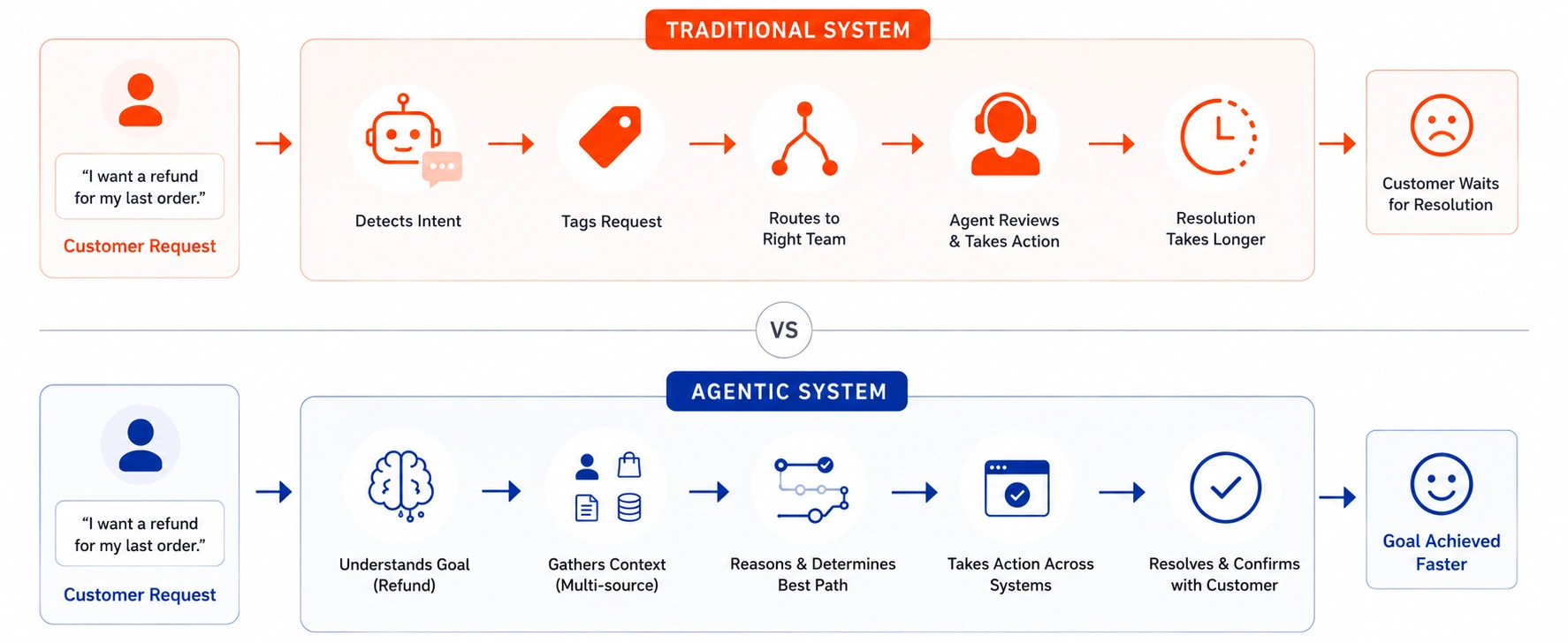
Most Customer Support Software identifies what a customer says. Agentic Customer Support Software identifies what a customer wants to achieve.

When a customer requests a refund, a traditional system tags the request and routes it. An agentic system goes further. It analyzes conversation history, account details, and customer context to determine the best path to resolution.

Goal-Oriented Reasoning

Instead of reacting to individual messages, the system continuously reasons toward a goal.

This is why agentic systems can successfully manage conversations that span multiple topics, changing circumstances, and unexpected customer requests without breaking the experience.

What This Enables

→ Fewer customer handoffs because the system understands the bigger picture.

→ More accurate resolutions by evaluating context instead of isolated messages.

→ Better customer experiences through intelligent, goal-driven interactions.

2. Autonomous Tool Use and System Integration

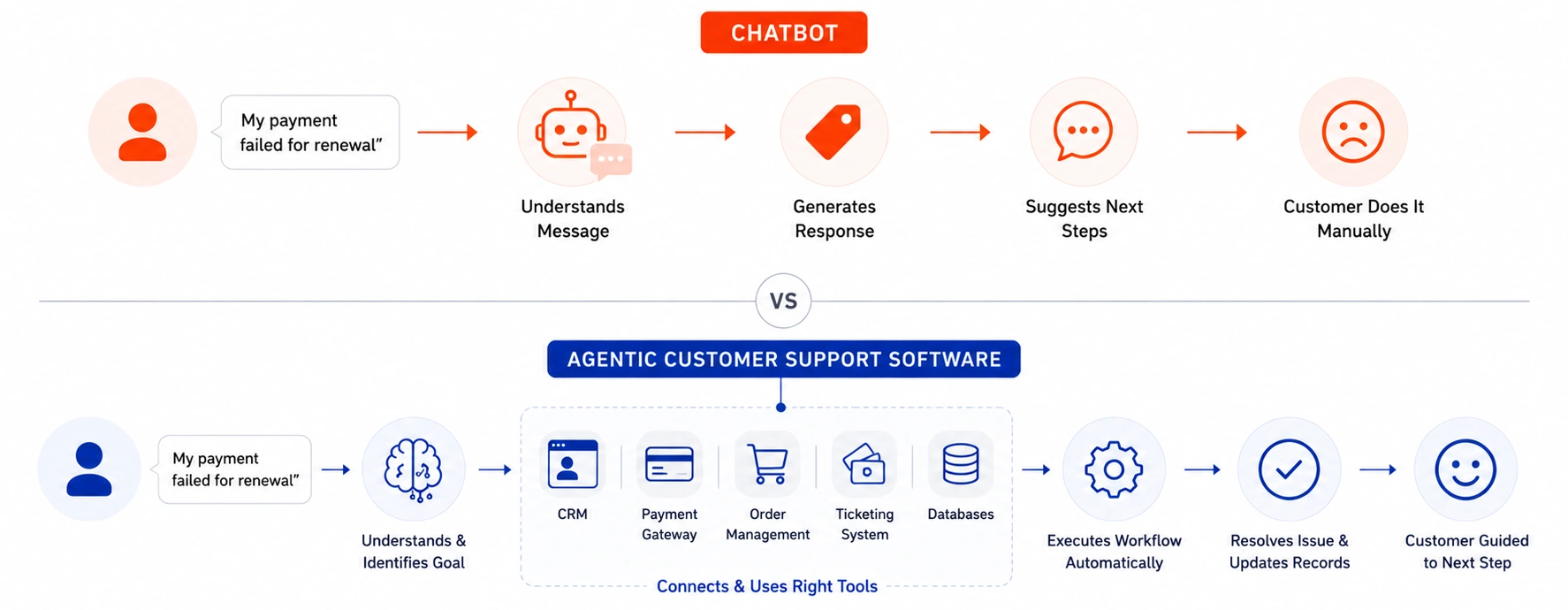
A chatbot talks.

An Agentic Customer Support Software platform takes action.

Modern agentic systems connect directly with CRMs, payment gateways, order management platforms, ticketing systems, and enterprise databases.

When a customer needs help, the system can access the right tools, retrieve information, execute workflows, and complete tasks without human involvement.

Autonomous Tool Use

For example, when a customer reports a failed subscription renewal, the system can investigate payment records, identify the root cause, initiate recovery workflows, update customer records, and guide the customer through resolution without involving a human agent.

The conversation becomes the interface, while the actual work happens behind the scenes.

What This Enables

→ End-to-end issue resolution within a single interaction.

→ Reduced operational workload for support teams.

→ Faster customer outcomes through direct system execution.

Real-World Example

The U.S. Internal Revenue Service (IRS) has begun deploying AI agents across multiple departments to help manage growing case volumes.

These systems assist with case reviews, resolution pathways, and administrative workflows, reducing operational bottlenecks while improving response times.

Customer Support Software
Looking to Implement Agentic Customer Support?
Empower your business with AI-driven support systems designed to deliver outcomes, not just responses.

3. Dynamic Multi-Step Planning and Execution

Customer problems rarely involve a single action.

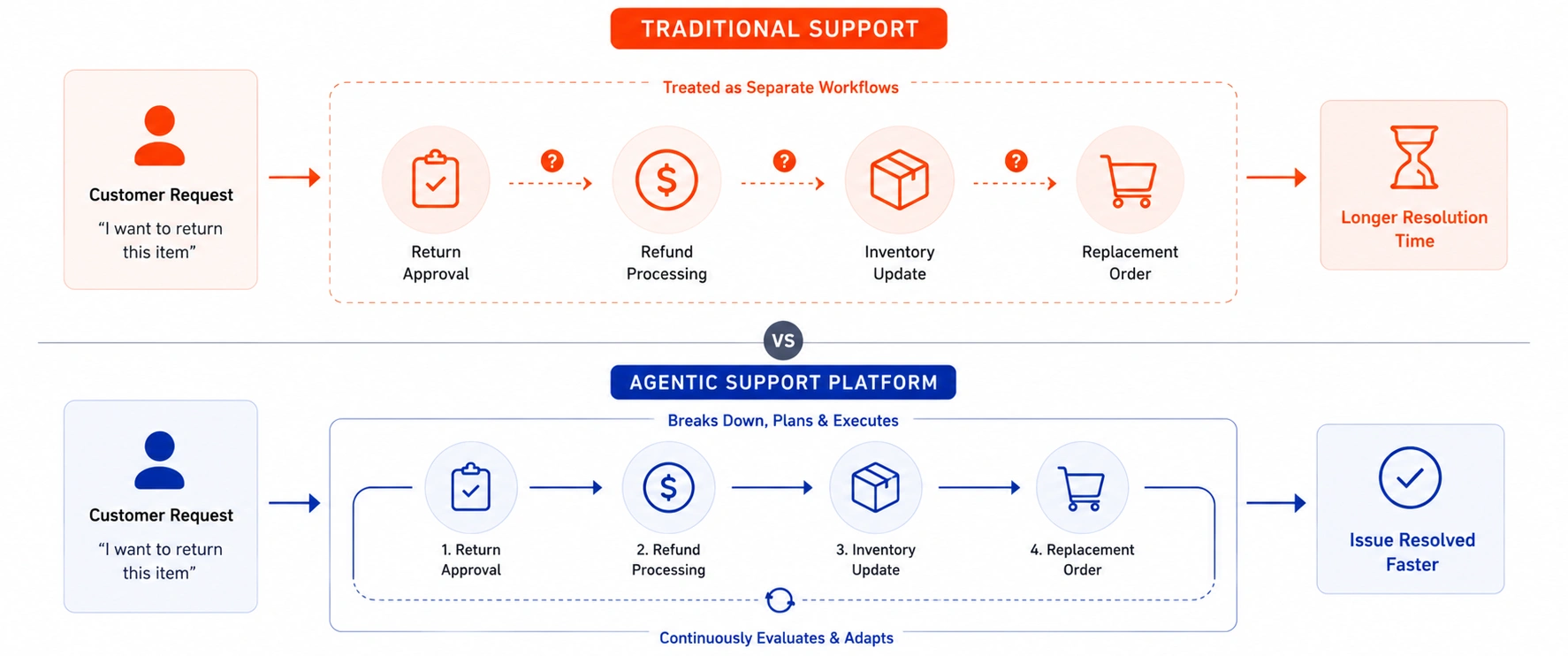
A return request may require a return approval, refund processing, inventory updates, and a replacement order. Traditional support systems often treat these as separate workflows.

Dynamic Multi-Step Planning

An Agentic Customer Support Software platform approaches the problem differently. It breaks complex objectives into manageable tasks, executes them in sequence, evaluates results, and continuously adapts its plan until the customer’s objective is achieved.

The system is not following a script. It is managing a process.

What This Enables

→ Handling of complex support scenarios without predefined workflows.

→ Greater flexibility when unexpected situations arise.

→ Higher first-contact resolution rates across customer journeys.

4. Persistent Memory and Contextual Continuity

One of the quickest ways to frustrate customers is to make them repeat themselves.

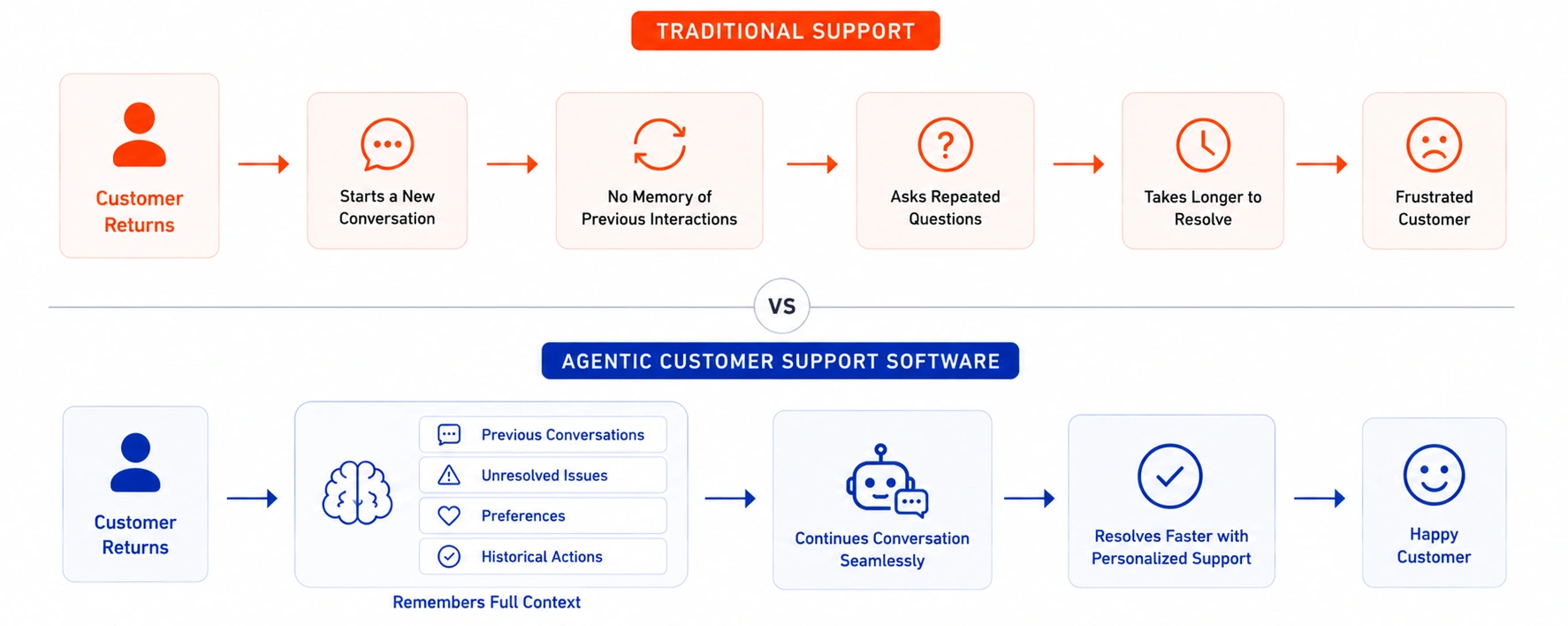
Traditional Customer Support Software often treats every interaction as a brand-new conversation. Agentic systems maintain memory across customer journeys.

Persistent Memory and Contextual Continuity

An Agentic Customer Support Software platform maintains continuity across interactions. It remembers previous conversations, customer preferences, unresolved issues, support history, and completed actions.

As a result, every interaction becomes part of a larger customer journey rather than an isolated event.

This continuity allows support experiences to become increasingly personalized over time.

What This Enables

→ Seamless customer experiences across channels and sessions.

→ Reduced customer effort during support interactions.

→ Personalized support that improves with every conversation.

Quick note here: Memory is what separates a smart chatbot from a genuine AI agent. Without memory, every interaction is context-free. With memory, every interaction builds on the last, and support becomes a relationship, not just a transaction.

5. Outcome-Driven Decision Making

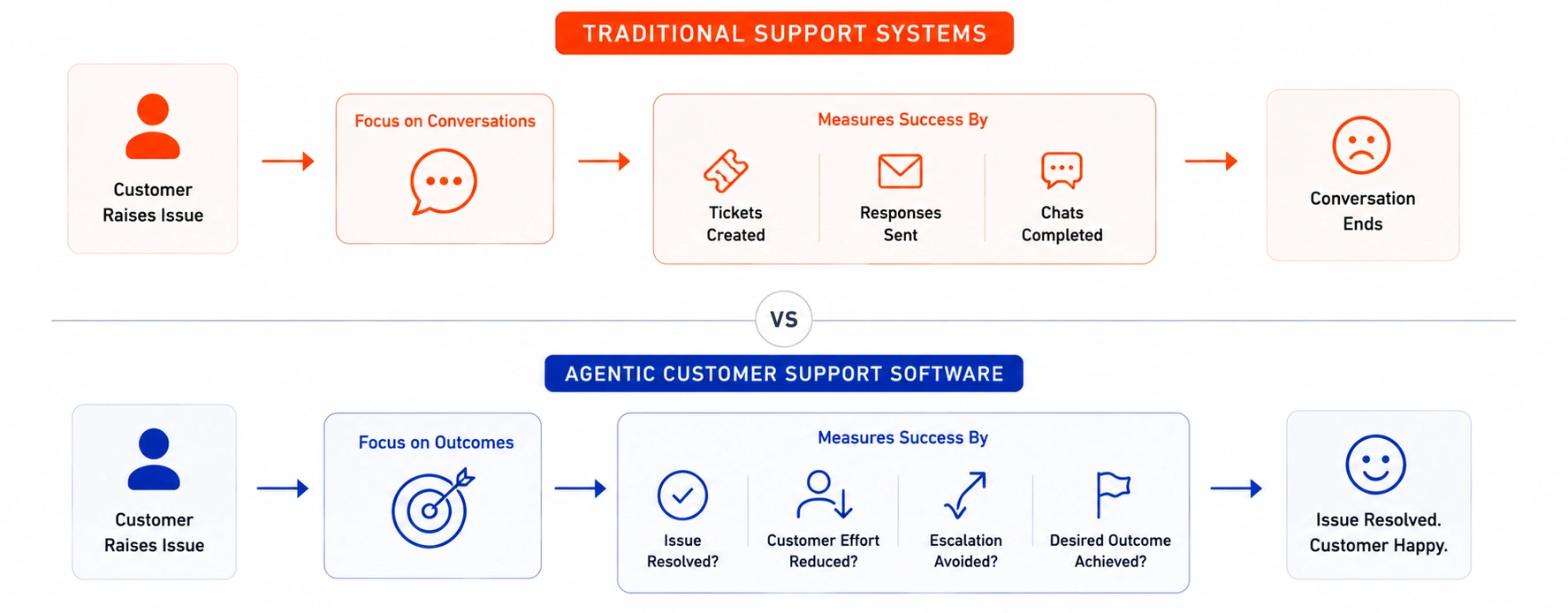
Traditional Customer Support Software often measures success using operational metrics such as response times, tickets handled, or conversations completed.

However, customers rarely care about these metrics.

They care about whether their issue was resolved.

Outcome-Driven Decision Making

An Agentic Customer Support Software platform is designed around outcomes rather than activities. Every decision, workflow, and action is evaluated based on its ability to move the customer closer to resolution.

The system constantly balances customer needs, business policies, operational constraints, and available actions to determine the most effective path forward.

This is what transforms support automation into autonomous problem solving.

What This Enables

→ Higher customer satisfaction through faster resolutions.

→ Lower escalation volumes and operational costs.

→ Support experiences optimized for outcomes instead of interactions.

The Bottom Line: Agentic Customer Support Software Is the New Standard

At its core, the difference is simple.

Traditional Customer Support Software is designed to answer customer questions.

Agentic Customer Support Software is designed to solve customer problems.

The five features we’ve covered, goal-oriented reasoning, autonomous actions, dynamic planning, persistent memory, and outcome-driven decision-making, are what make that possible.

Together, they enable support systems to understand context, take action across business systems, adapt to changing situations, and work toward resolution without constant human involvement.

As customer expectations continue to rise, businesses need more than faster responses. They need faster resolutions.

And that’s exactly where Agentic Customer Support Software stands apart.

Because in modern customer support, the real measure of success isn’t how quickly you reply—it’s how quickly you solve.

Building Agentic Customer Support Software Requires More Than AI

Deploying a chatbot is easy.

Building a truly Agentic Customer Support Software platform is much more complex. It requires the right AI architecture, enterprise integrations, workflow orchestration, memory systems, governance frameworks, and scalability foundations.

Without the right engineering approach, even the most advanced AI models struggle to deliver reliable customer outcomes.

That is where Azilen Technologies as an Enterprise AI development company helps enterprises design and build next-generation Customer Support Software solutions powered by agentic AI.

Agentic AI Engineering: Design intelligent support systems that understand customer goals, reason through problems, and drive resolutions autonomously.

Enterprise System Integration: Connect AI agents with CRMs, ERP platforms, payment systems, ticketing tools, and customer data ecosystems.

Workflow Orchestration: Build support experiences that can plan, execute, and manage complex multi-step customer journeys.

Memory & Context Architecture: Enable persistent customer context across conversations, channels, and support interactions.

Scalable AI Infrastructure: Develop enterprise-ready AI systems with the reliability, observability, security, and governance required for large-scale operations.

Future-Ready Customer Experience: Prepare your organization for the next generation of autonomous support operations and AI-driven customer engagement.

If you’re exploring how to build or modernize Customer Support Software with agentic AI capabilities, connect with Azilen Technologies to create intelligent support systems designed for real business outcomes.

Scale your AI
Scaling Toward Enterprise Superintelligence?
Design secure and scalable AI systems built for long-term growth.

FAQs: Agentic Customer Support Software

1. What is Agentic Customer Support Software?

Agentic Customer Support Software is a support system that goes beyond answering customer questions. It understands customer goals, reasons through problems, takes actions across connected business systems, and works toward resolution.

Unlike traditional chatbots, it focuses on solving issues rather than simply generating responses or routing requests to human agents.

2. How is Agentic Customer Support Software different from traditional Customer Support Software?

Traditional Customer Support Software primarily responds to customer queries and follows predefined workflows. Agentic Customer Support Software can understand context, make decisions, execute tasks, use enterprise tools, and adapt to changing situations.

The key difference is that traditional systems answer questions, while agentic systems actively work toward resolving customer problems.

3. What are the key features of Agentic Customer Support Software?

The most important features include goal-oriented reasoning, autonomous tool usage, dynamic task planning, persistent memory, and outcome-driven decision-making.

Together, these capabilities allow Agentic Customer Support Software to understand customer intent, perform actions across systems, maintain context, and deliver faster, more effective resolutions than traditional support solutions.

4. Can Agentic Customer Support Software integrate with existing business systems?

Yes. Modern Agentic Customer Support Software is designed to integrate with CRMs, ERP platforms, payment gateways, ticketing systems, order management tools, and internal databases.

These integrations allow the system to retrieve information, automate workflows, update records, and complete customer requests without requiring constant human intervention.

5. Why are businesses investing in Agentic Customer Support Software?

Businesses are adopting Agentic Customer Support Software because customers expect faster and more personalized support experiences.

By automating complex workflows, reducing manual effort, maintaining context, and improving resolution rates, agentic systems help organizations lower support costs, improve customer satisfaction, and scale customer service operations more efficiently.

Glossary

Customer Support Software: Platform that manages customer interactions, support requests, tickets, and service workflows.

Agentic Customer Support Software: AI-powered support system that understands goals, takes actions, and resolves issues autonomously.

Goal-Oriented Reasoning: AI capability to focus on customer objectives rather than individual requests or keywords.

Autonomous Tool Use: Ability of AI agents to interact with enterprise systems and applications independently.

Dynamic Task Planning: Process of breaking complex requests into actionable steps and executing them intelligently.

Persistent Memory: Capability to retain customer context, history, and preferences across interactions.

Function Calling: AI mechanism for triggering APIs, tools, and business workflows automatically.

Retrieval-Augmented Generation (RAG): AI architecture combining language models with external knowledge and business data.

ReAct Framework: AI approach that combines reasoning and actions to complete multi-step tasks.

Outcome-Driven Decision Making: Evaluating success based on issue resolution rather than conversation completion metrics.

author avatar
Swapnil Sharma Vice President – Strategic Consulting
Swapnil Sharma is VP – Strategic Consulting at Azilen Technologies with expertise in digital transformation, presales, and business strategy. He has led 750+ RFPs and helps organizations drive technology-led growth through consultative solutions.
google
Swapnil Sharma
Swapnil Sharma
VP - Strategic Consulting

Swapnil Sharma is a strategic technology consultant with expertise in digital transformation, presales, and business strategy. As Vice President - Strategic Consulting at Azilen Technologies, he has led 750+ proposals and RFPs for Fortune 500 and SME companies, driving technology-led business growth. With deep cross-industry and global experience, he specializes in solution visioning, customer success, and consultative digital strategy.

Related Insights

GPT Mode
AziGPT - Azilen’s
Custom GPT Assistant.
Instant Answers. Smart Summaries.