Skip to content

Loan Lending App Development Cost: Complete Pricing Breakdown and ROI Guide

Featured Image

Executive Summary

How much does loan lending app development cost? Loan lending app development costs range from $20,000 for MVPs to $800,000+ for enterprise lending platforms.

Average monthly operating cost: Monthly operating costs range from $7,000 to $58,000+, covering compliance, KYC, AML, payments, support, and integrations.

Cost by business model: Personal, BNPL, P2P, and SME lending platforms vary significantly in cost due to complexity requirements.

The ROI of lending app development: Revenue from origination fees and interest spreads helps recover development costs through sustained lending growth.

How to reduce loan lending app development cost: Partner with LaaS providers, prioritize core features, and embed compliance early to minimize expenses.

You have a great lending idea. The market opportunity is clear. The only question is: How much will it actually cost to build?

The answer isn’t as simple as a development quote. Beyond the app itself, there are compliance requirements, credit checks, payment integrations, and operational expenses that can significantly impact your budget. In this guide, we’ll break down the real cost of loan lending app development and what it takes to build a profitable lending business.

Loan Lending App Development Cost Disclaimer

Pro Tip

The cheapest lending app is rarely the most affordable. Building compliance, security, and underwriting capabilities correctly from day one can save thousands in future rework, penalties, and operational risks.

Calculate Your Loan Lending App Development Cost

Every lending business is different. Use this calculator to estimate your investment based on platform type, origination approach, compliance scope, and features.

Estimated Budget
$—
This is a rough estimate based on average 2026 US market development rates. The actual cost may vary depending on exact feature scope and compliance jurisdictions.
Selected Parameters

How Much Does Loan Lending App Development Cost in 2026?

For a quick benchmark, here’s what lenders typically spend to build and run a lending app at each stage of maturity.

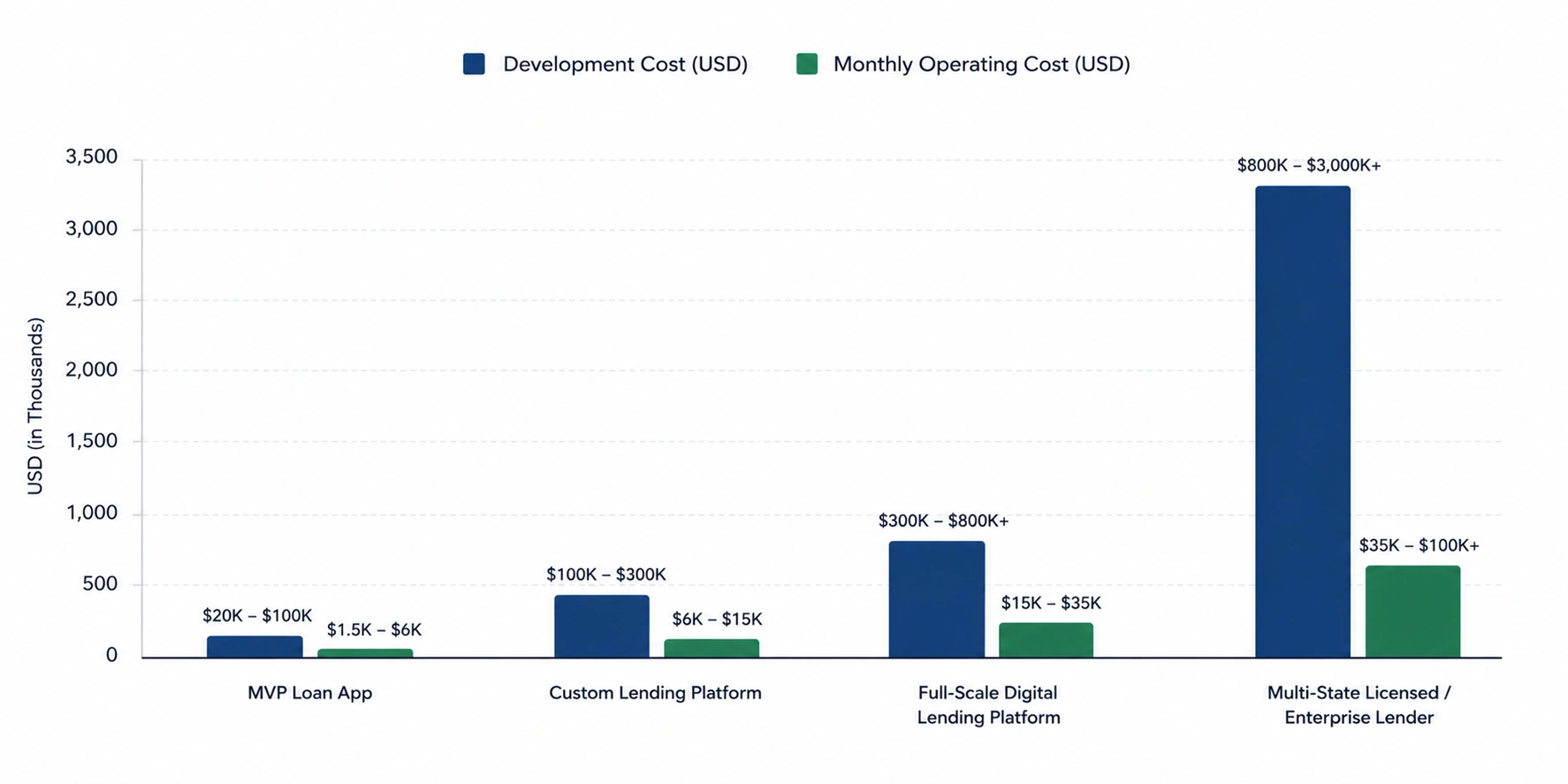
Build Tier What's Included Development Cost Monthly Operating Cost
MVP Loan App Onboarding, basic KYC, loan application, manual/rules-based underwriting, repayment tracking via a partner API $20,000 – $100,000 $1,500 – $6,000
Custom Lending Platform Automated underwriting, credit bureau integration, multi-product loans, borrower portal $100,000 – $300,000 $6,000 – $15,000
Full-Scale Digital Lending Platform AI-driven credit decisioning, servicing & collections automation, multi-channel disbursement, analytics $300,000 – $800,000+ $15,000 – $35,000
Multi-State Licensed / Enterprise Lender Own state lending or money transmitter licenses, bank-grade compliance, embedded lending-as-a-service $800,000 – $3,000,000+ $35,000 – $100,000+
Development Cost by Build Tier

Loan Lending App Technology Layers and What Drives Their Cost

A lending app isn’t a single system, it’s a combination of borrower onboarding, underwriting, payments, compliance, and servicing infrastructure.

According to the World Bank Digital Financial Services Resources, technology plays a critical role in expanding access to financial services while improving operational efficiency. Here’s where the development budget typically goes.

Layer What It Does Primary Cost Drivers
Loan Origination & Application Captures borrower details, documents, and eligibility inputs. UX design, document upload/e-signature, eligibility rules engine.
KYC/AML & Identity Layer Verifies identity, screens for fraud and sanctions. Per-verification fees, liveness checks, ongoing monitoring rules.
Credit Decisioning & Underwriting Engine Pulls credit bureau and alternative data, scores risk, approves or declines applications. Bureau access fees, scoring model complexity, decision-rule configuration.
Loan Servicing & Repayment Engine Generates schedules, tracks payments, and manages delinquency. Amortization logic, ACH/payment gateway integration, collections workflow.
Licensing & Compliance Layer Operates under state lending or money transmitter licenses. Application and bond fees, legal counsel, ongoing regulatory reporting.

Where the Loan Actually Moves – and Where the Cost Sits

Every borrower journey passes through the same five checkpoints. The heavier the checkpoint, the more it typically costs to build.

01Apply

Application

~15% of cost

02KYC/AML

Identity & Fraud Check

~15% of cost

03Underwrite

Credit Decisioning

~30% of cost

04Disburse

Funds Transfer

~10% of cost

05Service

Servicing & Collections

~30% of cost

Loan Lending App Development Cost Calculate
Before You Build, Know the Real Number.
Discover the actual investment required for your lending platform, from MVP development to compliance, licensing, and ongoing operations.

Ongoing Loan App Operating Cost (No One Talks About This)

Most founders budget for the build and forget the running cost. In lending, the recurring bills are what actually determine whether the business survives past year one.

Credit Bureau & Identity Verification

Every application triggers a per-pull charge from credit bureaus and ID verification vendors.

$500 – $12,000+ / month

→ Costs scale directly with application volume, not approved loans.

KYC/AML & Fraud Monitoring

Ongoing sanctions screening, transaction monitoring, and suspicious activity reporting.

$500 – $9,000 / month

→ Enhanced-diligence tiers cost more per check than basic verification.

Payment Processing & Loan Servicing

ACH pulls, card disbursements, and repayment collection through payment rails.

$1,000 – $8,000 / month

→ Per-transaction fees add up fast at higher repayment frequency.

Compliance, Licensing & Legal

Legal counsel, license renewals, regulator correspondence, and audit prep.

$1,500 – $9,500 / month

→ Multi-state operation multiplies filing and renewal costs.

Cloud Infrastructure & Security

Hosting, encrypted storage, and continuous penetration testing.

$800 – $4,000 / month

→ Scales with active loan volume, not app downloads.

Customer Support & Collections

Support staffing plus dedicated collections and dispute-handling workflows.

$3,000 – $15,000 / month

→AI-assisted support helps, but rarely below this floor for a regulated lender.

Loan Lending App Development Cost by Business Model

The same base architecture carries very different cost depending on who you’re lending to. Underwriting depth, marketplace mechanics, and compliance scope all move the number.

Business Model Typical Use Cases Build Cost Range Key Cost Drivers
Personal / Installment Loan App Short and medium-term personal loans $60,000 – $250,000 Credit bureau integration, repayment scheduling, 24/7 support
Payday / Cash Advance App Small, short-term, high-frequency loans $40,000 – $150,000 High-volume KYC, fast disbursement rails, state rate-cap compliance
BNPL (Buy Now, Pay Later) Point-of-sale installment financing $80,000 – $300,000+ Merchant/checkout SDK integration, real-time risk scoring
P2P Lending Marketplace Connecting individual borrowers with investors $150,000 – $500,000+ Investor dashboards, risk grading, secondary marketplace
SME / Business Lending Platform Working capital, invoice financing, credit lines $150,000 – $450,000 Business KYB, accounting integrations, cash-flow underwriting
Mortgage / Loan Origination Platform Home loans and large secured lending $200,000 – $600,000+ Complex underwriting, appraisal integrations, heavy compliance

Is $100K Too Much for Loan Lending App Development?

Not always. A loan lending app development investment of $100K can be highly profitable if it helps you launch faster, automate underwriting, and unlock new lending revenue streams.

→ Let borrowers apply, get approved, and receive loan decisions in minutes instead of days.
→ Generate revenue through origination fees, servicing fees, and interest-rate spreads on funded loans.
→ Automate credit decisioning and underwriting workflows, reducing operational costs and manual review effort.
→ Launch new lending products, personal loans, BNPL, lines of credit, and SME lending, without rebuilding your platform.
→ Scale your loan lending app efficiently while improving borrower experience, approval accuracy, and portfolio performance.

Quick Tip

Don’t evaluate loan lending app development cost on build price alone. Measure it against cost per funded loan, origination and interest revenue per borrower, and how much underwriting overhead you’d otherwise carry manually. That’s where the real return shows up.

1%–8%

Typical origination fee lenders earn per funded loan, layered on top of interest income.

8–16 wks

Typical launch time on an API-first lending platform, versus 6–12+ months (fully custom licensed build).

$240K–$475K

Estimated first-year cost of a full 50-state money transmitter license program, before any software is built.

Build vs. Buy: Own License or Lending-as-a-Service?

This is the single decision that determines every other number in this guide. Here’s how the two paths actually compare.

Criteria Build (Own License / Custom Platform) Buy (Lending-as-a-Service / Partner)
Use Case Complexity High — full control, custom products, multi-state operations Low to Medium — standard lending features and workflows
Time to Market 9–24+ months 8–16 weeks
Initial Investment $300,000 – $3,000,000+ $20,000 – $300,000
Regulatory Ownership You hold the license and compliance responsibility License and compliance managed by the partner
Ongoing Costs Compliance teams, surety bonds, regulatory management Platform fees, per-loan charges, revenue sharing
Customization Level Complete control over products and underwriting logic Limited to the partner's available capabilities
Loan Lending App Development Cost Fintech
Turn Your Lending Vision Into Reality
Explore our 👇

How Much Does It Cost to Build a Loan Lending App?

The cost to build a loan lending app can range from $20,000 for a basic MVP to over $500,000 for a feature-rich, multi-product lending platform. The final investment depends on mobile app development, borrower onboarding, credit decisioning, payment processing, and integration with banking and bureau infrastructure.

How to Reduce Loan Lending App Development Cost (Without Compromising Compliance)

Building a lending platform doesn’t have to mean overspending. With the right technology choices, phased development approach, and compliance strategy, you can significantly reduce loan lending app development costs while still creating a secure, scalable, and growth-ready platform.

✅ Partner with a Lending-as-a-Service (LaaS) provider instead of pursuing your own state licenses. This can significantly reduce infrastructure and licensing costs while shortening time-to-market from years to weeks.

✅ Launch with core lending features first—loan applications, KYC, basic underwriting, and repayment tracking—before expanding into BNPL, P2P lending, or AI-powered credit scoring.

✅ Build compliance into your loan lending app development strategy from day one. Retrofitting KYC/AML, audit trails, and credit reporting after launch is far more expensive.

✅ Leverage proven integrations for credit bureaus, identity verification, and payment processing rather than building custom alternatives from scratch.

✅ Compare multiple vendors before making a decision. Platform fees, revenue-sharing models, implementation costs, and support quality can vary significantly between providers.

What Does It Cost to Get Licensed to Lend Money in the US?

Lending licenses in the US are handled state by state, mostly through the Nationwide Multistate Licensing System (NMLS). There is no single national license, that patchwork is a major reason many lenders start with a Lending-as-a-Service partner.

License Type Typical Cost
Single-State Application Fee $250 – $10,000
Full 50-State Money Transmitter / Lending License Program $240,000 – $475,000+
Individual Mortgage Loan Originator (MLO) License $700 – $1,500
Annual License Renewal (Per State) Often Similar to the Original License Fee

How to Start a Loan Lending App

Launching a lending app doesn’t have to be overwhelming. By taking a phased approach, you can validate your business model, control development costs, and scale with confidence.

1. Define Your Lending Model and Target Market

Start by identifying the type of lending products you will offer and the borrowers you want to serve. Your lending model directly impacts technology requirements, compliance obligations, risk management, and revenue potential.

2. Understand Regulatory and Compliance Requirements

Research licensing, KYC, AML, data privacy, and reporting obligations before development begins. Addressing compliance early reduces legal risk, prevents costly redesigns, and helps accelerate regulatory approvals.

3. Select the Right Technology Approach

Choose between custom development, white-label software, or a Lending-as-a-Service platform based on your budget, scalability goals, desired level of control, and expected time-to-market.

4. Build a Minimum Viable Product (MVP)

Focus on essential capabilities such as borrower onboarding, loan applications, underwriting, approvals, and repayment tracking. A phased launch helps validate demand before larger investments are made.

5. Integrate Critical Lending Infrastructure

Connect credit bureaus, identity verification providers, payment processors, banking APIs, and fraud prevention tools to support efficient lending operations and improve underwriting accuracy.

Loan Lending App Success Starts with the Right Foundation

Building a successful lending platform is about far more than launching a loan app. Today’s leading digital lenders combine seamless borrower experiences, secure infrastructure, regulatory compliance, intelligent credit decisioning, and scalable technology to drive sustainable growth.

As an enterprise AI development company, Azilen helps organizations design, build, and scale secure, compliant, and future-ready lending platforms. Our teams bring expertise across digital lending platforms, credit decisioning, KYC/AML automation, payment ecosystems, AI-powered underwriting, and regulatory technology.

→ Define the most cost-effective loan lending app development strategy aligned with your business model and growth objectives.

→ Build scalable digital lending platforms designed to support future expansion, higher loan volumes, and new lending products.

→ Integrate credit bureaus, payment rails, banking APIs, and third-party underwriting services through a unified technology ecosystem.

→ Automate KYC, AML, borrower onboarding, and compliance workflows to improve operational efficiency and reduce manual effort.

→ Enable real-time portfolio visibility with AI-powered analytics, intelligent automation, and data-driven lending insights.

→ Reduce long-term operational costs with secure, scalable, and compliance-ready architecture built for sustainable growth.

Whether you’re launching a Lending-as-a-Service MVP, building a platform for consumers or SMEs, or pursuing your own lending license, we help you create a roadmap that balances cost, compliance, and business outcomes.

Get a Precise Cost Estimation for Your Loan Lending App Development
CTA

FAQs: Loan Lending App Development Cost

1. Do loan lending apps require a lending license?

Licensing requirements depend on your business model, geography, and whether you are lending directly or partnering with a licensed institution.

2. What is the difference between a loan lending app and a digital lending platform?

A loan lending app focuses on borrower interactions, while a digital lending platform includes underwriting, servicing, compliance, analytics, and operational workflows.

3. Can AI be used in loan lending applications?

Yes. AI can automate credit assessments, fraud detection, document verification, borrower segmentation, and portfolio risk monitoring while improving operational efficiency.

4. Is it possible to launch a lending app without building everything from scratch?

Many lenders accelerate time-to-market using Lending-as-a-Service (LaaS), white-label solutions, or pre-built lending infrastructure combined with custom features.

5. What integrations are required for a loan lending app?

Most lending platforms integrate with credit bureaus, identity verification providers, payment processors, banking APIs, fraud detection tools, and compliance systems.

Glossary

Loan Lending App: A digital application that enables borrowers to apply for loans, submit documents, receive approvals, track repayments, and manage lending activities through web or mobile channels.

Digital Lending Platform: A technology ecosystem that manages the complete loan lifecycle, including borrower onboarding, underwriting, disbursement, servicing, collections, and compliance operations.

KYC (Know Your Customer): A regulatory verification process that confirms borrower identities using documents, biometric checks, and data validation to prevent fraud and financial crime.

AML (Anti-Money Laundering): A set of compliance procedures and monitoring systems designed to identify, prevent, and report suspicious financial transactions and illegal activities.

Credit Underwriting: The process of evaluating a borrower’s creditworthiness by assessing financial history, income, liabilities, repayment behavior, and overall lending risk.

Lending-as-a-Service (LaaS): A platform model that provides pre-built lending infrastructure, compliance capabilities, and operational tools, allowing businesses to launch lending products faster.

Credit Bureau Integration: The connection between a lending platform and credit reporting agencies to access credit scores, borrowing history, and risk-related borrower data.

AI-Powered Credit Decisioning: The use of artificial intelligence and machine learning to automate risk assessment, loan eligibility checks, fraud detection, and lending decisions.

author avatar
Swapnil Sharma Vice President – Strategic Consulting
Swapnil Sharma is VP – Strategic Consulting at Azilen Technologies with expertise in digital transformation, presales, and business strategy. He has led 750+ RFPs and helps organizations drive technology-led growth through consultative solutions.
google
Swapnil Sharma
Swapnil Sharma
VP - Strategic Consulting

Swapnil Sharma is a strategic technology consultant with expertise in digital transformation, presales, and business strategy. As Vice President - Strategic Consulting at Azilen Technologies, he has led 750+ proposals and RFPs for Fortune 500 and SME companies, driving technology-led business growth. With deep cross-industry and global experience, he specializes in solution visioning, customer success, and consultative digital strategy.

Related Insights

GPT Mode
AziGPT - Azilen’s
Custom GPT Assistant.
Instant Answers. Smart Summaries.