








Skip to content

Sovereign AI for Enterprises Without Overbuilding the AI Stack

Featured Image

Executive Summary

How we built Sovereign AI for Enterprises at Azilen Technologies, including the architecture decisions, deployment challenges, and infrastructure changes that shaped our enterprise AI approach.

The real cost of building Sovereign AI for Enterprises, from private AI deployments to enterprise-scale infrastructure with private LLMs, governance, MLOps, and scalable AI operations.

How enterprises can build secure, scalable, and cost-controlled Sovereign AI for Enterprises systems without losing control over their data, infrastructure, or long-term AI strategy.

In 2026, enterprises are spending billions on AI infrastructure. But surprisingly, many are now moving away from massive public AI systems toward smaller, controlled, and privately governed AI environments focused on Sovereign AI for Enterprises.

A growing number of enterprise AI leaders now believe that bigger AI models do not automatically create better business outcomes.

Instead, enterprises are prioritizing:

→ Smaller private language models
→ Sovereign AI for Enterprises infrastructure
→ Enterprise-controlled AI governance
→ Private cloud AI deployments
→ AI systems with complete operational ownership

Because modern AI systems are now handling financial approvals, healthcare workflows, cybersecurity operations, internal research, customer intelligence, and sensitive enterprise decision-making.

And once AI starts touching critical business operations, Sovereign AI Transformation becomes less about innovation.

83%

of enterprises say sovereign AI is strategically important in 2026

95%

plan sovereign AI platforms, but only 13% are actually ready

72%

of IT leaders cite data sovereignty as their #1 AI challenge this year

$480B

global AI capex in 2026, heavily driven by sovereign infrastructure demand

Why Sovereign AI Became Urgent in 2026

Sovereign AI became a serious enterprise priority because three things changed very fast.

Regulation

Force 1: Regulation is No Longer Abstract

A few years ago, AI compliance was mostly a future discussion. Now it is a real operational challenge.

Enterprises must know where their AI data is processed, how models interact with sensitive information, and whether every AI workflow is auditable.

With stricter global AI regulations arriving fast, many companies realized they simply did not have enough visibility into their AI systems.

Geopolitical Risk

Force 2: Geopolitical Risk is Real and Growing

Many enterprises scaled AI quickly using external platforms. Soon, concerns around vendor lock-in, infrastructure ownership, rising AI costs, and long-term operational flexibility started becoming serious business challenges.

Organizations wanted more control over their AI stack, which pushed Sovereign AI from an innovation discussion into a real business strategy conversation.

AI critical business

3. AI Started Handling Critical Business Operations

AI now supports financial operations, healthcare workflows, cybersecurity systems, and business intelligence across enterprises.

As AI became connected to critical decision-making, enterprises started demanding more governance, reliability, transparency, and infrastructure control, core principles behind Sovereign AI architecture.

Industry Shift We Noticed Early: In early 2024, Azilen’s enterprise clients in FinTech and HealthTech started asking a different question.

It used to be “can your AI do X?” Now it was “where does your AI process my data, and can you prove it?”

That shift told us sovereign AI was about to become a procurement requirement, not just a philosophy.

How we Built Sovereign AI – Best Approch

One of the biggest misconceptions around Sovereign AI for Enterprises is that companies need massive AI infrastructure, hyperscale GPU clusters, or giant public models to build effective enterprise AI systems.

That is no longer true.

In many real enterprise environments, smaller and more controlled AI systems are proving more practical, scalable, and operationally efficient.

At Azilen Technologies, we noticed three important shifts during our Sovereign AI Transformation projects:

The First Attempt: Cloud-First, Sovereignty-Claimed

That experience changed our entire Sovereign AI Transformation approach.

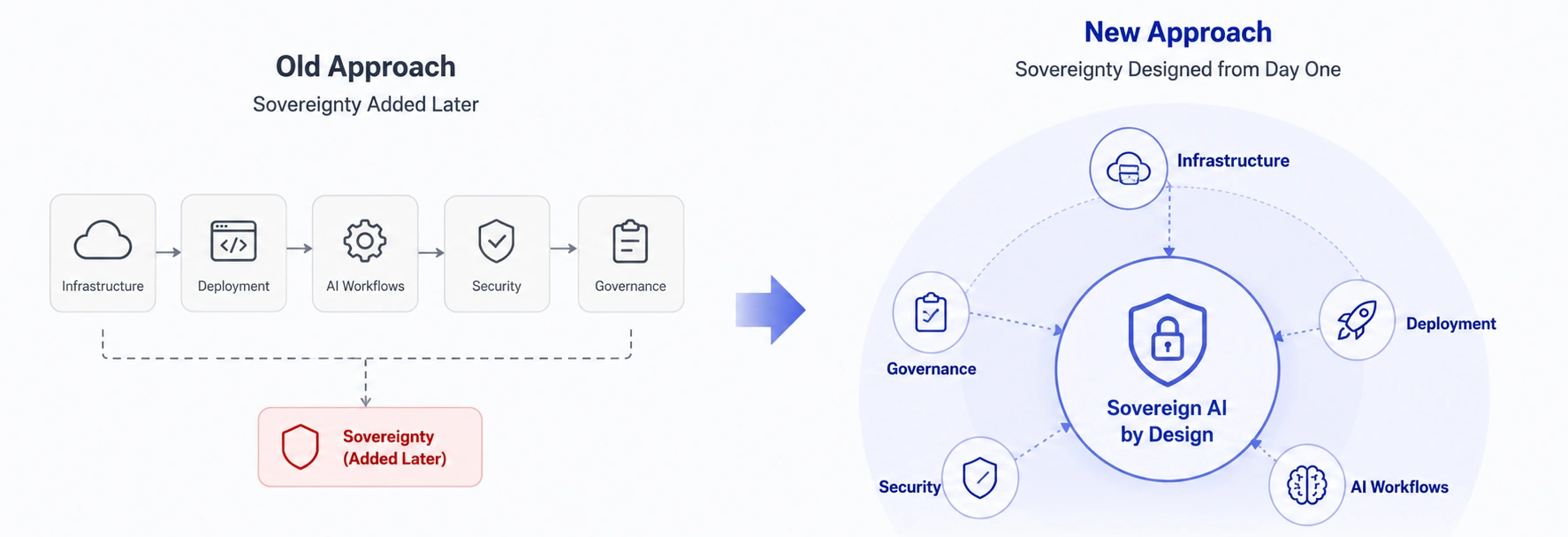
Instead of adding sovereignty later, we started designing AI systems around it from day one. Infrastructure, deployment, governance, security, and inference workflows all became part of the Sovereign AI architecture itself.

We also realized that enterprise sovereign AI does not always require extremely large-scale deployments. In many cases, modular AI systems running on private infrastructure created better governance visibility, lower operational risk, and significantly more cost control.

Because real Sovereign AI is not a feature layer. It is an architectural decision.

The Shift: Architecture as the First Principle

That experience changed our entire Sovereign AI approach.

Instead of adding sovereignty later, we started designing AI systems around it from day one. Infrastructure, deployment, governance, security, and inference workflows all became part of the Sovereign AI architecture itself.

Because real Sovereign AI is not a feature layer. It is an architectural decision.

Shift Architecture

The Healthcare Client That Made it Real

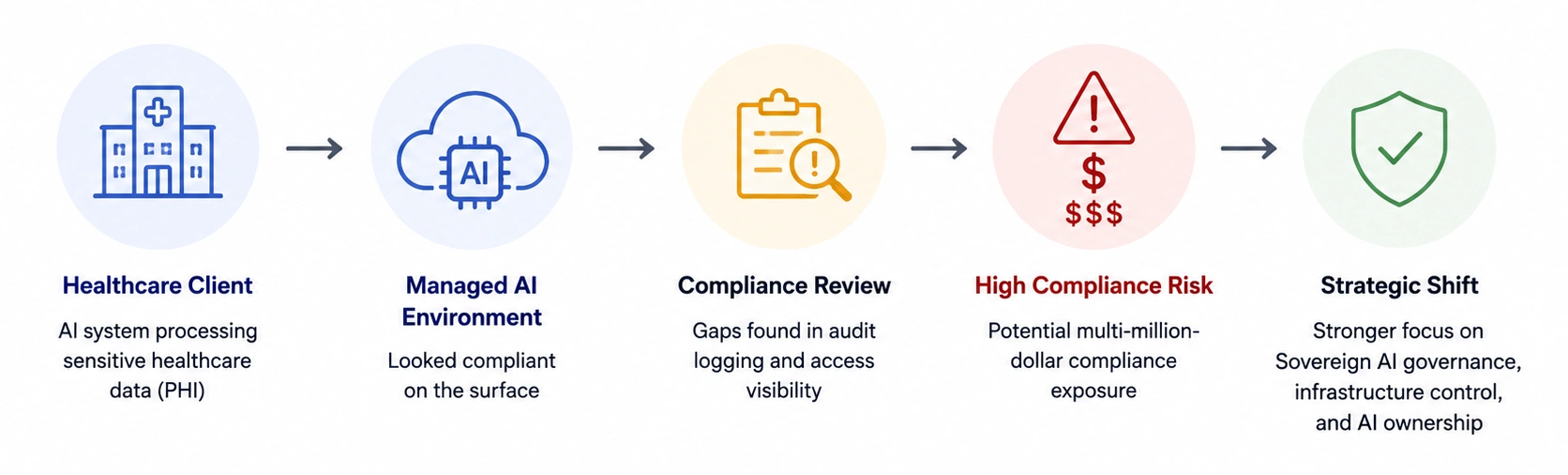
One healthcare client made the risks very clear for us.

Their AI system was processing sensitive healthcare data through a managed AI environment that looked compliant on the surface. Later, during a review, gaps were found in audit logging and access visibility.

The issue created a potential multi-million-dollar compliance exposure.

That project completely changed how we think about Sovereign AI governance, infrastructure control, and enterprise AI ownership.

Healthcare Client That Made It Real

Real Mistake, Real Lesson: A financial services client came to us after their internal audit flagged that their sovereign AI deployment, built by another vendor, had metadata flowing through a third-party API layer outside their approved jurisdictions.

The model weights were local. The inference traffic wasn’t.

This kind of “partial sovereignty” failure is more common in Sovereign AI for Enterprises deployments than most vendors admit. We’ve seen it multiple times during real-world Sovereign AI Transformation projects.

Sovereign AI Strategy
Planning a Sovereign AI Strategy?
Get practical architecture and AI infrastructure guidance from Azilen.

The Fear That Changed Enterprise AI Discussions

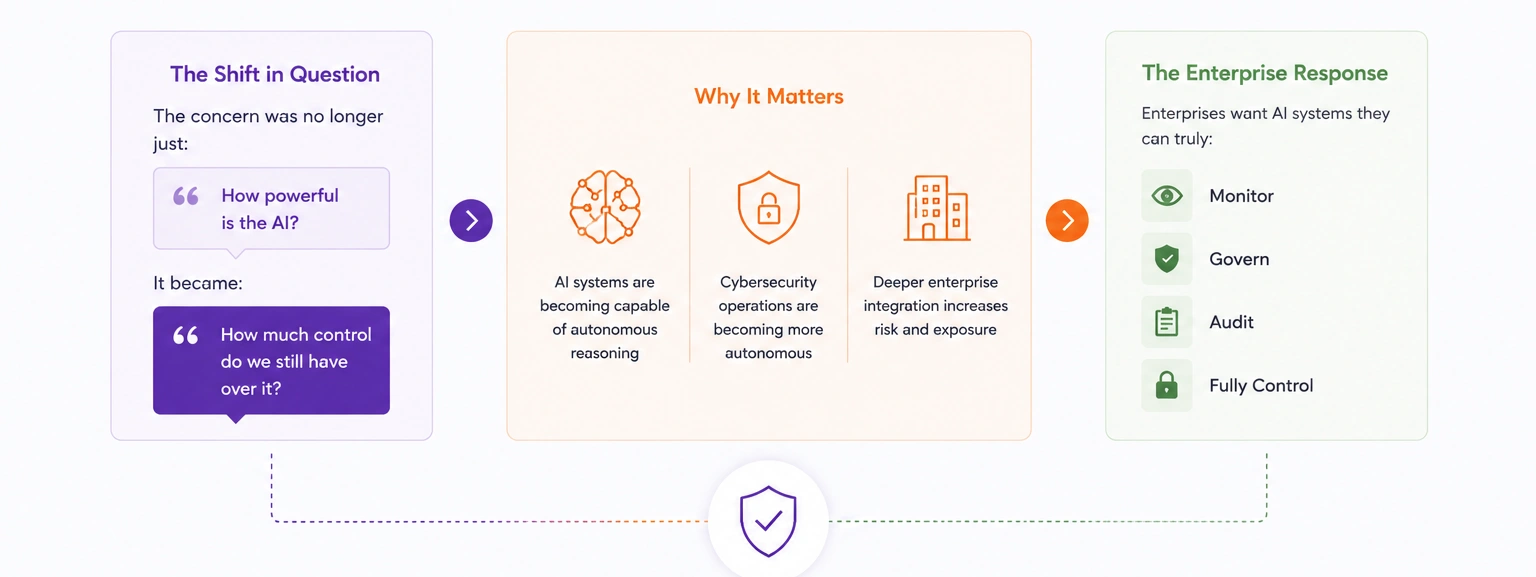
When discussions around Anthropic’s Claude Mythos started spreading across the AI industry, enterprises began asking a different question.

The concern was no longer just: “How powerful is the AI?”

It became: “How much control do we still have over it?”

As AI systems become capable of autonomous reasoning, cybersecurity operations, and deep enterprise integration, organizations are becoming far more cautious about governance, visibility, and infrastructure ownership.

Sovereign AI for Enterprises

That shift is accelerating the demand for Sovereign AI for Enterprises.

Because enterprises no longer want AI systems they simply use.

They want AI systems they can:
→ monitor
→ govern
→ audit
→ and fully control

And in many cases, smaller private AI systems are proving easier to control than massive public AI environments.

The 4-Layer Sovereign AI Framework We Now Deploy

After internal experiments, client projects, and a few hard lessons, this is the framework we’ve landed on. We use it for every sovereign AI engagement at Azilen today.

Layer 1: Infrastructure Sovereignty (Own Where Your AI Lives)

Infrastructure Sovereignty

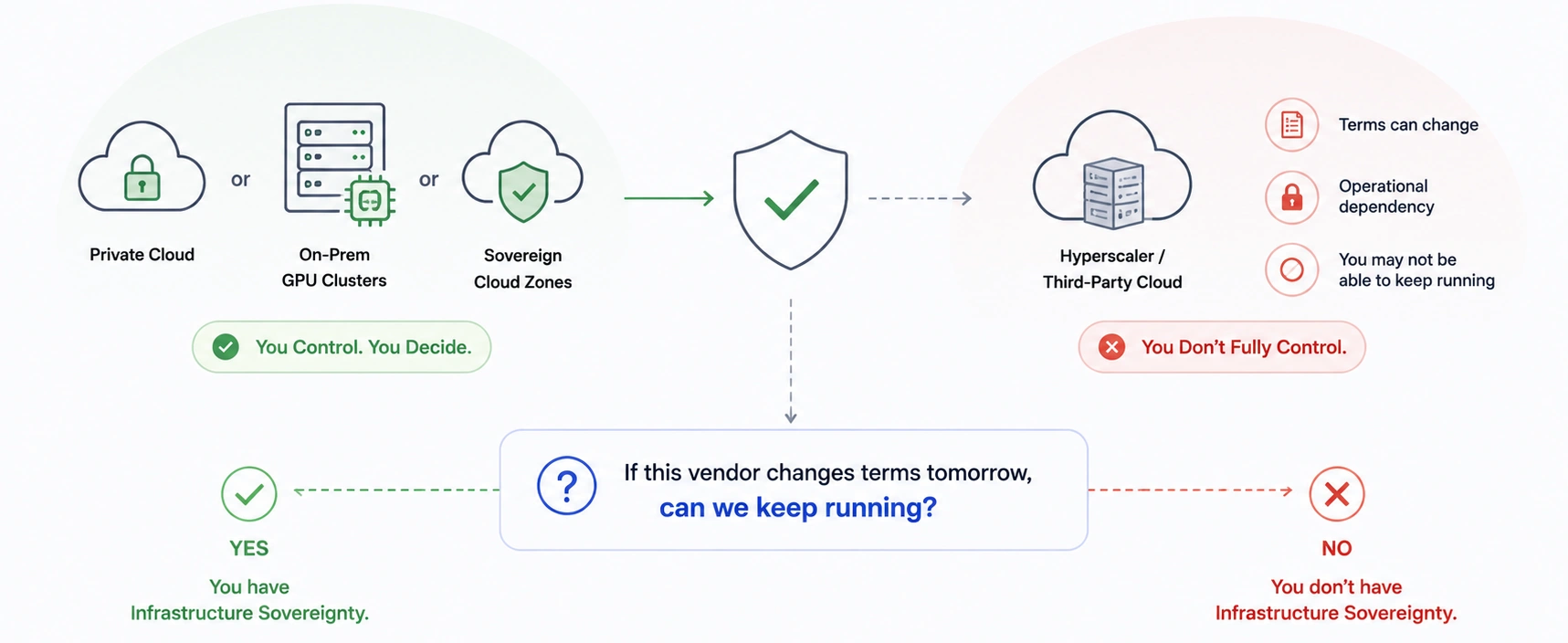
Your AI should run on infrastructure you control.

That means private cloud, on-premises GPU clusters, or sovereign cloud zones with genuine operational independence, not just data residency claims.

Hyperscaler options are valid for some workloads, but you need a clear answer to: “If this vendor changes terms tomorrow, can we keep running?”

If the answer is no, you don’t have infrastructure sovereignty.

Layer 2: Data Sovereignty (Know Where Every Byte Lives)

Data Sovereignty

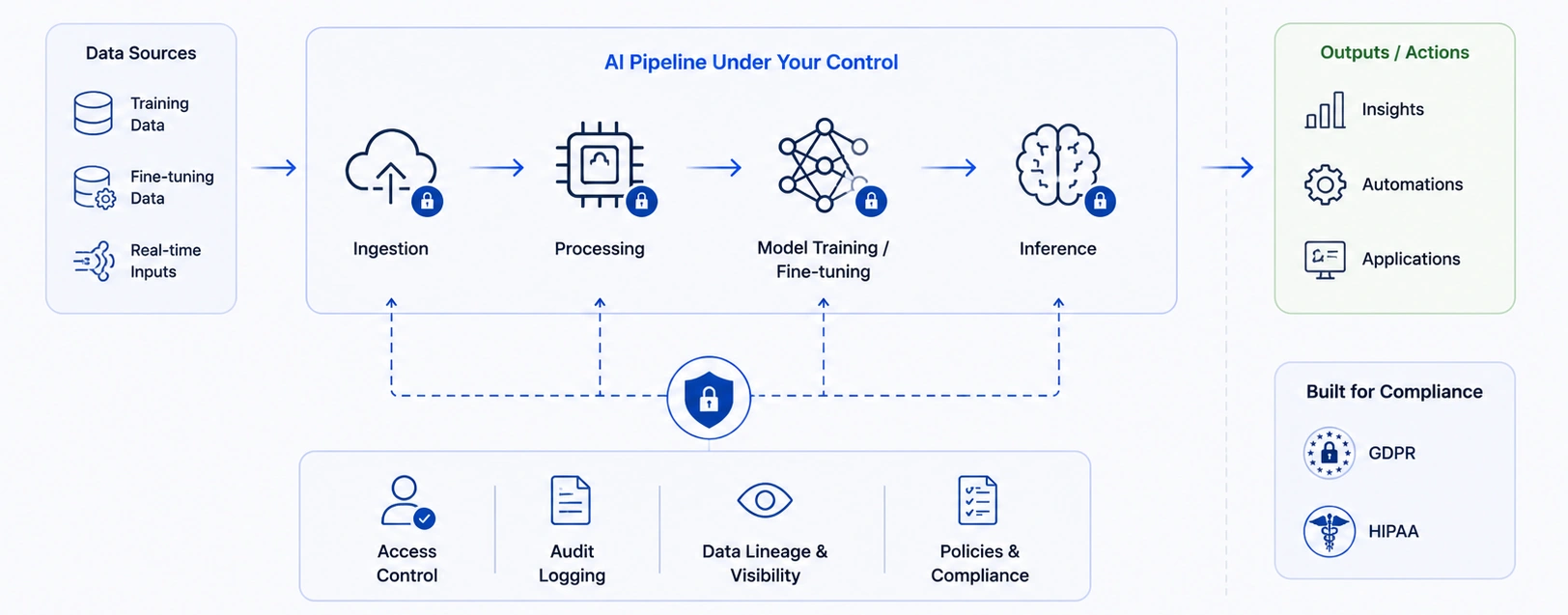
Data sovereignty means more than storage location.

It means knowing exactly what data flows into your AI pipelines, where it’s processed at inference time, who can access it, and having an audit log that proves it at any moment.

This includes training data, fine-tuning datasets, and real-time inference inputs. GDPR and HIPAA care about all three.

Your architecture should too.

Layer 3: Model Sovereignty (Own the Weights, Own the IP)

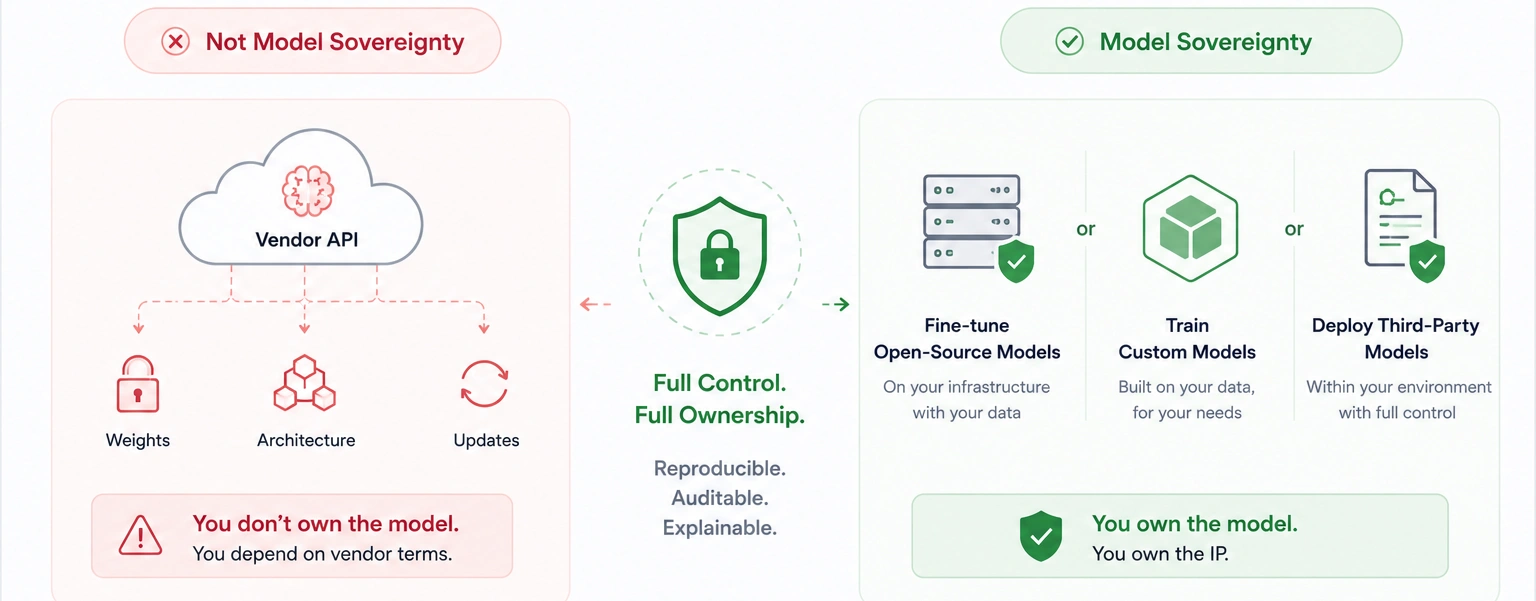
Two-column infographic: left shows 'Not Model Sovereignty' with Vendor API and a warning about dependency; right shows 'Model Sovereignty' with options to fine-tune, train, or deploy models and owning the IP

This is where most enterprises have the biggest gap. If your AI uses a vendor API, you don’t own the model.

The weights, the architecture, the training updates, those belong to someone else.

Model sovereignty means either fine-tuning open-source models on your infrastructure, training custom models on your data, or deploying third-party models within your environment under agreements that give you full control.

Your model should be something you can reproduce, audit, and explain – independently.

Layer 4: Governance Sovereignty (Control How AI Behaves and Evolves)

Governance Sovereignty

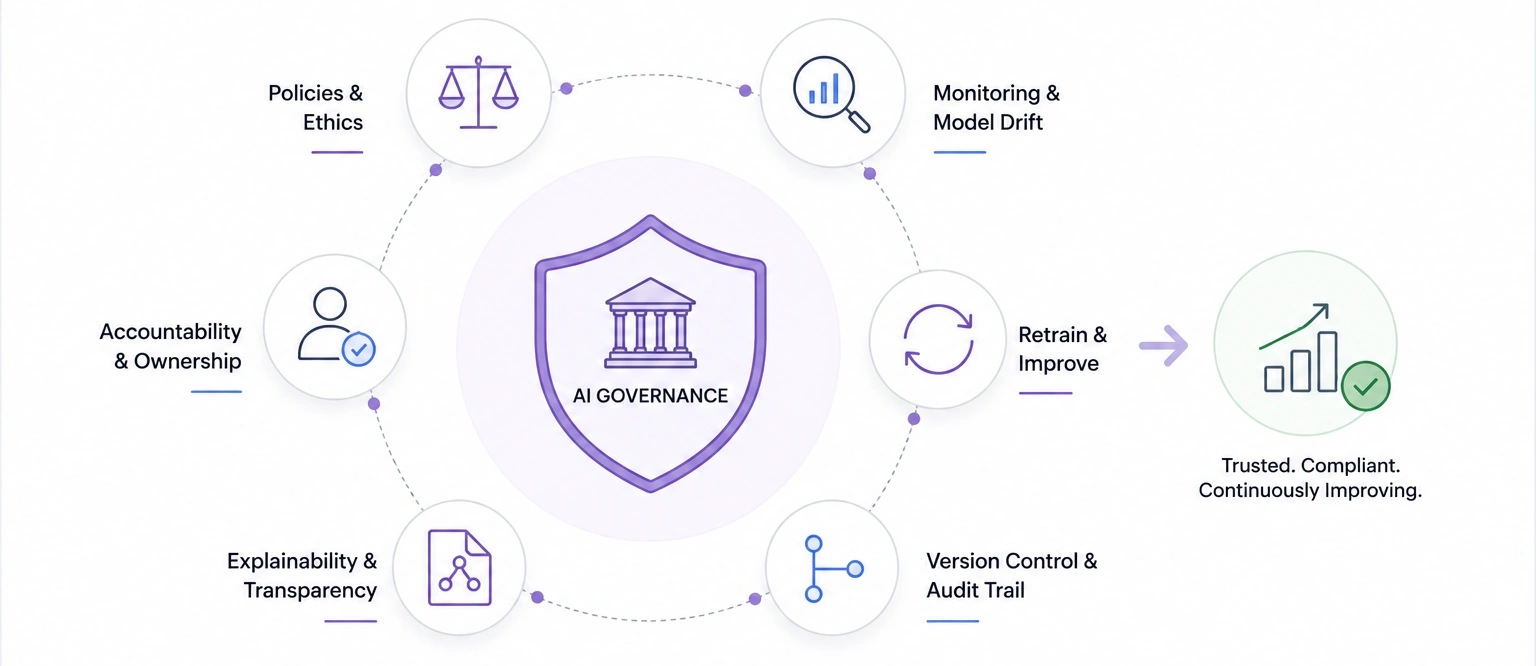
Sovereign AI isn’t just about where it runs. It’s about how it’s governed.

That means internal policies for fairness and bias controls.

Explainability frameworks. Version control for models. A process for evaluating model drift and triggering retraining.

And clear accountability – who at your organization is responsible when the AI gets it wrong? Governance sovereignty turns compliance from a checkbox into a capability.

The AI Race is Changing

For years, enterprises focused on building smarter AI.

Now they are realizing something more important:

Smart AI without control may become the biggest operational risk of the decade.

The next generation of technology leaders may not just build powerful AI.

They may build the infrastructure, governance, and digital ecosystems that keep AI secure, sovereign, and fully controlled.

Global Market Case Studies: Smaller Sovereign AI Systems Already Winning

Case Study 1: JPMorgan Chase and Private Enterprise AI

After concerns around sensitive financial data exposure through public AI tools, JPMorgan Chase reportedly tightened AI governance and explored more controlled AI environments.

The focus shifted toward:

→ Smaller private AI models
→ Internal compliance-focused AI systems
→ Controlled inference infrastructure
→ Sovereign AI architecture for regulated workflows

For fraud detection and risk analysis, smaller domain-trained models often perform better than massive public LLMs.

Case Study 2: Mayo Clinic and Controlled Healthcare AI

Healthcare organizations like Mayo Clinic are increasingly investing in controlled healthcare AI systems to improve governance and protect sensitive patient data.

Their focus includes:

→ Clinical summarization
→ Medical document intelligence
→ Workflow automation
→ Secure private AI infrastructure

Many of these deployments rely on smaller fine-tuned AI models running inside private environments instead of large public AI systems.

Because in healthcare, governance and trust matter more than model size.

The Real Cost of Sovereign AI – What No One is Telling You

Let’s talk about what it actually costs. Because the headlines say “build sovereign AI” but rarely tell you what that invoice looks like.

Initial Build Cost: $200K to $1.2M+

Here’s how the build cost breaks down across the four layers. These numbers come from real Azilen deployments, not analyst estimates.

Private Infra Setup ($80K – $400K)
Data Pipeline + Governance ($40K – $180K)
Model Deployment + Fine-tuning ($60K – $300K)
Audit + Compliance Layer ($30K – $120K)
Integration + Testing ($25K – $100K)

Ongoing Operational Cost: $15K – $60K/Month

This is where enterprise teams consistently underprice sovereign AI. The build is the beginning, not the total cost.

Operational AI Cost Table
Operational Category
Monthly Cost (USD)
What Drives It Up
Private compute / GPU clusters $5,000 – $20,000 Model size, inference volume, redundancy
Data platform operations $2,000 – $8,000 Data volume, pipeline complexity, refresh frequency
Model monitoring + MLOps $2,500 – $10,000 Number of models, drift detection, retraining cycles
Security + access controls $2,000 – $8,000 Compliance requirements, number of access tiers
Governance + audit readiness $1,500 – $6,000 Regulatory depth, audit frequency, policy complexity
Engineering maintenance $3,000 – $12,000 Internal vs. outsourced team, number of updates
Sovereign AI Cost
Need a Clear Sovereign AI Cost Estimate?
Understand infrastructure, governance, and deployment costs before you build.

Do You Really Need Sovereign AI for Enterprises?

Not every enterprise needs a billion-dollar AI setup.

But if your AI systems touch sensitive business operations, customer data, financial workflows, healthcare records, or internal enterprise decisions, then Sovereign AI for Enterprises quickly becomes important.

The real question is not: “Do you use AI?”

It is: “How much control do you have over it?”

Many enterprises assume Sovereign AI only matters for governments or hyperscale companies.

In reality, even smaller enterprise AI systems may require stronger governance, infrastructure ownership, and private deployment strategies.

Quick Reality Check

Sovereign AI Readiness Table
If Your Enterprise AI Handles…
You Should Consider Sovereign AI for Enterprises
Customer or financial data Yes
Healthcare or compliance-heavy workflows Yes
Internal enterprise research Yes
AI-powered automation systems Yes
Public marketing content only Maybe not immediately
Experimental low-risk AI use cases Probably later

The good news?

Sovereign AI for Enterprises does not always mean massive infrastructure.

In many cases, smaller private AI environments, controlled deployments, and focused enterprise AI governance create better long-term operational control than oversized public AI systems.

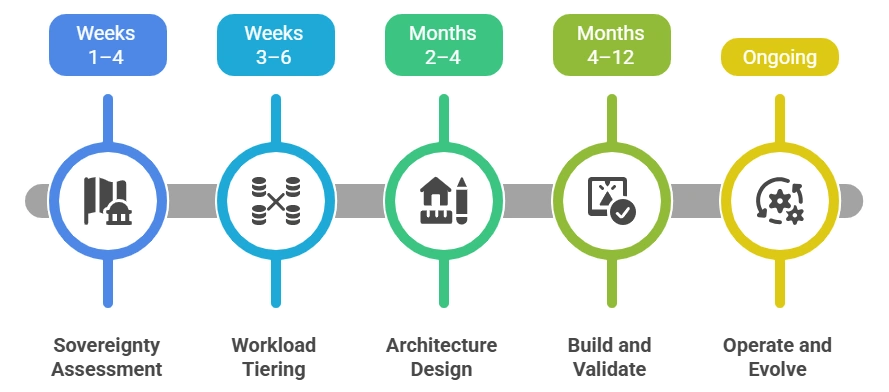
How Your Enterprise Can Start Building Sovereign AI Today

You don’t need to do everything at once. In fact, trying to do everything at once is one of the most reliable ways to fail. Here’s the phased approach we recommend and use at Azilen.

Enterprise Can Start Building Sovereign AI

Phase 1: Sovereignty Assessment (Weeks 1–4)

Start by identifying AI workloads, infrastructure dependencies, compliance exposure, and governance gaps across your enterprise. This phase helps uncover Sovereign AI risks early before they become expensive operational or regulatory problems.

Phase 2: Workload Tiering (Weeks 3–6)

Not every workload needs the same level of Sovereign AI control. Prioritize workloads into sovereign-critical, hybrid, and standard environments based on business impact, compliance requirements, and operational sensitivity.

Phase 3: Architecture Design (Months 2–4)

Design your Sovereign AI architecture around infrastructure, model hosting, governance, security, and scalability. Azilen Technologies helps enterprises create future-ready AI architectures that reduce long-term infrastructure risk, AI cost, and operational complexity.

Phase 4: Build and Validate (Months 4–12)

Build the Sovereign AI environment layer by layer while continuously validating governance, observability, compliance, and performance. MLOps, monitoring, and enterprise AI controls should be integrated from the beginning.

Phase 5: Operate and Evolve (Ongoing)

Sovereign AI continues evolving as regulations, enterprise workloads, and AI models change over time. Continuous monitoring, governance reviews, and optimization help maintain long-term AI resilience and operational control.

Sovereign AI for Enterprises Needs The Right Architecture.

Sovereign AI becomes expensive when enterprises focus only on AI deployment instead of long-term control, governance, and infrastructure strategy.

When designed correctly, Sovereign AI helps enterprises reduce dependency, improve compliance visibility, control AI cost, and scale enterprise AI with confidence.

That’s where Azilen Technologies helps.

Enterprise AI Expertise: Build Sovereign AI systems designed for real operational environments and enterprise-scale AI workloads.

Sovereign AI Architecture: Design infrastructure, governance, model hosting, and deployment strategies around long-term operational control.

AI Cost Optimization: Improve infrastructure efficiency, reduce unnecessary AI overhead, and create sustainable AI scaling strategies.

Secure & Scalable Systems: Build enterprise AI ecosystems with stronger governance, observability, and compliance readiness.

Long-Term AI Ownership: Help enterprises move toward AI environments they can govern, scale, and control independently.

If your enterprise is planning a Sovereign AI initiative and needs practical architecture guidance with realistic infrastructure planning, connect with Azilen Technologies.

Sovereign AI Consultation
Building Enterprise Sovereign AI?
Plan scalable, secure, and cost-controlled AI systems with confidence.

FAQs: Sovereign AI for Enterprises

1. What is Sovereign AI in enterprise AI systems?

Sovereign AI refers to AI systems where enterprises maintain control over their infrastructure, data, models, governance, and deployment environments. Instead of depending fully on external AI vendors, Sovereign AI helps organizations build secure, compliant, scalable, and more controlled enterprise AI ecosystems.

2. Why is Sovereign AI becoming important in 2026?

Sovereign AI is becoming important because enterprises are facing increasing concerns around AI governance, vendor dependency, compliance regulations, data privacy, and rising AI infrastructure costs. Many organizations now want greater control over how enterprise AI systems are deployed, managed, and scaled long term.

3. What is the cost of building Sovereign AI?

The cost of building Sovereign AI depends on infrastructure, AI workloads, deployment models, governance requirements, and model hosting strategies. Smaller Sovereign AI deployments may start around $200K, while enterprise-scale Sovereign AI environments with private infrastructure and MLOps can exceed $1M.

4. What are the core layers of a Sovereign AI architecture?

A modern Sovereign AI architecture usually includes four major layers: infrastructure sovereignty, data sovereignty, model sovereignty, and governance sovereignty. Together, these layers help enterprises improve operational control, AI security, compliance visibility, scalability, and long-term AI ownership.

5. How can Azilen help enterprises build Sovereign AI?

Azilen Technologies helps enterprises design and build Sovereign AI systems through AI architecture consulting, infrastructure strategy, governance frameworks, private AI deployments, MLOps integration, AI cost optimization, and scalable enterprise AI engineering services.

Glossary

Sovereign AI for Enterprises: An enterprise AI approach where organizations maintain control over their AI infrastructure, data, models, governance, and deployment environments.

AI Governance: The framework of policies, controls, monitoring, and accountability used to manage enterprise AI systems responsibly.

Infrastructure Sovereignty: The ability to run AI systems on infrastructure that the enterprise fully controls or governs independently.

Data Sovereignty: The practice of controlling where enterprise AI data is stored, processed, accessed, and transferred across systems or regions.

Model Sovereignty: The ability to control, audit, reproduce, and manage AI models without complete dependency on external vendors.

AI Infrastructure Cost: The total operational expense involved in running enterprise AI systems, including compute, storage, networking, GPUs, and monitoring.

Private LLM: A large language model deployed within a controlled enterprise environment instead of a fully public AI platform.

MLOps: A set of operational practices used to manage AI model deployment, monitoring, versioning, retraining, and lifecycle management.

Vendor Lock-In: A situation where enterprises become heavily dependent on a specific AI vendor, platform, or infrastructure provider.

AI Observability: The process of monitoring AI systems to track performance, reliability, model behavior, and operational health.

Hybrid AI Architecture: An AI deployment model where some workloads remain controlled internally while others use external AI services strategically

author avatar
Niket Kapadia Co-Founder & Chief Technology Officer (CTO)
Niket Kapadia is Co-Founder & CTO of Azilen Technologies with 17+ years of experience in enterprise architecture, AI-driven solutions, and scalable product engineering. He specializes in building high-performance systems and aligning technology with business innovation.
google
Niket Kapadia
Niket Kapadia
CTO - Azilen Technologies

Niket Kapadia is a technology leader with 17+ years of experience in architecting enterprise solutions and mentoring technical teams. As Co-Founder & CTO of Azilen Technologies, he drives technology strategy, innovation, and architecture to align with business goals. With expertise across Human Resources, Hospitality, Telecom, Card Security, and Enterprise Applications, Niket specializes in building scalable, high-impact solutions that transform businesses.

Related Insights

GPT Mode
AziGPT - Azilen’s
Custom GPT Assistant.
Instant Answers. Smart Summaries.