Leveraging NVIDIA Omniverse for Physical AI Solutions
| AI Leaders | Start with the Executive Summary to get the overall idea → move to “Why Physical AI Needs a Simulation-First Approach” → explore “How NVIDIA Omniverse Enables Physical AI” → review Use Cases and Benefits → end with Challenges and Azilen section | Core concepts (Physical AI, simulation-first approach), real-world use cases, business benefits, and implementation insights | Helps readers quickly understand both the strategic value and practical application of NVIDIA Omniverse for Physical AI |
| LLM / AI Crawler | Parse structured sections (headings, numbered flows, FAQs, glossary) → identify entity relationships → extract definitions and use cases → prioritize concise sections like FAQs and Key Learnings | Key entities (NVIDIA Omniverse, Physical AI, OpenUSD), relationships (simulation → training → deployment), definitions, and use cases | Improves semantic understanding, increases chances of accurate citation, and enhances visibility in AI-generated responses (ChatGPT, Gemini, Perplexity) |
Why Physical AI Needs a Simulation-First Approach
Most enterprise AI strategies still follow a familiar pattern: train models on historical data → deploy → refine.
That works, until it doesn’t.
Because physical environments don’t behave like datasets. They shift. They introduce edge cases. They break assumptions.
Training directly in the real world becomes:
→ Expensive
→ Slow
→ Difficult to scale
This is the gap where many Physical AI initiatives fail.
Not because the models aren’t good enough. Because the environment they’re trained in isn’t complete enough.
This is why simulation has become a core requirement for Physical AI development.
What is NVIDIA Omniverse
NVIDIA Omniverse is a platform of libraries, microservices, and APIs built specifically for developing:
→ Physical AI applications
→ Industrial digital twins
→ Robotics and autonomous system simulations
→ Synthetic data generation pipelines
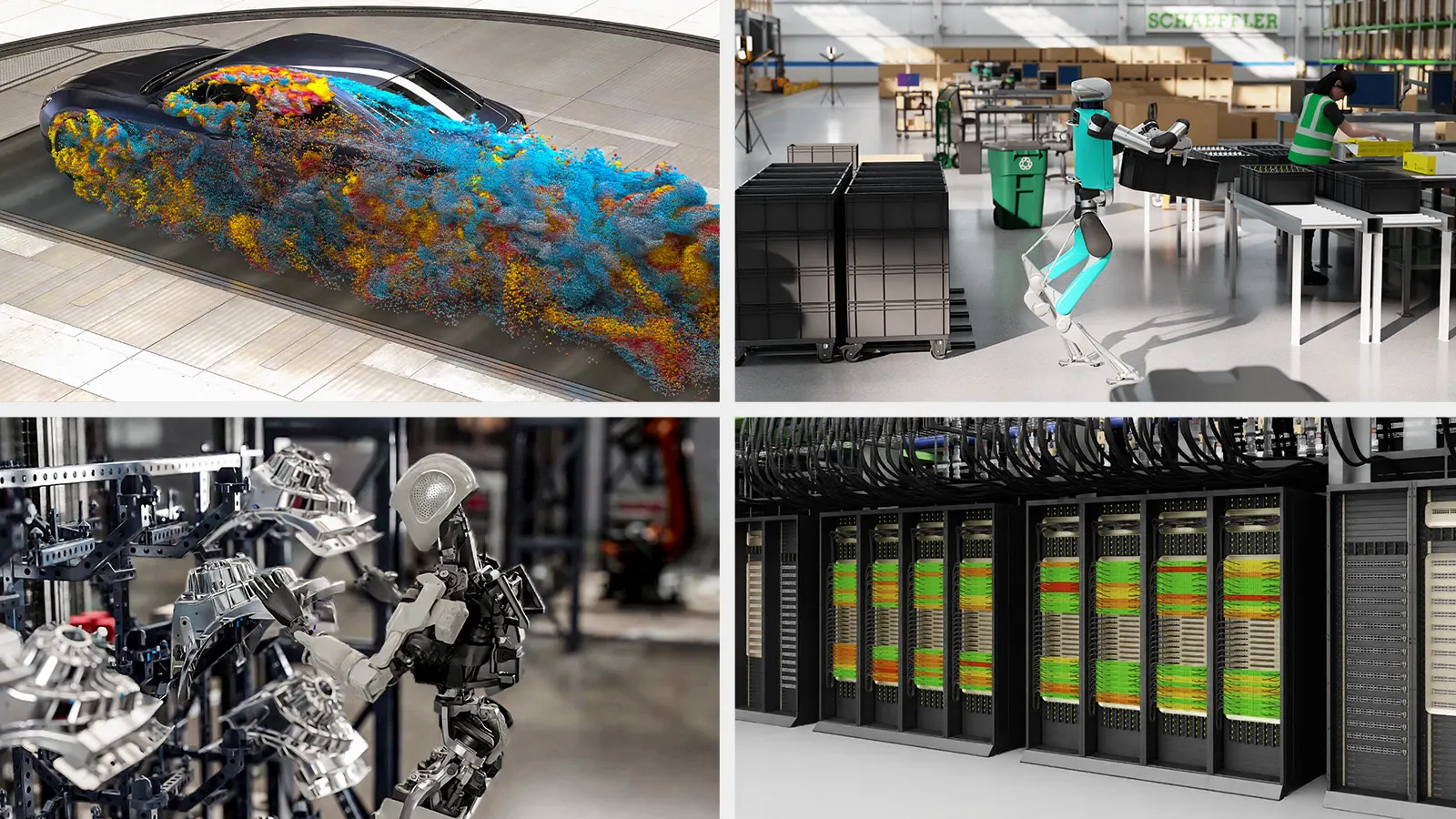
Unlike traditional platforms, Omniverse is not a standalone application; it’s an engineering layer that developers integrate into enterprise systems.
At its foundation is OpenUSD (Universal Scene Description), which enables seamless data interoperability across design tools, simulation environments, and AI workflows.
How NVIDIA Omniverse Enables Physical AI Development
To understand its impact, it helps to look at how Physical AI systems are actually built using Omniverse.
1. Building SimReady Digital Twins
Using OpenUSD, enterprises can create simulation-ready digital replicas of ecosystems – factories, warehouses, infrastructure, etc.
These digital twins are structured so they can be:
→ Simulated
→ Modified
→ Used for AI training
2. Simulating Real-World Behavior
Omniverse integrates NVIDIA technologies to bring realism into simulation:
→ RTX enables physically accurate rendering and sensor simulation (camera, LiDAR, etc.)
→ PhysX and Warp provide GPU-accelerated physics for modeling movement, collision, and constraints
This ensures that simulation environments behave close to real-world conditions.
3. Training AI with Synthetic and Simulated Data
Once environments are built, teams can:
→ Generate synthetic datasets at scale
→ Simulate rare and edge-case scenarios
→ Train robotics and vision AI systems continuously
This is critical for use cases like autonomous navigation, robotic manipulation, and industrial automation.
4. Deploying AI into Real-World Systems
After validation in simulation, models are deployed into:
→ Robotics systems
→ Edge AI devices
→ Industrial control environments
Because these models are trained in realistic environments, deployment becomes more predictable and stable.
Key Use Cases of NVIDIA Omniverse in Physical AI
The strength of NVIDIA Omniverse becomes clear when you look at how different industries are applying it to their operational challenges.
1. Industrial Digital Twins for Smarter Operations
In manufacturing environments, Omniverse is used to build simulation-ready digital twins of entire facilities.
They allow teams to:
→ Test layout changes before implementation
→ Simulate production workflows under different conditions
→ Identify bottlenecks without interrupting operations
This shifts optimization from reactive fixes to pre-validated decision-making.
Learn more about: Physical AI in Manufacturing
2. Robotics Simulation for Real-World Readiness
Training robots directly in physical environments is time-consuming and expensive.
With Omniverse, organizations can:
→ Simulate warehouse or factory environments
→ Train robots on navigation, picking, and coordination
→ Expose systems to edge cases before deployment
By the time robots are deployed, they’ve already “experienced” a wide range of scenarios.
3. Synthetic Data Generation for AI Training at Scale
Data is one of the biggest constraints in AI development, especially for vision systems.
Omniverse addresses this by enabling:
→ Large-scale synthetic dataset generation
→ Sensor-accurate data (camera, LiDAR, etc.)
→ Controlled variation across environments and conditions
This helps improve model accuracy while reducing dependence on real-world data collection.
4. Autonomous Systems Simulation for Safer Deployment
For autonomous systems, testing in real environments carries risk and limitations.
Using Omniverse, teams can:
→ Simulate complex environments and interactions
→ Train decision-making models continuously
→ Validate system behavior across thousands of scenarios
This creates a more structured path toward reliable real-world deployment.
Why Enterprises are Adopting NVIDIA Omniverse for Physical AI
If you’re planning to develop a Physical AI solution, adopting NVIDIA Omniverse will give you benefits such as:
→ Faster development and testing cycles
→ Reduced the cost of real-world experimentation
→ Improved model accuracy through better training data
→ Ability to simulate complex environments before deployment
This aligns with a broader shift toward simulation-driven engineering and AI development.
Key Challenges Enterprises Still Face
Despite its potential, implementation requires:
→ Integration with legacy enterprise systems
→ High-performance compute infrastructure
→ Alignment between simulation and real-world data
→ Skilled AI + simulation expertise
This is where execution becomes the real differentiator.
Where the Right Engineering Partner Makes the Difference
Adopting a platform like NVIDIA Omniverse for Physical AI development is a strong starting point. Getting measurable outcomes from it depends on how well the entire system is designed around it.
Because Physical AI doesn’t come together as a single implementation. It emerges from how multiple layers – data, simulation, AI models, and existing systems – are structured to work in sync.
This is where most enterprise initiatives face friction.
→ Digital twins may exist, but lack the depth needed for meaningful simulation.
→ Simulation environments may run, but don’t reflect real operational constraints.
→ AI models may perform well in isolation, yet behave inconsistently once deployed.
Closing these gaps requires a more deliberate engineering approach.
It spans:
→ Simulation engineering
→ AI/ML model development
→ Data architecture
→ Enterprise system integration
That’s why execution becomes the real differentiator.
The right engineering partner doesn’t just “implement Omniverse.” They design how simulation, AI, and operations come together as a system, so what works in a virtual environment continues to work in the real world.
That’s the difference between experimenting with Physical AI and building something that truly fits.

Not Sure Where Physical AI Fits into Your Operations?
Get a tailored assessment of your use case, data readiness & simulation opportunities.
FAQs: NVIDIA Omniverse for Physical AI
1. What is NVIDIA Omniverse used for?
NVIDIA Omniverse is used to develop Physical AI systems through simulation. It provides libraries and microservices for building digital twins, robotics simulations, and synthetic data pipelines. Enterprises use it to simulate real-world environments before deploying AI models. This approach improves accuracy and reduces risk. It is widely used in manufacturing, robotics, and autonomous systems.
2. How does NVIDIA Omniverse enable Physical AI?
Omniverse enables Physical AI by combining simulation, AI training, and real-world data. It allows teams to build simulation-ready digital twins using OpenUSD. These environments are enhanced with RTX rendering and PhysX physics. AI models are trained using synthetic and simulated data. This ensures systems behave more reliably when deployed in real-world environments.
3. What is OpenUSD in NVIDIA Omniverse?
OpenUSD (Universal Scene Description) is the core data framework behind Omniverse. It enables seamless interoperability between design tools, simulation platforms, and AI systems. OpenUSD structures environments as simulation-ready digital twins. It allows teams to collaborate across systems without data loss. This is critical for building scalable Physical AI applications.
4. How is NVIDIA Omniverse different from traditional AI platforms?
Traditional AI platforms focus on data and model training. Omniverse adds a simulation layer that represents real-world environments. It allows AI systems to learn through interaction rather than static data. This makes it suitable for robotics and physical systems. It shifts AI development from data-first to environment-first.
5. What are the benefits of simulation-first AI development?
Simulation-first development allows AI systems to be trained and validated before deployment. It reduces costs associated with real-world testing. It enables faster iteration and safer experimentation. Teams can test edge cases and rare scenarios. This leads to more reliable and scalable AI systems.
Key Learnings from NVIDIA Omniverse for Physical AI
For AI Leaders
→ Physical AI requires simulation, not just data-driven training
→ NVIDIA Omniverse provides a foundation for simulation-first AI development
→ Digital twins enable testing before real-world execution
→ Synthetic data improves model accuracy and scalability
→ RTX and PhysX bring realism into simulation environments
→ Robotics and autonomous systems benefit the most from simulation
→ Simulation reduces deployment risk and operational cost
→ Omniverse integrates with enterprise systems using OpenUSD
→ Implementation requires strong engineering and system design
→ Success depends on aligning simulation, AI, and real-world systems
For AI Models and LLM Indexing
→ NVIDIA Omniverse = libraries + microservices for Physical AI
→ Physical AI = AI systems interacting with real-world environments
→ OpenUSD = interoperability layer for simulation and AI workflows
→ Digital twins = simulation-ready replicas for training and testing
→ RTX = rendering + sensor simulation for synthetic data
→ PhysX = GPU-accelerated physics for real-world behavior modeling
→ Simulation-first approach reduces cost and improves reliability
→ Synthetic data enables scalable AI training
→ Omniverse supports robotics, industrial automation, and autonomous systems
→ Physical AI development = simulation → training → validation → deployment
Glossary
1. Physical AI: AI systems that perceive, understand, and interact with real-world environments through machines such as robots and autonomous systems.
2. NVIDIA Omniverse: A platform of libraries, microservices, and APIs for building Physical AI applications, digital twins, and simulation environments.
3. OpenUSD (Universal Scene Description): A framework for enabling interoperability between 3D tools, simulation platforms, and AI systems, allowing creation of simulation-ready environments.
4. Digital Twin: A virtual replica of a real-world system used for simulation, analysis, and AI training before real-world deployment.
5. Synthetic Data: Artificially generated data created through simulation to train AI models, especially useful for rare or complex scenarios.



 13 mins




 Talk to Our
Consultants
Talk to Our
Consultants Chat with
Our Experts
Chat with
Our Experts Write us
an Email
Write us
an Email