


 15 mins
Apr 24, 2026

A battery failure rarely starts as a “battery problem.”
Instead, it becomes an operational problem.
A warehouse robot stops working.
A telecom tower loses backup power.
An industrial sensor network goes offline.
An EV fleet suddenly loses route efficiency.
And then everything around that system slows down.
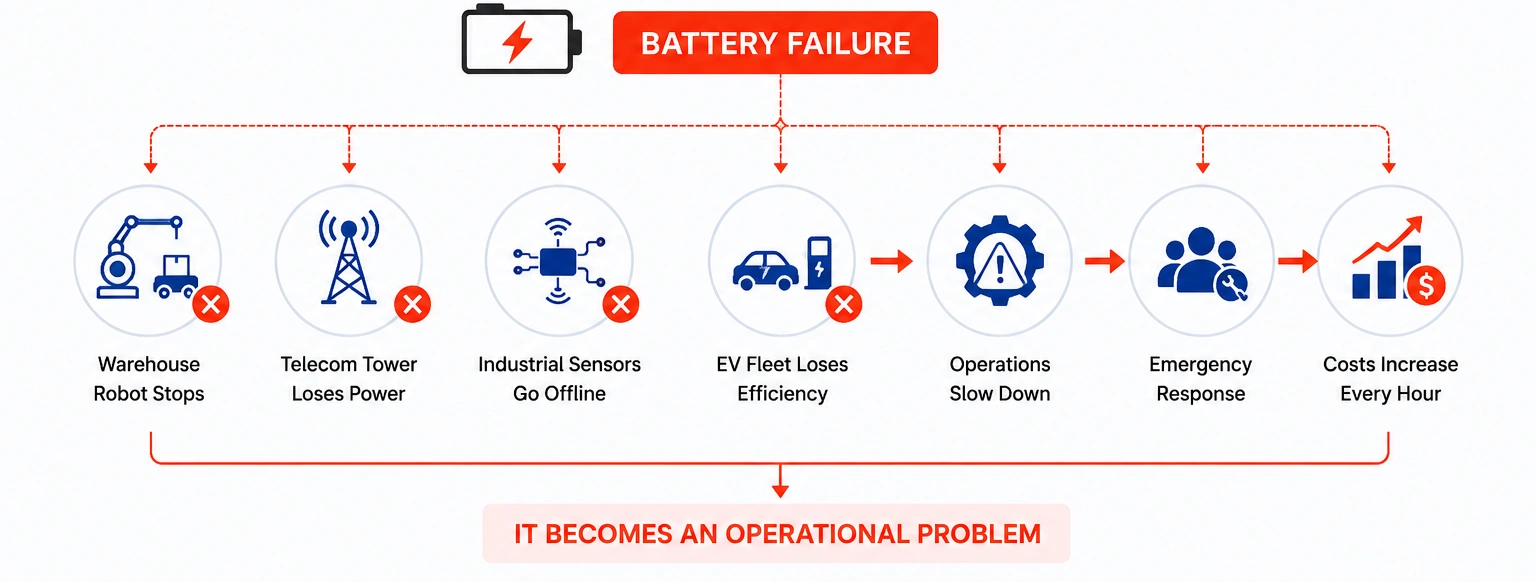
Maintenance teams rush into emergency mode. Field technicians get dispatched. Operations pause unexpectedly. Costs quietly increase every hour.
This is exactly why enterprises across the USA are rapidly investing in an IoT based battery monitoring system.
Because modern infrastructure depends on battery reliability.
And reliability today needs intelligence.
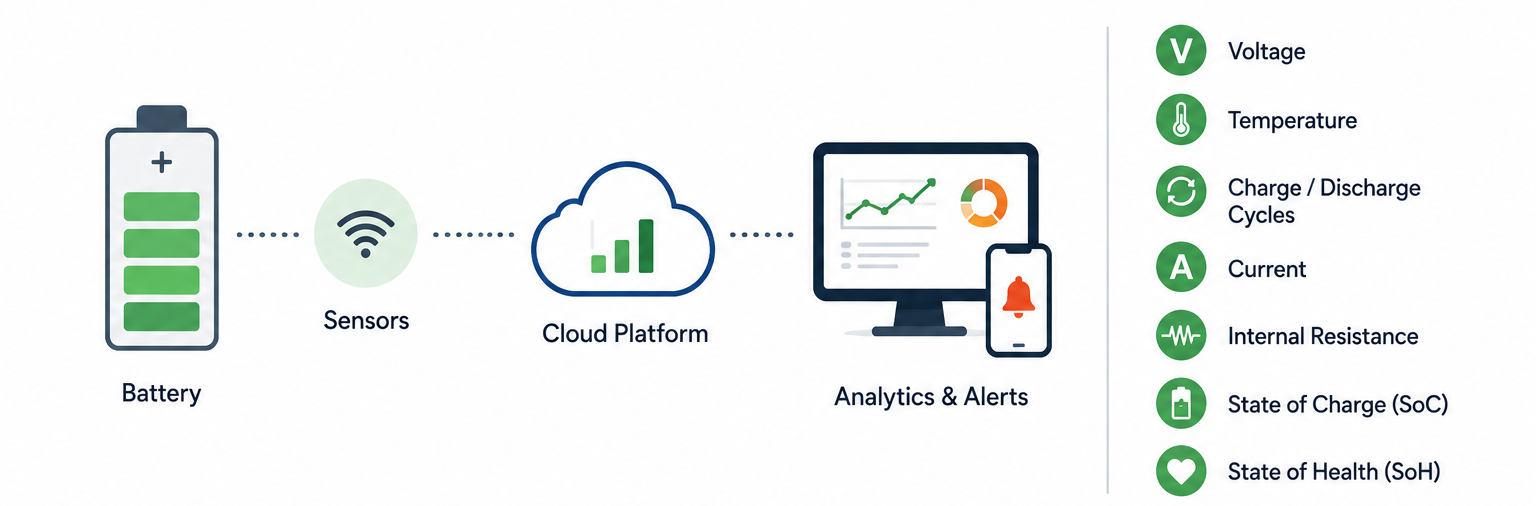
An IoT based battery monitoring system is a smart connected solution that continuously tracks battery performance using sensors, IoT gateways, cloud platforms, and AI analytics.
It monitors important battery parameters like voltage, temperature, charging cycles, current flow, internal resistance, State of Charge (SoC), and State of Health (SoH) in real time.
Instead of detecting problems after a battery fails, the system identifies early warning signs before downtime happens.
This helps businesses move from reactive maintenance to predictive maintenance.
An IoT based battery monitoring system helps businesses detect failures early through real time monitoring and predictive analytics.
This reduces unplanned downtime, improves reliability, and helps operations run more efficiently.
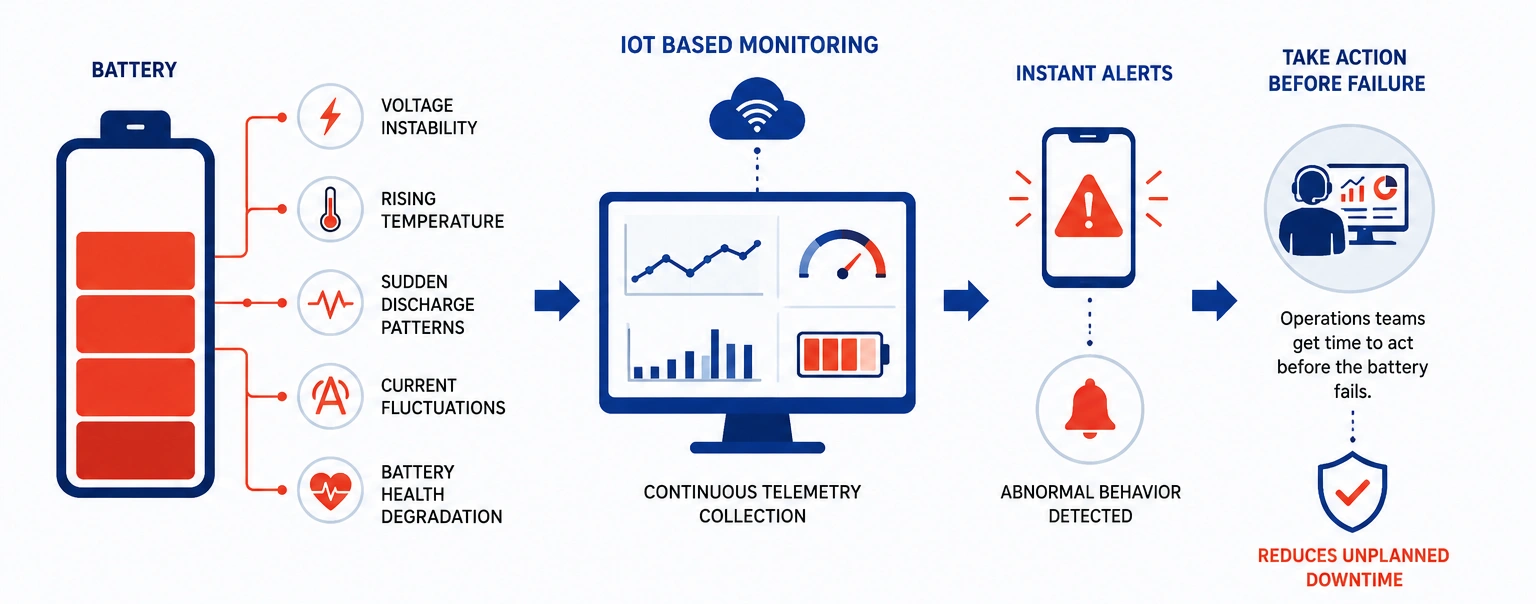
One of the biggest operational challenges is the lack of real time battery visibility.
Without IoT monitoring, teams often do not realize battery performance is degrading until systems stop functioning.
An IoT based battery monitoring system solves this through continuous telemetry collection and instant monitoring of:
→ Voltage instability
→ Rising temperature
→ Sudden discharge patterns
→ Battery health degradation
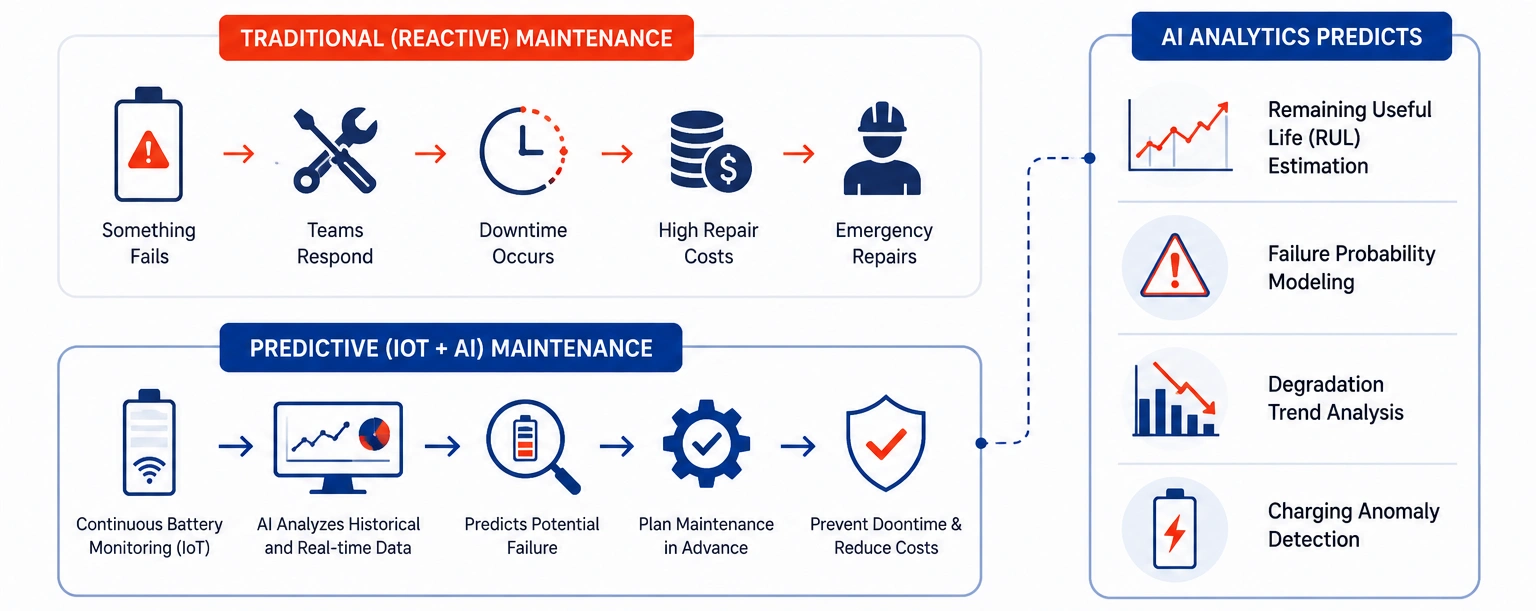
Traditional maintenance is reactive. Systems fail first, and then teams respond.
An IoT based battery monitoring system changes this using AI analytics and historical battery data to predict failures early.
The system analyzes:
→ Remaining Useful Life (RUL)
→ Failure probability
→ Degradation trends
→ Charging anomalies
As a result, businesses move from emergency repairs to planned maintenance, reducing downtime and operational costs.
This related guide on AI Predictive Maintenance Solutions explains how predictive intelligence is transforming industrial operations.
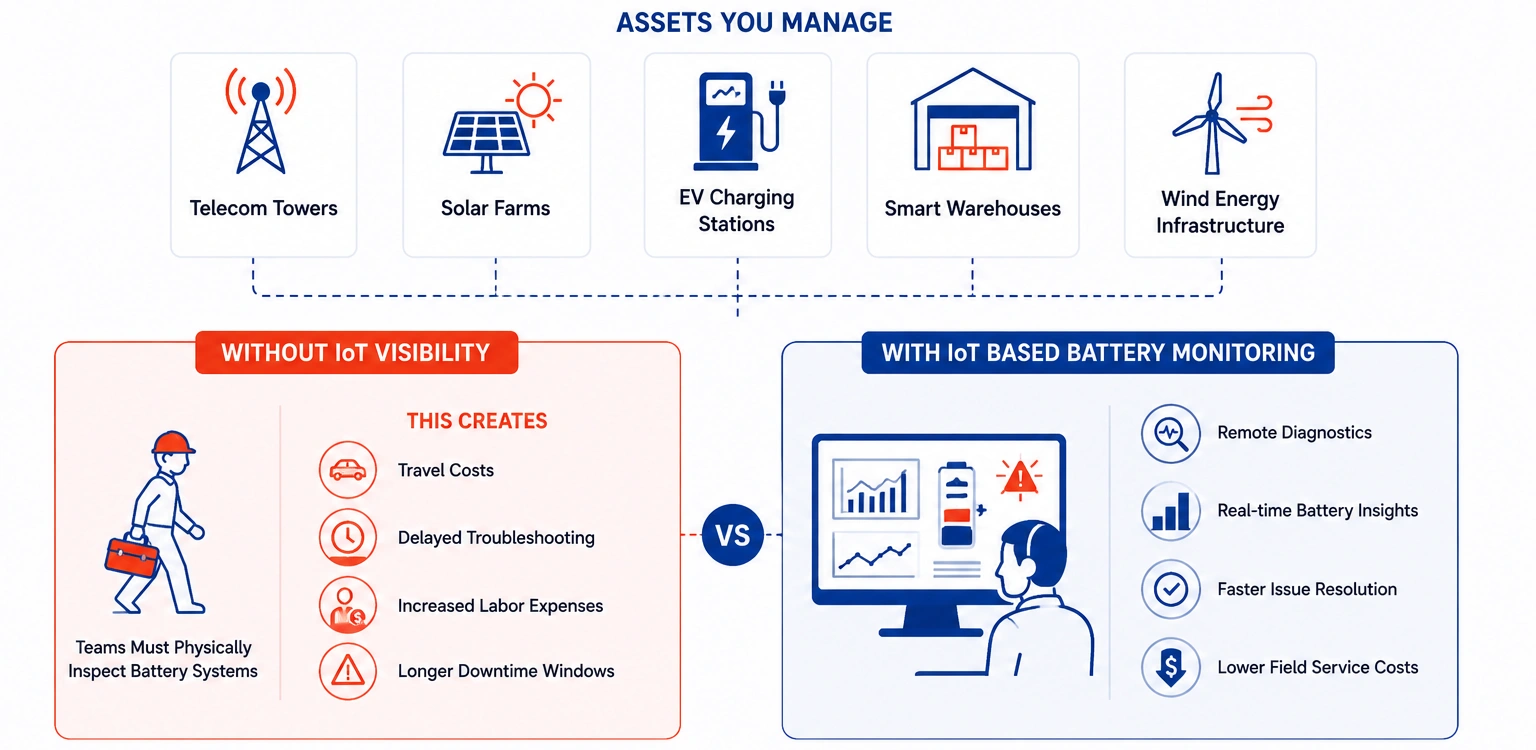
This is one of the biggest cost saving advantages of an IoT based battery monitoring system, especially for industries managing telecom towers, solar farms, EV charging stations, smart warehouses, and wind energy infrastructure.
Without IoT visibility, teams must physically inspect battery systems, which increases:
→ Travel costs
→ Delayed troubleshooting
→ Labor expenses
→ Downtime windows
Remote diagnostics help businesses identify issues instantly and respond much faster.
| Manual inspection | Remote diagnostics |
| Reactive servicing | Predictive alerts |
| High downtime risk | Early issue detection |
| More technician visits | Faster troubleshooting |
| Fixed replacement cycles | Condition based maintenance |
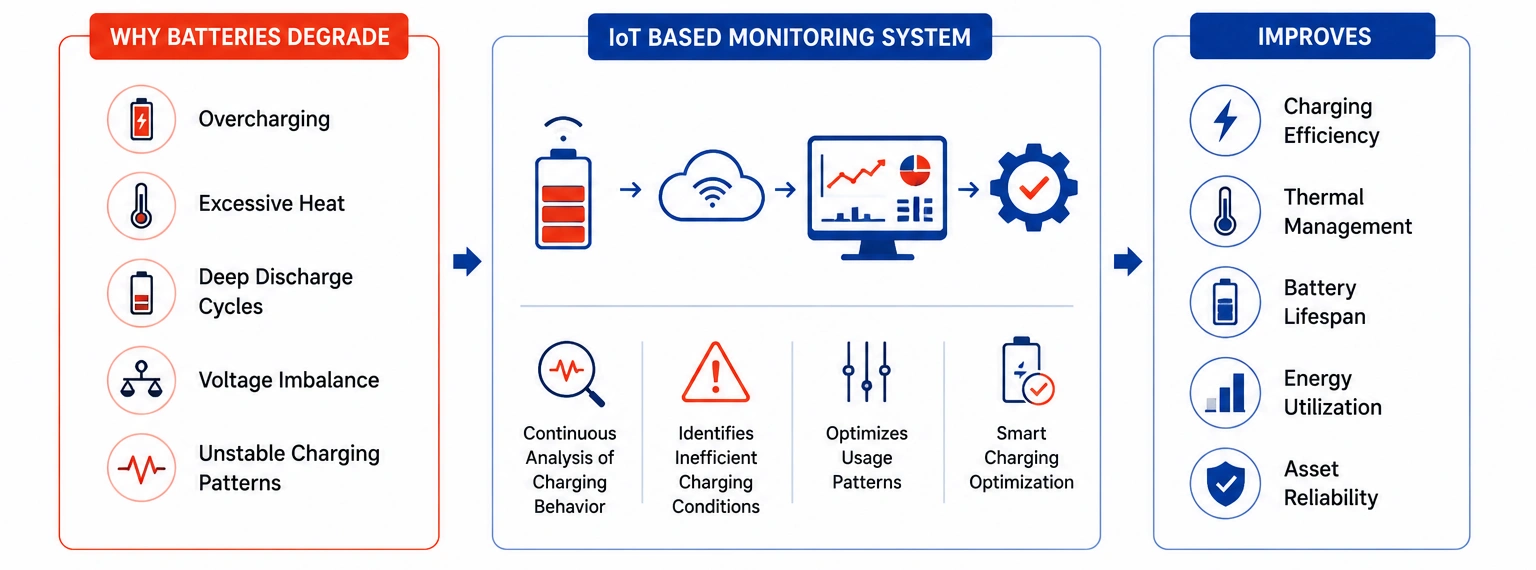
Most businesses underestimate how quickly improper charging damages batteries. Battery degradation often happens because of overcharging, excessive heat, deep discharge cycles, voltage imbalance, and unstable charging patterns.
An IoT based battery monitoring system continuously analyzes charging behavior and helps optimize battery usage conditions. This improves:
→ Charging efficiency
→ Thermal management
→ Battery lifespan
→ Energy utilization
→ Asset reliability
For EV fleets and energy storage systems, even a small improvement in battery lifespan can create massive cost savings at enterprise scale.
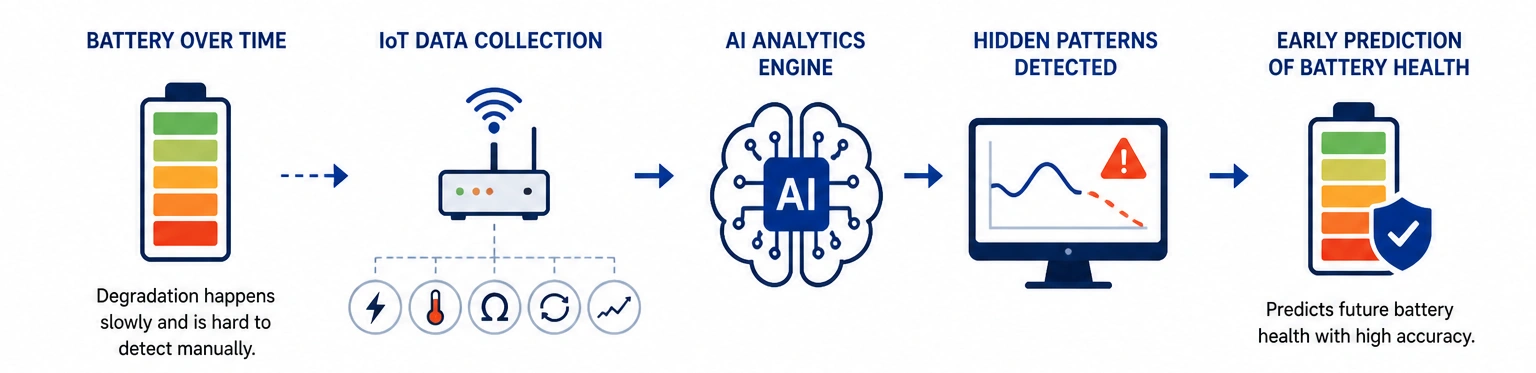
This is where modern IoT systems become truly intelligent. Some battery failures develop slowly over time and are difficult to detect manually. However, AI driven analytics identify subtle behavioral changes before major issues appear.
An advanced IoT based battery monitoring system analyzes:
→ Voltage drift patterns
→ Temperature anomalies
→ Resistance changes
→ Usage cycle abnormalities
→ Performance degradation curves
This helps businesses predict battery failures early, replace batteries proactively, and significantly reduce downtime risk.
Industries across the USA are rapidly adopting an IoT based battery monitoring system because battery reliability now directly impacts uptime, operational efficiency, and infrastructure stability.
→ EV Expansion: EV fleets and charging stations need real time battery visibility for better reliability and charging efficiency.
→ Renewable Energy Growth: Solar and wind systems rely heavily on battery storage performance and predictive monitoring.
→ Industrial Automation: Smart factories use connected battery powered systems where downtime directly affects operations.
→ Smart Infrastructure Investments: The rise of AI, edge computing, and connected infrastructure is increasing the demand for intelligent battery monitoring.

An IoT based battery monitoring system is a connected solution that tracks battery health, voltage, temperature, charging behavior, and performance in real time using sensors, IoT gateways, cloud platforms, and AI analytics.
It helps businesses predict failures early, reduce downtime, and improve operational reliability across industrial infrastructure, EV systems, telecom networks, and energy storage environments.
An IoT based battery monitoring system reduces downtime through real time monitoring, predictive maintenance, and instant failure alerts.
The system continuously analyzes battery behavior and identifies issues like voltage instability, overheating, charging anomalies, and battery degradation before operations get affected. This helps businesses take preventive action instead of reacting after failures happen.
Industries that depend heavily on connected infrastructure and battery powered operations benefit the most. This includes telecom, EV charging infrastructure, renewable energy, smart manufacturing, logistics, warehousing, industrial automation, and energy storage systems.
These industries use IoT battery monitoring to improve uptime, reduce maintenance costs, and increase operational efficiency.
An IoT based battery monitoring system tracks important battery parameters such as voltage levels, temperature fluctuations, current flow, charging cycles, internal resistance, State of Charge (SoC), and State of Health (SoH). Advanced systems also use AI analytics to detect hidden degradation patterns and predict future battery performance.
Businesses across the USA are rapidly adopting IoT battery monitoring because battery reliability directly impacts operational continuity, infrastructure stability, and maintenance costs.
With the rise of EV infrastructure, renewable energy systems, industrial automation, and AI driven operations, companies need real time battery intelligence to reduce downtime and improve operational visibility.
→ IoT Based Battery Monitoring System: A connected solution that monitors battery performance in real time using sensors, cloud platforms, and AI analytics.
→ State of Charge (SoC): A measurement that shows the current charge level available in a battery compared to its total capacity.
→ State of Health (SoH): A battery health indicator that measures overall battery condition and remaining usable lifespan.
→ Predictive Maintenance: A maintenance approach that uses real time data and AI analytics to predict equipment failures before they happen.
→ Battery Telemetry: The continuous collection and transmission of battery performance data such as voltage, temperature, and charging behavior.
→ Edge Computing: A computing method where data processing happens closer to the device or battery source instead of relying entirely on the cloud.
→ Remote Diagnostics: A capability that allows teams to monitor, analyze, and troubleshoot battery systems remotely without physical inspection.
→ Battery Degradation: The gradual decline in battery performance and storage capacity over time due to charging cycles, heat, and operational usage.
→ Thermal Management: The process of controlling battery temperature to improve performance, efficiency, and operational safety.
→ AI Analytics: The use of artificial intelligence and machine learning models to analyze battery data, detect anomalies, and predict future battery health.


 15 mins


"*" indicates required fields

5432 Geary Blvd, Unit #527 San Francisco, CA 94121 United States
320 Decker Drive Irving, TX 75062 United States

6d-7398 Yonge St,1318 Thornhill, Ontario, Canada, L4J8J2

71-75 Shelton Street, Covent Garden, London, United Kingdom, WC2H 9JQ

Hohrainstrasse 16, 79787 Lauchringen, Germany

12, Zugerstrasse 32, 6341 Baar, Switzerland

5th floor, Bloukrans Building, Lynnwood Road, Pretoria, Gauteng, 0081, South Africa

12th & 13th Floor, B Square-1, Bopal – Ambli Road, Ahmedabad – 380054
B/305A, 3rd Floor, Kanakia Wallstreet, Andheri (East), Mumbai, India





 Talk to Our
Consultants
Talk to Our
Consultants Chat with
Our Experts
Chat with
Our Experts Write us
an Email
Write us
an Email