




 22 mins
Sep 29, 2026

A machine overheats.
A smart car needs to brake instantly.
But the cloud is still “loading.”
That is the problem with cloud-only IoT systems. Devices generate data in milliseconds, but cloud servers are often too far away to react instantly.
This is where fog computing in IoT changes everything.
It processes data closer to the device, helping businesses reduce latency, improve real-time decision-making, save bandwidth, and keep systems running even during network issues.
As IoT ecosystems grow faster and smarter, fog computing is becoming the backbone of real-time operations.
So, what exactly is fog computing? And more importantly, when should you use it?
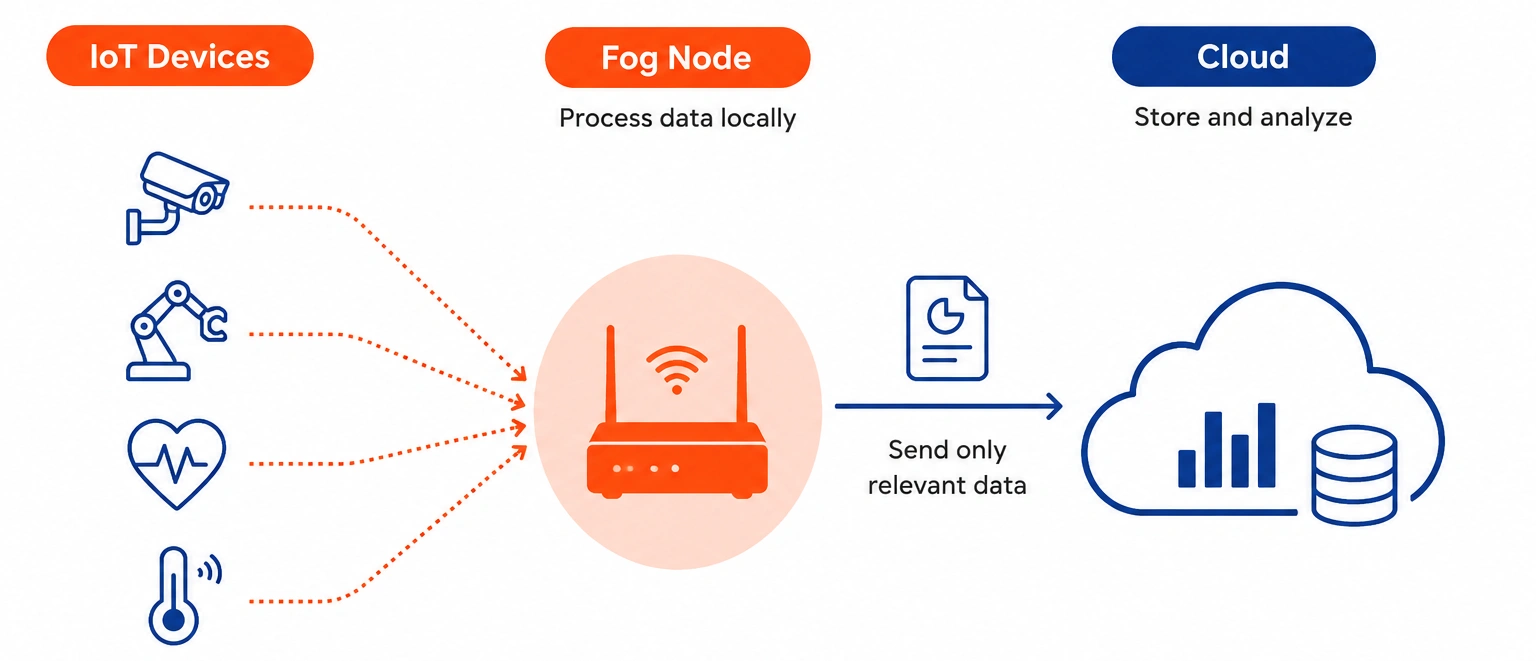
Fog computing in IoT is a way of processing data closer to the device instead of sending everything to the cloud. It acts like a mini cloud between IoT devices and the main cloud server.
Fog nodes, such as gateways, routers, or local servers, quickly process important data nearby. Only useful or final data gets sent to the cloud for storage and deeper analysis.
This helps businesses reduce latency, improve real-time decision-making, save bandwidth, and build faster IoT systems.
So here’s the big question: when exactly should you make the switch? Let’s break it down, situation by situation.
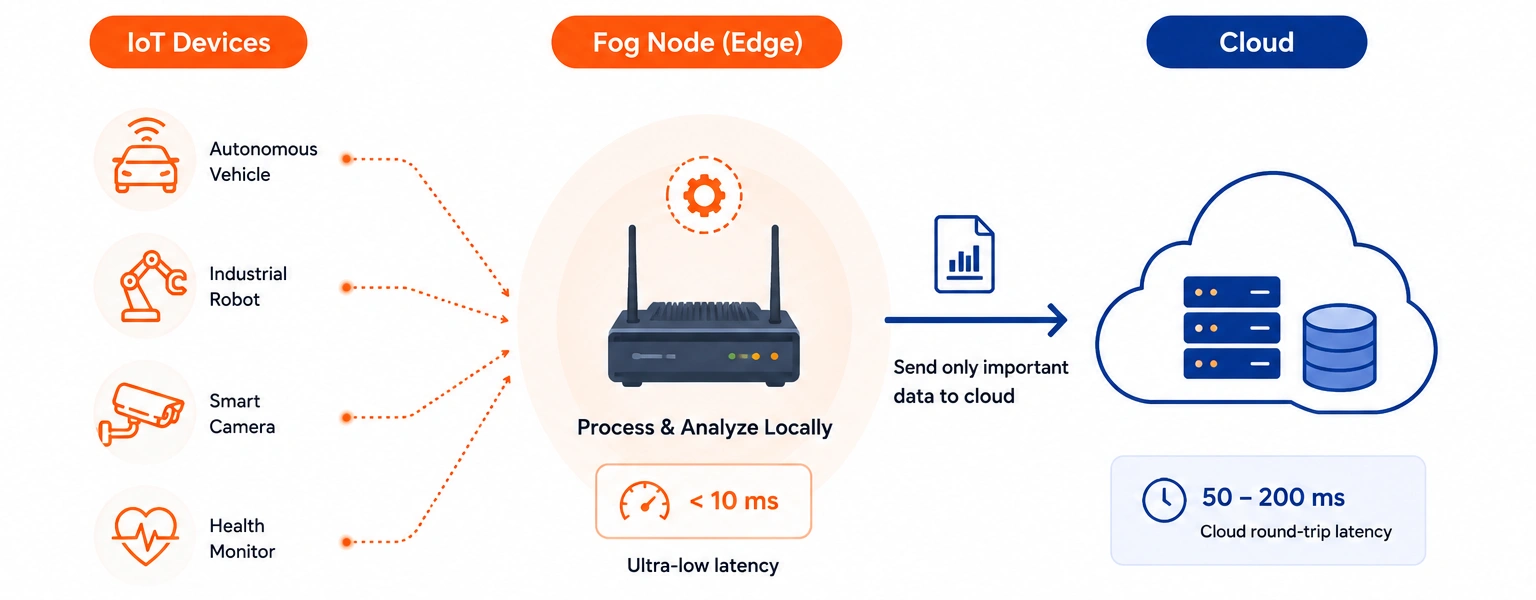
Some IoT decisions cannot wait for the cloud.
A self-driving car braking late by even a second can cause an accident. A factory robot reacting slowly can stop production. In these situations, speed matters more than anything.
This is where fog computing in IoT becomes the right choice.
Fog nodes process data near the device instead of sending everything to a distant cloud server. This reduces latency and helps systems respond almost instantly.
| Autonomous vehicles | Faster decision-making |
| Industrial robots | Ultra-low latency |
| Smart traffic systems | Real-time processing |
| Healthcare monitoring devices | Less dependency on cloud connectivity |
| Emergency response systems | Continuous local responsiveness during outages |
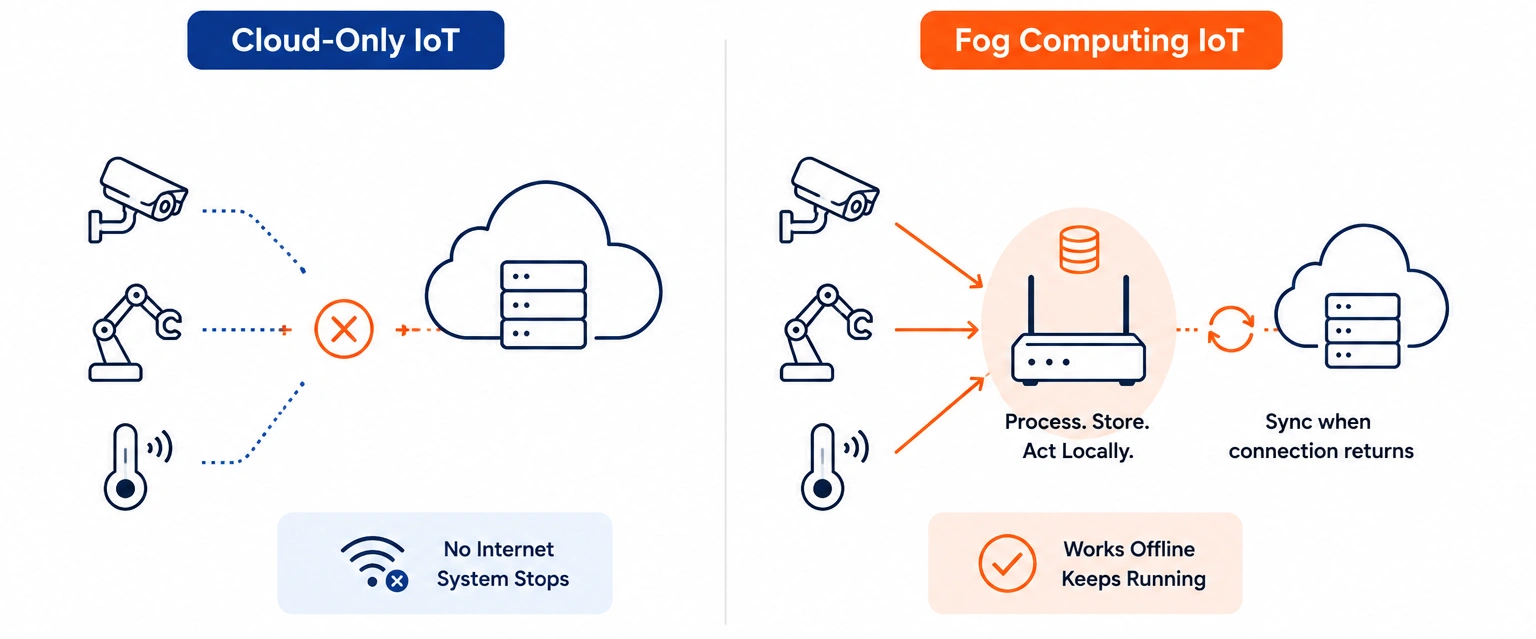
Cloud-only IoT systems depend completely on internet connectivity. If the connection fails, devices may stop working or lose important data.
Fog computing in IoT solves this problem by processing and storing data locally.
Fog nodes continue running even in remote areas with weak or no internet. Once the connection returns, the data syncs back to the cloud.
This is especially useful in places like oil rigs, mining sites, cargo ships, wind farms, and military operations where reliable internet is not always available.
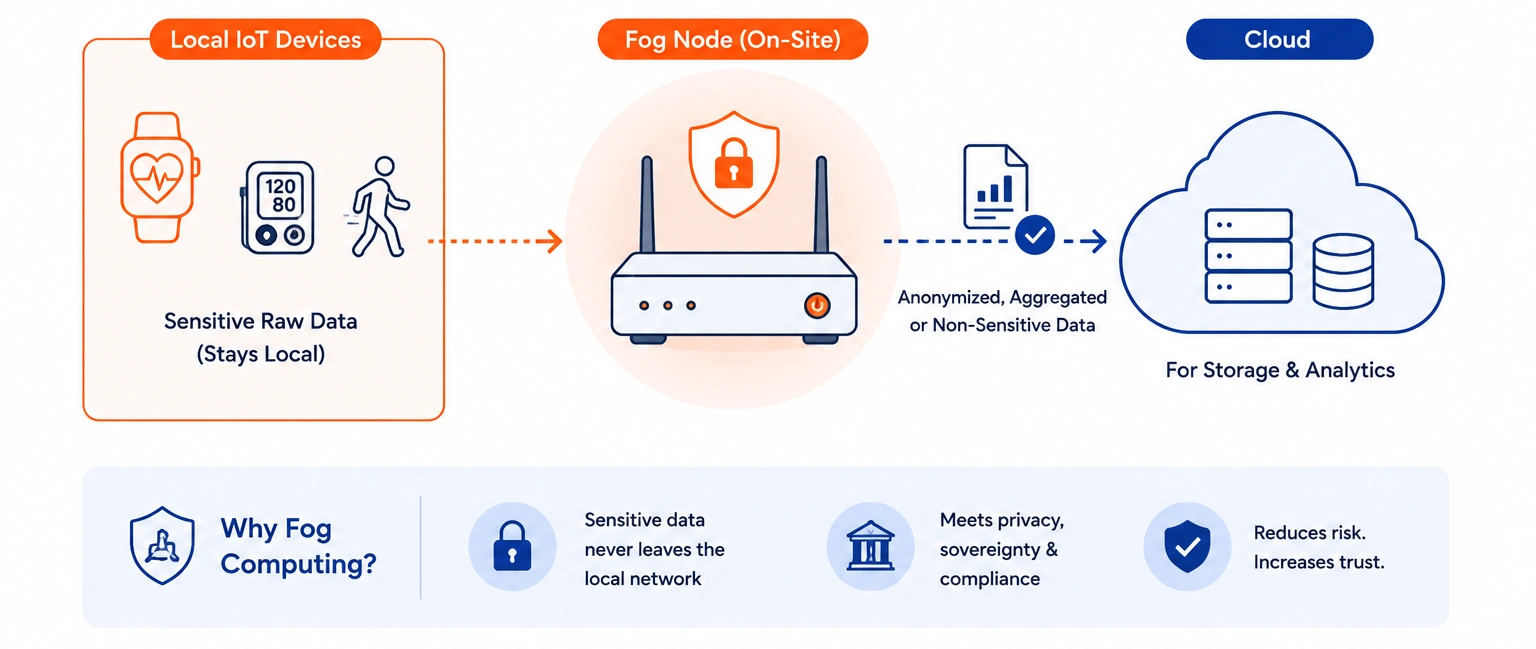
Some IoT data is too sensitive to send directly to the cloud. Industries like healthcare, finance, defense, and critical infrastructure must follow strict privacy and compliance rules.
Fog computing in IoT helps keep sensitive data local.
Fog nodes process data on-site and only send safe or summarized information to the cloud.
This improves security, reduces compliance risks, and gives businesses more control over their data.
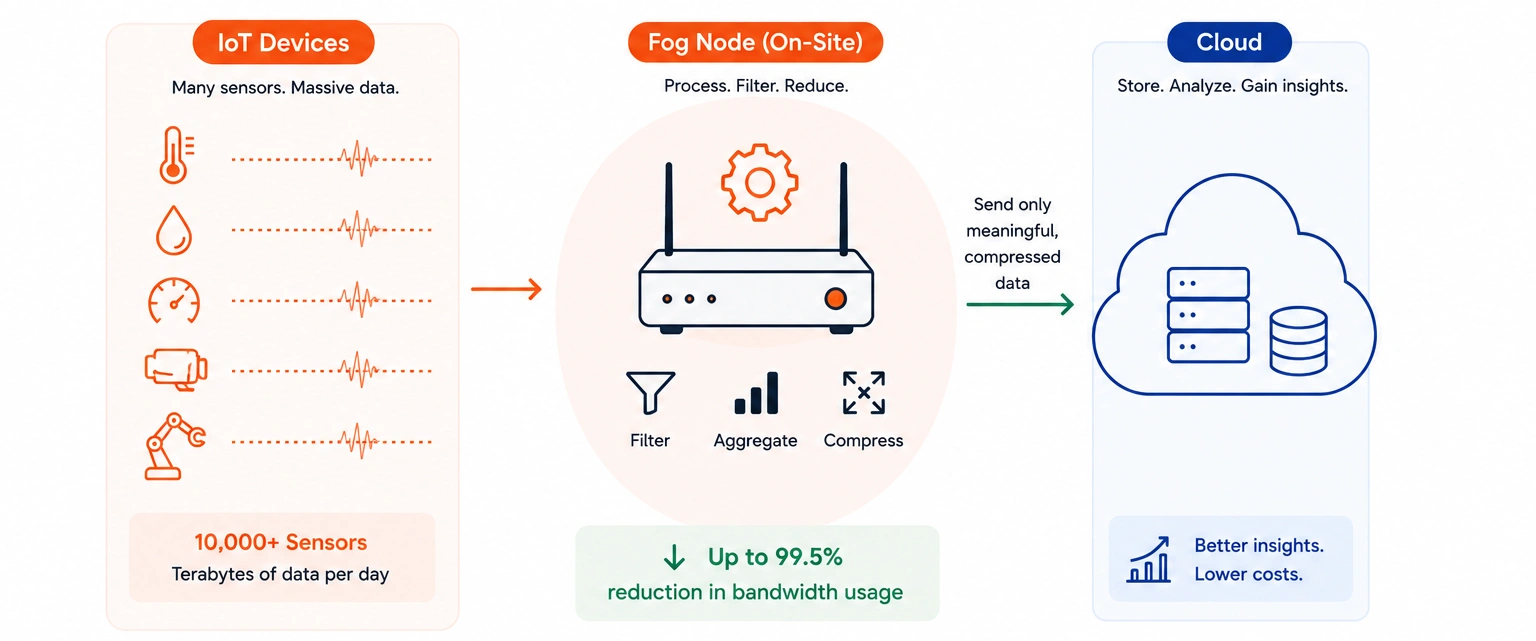
Large IoT monitoring systems generate huge amounts of data every second. Sending all of that raw data directly to the cloud increases bandwidth usage, storage costs, and processing time.
Fog computing in IoT helps by filtering and processing data locally before sending it to the cloud. Only useful and important data gets uploaded.
This reduces bandwidth costs, improves cloud performance, and makes analytics faster and more efficient.
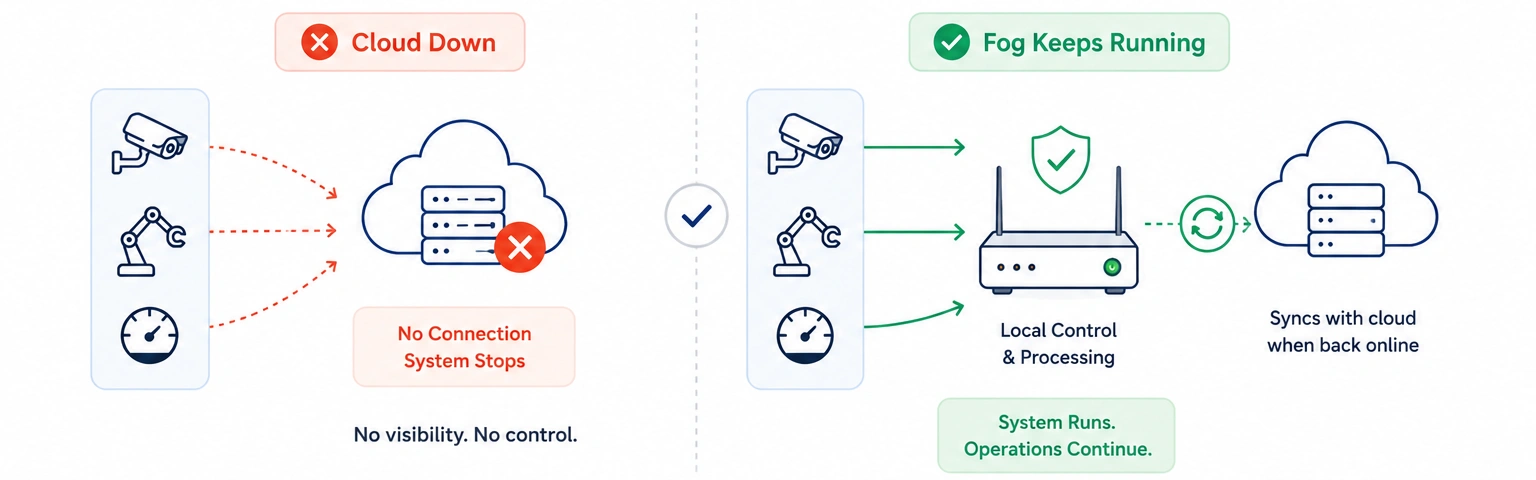
Cloud outages can stop critical IoT systems. In industries like healthcare, manufacturing, power grids, and traffic management, even a few minutes of downtime creates serious problems.
Fog computing in IoT keeps systems running even when the cloud is unavailable. Fog nodes continue processing data, monitoring devices, and controlling operations locally until connectivity returns.
This makes fog computing ideal for high-availability IoT systems where reliability and continuous operation are critical.
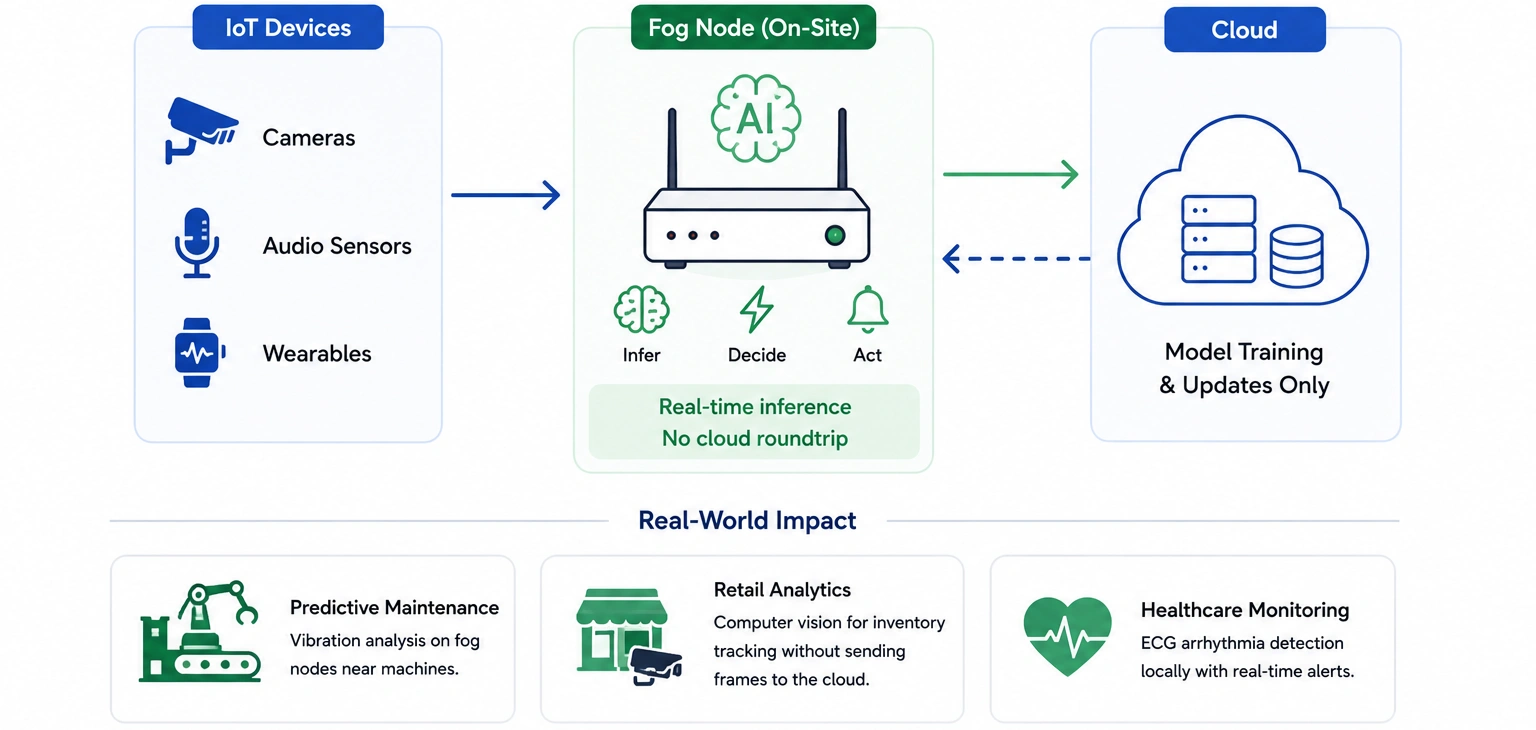
Many modern IoT systems use AI for instant decision-making. Sending data to the cloud for every AI task creates delays and increases bandwidth usage.
Fog computing in IoT allows AI models to run locally on fog nodes. Devices can process video, audio, sensor data, and alerts in real time without waiting for cloud responses.
This is useful for predictive maintenance, smart surveillance, retail analytics, and healthcare monitoring where fast AI decisions are critical.
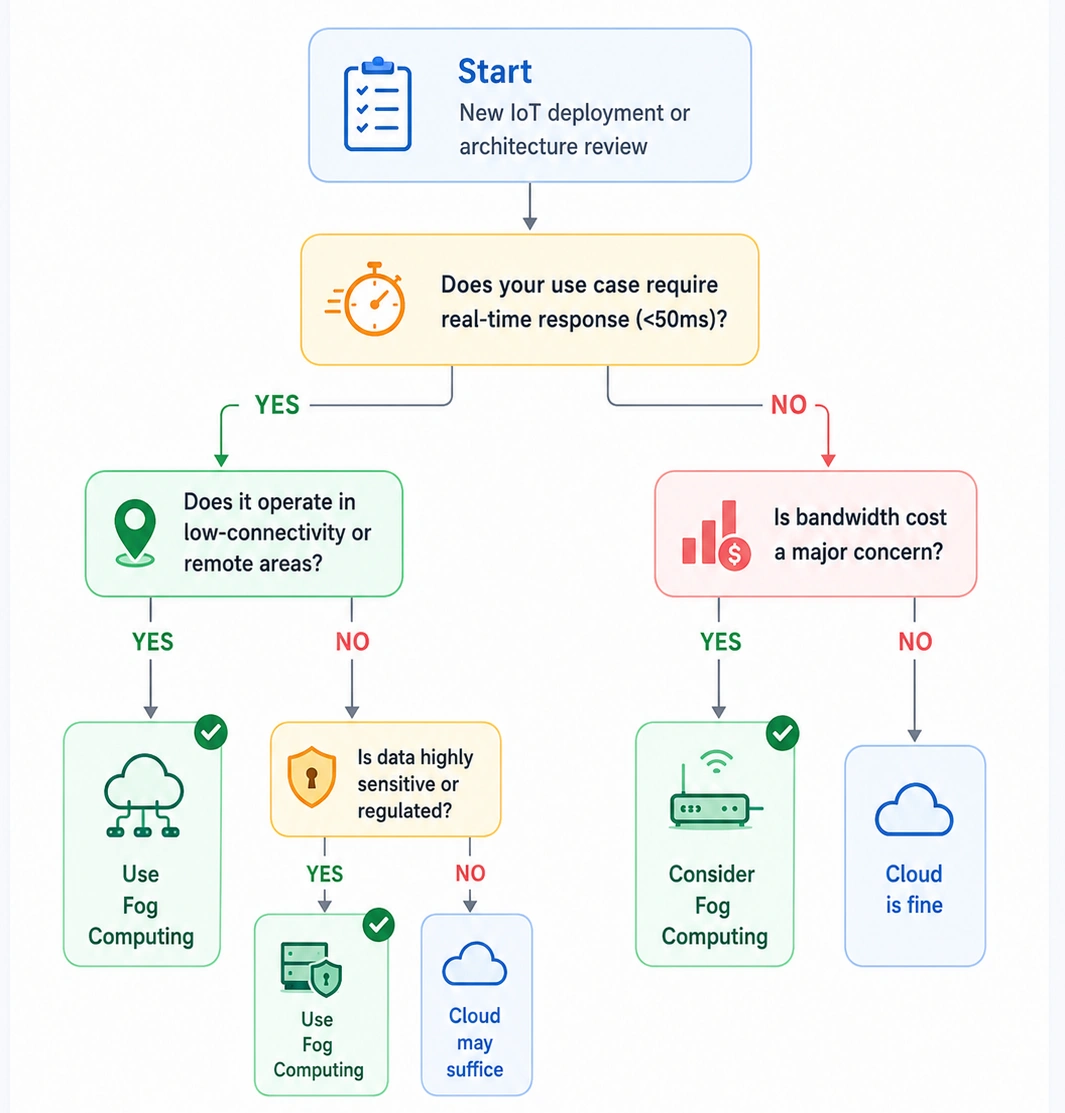
Not every IoT use case needs fog. Here’s a fast reference to help you decide:
| Response time must be under 50ms | Latency tolerance is above 200ms |
| Devices operate in remote areas | You need unlimited storage scale |
| Data is regulated (HIPAA, GDPR) | Deep batch analytics are the priority |
| Bandwidth is limited or expensive | Data volume is manageable |
| System uptime is mission-critical | Reliable internet is always available |
| AI inference must happen locally | Training large ML models is the goal |
| Tens of thousands of sensors involved | Cross-region data sharing is needed |
| You need offline resilience | Budget favors OpEx over CapEx |
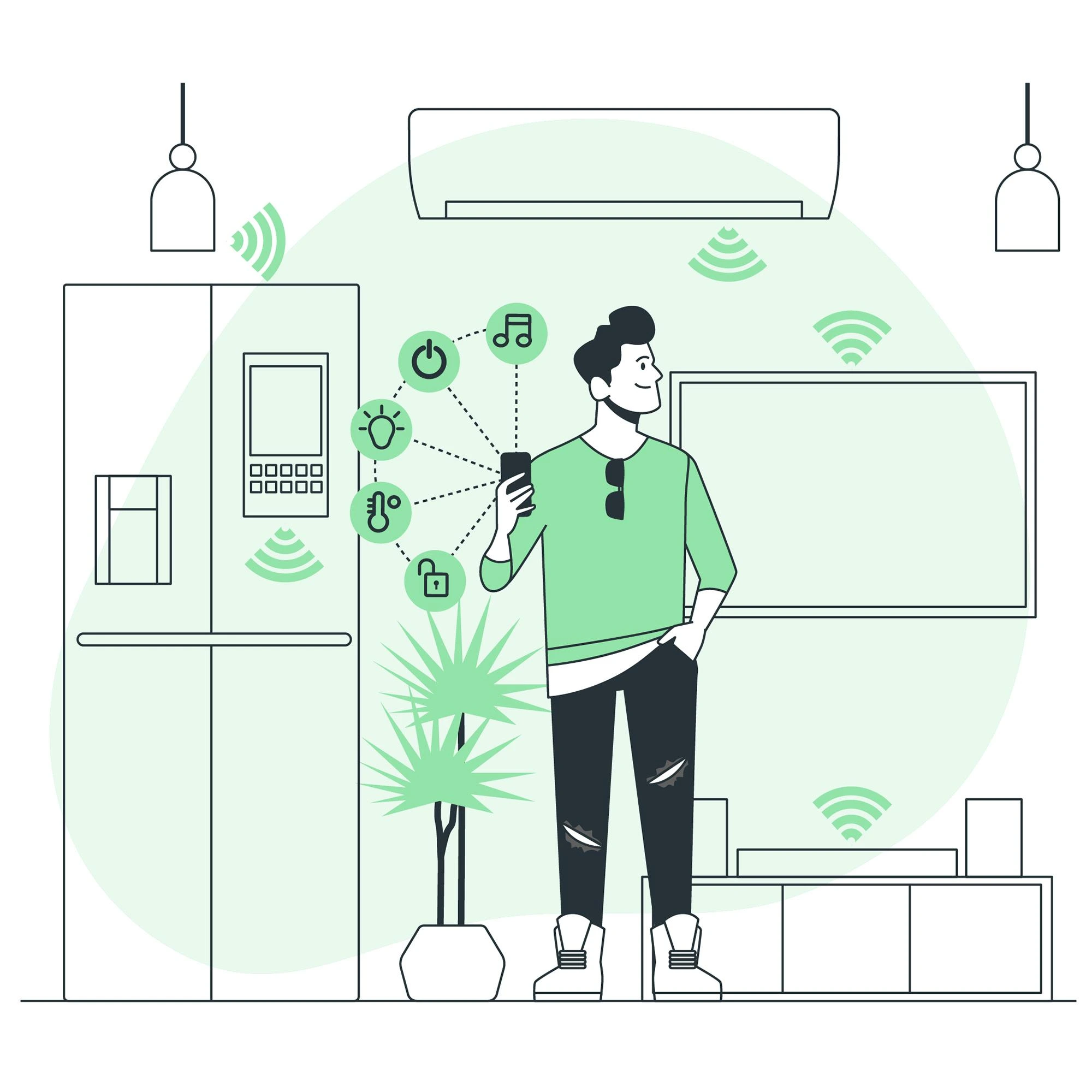
Fog computing in IoT processes data closer to connected devices instead of relying completely on distant cloud servers. This helps businesses improve speed, reduce latency, save bandwidth, and support real-time decision-making in smart systems.
Cloud computing processes data in centralized servers, while fog computing handles data near IoT devices. Fog computing is better for low-latency and real-time applications, whereas cloud computing works best for storage, analytics, and large-scale data management.
Businesses should use fog computing in IoT when applications need real-time responses, local processing, remote operations support, lower bandwidth usage, or uninterrupted system performance. Industries like healthcare, manufacturing, transportation, and smart cities commonly use fog-based architectures.
Fog computing in IoT improves response time, reduces latency, lowers bandwidth costs, supports real-time analytics, improves operational reliability, and enables local decision-making. It also helps IoT systems continue working even during internet or cloud connectivity issues.
No. Fog computing is not replacing cloud computing. Instead, both technologies work together. Fog computing handles local and time-sensitive processing, while cloud computing supports long-term storage, centralized analytics, machine learning, and large-scale infrastructure management.
→ Fog Computing in IoT: A computing approach that processes IoT data closer to devices instead of sending everything to the cloud.
→ Edge Computing: A system where data processing happens directly near the device or sensor for faster response times.
→ Latency: The time taken for data to travel from a device to a server and back.
→ Fog Node: A local device, gateway, or server that processes IoT data between the cloud and connected devices.
→ Real-Time Processing: The ability to process and respond to data instantly or within milliseconds.
→ IoT Ecosystem: A network of connected devices, sensors, software, and cloud systems working together.
→ Bandwidth Usage: The amount of network data transferred between devices and cloud systems.
→ Edge AI: Artificial intelligence models that run locally on edge or fog devices without depending on the cloud.
→ Cloud Computing: A centralized computing model where data is processed and stored in remote data centers.
→ Smart Devices: Connected electronic devices that collect, share, and process data through IoT networks.
 22 mins

"*" indicates required fields

5432 Geary Blvd, Unit #527 San Francisco, CA 94121 United States
320 Decker Drive Irving, TX 75062 United States

6d-7398 Yonge St,1318 Thornhill, Ontario, Canada, L4J8J2

71-75 Shelton Street, Covent Garden, London, United Kingdom, WC2H 9JQ

Hohrainstrasse 16, 79787 Lauchringen, Germany

12, Zugerstrasse 32, 6341 Baar, Switzerland

5th floor, Bloukrans Building, Lynnwood Road, Pretoria, Gauteng, 0081, South Africa

12th & 13th Floor, B Square-1, Bopal – Ambli Road, Ahmedabad – 380054
B/305A, 3rd Floor, Kanakia Wallstreet, Andheri (East), Mumbai, India





 Talk to Our
Consultants
Talk to Our
Consultants Chat with
Our Experts
Chat with
Our Experts Write us
an Email
Write us
an Email