Skip to content

Industrial Computer Vision for quality control

Featured Image

Executive Summary

Quality control is one of the biggest challenges in manufacturing. Manual inspection often misses defects, especially during long shifts, leading to scrap, rework, warranty claims, and higher operational costs. This is where Industrial Computer Vision helps by using AI-powered cameras and intelligent inspection systems to detect defects in real time with greater accuracy and consistency.

In this blog, we will explore how Industrial Computer Vision is transforming quality control across industries such as automotive, electronics, pharmaceuticals, food & beverage, and medical devices. We will cover its benefits, key use cases, implementation challenges, and how businesses can use AI, Edge Computing, and IoT-powered quality inspection systems to improve product quality, reduce costs, and achieve compliance at scale.

Let’s talk about what’s actually happening on most production floors. A trained inspector stands at a station and looks for defects. They’re skilled. They’re experienced. And under ideal conditions, they catch a lot.

But conditions are never ideal. After two hours of continuous inspection, human visual accuracy degrades by 15–25%. Two different inspectors evaluating the same borderline part agree only 55–70% of the time. And no human eye, no matter how sharp, can detect a 0.1mm hairline crack on a part moving at 500 units per minute.

The result is a hidden tax on your business that most leadership teams only see in aggregate, never in real time.

What’s Actually Happening

Your QA process is sampling 5–10% of output. The remaining 90% moves without a verified quality check. Defects that slip through cost you at the worst possible moment, when they reach your customer or force a recall.

What Computer Vision does

Every single unit gets inspected. Every frame captured. Every defect flagged in under 50 milliseconds. Defect escape rate drops from 20–30% down to under 1%. No samples. No gaps. No shift-to-shift inconsistency.

Poor quality quietly drains profits through scrap, rework, warranty claims, and production delays. The longer a defect remains undetected, the higher the cost to fix it.

“The cheapest defect to fix is the one caught the moment it happens.”

Industrial Computer Vision helps manufacturers detect defects in real time, reducing waste, improving product quality, and preventing costly issues from moving further down the production line.

The Six Specific Problems Industrial Computer Vision Solves

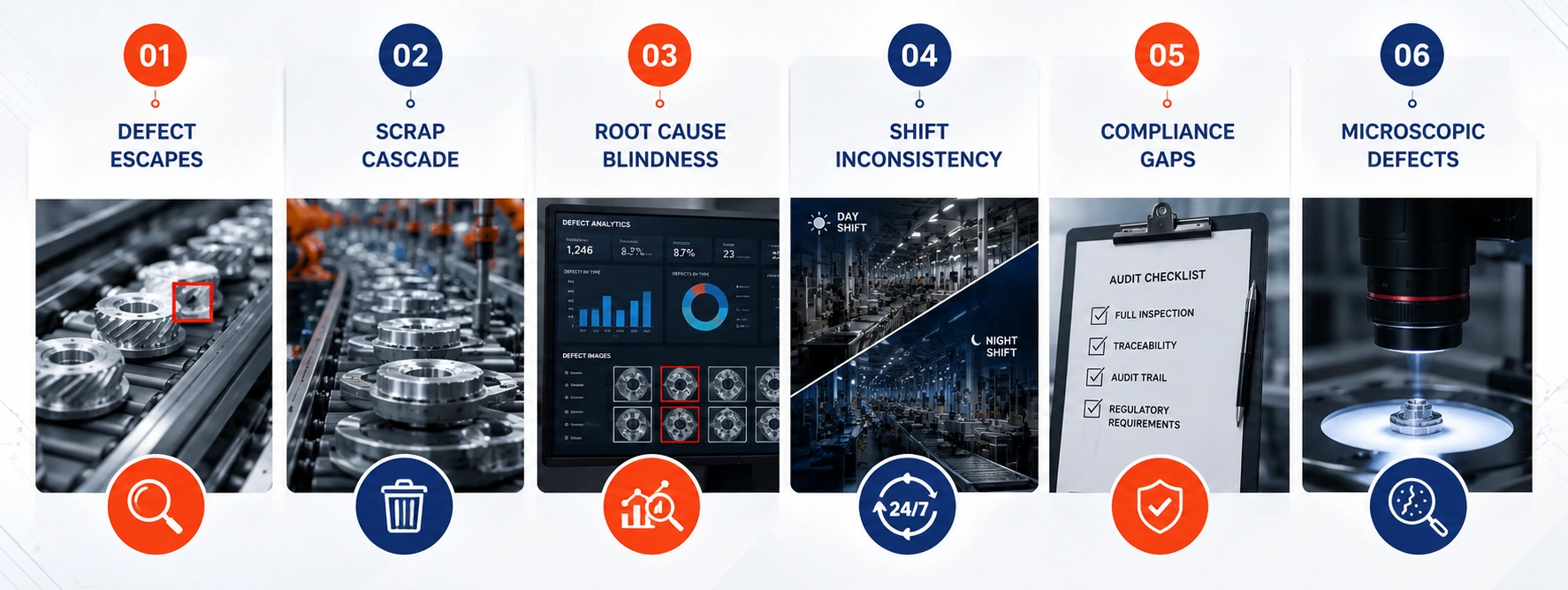
Industrial Computer Vision isn’t a single solution, it’s a platform that addresses multiple quality failure points simultaneously. Here are the six problems it’s built to fix, and exactly how it fixes each one.

Six-panel infographic about manufacturing quality control: Defect Escapes, Scrap Cascade, Root Cause Blindness, Shift Inconsistency, Compliance Gaps, and Microscopic Defects with related visuals.

Defect Escapes

Defects that slip past inspection and reach your customer are the most expensive quality failure. They trigger warranty claims, OEM penalties, and brand damage that outlasts the financial hit.

How it’s solved: AI vision inspects 100% of output, not samples. Defect escape rates drop from 20–30% to under 1% in documented deployments.

Scrap Cascade

A defect caught at Station 1 costs you one component. A defect caught at Station 8 costs you the component plus seven stages of labor, energy, and machine time on a part that was already bad.

How it’s solved: Inline inspection at each stage stops bad parts from progressing. The defect is caught at the source, not at the end.

Root Cause Blindness

Manual inspection catches the defect but loses the context. You know you have a problem, you don’t know which machine, which shift, which tool wear pattern is causing it.

How it’s solved: Every defect is logged with timestamp, machine ID, batch, image, and defect type — feeding a live root-cause dashboard tied to your MES.

Shift Inconsistency

Your morning shift and your night shift don’t inspect to the same standard. It’s not a people problem, it’s a biology problem. Fatigue, lighting changes, and judgment variation create invisible quality gaps between shifts.

How it’s solved: The same AI model, the same threshold, the same decision, 24 hours a day, 7 days a week.

Compliance Gaps

In pharma, food, aerospace, and medical devices, 100% inspection isn’t a best practice anymore. FDA, EU GMP Annex 1, and FSMA now mandate it. Sampling-based systems are becoming non-compliant.

How it’s solved: Full inspection coverage with timestamped audit logs for every unit, ready for FDA audits, IATF 16949 reviews, and ISO 13485 certification.

Microscopic Defects

Hairline cracks. Sub-millimeter porosity. Surface oxidation under 0.1mm. These defects are invisible to the naked eye but catastrophic in aerospace, automotive safety components, and medical implants.

How it’s solved: High-resolution industrial cameras with structured lighting and CNN models trained to detect defects smaller than 0.1mm, at production speed.

Before and After Industrial Computer Vision: What Actually Changes

It’s easy to talk about “transformation.” Here is what it concretely looks like on your production floor — before a vision system, and after one is running.

Quality Improvement with Industrial Computer Vision
Quality Dimension
Before (Manual / Sampling)
After (Industrial Computer Vision)
Inspection coverage 5–10% of output (sampling) 100% of every unit, every shift
Defect detection accuracy 70–80% under real conditions 95–99% sustained accuracy
Microscopic defect visibility Invisible under 0.3mm Detectable below 0.1mm
Shift-to-shift consistency 55–70% inter-inspector agreement 100% identical threshold, every shift
Time-to-detection Hours or post-shipment Under 50ms, inline, at station
Root cause traceability Manual logs, often incomplete Full defect log: machine, shift, batch, image
Compliance evidence Sample-based records, audit risk 100% unit-level audit trail, always ready
Scrap location Caught late — multiple stages wasted Caught at source — Stage 1 reject
False positive rate Variable — subjective judgment Optimized threshold — minimal good parts rejected

Real-world outcome: Automotive manufacturer, U.S. Midwest

After deploying Industrial Computer Vision on a stamping line: escape rate dropped from 2.3% to 0.1%, scrap cost per unit fell by 61%, and $1.8M in annual warranty claims was eliminated. The system paid for itself from the first prevented recall. Implementation: 2–4 months for the pilot line.

What Industrial Computer Vision Can Detect — That Nothing Else Can

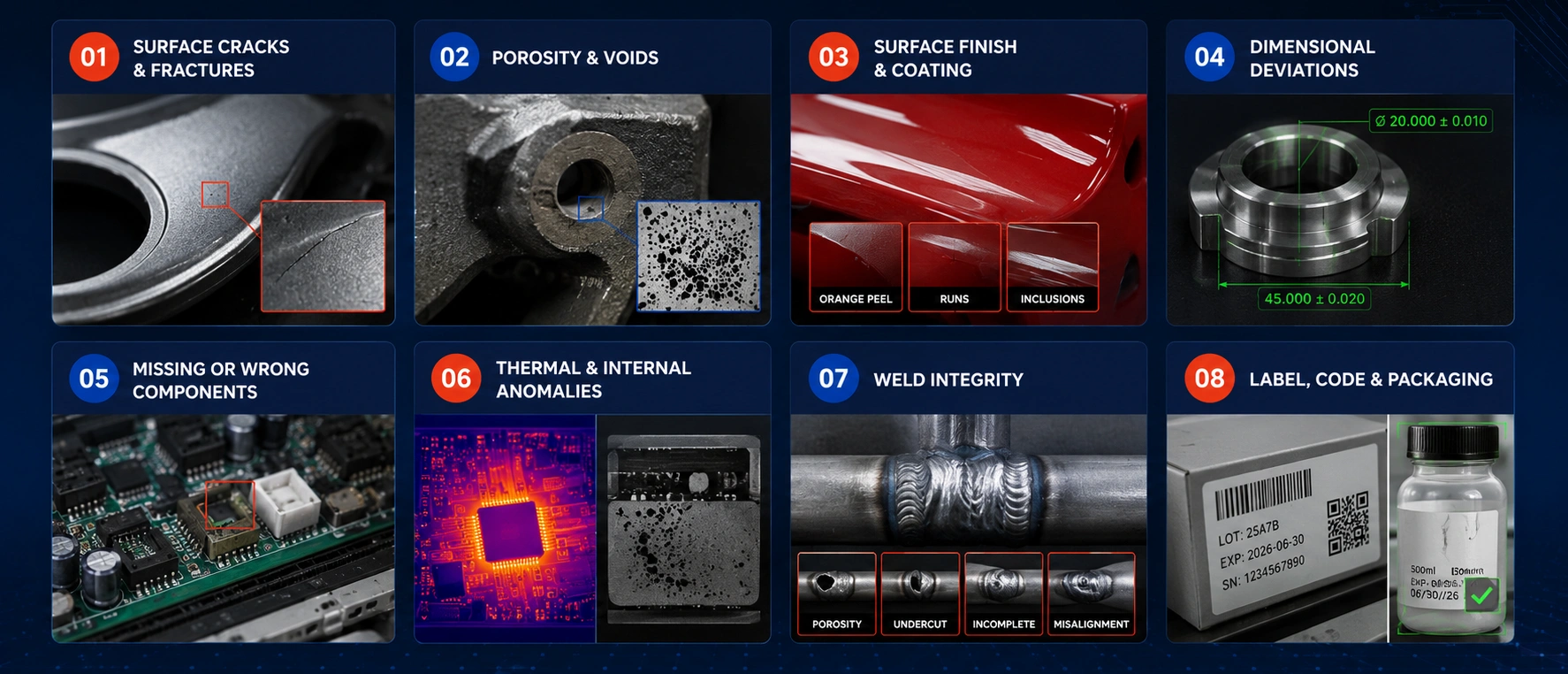
Eight-panel infographic listing common manufacturing defects: cracks, porosity, finish, dimensional deviations, missing components, thermal/anomalies, weld integrity, and labeling/packaging.

Surface Cracks & Fractures: Detects hairline cracks and micro-fractures below 0.1mm that are invisible to the human eye but critical to product safety.

Porosity & Voids: Identifies internal voids, air pockets, and material inconsistencies in castings, welds, and molded components before failure occurs.

Surface Finish & Coating: Detects paint defects, coating variations, oxidation, scratches, dents, and surface quality issues across production lines.

Dimensional Deviations: Measures dimensions, flatness, diameter, and positioning with micron-level precision for consistent quality verification at scale.

Missing or Wrong Components: Identifies missing parts, incorrect assemblies, orientation errors, misplaced labels, and incomplete product configurations instantly.

Thermal & Internal Anomalies: Reveals abnormal heat patterns, contamination, hidden structural defects, and internal quality issues using advanced imaging.

Weld Integrity: Inspects weld seams for porosity, undercutting, cracks, incomplete fusion, alignment issues, and geometric deviations in real time.

Label, Code & Packaging: Verifies barcode readability, label accuracy, expiry dates, fill levels, packaging quality, and seal integrity automatically.

The defect you’re not tracking may be your biggest liability

Most manufacturers focus their inspection on defects they’ve already seen. The more dangerous risk is the defect type you haven’t encountered yet, introduced by a new material batch, a worn tool, or a process drift.

AI anomaly detection models learn what “normal” looks like and flag anything that deviates, including defects that have never been labeled or named before.

Which Industries Need Industrial Computer Vision – And Why Right Now

Every sector has its own defect profile, its own cost of a miss, and its own regulatory pressure. Below is the honest picture for the industries where the demand for Industrial Computer Vision is most urgent, and most consequential.

Automotive Solution

Automotive: Prevent Quality Escapes Before They Reach OEMs

→ Detects paint, weld, and assembly defects before costly downstream processing.
→ Delivers full production traceability required for automotive quality compliance standards.
→ Reduces warranty claims, rework costs, and OEM quality penalty exposure.

Pharmaceuticals Solution

Pharmaceuticals: Achieve 100% Inspection and Regulatory Compliance

→ Inspects every vial, capsule, and package with consistent accuracy.
→ Prevents labeling errors that can trigger recalls and compliance violations.
→ Creates audit-ready inspection records for FDA and GMP requirements.

Electronics & Semiconductors Solution

Electronics & Semiconductors: Improve Yield and Production Accuracy

→ Identifies solder, wafer, and component placement defects at scale.
→ Supports high-speed production lines where manual inspection becomes impractical.
→ Improves manufacturing yield by catching defects before assembly progression.

Food & Beverage Solution

Food & Beverage: Protect Consumers and Brand Reputation

→ Detects contamination, foreign objects, and packaging defects automatically.
→ Verifies fill levels, seals, labels, and freshness indicators consistently.
→ Supports traceability requirements while reducing costly product recalls significantly.

Aerospace & Medical Devices Solution'

Aerospace & Medical Devices: Ensure Safety-Critical Product Quality

→ Detects microscopic defects that could compromise product safety performance.
→ Verifies dimensional accuracy, assembly completeness, and packaging integrity.
→ Supports strict quality standards with documented inspection evidence throughout.

Building Successful Industrial Computer Vision Solutions Requires More Than Cameras

Deploying Industrial Computer Vision is not just about installing cameras on a production line. Success depends on the right AI models, imaging systems, data infrastructure, edge computing capabilities, and integration with existing manufacturing operations.

As an Enterprise AI Development Company, Azilen helps manufacturers build end-to-end Industrial Computer Vision solutions that improve quality control, reduce defects, and deliver real-time production visibility.

Industrial Vision Strategy & Architecture: Design scalable computer vision ecosystems aligned with production, quality, and compliance objectives.

Camera & Imaging System Integration: Deploy industrial cameras, lighting systems, and imaging technologies optimized for defect detection.

Enterprise AI Development Services: Build custom AI models trained to identify product-specific defects with high accuracy.

Edge AI & Real-Time Inspection: Enable low-latency defect detection directly on the production line for instant quality decisions.

Manufacturing Data & System Integration: Connect vision systems with MES, ERP, SCADA, and quality management platforms.

MLOps & Continuous Optimization: Continuously improve model performance, inspection accuracy, and operational outcomes as production evolves.

If you’re planning an Industrial Computer Vision initiative, partner with Azilen, an Enterprise AI Development Company, to build a scalable, AI-powered quality inspection ecosystem.

FAQs: Predictive Maintenance using IoT Data Engineering

1. What is Industrial Computer Vision in manufacturing?

Industrial Computer Vision uses AI, machine learning, industrial cameras, and advanced imaging systems to automatically inspect products and production processes. Unlike manual inspection, it analyzes 100% of output in real time, helping manufacturers detect defects, improve quality control, reduce waste, and maintain compliance across high-speed production environments.

2. How does Industrial Computer Vision improve quality control?

Industrial Computer Vision improves quality control by detecting defects with greater speed, consistency, and accuracy than manual inspection. It identifies issues such as cracks, dimensional deviations, missing components, packaging defects, and surface imperfections in real time, reducing scrap, rework, warranty claims, and customer complaints while increasing overall production quality.

3. Which industries benefit most from Industrial Computer Vision?

Industries with strict quality and compliance requirements gain the greatest value from Industrial Computer Vision. This includes automotive, pharmaceuticals, electronics, semiconductors, food and beverage, aerospace, and medical devices. These industries use AI-powered visual inspection to improve traceability, reduce defects, support regulatory compliance, and increase manufacturing efficiency.

4. What types of defects can AI-powered visual inspection detect?

AI-powered visual inspection systems detect a wide range of defects, including surface cracks, porosity, coating inconsistencies, dimensional variations, weld defects, thermal anomalies, missing components, packaging issues, and barcode errors. Advanced systems also identify microscopic defects that are often invisible to human inspectors during manual quality checks.

5. What is required to implement an Industrial Computer Vision solution?

A successful Industrial Computer Vision implementation requires more than cameras. Manufacturers need the right imaging hardware, AI models, data infrastructure, edge computing capabilities, and integration with MES, ERP, and quality management systems. Working with an Enterprise AI Development Company helps ensure scalability, accuracy, and long-term operational value.

Glossary

Industrial Computer Vision: AI-powered technology that uses cameras and machine learning to automatically inspect products, detect defects, and improve manufacturing quality.

Automated Visual Inspection: The process of using cameras and AI instead of human inspectors to identify quality issues during production.

Defect Detection: The identification of product flaws, abnormalities, or deviations that may affect performance, safety, or compliance.

Edge AI: Artificial intelligence models deployed directly on factory equipment for real-time analysis without relying on cloud processing.

Machine Vision Camera: Industrial-grade cameras designed to capture high-resolution images for automated inspection and quality control applications.

Quality Control (QC): The practice of monitoring products and processes to ensure they meet predefined quality standards and specifications.

Dimensional Inspection: Automated measurement of product dimensions, tolerances, and geometry to verify manufacturing accuracy and consistency.

Deep Learning: An advanced AI technique that enables vision systems to learn, recognize, and classify complex defect patterns from images.

Traceability: The ability to track every product, inspection result, batch, and production event throughout the manufacturing lifecycle.

Real-Time Inspection: Continuous product inspection performed instantly during production, enabling immediate detection and correction of quality issues.
author avatar
Niket Kapadia Co-Founder & Chief Technology Officer (CTO)
Niket Kapadia is Co-Founder & CTO of Azilen Technologies with 17+ years of experience in enterprise architecture, AI-driven solutions, and scalable product engineering. He specializes in building high-performance systems and aligning technology with business innovation.
google
Niket Kapadia
Niket Kapadia
CTO - Azilen Technologies

Niket Kapadia is a technology leader with 17+ years of experience in architecting enterprise solutions and mentoring technical teams. As Co-Founder & CTO of Azilen Technologies, he drives technology strategy, innovation, and architecture to align with business goals. With expertise across Human Resources, Hospitality, Telecom, Card Security, and Enterprise Applications, Niket specializes in building scalable, high-impact solutions that transform businesses.

Related Insights

GPT Mode
AziGPT - Azilen’s
Custom GPT Assistant.
Instant Answers. Smart Summaries.