




 13 mins
Sep 25, 2026
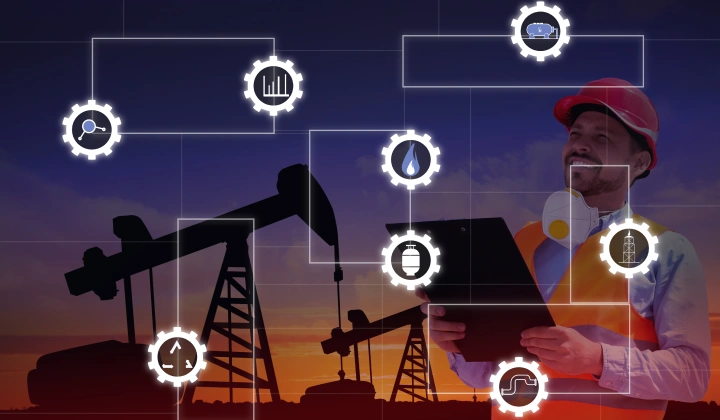
The oil and gas industry faces growing pressure to improve operational efficiency, reduce downtime, optimize production, and meet evolving sustainability goals. Traditional AI has delivered valuable insights, but today’s complex operations require systems that can analyze, reason, and take action autonomously.
Agentic AI in the oil and gas industry enables intelligent AI agents to automate decision-making, optimize workflows, and enhance upstream, midstream, and downstream operations—helping companies improve productivity, asset reliability, and operational resilience.
Agentic AI in the oil and gas industry combines AI agents, large language models (LLMs), and machine learning to autonomously analyze data, make decisions, and execute workflows across exploration, drilling, production, transportation, and refining. Unlike traditional AI, Agentic AI goes beyond generating insights by coordinating complex operational tasks with minimal human intervention.
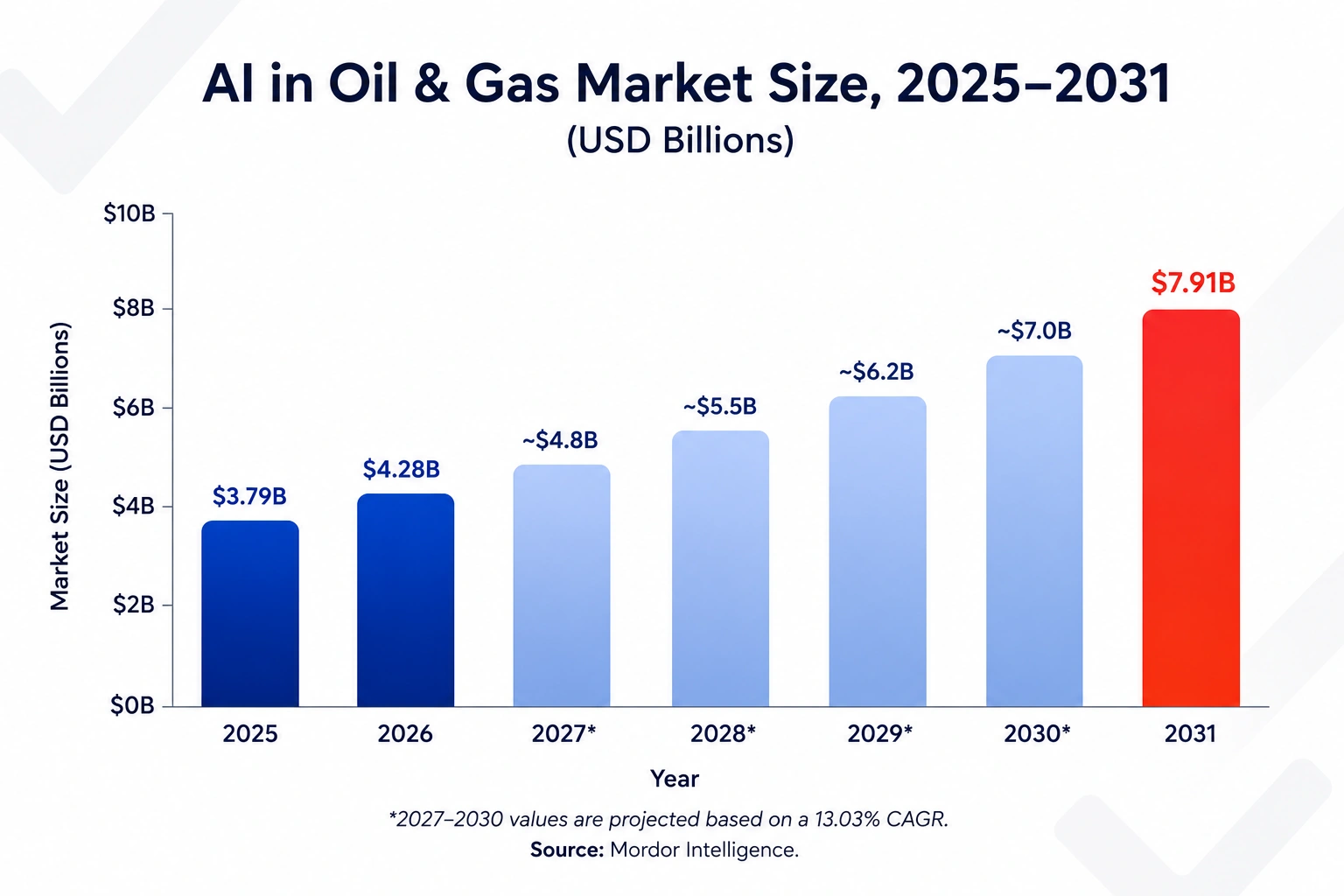
As operators face aging assets, rising costs, workforce shortages, and stricter environmental regulations, Agentic AI for oil and gas helps optimize operations, improve asset reliability, reduce downtime, and accelerate digital transformation. According to Mordor Intelligence, the global AI in oil and gas market is expected to grow at a 13.03% CAGR, driven by predictive maintenance, autonomous drilling, and industrial AI adoption.
Get a real, data-backed number in under two minutes — whether you're scoping an AI investment or weighing maintenance spend against uptime and OEE gains.
Free · Instant results · No signup required
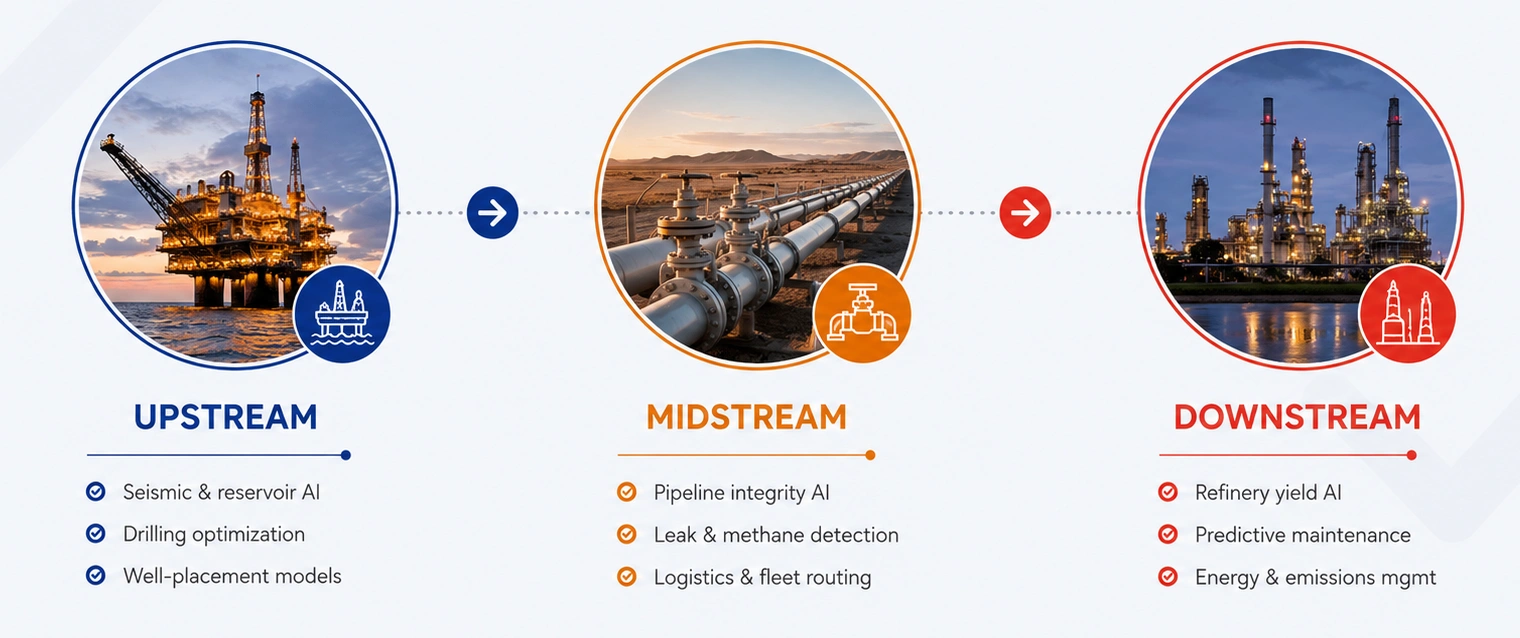
Agentic AI transforms every stage of the oil and gas value chain by enabling autonomous AI agents to analyze data, make decisions, and execute operational workflows. In upstream operations, AI agents optimize exploration, reservoir modeling, and drilling.
Midstream teams use them to monitor pipeline integrity, detect leaks, and streamline logistics, while downstream operators rely on Agentic AI to optimize refinery performance, predictive maintenance, and energy efficiency, all through a connected, intelligent decision-making framework.
| Segment | AI Application | Real-World Example | Reported Impact |
|---|---|---|---|
| Upstream | Agentic AI for seismic interpretation & reservoir modeling | ADNOC & AIQ's ENERGYai, built on a 70-billion-parameter LLM | 10× faster seismic interpretation and 70% higher precision (SLB, 2025) |
| Upstream | Autonomous and AI-enabled drilling rigs | ADNOC Drilling's AD-300 walking island rig | Delivered ahead of schedule as part of a $1.54B six-rig automation program (The National, 2026) |
| Midstream | Satellite + AI methane leak detection | UNEP's Methane Alert and Response System (MARS) | 40+ mitigation actions since 2024, with climate benefits comparable to removing ~24 million cars' annual emissions (UNEP, 2026) |
| Downstream | Predictive maintenance for rotating equipment | Machine learning models using vibration, thermal, and pressure sensor data | Industry studies report 30–70% lower unplanned downtime, depending on deployment maturity |
| Cross-chain | Generative AI copilots for engineers | Natural-language querying of decades of drilling and production data | Reduced reporting and analysis cycles from months to days (AIQ, 2024) |
AI-driven predictive maintenance helps oil and gas operators identify equipment failures before they occur by analyzing sensor data such as vibration, temperature, pressure, and historical performance. Instead of relying on fixed maintenance schedules, AI enables condition-based maintenance, reducing unexpected breakdowns and extending asset life.
By combining industrial AI, IoT sensors, and edge analytics, operators can minimize costly downtime, improve equipment reliability, and schedule maintenance during planned shutdowns. Learn more about how predictive maintenance in oil and gas transforms asset performance in our guide: Predictive Maintenance AI Works in Oil and Gas
Oil and gas companies are using Agentic AI and Generative AI to automate complex workflows, improve operational efficiency, and accelerate data-driven decision-making across exploration, production, transportation, and refining. Instead of simply generating insights, AI agents can analyze, reason, and execute actions across enterprise systems.
As AI adoption matures, Agentic AI is enabling oil and gas companies to move beyond predictive analytics toward autonomous, intelligent operations that improve productivity, safety, and operational resilience.
AI enables oil and gas companies to achieve ESG goals by continuously monitoring emissions, detecting methane leaks, and automating environmental reporting. According to the IEA’s Global Methane Tracker, only a small share of global oil and gas production currently meets near-zero methane emission standards, highlighting the need for AI-powered monitoring.
AI systems such as UNEP’s Methane Alert and Response System (MARS) have analyzed over 1.3 million satellite observations since 2023 to identify methane plumes and accelerate mitigation efforts. Combined with IoT sensors and computer vision, AI helps operators produce audit-ready emissions data, strengthen regulatory compliance, and support frameworks such as OGMP 2.0.
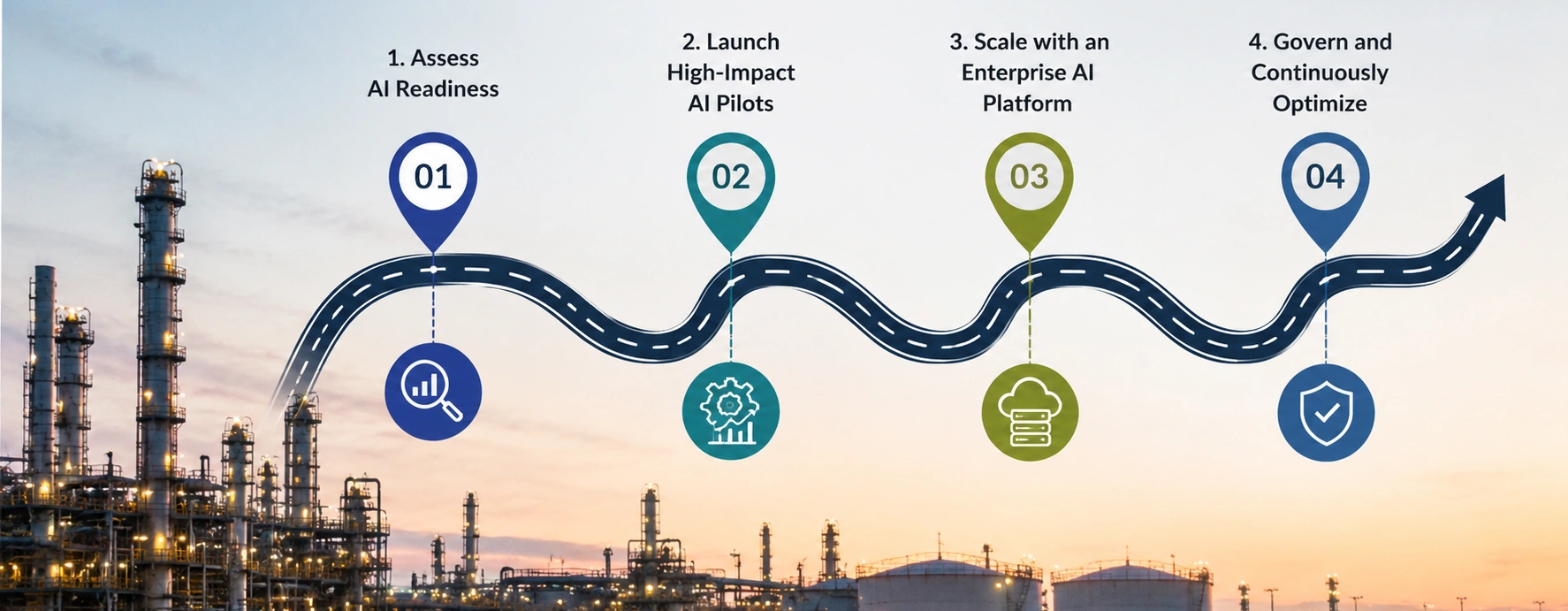
Successful AI adoption begins with targeted initiatives that deliver measurable business value before scaling across the enterprise. A structured roadmap helps oil and gas companies reduce implementation risks, accelerate ROI, and build a foundation for long-term digital transformation.

Agentic AI is a new generation of artificial intelligence that uses autonomous AI agents to analyze data, make decisions, and execute tasks with minimal human intervention. In the oil and gas industry, Agentic AI supports applications such as drilling optimization, predictive maintenance, production planning, emissions monitoring, and asset management by automating complex operational workflows.
Generative AI creates content such as reports, summaries, and recommendations based on prompts, while Agentic AI goes a step further by planning actions, interacting with enterprise systems, and executing workflows autonomously. Oil and gas companies often combine both technologies to improve engineering productivity, operational efficiency, and decision-making.
Agentic AI is used across upstream, midstream, and downstream operations for predictive maintenance, drilling optimization, reservoir analysis, production forecasting, pipeline monitoring, refinery optimization, digital twins, emissions management, and intelligent field operations. These use cases help reduce downtime, improve safety, and increase operational efficiency.
Agentic AI helps operators reduce unplanned downtime, optimize production, improve asset reliability, lower maintenance costs, strengthen ESG compliance, and accelerate decision-making. By automating repetitive and data-intensive processes, organizations can improve productivity while enabling engineers to focus on higher-value activities.
Azilen designs and develops enterprise-grade Agentic AI solutions tailored to oil and gas operations. Our expertise spans AI strategy, Agentic AI, Generative AI, Data Engineering, IoT, Digital Twins, Computer Vision, MLOps, and enterprise AI platform development, helping organizations move from AI pilots to scalable, production-ready intelligent operations.
 13 mins
 6 mins
"*" indicates required fields

5432 Geary Blvd, Unit #527 San Francisco, CA 94121 United States
320 Decker Drive Irving, TX 75062 United States

6d-7398 Yonge St,1318 Thornhill, Ontario, Canada, L4J8J2

71-75 Shelton Street, Covent Garden, London, United Kingdom, WC2H 9JQ

Hohrainstrasse 16, 79787 Lauchringen, Germany

12, Zugerstrasse 32, 6341 Baar, Switzerland

5th floor, Bloukrans Building, Lynnwood Road, Pretoria, Gauteng, 0081, South Africa

12th & 13th Floor, B Square-1, Bopal – Ambli Road, Ahmedabad – 380054
B/305A, 3rd Floor, Kanakia Wallstreet, Andheri (East), Mumbai, India






 Talk to Our
Consultants
Talk to Our
Consultants Chat with
Our Experts
Chat with
Our Experts Write us
an Email
Write us
an Email