Skip to content

Agentic AI for Autonomous Decision Making in Manufacturing

Featured Image

Executive Summary

Manufacturing companies are collecting more data than ever before.

Yet many production decisions still depend on emails, meetings, spreadsheets, and manual approvals.

At Azilen, we recently worked on an initiative focused on Agentic AI for Autonomous Decision Making, where AI agents continuously monitored factory operations, supply chain inputs, production constraints, and inventory signals to recommend and execute operational decisions in near real time.

The outcome was simple: Faster decisions, less operational friction, better production continuity.

And a factory environment that spent less time reacting and more time producing.

If your organization already has IoT data, ERP systems, MES platforms, or supply chain software in place, the next opportunity may not be more dashboards.

It may be giving your systems the ability to act.

Manufacturing Doesn’t Have a Data Problem Anymore

Most manufacturers already know what is happening.

The challenge is deciding what to do next.

Walk through almost any large manufacturing facility and you will find:

→ Production dashboards
→ Supply chain reports
→ Quality metrics
→ Machine performance data
→ Inventory visibility
→ Demand forecasts

Information is everywhere. Decision-making is not.

One operations leader we spoke with described it perfectly:

“We know the problem within minutes. Solving it takes hours.”

That statement captures why Agentic AI for Autonomous Decision Making is becoming such an important discussion across manufacturing leadership teams.

The gap between awareness and action is where operational losses occur.

How Azilen Approached Agentic AI for Autonomous Decision Making

Rather than introducing another reporting layer, we focused on something different.

Decision execution.

The objective was straightforward:

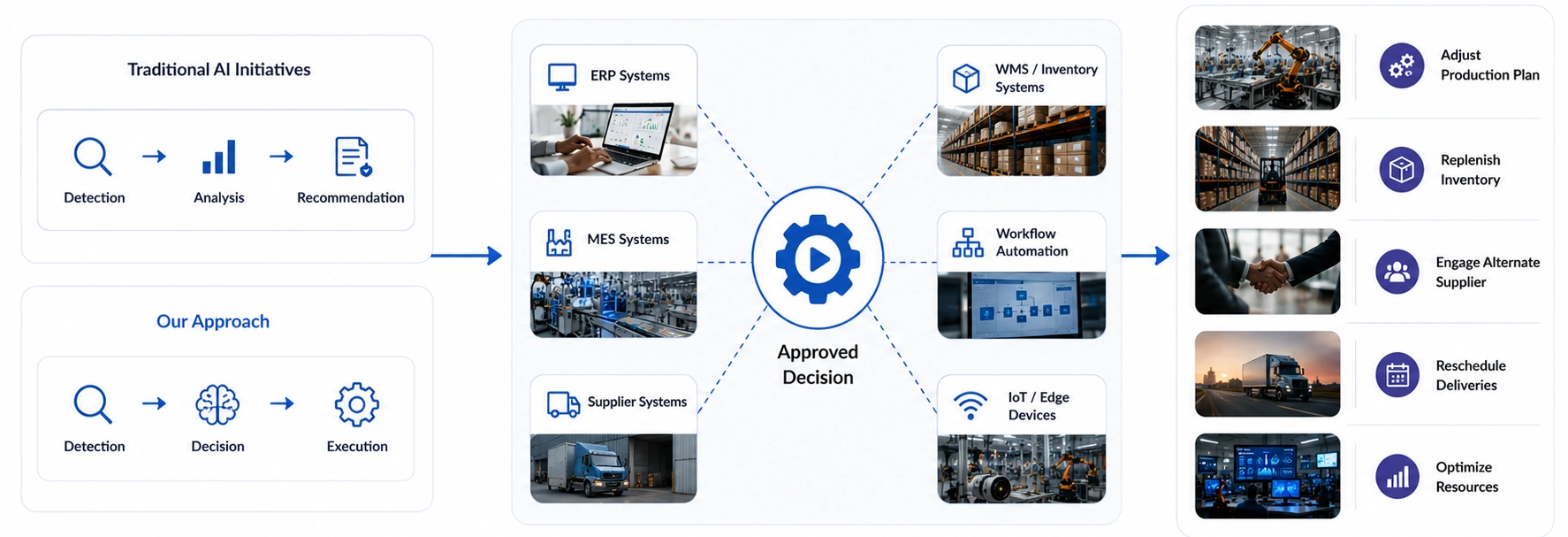
Allow systems to understand operational conditions, evaluate possible responses, and initiate actions without waiting for human intervention for every decision.

To achieve this, we combined four critical capabilities:

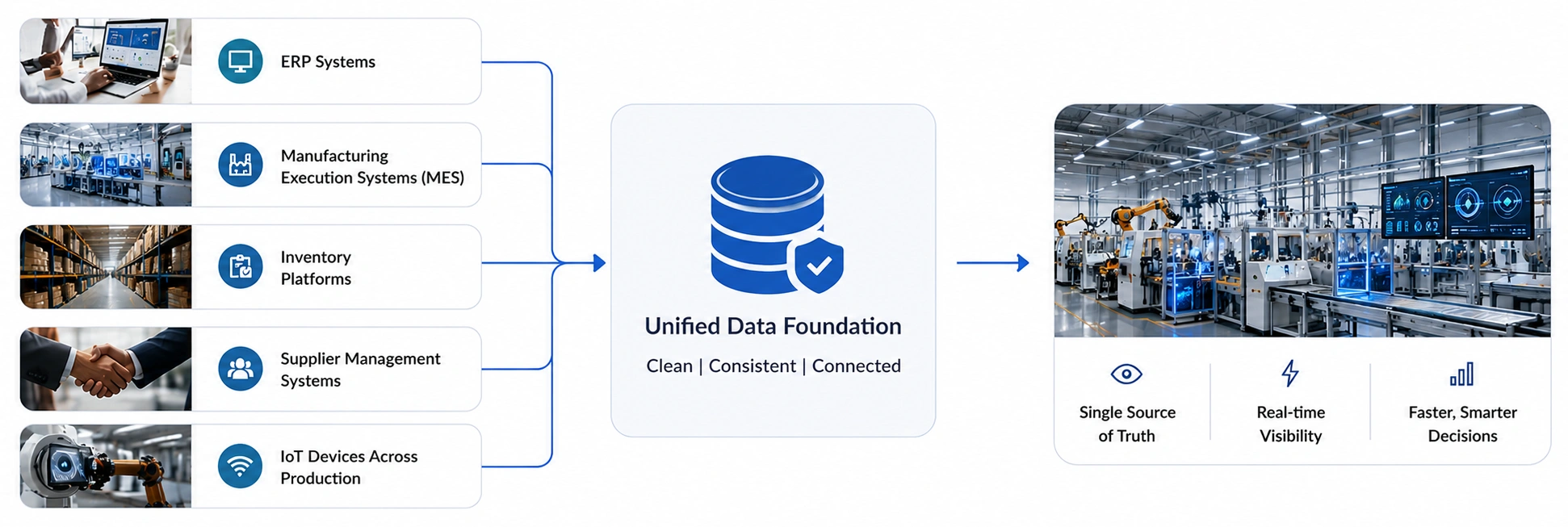
Step 1: Build a Reliable Data Foundation

Build a Reliable Data Foundation

Every autonomous decision depends on trusted information.

As part of our AI Agent Consulting Services, we first evaluated how data was flowing across the manufacturing ecosystem and identified the gaps that could impact autonomous decision-making.

We integrated operational data coming from:

→ ERP systems
→ Manufacturing Execution Systems (MES)
→ Inventory platforms
→ Supplier management systems
→ IoT devices across production environments

This created a single operational view of the factory. Without this foundation, autonomous decision-making is impossible.

This is where strong Data Engineering and AI Agent Consulting Services become essential.

Step 2: Introduce Agentic Workflows

Introduce Agentic Workflows

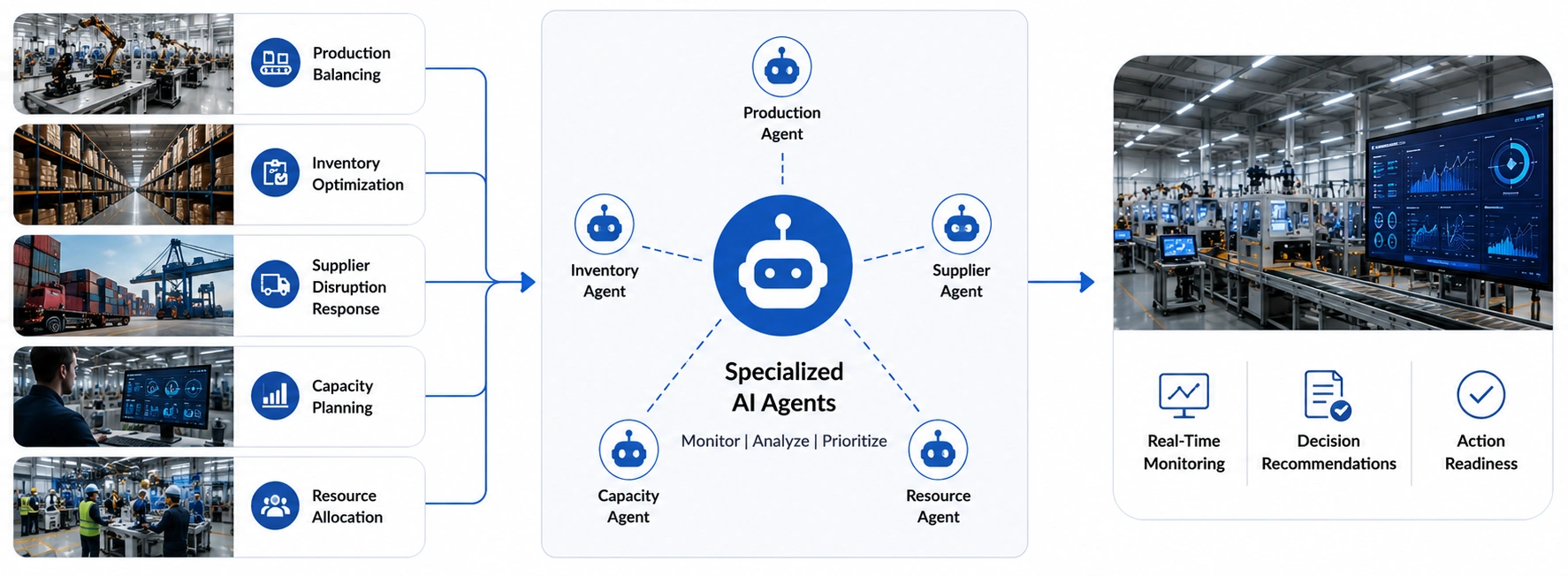
Once data became available in real time, AI agents were introduced.

As part of our AI Agent Development approach, each agent was designed to support a specific operational objective while working together as part of a larger autonomous decision-making framework.

For example:

→ Production balancing
→ Inventory optimization
→ Supplier disruption response
→ Capacity planning
→ Resource allocation

Instead of waiting for instructions, agents continuously monitored conditions and prepared actions.

This is where AI Agent Development plays a critical role. Rather than building generic automation workflows, intelligent agents are developed to understand operational context, evaluate changing conditions, and support faster decision-making across the manufacturing environment.

Autonomous Decision Making
Ready to Unlock the Value of Generative AI?
Turn operational knowledge, enterprise data, and business processes into intelligent AI experiences with Generative AI.

Step 3: Enable Context-Aware Decision Making With LLMs

AI Movement Analytics

Not every disruption follows a predefined rule.

This is where Large Language Models added value.

The system could evaluate multiple operational variables simultaneously.

A delayed shipment was no longer viewed as a logistics issue alone.

The agent also considered:

→ Current production commitments
→ Available inventory
→ Alternate suppliers
→ Delivery obligations
→ Capacity constraints

As a result, recommendations became significantly more practical and aligned with business priorities.

Step 4: Connect Decisions to Execution

Connect Decisions to Execution

This was the most important step.

Many AI initiatives stop at recommendations. We wanted action.

Through enterprise integrations, approved actions could automatically trigger operational workflows.

The system moved from: Detection → Analysis → Recommendation

to

Detection → Decision → Execution

That change alone reduced operational response times dramatically.

What Changed After Implementation

The biggest improvement was not productivity.

It was decision velocity.

Teams spent less time coordinating.

Operations became more resilient.

Production schedules adapted faster.

Supply chain disruptions created less operational impact.

Most importantly, leadership gained confidence that decisions were being handled consistently, even when conditions changed rapidly.

Your Factory Already Has the Data. The Question Is What Happens Next.

Many organizations already possess the building blocks:

➜ IoT infrastructure

➜ ERP systems

➜ MES platforms

➜ Supply chain visibility

➜ Operational analytics

The next step is connecting those assets into an intelligent decision-making layer.

At Azilen, we help manufacturers build that foundation through:

➜ Agentic AI Development

➜ Enterprise AI Solutions

➜ Data Engineering Services

➜ IoT & Connected Factory Platforms

➜ AI-Powered Workflow Automation

The goal is not to replace people.

The goal is to remove unnecessary delays from operational decision-making.

Because in modern manufacturing, the organizations that decide faster usually win faster.

Benefits of Agentic AI for Autonomous Decision Making in Manufacturing

Benefits of Agentic AI

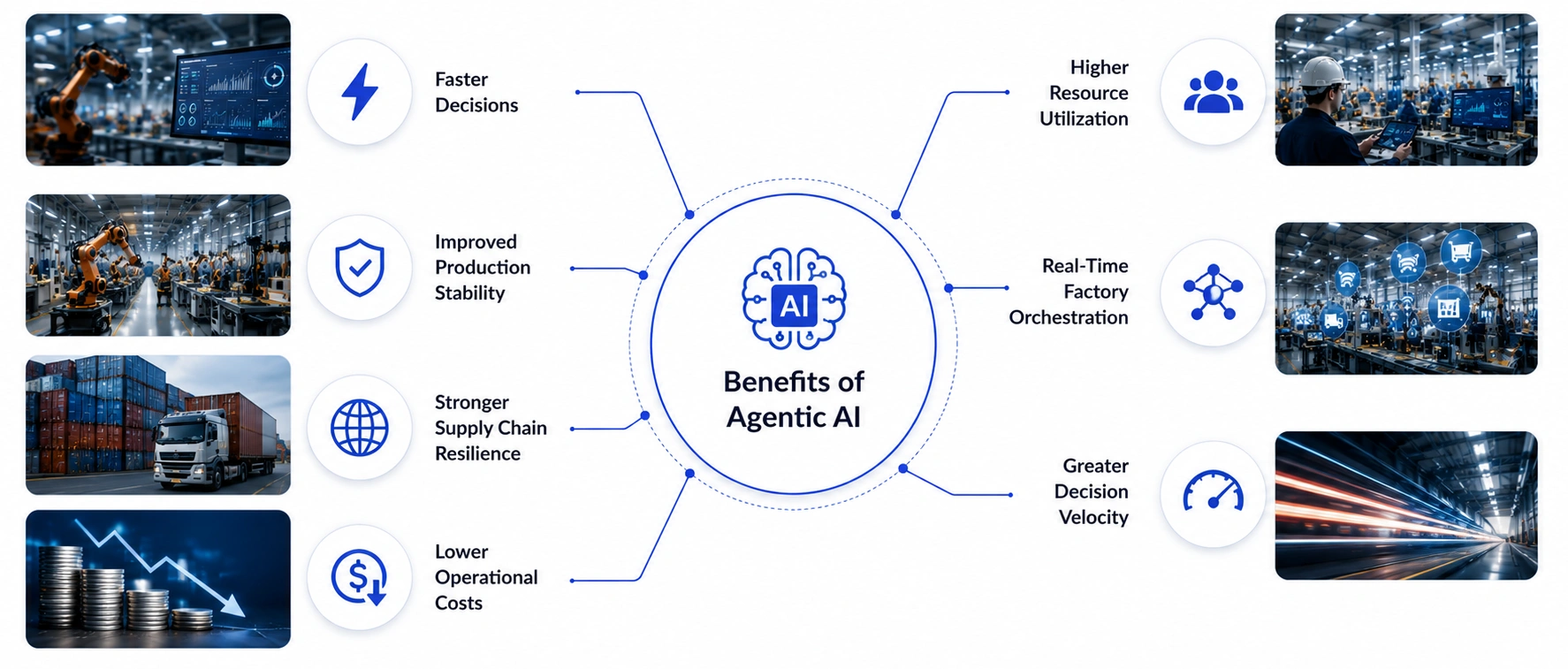
Manufacturers have to deal with a lot of pressure to respond quickly to problems while keeping their operations efficient and profitable.

This is where Agentic AI for Autonomous Decision Making really helps manufacturers. It looks at the data from the factory all the time. Makes smart decisions, which helps the factory run faster more smoothly and be more resilient.

Decision-Making: Agentic AI looks at what is happening and does something about it right away which means there are no more delays because people have to check and approve things.

Improved Production Stability: If something goes wrong Agentic AI changes the production schedule automatically which helps to minimize the time the factory is not working.

Stronger Supply Chain Resilience: It always watches what the suppliers are doing how inventory there is and what people want to buy so it can reduce the impact of unexpected problems.

Lower Operational Costs: Agentic AI makes decisions, which helps to reduce waste, extra work hours, too much inventory and things that are not working well.

Higher Resource Utilization: It makes sure that people, equipment and materials are used in the way possible all the time, which improves how well the factory works.

Real-Time Factory Orchestration: Agentic AI makes decisions that affect production buying things, logistics and inventory which makes everything run smoothly.

Decision Velocity: Manufacturers can respond to changes much faster which gives them an advantage over other companies.

For companies that want to make their operations run on their own Agentic AI provides the part that turns the data from the factory into decisions that can be used right away.

Building Agentic AI for Autonomous Decision Making Solutions

To do this you need to think about what happens after you put AI agents in place. The real benefit comes when the information from the day to day work the systems that the company uses and the way that work is organized all come together to make and carry out decisions away.

As a Enterprise AI Development Company that helps businesses use AI, Azilen assists manufacturers in building Agentic AI for autonomous decision making solutions. They do this by combining Agentic AI, Data Engineering, IoT, Enterprise Integration and Large Language Models into one system that makes decisions.

Here are the steps to follow:

Build a data foundation: Connect the systems that the company uses to manage the business, like ERP, MES, supply chain, inventory and IoT systems. This creates one place where all the information about the work is kept.

Enable real-time visibility: Bring the information from the production floor, inventory, suppliers and the work that is being done. This helps make decisions faster and more accurately.

Deploy AI agents: Create AI agents that watch what is going on find problems and figure out what to do next.

Integrate Enterprise AI across operations: Put AI-driven intelligence into the planning of production managing the supply chain buying things and the work that is being done.

Automate decision execution: Connect the decisions made by AI directly to the systems that the company uses. This reduces the need for people to get involved and makes things happen faster.

Optimize factory operations continuously: Use Agentic AI workflows and real-time information to make production more efficient use resources better and make the work more resilient.

When you do these things manufacturers can reduce delays make decisions faster make the supply chain stronger and get closer, to having a factory that can run on its own.

Autonomous Decision Making Manufacturing
Ready to Build Smarter Manufacturing Operations?
Talk to our experts and discover how Agentic AI can accelerate decision-making across your factory.

FAQs: Agentic AI for Autonomous Decision Making

1. What is Agentic AI for Autonomous Decision Making in manufacturing?

Agentic AI for Autonomous Decision Making is an advanced AI approach that allows manufacturing systems to analyze real-time operational data, evaluate different scenarios, and take actions with minimal human intervention. Unlike traditional automation, AI agents can adapt to changing conditions, optimize production schedules, respond to supply chain disruptions, and continuously improve operational performance.

2. How does Agentic AI improve manufacturing operations?

Agentic AI improves manufacturing operations by reducing decision-making delays, optimizing resource allocation, improving production planning, and increasing supply chain resilience. AI agents continuously monitor factory conditions and execute actions based on business objectives, helping manufacturers operate more efficiently and respond faster to disruptions.

3. What is the difference between traditional automation and Agentic AI?

Traditional automation follows predefined rules and workflows, while Agentic AI can understand context, evaluate multiple options, and make intelligent decisions in real time. This allows manufacturers to move beyond automated tasks and create autonomous operations that adapt to changing business and production conditions.

4. What technologies are required to implement Agentic AI for Autonomous Decision Making?

Successful Agentic AI implementations typically combine AI Agents, Large Language Models (LLMs), Data Engineering, IoT platforms, Enterprise Integration Layers, ERP systems, and Manufacturing Execution Systems (MES). Together, these technologies provide the real-time data and intelligence needed for autonomous decision-making.

5. How can an Enterprise AI Development Company help build Agentic AI solutions?

An experienced Enterprise AI Development Company helps manufacturers design the right data foundation, integrate enterprise systems, develop intelligent AI agents, and automate operational workflows. This enables organizations to implement Agentic AI for Autonomous Decision Making faster while reducing implementation risks and accelerating business value.

author avatar
Chintan Shah Vice President – Delivery
Chintan Shah is VP – Delivery at Azilen Technologies, specializing in enterprise solutions, digital transformation, and scalable software delivery. He focuses on driving operational excellence and high-performance technology execution.
google
Chintan Shah
Chintan Shah
Vice President - Delivery at Azilen Technologies

Chintan Shah is an experienced software professional specializing in large-scale digital transformation and enterprise solutions. As VP - Delivery at Azilen Technologies, he drives strategic project execution, process optimization, and technology-driven innovations. With expertise across multiple domains, he ensures seamless software delivery and operational excellence.

Related Insights

GPT Mode
AziGPT - Azilen’s
Custom GPT Assistant.
Instant Answers. Smart Summaries.