Skip to content

How Predictive Maintenance AI Works in Oil and Gas (And How to Build One)

Featured Image

Executive Summary

Predictive Maintenance AI helps oil and gas companies predict equipment failures before they happen by analyzing real-time sensor data with machine learning. Instead of relying on fixed maintenance schedules, it enables condition-based maintenance that reduces unplanned downtime, extends asset life, and improves operational efficiency. This guide explains how Predictive Maintenance AI works, the technologies behind it, the implementation process, and the key considerations for building a successful AI-powered predictive maintenance system.

→ Understand how Predictive Maintenance AI uses sensor data, machine learning, and anomaly detection to identify potential equipment failures.

→ Explore the step-by-step process of building an AI-powered predictive maintenance system, from data collection and model training to CMMS integration.

→ Learn the business benefits, common implementation challenges, and real-world results of predictive maintenance in oil and gas to accelerate your AI adoption strategy.

Every equipment failure tells a story before it happens. The problem is, those warning signs are hidden in millions of sensor readings that no human can monitor continuously.

Predictive Maintenance AI turns those signals into actionable insights. It detects potential failures before they become costly shutdowns, enabling smarter maintenance decisions across oil and gas operations. Here’s how the technology works and what it takes to build a production-ready solution.

“In oil and gas, the cost of missing a warning sign is measured in downtime, revenue, and risk. AI makes those warnings impossible to ignore.”

The Role of Predictive Maintenance AI in Oil and Gas Operations

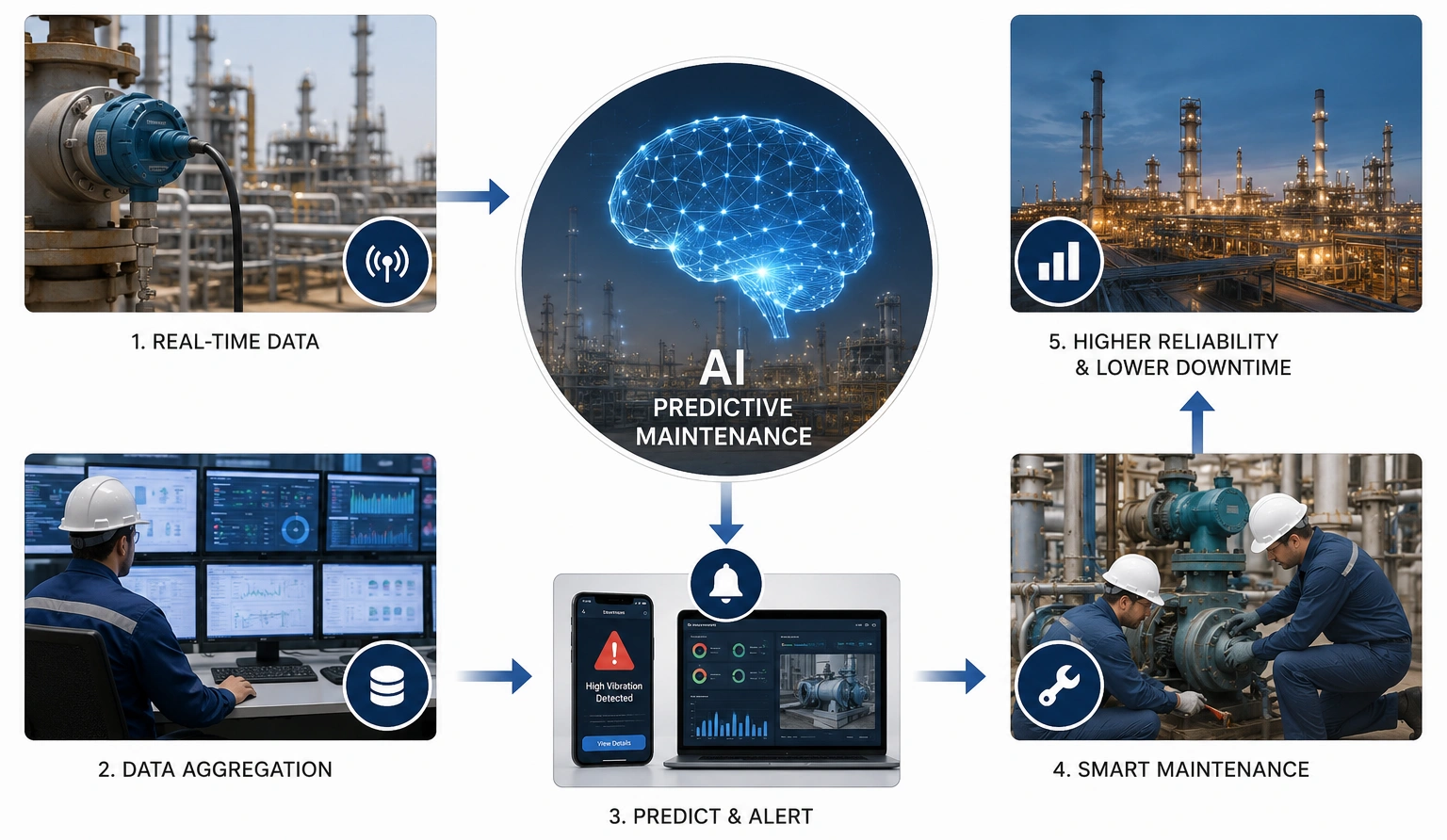
In the oil and gas industry, equipment failures can lead to costly downtime, production losses, and safety risks. Predictive Maintenance AI helps operators monitor asset health in real time, predict failures before they happen, and make smarter maintenance decisions based on actual equipment condition rather than fixed schedules.

Role of Predictive Maintenance AI in Oil and Gas Operations

Monitor Equipment Health in Real Time: Continuously analyzes sensor data such as vibration, temperature, pressure, and acoustic signals to detect abnormal equipment behavior before it becomes a major issue.

Predict Equipment Failures Early: Uses machine learning and historical maintenance data to identify failure patterns, allowing maintenance teams to address problems before unexpected breakdowns occur.

Optimize Maintenance Planning: Enables condition-based maintenance by scheduling repairs only when equipment shows signs of wear, reducing unnecessary maintenance activities and operational costs.

Improve Asset Reliability and Uptime: Keeps pumps, compressors, turbines, pipelines, and other critical assets running efficiently, extending equipment life while reducing unplanned downtime.

Support Safer, Data-Driven Operations: Integrates with SCADA, IoT sensors, and CMMS platforms to deliver actionable insights, helping operators improve safety, streamline maintenance workflows, and make faster operational decisions.

18,214 24,501 31,890 39,120 42,000
Free ROI & Cost Calculators

Stop Guessing. Start Calculating.

Get a real, data-backed number in under two minutes — whether you're scoping an AI investment or weighing maintenance spend against uptime and OEE gains.

Free · Instant results · No signup required

Predictive Maintenance AI vs Traditional Maintenance Approaches

Traditional maintenance relies on fixed schedules or repairs after a breakdown, often leading to unnecessary servicing or costly downtime. Predictive Maintenance AI takes a smarter approach by analyzing real-time equipment data to identify potential failures before they occur. Here’s how the two compare.

Traditional Maintenance Predictive Maintenance AI Business Impact
Time-based or reactive maintenance AI-driven, condition-based maintenance Fewer unexpected equipment failures
Manual inspections and scheduled servicing Real-time monitoring using IoT sensor data Faster issue detection and response
Problems identified after visible symptoms Predicts failures using machine learning Reduced unplanned downtime
Frequent or emergency maintenance Maintenance only when needed Lower maintenance costs
Limited asset health visibility Continuous equipment health monitoring Improved asset reliability and longer equipment life
Reactive maintenance decisions Data-driven maintenance recommendations Better operational efficiency and safety

How Does Predictive Maintenance AI in Oil and Gas Actually Work?

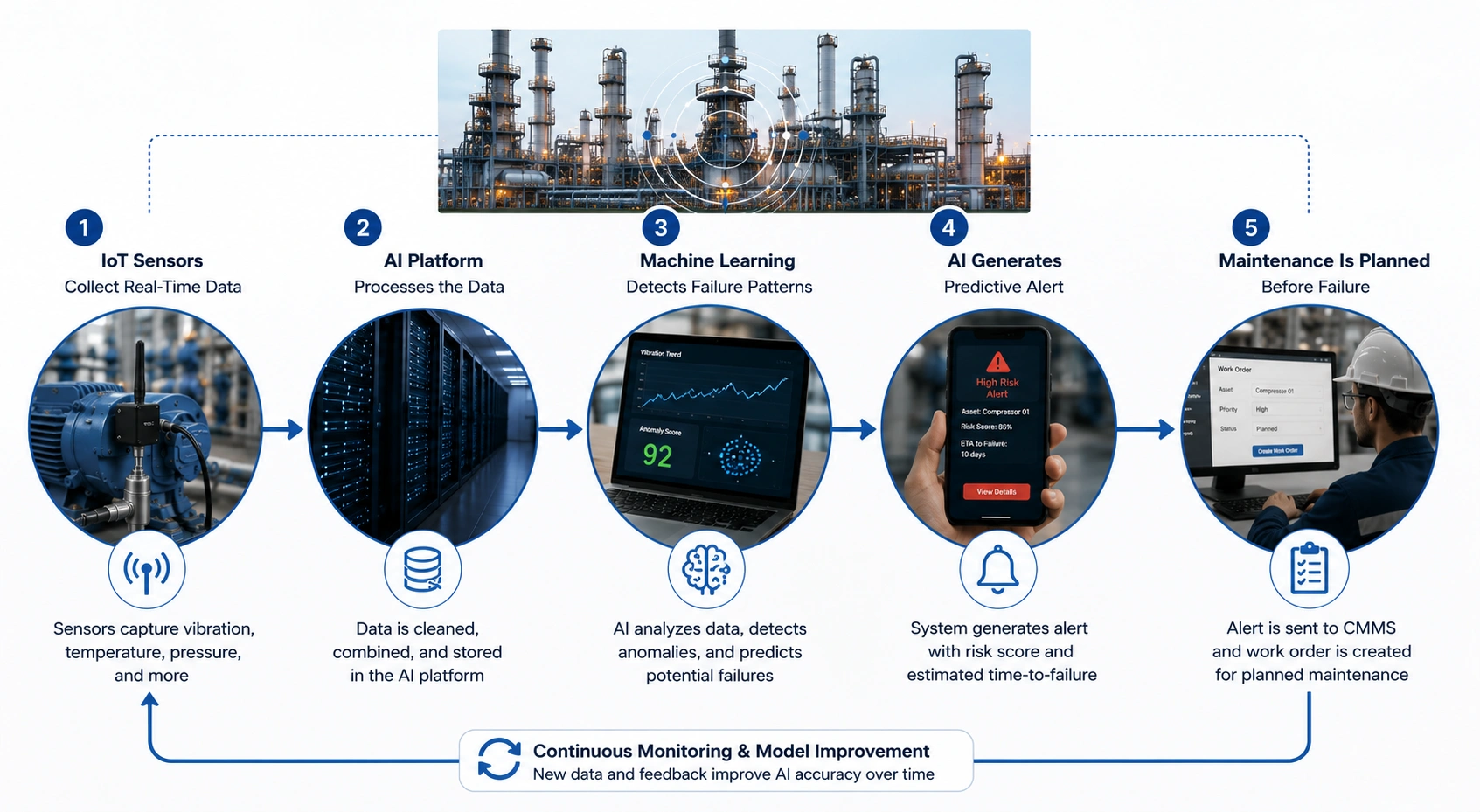
At its core, Predictive Maintenance AI in Oil and Gas follows a continuous five-step process that transforms real-time equipment data into proactive maintenance decisions. By combining IoT sensors, AI platforms, machine learning, and CMMS integration, oil and gas operators can detect potential equipment failures before they disrupt production, improve asset reliability, and optimize maintenance planning.

The diagram below illustrates how Predictive Maintenance AI in Oil and Gas works, from collecting sensor data to automatically generating maintenance recommendations and work orders.

Predictive Maintenance AI in Oil and Gas Actually Work

1. IoT Sensors Collect Real-Time Data

Industrial IoT solutions deploy sensors across pumps, compressors, turbines, pipelines, and other critical assets to continuously capture real-time equipment data, including vibration, temperature, pressure, flow rate, and acoustic signals.

Example: An Industrial IoT Solution detects a gradual increase in vibration from a compressor over several days, signaling early bearing wear before it leads to an unexpected failure.

2. The AI Platform Processes the Data

The sensor data is transmitted to an AI platform or industrial data lake, where it is cleaned, organized, and combined with historical maintenance records and equipment operating data.

Example: The AI platform compares current compressor readings with maintenance records from the past three years to identify normal operating behavior and detect unusual patterns.

3. Machine Learning Detects Failure Patterns

Machine learning models analyze live equipment data alongside historical failure patterns to identify anomalies, predict equipment failures, and estimate the remaining useful life of critical assets.

Example: The AI model recognizes that the current vibration and temperature trend closely matches a previous bearing failure that occurred two weeks before an unplanned shutdown.

4. AI Generates a Predictive Alert

When the probability of failure exceeds a predefined threshold, the Predictive Maintenance AI platform automatically generates an alert containing a risk score, confidence level, and estimated time-to-failure.

Example: The maintenance team receives an alert indicating that the compressor has an 85% probability of bearing failure within the next 10 days, allowing them to schedule maintenance before a breakdown occurs.

5. Maintenance Is Planned Before Failure

The predictive alert is automatically integrated with a CMMS, such as IBM Maximo or SAP PM, where a work order is created for maintenance engineers to inspect and repair the equipment during a planned maintenance window.

Example: Engineers replace the worn bearing during scheduled downtime, preventing an unexpected production shutdown, reducing maintenance costs, and extending the asset’s operational life.

Why Does Unplanned Downtime Cost Oil and Gas Companies So Much?

Oil and gas has some of the highest downtime costs of any industry, because a single shut-in asset stops production entirely rather than just slowing a line. Here’s how it compares.

Average Cost of One Hour of Unplanned Downtime, by Industry-reported estimates, most recent published figures:

Oil & Gas ($500000)
Automotive ($2,300,000)
Manufacturing (avg.) ($260,000)
Cross-industry median ($125,000)

27 days

Average unplanned downtime per year for an offshore oil and gas asset

$42M/yr

Average annual cost of unplanned downtime reported

$6.6B/yr

What U.S. refiners alone lose annually to unplanned downtime

Key Components of a Predictive Maintenance AI System

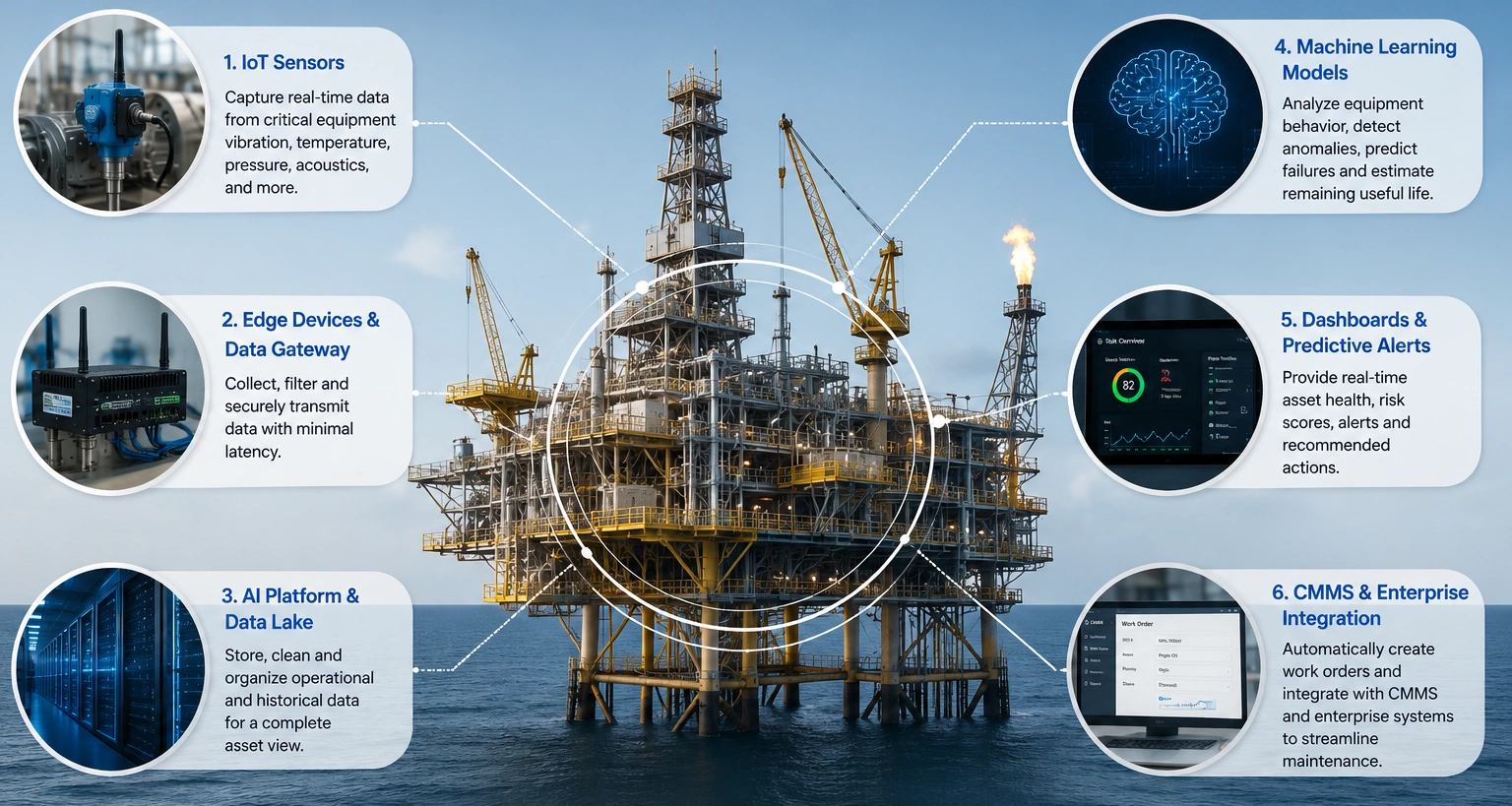
A successful Predictive Maintenance AI system is more than just a machine learning model. It combines industrial sensors, data infrastructure, AI platforms, and enterprise applications to continuously monitor equipment health and recommend maintenance actions.

Each component plays a critical role in transforming raw operational data into reliable, data-driven maintenance decisions.

Key Components of a Predictive Maintenance AI System

IoT Sensors: Capture real-time equipment data such as vibration, temperature, pressure, acoustic signals, and flow rate from critical assets like pumps, compressors, turbines, and pipelines.

Edge Devices & Data Gateway: Collect sensor data from multiple assets, filter unnecessary information, and securely transmit it to the AI platform with minimal latency.

AI Platform & Data Lake: Store, clean, and organize historical and live operational data. The AI platform combines sensor readings with maintenance records to create a complete view of asset health.

Machine Learning Models: Analyze equipment behavior, detect anomalies, predict potential failures, and estimate the remaining useful life (RUL) of critical assets.

Dashboards & Predictive Alerts: Present maintenance teams with real-time asset health, risk scores, failure predictions, and recommended actions through intuitive dashboards and automated alerts.

CMMS & Enterprise Integration: Connect with systems like IBM Maximo, SAP PM, or other CMMS platforms to automatically generate work orders and streamline maintenance workflows.

What Results Are Oil and Gas Companies Actually Getting?

The business value of Predictive Maintenance AI is no longer theoretical. Leading oil and gas companies are already using AI-powered maintenance to reduce downtime, improve asset reliability, and increase operational efficiency. The examples below highlight publicly reported outcomes from real-world deployments.

Organization AI Implementation Reported Results
Shell AI-driven predictive maintenance across offshore assets Detected ~70% of pump failures up to two days early, reducing unplanned downtime by up to 25% and maintenance costs by 15%.
McKinsey Research Industry-wide predictive maintenance analysis Reported 30–50% reduction in unplanned downtime and 20–40% longer equipment life.
ADNOC Enterprise AI platform across operations Generated approximately $500 million in annual business value through AI-driven operational improvements.
Industry Trends AI investment in oil & gas Predictive maintenance accounts for 37.6% of AI spending, making it the industry's largest AI application.

These figures are based on publicly available reports and industry research. Actual results depend on asset condition, data quality, and implementation strategy.

How to Build a Predictive Maintenance AI in Oil and Gas Solution

Building a production-ready Predictive Maintenance AI in Oil and Gas solution requires more than selecting a machine learning model. Success depends on combining high-quality operational data, scalable AI infrastructure, and seamless integration with existing industrial systems.

At Azilen Technologies, we help oil and gas companies design, develop, and deploy AI-powered predictive maintenance solutions that integrate with their existing technology landscape and deliver measurable business outcomes.

Assess Your Data Readiness: Evaluate existing IoT sensors, SCADA systems, maintenance records, and operational data to determine whether sufficient, high-quality data is available to build an effective Predictive Maintenance AI in Oil and Gas solution.

Build a Scalable Data Foundation: Integrate data from Industrial IoT solutions, historians, ERP, and CMMS platforms into a centralized AI platform that supports secure, real-time analytics and predictive insights.

Develop and Train AI Models: Use machine learning, anomaly detection, and predictive analytics to identify equipment failure patterns, estimate remaining useful life, and continuously improve prediction accuracy.

Integrate with Enterprise Systems: Connect your Predictive Maintenance AI in Oil and Gas solution with SCADA, IoT platforms, IBM Maximo, SAP PM, and other enterprise applications to automate alerts and maintenance workflows.

Deploy, Monitor, and Optimize: Deploy the solution across production environments, validate model performance, monitor prediction accuracy, and continuously retrain AI models as new operational data becomes available.

Build a Smarter Predictive Maintenance AI Strategy

Implementing Predictive Maintenance AI is more than deploying machine learning models. The real value comes from transforming equipment data into proactive maintenance decisions that reduce downtime, improve asset reliability, and optimize operational performance.

As an enterprise AI development company, Azilen helps oil and gas organizations design, build, and scale AI-powered predictive maintenance solutions that integrate seamlessly with existing operations.

→ Assess asset readiness and identify the highest-value predictive maintenance use cases

→ Develop AI models using real-time sensor data and historical maintenance records

→ Integrate AI with IoT, SCADA, ERP, and CMMS platforms for seamless workflows

→ Deploy scalable AI solutions that continuously monitor equipment health

→ Reduce unplanned downtime, maintenance costs, and equipment failures

→ Improve asset reliability, operational efficiency, and maintenance decision-making

Whether you’re starting with a single critical asset or scaling Predictive Maintenance AI across multiple facilities, Azilen helps you turn operational data into measurable business outcomes.

Get a Tailored AI Strategy for Your Oil & Gas Operations
CTA

FAQs: AI in Oil & Gas Industry

1. What equipment can benefit most from Predictive Maintenance AI in oil and gas?

Predictive Maintenance AI is most effective for critical assets that generate continuous operational data, including pumps, compressors, turbines, pipelines, motors, valves, drilling equipment, and heat exchangers. These assets are monitored using IoT sensors that track vibration, temperature, pressure, and other performance metrics to detect early signs of failure before they disrupt operations.

2. What data is required to build a Predictive Maintenance AI solution?

A Predictive Maintenance AI solution relies on a combination of real-time sensor data, historical maintenance records, equipment operating conditions, and failure history. The more accurate and consistent the data, the better machine learning models can predict equipment failures and optimize maintenance schedules.

3. Can Predictive Maintenance AI integrate with existing SCADA and CMMS systems?

Yes. Modern Predictive Maintenance AI platforms are designed to integrate with existing industrial systems, including SCADA, IoT platforms, ERP solutions, and CMMS software such as IBM Maximo and SAP PM. This allows organizations to automate alerts, create work orders, and improve maintenance workflows without replacing their existing infrastructure.

4. How long does it take to implement Predictive Maintenance AI?

Implementation timelines depend on asset complexity, data quality, and system integration requirements. A pilot project for a single asset type can often be completed within 8–14 weeks, while enterprise-wide deployment across multiple facilities may take several months as additional assets and workflows are integrated.

5. Why choose Azilen to build a Predictive Maintenance AI solution?

Azilen helps oil and gas companies design, develop, and scale Predictive Maintenance AI solutions tailored to their operations. From AI strategy and data engineering to machine learning, IoT integration, and enterprise deployment, our team builds scalable solutions that reduce downtime, improve asset reliability, and integrate seamlessly with existing industrial systems.

author avatar
Chintan Shah Vice President – Delivery
Chintan Shah is VP – Delivery at Azilen Technologies, specializing in enterprise solutions, digital transformation, and scalable software delivery. He focuses on driving operational excellence and high-performance technology execution.
google
Chintan Shah
Chintan Shah
Vice President - Delivery at Azilen Technologies

Chintan Shah is an experienced software professional specializing in large-scale digital transformation and enterprise solutions. As VP - Delivery at Azilen Technologies, he drives strategic project execution, process optimization, and technology-driven innovations. With expertise across multiple domains, he ensures seamless software delivery and operational excellence.

Related Insights

GPT Mode
AziGPT - Azilen’s
Custom GPT Assistant.
Instant Answers. Smart Summaries.