




 14 mins
Sep 02, 2025
Methane emissions have become one of the biggest operational, financial, and compliance challenges for the oil and gas industry.
As regulations tighten and investors demand greater transparency, traditional leak detection methods are no longer enough.
AI for methane emissions enables companies to detect leaks in real time, reduce product loss, automate compliance reporting, and improve operational efficiency, turning methane management from a regulatory burden into a business advantage.
Methane is the main component of natural gas and is released during oil and gas exploration, production, processing, storage, and transportation. Although it is invisible, methane has a significant impact on both the environment and business operations.
→ A powerful greenhouse gas: Methane traps around 80 times more heat than CO₂ over a 20-year period, making it one of the biggest contributors to short-term global warming.
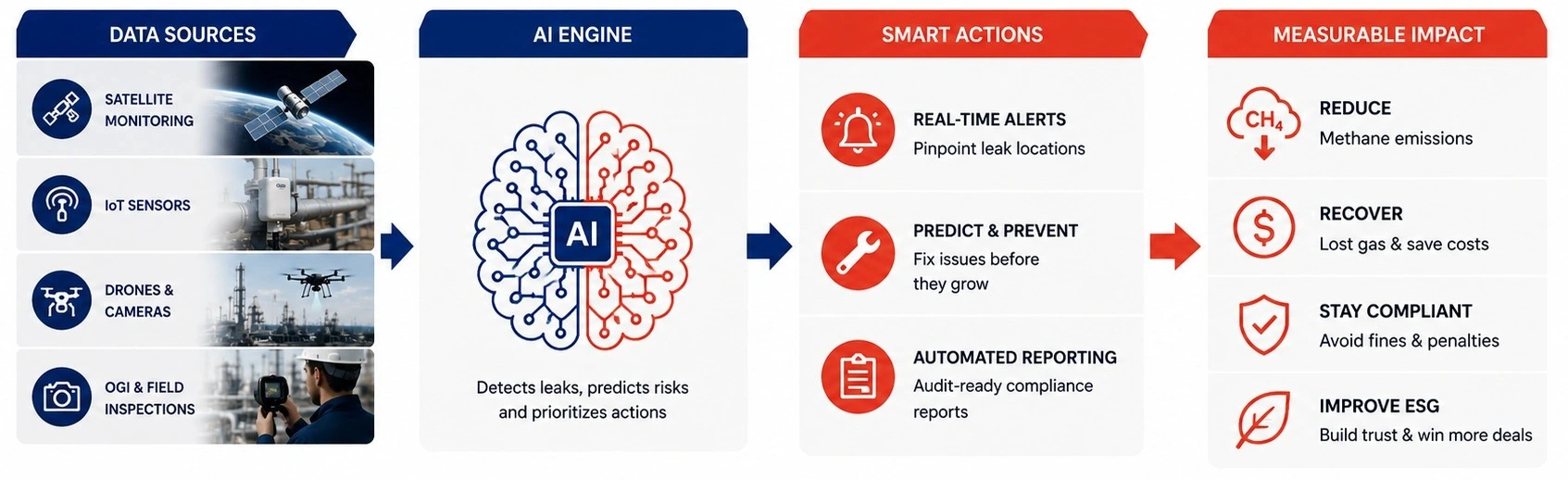
→ A direct financial loss: Every methane leak is lost natural gas that could have been sold. According to Wipro, oil and gas companies lost tens of billions of dollars in FY23 due to methane leaks, energy waste, and regulatory penalties.
Reducing methane emissions is no longer just an environmental goal. It helps oil and gas companies recover valuable product, lower operational costs, strengthen ESG performance, and stay compliant with evolving methane regulations.
Three things are pushing companies to act:
| Pressure | What It Means in Simple Words | Key Date |
|---|---|---|
| EU Methane Regulation | If you sell oil or gas to the EU, you must prove—using measured data—how much methane you emit. Companies that fail to comply could face penalties of up to 20% of their annual turnover. | Full import rules apply from January 2027 |
| Investor & Buyer Pressure | Even without regulatory fines, investors and customers increasingly expect proof of low methane emissions. Companies unable to provide reliable data risk losing business opportunities. | Ongoing |
| Public Satellite Tracking | The UN's MARS system monitors methane emissions from space and alerts governments and the public when significant leaks are detected, even if companies do not report them. | Live since 2024 |
Methane compliance is no longer limited to detecting leaks. Operators must prove emissions data is accurate, maintain complete records, respond to incidents on time, and demonstrate compliance throughout the asset lifecycle. AI helps automate these compliance activities, reducing administrative effort while improving accuracy and audit readiness.
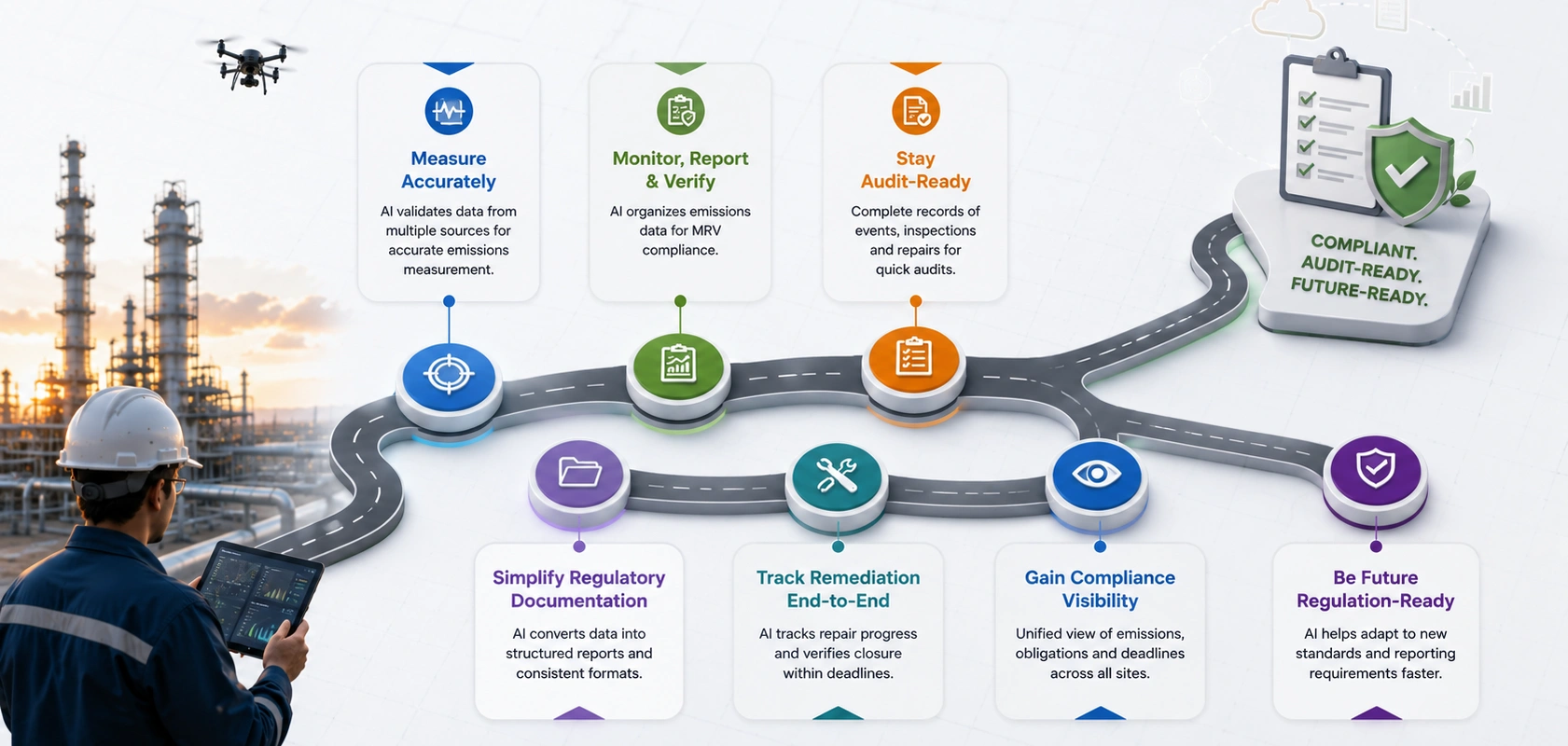
→ Measurement Accuracy: Regulations increasingly require measured methane emissions instead of estimates. AI validates data from multiple monitoring sources, helping improve the accuracy and consistency of emissions records.
→ Monitoring, Reporting & Verification (MRV): AI supports MRV frameworks by continuously organising emissions data, maintaining historical records, and ensuring evidence is available throughout the reporting period rather than only during audits.
→ Audit Readiness: AI maintains a complete digital record of methane events, inspections, repairs, and verification activities, allowing operators to produce audit evidence quickly without manually collecting information from multiple systems.
→ Regulatory Documentation: Compliance requires extensive documentation for regulators, customers, and ESG reporting. AI streamlines document preparation by organising emissions data into consistent, structured formats that reduce reporting effort and human error.
→ Leak Remediation Tracking: Compliance does not end when a leak is detected. AI tracks remediation timelines, repair status, verification inspections, and closure records, helping demonstrate that corrective actions were completed within required timeframes.
→ Future Regulatory Readiness: As methane regulations continue to evolve globally, AI enables organisations to adapt more quickly by supporting new reporting requirements, measurement standards, and customer compliance requests without rebuilding existing processes.
Traditional methane leak detection relies on periodic inspections, which often leave leaks undetected for days or even weeks. AI transforms this process by continuously analysing data from multiple sources, identifying abnormal patterns, and helping operators act before small leaks become costly environmental and financial problems.
Methane emissions are not only an environmental concern, they also represent lost revenue, rising maintenance costs, and increasing compliance risks. Every undetected leak means valuable natural gas escapes into the atmosphere instead of being sold.
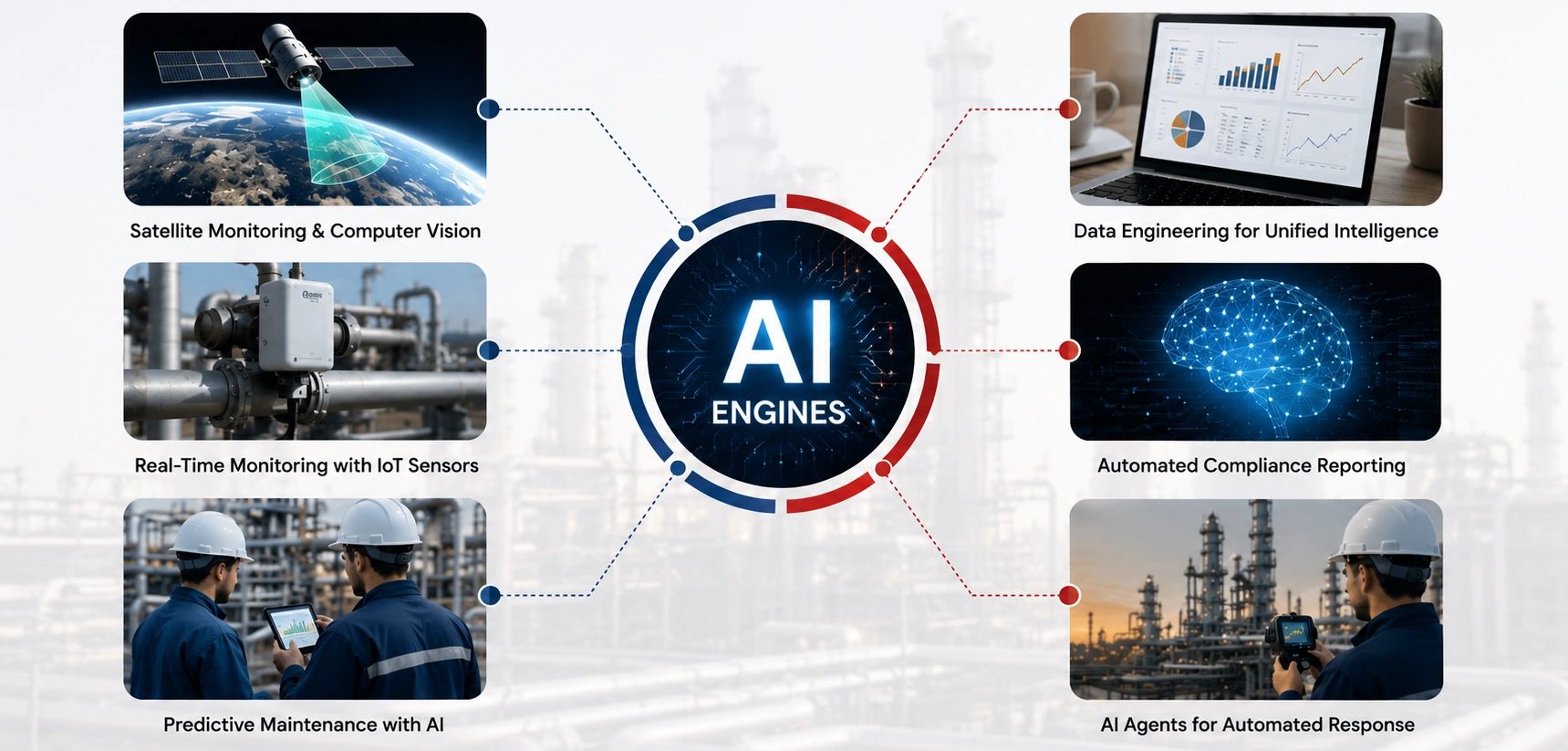
By using AI for methane emissions, oil and gas companies can detect leaks earlier, predict equipment failures, automate compliance reporting, and significantly improve operational efficiency.
| AI Capability | How It Creates Value | Potential Business Impact |
|---|---|---|
| AI Methane Leak Detection | Detects methane leaks early using satellite imagery, computer vision, drones, and IoT sensors, reducing gas loss before it becomes a major issue. | ~100 million m³ of natural gas recovered in a 2025 AI methane programme. |
| Predictive Maintenance | Uses AI, machine learning, and equipment health analytics to predict failures before valves, compressors, seals, or pipelines begin leaking. | 15%+ reduction in maintenance costs (Wipro). |
| Continuous AI Monitoring | Continuously analyses sensor data and operating conditions to identify abnormal methane emissions in real time. | 30–70% reduction in methane emissions reported across industry programmes. |
| Automated Compliance Reporting | Generates audit-ready emissions reports and maintains continuous records for regulatory compliance and ESG reporting. | Helps reduce compliance costs and avoid penalties of up to 20% of annual turnover under the EU Methane Regulation. |
| Enterprise AI for Methane Management | Combines leak detection, predictive maintenance, and operational intelligence into a single AI-driven workflow. | ~US$20 million estimated business value generated in a national oil company methane abatement programme. |
The financial benefits of AI extend well beyond regulatory compliance. Wipro reports that AI-driven predictive maintenance can reduce methane emissions by more than 70% while lowering maintenance costs by over 15% by identifying equipment issues before they become leaks.
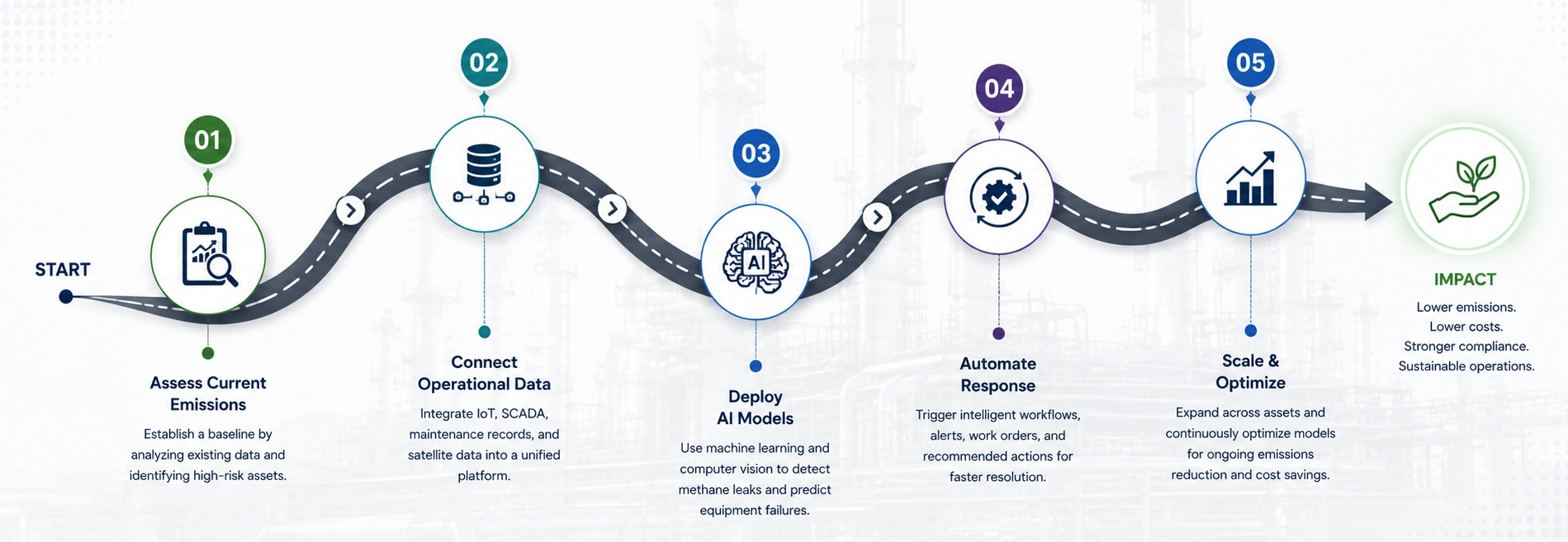
Adopting AI for methane emissions does not require replacing existing infrastructure overnight. Most successful oil and gas companies begin with a pilot project, validate results, and gradually expand AI across assets, pipelines, and processing facilities.
A phased implementation reduces deployment risk while delivering measurable operational and financial value.

AI detects methane leaks by analysing data from satellite imagery, IoT sensors, Optical Gas Imaging (OGI) cameras, drones, and SCADA systems. Using machine learning and computer vision, AI identifies abnormal methane emissions in real time, prioritises high-risk leaks, and alerts operators before they become costly environmental or operational issues.
AI helps oil and gas companies reduce methane emissions, recover lost natural gas, lower maintenance costs, improve asset reliability, and automate regulatory reporting. It also enables predictive maintenance, real-time monitoring, and faster leak response, helping organisations achieve both sustainability and operational efficiency goals.
Yes. AI automates methane monitoring, continuously tracks emissions, and generates audit-ready compliance reports. This helps operators meet requirements such as the EU Methane Regulation, improve ESG reporting, maintain accurate emissions records, and reduce the risk of regulatory penalties.
AI-powered methane management combines multiple technologies, including Computer Vision, Industrial IoT, predictive analytics, Generative AI, satellite monitoring, drones, Optical Gas Imaging (OGI), and AI agents. Together, these technologies enable continuous monitoring, intelligent leak detection, predictive maintenance, and automated compliance workflows.
Most organisations begin by establishing an emissions baseline, integrating operational data from IoT sensors, SCADA systems, and inspection records, and deploying AI models for methane leak detection and predictive maintenance. As the programme matures, companies can automate compliance reporting, optimise maintenance workflows, and scale AI across upstream, midstream, and downstream operations to maximise business value.
 14 mins
 "*" indicates required fields

5432 Geary Blvd, Unit #527 San Francisco, CA 94121 United States
320 Decker Drive Irving, TX 75062 United States

6d-7398 Yonge St,1318 Thornhill, Ontario, Canada, L4J8J2

71-75 Shelton Street, Covent Garden, London, United Kingdom, WC2H 9JQ

Hohrainstrasse 16, 79787 Lauchringen, Germany

12, Zugerstrasse 32, 6341 Baar, Switzerland

5th floor, Bloukrans Building, Lynnwood Road, Pretoria, Gauteng, 0081, South Africa

12th & 13th Floor, B Square-1, Bopal – Ambli Road, Ahmedabad – 380054
B/305A, 3rd Floor, Kanakia Wallstreet, Andheri (East), Mumbai, India








 Talk to Our
Consultants
Talk to Our
Consultants Chat with
Our Experts
Chat with
Our Experts Write us
an Email
Write us
an Email