Skip to content

Smart Energy Management & Sustainability Analytics

Featured Image

Executive Summary

Energy costs are going up. Manufacturers have to meet sustainability targets. At the time they need to make more products without spending more money on operations.

This is getting hard because most plants do not know where their energy is going. They do not know where it is being wasted or used unnecessarily.

With Smart Energy Management and Sustainability Analytics manufacturers can see how energy they are using right now. They can find out what is not working well and make decisions about how to run their operations. By using sensors Data Engineering, cloud platforms and AI-driven analytics companies can see what they need to do to lower their energy bills reduce their carbon footprint and be more sustainable.

At Azilen we help manufacturers use their energy data to make business decisions. We help them grow without having to pay more for energy or worry about sustainability.

Why Smart Energy Management is Becoming a Big Deal

For a time, energy was just a normal cost of doing business.

A plant used power. Got a utility bill. Kept going.

That does not work anymore.

Today manufacturers are under a lot of pressure from regulators, customers, investors and partners to be more efficient and show they are being sustainable. At the time energy prices keep changing making it hard to know what operating costs will be.

So more manufacturing leaders are asking:

How can we keep making more products without using too much energy and making too much carbon?

The problem is that most facilities do not know how they are using energy.

Production data is in one system. Utility data is else. Equipment-level energy information is often missing. Because of this many companies only find out they are wasting energy after they have already spent much money.

This is where Smart Energy Management and Sustainability Analytics really help.

Now looking at old reports and guessing manufacturers can see in real time how energy is being used in their machines, production lines and facilities. Importantly they can see what they need to do to stop wasting energy before it becomes a big problem.

The result is not just using energy.

The result is having control over operations being more sustainable and having a clearer path, to growing in the long term.

The Business Problem: Energy Data Exists Everywhere but Insights Exist Nowhere

The Business Problem

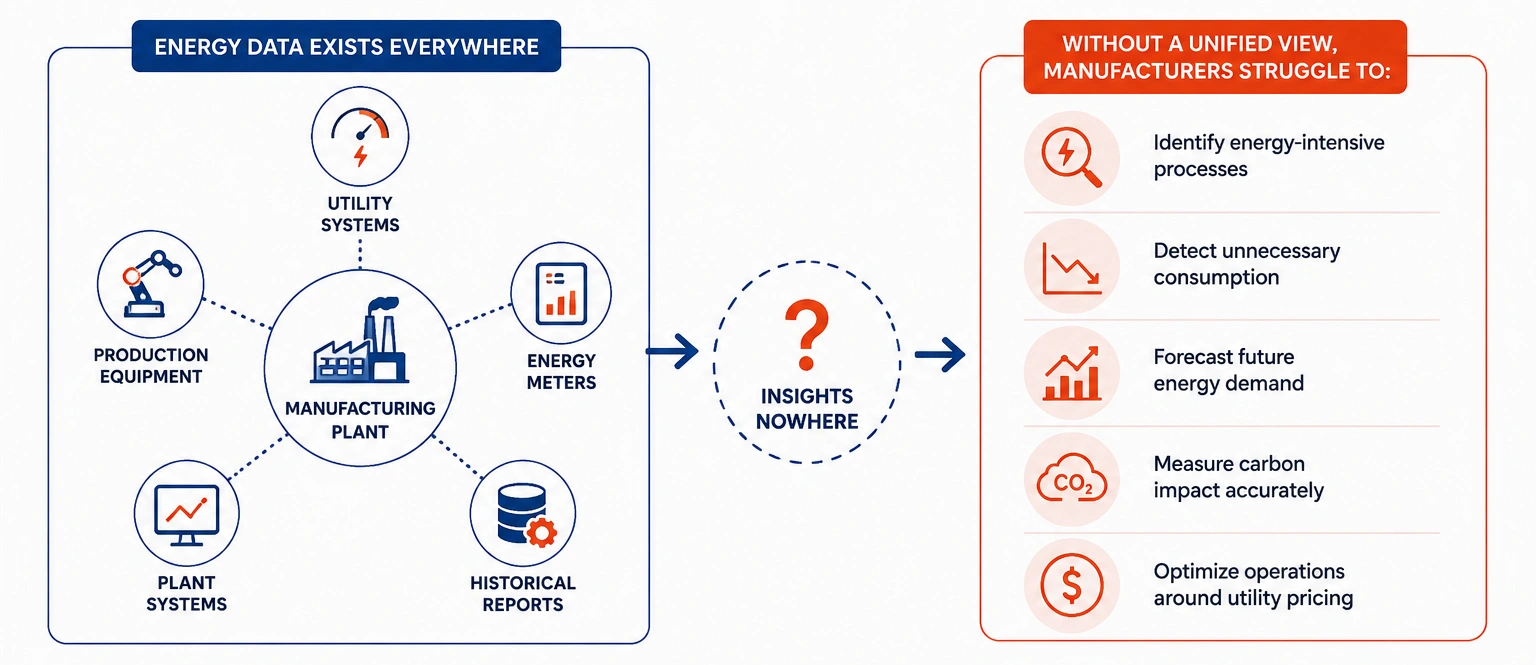
Many plants already generate large amounts of operational data.

However, energy information is often disconnected from production data.

Without a unified view, manufacturers struggle to:

→ Identify energy-intensive processes

→ Detect unnecessary consumption

→ Forecast future energy demand

→ Measure carbon impact accurately

→ Optimize operations around utility pricing

Consequently, leadership teams make decisions based on historical reports instead of real-time intelligence.

That delay creates unnecessary cost and risk.

How Azilen Helps Manufacturers Turn Energy Data Into Cost Savings

Every manufacturing facility consumes energy. The problem is that very few facilities know exactly where that energy is going.

When we started working on Smart Energy Management & Sustainability Analytics initiatives, one challenge appeared almost every time. Energy data existed, but nobody had a complete picture. Production teams looked at machine performance. Facility teams monitored utilities. Sustainability teams tracked carbon metrics. Yet all three groups were often working from different data sets.

The first thing we focus on is connecting those disconnected views.

1. Bringing Energy Consumption Into One Place

1. Bringing Energy Consumption Into One Place

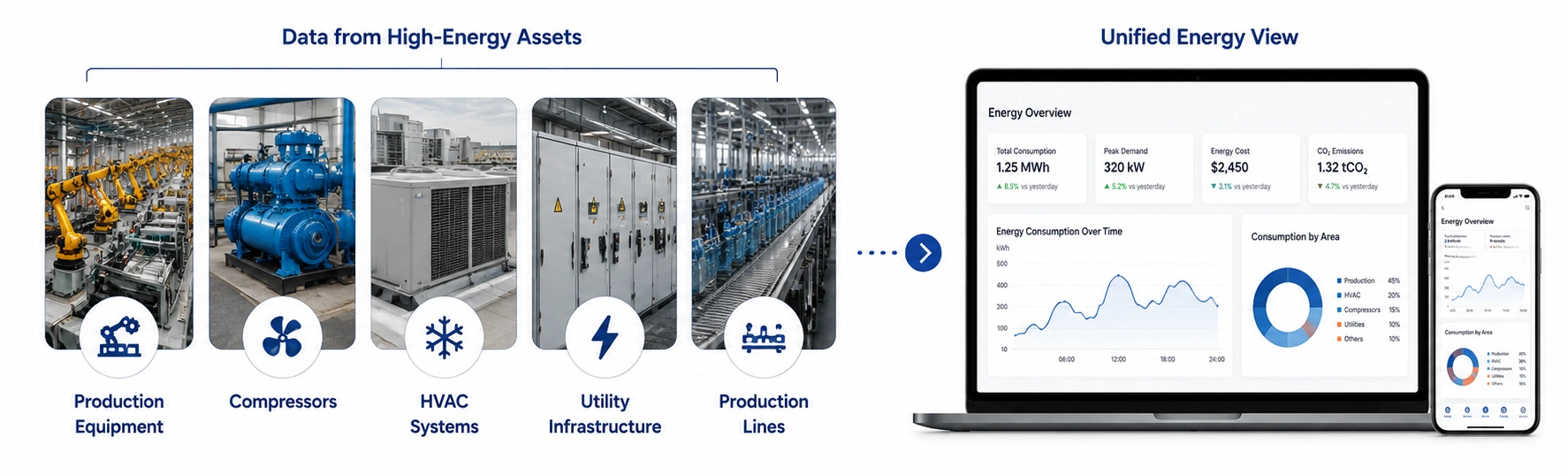
We begin by collecting data from the assets that consume the most energy. Depending on the facility, this may include production equipment, compressors, HVAC systems, utility infrastructure, or entire production lines.

Instead of waiting for monthly utility reports, plant teams start seeing what is happening while operations are running. This often reveals surprises. Equipment that was assumed to be efficient may be consuming far more power than expected. Some assets continue drawing energy even when production demand is low.

However, uncovering these insights becomes difficult when information is scattered across multiple systems. This is where a strong Data Strategy Consulting, architecture, and planning approach becomes essential.

2. Building a Reliable Data Foundation

Building a Reliable Data Foundation

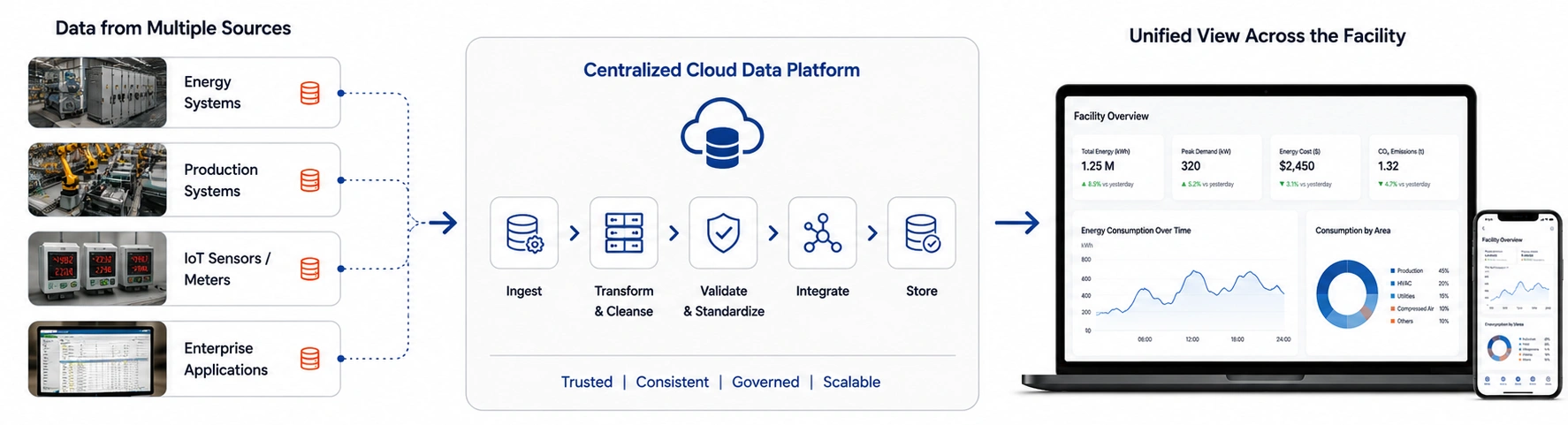
Once the data starts flowing, the next challenge is making it usable.

In many manufacturing environments, energy information comes from different platforms, different vendors, and different formats. Looking at raw data rarely helps leadership teams make decisions.

This is where our Data Engineering teams become heavily involved.

We create a centralized cloud environment where energy, operational, and production data can be viewed together. Rather than comparing spreadsheets from multiple departments, manufacturers gain a single view of performance across the facility.

That foundation becomes important later because every recommendation depends on having trusted data.

3. Finding Patterns That Normally Go Unnoticed

3. Finding Patterns That Normally Go Unnoticed

After the data is organized, patterns begin to emerge.

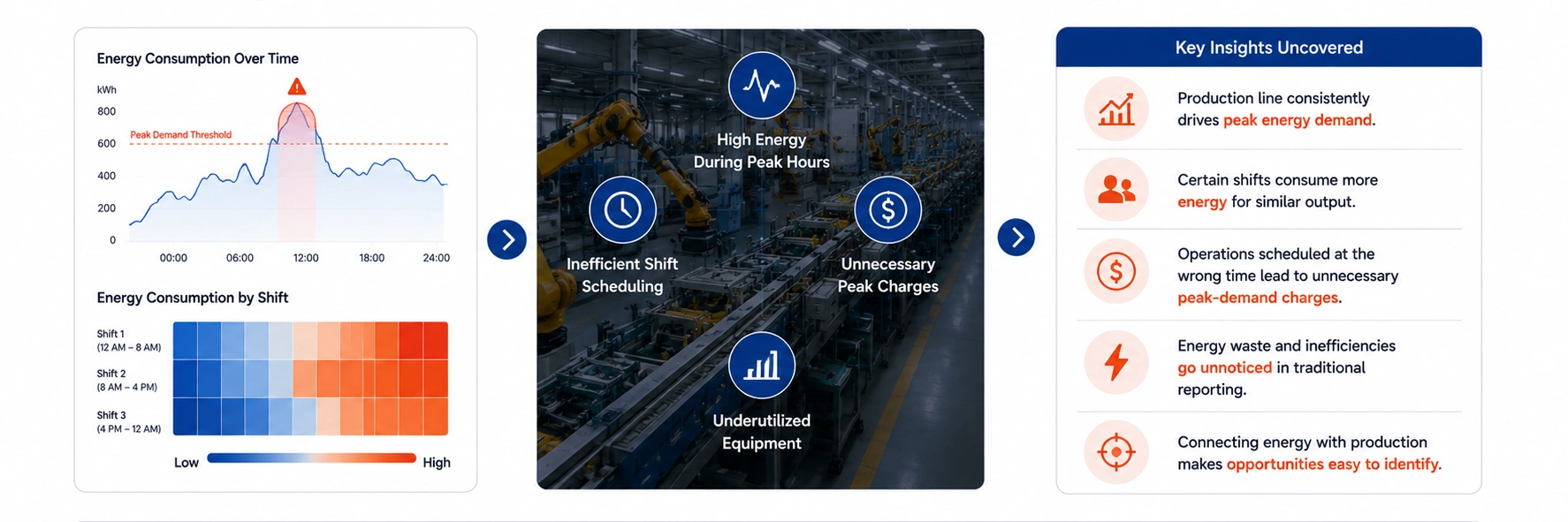
Sometimes a production line consistently drives peak energy demand. In other cases, specific shifts consume more energy despite producing similar output. We have also seen situations where facilities were paying unnecessary peak-demand charges simply because certain operations were scheduled at the wrong time.

These issues rarely stand out in traditional reporting.

However, when energy consumption is connected with production activity, the opportunities become much easier to identify. By combining Sustainability Analytics with AI Agent Integration Services, manufacturers can automatically monitor energy trends, detect anomalies, generate recommendations, and alert operations teams to potential inefficiencies before they impact costs.

Smart Energy Management
Ready to Turn Raw Data into Business Value?
Build reliable data pipelines and modern architectures designed for scale and performance.

4. Using AI to Predict What Happens Next

4. Using AI to Predict What Happens Next

Looking at yesterday’s numbers is useful.

Knowing what is likely to happen next week is far more valuable.

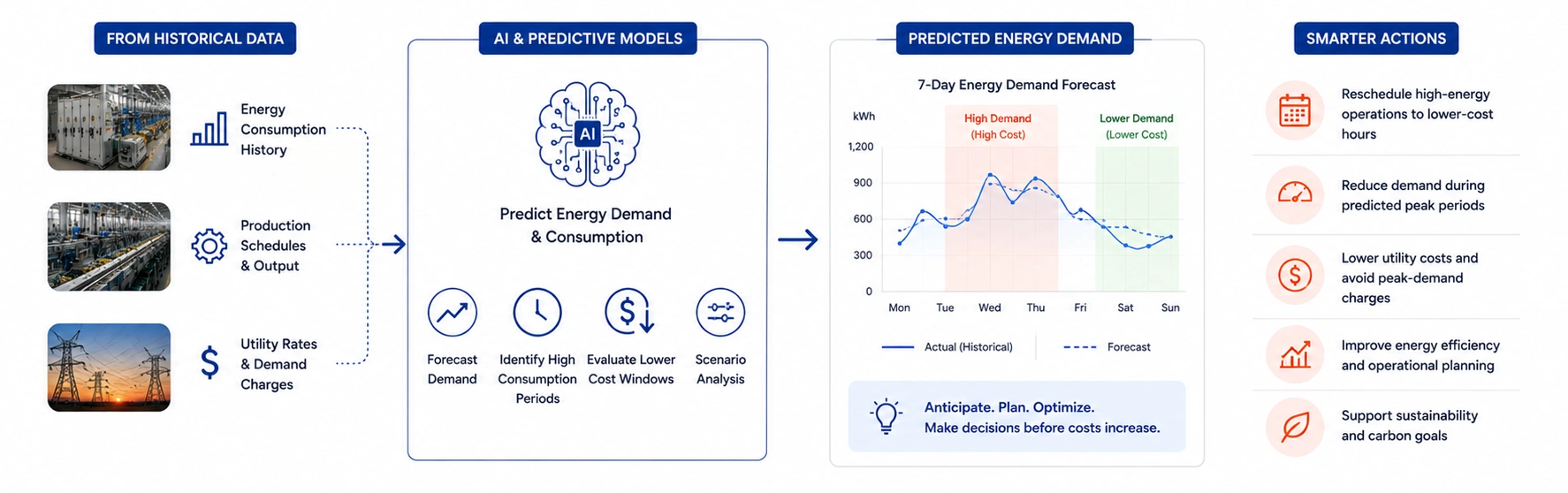
This is where predictive models help manufacturers move from monitoring energy to managing it. Instead of reacting to spikes in utility costs, teams can forecast demand, anticipate high-consumption periods, and evaluate whether certain operations should be shifted to lower-cost hours.

The goal is not to add complexity. The goal is to give operations teams enough visibility to make smarter decisions before costs increase.

5. Turning Sustainability Into Something Measurable

5. Turning Sustainability Into Something Measurable

Many organizations have sustainability goals. The challenge is proving progress.

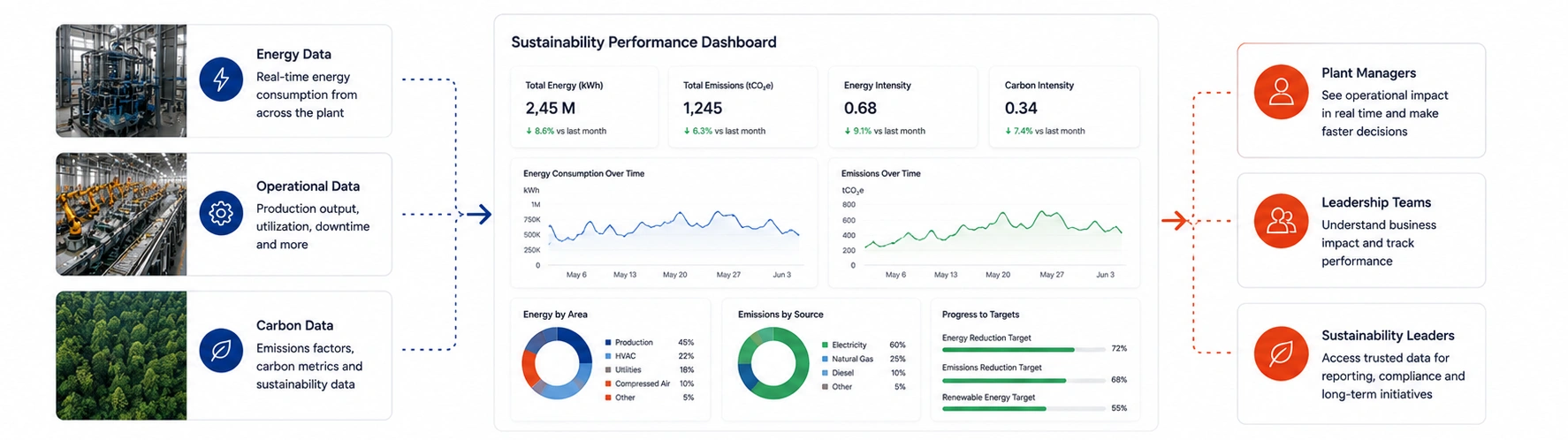
By combining energy data, operational data, and carbon-related metrics, we help create dashboards through our Analytics & Data Visualization Services that show how day-to-day decisions affect sustainability performance. Plant managers can see operational impact. Leadership teams can see business impact. Sustainability leaders gain data that supports reporting requirements, compliance initiatives, and long-term sustainability strategies.

Most importantly, everyone works from the same numbers.

Where the Real Business Value Appears

The most successful projects are not the ones with the most dashboards.

They are the ones that change how decisions are made.

Once manufacturers can clearly see where energy is being consumed, understand what is driving costs, and predict future demand patterns, optimization becomes much easier. Some organizations choose to shift energy-intensive activities to off-peak hours. Others focus on improving equipment efficiency or reducing unnecessary consumption across facilities.

The result is usually the same: lower energy spend, stronger sustainability performance, and a business that is better prepared for future growth without increasing resource consumption at the same pace.

That is the outcome we focus on at Azilen. Not simply collecting energy data, but helping manufacturers use it to make better operational decisions.

What Business Leaders Gain from Gen AI for Rapid Product Design

Technology matters.

Business outcomes matter more.

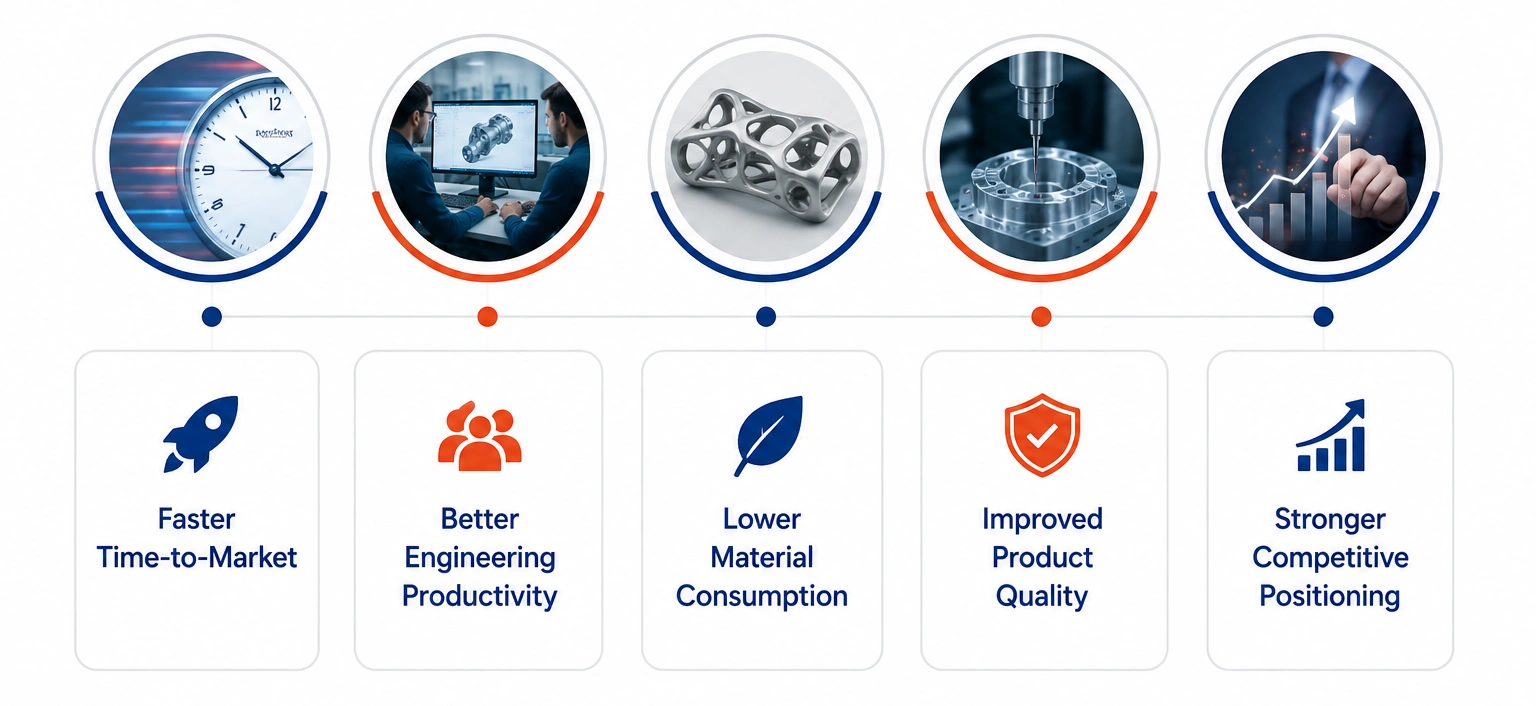
When manufacturers implement Gen AI for Rapid Product Design effectively, they typically see benefits across multiple areas.

Business Leaders Gain from Gen AI for Rapid Product Design

Faster Time-to-Market: Design cycles that traditionally take months can be significantly shortened through AI-driven design exploration, virtual testing, and early-stage validation, helping organizations bring products to market much faster.

Better Engineering Productivity: Engineering teams spend less time evaluating design alternatives and more time refining high-potential concepts that align with business and performance goals.

Lower Material Consumption: Gen AI for Rapid Product Design identifies opportunities to reduce material usage while maintaining required strength, durability, and product performance standards.

Improved Product Quality: Access to thousands of design possibilities increases the likelihood of discovering higher-performing, more reliable, and production-ready solutions before manufacturing begins.

Stronger Competitive Positioning: Organizations that innovate and launch products faster gain earlier access to market opportunities, customer demand, and long-term revenue growth.

Why Data Engineering is the Foundation of Smart Energy Management

Many manufacturers start their energy optimization journey by investing in dashboards and reporting tools.

The challenge is that dashboards only display information. They do not fix disconnected, incomplete, or inconsistent data.

This is where Data Engineering becomes critical for Smart Energy Management and Sustainability Analytics.

A strong Data Engineering foundation helps manufacturers:

➜ Connect data from IoT power sensors, machines, utility systems, and production equipment

➜ Create a single source of truth across operations, energy management systems, and sustainability platforms

➜ Improve the accuracy of Sustainability Analytics and carbon reporting

➜ Enable predictive energy models that identify future demand and consumption patterns

➜ Support AI-driven recommendations with reliable and trusted data

➜ Scale Smart Energy Management initiatives across multiple plants and facilities

Without reliable data, even the most advanced analytics platform struggles to deliver meaningful results.

With the right data foundation in place, manufacturers gain the visibility needed to make faster and more confident decisions.

Building Successful Smart Energy Management & Sustainability Analytics Solutions Requires More Than Energy Monitoring

Reducing energy costs and improving sustainability performance is not simply about installing sensors or adding another dashboard.

The manufacturers seeing the strongest results are building connected ecosystems where energy, operational, production, and sustainability data work together. When those systems operate in isolation, it becomes difficult to identify inefficiencies, forecast demand, or measure the true impact of improvement initiatives.

At Azilen, as a Enterprise AI Development Company, we help manufacturers build Smart Energy Management & Sustainability Analytics solutions that combine IoT, Data Engineering, CloudOps, and AI to create measurable business outcomes.

➜ Create an energy management strategy aligned with operational and sustainability goals. This helps ensure every initiative supports both cost reduction and long-term business growth.

➜ Connect energy data from production equipment, utility infrastructure, HVAC systems, compressors, and facility operations. This creates complete visibility across the manufacturing environment.

➜ Build a trusted Data Engineering foundation. This ensures energy, production, and sustainability data remain accurate, accessible, and ready for analysis.

➜ Establish a centralized cloud platform for Energy Management Systems and Sustainability Analytics. This gives teams a single source of truth instead of relying on disconnected reports and spreadsheets.

➜ Use AI and predictive load models to forecast future energy demand. This helps operations teams anticipate consumption spikes before they impact costs.

➜ Identify hidden inefficiencies and energy-intensive processes. This makes it easier to uncover waste that traditional reporting often misses.

With the right foundation in place, organizations can reduce energy spend, improve operational efficiency, strengthen sustainability reporting, and continue growing without increasing energy consumption at the same pace.
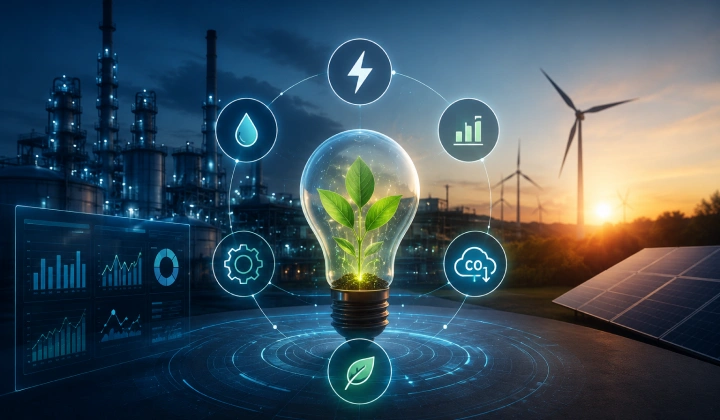
Smart Energy Management Azilen
Ready to Turn Energy Data Into Measurable Business Value?
Talk to our team about building a connected energy management solution tailored to your operations.

FAQs: Smart Energy Management in Manufacturing

1. What is Smart Energy Management in manufacturing?

Smart Energy Management is the process of monitoring, analyzing, and optimizing energy consumption across manufacturing facilities using technologies such as IoT sensors, Energy Management Systems, Data Engineering platforms, and AI-powered analytics. It helps manufacturers reduce energy costs, improve operational efficiency, and support sustainability goals through real-time visibility and data-driven decision-making.

2. How does Sustainability Analytics help manufacturers reduce operating costs?

Sustainability Analytics helps manufacturers understand how energy consumption, resource utilization, and operational activities affect both costs and environmental performance. By identifying inefficiencies, tracking carbon-related metrics, and uncovering opportunities for optimization, organizations can reduce energy waste, lower utility expenses, and improve overall operational efficiency.

3. How can IoT and AI improve energy efficiency in manufacturing plants?

IoT sensors continuously collect energy data from machines, production lines, utilities, and facility infrastructure. AI analyzes this data to identify consumption patterns, predict future energy demand, detect inefficiencies, and recommend optimization opportunities. Together, IoT and AI enable manufacturers to move from reactive energy monitoring to proactive energy management.

4. Why is Data Engineering important for Smart Energy Management and Sustainability Analytics?

Data Engineering creates the foundation for Smart Energy Management by connecting data from multiple systems into a single, trusted source. It ensures energy, production, operational, and sustainability data can be analyzed together, improving the accuracy of reporting, forecasting, and AI-driven recommendations while supporting better business decisions.

5. What business benefits can manufacturers expect from Smart Energy Management and Sustainability Analytics?

Manufacturers that implement Smart Energy Management and Sustainability Analytics often achieve lower energy costs, improved operational efficiency, better sustainability reporting, reduced carbon-related exposure, and stronger resource utilization. These capabilities help organizations scale operations while maintaining control over energy consumption and sustainability performance.

author avatar
Chintan Shah Vice President – Delivery
Chintan Shah is VP – Delivery at Azilen Technologies, specializing in enterprise solutions, digital transformation, and scalable software delivery. He focuses on driving operational excellence and high-performance technology execution.
google
Chintan Shah
Chintan Shah
Vice President - Delivery at Azilen Technologies

Chintan Shah is an experienced software professional specializing in large-scale digital transformation and enterprise solutions. As VP - Delivery at Azilen Technologies, he drives strategic project execution, process optimization, and technology-driven innovations. With expertise across multiple domains, he ensures seamless software delivery and operational excellence.

Related Insights

GPT Mode
AziGPT - Azilen’s
Custom GPT Assistant.
Instant Answers. Smart Summaries.