Skip to content

How Much Does Cloud Migration Cost in 2026?

Featured Image

Executive Summary

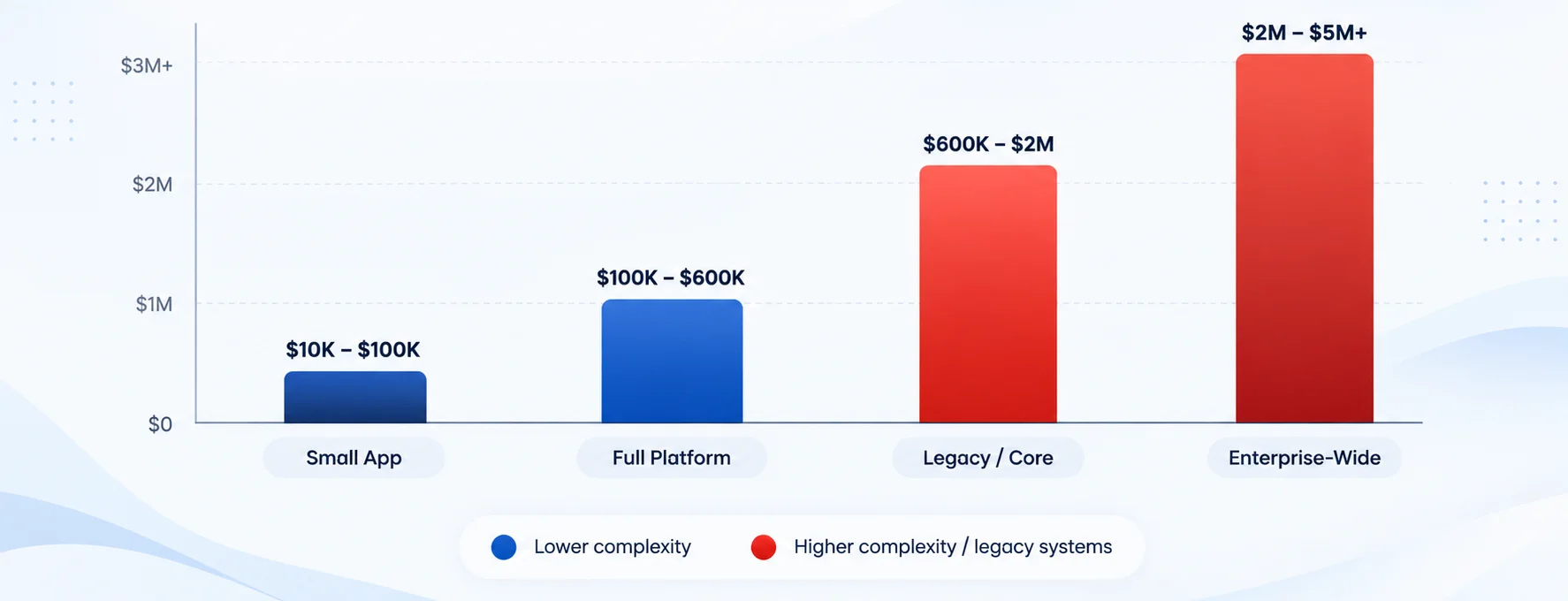
Cloud migration costs range from $10,000 to $2 million+, depending on what you are moving, how complex your systems are, and how much modernization is involved. A single application cost $10,000–$100,000, while a full platform can reach $100,000–$600,000. Large enterprises migrating legacy or core systems may spend $1 million to $5 million or more.

The biggest factor in the cost of cloud migration isn’t always company size. It is how much of your existing environment can be moved as-is versus how much needs to be rebuilt or modernized. A cloud migration cost calculator can help create an initial estimate based on your workload and migration scope.

Cloud migration sounds straightforward until you start asking one question: how much will it actually cost?

The answer depends on what you’re moving, how complex your systems are, and whether you’re simply migrating or also modernizing along the way.

“The real cost of cloud migration is shaped less by how much you move and more by how much you need to change along the way.”

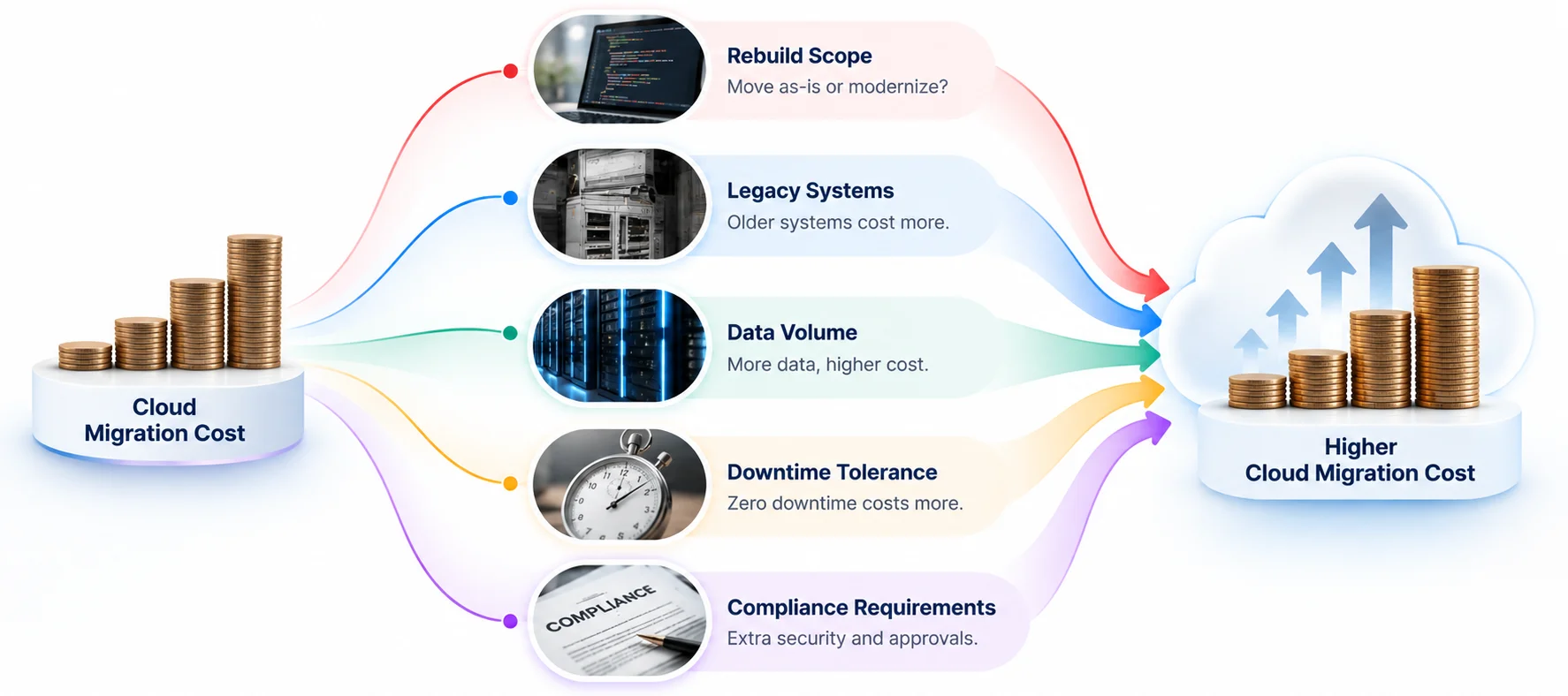
What Factors Affect Cloud Migration Cost?

Two companies can spend very different amounts on cloud migration, even if they are the same size. The cost of cloud migration depends more on what you are moving and how much work is needed to move it.

What Factors Affect Cloud Migration Cost

How Much Needs to Be Rebuilt: A simple lift-and-shift usually costs less than rebuilding applications for the cloud.

Legacy System Age: Older or highly customized systems often need more time and effort to migrate.

Data Volume: More data means more work for transfer, validation, and reconciliation.

Downtime Tolerance: Zero-downtime migrations can cost more because old and new systems may need to run together.

Compliance Requirements: Finance, healthcare, and other regulated industries may need additional security checks, audits, and validation.

Cloud Cost Management

Looking to Control Your Cloud Migration Costs?

Get better visibility and control over your cloud spending.

Explore Cloud Cost Management

Cloud Migration Cost

It’s more useful to estimate costs based on what you’re migrating, not just the size of the company.

Typical Cloud Migration Cost by Project Scope

These are estimated USD ranges, not fixed prices. The actual cost depends on your systems, data, complexity, and migration approach.

Cloud Migration Cost by Project Size

Cloud Migration Cost Breakdown

The cost of cloud migration depends on more than the number of applications you move. You also need to consider assessment, planning, data migration, application changes, infrastructure setup, security, testing, and post-migration optimization.

For a typical migration, costs can range from $10,000 to $2 million+, while large enterprise migrations can go beyond this range. The table below gives a more detailed view of where your cloud migration costs can go.

Cost Component Typical Cost Range What It Covers
Migration Assessment & Planning $5,000–$30,000 Infrastructure assessment, dependency mapping, migration strategy, and roadmap
Cloud Infrastructure Setup $5,000–$50,000+ Cloud environment, networking, storage, compute, security, and access setup
Application Migration $10,000–$150,000+ Moving, configuring, or adapting applications for the cloud
Data Migration $5,000–$100,000+ Data transfer, validation, cleansing, and reconciliation
Application Modernization $20,000–$250,000+ Refactoring applications, adopting cloud-native services, and improving architecture
Security & Compliance $10,000–$100,000+ Security controls, encryption, IAM, compliance checks, and testing
Testing & Deployment $5,000–$50,000+ Performance testing, integration testing, user acceptance, and deployment
Post-Migration Optimization $5,000–$75,000+ Right-sizing, monitoring, performance tuning, and cost optimization
Ongoing Cloud Operations $2,000–$25,000+/month Monitoring, maintenance, support, security, and cloud management

Note: These are indicative USD estimates. Actual costs vary based on workload complexity, data volume, migration strategy, cloud platform, security requirements, and the level of modernization involved.

Free Cloud Migration Cost Calculator

Get a quick estimate of your cloud migration costs by entering your project type, company size, and data volume. It takes less than a minute to get a ballpark figure.

Estimated Budget
$—
This is a rough estimate based on typical 2026 US market migration rates. The actual cost depends on your exact systems, data volume, and compliance jurisdictions.
Selected Parameters

What Are the Hidden Costs of Cloud Migration?

Some cloud migration costs are easy to miss during initial planning. Here are the common hidden expenses:

Running Parallel System

Running old and new systems together during migration can increase costs, especially when zero-downtime cutovers require parallel environments.

Team
Training

Teams may need training to manage cloud-native tools, platforms, and operations, adding time and costs beyond the migration project effectively.

Data Egress Fees

Moving amounts of data between clouds can create egress fees, adding unexpected costs when migration routes are not planned effectively.

Post-Migration Optimization

Cloud spending can rise after migration if resources are oversized, unused, or poorly managed without regular performance and cost optimization.

Compliance Re-Validation

Cloud migration may require renewed security checks, access controls, encryption reviews, and compliance validation before systems can operate safely today.

Third-Party Licensing

Some existing software licenses may not transfer directly to cloud environments, requiring new agreements, or additional licensing costs overall.

Abstract cloud diagram with connected nodes, a gear icon, and a checkmark on blue shapes in the cloud.
Not sure your cloud migration is cost-efficient?
Azilen’s cloud engineers can identify cost, performance, and optimization gaps.

Does the Cloud Provider (AWS, Azure, GCP) Affect Cost?

The cost of cloud migration can vary slightly by provider. The migration work may be similar, but pricing models, discounts, and workload requirements can affect the final cost.

Setup What It Means Best For
Single Cloud Everything runs on one provider — just AWS, just Azure, or just GCP Small teams wanting simplicity and one bill to manage
Hybrid Cloud A mix of public cloud and your own private servers or data center, connected together Companies with strict data rules or big existing investments in physical servers
Multi-Cloud Two or more public cloud providers (AWS, Azure, GCP) used together, usually with no private servers involved Growing companies wanting flexibility, redundancy, and the best tool for each workload

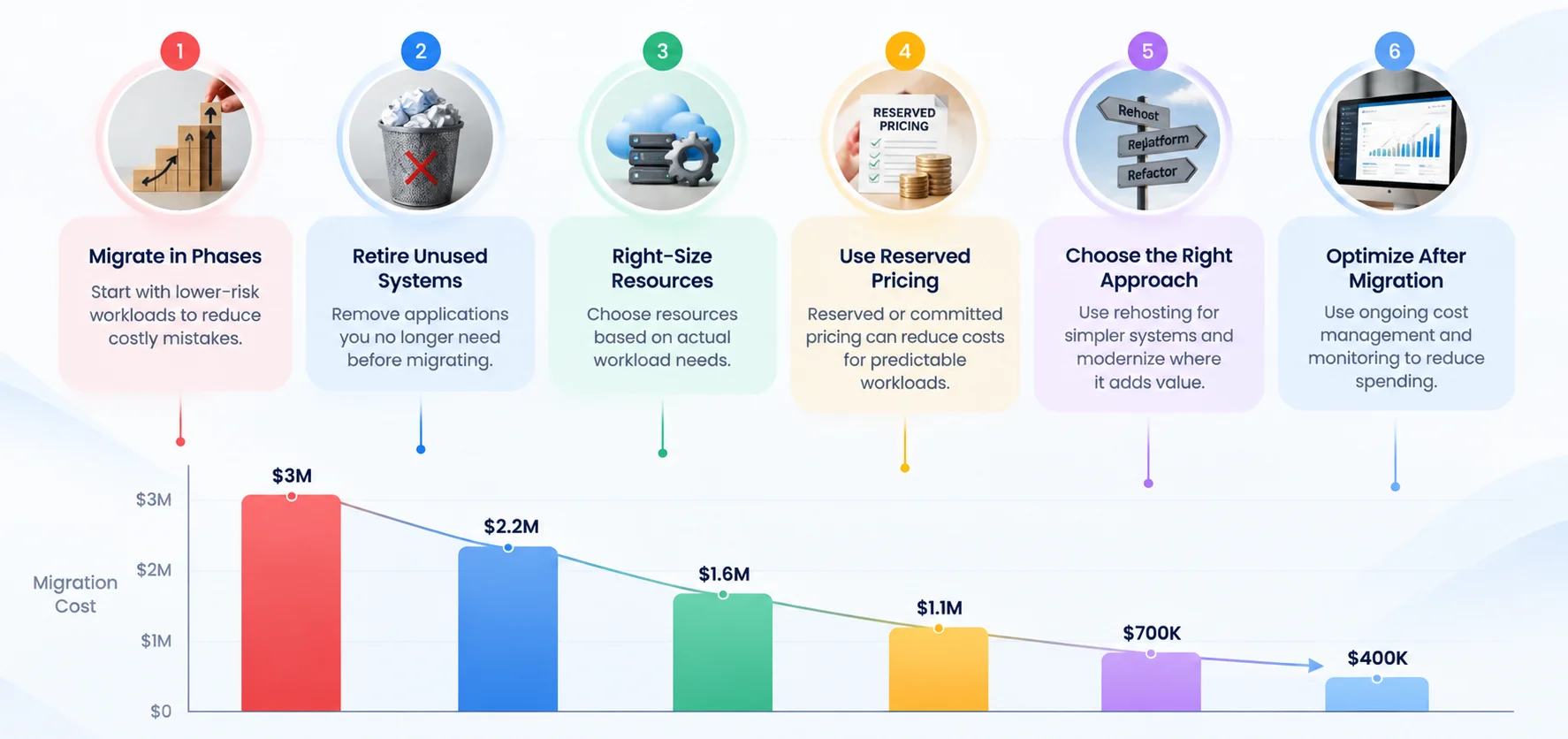
How Can You Reduce Cloud Migration Costs?

How Can You Reduce Cloud Migration Costs

Migrate in Phases: Start with lower-risk workloads to test the process and reduce costly migration mistakes.

Retire Unused Systems: Remove applications and systems you no longer need before paying to migrate them.

Right-Size Resources: Avoid copying on-premises capacity directly to the cloud. Choose resources based on actual workload needs.

Use Reserved Pricing: For predictable workloads, reserved or committed pricing can reduce costs compared with on-demand rates.

Choose the Right Migration Approach: Use rehosting for simpler, lower-value systems and save deeper modernization for workloads where it adds value.

Optimize After Migration: Ongoing Cloud Cost Management can help reduce unnecessary spending after workloads go live. Cloud Infrastructure Management and CloudOps Services can also support ongoing monitoring and optimization.

Is Cloud Migration Worth the Cost?

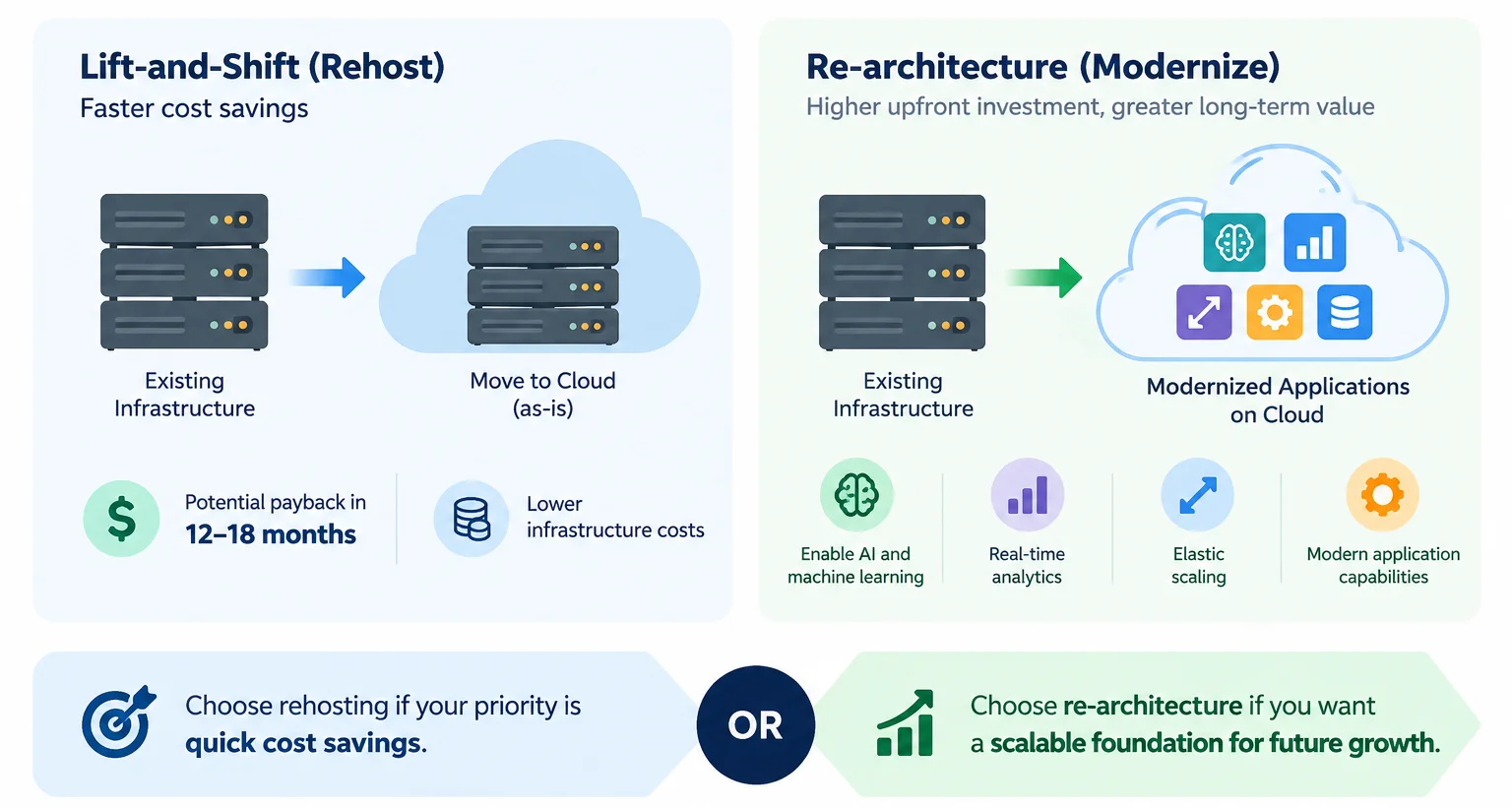
Yes, for most companies, cloud migration is worth the investment. A simple rehost or lift-and-shift approach can often deliver cost savings faster, with a potential payback in 12–18 months.

Is Cloud Migration Worth the Cost

A full re-architecture costs more upfront and takes longer to pay back. But it can unlock AI, real-time analytics, elastic scaling, and modern application capabilities that legacy infrastructure may not support efficiently.

If your priority is quick cost savings, start with rehosting. If you want to build a scalable foundation for future growth, refactoring and modernization may deliver more long-term value.

How Does Azilen Help with Cloud Migration?

Cloud migration can become complex when applications, data, and infrastructure need to move without disrupting business operations. Azilen helps businesses plan, execute, and optimize migrations with a focus on security, scalability, performance, and cost control.

As an enterprise AI development company, Azilen combines cloud engineering and modernization expertise to support businesses throughout their cloud journey.

Migration Assessment: Analyse your applications, infrastructure, data, and dependencies to build a practical migration plan.

Cloud Application Migration: Move and modernize applications for improved scalability, performance, and reliability.

Cloud Data Migration: Transfer critical data securely with proper validation and minimal disruption.

Cloud Infrastructure Migration: Modernize infrastructure while improving security, scalability, and operational efficiency.

Cloud Cost Management: Identify resource waste and optimize cloud spending before and after migration.

Ongoing Optimization: Monitor performance, resources, and costs to keep your cloud environment efficient as you scale.

With Cloud Migration Services, Azilen helps businesses move to the cloud with greater control, less disruption, and a clear path toward long-term optimization.

Reduce Your Cloud Migration Costs Without Compromising Performance.
CTA

FAQs: Cloud Migration Cost

1. How much does cloud migration cost?

Cloud migration costs can range from $10,000 to $2 million+, depending on the number of applications, data volume, infrastructure complexity, migration strategy, and modernization requirements. Smaller application migrations may cost less, while large enterprise or legacy migrations can require significantly higher budgets.

2. What factors affect cloud migration costs?

The main factors include application complexity, legacy systems, data volume, downtime requirements, compliance needs, migration approach, and post-migration optimization. The amount of rebuilding or modernization required can also have a major impact on the overall cost of cloud migration.

3. Is AWS, Azure, or Google Cloud cheaper for migration?

There is no single provider that is always cheaper. The final cost depends on your workloads, existing technology, licensing, usage patterns, and required services. For example, businesses already using Microsoft products may benefit from Azure licensing advantages, while other workloads may fit AWS or Google Cloud better.

4. How can I reduce cloud migration costs?

You can reduce cloud migration costs by migrating in phases, retiring unused systems, right-sizing resources, choosing the right migration strategy, using reserved or committed pricing, and optimizing the environment after migration. Planning these factors early can help avoid unnecessary migration and infrastructure expenses.

5. What are the hidden costs of cloud migration?

Hidden costs can include running old and new systems together, data transfer or egress fees, compliance re-validation, team training, third-party licensing, and post-migration optimization. Identifying these expenses during the planning stage can help create a more realistic cloud migration budget.

6. How can I estimate my cloud migration costs?

A cloud migration cost calculator can provide an initial estimate based on factors such as project type, company size, data volume, and migration scope. For a more accurate estimate, businesses should also assess application dependencies, infrastructure requirements, security needs, downtime tolerance, and modernization plans.

author avatar
Swapnil Sharma Vice President – Strategic Consulting
Swapnil Sharma is VP – Strategic Consulting at Azilen Technologies with expertise in digital transformation, presales, and business strategy. He has led 750+ RFPs and helps organizations drive technology-led growth through consultative solutions.
google
Swapnil Sharma
Swapnil Sharma
VP - Strategic Consulting

Swapnil Sharma is a strategic technology consultant with expertise in digital transformation, presales, and business strategy. As Vice President - Strategic Consulting at Azilen Technologies, he has led 750+ proposals and RFPs for Fortune 500 and SME companies, driving technology-led business growth. With deep cross-industry and global experience, he specializes in solution visioning, customer success, and consultative digital strategy.

Related Insights

GPT Mode
AziGPT - Azilen’s
Custom GPT Assistant.
Instant Answers. Smart Summaries.