

Skip to content

Headless IoT: The Architecture Behind Modern Systems

Featured Image

Executive Summary

This blog is a complete breakdown of Headless IoT, one of the most important architectural shifts happening in technology today.

In simple terms, Headless IoT means your connected devices stop sending data to a screen for a human to read, and instead let an AI agent read that data and take action automatically, in milliseconds, around the clock.

You will learn what Headless IoT actually is (with a simple analogy), why traditional IoT is failing at scale, how the architecture works technically step by step, and most importantly, how it is transforming eight different industries including manufacturing, healthcare, agriculture, retail, smart cities, logistics, energy, and construction.

We also cover the real cost math, three detailed US case studies, and what challenges you should be ready for. By the end, you will have everything you need to understand this shift, and know whether it applies to your business.

Let’s start with a scenario you may have seen before.

You run a facility with hundreds of sensors. Data flows into a dashboard — graphs, alerts, everything looks under control.

Then, late at night, a machine starts failing. The sensor detects it. The dashboard updates. But no one is watching. The failure happens anyway. Production stops. Hours are lost. Costs add up quickly.

So here’s the real question Headless IoT asks: Why does a human need to be in that loop at all?

“Every system that was designed to be watched by humans is being redesigned to act without them.”

Traditional IoT was built around the idea that humans are the decision-makers and machines are the reporters.

Headless IoT flips this completely.

The AI agent is the decision-maker. The human is the governor, reviewing what the agent escalates, setting policies, and approving exceptions. That is a profound shift, and it is happening right now across every industry you can name.

27.1B

IoT devices connected globally by 2025 (IoT Analytics)

75%

Enterprise data processed at the edge by 2025 (Gartner)

$864B

Global IoT market size in 2025, growing to $4T by 2032

68%

Of tech support interactions handled by agentic AI by 2028

What exactly is Headless IoT?

Before we get into the deep technical details, let us explain this in the simplest possible way, because the concept is genuinely straightforward once you see the analogy.

Headless Iot view

The term “headless” comes from software architecture, where systems run without a fixed front-end and operate through APIs and logic. In IoT, this means the system does not rely on a human watching a dashboard. It senses, analyzes, and acts on its own.

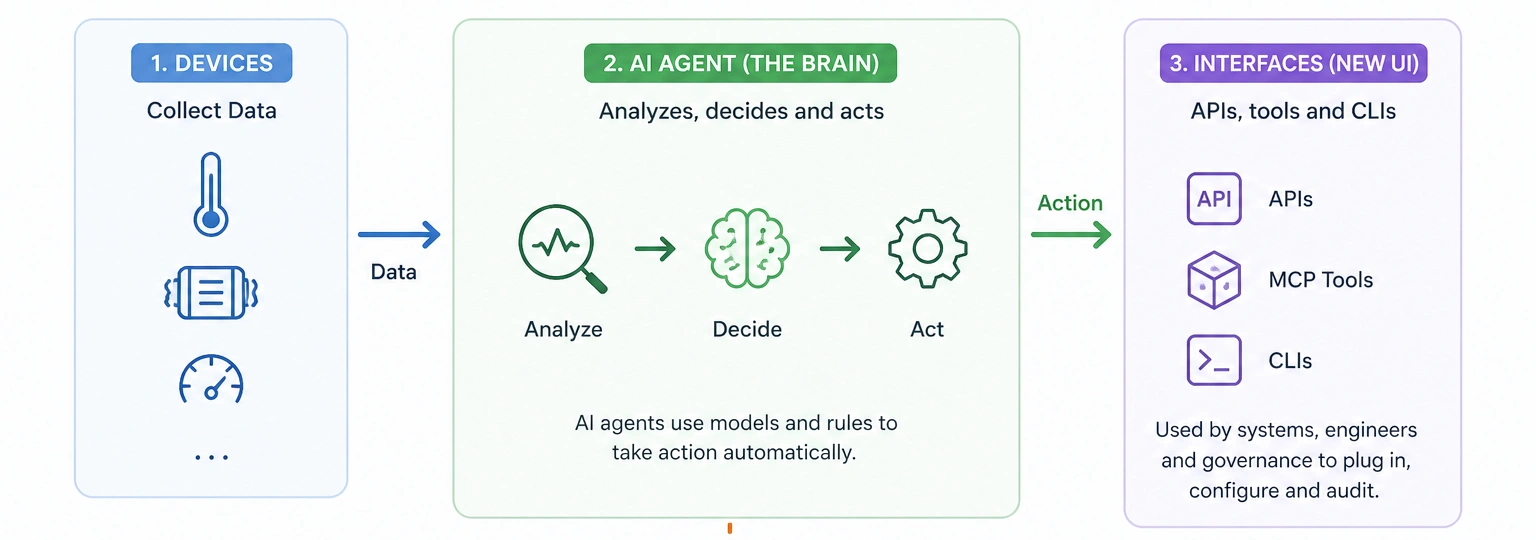
Headless IoT works through three key parts. Devices and sensors collect data continuously. AI agents analyze that data, make decisions, and trigger actions automatically.

APIs and tools act as the interface, allowing other systems and engineers to connect, configure, and manage the system.

The dashboard still exists, but its role changes. It becomes an exception layer, used only when the system flags something that needs human attention, similar to how a pilot monitors autopilot and intervenes only when required.

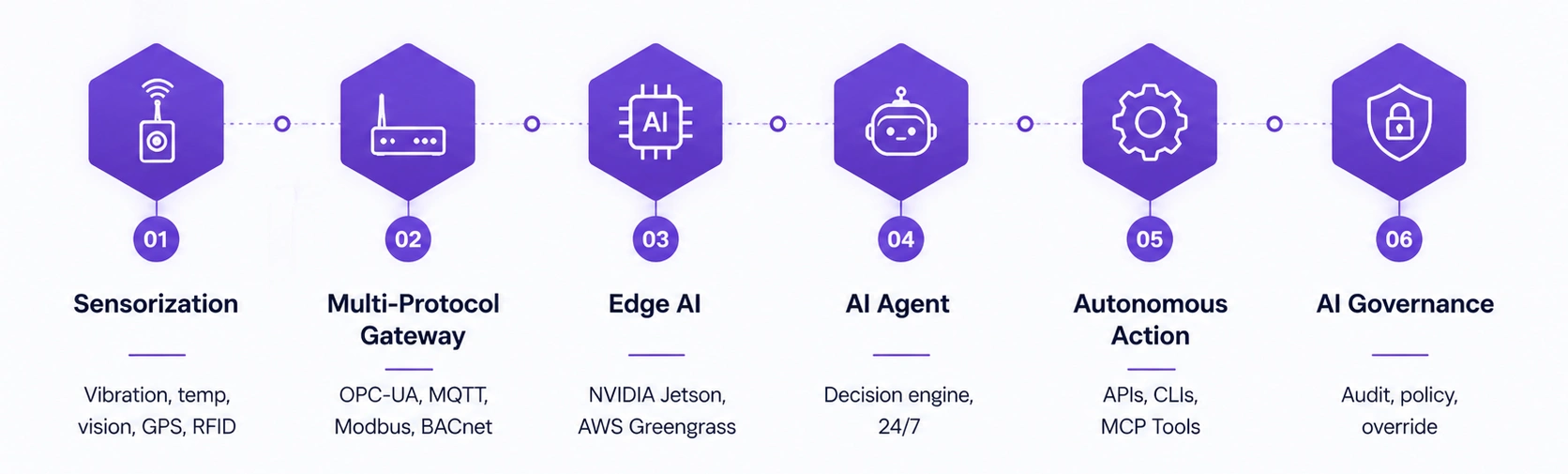
How the Headless IoT architecture works (layer by layer)

Let us go through the entire stack from the physical world all the way to governance. Each layer has a specific job, and understanding each one helps you evaluate where your organization currently is and what gaps need to be filled.

Layer 1: The Sensorization Layer

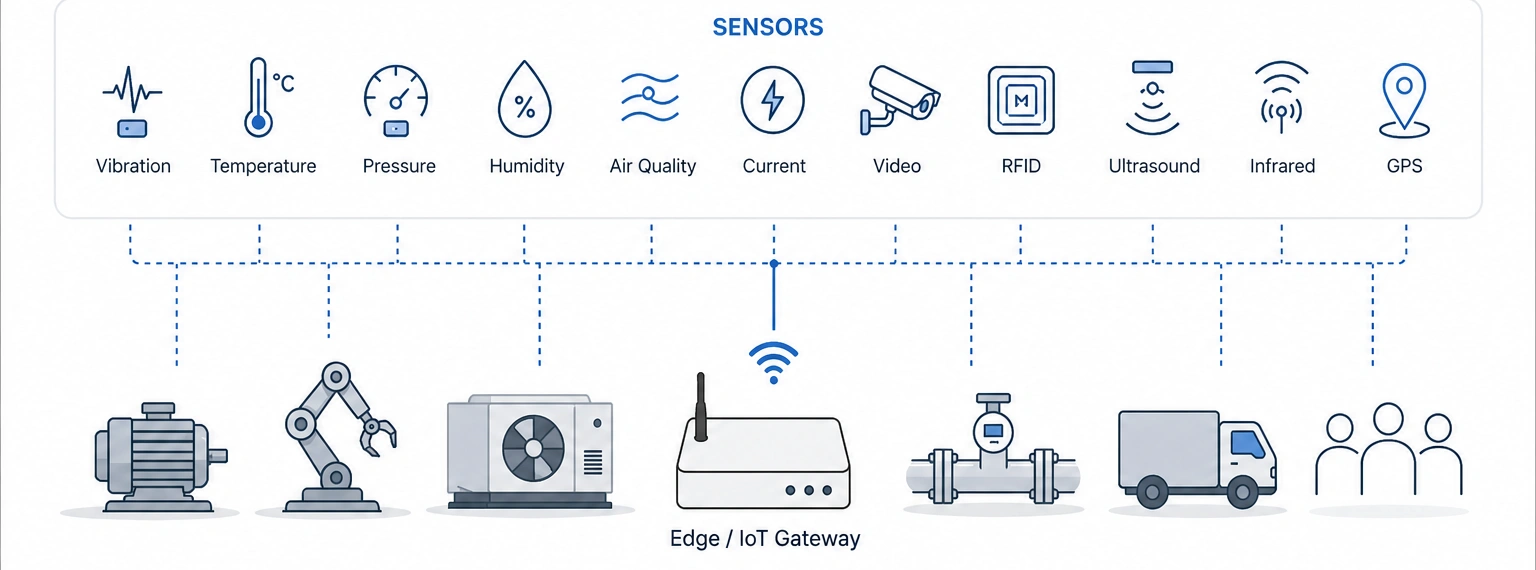
Sensors panel feeding an Edge/IoT gateway connected to industrial equipment: motor, robotic arm, cooling unit, valve, truck, and people (GPS, RFID, ultrasonic, infrared, etc.). Reading context: industrial monitoring network.

Everything in Headless IoT starts with data from the physical world. Sensors are placed on machines, environments, vehicles, and other assets to continuously capture real-world signals. These signals form the foundation for everything the system does next.

→ Sensors collect data such as vibration, temperature, pressure, humidity, flow, and more
→ Different sensor types (RFID, GPS, video, infrared, etc.) capture different real-world conditions
→ Data is collected continuously, not just at intervals
→ Sensor placement is intentional — focused on what the system needs to understand
→ The goal is not more data, but the right data for decision-making

The Sensorization Layer is where intelligence begins. If the data is wrong or incomplete, everything that follows becomes unreliable.

That’s why Headless IoT starts by understanding what needs to be decided, and then captures the exact signals required to make that decision accurately.

Layer 2: The Connectivity & Protocol Layer

Layer 2 The Connectivity & Protocol Layer

Once data is captured, it needs to move. This layer ensures that data from different devices and systems can travel smoothly, even when they speak different “languages.”

→ Sensor data flows from machines to processing systems
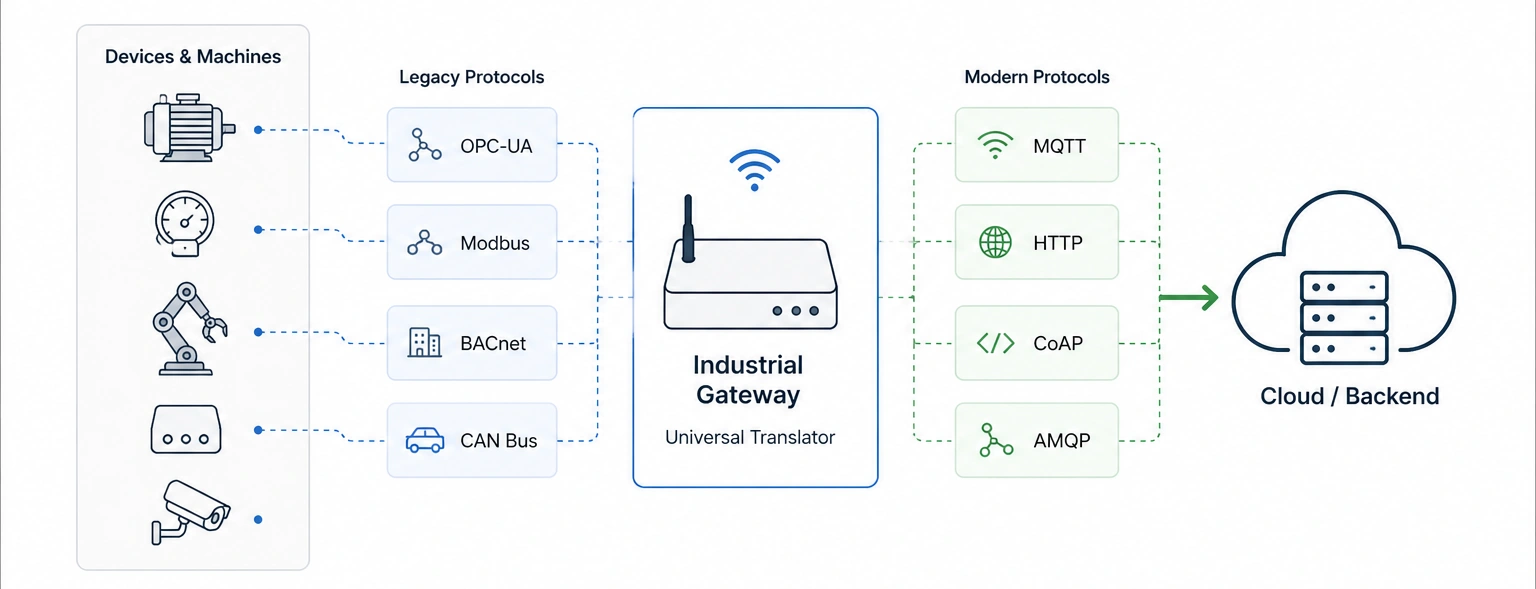
→ Legacy protocols (OPC-UA, Modbus, BACnet, CAN) connect older machines
→ Modern protocols (MQTT, HTTP, CoAP, AMQP) connect newer devices
→ Gateways act as translators between different protocols
→ All data is unified into a single, consistent data stream

The Connectivity Layer brings everything together. It removes protocol complexity and ensures that all devices, old or new, can communicate seamlessly.

Without this layer, data stays fragmented. With it, systems become truly connected.

Layer 3: The Edge Intelligence Layer

Layer 3 The Edge Intelligence Layer

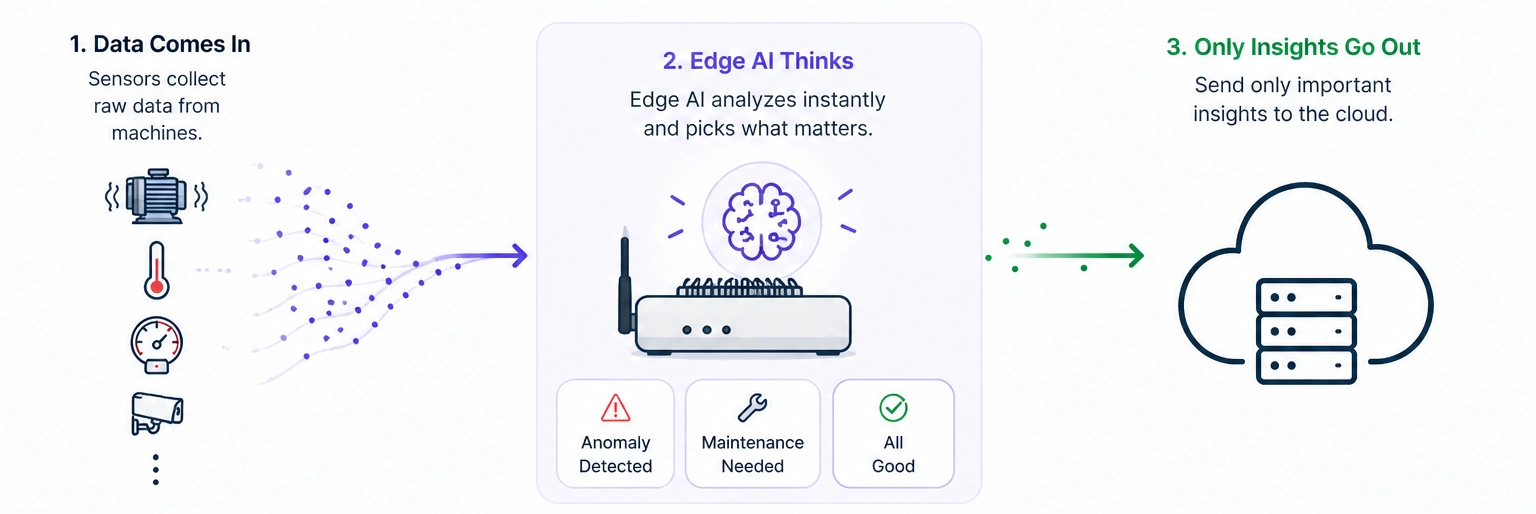
This is where the system starts becoming truly intelligent. Instead of sending all data to the cloud, decisions begin at the source, right where the data is generated.

→ Sensors send raw data to edge devices
→ Edge AI analyzes data instantly at the source
→ Decisions are made in real time (no cloud delay)
→ Only important insights are sent to the cloud
→ Raw data is filtered, reducing unnecessary data flow

The Edge Intelligence Layer turns data into action, instantly. It reduces delay, lowers costs, and enables faster, safer decisions.

Instead of waiting for the cloud, the system thinks and responds in real time, exactly where it matters most.

Layer 4: The Agent Intelligence Layer

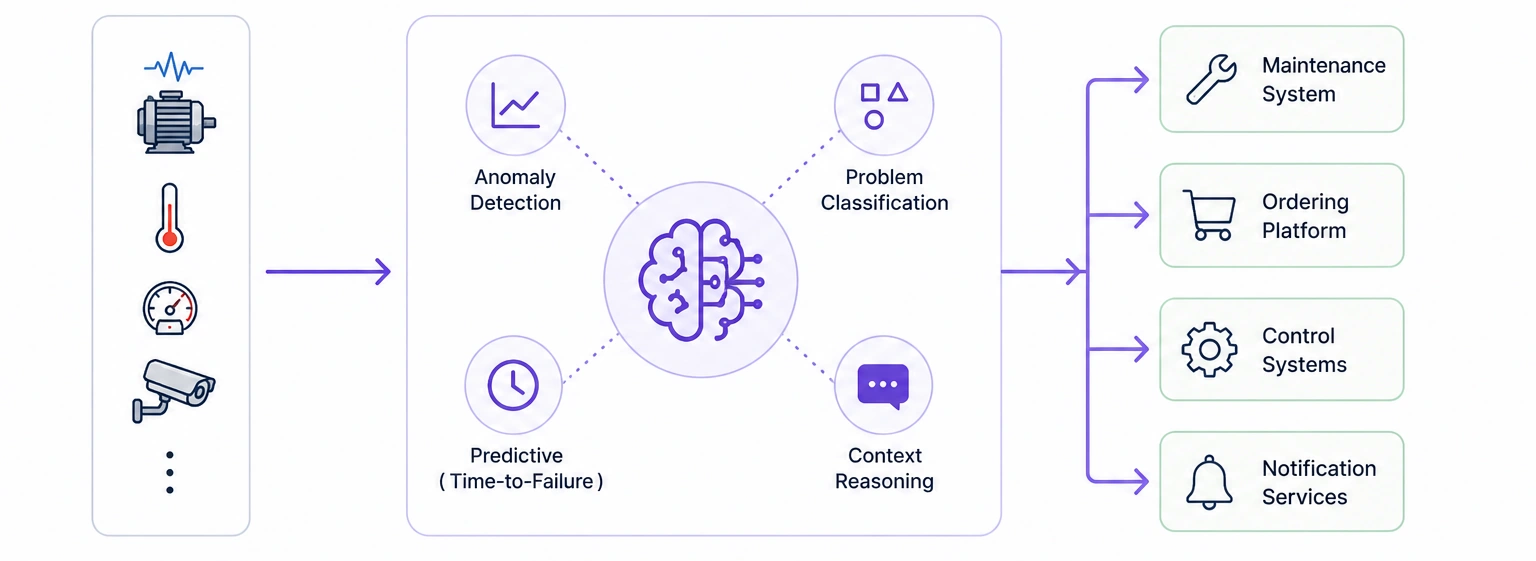
AI-powered monitoring workflow: input sensors feed a central brain with anomaly detection, problem classification, predictive maintenance, and context reasoning, connected to maintenance, ordering, control, and notification modules.

This is where the system becomes truly autonomous. Instead of just analyzing data, the system now understands situations, makes decisions, and takes actions on its own.

AI agents sit at this layer, trained on real operational data. They continuously interpret signals, identify what is happening, and decide what needs to be done, without waiting for human input.

→ The system detects unusual patterns in incoming data
→ It identifies what type of issue or situation is occurring
→ It predicts what might happen next (for example, failure risk)
→ It understands context by combining multiple signals together
→ It decides the best action based on learned behavior
→ It triggers actions directly through connected systems

The Agent Intelligence Layer turns insight into execution. It removes the need for constant human intervention and enables systems to respond instantly and intelligently.

Instead of just monitoring operations, the system actively manages them, making decisions and taking action in real time.

Layer 5: The Governance & AI Oversight Layer

Layer 5 The Governance & AI Oversight Layer

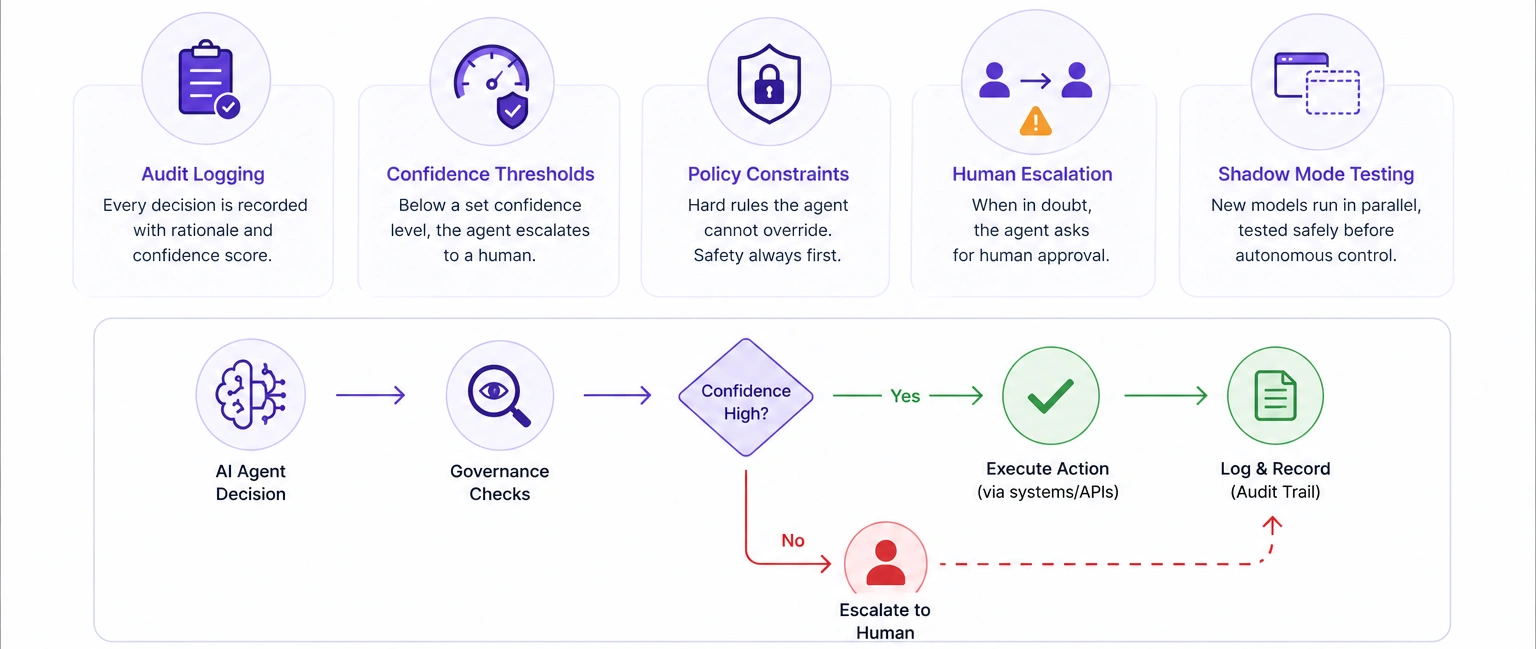
This layer ensures that autonomous systems operate safely, reliably, and within defined boundaries. As decisions become automated, governance becomes essential to maintain trust, control, and accountability.

→ Every decision made by the system is logged with context and reasoning
→ Confidence levels are evaluated before taking any action
→ Low-confidence decisions are escalated to humans instead of executed
→ Policy rules define strict boundaries the system cannot override
→ Safety-critical actions require validation from multiple signals
→ New models are tested in parallel before being fully deployed

The Governance Layer builds trust in autonomous systems. It ensures that AI does not act blindly, but within defined limits and accountability.

This is what makes Headless IoT enterprise-ready, not just intelligent, but controlled, safe, and reliable.

The Headless IoT decision loop (Visualized)

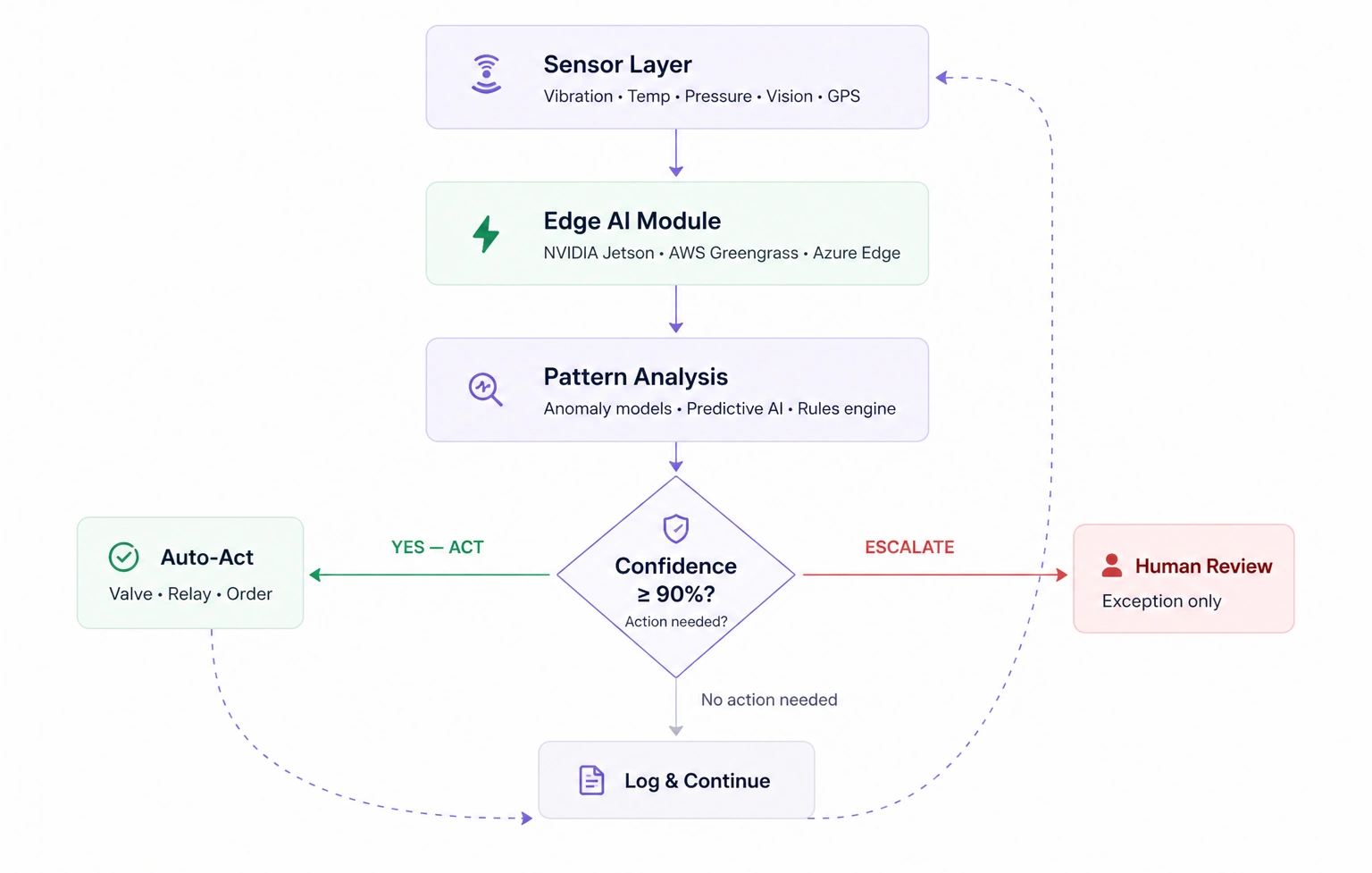
Here is exactly what happens inside a headless system, every second. Notice that there is no human in this cycle unless the agent confidence score falls below the threshold.

Even then, the human approves, they do not diagnose.

The Headless IoT decision loop

A Detailed US Case Studies

Theory and formulas are useful, but what moves decisions is real proof. Here is a well-documented US deployments that demonstrate Headless IoT at production scale.

Caterpillar’s fleet management platform is a strong example of headless IoT in action. Edge AI agents analyze machine data in real time and take decisions automatically, adjusting fleet schedules, triggering maintenance, and optimizing fuel usage without human intervention.

The system continuously tracks GPS, engine load, fuel consumption, idle time, and machine health. Based on this, it assigns equipment efficiently, schedules fuel delivery, and creates maintenance tasks, only involving humans when needed.

The impact is significant. At a major U.S. project site, idle time dropped from over 50% to around 20%, while productivity increased, reducing both project time and operational costs.

60%

Idle time reduction at pilot
site

35%+

Increase in material throughput

24/7

Autonomous coverage, zero shift gaps

0

Operators needed for routine decisions

How to Start Your Headless IoT Journey

You don’t need to replace your entire system to go headless. The right approach is to start small, focus on a high-impact use case, and expand gradually with confidence.

How to Start Your Headless IoT Journey

Identify your highest-impact problem: Start where delays or manual decisions cost the most — like downtime, quality issues, or slow response. A focused use case helps prove real business value early.

Audit your current data and sensors: Understand what data you already have, how reliable it is, and where the gaps are. Strong data quality is the foundation of any intelligent system.

Define clear decision boundaries: Decide what the system can handle on its own, what needs validation, and what must always involve a human. This builds control and trust from day one.

Deploy in shadow mode first: Let the system observe and recommend actions without executing them. This helps validate accuracy, fine-tune models, and build confidence internally.

Expand autonomy step by step: Start with low-risk actions and gradually move toward more critical decisions as the system proves its reliability.

Conclusion

Headless IoT is not just a technology shift, it’s an operational transformation. The challenge is not just building the system, but designing it correctly, integrating it with existing environments, and ensuring it performs reliably at scale.

That’s where having the right implementation partner becomes critical, to move from concept to real, working impact.

Build Smarter Systems with Headless IoT

Azilen is an Enterprise AI Development Company that helps organisations design and scale Headless IoT systems that move beyond dashboards, toward real-time, autonomous decision-making.

Instead of complex, tightly coupled setups, the focus stays on building systems that are flexible, scalable, and ready for real-world operations.

What we help with:

→ Designing headless IoT architecture aligned with your use case
→ Building edge + AI-driven decision systems
→ Integrating AI agents for autonomous actions
→ Connecting legacy and modern systems into one unified layer
→ Scaling deployments across devices, environments, and operations

Whether the goal is reducing manual intervention, improving efficiency, or enabling real-time automation, Headless IoT creates systems that actually act.

Work with our IoT and AI experts to build systems that are designed to scale, respond instantly, and deliver measurable impact.

IoT App Development
Build Smart Manufacturing Systems with IoT and AI
See how our Enterprise AI Development Company designs, develops, and scales solutions 👇

FAQs: Headless IoT

1. What is Headless IoT in simple terms?

Headless IoT is an architecture where devices, data processing, and decision-making systems work independently of a dashboard. Instead of relying on humans to monitor screens, the system uses AI agents to analyze data and take actions automatically in real time.

2. How is Headless IoT different from traditional IoT systems?

Traditional IoT systems depend heavily on dashboards and human intervention. Headless IoT separates the data layer from the interface and uses AI to make decisions automatically. This makes systems more flexible, scalable, and faster in responding to real-world events.

3. What are the benefits of Headless IoT for businesses?

Headless IoT helps businesses reduce manual effort, improve response time, and scale systems easily. It enables real-time decision-making, lowers operational costs, and allows multiple systems to use the same data without conflicts.

4. Where is Headless IoT used?

Headless IoT is used across industries like manufacturing, logistics, healthcare, and smart infrastructure. It is especially useful in environments where real-time decisions are critical, such as predictive maintenance, automated operations, and remote monitoring systems.

5. How can a company start with Headless IoT?

Companies can start by identifying a high-impact use case, auditing their existing data and sensors, and gradually introducing AI-driven decision systems. Working with an experienced implementation partner helps ensure proper architecture, integration, and scalability.

Glossary

Headless IoT: A system where devices, data, and decisions work independently, without relying on dashboards

IoT (Internet of Things): Connected devices that collect and share real-world data

AI Agents: Systems that analyze data, make decisions, and take actions automatically

Edge Computing: Processing data close to the source instead of sending everything to the cloud

Edge AI: Running AI models directly on devices for real-time decisions

API (Application Programming Interface): A way for different systems to connect and exchange data

Sensorization: Adding sensors to assets to capture real-world signals

Protocols (MQTT, OPC-UA, etc.): Standards that allow devices and systems to communicate

Predictive Maintenance: Using data to detect issues early and prevent failures

Digital Twin: A real-time virtual model of a physical system

google
Chintan Shah
Chintan Shah
Associate Vice President - Delivery at Azilen Technologies

Chintan Shah is an experienced software professional specializing in large-scale digital transformation and enterprise solutions. As AVP - Delivery at Azilen Technologies, he drives strategic project execution, process optimization, and technology-driven innovations. With expertise across multiple domains, he ensures seamless software delivery and operational excellence.

Related Insights

GPT Mode
AziGPT - Azilen’s
Custom GPT Assistant.
Instant Answers. Smart Summaries.