




 19 mins
Oct 07, 2026

An AI chatbot can handle thousands of conversations, but do you know how much each one costs your business?
From AI responses to human handoffs, every interaction adds to your bill.
In this guide, you’ll learn how to calculate the cost per conversation, identify key expenses, and reduce chatbot running costs without compromising customer experience.
“Beware of little expenses; a small leak will sink a great ship.”
— Benjamin Franklin
Cost per conversation AI chatbot means how much you spend to handle each conversation with your chatbot. To calculate it, divide the total monthly running costs by the number of conversations handled that month.
Think of it like a taxi. You want to know how much each ride costs, not just how much fuel the taxi uses.

The cost includes more than just the AI model. You also need to consider hosting, integrations, monitoring, and maintenance.
Your LLM cost per conversation depends on how many messages the user sends, how long the conversation gets, and how much the AI writes in response. Each new turn may include earlier messages again, increasing the number of input tokens and the overall cost. Learn how conversation history works.
For example, if a conversation uses 4,000 input tokens and 400 output tokens, the model cost depends on the model’s current pricing. Longer conversations can cost more because they often require more tokens.
Tokens are only one part of the total cost. Here are the main expenses, what they cover, and what makes them increase.
| Cost | What It Covers | What Makes It Increase? |
|---|---|---|
| AI Model Usage | Processing questions and generating answers. | Longer conversations and more tokens. |
| Data Retrieval | Finding relevant information from documents. | More searches and queries. |
| Safety Checks | Checking answers for errors and unsafe content. | More conversations to review. |
| Tools and APIs | Connecting to CRMs, order systems, and other apps. | More tool calls and API requests. |
| Hosting and Monitoring | Running servers and tracking performance. | Higher usage and infrastructure needs. |
| Testing and Maintenance | Testing responses and updating chatbot data. | Frequent testing and updates. |
| Human Support | Transferring complex queries to support staff. | More conversations needing human help. |
Cost per resolved conversation = Total monthly cost ÷ Number of conversations successfully resolved
A resolved conversation means the chatbot gives the customer the right answer without needing help from a human.
However, a customer leaving the chat does not always mean their problem was solved. So, check some conversations manually to make sure customers are actually getting the help they need.
| Cost Metric | Result |
|---|---|
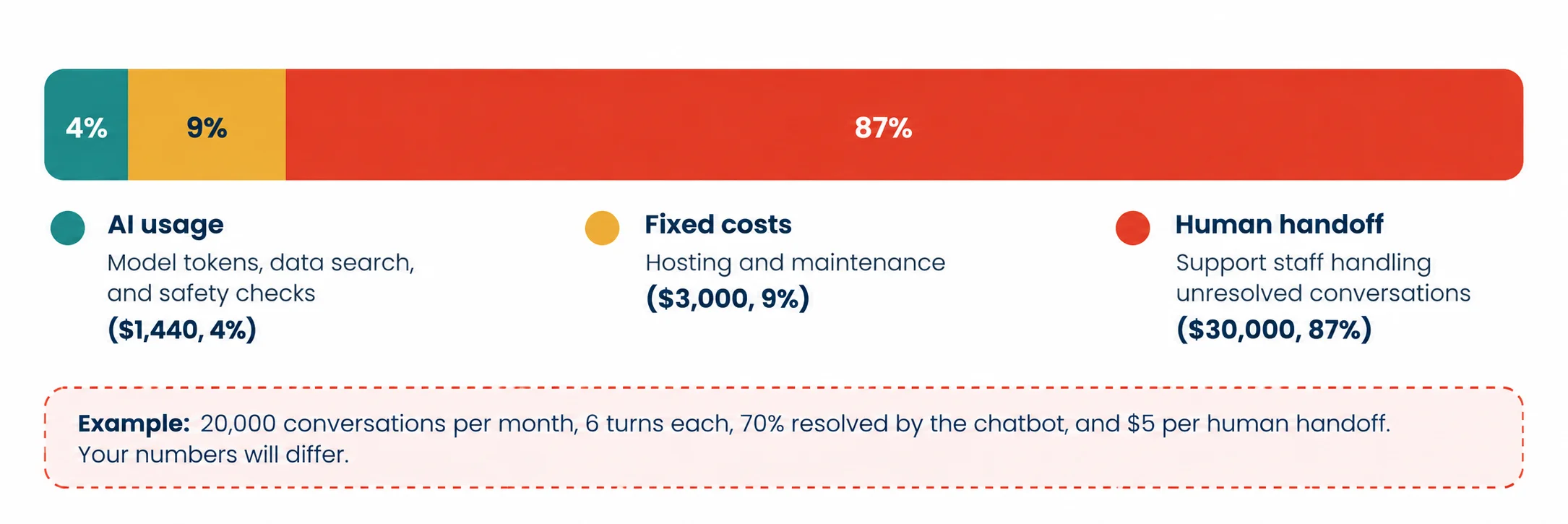
| Total monthly cost | $34,440 |
| Cost per conversation (20,000 chats) | $1.72 |
| Successfully resolved conversations | 14,000 |
| Cost per resolved conversation | $2.46 |
A chatbot may handle conversations cheaply but still fail to solve customers’ problems.
That is why you should track both costs: the cost of every conversation and the cost of each successfully resolved conversation.
Resolution rate: 70%
Let’s start with our example of $2.46 per resolved conversation and see how changing different costs affects the result.
| Change | Cost per Resolved Conversation | Cost Reduction |
|---|---|---|
| Reduce AI cost per turn by 50% | $2.41 | 2% |
| Reduce human handoff cost from $5 to $4 | $2.03 | 17% |
| Increase the resolution rate from 70% to 80% | $1.53 | 38% |
In this example, cutting AI costs in half makes only a small difference. But increasing the resolution rate from 70% to 80% reduces the cost per resolved conversation by about 38%.
The key takeaway: Helping the chatbot solve more customer problems can reduce costs more than simply reducing AI usage.
However, the results depend on your chatbot’s costs and resolution rate. If human support costs are low or your chatbot already resolves most conversations, reducing AI costs may have a bigger impact.
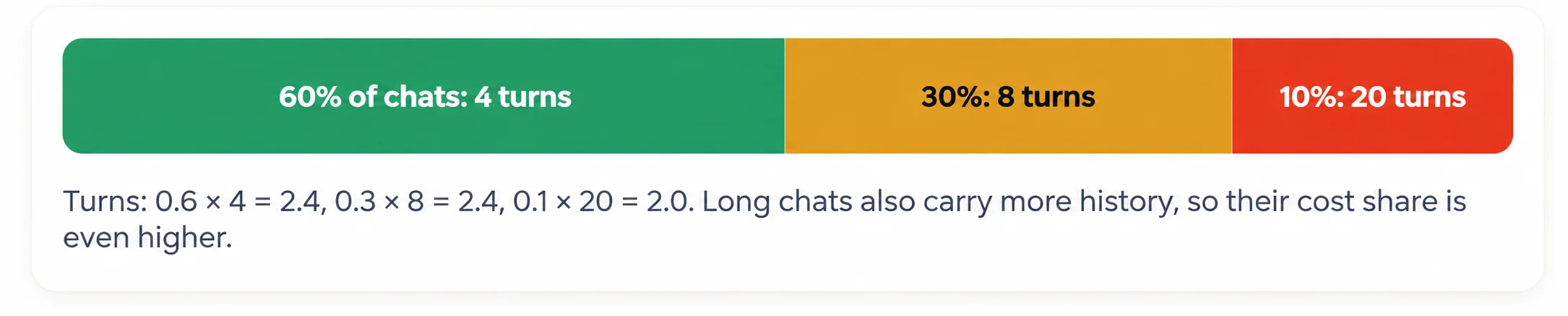
Longer conversations usually cost more because the chatbot needs to process more messages and use more tokens.
For example, suppose 60% of chats take 4 turns, 30% take 8 turns, and 10% take 20 turns. The average is 6.8 turns per conversation. However, the longest 10% of chats account for about 29% of all turns, increasing AI chatbot running costs.
To control these costs:
→ Track long conversations: Monitor the 90th percentile of conversation length and cost, not just the average.
→ Set a handoff limit: If the chatbot cannot solve a problem after a set number of turns, transfer the conversation to a human.
→ Review lengthy chats: Find repeated questions and issues that prevent the chatbot from resolving customer queries and increase AI chatbot running costs.
You can reduce the cost per conversation by improving resolution rates, reducing human handoff costs, limiting long chats, choosing the right AI model, and optimizing token usage. Here are six practical ways to lower your AI chatbot running costs.
→ Track costs weekly: Monitor cost per conversation and cost per resolved conversation every week to identify spending changes.
→ Check resolution rates: Track resolution and handoff rates, and manually review sample conversations to confirm customers receive correct answers.
→ Monitor long conversations: Track conversation length and costs at the 90th percentile to identify unusually long, expensive chatbot interactions.
→ Measure costs by topic: Compare costs across conversation topics to identify which questions cause the most human handoffs and increase spending.
Set alerts when resolution rates drop, long conversations increase, or daily spending rises unexpectedly. This helps you control AI chatbot running costs.
At Azilen, token optimization is one of five pillars in our APEX framework, next to governance and hallucination guards. For chatbots, we start with the whole cost stack, not only tokens.

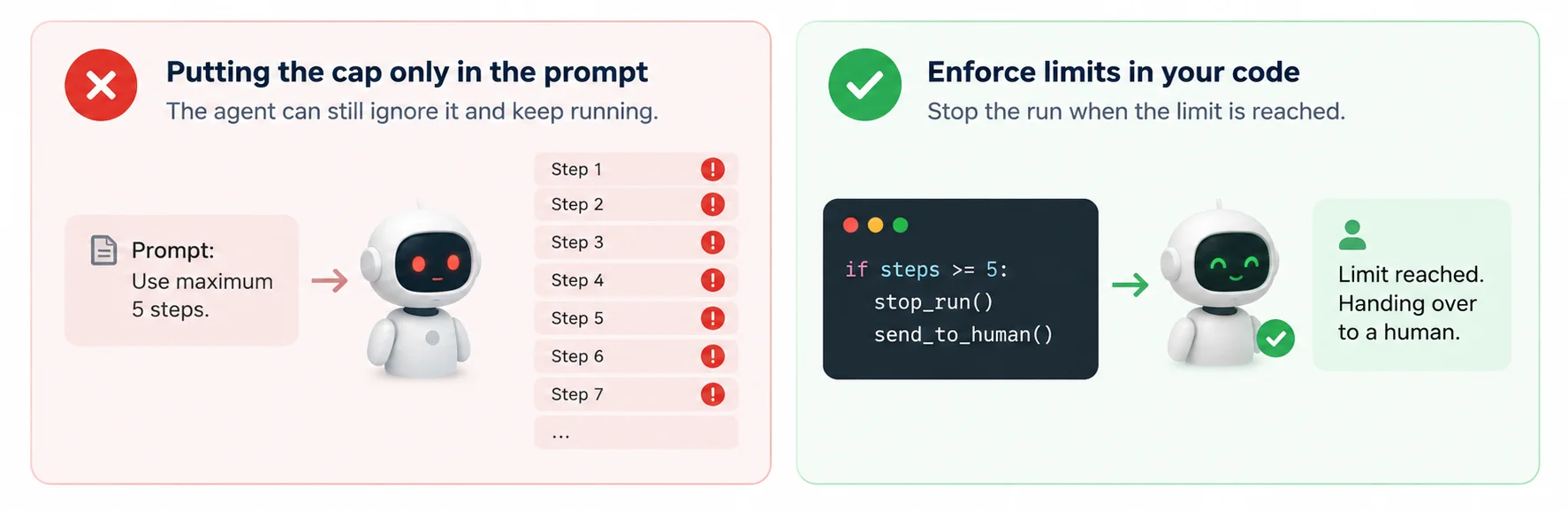
Agents need loops. Loops need limits.
Our logo draws inspiration from orbits, where balance keeps a planet moving steadily. AI agents need the same balance: freedom to complete tasks and limits to control costs.
Guided by our ORBIT values of Openness and Trust, we make AI token usage and costs easy to track, helping teams understand spending and improve efficiency.
Tracking AI agent token usage helps you find wasted steps, control agentic AI costs, and prevent unexpected increases in spending. Monitor performance before release and throughout production.
| When | What to Do | What to Check |
|---|---|---|
| Before Release | Test the agent on real tasks. | Steps, tokens, tool errors, and run time. |
| At Release | Add cost checks to your build process. | Flag increases in average steps or tokens, such as 20%. |
| In Production | Track each agent run. | Retries, cost per successful task, and steps per run. |
| Every Day | Review a short usage report. | How many runs reach their limits. |
Monitoring AI agent token usage helps identify wasted steps, repeated tool calls, and unexpected cost increases. Track token usage, response time, tool errors, and the number of calls per task to find where your agent needs improvement.
Google Cloud’s agent observability guide explains how to monitor token usage, tool activity, latency, and errors. These metrics help you identify inefficient workflows and improve token optimization for AI agents.
→ Counting Only Tokens: AI model usage may be just one part of your total chatbot running costs.
→ Assuming No Reply Means Success: Customers leaving chats without responding does not always mean their problems are solved.
→ Ignoring Handoff Costs: Human support can be expensive, so include agent time when calculating cost per resolved conversation.
→ Tracking Only Averages: Monitor the 90th percentile to identify long conversations that increase AI chatbot costs.
→ Forgetting Fixed Costs: Include hosting, testing, monitoring, and maintenance when calculating total chatbot running costs.
→ Using One Cost for Every Topic: Track costs by topic to identify expensive queries and opportunities for improvement.
The cost depends on AI model usage, conversation length, hosting, integrations, and human support. Calculate it by dividing total monthly chatbot costs by the number of conversations handled.
Divide your total monthly chatbot running costs by the total number of conversations. For example, if your chatbot costs $2,000 monthly and handles 10,000 conversations, the cost is $0.20 per conversation.
The main factors include AI model pricing, token usage, conversation length, data retrieval, API calls, hosting, maintenance, and human handoffs. Higher usage and longer conversations can increase overall costs.
Cost per conversation measures the average cost of every chatbot conversation. Cost per resolved conversation measures the cost of conversations successfully resolved. The second metric helps businesses understand how efficiently their chatbot solves customer problems.
Improve resolution rates, reduce unnecessary human handoffs, limit repetitive conversations, choose suitable AI models, and optimize token usage. Track both cost per conversation and cost per resolved conversation to measure improvements.


 19 mins
 26 mins
 "*" indicates required fields

5432 Geary Blvd, Unit #527 San Francisco, CA 94121 United States
320 Decker Drive Irving, TX 75062 United States

6d-7398 Yonge St,1318 Thornhill, Ontario, Canada, L4J8J2

71-75 Shelton Street, Covent Garden, London, United Kingdom, WC2H 9JQ

Hohrainstrasse 16, 79787 Lauchringen, Germany

12, Zugerstrasse 32, 6341 Baar, Switzerland

5th floor, Bloukrans Building, Lynnwood Road, Pretoria, Gauteng, 0081, South Africa

12th & 13th Floor, B Square-1, Bopal – Ambli Road, Ahmedabad – 380054
B/305A, 3rd Floor, Kanakia Wallstreet, Andheri (East), Mumbai, India





 Talk to Our
Consultants
Talk to Our
Consultants Chat with
Our Experts
Chat with
Our Experts Write us
an Email
Write us
an Email