




 15 mins
Jun 26, 2026
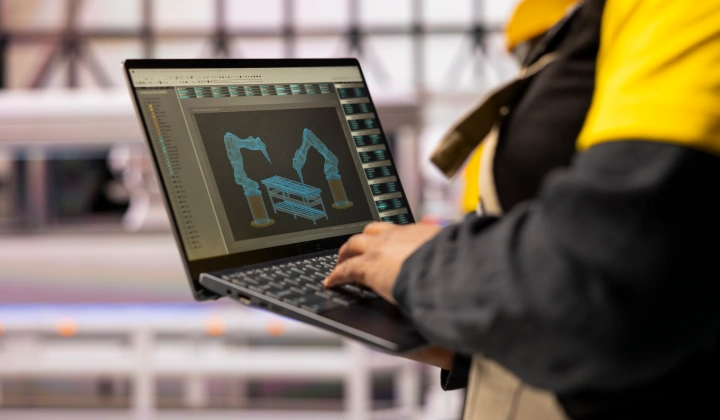
Across North American plants, production still depends on equipment installed over decades.
At the same time, manufacturers continue to invest in connected operations, edge computing, and predictive maintenance as core Industry 4.0 priorities, which puts brownfield modernization at the center of digital transformation strategies.
That creates a practical engineering challenge.
→ PLCs continue to control critical processes.
→ SCADA systems remain the operational backbone for many facilities.
→ Newer production cells introduce OPC UA, MQTT, and cloud-connected controllers beside infrastructure built around Modbus and CAN.
Every expansion adds another communication pattern, another vendor, and another data model.
An Industrial IoT gateway solves this architectural problem.
It creates a common communication layer across heterogeneous equipment, prepares telemetry before it reaches enterprise systems, and gives manufacturers a path to expand digital capabilities while production assets continue to deliver value.
Industrial IoT gateway influences every capability that follows, including predictive maintenance, energy intelligence, production monitoring, and enterprise-wide operational visibility.
Industrial IoT gateway architecture succeeds because each layer solves a specific operational constraint.
A protocol translator alone cannot prepare telemetry for analytics. Edge processing alone cannot reconcile incompatible industrial protocols.
Enterprise visibility depends on the coordination of every layer rather than the capability of one component.
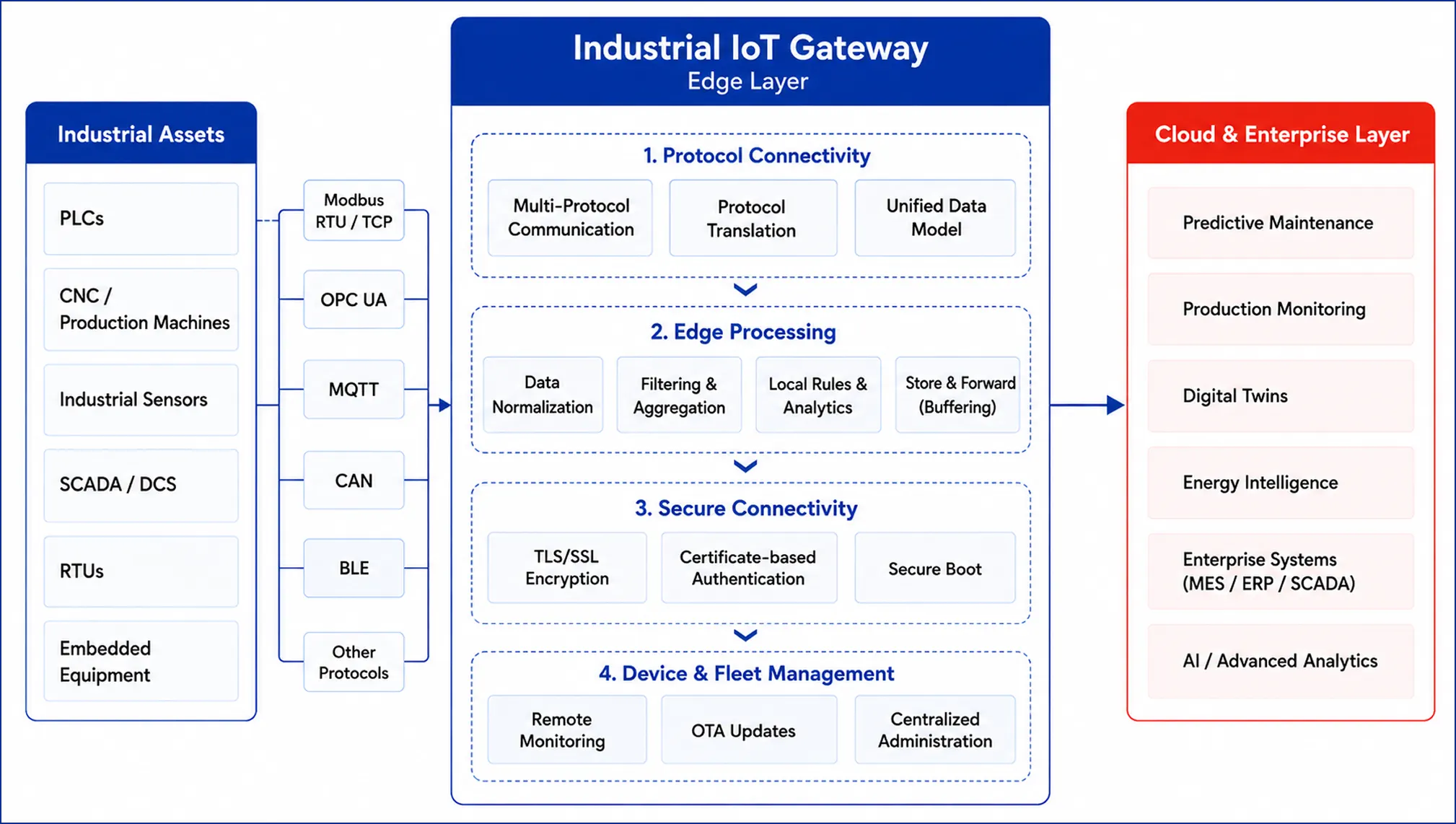
In most brownfield environments, device layer includes PLCs, RTUs, CNC machines, industrial controllers, specialized sensors, and embedded equipment that performs dedicated production tasks.
These devices rarely originate from one modernization program. They reflect procurement decisions, equipment upgrades, and vendor relationships.
As a result, operational data leaves each device through its own communication method and data structure.
The gateway begins its work here by creating a consistent entry point for fundamentally different equipment.
The gateway does more than forward these protocols.
It converts them into a common operational data model that downstream systems can understand without protocol-specific integrations for every application.
| Modbus (RTU/TCP) | Industrial controller communication | PLCs, RTUs, legacy production equipment | Allows gateways to connect decades-old factory assets and convert operational data into a standardized format for enterprise systems. |
| OPC UA | Structured industrial data exchange | SCADA, MES, industrial controllers | Provides rich contextual information that helps gateways preserve machine relationships instead of transmitting isolated data points. |
| MQTT | Lightweight telemetry messaging | Edge devices, cloud-connected equipment | Supports efficient communication between gateways and cloud platforms, which makes it suitable for large-scale industrial deployments. |
| CAN Bus | Embedded machine communication | Industrial vehicles, robotics, heavy machinery | Captures high-speed operational data from embedded systems and brings it into broader manufacturing analytics. |
| BLE (Bluetooth Low Energy) | Short-range wireless communication | Wearables, portable sensors, condition monitoring devices | Extends gateway connectivity to mobile and battery-powered industrial devices without requiring wired infrastructure. |
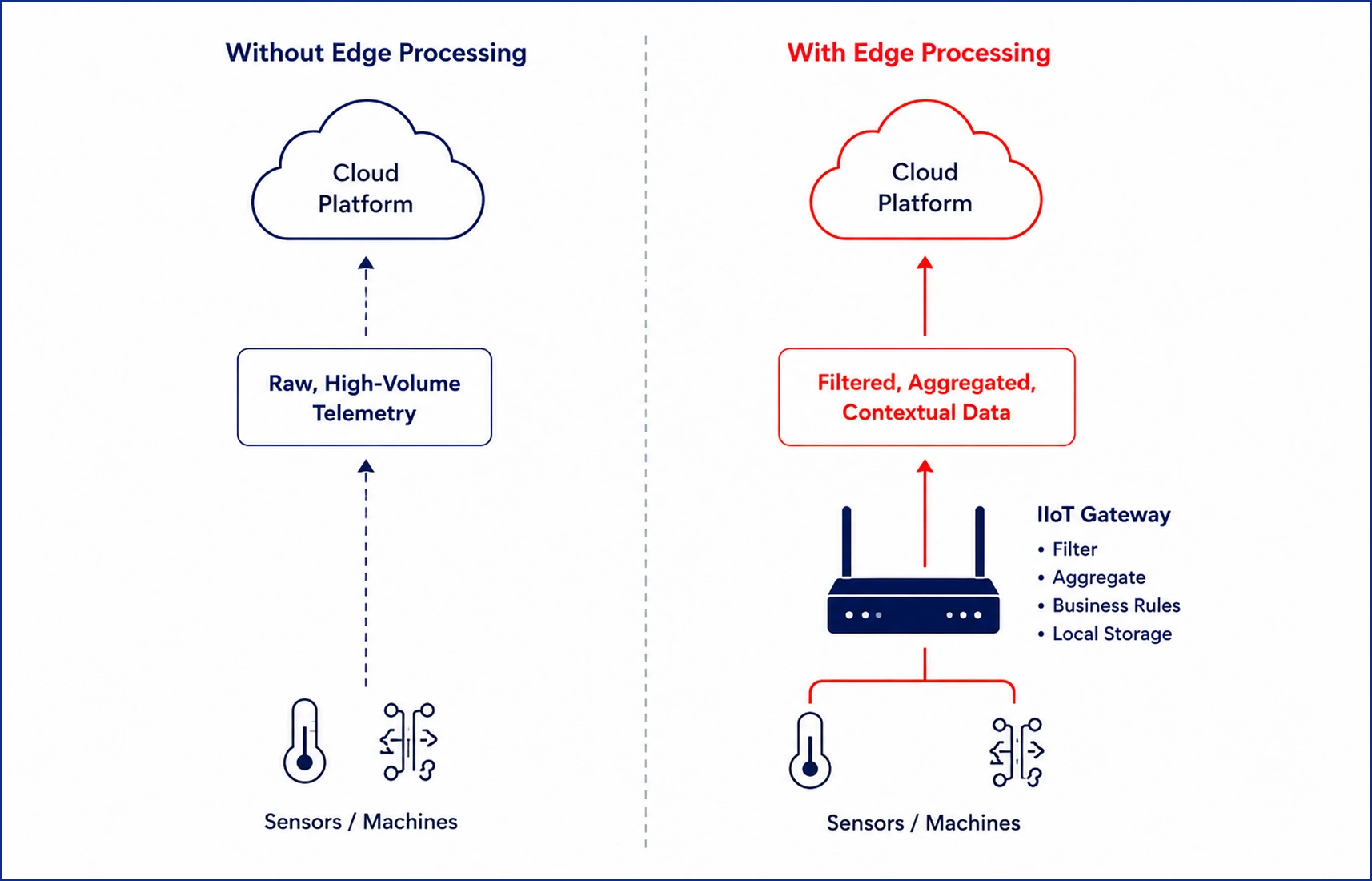
Raw telemetry carries limited value on its own.
A temperature sensor may produce hundreds of readings every minute, while vibration sensors generate continuous streams that contain long periods of stable operation.
An Industrial IoT gateway filters repetitive data, aggregates meaningful measurements, applies local rules, and preserves telemetry during network interruptions.
The cloud receives contextual data that supports faster analytics with lower bandwidth and storage overhead.
Cloud platforms perform best when telemetry arrives in a predictable format.
That consistency allows digital twins to represent equipment behavior accurately, predictive maintenance models to compare assets across facilities, and enterprise dashboards to present production without custom integrations for every machine vendor.
The gateway therefore serves two audiences simultaneously.
It understands the language of industrial equipment while preparing information for enterprise software that depends on standardized operational data.
Based on Azilen’s experience with Industrial IoT gateway deployments, these five design principles help manufacturers build gateway architectures that support factory-scale operations across connected assets and multiple plants.
The gateway should filter repetitive readings, aggregate meaningful measurements, and reduce unnecessary traffic before telemetry reaches enterprise systems.
This allows cloud platforms to process operational context instead of millions of raw sensor events.
Store-and-forward capability keeps operational history intact by buffering telemetry locally until connectivity returns.
Production teams retain a complete equipment timeline instead of fragmented datasets.
Certificate-based authentication gives every gateway a verified identity, which strengthens access control across distributed manufacturing environments.
A trusted identity also simplifies secure communication between edge devices and enterprise platforms.
Remote provisioning, health monitoring, configuration control, and OTA updates become essential as deployments expand across multiple plants.
Centralized management reduces maintenance effort while keeping gateway configurations consistent across sites.
A consistent data model at the gateway allows analytics, digital twins, and predictive maintenance platforms to work across equipment from different vendors.
It also reduces custom integrations every time a new machine enters production.
IoT for predictive maintenance depends on one condition before it depends on AI: reliable operational data.
Most legacy equipment already generates signals that indicate equipment health, including vibration, temperature, pressure, motor current, runtime hours, and cycle counts. These signals often remain isolated inside PLCs or vendor-specific controllers, which makes plant-wide analysis difficult.
An IIoT gateway changes that flow by,
→ Collecting telemetry from multiple protocols
→ Standardizing it at the edge
→ Sending consistent operational data to analytics platforms
The maintenance team receives one continuous equipment history instead of disconnected data streams from different machines.
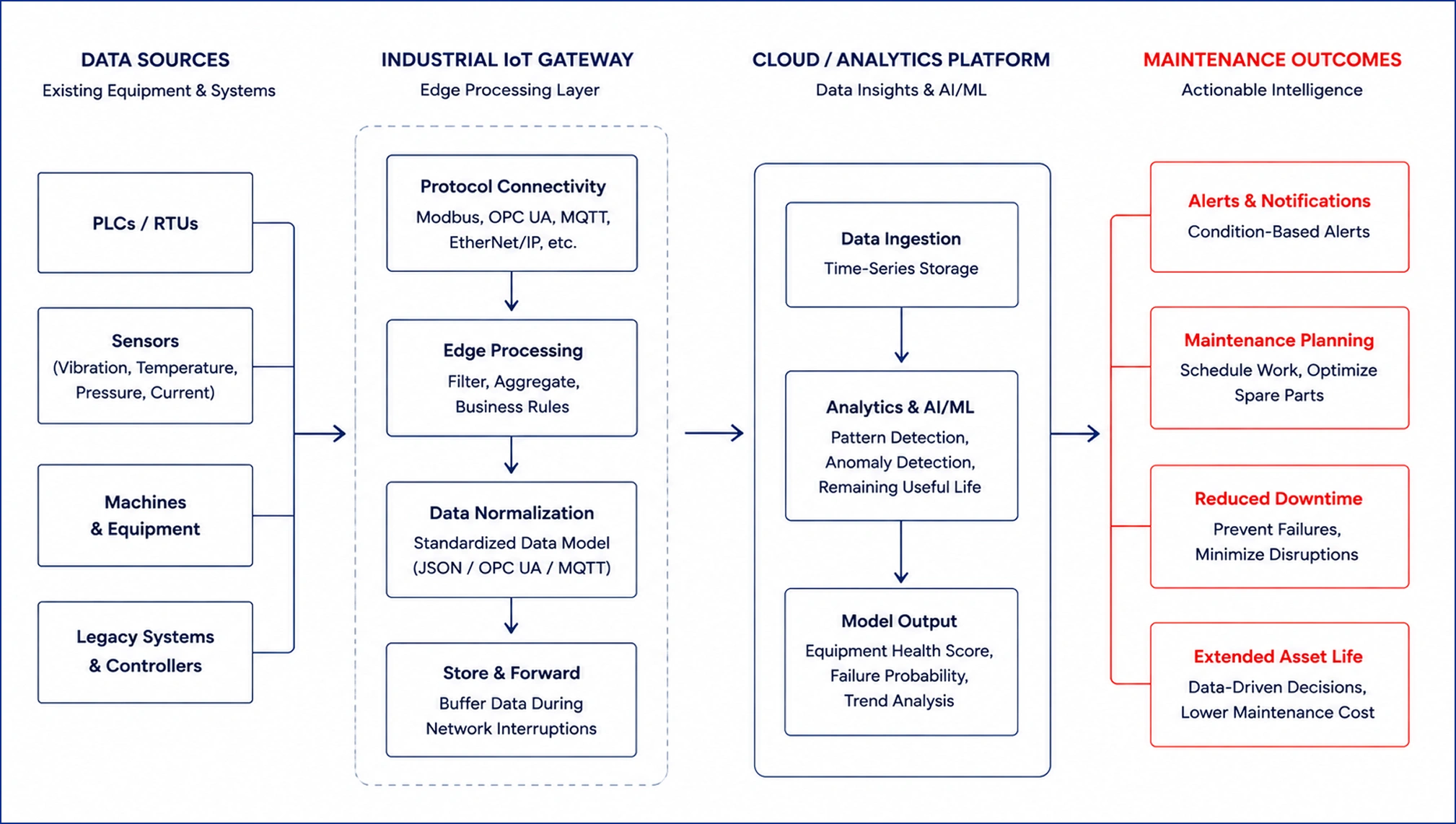
Multi-protocol Industrial IoT gateways become valuable when they create one operational data layer across equipment that was never designed to communicate through the same standard.
Azilen has seen this pattern repeatedly in manufacturing environments where PLCs, RTUs, industrial sensors, and production machines operate through a mix of Modbus, OPC UA, MQTT, and vendor-specific communication protocols.
Each system produces reliable operational data, yet every source follows its own communication model, data structure, and update frequency.
The gateway architecture has to reconcile those differences before analytics platforms can produce trustworthy insights.
Instead of creating separate integrations for every machine, the gateway establishes one structured communication layer between factory assets and enterprise systems.
| Connects PLCs, RTUs, sensors, and industrial equipment through Modbus, OPC UA, MQTT, and other industrial protocols. | |
| Filters repetitive data, applies local business rules, and prepares telemetry before cloud transmission. | |
| Converts different data formats into a consistent operational model across equipment vendors. | |
| Preserves operational history during temporary network interruptions and synchronizes it when connectivity returns. | |
| Delivers standardized telemetry to analytics platforms, MES, ERP, and predictive maintenance systems. |
Brownfield modernization works best as a phased engineering effort.
Each stage solves one operational constraint before the next layer of complexity enters the architecture.
That sequence allows manufacturers to modernize existing infrastructure while production continues on the factory floor.
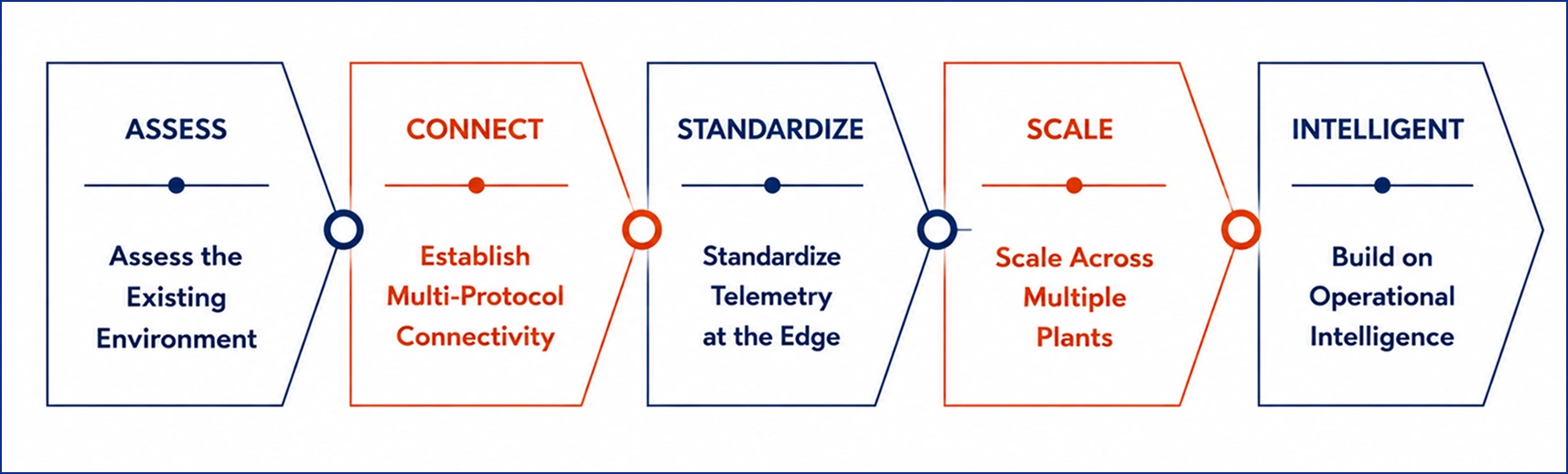
The first step is to inventory PLCs, RTUs, SCADA systems, sensors, and communication protocols across the plant.
This assessment identifies where protocol diversity exists and where gateways will create the greatest operational value.
Introduce gateways at the edge to connect Modbus, OPC UA, MQTT, and other industrial protocols through a common communication layer.
The objective is consistent connectivity rather than isolated machine integrations.
Normalize operational data before cloud transmission.
A shared data model allows analytics platforms, MES, and enterprise applications to work with consistent information across equipment from different vendors.
Once the architecture proves itself in one facility, centralized gateway management, remote provisioning, health monitoring, and OTA updates make multi-site expansion manageable.
With reliable telemetry already in place, manufacturers can expand into predictive maintenance, energy intelligence, digital twins, and AI-driven operational analysis without rebuilding the underlying connectivity layer.
An Industrial IoT gateway is a hardware and software layer that connects factory equipment with enterprise systems. It collects data from PLCs, sensors, SCADA systems, and industrial controllers, translates different communication protocols, and prepares telemetry before it reaches cloud platforms. This creates a consistent data flow across legacy and modern equipment.
Manufacturing plants often use equipment from different vendors that communicate through Modbus, OPC UA, MQTT, CAN, and other protocols. A multi-protocol gateway allows these systems to exchange data through one communication layer. This reduces integration complexity and creates a foundation for plant-wide analytics.
An Industrial IoT gateway focuses on connecting industrial equipment, translating protocols, and moving operational data across factory systems. An edge gateway adds local processing capabilities such as filtering, aggregation, and business rules before cloud transmission. Many enterprise deployments combine both capabilities in the same gateway architecture.
The right protocol mix depends on the manufacturing environment, but most enterprise gateways support Modbus, OPC UA, MQTT, CAN Bus, and BLE. These protocols cover legacy controllers, modern industrial systems, embedded equipment, and wireless sensors. Broad protocol support makes future equipment expansion much easier.
Yes. Industrial IoT gateways are widely used in brownfield manufacturing environments where legacy PLCs and SCADA systems remain part of daily operations. The gateway connects existing equipment without requiring complete infrastructure replacement, which makes modernization more practical and cost-effective.


 15 mins
 28 mins
 "*" indicates required fields

5432 Geary Blvd, Unit #527 San Francisco, CA 94121 United States
320 Decker Drive Irving, TX 75062 United States

6d-7398 Yonge St,1318 Thornhill, Ontario, Canada, L4J8J2

71-75 Shelton Street, Covent Garden, London, United Kingdom, WC2H 9JQ

Hohrainstrasse 16, 79787 Lauchringen, Germany

12, Zugerstrasse 32, 6341 Baar, Switzerland

5th floor, Bloukrans Building, Lynnwood Road, Pretoria, Gauteng, 0081, South Africa

12th & 13th Floor, B Square-1, Bopal – Ambli Road, Ahmedabad – 380054
B/305A, 3rd Floor, Kanakia Wallstreet, Andheri (East), Mumbai, India








 Talk to Our
Consultants
Talk to Our
Consultants Chat with
Our Experts
Chat with
Our Experts Write us
an Email
Write us
an Email