Skip to content

IoT in Healthcare Solutions: How Connected Devices Are Changing Patient Care

Featured Image

Executive Summary

This blog explores how IoT in healthcare solutions are transforming patient care through connected devices and smarter healthcare systems.

→ Understand IoT in healthcare: Explore how connected medical devices collect and share patient data.

→ See how it works: Learn about the architecture behind connected healthcare systems.

→ Explore key applications: Discover remote patient monitoring, AI integration, and emerging healthcare trends.

→ Plan and build solutions: Understand the challenges, security requirements, and cost factors involved in developing IoT healthcare solutions.

A human body speaks long before it asks for help. A heartbeat changes. Breathing slows. Something feels different. The question is, are we listening? Perhaps that’s what IoT in healthcare solutions are trying to answer. Giving doctors a way to listen, even when they aren’t around.

Small devices. Quiet sensors. Constant signals. All working together to make healthcare less about reacting and more about understanding. In this blog, let’s explore how connected devices are changing patient care, one signal at a time.

“The art of medicine consists of amusing the patient while nature cures the disease.”

— Voltaire

$154.74B

Expected size of the IoT medical devices market
by 2030, up from $65.08
billion in
2025.

Source: MarketsandMarkets

159.7M

Connected home medical monitors expected in care programs by 2030, up from 92.7 million in 2025.

Source: Berg Insight, via AZoSensors

99%

Of 351 healthcare organizations studied had connected medical devices with known, actively exploited weaknesses.

Source: Claroty Team82

What is IoT in Healthcare?

The Internet of Things (IoT) refers to a network of physical devices equipped with sensors, software, and internet connectivity that allow them to collect, exchange, and transmit data. In healthcare, this technology is known as the Internet of Medical Things (IoMT).

It includes connected medical devices such as smartwatches, remote blood pressure monitors, wearable ECG patches, and smart hospital beds that help healthcare professionals monitor patients and access real-time health information.

Secure Health Data Monitoring

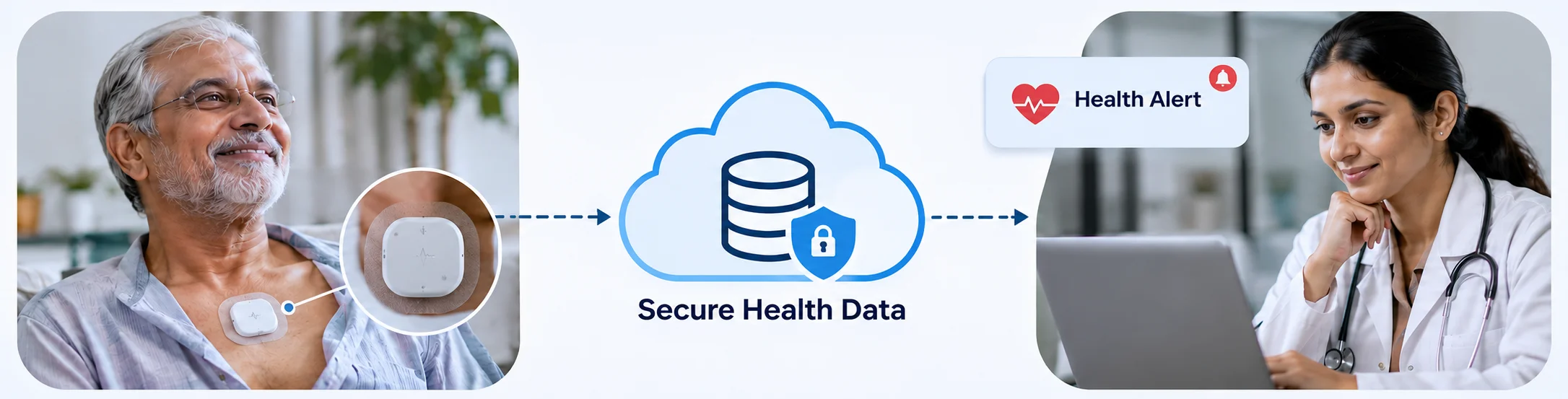
For example: A patient with a heart condition can wear a smart monitoring patch at home that continuously tracks heart activity and transmits the readings to their healthcare provider. If the device detects an unusual pattern, it can send an alert to the care team, allowing them to assess the situation and respond without waiting for the patient’s next scheduled appointment.

A Hospital Ward Without IoT vs With IoT

Drag the slider to see what changes when devices, data, and alerts work together, from checking patients now and then to watching them all the time.

Manual checksPaper chartsProblems found late
WITHOUT IOT
Live vitals 24/7Instant alertsOne dashboard
WITH IOT
‹›

How Does IoT in Healthcare Work?

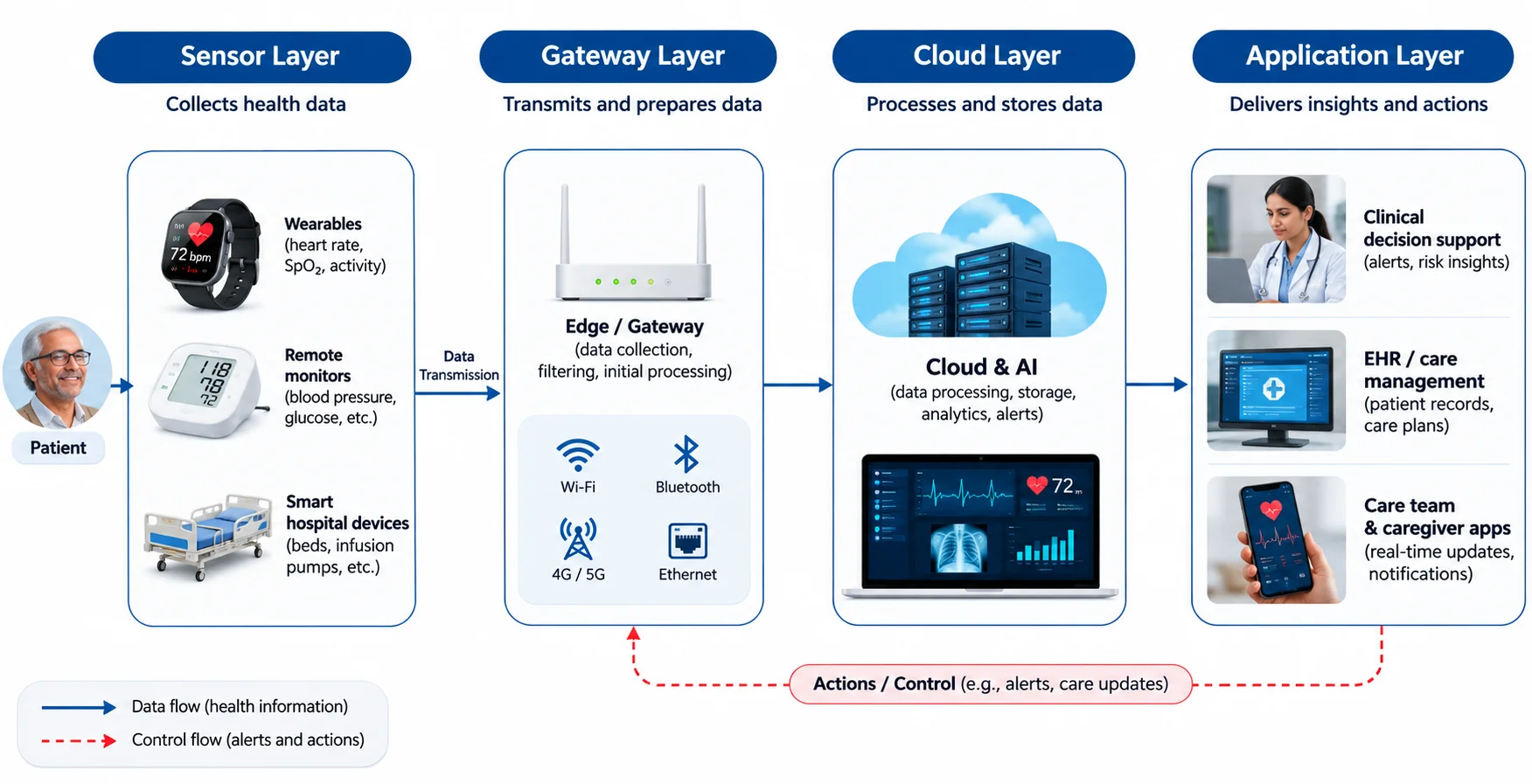
Behind every connected healthcare device is a journey that turns patient data into useful information. While the technology may differ, most IoT healthcare systems follow a common four-stage process: collecting data, transmitting it, processing it, and making it available to healthcare professionals.

A four-panel architecture diagram showing sensors collecting health data, a gateway transmitting it, cloud processing, and clinical apps used for insights without including people details.

Source: Faros AI

Where is IoT Used in Healthcare?

IoT is not one product. It shows up in many places, from a patient’s living room to the hospital store room. Here are the most common settings.

Care Setting Example Devices What IoT Does Who Benefits
Home Care Blood pressure cuffs, pulse oximeters, and smart scales. Sends daily readings to the care team and flags changes. Patients, family members, and clinics.
Chronic Disease Glucose monitors, ECG patches, and smart inhalers. Tracks long-term conditions and treatment use. Patients and doctors.
Hospital Wards Vital-sign patches, smart beds, and infusion pumps. Monitors patients continuously and reduces manual checks. Nurses and patients.
Emergency and Field Work Wearable armbands, chest belts, and GPS tags. Detects heat stress, falls, and exhaustion in real time. First responders and employers.
Rehabilitation and Therapy Motion sensors, VR headsets, and remote controllers. Guides exercises and shares progress with caregivers. Therapists and patients.
Elderly Care Fall sensors, wearables, and smart-home sensors. Sends alerts when unusual activity or events are detected. Seniors and caregivers.
Hospital Operations Asset tags and cold-chain temperature sensors. Tracks equipment, medicines, and room conditions. Administrators and supply teams.
Enterprise AI Governance Discovery Call
Ready to Build Smarter Healthcare Solutions?
Azilen helps businesses create connected IoT healthcare solutions for smarter monitoring and better patient care.

What Are the Main IoT Healthcare Solutions?

Remote Patient Monitoring

Devices track heart rate, blood pressure, oxygen, or glucose at home and send alerts when changes.

Wearables
Devices

Armbands, patches, and watches collect vital signs and movement, such as falls or heat stress.

Smart
Hospitals

Sensors track beds, equipment, room conditions, and staff workflows so nothing gets lost or delayed.

Connected
Therapies

Rehab tools, pumps, and inhalers share usage data so care teams can adjust treatment.

Hospital at Home

Patients recover at home while nurses watch their data from a central
dashboard.

Predictive Analytics

AI studies the data to flag risks early, like a patient who is getting worse or a machine about to fail.

What Are the Biggest Challenges of IoT in Healthcare, and How Do You Solve Them?

Most failed projects stumble on the same few problems. Planning for them early saves time and money.

Challenge Why It Matters How to Solve It
Cybersecurity Connected devices can be targeted by cyberattacks. Claroty found known, exploited vulnerabilities in devices at 99% of the 351 organizations it studied. Give every device a unique identity, encrypt data, segment networks, apply over-the-air (OTA) updates, and monitor unusual activity.
Device Connectivity Issues Different device brands use different communication protocols, which can prevent data from moving between systems. Use open standards such as HL7 FHIR, well-designed APIs, and middleware to connect different systems.
Privacy and Compliance Healthcare data is highly sensitive. Regulations such as HIPAA and GDPR apply, while medical devices may also require FDA or EU approval. Collect only necessary data, maintain audit logs, apply role-based access controls, and involve compliance experts from the beginning.
Weak Connectivity or Battery Life Devices that frequently disconnect may fail to transmit important health readings or critical alerts. Process urgent data at the edge, store readings locally, and synchronize them when connectivity returns.
Too Many Alerts Frequent false alarms can overwhelm nurses and cause them to miss important notifications. Set personalized alert thresholds and use machine learning to reduce false alarms.
Scalability A system that works with 10 devices may struggle to manage 10,000 devices. Choose a device management platform and cloud architecture designed to scale as requirements grow.

What Are the Steps to Start an IoT Healthcare Project?

A successful healthcare technology begins with understanding a problem that needs solving. When planning IoT in healthcare solutions, the best approach is to start with a small, meaningful goal, test what works, and gradually build something that can make a real difference to patient care.

Here are six practical steps to get started:

1. Start With a Healthcare Problem Worth Solving

Before choosing any technology, understand what needs to change. Is it reducing hospital readmissions, monitoring patients remotely, or identifying fall risks earlier? Pick one clear clinical goal and decide how you will measure success.

2. Choose the Right Devices and Connectivity

Once the goal is clear, identify the devices that can help achieve it. These could include wearable health monitors, smart sensors, or connected medical equipment. Also, decide how they will communicate through Bluetooth Low Energy (BLE), Wi-Fi, or cellular networks.

3. Plan the Architecture and Security

Think about where the collected data will go, how it will be processed, and who will have access to it. Plan the cloud infrastructure, user permissions, and data encryption from the beginning rather than treating security as an afterthought.

4. Build a Small Pilot Before Going Big

You don’t need to connect an entire hospital on day one. Start with a limited number of devices or patients. Let doctors and nurses use the system, observe how it performs, and collect their feedback before expanding.

5. Test the System and Meet Regulatory Requirements

Healthcare data leaves little room for mistakes. Test device accuracy, system reliability, and cybersecurity. Also, identify the applicable requirements, including HIPAA, GDPR, and medical device regulations, depending on your location and use case.

6. Scale, Monitor, and Keep Improving

Once the pilot delivers the expected results, gradually expand the solution. Monitor device performance, maintain software updates, review alerts, and improve the system as healthcare needs evolve. An IoT healthcare project is not a one-time implementation; it requires continuous attention.

How do you build a secure IoT healthcare solution?

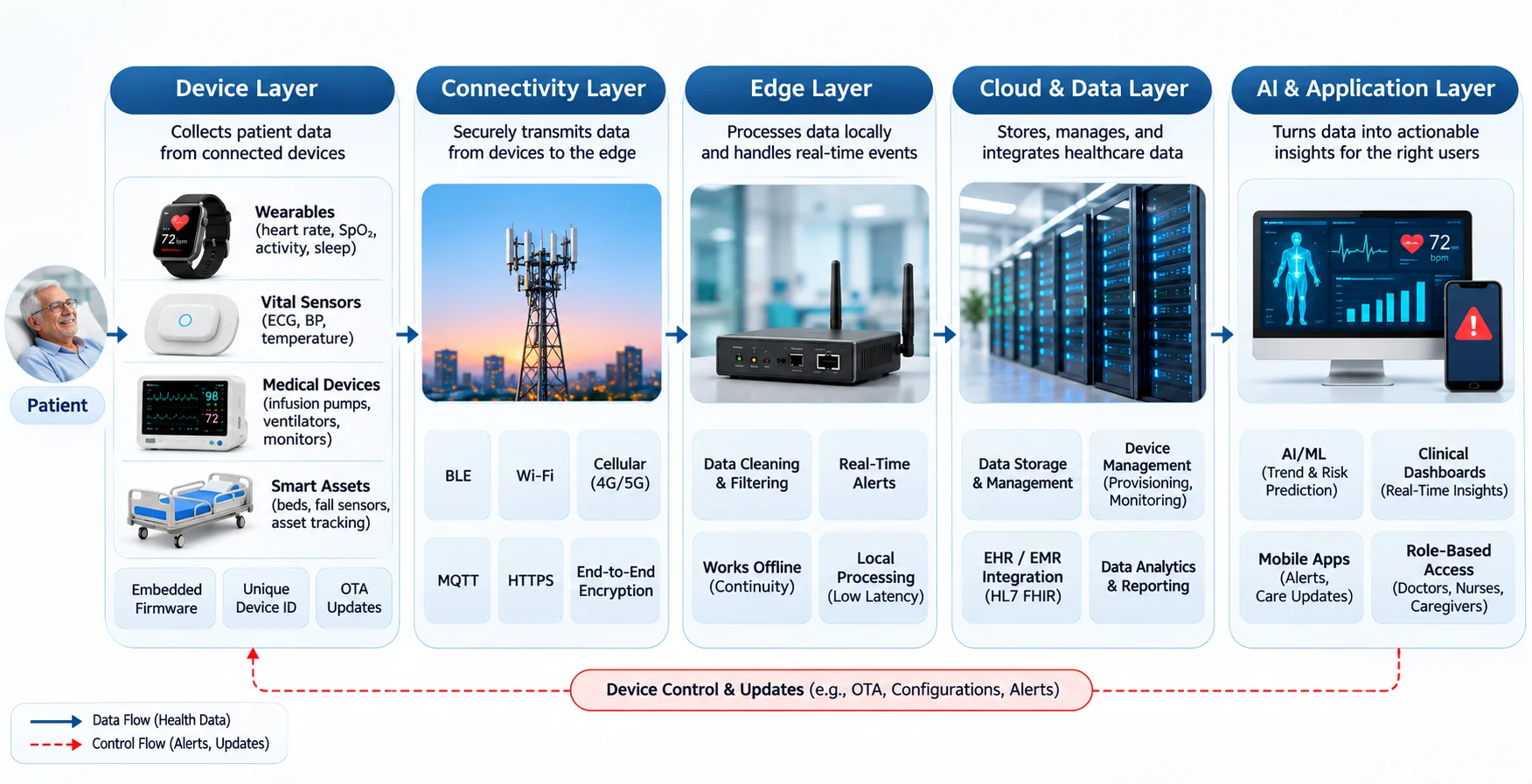
A good solution is built in layers. Each layer has one job, and security is part of every layer.

Connected IoT Healthcare Architecture

How Is AI Changing IoT in Healthcare?

A device can collect a thousand readings, but can it understand what they mean? That’s where AI steps in. It turns patient data into meaningful insights, spots early warning signs, and helps doctors act before small changes become serious problems.

With AI integration services, connected devices and healthcare systems can work together to make care smarter, faster, and more proactive.

What Are the Future Trends in IoT Healthcare?

The future of healthcare is moving beyond simply monitoring patients. The next generation of IoT in healthcare solutions will focus on smarter decisions, faster responses, and more connected care experiences. Here are five trends worth watching.

1. AI Agents in Healthcare → AI agents will help summarize patient records, identify potential risks, coordinate follow-ups, and automate routine healthcare workflows.

2. Edge AI → More health data will be processed directly on or near connected devices, enabling faster alerts, lower latency, and reduced dependence on cloud connectivity.

3. Remote Patient Monitoring → Home-based monitoring is gaining momentum. According to Berg Insight’s market research, connected home medical monitoring devices are expected to grow from 92.7 million in 2025 to 159.7 million by 2030.

4. Better Healthcare Interoperability → Standards such as HL7 FHIR will help medical devices, healthcare applications, and electronic health records exchange information more consistently.

5. Security by Design → Device authentication, data encryption, regular security updates, and access controls will become essential as connected medical devices expand. The FDA’s medical device cybersecurity guidance highlights the importance of security throughout a device’s lifecycle.

What Affects the Cost of an IoT Healthcare Solution?

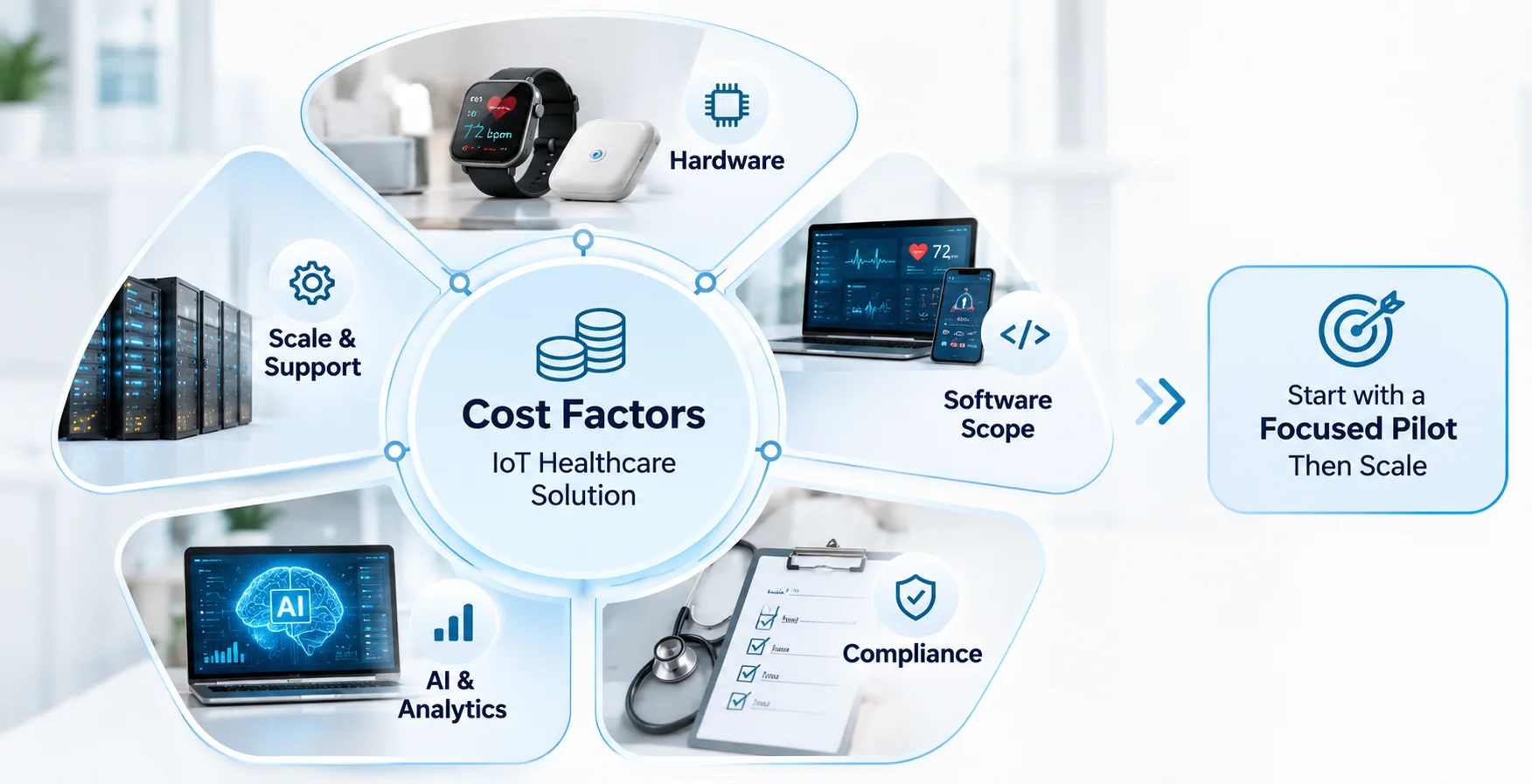
There is no fixed price for an IoT healthcare solution. The overall investment depends on the project’s complexity, technology, and long-term requirements. Here are the key factors that influence the cost:

IoT Healthcare Cost Factors

→ Hardware: Off-the-shelf medical devices or custom-built equipment with dedicated firmware.

→ Software Scope: Mobile applications, web dashboards, admin panels, and EHR integrations.

→ Compliance: Testing, documentation, certifications, and regulatory approvals required for your target market.

→ AI and Analytics: Basic monitoring alerts generally cost less than advanced predictive models and AI-powered analytics.

→ Scale and Support: The number of connected devices, ongoing monitoring, maintenance, and software updates.

The smartest approach is to start with a focused pilot, understand what delivers value, and gradually expand the solution.

How Does Azilen Help Businesses Build IoT Healthcare Solutions?

Building connected healthcare solutions takes more than medical devices. It requires reliable software, seamless data integration, intelligent automation, and secure architecture.

As an enterprise AI development company, Azilen brings together its engineering, AI, and integration expertise to help businesses develop connected, scalable healthcare solutions.

→ IoT Solution Development: Build connected applications and systems that bring medical devices and healthcare platforms together.

→ AI & Data Engineering: Turn patient data into meaningful insights through intelligent analytics and AI capabilities.

→ System Integration: Connect medical devices, healthcare applications, and enterprise systems for smoother data exchange.

→ Secure Architecture: Design scalable systems with a focus on data protection, reliability, and interoperability.

Azilen helps businesses turn connected healthcare technology into practical solutions that support better patient care.

Build Smarter, Connected Healthcare Solutions with Azilen.
CTA

FAQs: IoT in Healthcare Solutions

1. Can IoT devices monitor patients 24/7 without hospital supervision?

Yes. Connected medical devices can continuously track vital signs and send readings to healthcare professionals remotely. However, alerts still need clinical review, and these devices do not replace emergency care or direct medical supervision.

2. What happens if an IoT healthcare device loses internet connectivity?

Many IoT devices can temporarily store health readings locally and transmit them once connectivity returns. Edge computing can also support certain local alerts, depending on the device and system design.

3. Can existing hospital equipment be connected to an IoT platform?

In many cases, yes. Existing equipment can be connected through compatible gateways, APIs, or integration interfaces. However, compatibility depends on the device’s communication capabilities, age, and manufacturer support.

4. Who owns the health data collected by connected medical devices?

Data ownership and control depend on applicable laws, patient agreements, and healthcare arrangements. Healthcare providers and technology vendors must clearly define how patient information is collected, accessed, stored, and shared.

5. Can small clinics and independent healthcare providers afford IoT solutions?

Yes. Clinics can begin with a focused implementation, such as connected blood pressure monitors or remote patient monitoring devices, rather than investing in an entire hospital-wide IoT infrastructure.

6. Can IoT healthcare systems work with multiple medical device brands?

Yes, provided the devices support compatible communication protocols, data formats, or integration interfaces. Standards such as HL7 FHIR can also help connect healthcare applications and electronic health records.

google
Niket Kapadia
Niket Kapadia
CTO - Azilen Technologies

Niket Kapadia is a technology leader with 17+ years of experience in architecting enterprise solutions and mentoring technical teams. As Co-Founder & CTO of Azilen Technologies, he drives technology strategy, innovation, and architecture to align with business goals. With expertise across Human Resources, Hospitality, Telecom, Card Security, and Enterprise Applications, Niket specializes in building scalable, high-impact solutions that transform businesses.

Related Insights