Skip to content

How to Start IoT Platform Modernization Without Rebuilding Everything

Featured Image

Executive Summary

Many IoT platforms are outdated, while device scale and data demands keep increasing. A full rebuild is costly, time-consuming, and risky.

This blog explains how to approach IoT Platform Modernization without rebuilding everything. It shows how to upgrade your platform step by step using patterns like the Strangler Fig, modern data pipelines, microservices, and edge intelligence.

You will also learn key steps, real-world examples, and common mistakes, so you can modernize your IoT platform without disrupting existing systems.

When Should You Start IoT Platform Modernization?

Monday morning. Everything looks fine. Devices are connected. Data is flowing.

But something feels off.

A few delays. Slower analytics. Small issues that were not there before. Nothing is broken, but the system is not keeping up.

This is how most IoT Platform Modernization journeys begin, not with failure, but with friction.

When Should You Start IoT Platform Modernization

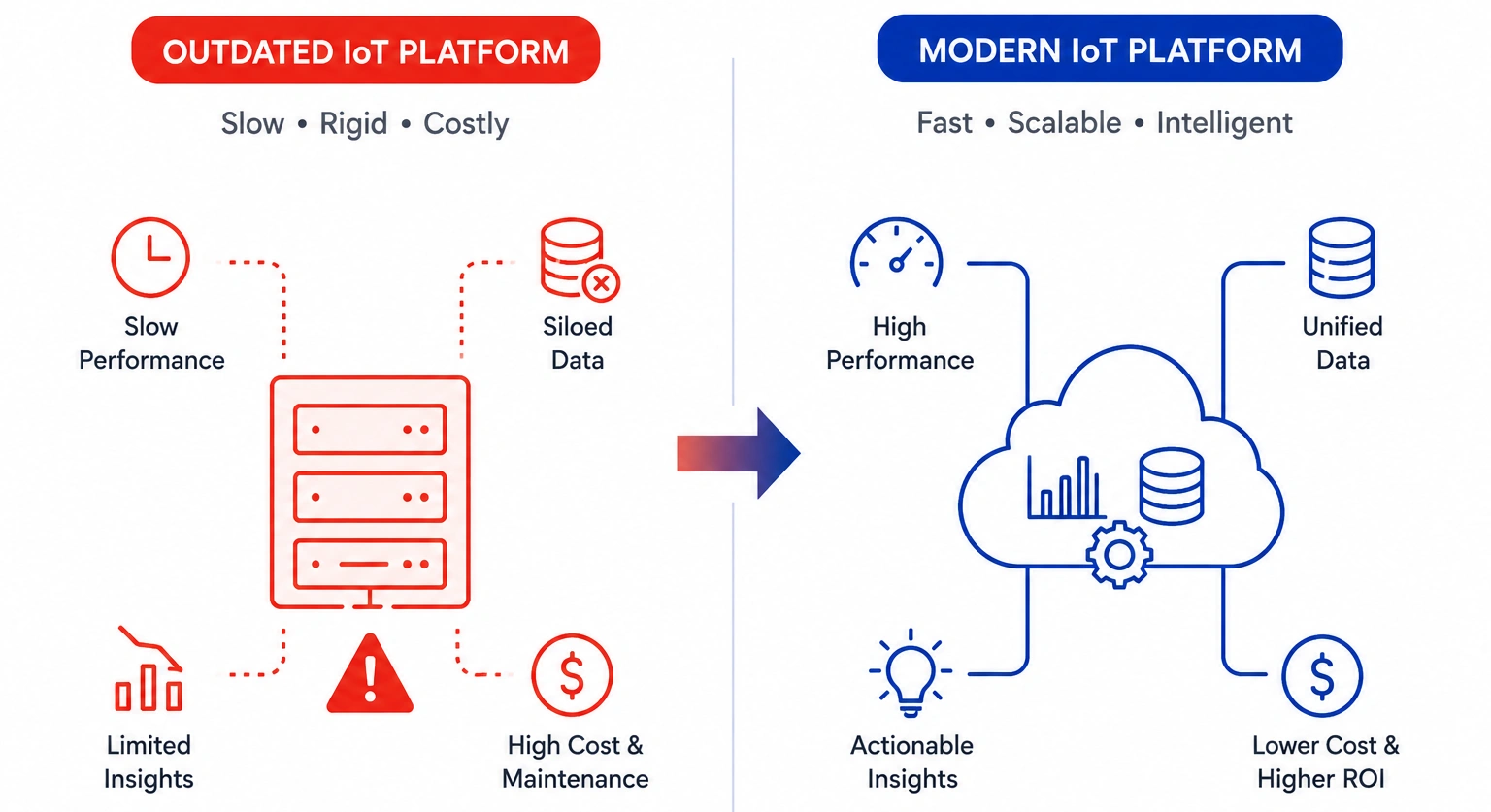
Your platform was built for a different time, when device volumes were lower and data was simpler. Today, you are handling continuous data streams, real-time expectations, and growing scale.

The problem is not your devices. It is the platform behind them.

Most teams assume a full rebuild is the only solution. But that brings high cost, long timelines, and risk.

So the real question is simple:

How do you approach IoT Platform Modernization without rebuilding everything?

What is IoT Platform Modernization (And What it is NOT)?

IoT Platform Modernization means upgrading your platform, data, devices, APIs, and security, without rebuilding everything.

What it is not:

→ Not a full rebuild

→ Not a risky “migrate everything” move

→ Not deleting your legacy system out of frustration

Think of it like renovating a house. You fix one room at a time while people still live in it.

Same here. Improve step by step. Keep things running.

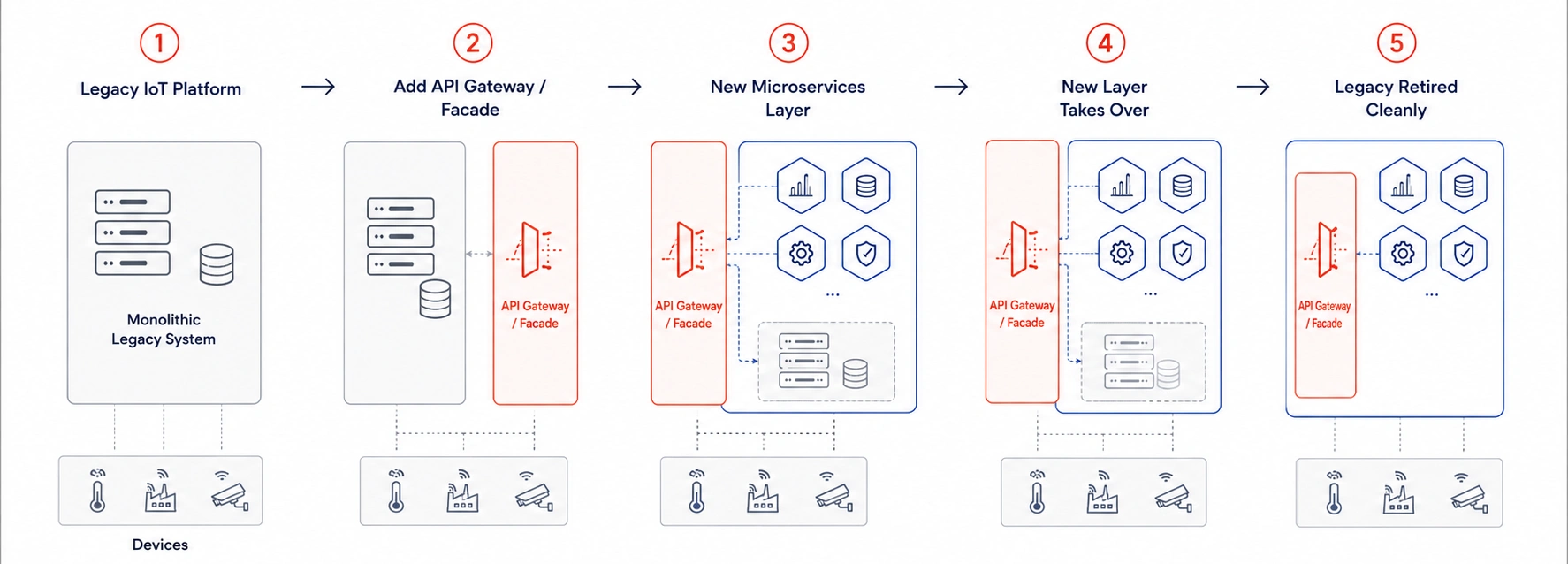
This approach is called the Strangler Fig Pattern.

The Strangler Fig: The Architecture Behind Smart IoT Platform Modernization

The Strangler Fig Pattern, originally described by software architect Martin Fowler, is simple but powerful.

You wrap new functionality around an old system, gradually routing more traffic to the new layer. Over time, the old system becomes irrelevant.

This pattern is now a core approach in IoT Platform Modernization, especially when combined with strong IoT Data Analytics capabilities that help you understand, optimize, and validate each step of the transition.

The Strangler Fig IoT Platform Modernization

Netflix used this exact approach to migrate from its Reloaded media platform to the new Cosmos system.

Allianz applied it to modernize mainframe-based claims processing using Apache Kafka as an event backbone, migrating without disrupting ongoing insurance operations.

The pattern works. The key is how you apply it to IoT.

6 Steps to Start IoT Platform Modernization Without Rebuilding Everything

These steps are ordered deliberately. Skip one and you increase risk. Follow them in sequence and you move fast without breaking things.

Step 1: Audit Your Current IoT Architecture Honestly

Step 1 Audit Your Current IoT Architecture Honestly

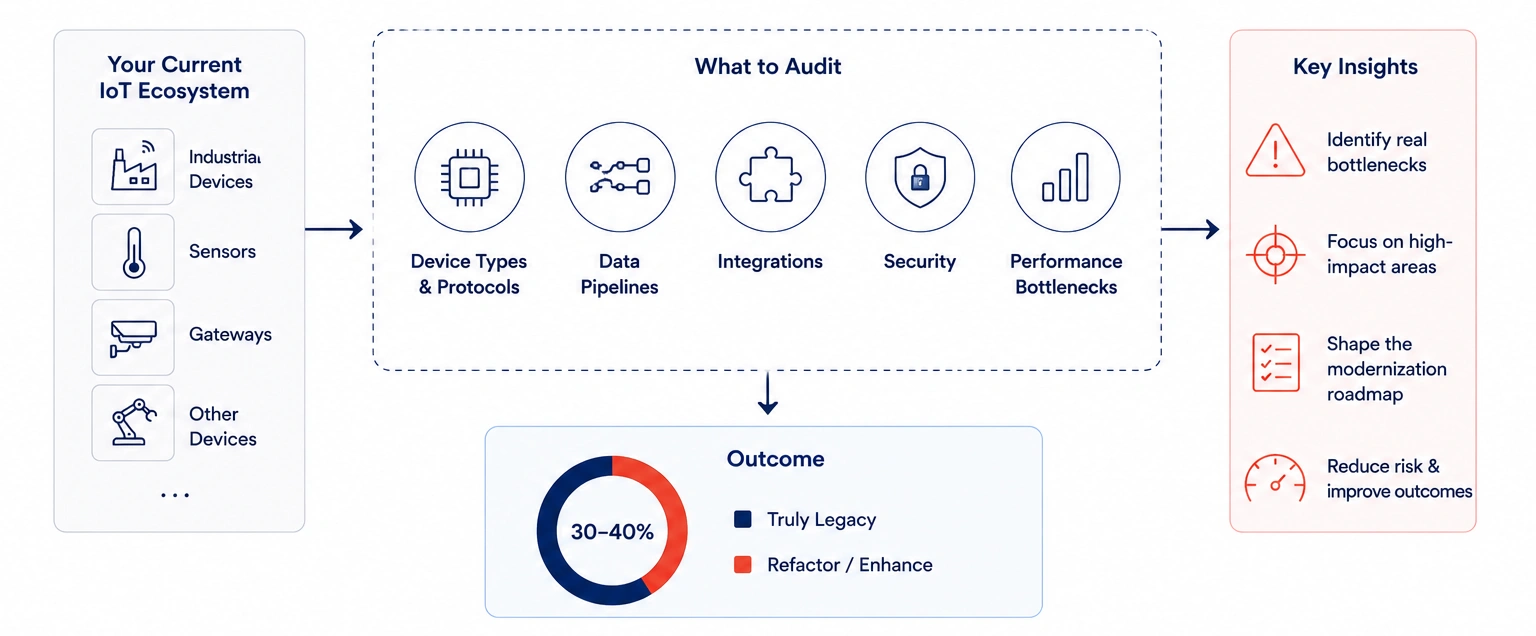
Before you modernize anything, understand exactly what you have.

Map every device type, protocol, data pipeline, and integration. Identify where the real bottlenecks are.

Is it device onboarding? Real-time data ingestion? Security gaps?

Most teams discover that only 30–40% of their platform is truly legacy. The rest just needs refactoring. This audit shapes everything that follows.

Step 2: Add an API Gateway as Your Modernization Facade

Step 2 Add an API Gateway as Your Modernization Facade

This is your first concrete step.

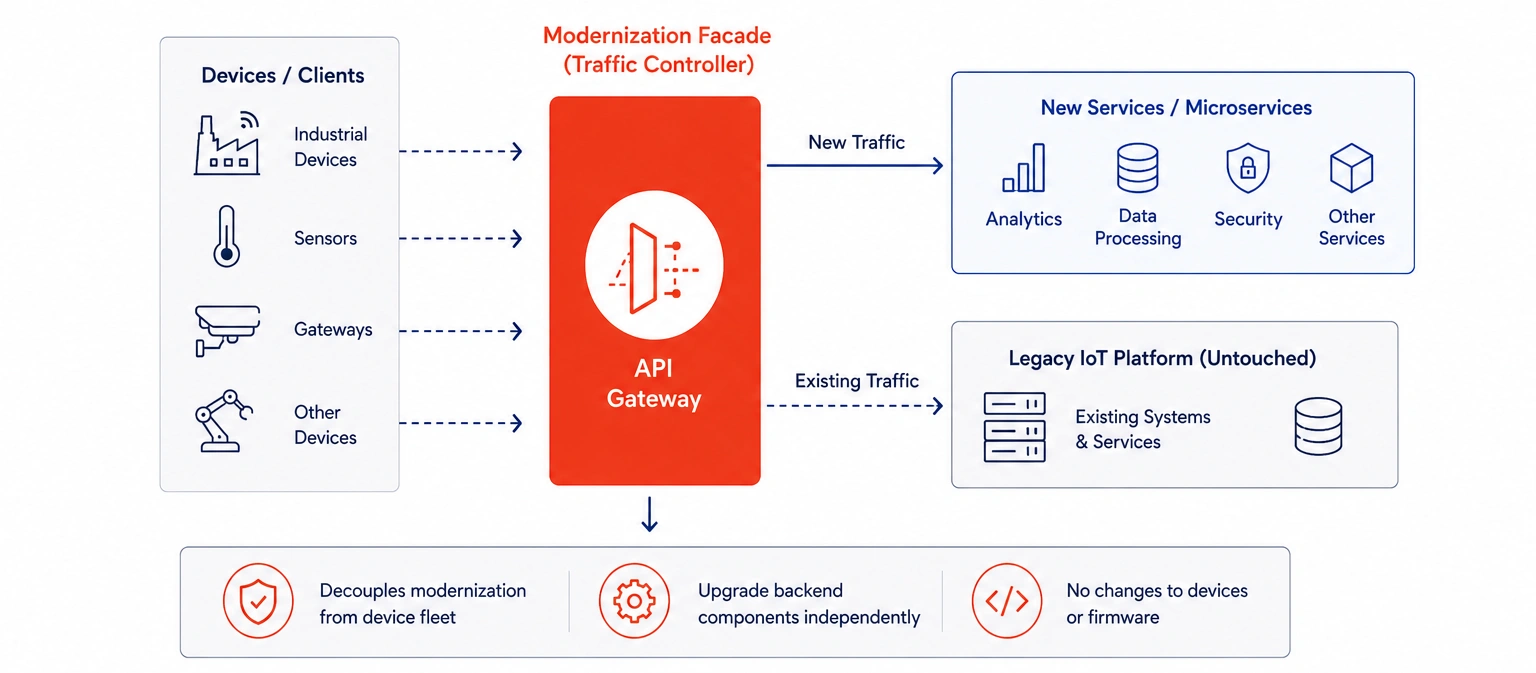
Deploy an API gateway in front of your legacy platform.

It does not replace anything yet. Instead, it becomes the traffic controller. New services route through it. Old services stay untouched.

This single step decouples your modernization roadmap from your current device fleet. You can now upgrade backend components without touching a single firmware line.

Step 3: Modernize The Data Pipeline, Not The Application

Step 3 Modernize The Data Pipeline, Not The Application

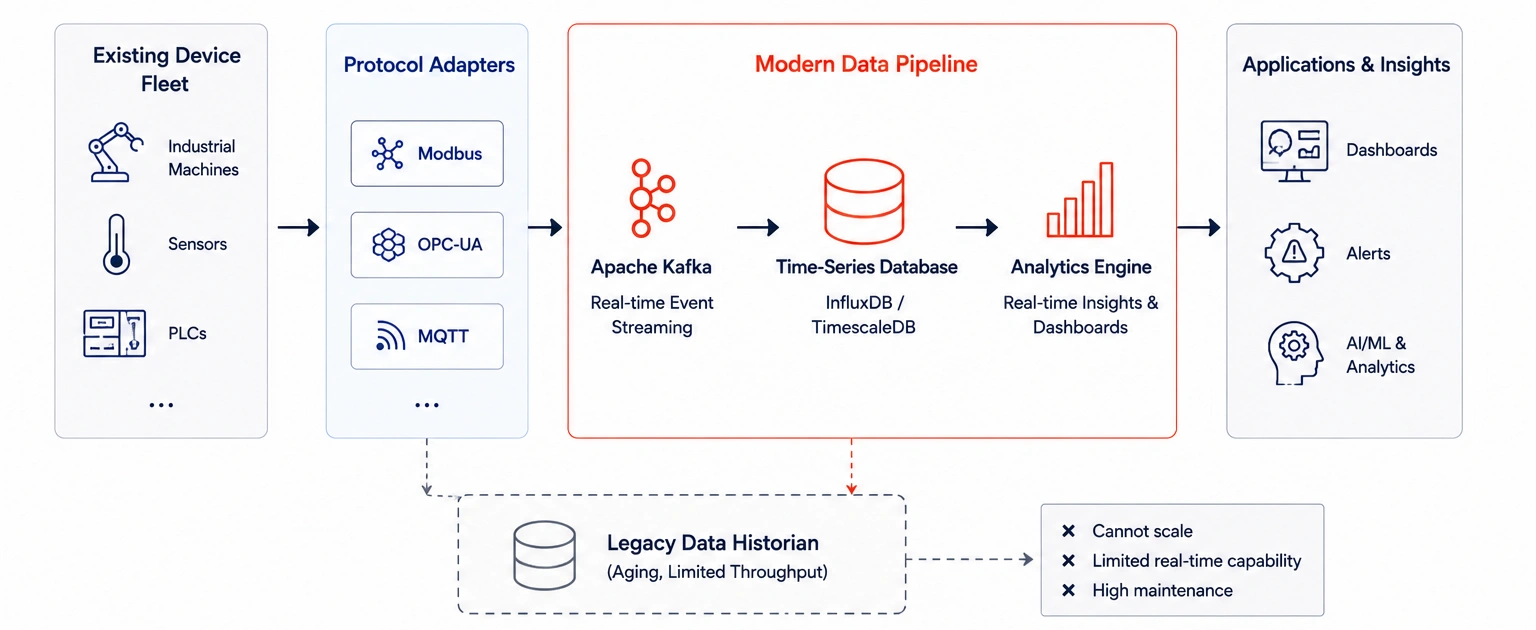
Most IoT platforms have aging data pipelines that cannot handle modern throughput.

This is the highest-ROI fix. Replace your legacy data historian with a modern time-series database like InfluxDB or TimescaleDB.

Add Apache Kafka for real-time event streaming. Connect it to your existing device fleet using protocol adapters for Modbus, OPC-UA, or MQTT.

Suddenly, your old devices are feeding a modern analytics engine. No firmware update required.

Explore how IoT in renewable energy tackles performance blind spots, and why IoT Platform Modernization makes it possible.

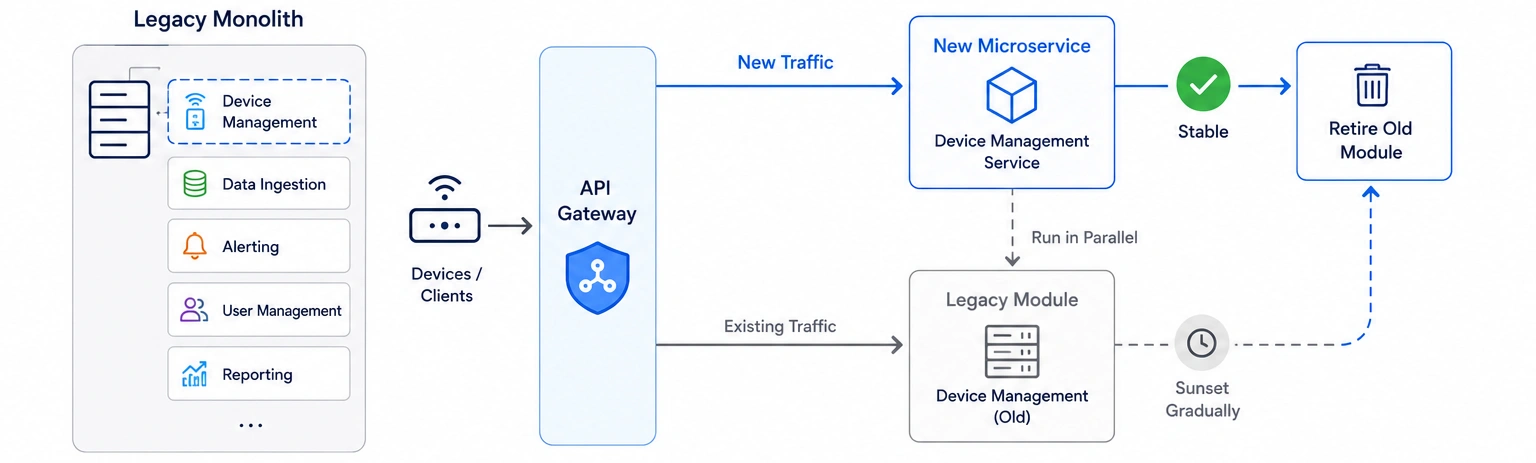
Step 4: Extract High-Value Microservices From Your Monolith

Step 4 Extract High-Value Microservices From Your Monolith

Now you start the actual strangling in your IoT Platform Modernization journey.

Pick the module with the highest business value and the most technical debt, usually device management or alerting.

Build it as a standalone microservice and route traffic to it via your gateway.

Run both the old and new versions in parallel for a period. Once the new service is stable, retire the old one. Then move to the next module. Repeat.

Step 5: Introduce Edge Intelligence Gradually

Step 5 Introduce Edge Intelligence Gradually

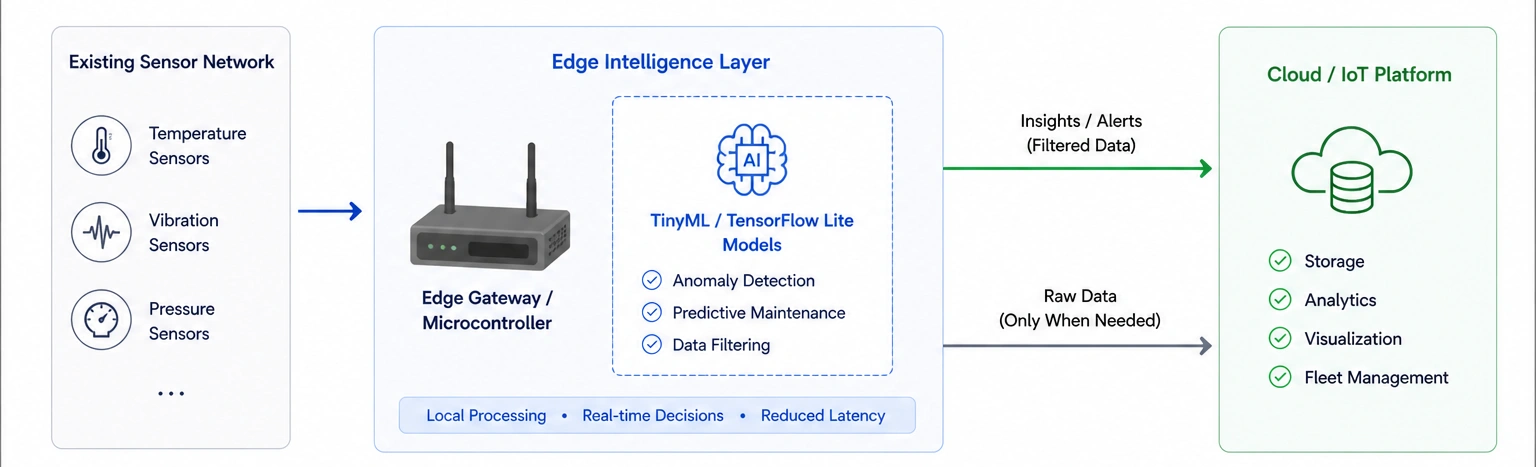
Once your data pipeline is modern, the next layer is edge AI, and this is where the right IoT Consulting Services make a real difference.

Deploy TinyML models or TensorFlow Lite directly onto edge gateways and microcontrollers.

This enables local anomaly detection, predictive maintenance alerts, and data filtering, reducing cloud bandwidth costs by 40–70%.

You do not need to replace field devices to do this. You add edge compute capability on top of your existing sensor network.

Step 6: Embed a Zero-Trust Security Framework Throughout

Step 6 Embed a Zero-Trust Security Framework Throughout

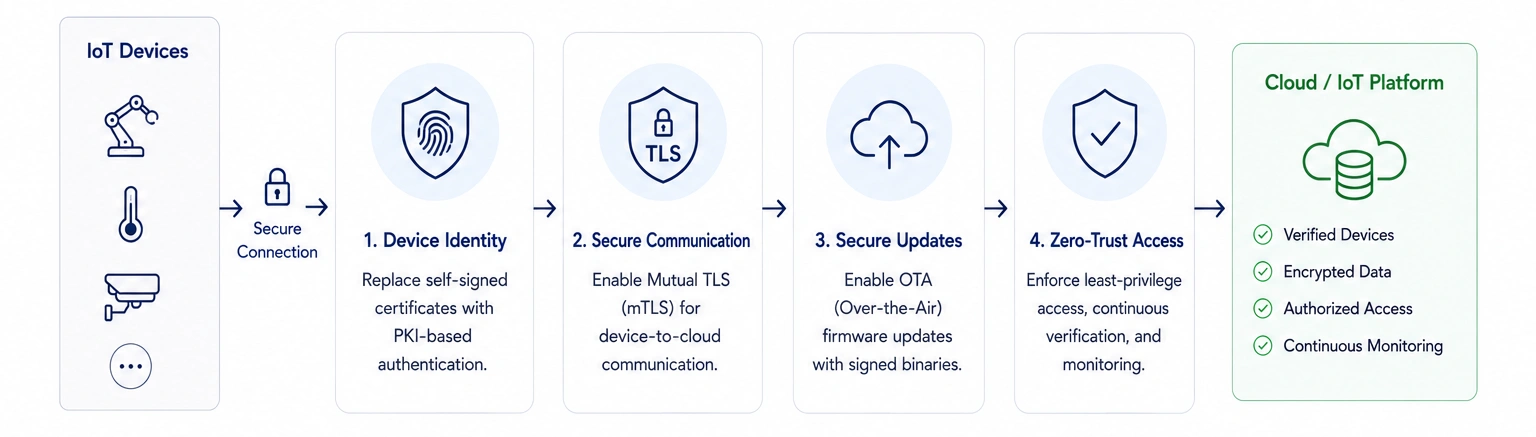
Security cannot be a phase-six afterthought. But neither does it require a full rebuild.

Apply zero-trust principles incrementally. Start with device identity, replace self-signed certificates with PKI-based authentication.

Add mutual TLS (mTLS) for device-to-cloud communication. Enable OTA (over-the-air) firmware updates with signed binaries.

As the US IoT Cybersecurity Improvement Act tightens compliance requirements, this step protects you from regulatory risk as well as cyber threats.

Explore our complete guide: How to Make IoT Product Development Successful in 2026 (A Practical Engineering Guide), for a deeper, engineering-first approach.

The IoT Platform Modernization Comparison Table

Not every strategy fits every company. Here is how the three main approaches compare, and when to use each one.

Modernisation Strategies Comparison
Strategy
What it means
Best for
Risk
Typical timeline
Refactor Update code without changing core architecture. Optimize data flows and protocols. Platforms with solid architecture but outdated code Low 3–6 months
Replatform (Strangler Fig) Migrate component by component to a modern stack while legacy runs in parallel Most enterprise IoT platforms Medium 6–18 months
Rebuild Full redevelopment from scratch with a clean architecture Platforms with fundamental architectural flaws Very high 18–36 months
Wrap with API layer Add a modern API layer over legacy systems without modifying the core Quick wins and buying time for larger modernization Very low 4–8 weeks

For most product teams, the Replatform strategy using the Strangler Fig Pattern is the right answer. It balances speed, risk, and continuity.

Real-World IoT Platform Modernization: Case Studies That Prove It Works

Teréga: Replacing a Legacy Data Historian Without Downtime

Replacing a legacy data historian without downtime

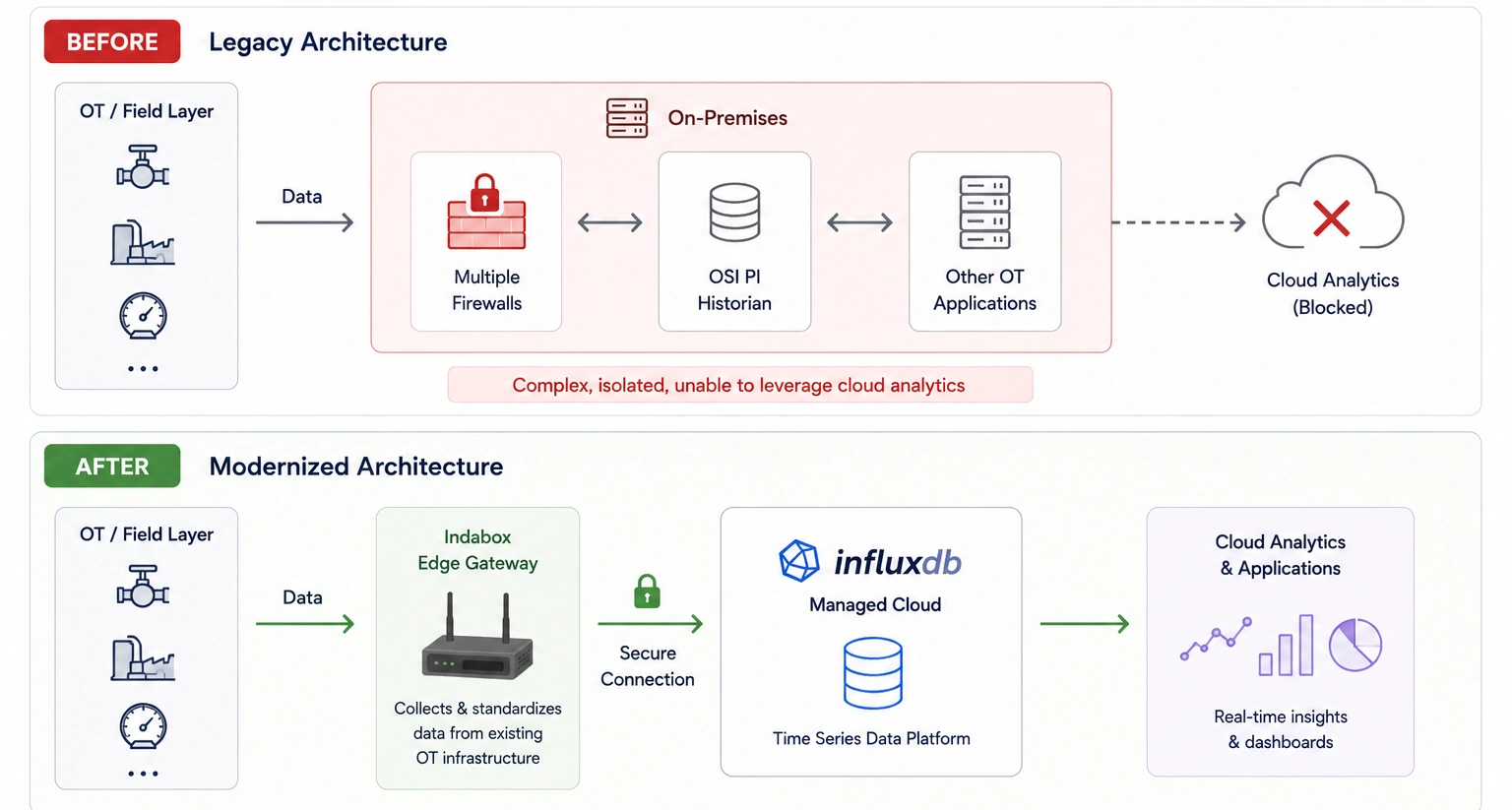
Teréga operates 5,000 km of natural gas pipelines in France. Their legacy on-premises OSI Pi historian was surrounded by an “elaborate maze of firewalls” that blocked cloud analytics.

They did not rebuild their OT stack. Instead, they replaced only the historian layer, migrating to InfluxDB’s managed cloud solution and building a new edge gateway called Indabox to bridge the existing OT infrastructure.

Today, over 100,000 metrics including pressure, temperature, and gas quality flow in real time. The platform is fully cloud-native. The physical infrastructure is the same.

The Technical Stack Behind Modern IoT Platform Modernization

Here is the architecture stack that leading enterprises are converging on in 2026.

Device connectivity includes technologies like MQTT 5.0, OPC-UA, and Modbus adapters, which help standardize communication across both legacy and modern devices.

Edge compute uses tools such as TinyML, TensorFlow Lite, and ONNX Runtime to enable on-device AI, anomaly detection, and faster local decision-making.

Event streaming is powered by platforms like Apache Kafka and Apache Flink, allowing real-time processing and smooth routing of IoT data.

Time-series storage solutions like InfluxDB and TimescaleDB store high-frequency sensor data efficiently at scale.

Cloud IoT core platforms such as AWS IoT Core and Azure IoT Hub handle device lifecycle management and support OTA (over-the-air) updates.

API gateways like Kong and AWS API Gateway manage traffic routing, enforce security, and handle version control across services.

Orchestration is handled by Kubernetes (EKS, AKS, GKE), which manages containers and ensures microservices run smoothly.

Security frameworks including mTLS, PKI, and Zero Trust ensure secure device identity and encrypted communication across the platform.

How Azilen Supports Your IoT Platform Modernization Journey

We act as an Enterprise AI Development Partner for teams treating IoT Platform Modernization as a long-term system decision, not a quick fix.

Modernizing an IoT platform is not just about upgrading technology. It is about building a system that works reliably across scale, devices, and time.

Our team brings together embedded engineers, cloud architects, data specialists, and AI experts who have worked on real-world connected systems across industries like manufacturing, logistics, retail, and enterprise platforms.

We help you:

✔️ Define a scalable architecture across edge, gateway, and cloud for IoT Platform Modernization

✔️ Design modern data pipelines and introduce edge intelligence step by step

✔️ Build and optimize firmware for performance and long-term reliability

✔️ Implement secure device identity, provisioning, and lifecycle management

✔️ Enable OTA updates and remote diagnostics without operational disruption

✔️ Develop cloud-native platforms with strong monitoring and observability

✔️ Integrate AI/ML models for predictive insights and smarter decision-making

If you are planning or already working on IoT Platform Modernization, we help you move forward with clarity, without breaking what already works.

IoT App Development
Start Your IoT Platform Modernization
Understand how we modernize and scale IoT platforms 👇

FAQs: IoT Platform Modernization

1. What is IoT Platform Modernization?

IoT Platform Modernization is the process of upgrading your existing IoT system—such as data pipelines, device management, and analytics, without rebuilding everything from scratch.

It focuses on improving performance, scalability, and security while keeping current devices and infrastructure running.

2. Do I need to rebuild my IoT platform to modernize it?

No, a full rebuild is not required for IoT Platform Modernization. Most organizations use a phased approach, where they upgrade specific components like data pipelines or APIs while keeping the rest of the system active. This reduces risk, cost, and downtime.

3. What are the first steps in IoT Platform Modernization?

The first step in IoT Platform Modernization is auditing your current architecture. This includes mapping devices, protocols, data flow, and identifying bottlenecks. After that, teams usually add an API gateway and start modernizing the data pipeline.

4. Why is modernizing the data pipeline important in IoT?

The data pipeline is often the biggest limitation in legacy systems. In IoT Platform Modernization, upgrading to real-time streaming and time-series databases improves performance, enables faster insights, and supports large-scale device data without changing existing hardware.

5. How long does IoT Platform Modernization take?

The timeline for IoT Platform Modernization depends on the approach. A phased strategy can take anywhere from a few months to over a year, depending on system complexity. However, it allows continuous improvements without disrupting operations.

Glossary

1. IoT (Internet of Things): A network of connected devices that collect, exchange, and act on data through sensors, software, and connectivity.

2. IoT Platform Modernization: The process of upgrading an existing IoT system, data pipelines, device management, and infrastructure, without rebuilding everything from scratch.

3. API Gateway: A layer that sits between devices and backend systems, managing traffic, routing requests, and enabling smooth integration between old and new services.

4. Edge Computing: Processing data closer to the device (at the “edge”) instead of sending everything to the cloud, reducing latency and improving real-time decision-making.

5. Microservices Architecture: A system design where applications are broken into smaller, independent services that can be developed, deployed, and scaled separately.

6. Time-Series Database: A database optimized for handling time-based data, such as sensor readings, making it easier to store and analyze IoT data at scale.

7. Zero-Trust Security: A security model where no device or system is trusted by default, and every request is verified to ensure secure communication across the IoT platform.
google
Chintan Shah
Chintan Shah
Associate Vice President - Delivery at Azilen Technologies

Chintan Shah is an experienced software professional specializing in large-scale digital transformation and enterprise solutions. As AVP - Delivery at Azilen Technologies, he drives strategic project execution, process optimization, and technology-driven innovations. With expertise across multiple domains, he ensures seamless software delivery and operational excellence.

Related Insights

GPT Mode
AziGPT - Azilen’s
Custom GPT Assistant.
Instant Answers. Smart Summaries.