




Skip to content

LLM Token Optimization: Where Your Tokens Go and What to Cut First

Featured Image

Executive Summary

LLM token optimization is about reducing unnecessary token usage while keeping AI responses accurate and useful. This guide explains where tokens go, what to cut first, and how better LLM efficiency can reduce AI costs.

→ Find token waste: Understand how chat history, retrieved documents, instructions, and AI responses add to your token usage.

→ Optimize LLM costs: Use context engineering, caching, shorter outputs, and the right AI model to reduce unnecessary token consumption.

→ Improve token efficiency: Track token usage, set budgets, and monitor performance to keep costs under control without sacrificing answer quality.

Your AI is getting smarter.
Your answers are getting better.

And somehow, the bill keeps getting bigger.

The surprising part?
You may not be paying for better answers.

You may be paying for tokens you never needed to send.

Old chat history. Extra documents. Repeated instructions. Long AI responses. They quietly add up.

This blog breaks down where your tokens actually go, what to cut first, and how to make your LLM work smarter without making it worse.

What Is LLM Token Optimization?

LLM token optimization means using fewer tokens without reducing the quality of an AI’s response. It helps reduce AI costs and makes AI tools more efficient.

A token is a small piece of text, such as a word, part of a word, or punctuation mark. Every time you send a message to an AI, it uses input tokens. The answer it generates uses output tokens. More tokens generally mean higher costs.

What Is LLM Token Optimization

For example: Imagine asking an AI to summarise a 10-page report. Instead of sharing the entire report, you provide only the important information. The AI has fewer tokens to process, which can reduce costs while still giving you a useful summary.

That’s the basic idea behind LLM token optimization: cut unnecessary tokens, keep useful information, and spend less.

What Is LLM Token Management?

LLM token management is the process of tracking, controlling, and planning how many tokens an AI model uses. It helps you stay within your budget and avoid unnecessary AI costs.

Think of it like managing your monthly household expenses. You track where your money goes, set limits, and check where you can save.

Here are four basic steps to manage LLM tokens:

Measure

Track how many tokens each AI feature, customer, or model uses.

Budget

Set clear token limits for every task, feature, or customer.

Alert

Get notified quickly when token usage suddenly increases beyond normal.

Review

Regularly analyze usage and identify opportunities to reduce unnecessary tokens.

In simple terms, token optimization reduces waste, while token management helps you control usage over time.

Why Do AI Token Costs Grow So Fast?

AI token costs grow mainly because the model processes old chat messages again and output tokens can be more expensive than input tokens.

Reason 1: Longer conversations use more tokens.

When you continue a conversation, your AI application may send earlier messages along with your new question. This means the model has more text to process with every new turn.

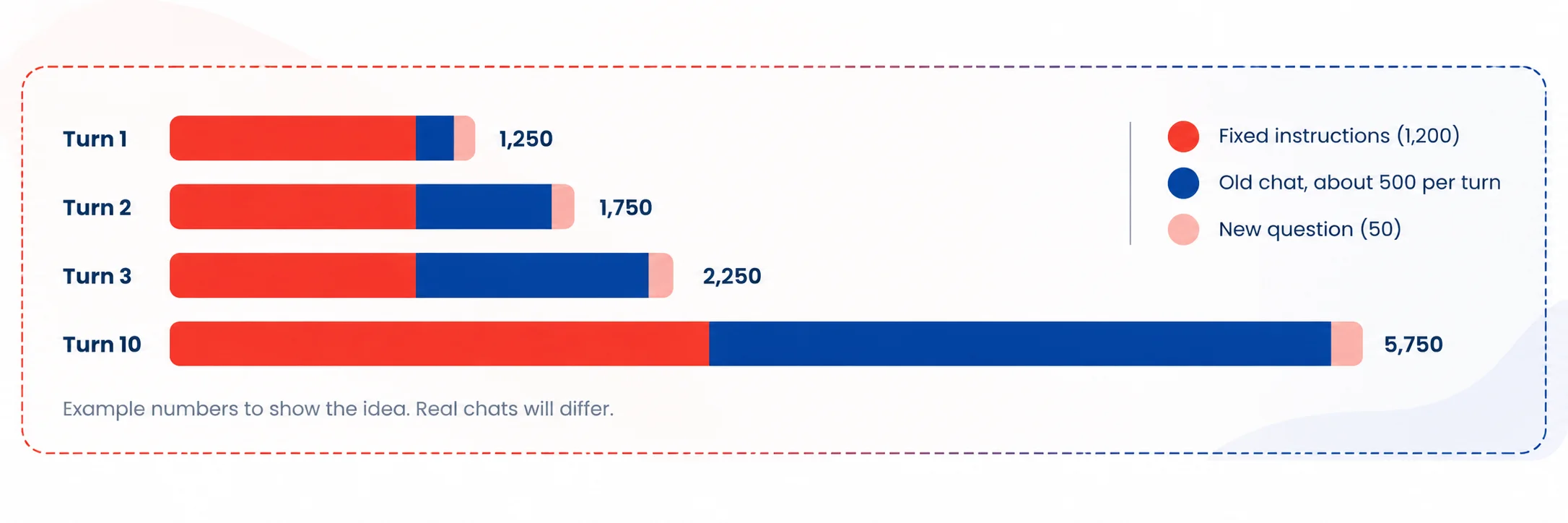
For example, your first question may use 1,250 tokens. By the 10th turn, the total can reach 5,750 tokens because the earlier chat keeps adding to the input.

Why do AI token costs grow so fast

Reason 2: Output tokens can cost more than input tokens.

Input tokens are the information you send to an AI. Output tokens are the answers it generates. In many AI models, output tokens cost more than input tokens. (Source)

For example, at the prices given for Claude Sonnet, 1 million input tokens cost $2, while 1 million output tokens cost $10. That means generating answers can cost five times more than processing the same number of input tokens.

The takeaway: Longer conversations increase input usage, while lengthy answers can increase output costs. Both can make your AI bills grow quickly.

Where Do Your Tokens Go in One LLM Request?

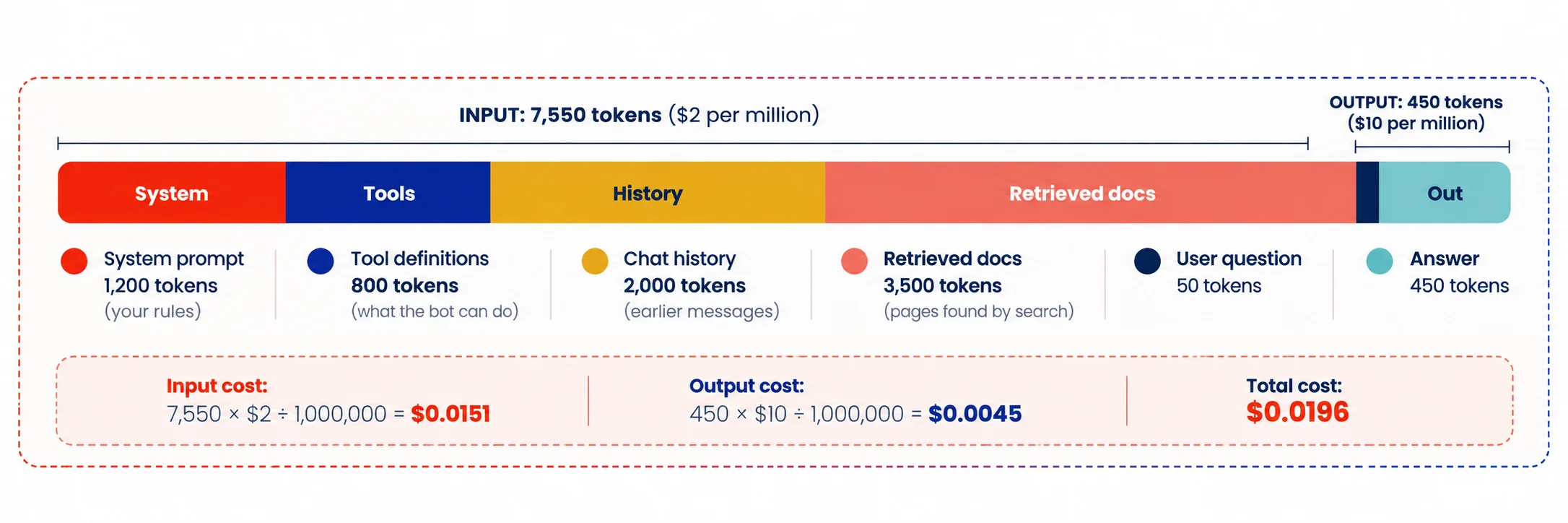
In a single LLM request, tokens are used for instructions, chat history, retrieved documents, the user’s question, and the AI’s answer.

Let’s take a customer support chatbot as an example. It receives a question, checks company documents, reads previous messages, and generates a response.

Where do your tokens go in one LLM request

→ System instructions: Rules that tell the AI how to respond.
→ Chat history: Previous messages in the conversation.
→ Retrieved documents: Information taken from company files or databases.
→ User question: The latest question asked by the customer.
→ AI response: The answer generated by the model.

In this example, around 94% of tokens are used for input, and retrieved documents alone account for about 44%.

This means most tokens are used to provide information to the AI rather than generate the final answer. Cutting unnecessary input, especially repeated or irrelevant documents, can help reduce costs.

What Should You Cut First to Reduce AI Token Costs?

To reduce AI token costs, start by cutting the largest unnecessary token usage. Focus on these five areas.

Retrieved documents

Send only the most relevant parts of a document instead of the entire file. For example, reduce 3,500 tokens to 1,500.

Chat history

Keep only recent messages and summarize older conversations. For example, reduce 2,000 tokens to 600.

Instructions and tools

Avoid repeating unnecessary instructions. Keep frequently used instructions at the beginning and use prompt caching to save costs when supported.

Answer length

Ask the AI to give short and direct answers. Set a maximum output length. For example, reduce 450 tokens to 300.

Model choice

Use smaller, less expensive models for simple tasks and more capable models for complex tasks. For example, according to the provided pricing, Haiku 4.5 costs $1 per million input tokens, while Opus 5.5 costs $4 per million input tokens.

What Is Token Efficiency and How Do You Measure It?

Token efficiency means getting more useful results while using fewer tokens. It helps you understand whether your AI is using tokens wisely or wasting them.

To measure token efficiency, track these five metrics:

Metric Simple Meaning Example
Tokens per Request Total tokens used for one request 8,000 → 4,450
Cost per Request Cost of one AI request $0.0196 → $0.0077
Input-to-Output Ratio Input tokens compared to output tokens 17:1 → About 14:1
Cache Hit Rate Percentage of input tokens served from the cache 0% → About 48%
Answer Quality How accurate and useful the AI's answers are Must not drop

For example, if an AI chatbot uses 8,000 tokens to answer a question and you optimize it to use 4,450 tokens, you reduce token usage significantly.

However, using fewer tokens is not enough. The AI must still provide accurate and useful answers.

The goal is to reduce token usage and costs while maintaining answer quality.

How Much Can LLM Efficiency Save? A Worked Example

Small changes in token usage can make a big difference when an AI application handles thousands of requests. Let’s look at a simple example.

Part Before After
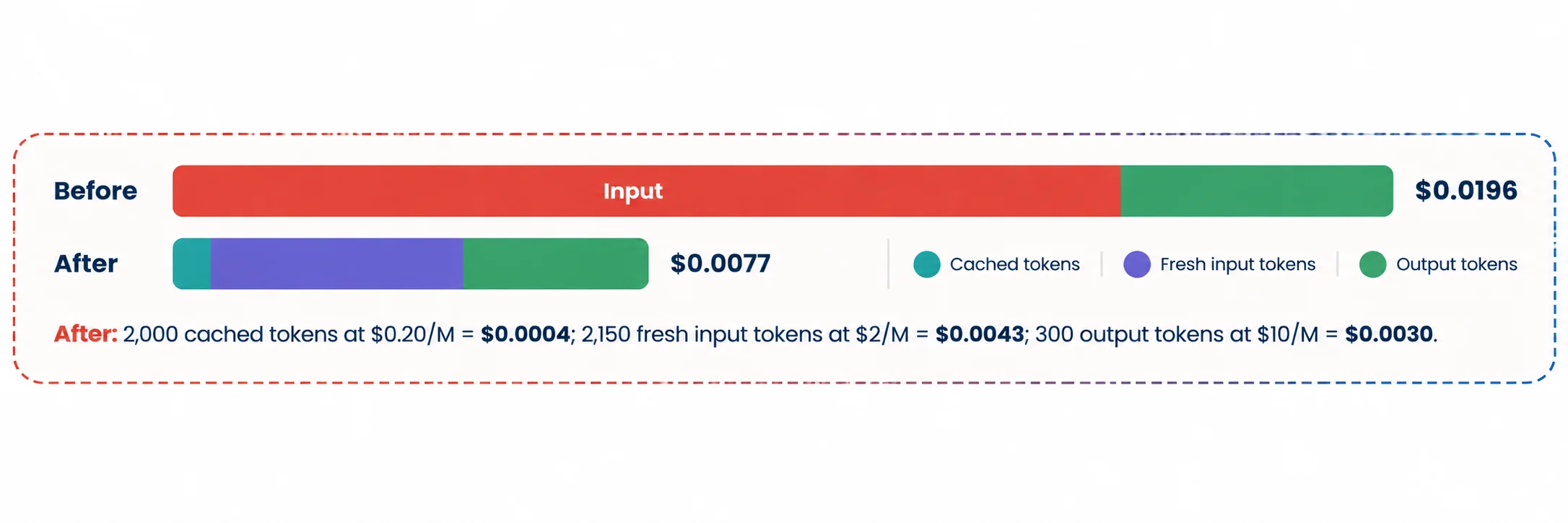
Retrieved Documents 3,500 tokens 1,500 tokens
Chat History 2,000 tokens 600 tokens
System Instructions + Tools 2,000 tokens (full price) 2,000 tokens (cached)
AI Answer 450 tokens 300 tokens
Cost per Request $0.0196 $0.0077
How much can LLM efficiency save

The changes above reduce the cost of one request from $0.0196 to $0.0077 – about 61% less per request.

That saving becomes much bigger at scale. If your application handles 10,000 requests every day, the monthly cost could drop from around $5,880 to $2,310.

→ Before: About $5,880/month
→ After: About $2,310/month
→ Monthly saving: About $3,570

Note: These are example numbers. Your actual costs will depend on your model, token usage, and pricing. The first request that fills a cache can also cost a little more. Always measure your actual usage before estimating savings.

How Does Azilen Do LLM Token Optimization?

At Azilen, LLM token optimization is part of the APEX framework, which also covers governance, hallucination guards, standards and compliance, and security. These checks are included throughout the development process, not added at the end.

Context engineering

Send only the information the AI needs. Remove unnecessary or repeated context.

Smart
Caching

Reuse the same information when possible instead of paying the full price for those tokens again.

Model
routing

Use a smaller, lower-cost model for simple tasks and a more powerful model only when the task needs it.

The approach is simple. First, find where the tokens are going. Then, reduce the biggest source of unnecessary usage. After each change, Azilen checks whether the AI is still giving accurate and useful answers.

The goal is not just to reduce the number of tokens. It is to reduce cost without reducing answer quality. Budgets and usage alerts can then help keep token usage under control over time.

Azilen team culture

Balance is part of our culture.

Our logo is inspired by orbits, where two opposite forces work together to keep a planet steady. We follow the same idea with token optimization, reduce AI costs while keeping the quality of results high.

Our ORBIT values of Openness and Trust mean we keep things clear and transparent, so you can easily understand where your tokens and money are being used.

What Mistakes Should You Avoid in LLM Token Optimization?

Token optimization is not just about cutting as many tokens as possible. If you remove the wrong information, change the prompt structure, or ignore output costs, you may save tokens but get worse results.

What Mistakes Should You Avoid in LLM Token Optimization

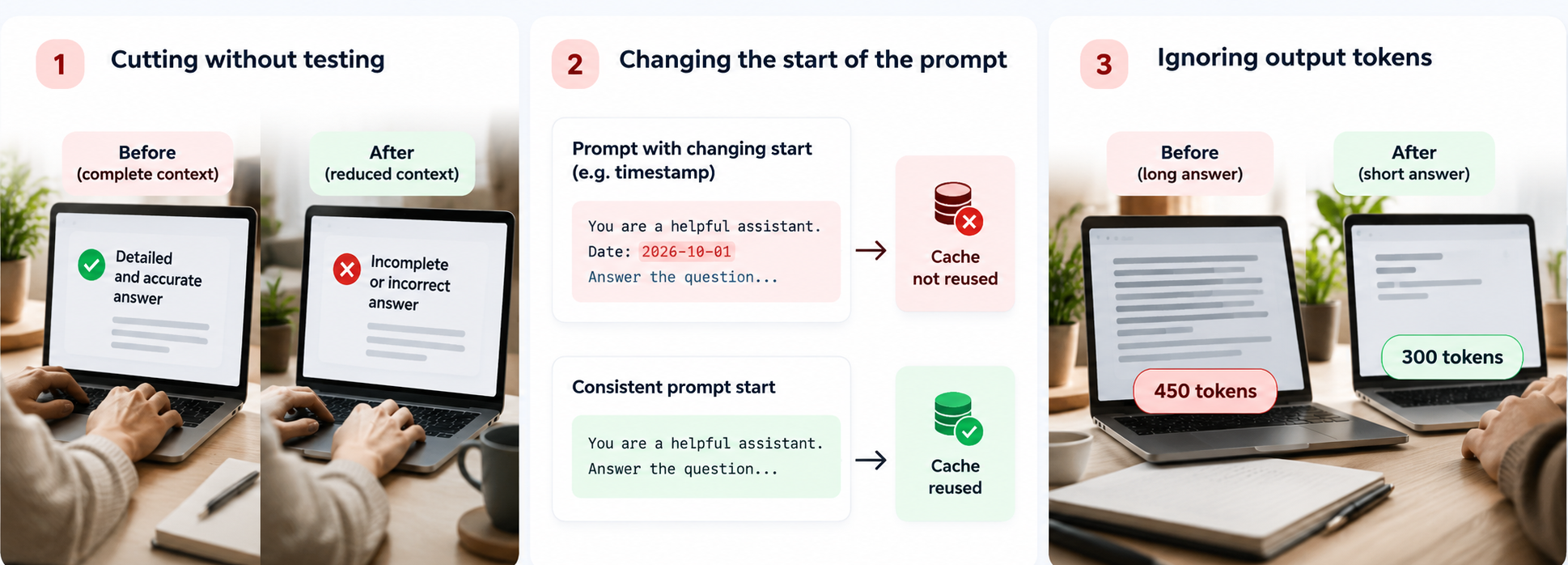
→ Cutting without testing: A shorter prompt does not always mean a better prompt. Removing useful context can make the AI give incomplete or incorrect answers. After every optimization, test the response quality to make sure the AI still performs well.

→ Changing the start of the prompt: If the beginning of your prompt keeps changing, such as adding a timestamp or changing instructions, cached tokens may not be reused. Keep frequently repeated instructions consistent so caching can work properly.

→ Ignoring output tokens: Many teams focus only on reducing input tokens and forget about the tokens generated by the AI. Output tokens can cost more than input tokens. Asking the AI to give short, clear, and direct answers can help reduce these costs.

The goal is simple: use fewer tokens, but never at the cost of answer quality.

Optimize Your LLM Costs Without Compromising Quality

With 17+ years of experience as an Enterprise AI Development Company, Azilen helps businesses build AI solutions that are efficient, scalable, and ready for real-world use. Our expertise in LLM token optimization helps enterprises control AI costs while maintaining the quality and accuracy of AI responses.

→ Optimize AI costs: Reduce unnecessary token usage and improve AI efficiency.

→ Build smarter AI systems: Use context engineering, caching, and model routing to make AI applications more effective.

→ Scale with confidence: Build secure, reliable, and scalable AI solutions that can grow with your business.

With the right approach, AI can deliver better results without unnecessary costs. Azilen helps enterprises find that balance between performance, quality, and cost.

Wasting Tokens, Rising AI Costs, and Unoptimized LLMs?
See how Azilen helps enterprises build efficient, scalable, and production-ready LLM solutions.

Top FAQs on LLM Token Optimization

1. How can I identify which parts of my LLM application are consuming the most tokens?

Track token usage across system prompts, conversation history, retrieved documents, tool outputs, and generated responses. Breaking usage down by component helps you identify the biggest sources of unnecessary token consumption.

2. What should I cut first when optimizing LLM token usage?

Start with repetitive context, unnecessary chat history, oversized system prompts, irrelevant retrieved documents, and verbose tool outputs. These areas often provide the quickest opportunities to reduce token usage without significantly affecting response quality.

3. How can I reduce LLM token costs without lowering response quality?

Use techniques such as prompt compression, context trimming, semantic retrieval, caching, structured outputs, and model-specific token limits. The goal is to remove unnecessary information while preserving the context the model actually needs.

4. Does reducing the number of tokens always make an LLM application cheaper?

Not necessarily. Token costs depend on factors such as input versus output tokens, the model being used, cached tokens, and API pricing. A good optimization strategy focuses on reducing unnecessary tokens rather than simply minimizing token counts.

5. How do I optimize token usage in RAG applications without losing important context?

Improve retrieval quality before reducing context size. Retrieve fewer but more relevant chunks, remove duplicate information, rerank results, and compress retrieved content before sending it to the LLM. This can reduce token usage while keeping the information needed for accurate responses.

author avatar
Swapnil Sharma Vice President – Strategic Consulting
Swapnil Sharma is VP – Strategic Consulting at Azilen Technologies with expertise in digital transformation, presales, and business strategy. He has led 750+ RFPs and helps organizations drive technology-led growth through consultative solutions.
google
Swapnil Sharma
Swapnil Sharma
VP - Strategic Consulting

Swapnil Sharma is a strategic technology consultant with expertise in digital transformation, presales, and business strategy. As Vice President - Strategic Consulting at Azilen Technologies, he has led 750+ proposals and RFPs for Fortune 500 and SME companies, driving technology-led business growth. With deep cross-industry and global experience, he specializes in solution visioning, customer success, and consultative digital strategy.

Related Insights

GPT Mode
AziGPT - Azilen’s
Custom GPT Assistant.
Instant Answers. Smart Summaries.