
Skip to content

How NVIDIA Fleet Command Helps You Manage Edge AI at Scale Efficiently

Featured Image

Executive Summary

NVIDIA Fleet Command helps enterprises manage Edge AI at scale by providing a centralized control plane for deploying, monitoring, updating, and securing AI workloads across distributed environments. It enables consistent edge AI deployment, real-time observability, AI lifecycle management, and remote operations without on-site dependency. With features like container-based provisioning, over-the-air updates, scalable orchestration, and efficient GPU utilization through MIG, NVIDIA Fleet Command simplifies distributed AI infrastructure management. This allows organizations to maintain performance, reduce operational overhead, and scale edge AI systems reliably across hundreds or thousands of locations.

When Edge AI starts expanding beyond a few locations, the shift is immediate.

What worked for 5 sites starts breaking at 50. At 200, it becomes operational friction. At 1,000, it turns into a full-time coordination problem.

Because you’re no longer dealing with infrastructure in one place. You’re dealing with hundreds of distributed environments – stores, plants, warehouses, intersections – each running AI workloads that need to stay aligned, updated, and reliable.

That’s where teams start feeling the pressure.

NVIDIA Fleet Command fits right into this point. It brings structure to something that otherwise spreads out quickly.

Let’s walk through how it helps, from an operational and system-level perspective.

Why Managing Edge AI at Scale Gets Complex

Once deployments grow, a few patterns start repeating across organizations.

There is always scale. Hundreds or thousands of nodes are spread across locations.

There is fragmentation. Each site ends up with slight variations.

There is limited visibility. Teams rely on partial monitoring or delayed signals.

There is constant change. Models evolve, workloads shift, and infrastructure gets updated.

And there is security sitting across all of this.

When these factors combine, operations become reactive. Teams spend time fixing inconsistencies instead of improving systems.

This is the exact layer where NVIDIA Fleet Command starts making a difference.

What Value NVIDIA Fleet Command Brings

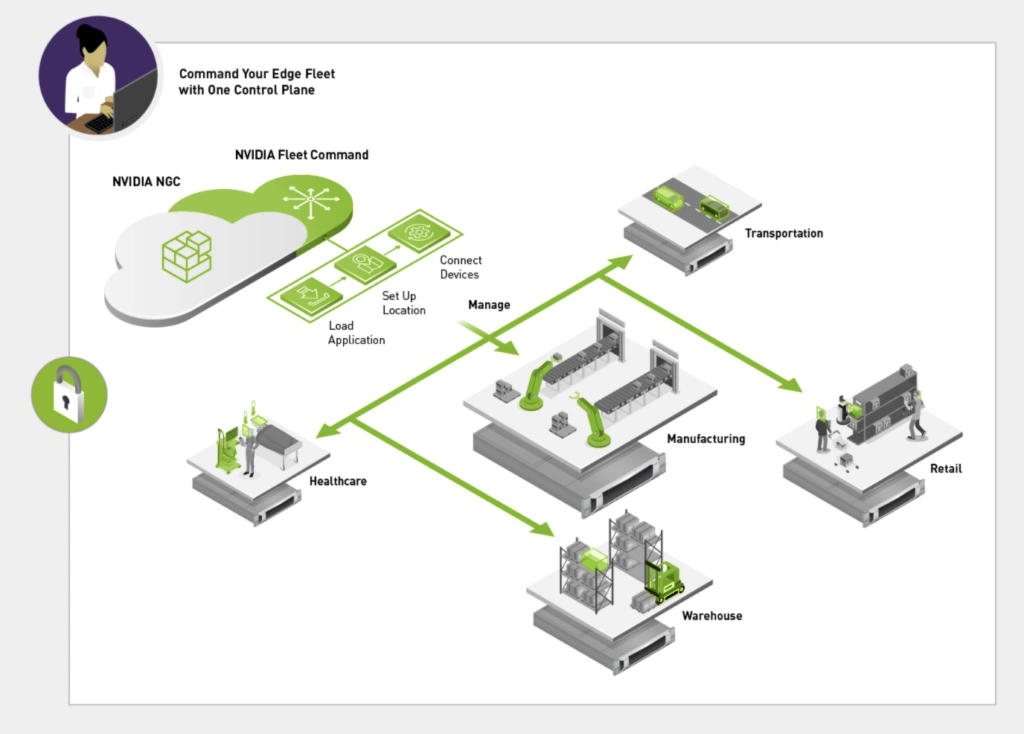
At a practical level, NVIDIA Fleet Command acts as a control layer over your entire edge AI infrastructure.

NVIDIA Fleet Command

Source: NVIDIA

Instead of treating each location separately, it lets you manage everything from one place:

→ Deploy workloads

→ Monitor performance

→ Manage infrastructure

→ Roll out updates

→ Maintain security

In fact, it is designed specifically for AI workloads running on NVIDIA-powered edge systems, so it aligns with how models are packaged, deployed, and executed in real environments.

From what we’ve seen, its real value comes from how it simplifies ongoing operations after deployment, which is where most complexity usually sits.

How NVIDIA Fleet Command Helps Manage Edge AI at Scale

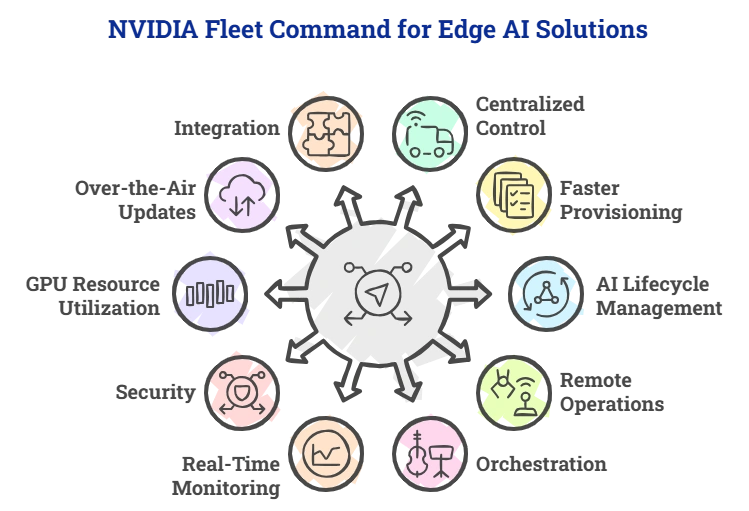
A practical view of how NVIDIA Fleet Command supports deployment, monitoring, and lifecycle control across large-scale Edge AI systems.

Manage Edge AI with NVIDIA Fleet Command

1. Centralized Control Across Distributed Environments

The first shift teams notice is visibility.

Everything – nodes, workloads, performance – becomes accessible from one interface.

Instead of checking site-by-site, teams can:

→ View the full fleet in real-time

→ Track system health across locations

→ Take action across one node or thousands

That clarity changes how operations run day to day. Decisions become faster, and coordination becomes lighter.

2. Faster Provisioning and Consistent Deployment

Bringing new locations online usually takes time – setup, configuration, and validation.

With NVIDIA Fleet Command, provisioning becomes structured and repeatable.

Applications run as containers, which means:

→ Every site receives the same setup

→ Deployments stay consistent

→ Rollouts can happen in stages

So, when a business expands – new stores, new plants – the process follows a known pattern instead of starting from scratch each time.

3. AI Lifecycle Management that Stays Aligned

Fleet Command supports the full AI lifecycle:

→ Deploy new models

→ Roll out updates in a controlled way

→ Monitor performance continuously

→ Replace or retire older versions cleanly

Teams can track which version runs where, compare behavior, and adjust quickly when needed.

That keeps the entire fleet aligned, even as models change.

4. Remote Operations that Actually Scale

Edge environments are physically spread out. Visiting sites for routine updates or debugging slows everything down.

Fleet Command makes remote operations practical at scale.

Teams can:

→ Access logs instantly

→ Restart workloads

→ Push configuration changes

→ Resolve issues without being on-site

This shortens response time and reduces reliance on local intervention.

5. Orchestration Across Large Fleets

Managing a handful of nodes is straightforward. Managing thousands requires structure.

Fleet Command allows teams to:

→ Group nodes by location, function, or hardware

→ Apply consistent policies across groups

→ Roll out updates across the fleet in a controlled way

Adding more nodes doesn’t increase complexity in the same way. The system expands while staying manageable.

6. Real-Time Monitoring and Observability

Running AI systems without visibility leads to delayed reactions.

NVIDIA Fleet Command provides real-time insights into:

→ Hardware performance (GPU, CPU, memory)

→ Application behavior (latency, throughput)

→ Connectivity and system health

→ Signals that indicate model performance changes

When something shifts, teams see it early and can respond before it impacts operations.

7. Security Built for Distributed Environments

Edge systems operate outside traditional boundaries, so consistency in security matters.

Fleet Command brings a structured approach:

→ Controlled access through defined roles

→ Encrypted communication between systems

→ Verified system integrity during startup

→ Secure update mechanisms with rollback options

Each node follows the same security model, which keeps the overall environment stable and predictable.

8. Better Use of GPU Resources with MIG

Edge hardware carries cost, so utilization becomes important.

With Multi-Instance GPU (MIG) support:

→ A single GPU can handle multiple workloads

→ Resources are divided efficiently

→ Workloads run in isolation without interference

This allows teams to run more workloads on existing infrastructure without overloading it.

9. Over-the-Air Updates Without Disruption

Keeping systems current across many locations requires coordination.

Fleet Command supports structured updates:

→ Roll out changes to selected nodes or the entire fleet

→ Schedule updates to match operational windows

→ Revert quickly if something needs adjustment

→ Track every update with audit logs

This keeps systems current while maintaining stability.

10. Integration into Existing AI Workflows

Fleet Command fits into the broader NVIDIA ecosystem and enterprise workflows.

It works alongside:

→ NVIDIA NGC for model and container management

→ NVIDIA Metropolis and DeepStream for AI applications

→ Existing enterprise monitoring and security tools

It connects development workflows with production environments at the edge.

The Business Impact of Leveraging NVIDIA Fleet Command

When these capabilities come together, a few outcomes start to show clearly.

Deployment timelines shrink because environments stay consistent.

Operational overhead reduces because remote management replaces manual effort.

System reliability improves because monitoring and controlled updates keep everything aligned.

Infrastructure gets used efficiently because GPU resources support multiple workloads without unnecessary expansion.

Teams operate with more confidence because they have visibility and control across the entire system.

Get Consultation
Is Your Edge AI Foundation Strong Enough for Scale?
Get clarity early on 👇

Why Fleet Command Fits North American Enterprise Environments

Large distributed operations are common across North America.

Retail chains, manufacturing networks, logistics hubs, and healthcare systems – all operate across multiple locations.

Managing these environments manually increases operational load and cost.

Fleet Command aligns well with that environment:

→ Supports structured audit and compliance requirements

→ Matches security expectations with consistent controls

→ Handles real-time workloads that depend on reliability

→ Reduces operational overhead where labor costs are higher

Overall, it fits naturally into how large distributed operations already function.

Accelerate Your Edge AI Deployment with the Right Implementation Partner

NVIDIA Fleet Command provides the platform. But getting value from it requires an architecture that aligns with your operational model, a deployment strategy that scales correctly, and an AI lifecycle management process that fits your development and business cadence.

Being an enterprise AI development company, we help organizations:

✔️ Design and architect distributed Edge AI environments optimized for Fleet Command

✔️ Implement and integrate Fleet Command into existing enterprise operations and toolchains

✔️ Build AI lifecycle management workflows that keep edge models current, performant, and compliant

✔️ Operate and support large-scale edge AI fleets post-deployment

Whether you are deploying Edge AI for the first time or scaling an existing fleet, the architecture decisions you make now determine how manageable and cost-effective your operations are at scale.

If you are evaluating NVIDIA Fleet Command for your edge infrastructure, or if you are already deployed and struggling with operational complexity, we can help you overcome complexity and build a system that works at scale.

Get in touch to discuss your Edge AI architecture and how Fleet Command fits into your enterprise infrastructure.

Consultation
Want to Implement NVIDIA Fleet Command with the Right Approach?
Discuss your requirements with NVIDIA experts.

FAQs: NVIDIA Fleet Command

1. What is NVIDIA Fleet Command used for?

NVIDIA Fleet Command is a cloud-based platform designed to manage Edge AI infrastructure at scale. It allows enterprises to deploy, monitor, and update AI workloads across distributed edge locations from a single interface. Teams can control multiple nodes without handling each site separately. It supports containerized applications, centralized visibility, and secure operations. This makes it easier to manage large-scale AI environments consistently. It is widely used in industries with distributed operations.

2. How does NVIDIA Fleet Command help manage Edge AI at scale?

NVIDIA Fleet Command helps manage Edge AI at scale by providing centralized control over distributed systems. It enables consistent deployment, real-time monitoring, and remote operations across multiple edge nodes. Teams can manage thousands of locations without increasing operational complexity. It also supports lifecycle management of AI models across environments. This structured approach keeps systems aligned and reduces manual effort. It allows organizations to scale efficiently.

3. Can NVIDIA Fleet Command deploy AI models remotely?

Yes, NVIDIA Fleet Command supports remote deployment of AI models across edge locations. Models are packaged as containers and pushed to selected nodes or entire fleets. This ensures consistency across all deployments. Teams can roll out updates in stages and monitor behavior during deployment. It reduces dependency on on-site setup and manual configuration. Remote deployment also speeds up scaling across new locations.

4. How does NVIDIA Fleet Command handle AI model updates?

NVIDIA Fleet Command manages AI model updates through controlled, over-the-air deployment. Teams can push new versions to selected nodes or the entire fleet with rollout strategies. It provides version tracking, allowing visibility into which model runs where. If needed, updates can be rolled back quickly to maintain stability. This structured update process keeps systems aligned across locations. It also helps maintain performance consistency.

5. What kind of monitoring does NVIDIA Fleet Command provide?

NVIDIA Fleet Command provides real-time monitoring across hardware and applications. It tracks GPU utilization, CPU performance, memory usage, and system health. It also monitors inference latency, throughput, and workload behavior. This visibility helps teams detect issues early and respond quickly. Alerts highlight performance deviations across nodes. It supports maintaining reliability across distributed Edge AI systems.

Glossary

1. Edge AI: AI processing that happens directly on local devices or edge nodes instead of centralized cloud systems.

2. NVIDIA Fleet Command: A cloud-based platform for managing, deploying, and monitoring AI workloads across distributed edge infrastructure.

3. Edge AI Management Platform: A system that enables centralized control of AI deployments, updates, monitoring, and security across multiple edge locations.

4. AI Lifecycle Management: The process of deploying, updating, monitoring, and retiring AI models across environments.

5. Centralized Control Plane: A single interface used to manage and monitor all edge devices and workloads across a distributed system.

google
Niket Kapadia
Niket Kapadia
CTO - Azilen Technologies

Niket Kapadia is a technology leader with 17+ years of experience in architecting enterprise solutions and mentoring technical teams. As Co-Founder & CTO of Azilen Technologies, he drives technology strategy, innovation, and architecture to align with business goals. With expertise across Human Resources, Hospitality, Telecom, Card Security, and Enterprise Applications, Niket specializes in building scalable, high-impact solutions that transform businesses.

Related Insights

GPT Mode
AziGPT - Azilen’s
Custom GPT Assistant.
Instant Answers. Smart Summaries.