
Skip to content

How NVIDIA MLOps Integration Helps You Build AI Faster?

Featured Image

TL;DR

This blog began with a simple observation: teams build promising AI prototypes, yet getting them production-ready often takes far longer than expected. NVIDIA MLOps integration changes that pace. With GPU acceleration, optimized AI libraries, and deployment-ready tooling, it streamlines training, testing, deployment, and monitoring across the entire AI lifecycle. Enterprises use it to speed up experimentation, reduce infrastructure friction, and ship AI products faster with higher reliability. The blog breaks down how it works, where it fits in real-world scenarios, and how teams can use it to accelerate AI product development across industries.

The idea for this blog came from a conversation we had a few weeks back with a product leader. He shared how his team had strong AI concepts, solid prototypes, and clear business goals, yet the journey from a working model to a stable production rollout felt slow and unpredictable. Every new AI feature demanded heavy experimentation, faster training cycles, and smoother deployment pathways, yet the tools in place struggled to keep up with that ambition.

That discussion stayed with us. Many teams across industries face the same pressure: build AI products at a pace that matches market expectations while maintaining performance, reliability, and scale. This led us to revisit something we frequently rely on in our own work, NVIDIA MLOps integration.

Understanding NVIDIA MLOps Integration

AI product development grows smoother when experimentation, training, deployment, and monitoring all move in sync. MLOps aligns those stages into a clear workflow. NVIDIA strengthens this flow through its GPU-accelerated ecosystem.

Key pieces in the NVIDIA stack:

GPU Acceleration: Boosts training speed for deep learning and classical ML workloads.

CUDA and cuDNN: High-efficiency libraries that power faster computations.

NVIDIA Triton Inference Server: Streamlines the way models run in production across cloud or edge.

NVIDIA RAPIDS: Handles data engineering and ML pipelines on GPUs, which cuts preparation time significantly.

NVIDIA AI Enterprise and Fleet Command: Supports enterprise governance, deployment, and lifecycle operations at scale.

When these components blend with MLOps practices, AI teams experience shorter cycles, faster feedback loops, and smooth transitions from local experiments to production environments.

How NVIDIA MLOps Integration Accelerates AI Product Development Lifecycle?

NVIDIA MLOps integration brings structure, speed, and reliability to every stage of the AI development. Here’s how:

1. Faster Training Cycles

AI teams often wait long hours or days for models to train. With NVIDIA GPUs, this entire phase moves at a different speed. GPUs handle thousands of operations in parallel, which means large datasets, deep learning models, and complex training loops complete much faster.

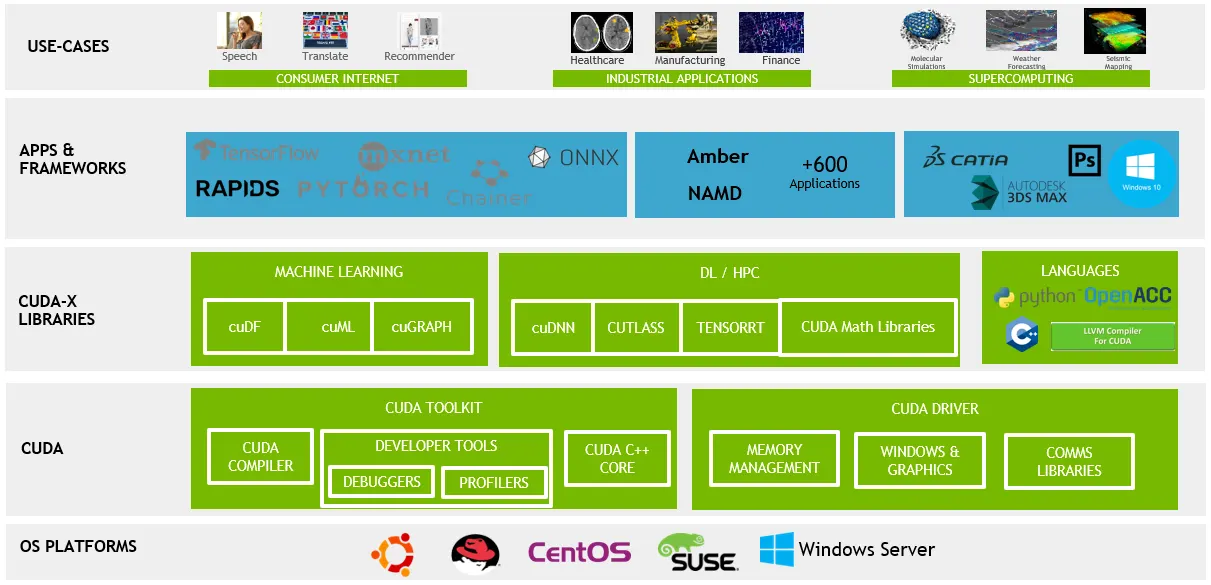
CUDA and cuDNN add another layer of efficiency. They tune the way computations run on GPUs, so training feels smoother and more responsive.

What is CUDA

Source: NVIDIA

When training finishes quickly, teams explore more ideas, tune hyperparameters freely, and experiment without slowing down product timelines.

2. Smooth Deployments Across Environments

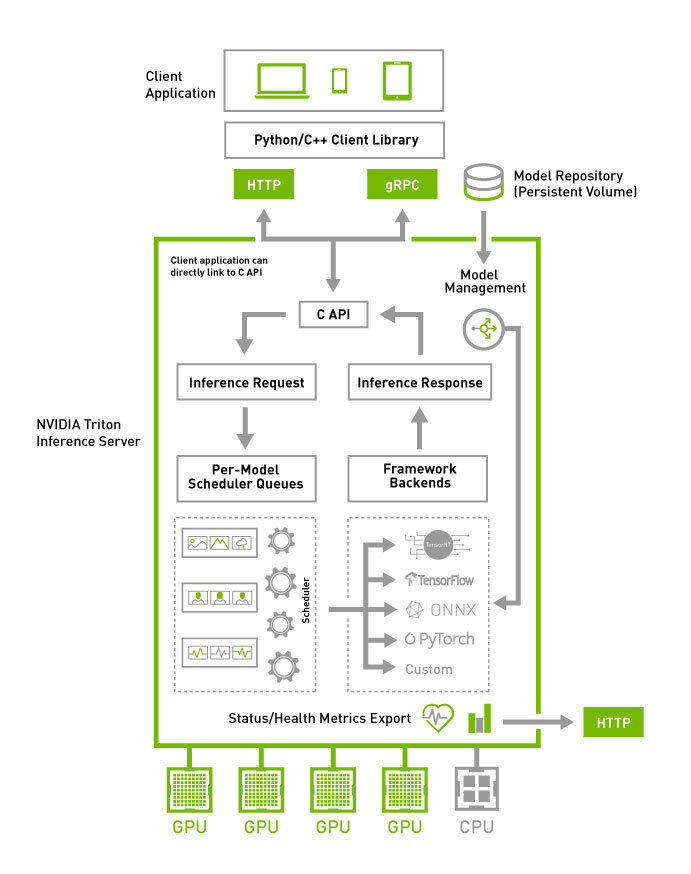
Deployment becomes easier when the system running the model stays consistent across every environment. NVIDIA Triton Inference Server brings that consistency. It supports multiple model formats (TensorFlow, PyTorch, ONNX, XGBoost, etc.) and runs them through a single unified engine.

NVIDIA Triton Inference Server

This simplifies the final stages of AI product development. Teams package their models once, test them once, and deploy them confidently across cloud, on-premise, or edge. Kubernetes helps scale these deployments automatically based on incoming traffic.

3. Clear Production Monitoring and Feedback

After deployment, AI products depend on continuous updates. With NVIDIA-backed MLOps workflows, teams monitor drift, accuracy, latency, throughput, and user behavior through dashboards and automated logs.

This keeps the AI product stable and dependable throughout its lifecycle.

4. Real-Time Data Handling and Insights

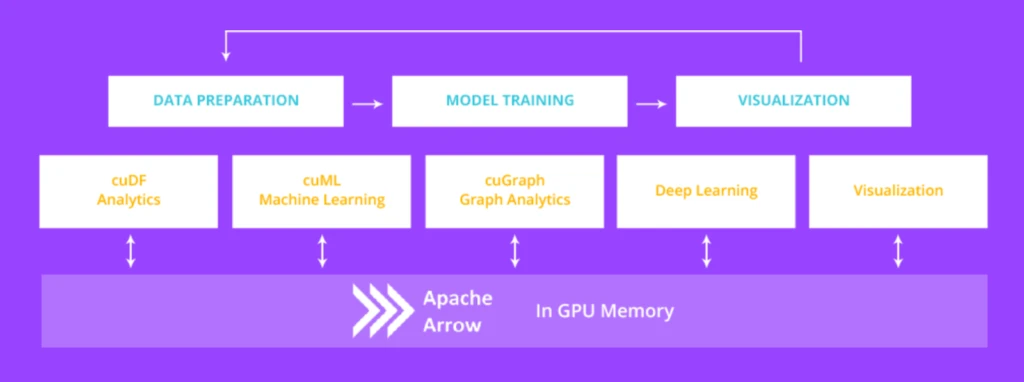
NVIDIA RAPIDS brings GPU acceleration to data engineering pipelines. This cuts the time needed for loading, transforming, cleaning, and analyzing data. Workloads that usually take minutes or hours finish in seconds.

Real-time AI becomes achievable because the entire chain, from raw data to model inference, moves quickly and stays responsive under load.

The image below represents a data science pipeline with GPUs and RAPIDS.

Data science pipeline with GPUs and RAPIDS

Source: NVIDIA

5. Automated Model Updates and Continuous Delivery

AI models evolve through continuous learning. New data changes patterns, new user behavior changes trends, and business requirements shift over time.

NVIDIA MLOps integration supports this through automated retraining pipelines, version control, and CI/CD for machine learning. Once a new model reaches the required accuracy, it moves through automated checks and enters production smoothly.

6. Scalable Performance for Growing Workloads

AI workloads grow as products succeed. More users, more data, deeper models, and new features create fresh demands on infrastructure.

GPU clusters, managed through tools like Kubernetes and Fleet Command, bring horizontal scale to AI systems. Workloads grow without disruptions, and performance stays steady even under heavy use.

What a Good NVIDIA MLOps Roadmap Looks Like?

With NVIDIA’s ecosystem, NVIDIA MLOps integration becomes a structured journey that blends hardware, software, and workflow engineering.

1. A Clear Starting Point: Data + Compute Alignment

Every successful roadmap begins with understanding how the current data pipelines match the expected GPU workloads. Teams map:

→ High-volume ingestion tasks

→ Feature engineering pipelines

→ Training throughput targets

→ GPU utilization patterns

This creates a shared view of how pipelines should evolve once NVIDIA GPUs, CUDA-optimized libraries, and RAPIDS-accelerated data workflows kick in.

2. A Unified Development Environment for the Entire Team

A roadmap gains momentum once engineers, data scientists, and DevOps work within standardized environments. This includes:

→ NGC containers for training, inference, and visualization

→ Reproducible CUDA-aligned environments

→ Shared workspace orchestration through Kubernetes, Triton, or DGX systems

This reduces time spent on environment setup and helps the team move through experiments faster.

3. A Training Architecture That Scales Naturally

The roadmap defines how training upgrades will roll out across the lifecycle. Typical steps include:

→ Initial training on a GPU workstation or cloud GPU instance

→ Migration to multi-GPU and multi-node training

→ Automated scheduling through Kubeflow, MIG partitions, or Slurm

Distributed training frameworks updated through NGC

This creates a natural path from experimentation to enterprise-grade training speed.

4. A Model Deployment Layer Built Around Triton

Triton becomes the anchor for sustained production performance. A good roadmap defines:

→ How models will move from training pipelines to Triton

→ How ensembles will combine traditional ML with deep learning

→ How dynamic batching, GPU acceleration, and multi-framework hosting will run

→ How inference endpoints will connect with enterprise applications

This creates a predictable deployment cycle that supports high-traffic workloads.

5. A Continuous Optimization Strategy

Enterprises gain real value once continuous optimization becomes part of the roadmap. This usually includes:

→ GPU monitoring through DCGM

→ Auto-scaling GPU instances

→ Model refinement cycles

→ Precision optimization (FP16, INT8, TensorRT flows)

→ Cost-performance tuning on cloud GPU architectures

This forms the backbone of sustainable performance.

6. A Compliance and Governance Layer Built into the Stack

A mature roadmap keeps compliance, observability, and audit readiness at the center. Key parts include:

→ Versioning for datasets, models, and pipelines

→ Governance workflows integrated with the MLOps platform

→ Monitoring around drift, bias, and performance stability

→ Clear documentation around each lifecycle stage

This helps enterprises run AI responsibly at scale.

7. A Long-Term Evolution Plan

The roadmap ends with a future-ready view. Typical long-term items include:

→ Adoption of RAG, agentic systems, and multimodal models

→ MIG-partitioned GPU clusters for flexible workloads

→ Integration with enterprise data lakes and vector DBs

→ Hybrid edge + cloud GPU setups

→ Continuous pipeline upgrades aligned with NVIDIA’s ecosystem releases

This ensures every iteration brings the enterprise closer to a fully AI-driven operating model.

Why Partnering Matters and the Edge Azilen Brings?

Enterprises reach a point where GPUs, pipelines, and orchestration tools need to work as one system. This is the stage where a partner shapes the pace of progress. A seasoned team accelerates the early groundwork, builds guardrails around complexity, and ensures each layer of the NVIDIA ecosystem contributes to business value.

Being an enterprise AI development company, we blend strong architectural thinking with hands-on NVIDIA expertise to build AI systems that move from idea to production without losing momentum.

We bring:

✔️ Engineering depth that strengthens every layer of the pipeline

✔️ Product acceleration through refined training, deployment, and optimization flows

✔️ Expertise in the NVIDIA ecosystem across Triton, TensorRT, NGC, and GPU orchestration

✔️ Experience with enterprise-scale AI where compliance, uptime, and performance guide decisions

✔️ A predictable delivery approach built around clarity, iteration, and outcome alignment

This is how enterprises secure a reliable path toward faster development, stronger performance, and AI platforms ready for the next wave of growth.

Get Consultation
Give Your AI Products the Boost They Need
Get support from engineers who work with NVIDIA tools every day.

FAQs About NVIDIA MLOps Integration

1. How do we know if our AI product is ready for NVIDIA MLOps integration?

Most teams get a clear idea once they look at their training cycles, deployment flow, or the growing number of models they manage. If things feel slower than they should or the system demands stronger performance, this integration usually creates an immediate uplift. During a short readiness check, we help you understand exactly where the value shows up for your product.

2. What is the first step if we want Azilen to help us with NVIDIA MLOps?

Everything begins with a quick discovery call. We walk through your current setup, understand your product goals, and map the areas where the NVIDIA ecosystem can strengthen speed and scale. It sets the foundation for a smooth, structured plan.

3. Can Azilen work with our existing infrastructure and tools?

Yes. Teams often have cloud setups, data platforms, or pipelines they already trust. We plug into that environment, align with your workflows, and bring in NVIDIA components in a way that feels natural for your team to adopt.

4. How do you scope and estimate an NVIDIA MLOps project?

We evaluate your environment, data flow, ML lifecycle, deployment goals, and performance targets. This gives a clear picture of effort and timeline. The idea is to make the plan predictable, so every step feels aligned with your product roadmap.

5. What kind of involvement is needed from our internal team?

A product owner who understands the outcomes you want, an engineering contact for environment access, and regular check-ins. We handle the architectural decisions and engineering heavy lifting, while your team stays focused on core product development.

Glossary

NVIDIA MLOps Integration: A coordinated setup that brings NVIDIA’s GPU stack, model workflows, and deployment pipelines into one streamlined system.

NGC (NVIDIA GPU Cloud): A catalog of optimized containers, models, frameworks, and tools that speed up AI development and deployment.

Triton Inference Server: NVIDIA’s inference engine that serves models at scale with high throughput and efficient resource use.

TensorRT: A toolkit that boosts model inference performance through precision tuning and optimization techniques.

MIG (Multi-Instance GPU): A feature that divides a single GPU into multiple isolated compute units for efficient workload distribution.

Swapnil Sharma
Swapnil Sharma
VP - Strategic Consulting

Swapnil Sharma is a strategic technology consultant with expertise in digital transformation, presales, and business strategy. As Vice President - Strategic Consulting at Azilen Technologies, he has led 750+ proposals and RFPs for Fortune 500 and SME companies, driving technology-led business growth. With deep cross-industry and global experience, he specializes in solution visioning, customer success, and consultative digital strategy.

Related Insights

GPT Mode
AziGPT - Azilen’s
Custom GPT Assistant.
Instant Answers. Smart Summaries.