



Skip to content

AI-Optimized Supply Chain & Inventory Management

Featured Image

Executive Summary

Most manufacturers do not lose money because they cannot produce enough.

They lose money because inventory arrives too early, too late, or in the wrong quantity.

That is why AI-Optimized Supply Chain & Inventory Management has become a strategic priority for CEOs, COOs, and CSCOs. By combining AI, predictive modeling, and data engineering, manufacturers can forecast demand more accurately, reduce inventory carrying costs, prevent stock shortages, and improve fulfillment performance.

At Azilen, we help manufacturers build intelligent supply chain ecosystems that continuously learn from operational data, supplier performance, market trends, and economic signals. The result is a more resilient, scalable, and profitable supply chain that is ready for uncertainty.

Most manufacturers are not struggling because of production capacity.

They are struggling because inventory decisions are based on outdated information.

The warehouse may be full. Yet critical materials are unavailable. Customer demand continues to shift, while supply chain disruptions appear without warning.

As a result, teams spend more time reacting than planning.

This is where AI-Optimized Supply Chain & Inventory Management creates a competitive advantage. Instead of relying on yesterday’s data, manufacturers can predict what is coming next and act before problems impact revenue.

The biggest supply chain risk today isn’t disruption. It’s making tomorrow’s decisions using yesterday’s data.

How Does AI-Optimized Supply Chain & Inventory Management Improve Business Growth?

The biggest misconception about AI in supply chains is that it is only about automation.

In reality, it is about making better business decisions. When inventory levels are optimized, cash is no longer trapped in excess stock.

When demand forecasts improve, production becomes more predictable.

When fulfillment performance increases, customer satisfaction improves.

And when disruptions are identified earlier, businesses can protect revenue before problems occur.

An AI-Optimized Supply Chain continuously evaluates thousands of data points that influence supply and demand.

These may include:

→ Historical sales patterns
→ Seasonal demand fluctuations
→ Supplier performance trends
→ Transportation and logistics delays
→ Commodity price movements
→ Economic indicators
→ Market demand signals
→ Production capacity changes

As new data enters the system, forecasts automatically improve.

Consequently, decisions become faster, more accurate, and less dependent on manual planning.

This creates a supply chain that can adapt to change instead of struggling against it.

How Did Azilen Build an AI-Optimized Supply Chain & Inventory Management Framework?

At Azilen, we approach supply chain transformation as a business growth initiative rather than a technology project.

The objective is simple.

Help organizations improve resilience, reduce waste, and create long-term operational stability.

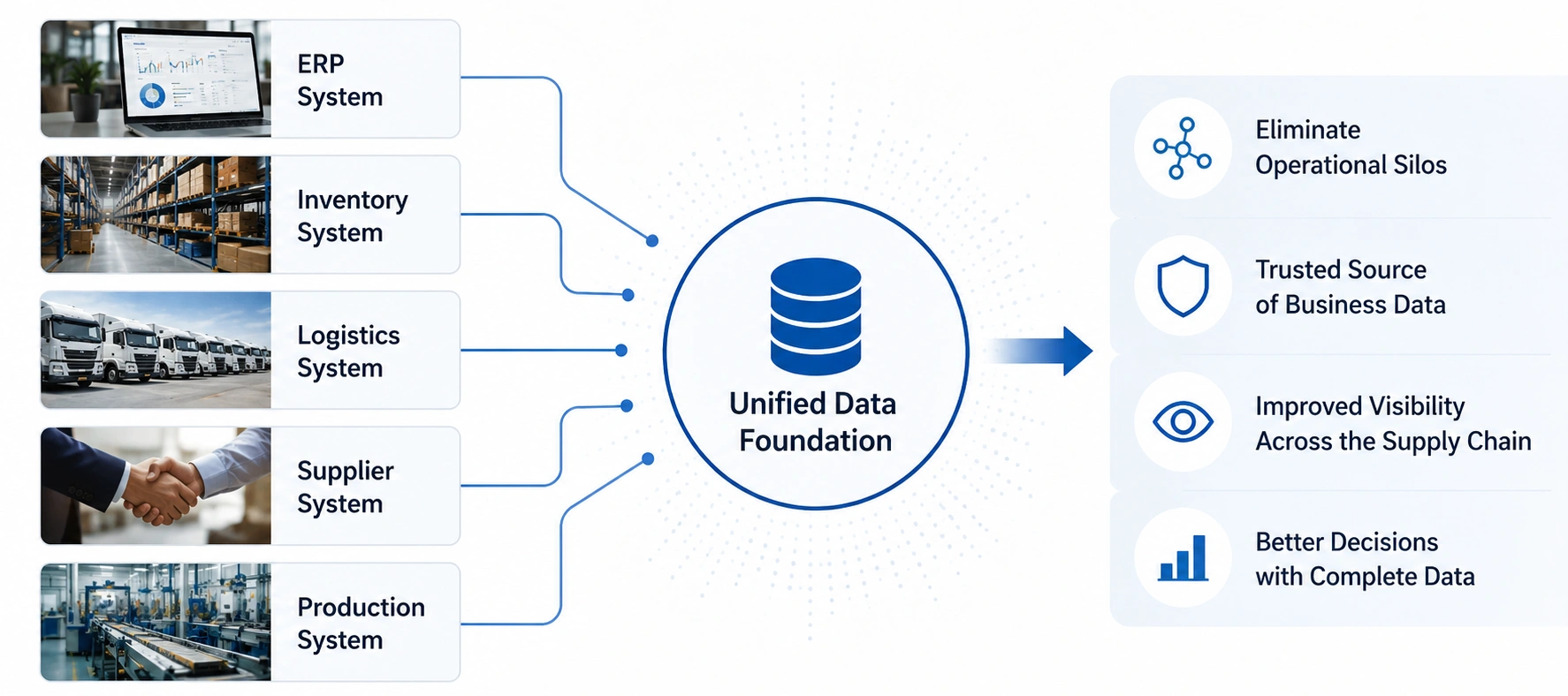
Step 1: Create a Unified Data Foundation

Most supply chain challenges begin with fragmented information.

Inventory data lives in one system. Supplier data lives in another.

Production and logistics data are stored elsewhere.

Therefore, the first step is creating a unified data ecosystem.

Step 1 Create a Unified Data Foundation

This foundation allows leaders to make decisions based on a complete operational picture.

→ Connect ERP, inventory, logistics, supplier, and production systems
→ Eliminate operational silos
→ Create a trusted source of business data
→ Improve visibility across the supply chain

Without reliable data, reliable forecasting is impossible.

Step 2: Build AI-Powered Demand Forecasting

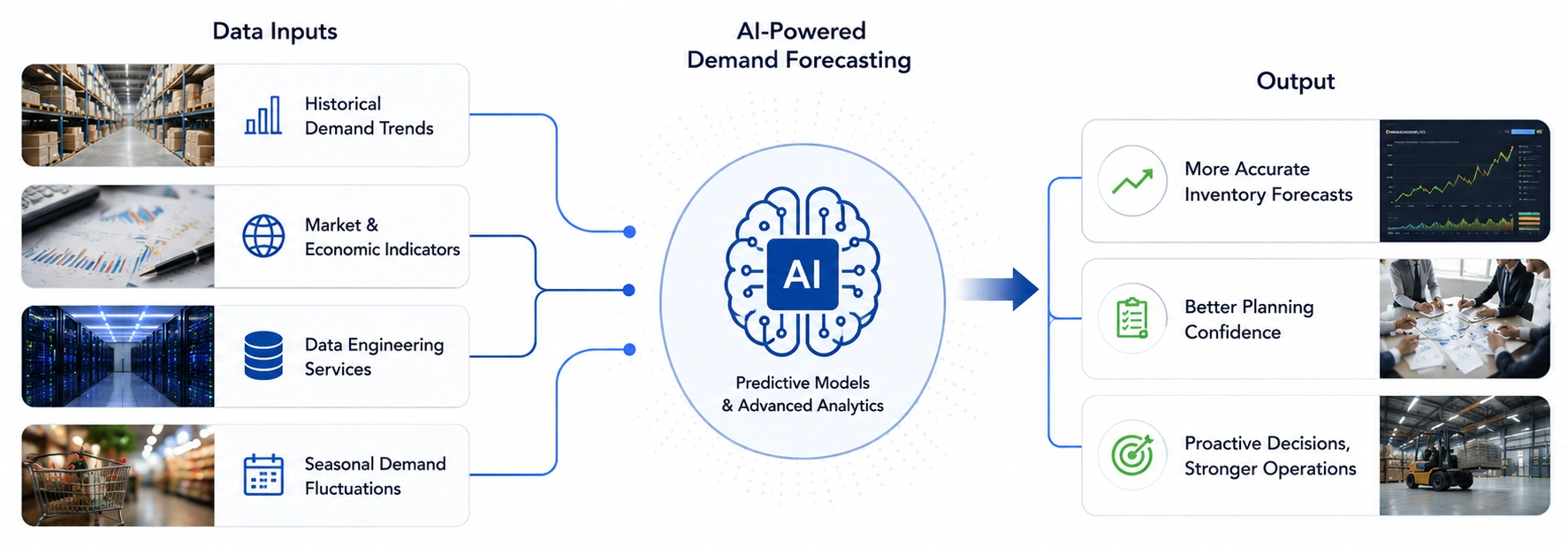
Once data is connected, predictive models begin identifying future demand patterns.

Unlike traditional forecasting methods, AI considers both internal and external influences.

This is where strong Data Engineering Services become critical. Without a scalable data foundation, forecasting models cannot access clean, reliable, and real-time information required for accurate predictions.

Step 2 Build AI-Powered Demand Forecasting

As a result, businesses can prepare for demand shifts before they impact operations.

→ Analyze historical demand trends
→ Evaluate market and economic indicators
→ Leverage Data Engineering Services to unify and prepare operational data
→ Detect seasonal demand fluctuations
→ Generate more accurate inventory forecasts

This improves planning confidence across procurement, manufacturing, and operations teams.

Step 3: Enable AI-Driven Inventory Decisions

Forecasting alone is not enough.

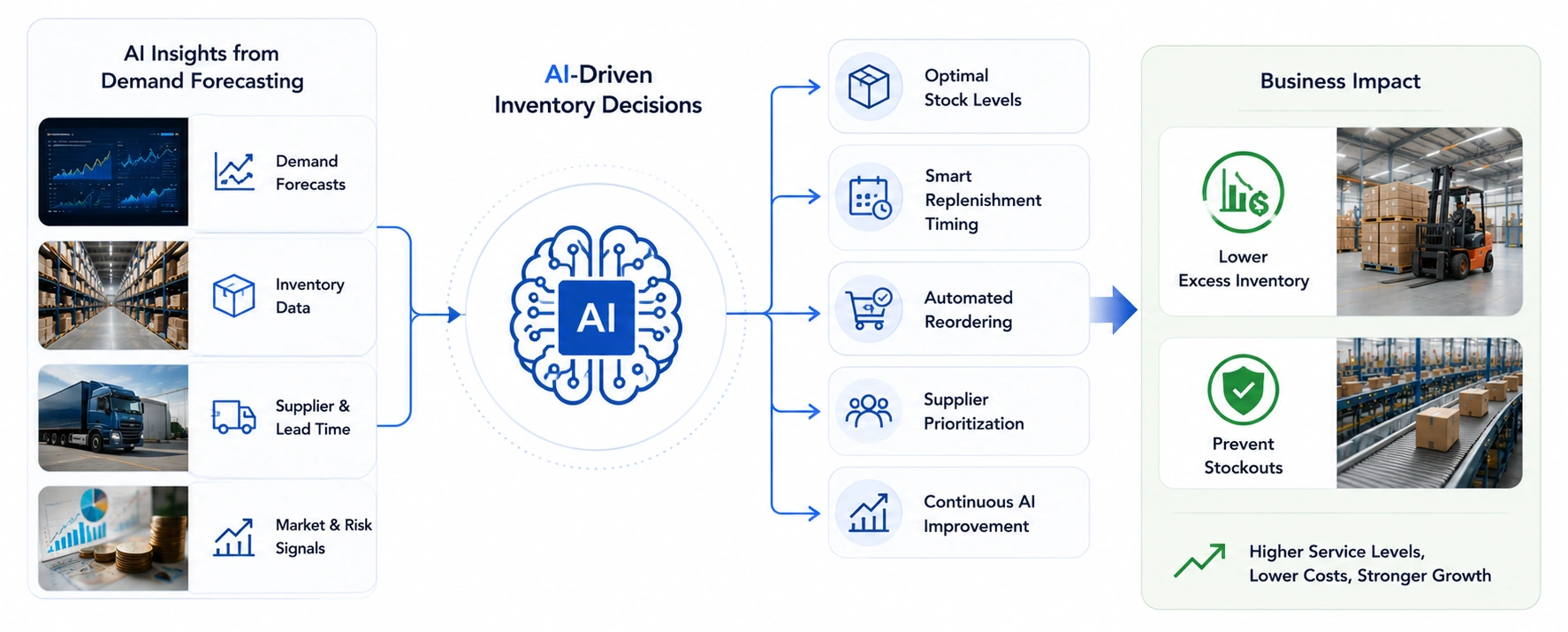
The real value comes from turning insights into action.

Through strategic AI Development, intelligent inventory models continuously recommend optimal decisions while learning from changing business conditions.

Step 3 Enable AI-Driven Inventory Decisions

→ Identify ideal stock levels
→ Recommend replenishment timing
→ Automate material reordering
→ Prioritize suppliers based on risk and performance
→ Apply AI Development capabilities to continuously improve inventory recommendations

Consequently, businesses reduce excess inventory while preventing costly stockouts.

CloudOps for Manufacturing
What If Your Supply Chain Could Predict Tomorrow?
Less excess inventory. Fewer shortages. Better fulfillment. More growth. That's what happens when decisions become intelligent.

Step 4: Continuously Optimize Supply Chain Performance

Markets evolve.

Customer behavior changes.

Supplier performance fluctuates.

Therefore, optimization must be ongoing.


Step 4 Continuously Optimize Supply Chain Performance

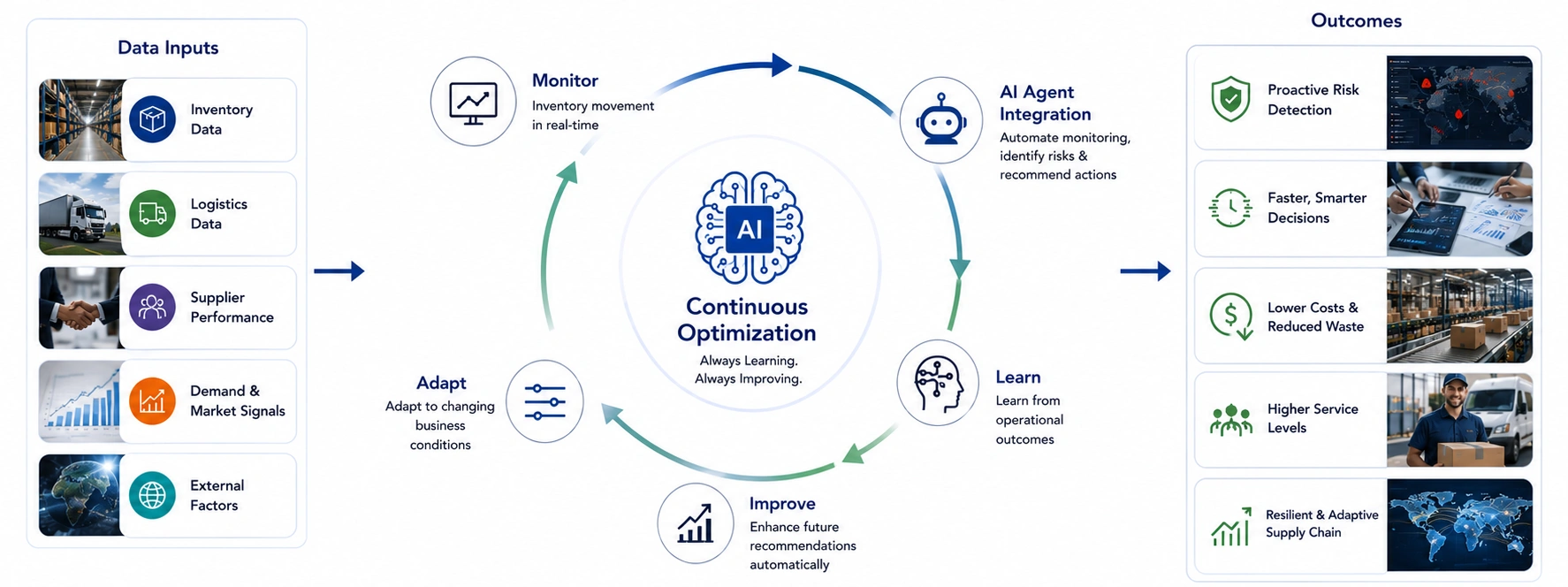
Modern supply chains are increasingly leveraging AI Agent Integration to automate monitoring, identify risks, and recommend actions without requiring constant human intervention.

→ Monitor inventory movement continuously
→ Enable AI Agent Integration for proactive decision-making
→ Learn from operational outcomes
→ Improve future recommendations automatically
→ Adapt to changing business conditions

This creates a truly adaptive and resilient AI-Optimized Supply Chain capable of responding to disruption before it impacts business performance.

What Business Outcomes Can Manufacturers Expect?

Business Outcomes Manufacturers

The value extends far beyond inventory reduction.

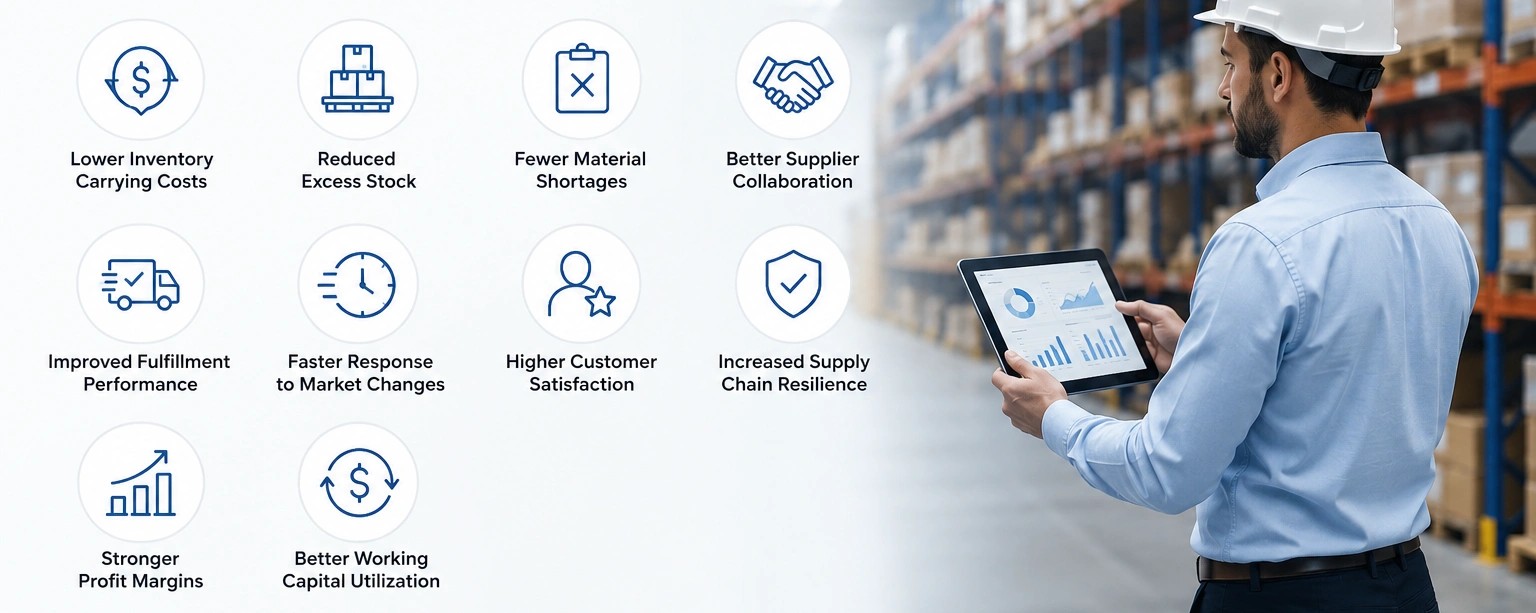
Organizations that embrace AI-Optimized Supply Chain & Inventory Management often achieve improvements across multiple business areas.

→ Lower inventory carrying costs
→ Reduced excess stock
→ Fewer material shortages
→ Better supplier collaboration
→ Improved fulfillment performance
→ Faster response to market changes
→ Higher customer satisfaction
→ Increased supply chain resilience
→ Stronger profit margins
→ Better working capital utilization

For executive teams, however, the greatest benefit is predictability.

When inventory decisions become more accurate, business planning becomes more reliable.

And when planning becomes more reliable, growth becomes easier to achieve.

Is Your Business Ready for AI-Optimized Supply Chain & Inventory Management?

The future of manufacturing will not be defined by who produces the most.

It will be defined by who can predict demand faster, respond to disruptions earlier, and make smarter inventory decisions at scale.

That is exactly what AI-Optimized Supply Chain & Inventory Management makes possible.

By combining predictive intelligence, Data Engineering Services, AI Development, and AI Agent Integration, manufacturers can transform fragmented supply chain operations into connected, intelligent ecosystems that continuously adapt to change.

At Azilen, we help organizations build the data foundations, forecasting capabilities, and intelligent decision-making systems required to create resilient, future-ready supply chains.

The opportunity is no longer about reducing inventory costs alone.

It is about creating a competitive advantage that improves fulfillment performance, protects revenue, strengthens customer relationships, and unlocks sustainable business growth.

The question is not whether AI will transform supply chains.

The question is whether your organization will lead that transformation or be forced to catch up to it.

Building Successful AI-Optimized Supply Chain & Inventory Management

Forecasting demand is important. However, forecasting demand while managing inventory costs, supply disruptions, and customer expectations is what drives long-term success.

As a Enterprise AI Development Company, Azilen helps manufacturers build AI-Optimized Supply Chain & Inventory Management solutions that combine predictive analytics, Data Engineering Services, AI Development, and AI Agent Integration to create more resilient and efficient supply chain operations.

Here are the benefits:

➜ Improve Demand Forecasting Accuracy: Anticipate demand shifts using AI-driven insights and predictive modeling.

➜ Reduce Excess Inventory: Optimize stock levels while lowering inventory carrying costs.

➜ Prevent Material Shortages: Identify supply risks early and improve replenishment planning.

➜ Automate Inventory Decisions: Use AI Development to recommend optimal ordering and inventory actions.

➜ Enable Real-Time Visibility: Leverage Data Engineering Services to connect supply chain data across systems.

➜ Strengthen Supply Chain Resilience: Utilize AI Agent Integration to continuously monitor risks and opportunities.

➜ Improve Fulfillment Performance: Align inventory availability with customer demand more effectively.

With the right AI-Optimized Supply Chain & Inventory Management strategy, manufacturers can reduce costs, improve operational agility, strengthen supply chain resilience, and create a foundation for sustainable business growth.

CloudOps for Manufacturing AZILEN
Ready to Turn Data Into Better Business Decisions?
Discover how a modern data foundation can improve visibility, forecasting, and operational performance.

FAQs: AI-Optimized Supply Chain & Inventory Management

1. What is AI-Optimized Supply Chain & Inventory Management?

AI-Optimized Supply Chain & Inventory Management uses artificial intelligence, predictive analytics, and operational data to improve demand forecasting, inventory planning, and replenishment decisions. It helps manufacturers reduce excess inventory, prevent material shortages, improve fulfillment performance, and create a more resilient supply chain that can adapt to changing market conditions.

2. Why are manufacturers investing in AI-Optimized Supply Chain & Inventory Management?

Manufacturers are investing in AI-Optimized Supply Chain & Inventory Management to improve forecasting accuracy, lower inventory carrying costs, reduce supply chain risks, and respond faster to market changes. By turning data into actionable insights, organizations can improve operational efficiency, strengthen customer satisfaction, and build a competitive advantage in an increasingly unpredictable business environment.

3. How does AI-Optimized Inventory Management improve demand forecasting?

AI-Optimized Inventory Management analyzes historical sales patterns, market trends, supplier performance, and external business signals to predict future demand more accurately. This allows manufacturers to make proactive inventory decisions, avoid overstocking, minimize stockouts, and align inventory levels with actual customer demand while improving overall planning confidence.

4. What role do Data Engineering Services play in AI-Optimized Supply Chain initiatives?

Data Engineering Services create the foundation for successful AI-Optimized Supply Chain initiatives by connecting ERP systems, supplier networks, inventory platforms, and operational data sources. A unified data environment improves visibility, supports accurate forecasting, enables real-time decision-making, and ensures AI models have access to reliable and high-quality business data.

5. How can manufacturers get started with AI-Optimized Supply Chain & Inventory Management?

Manufacturers can begin by assessing their current supply chain data, forecasting processes, and inventory management challenges. From there, organizations can implement Data Engineering Services, AI Development, and AI Agent Integration capabilities to improve visibility, automate decision-making, and build a scalable AI-Optimized Supply Chain that delivers measurable business value.

author avatar
Chintan Shah Vice President – Delivery
Chintan Shah is VP – Delivery at Azilen Technologies, specializing in enterprise solutions, digital transformation, and scalable software delivery. He focuses on driving operational excellence and high-performance technology execution.
google
Chintan Shah
Chintan Shah
Vice President - Delivery at Azilen Technologies

Chintan Shah is an experienced software professional specializing in large-scale digital transformation and enterprise solutions. As VP - Delivery at Azilen Technologies, he drives strategic project execution, process optimization, and technology-driven innovations. With expertise across multiple domains, he ensures seamless software delivery and operational excellence.

Related Insights

GPT Mode
AziGPT - Azilen’s
Custom GPT Assistant.
Instant Answers. Smart Summaries.