


 10 mins
Mar 26, 2025

AI is no longer confined to controlled experiments or isolated innovation teams. In 2026, enterprises are embedding AI into customer experiences, business operations, decision-making, and increasingly autonomous workflows.
As adoption accelerates, the question is no longer whether organizations should use AI, but how they can scale it without losing control over data, risk, compliance, or accountability.
This is where enterprise AI governance becomes essential. A practical AI governance framework helps organizations manage AI risk, establish accountability, protect sensitive data, and maintain compliance as AI systems scale.
For enterprises building or expanding AI agents, AI agent consulting services can help establish the right governance and compliance foundation from the start.
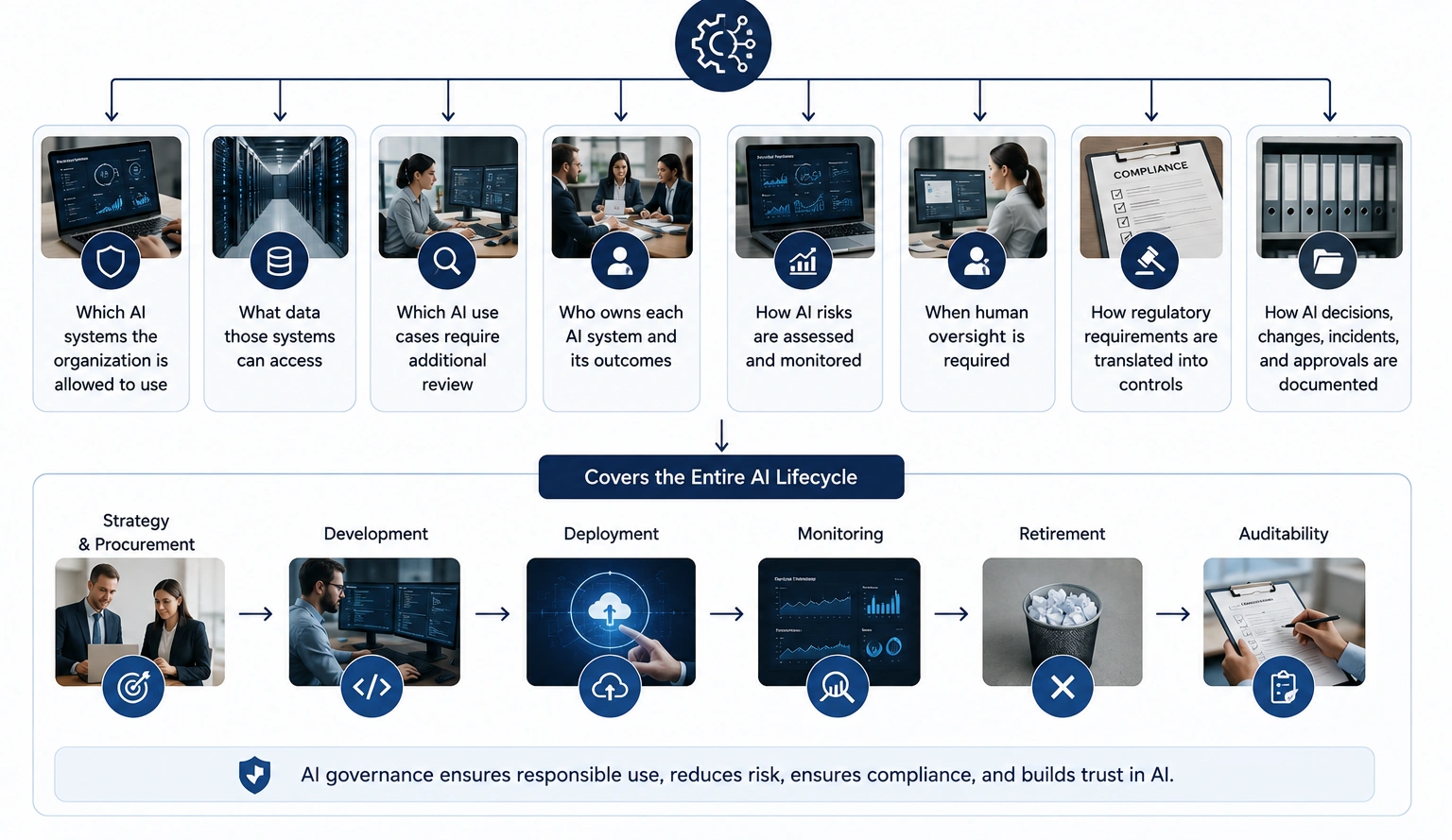
Enterprise AI governance is the system of policies, processes, roles, controls, and technologies an organization uses to manage AI throughout its lifecycle.
It determines:
→ Which AI systems the organization is allowed to use
→ What data those systems can access
→ Which AI use cases require additional review
→ Who owns each AI system and its outcomes
→ How AI risks are assessed and monitored
→ When human oversight is required
→ How regulatory requirements are translated into controls
→ How AI decisions, changes, incidents, and approvals are documented
AI governance is broader than simply writing an acceptable-use policy. It extends from AI strategy and procurement to development, deployment, monitoring, retirement, and auditability.
It is also different from related disciplines.
AI ethics defines values such as fairness, transparency, safety, and human oversight.
Data governance establishes how data is classified, accessed, protected, maintained, and used.
IT governance provides broader oversight of technology investments, systems, and operations.
AI governance connects these disciplines to the unique behavior of AI systems, including probabilistic outputs, model drift, hallucinations, autonomous actions, training-data risks, and changing model capabilities.

AI governance has moved from an IT concern to a board-level business priority. Three forces are driving the shift: rising AI-related security exposure, enforceable regulation, and the rapid expansion of enterprise AI.
As enterprises move from AI experimentation to autonomous AI agents, governance needs to extend beyond policies and documentation. Agents can access enterprise data, interact with tools, and execute actions, making control, security, compliance, human oversight, and auditability essential.
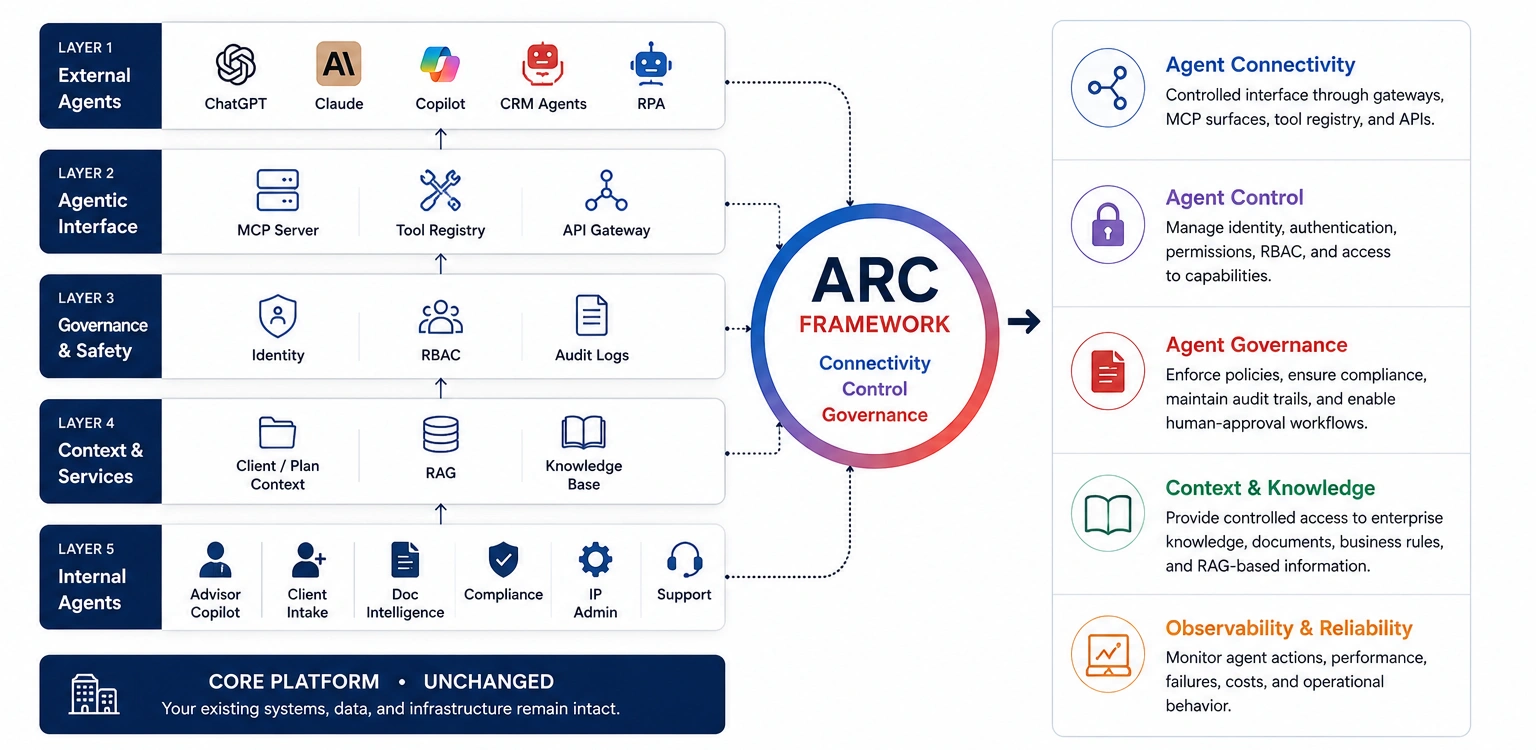
Azilen’s Agentic-Readiness & Control (ARC) Framework is designed to help enterprises make their software platforms safely usable by AI agents. It goes beyond basic agent connectivity by adding the control and governance layer required for production-ready agentic AI.
→ Agent Connectivity: Connect external and internal AI agents through controlled gateways, MCP surfaces, tool registries, and APIs.
→ Agent Control: Manage authentication, identity, permissions, RBAC, and access to enterprise capabilities.
→ Agent Governance: Apply policies, compliance controls, audit trails, and human-approval workflows.
→ Context & Knowledge: Give agents controlled access to business knowledge, documents, policies, and RAG-based information.
→ Observability & Reliability: Monitor agent actions, performance, failures, costs, and operational behavior.
The ARC Framework is designed to sit on top of an organization’s existing platform, allowing enterprises to introduce agentic capabilities without replacing their core systems.
This makes ARC particularly relevant as enterprises scale AI agents across business-critical workflows where connectivity alone is not enough, every action needs the right level of control, governance, and accountability.
A strong AI governance framework brings together the organizational, technical, and operational controls needed to manage AI throughout its lifecycle. While frameworks such as NIST AI RMF organize AI risk management around Govern, Map, Measure, and Manage, enterprises typically operationalize these principles through a set of interconnected governance components.
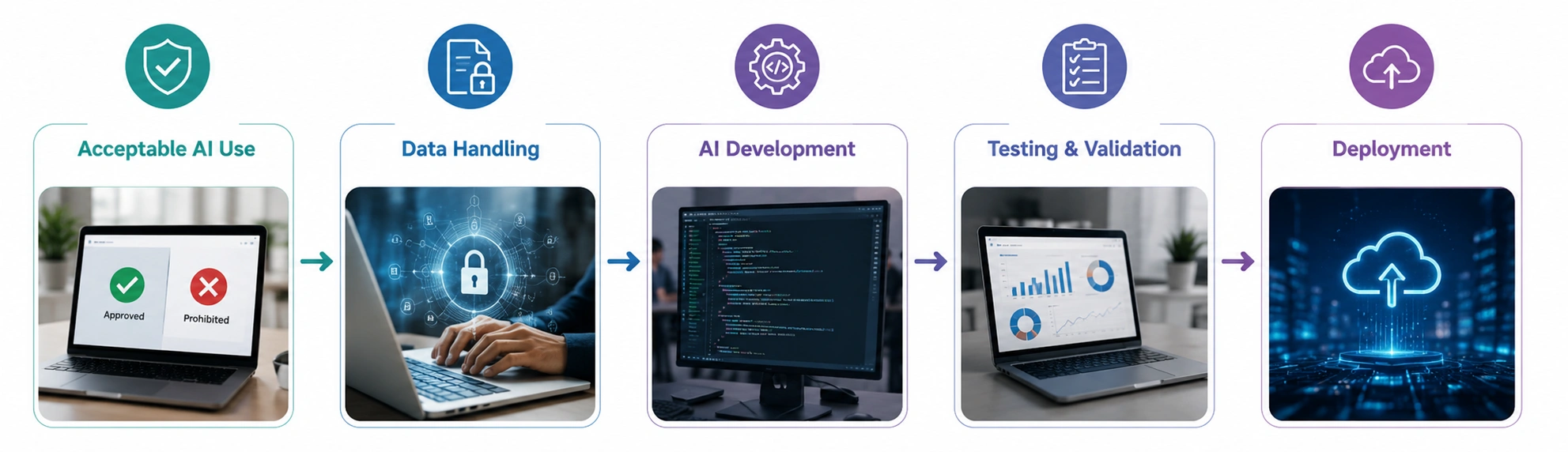
Clear policies define how AI can be developed, purchased, deployed, and used across the organization.
→ Acceptable AI use: Define approved and prohibited use cases.
→ Data handling: Establish rules for sensitive and confidential information.
→ AI development: Set standards for testing, validation, and deployment.
Example: Employees can use an approved enterprise AI assistant but cannot enter confidential customer data into public AI tools.
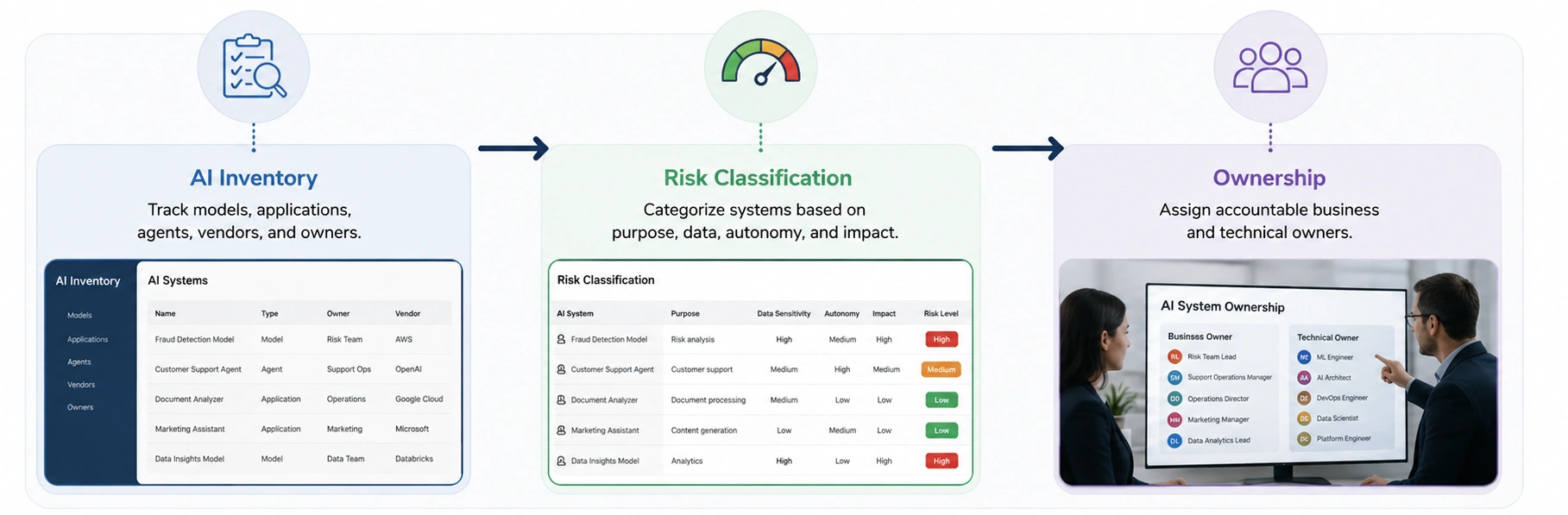
Organizations need visibility into every AI system and a consistent way to determine the level of oversight it requires.
→ AI inventory: Track models, applications, agents, vendors, and owners.
→ Risk classification: Categorize systems based on purpose, data, autonomy, and impact.
→ Ownership: Assign accountable business and technical owners.
Example: A meeting summarizer may be low risk, while an AI system supporting credit decisions requires enhanced controls.
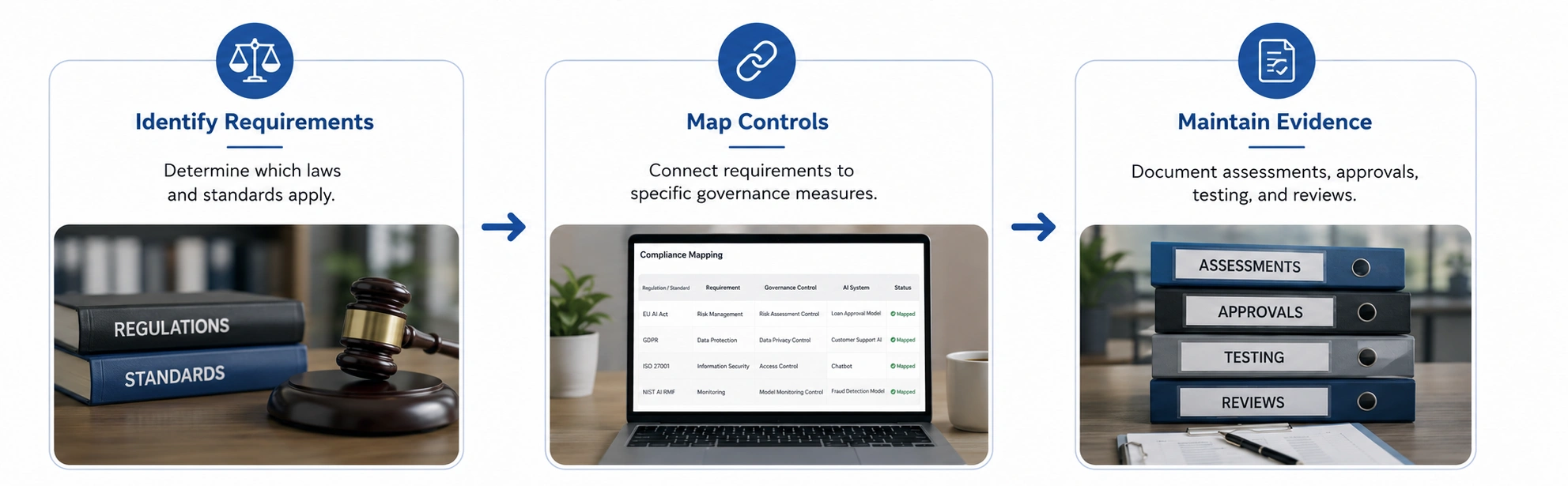
Governance should connect applicable regulations and standards directly to the controls used across AI systems.
→ Identify requirements: Determine which laws and standards apply.
→ Map controls: Connect requirements to specific governance measures.
→ Maintain evidence: Document assessments, approvals, testing, and reviews.
Example: An AI system operating in the EU can be mapped against applicable EU AI Act requirements and assigned specific compliance controls.
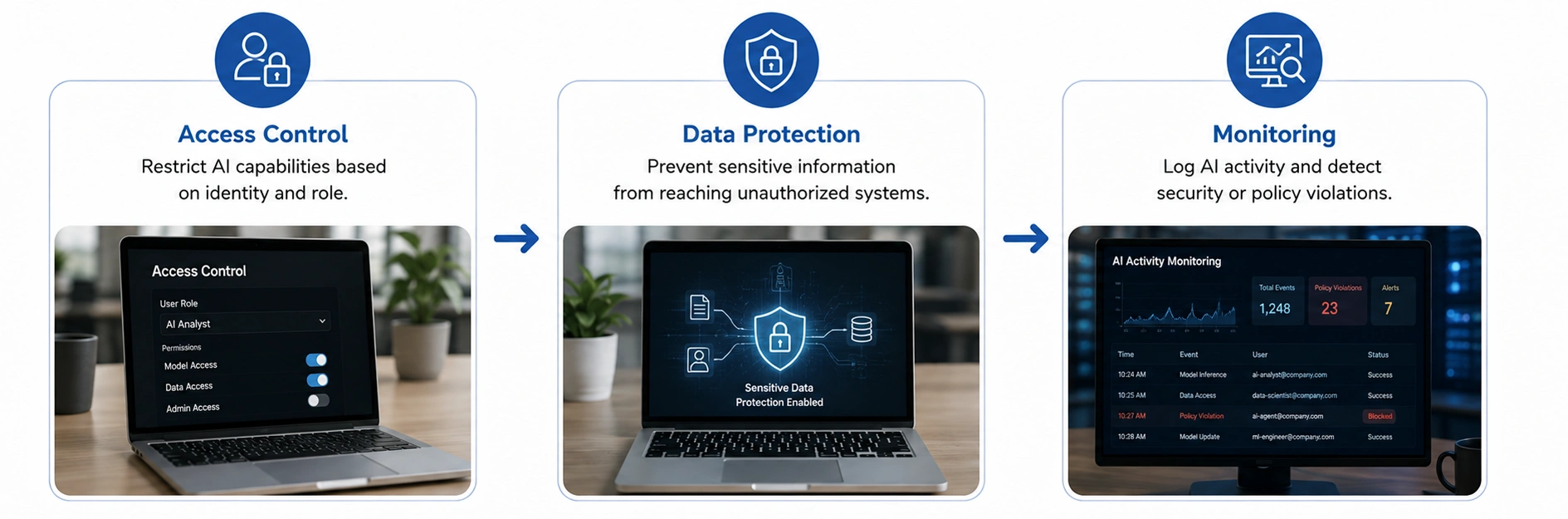
Technical safeguards turn AI governance policies into enforceable controls across models, applications, data, and agents.
→ Access control: Restrict AI capabilities based on identity and role.
→ Data protection: Prevent sensitive information from reaching unauthorized systems.
→ Monitoring: Log AI activity and detect security or policy violations.
Example: An enterprise AI platform can block sensitive customer data from being sent to an unauthorized external model.
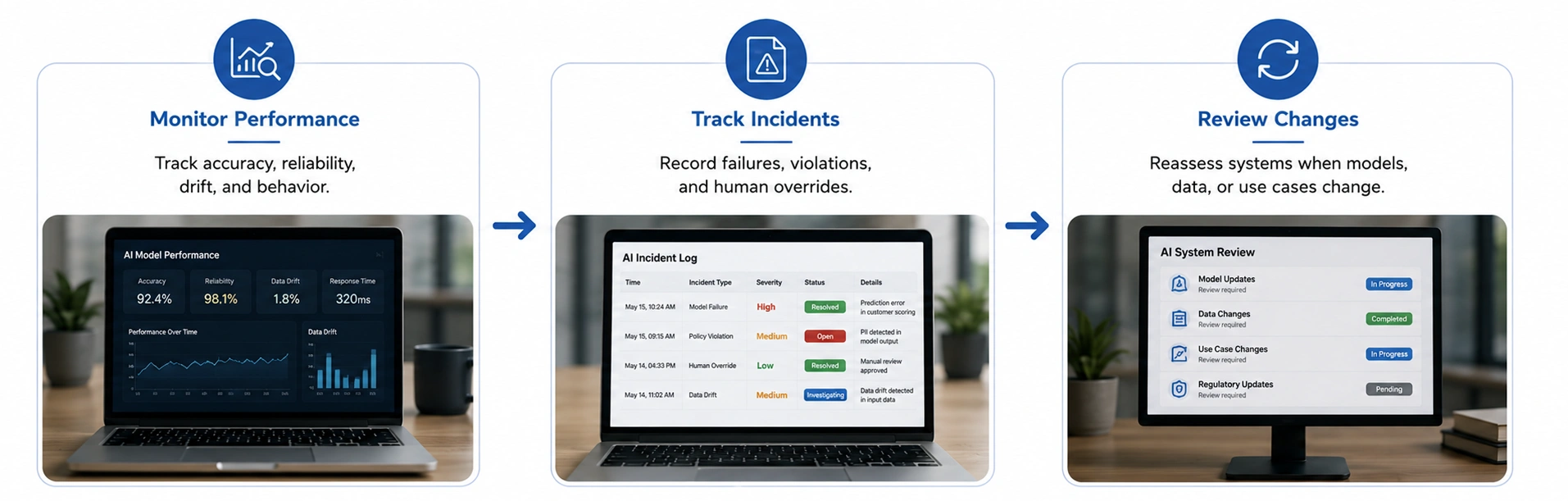
AI governance must continue after deployment because models, data, risks, and business requirements change over time.
→ Monitor performance: Track accuracy, reliability, drift, and behavior.
→ Track incidents: Record failures, violations, and human overrides.
→ Review changes: Reassess systems when models, data, or use cases change.
Example: A sudden increase in inaccurate chatbot responses can trigger an automated review after a model update.
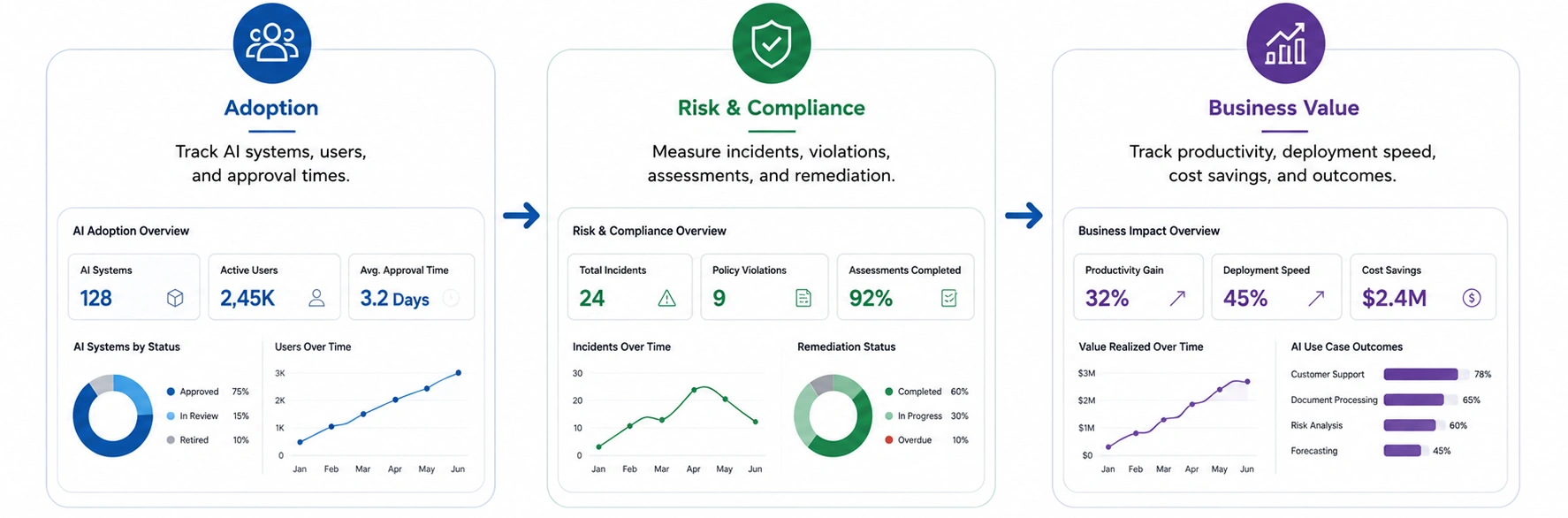
Governance needs measurable outcomes that give executives and boards visibility into AI adoption, risk, compliance, and business impact.
→ Adoption: Track AI systems, users, and approval times.
→ Risk & compliance: Measure incidents, violations, assessments, and remediation.
→ Business value: Track productivity, deployment speed, cost savings, and outcomes.
Example: A governance dashboard can show how many AI systems are in production, their risk levels, compliance status, and outstanding issues.
Building AI governance requires more than defining policies, it requires those policies to work across AI models, agents, applications, data, and enterprise workflows. Azilen combines AI engineering, data engineering, integration, and agentic AI expertise to help enterprises build governance into their AI architecture from the start.
| Enterprise Need | How Azilen Helps |
|---|---|
| AI Governance & Risk Advisory | Define governance objectives, assess AI risks, establish accountability, and align AI initiatives with applicable regulations and standards. |
| Governed AI Architecture | Embed security, access controls, human oversight, monitoring, auditability, and compliance into AI applications and workflows. |
| AI Agent Governance | Establish controls for agent identity, permissions, tool access, autonomy, escalation, and human-in-the-loop intervention. |
| AI Monitoring & Observability | Monitor AI performance, behavior, risks, policy violations, and changes throughout the AI lifecycle. |
| Enterprise Integration | Connect AI governance controls with existing data platforms, applications, identity systems, workflows, and enterprise infrastructure. |
With governance embedded across the AI lifecycle, enterprises can move from isolated AI experiments to secure, accountable, compliant, and production-ready AI systems, without turning governance into a bottleneck for innovation.

Enterprise AI governance is the set of policies, processes, roles, and technical controls used to manage AI across an organization. It helps enterprises control AI risks, protect sensitive data, meet regulatory requirements, establish accountability, and monitor AI systems throughout their lifecycle. Effective governance allows businesses to scale AI responsibly without unnecessarily slowing innovation.
Building an AI governance framework starts with creating an inventory of AI systems and classifying them based on risk, purpose, data, and level of autonomy. Enterprises then define policies, assign ownership, map regulatory requirements, implement technical controls, establish human oversight, and continuously monitor AI performance, incidents, compliance, and business impact.
An AI governance platform should provide centralized visibility and control across enterprise AI systems. Key capabilities include AI inventory and discovery, risk classification, policy management, compliance mapping, approval workflows, access controls, monitoring, audit trails, evidence collection, and reporting. For organizations using AI agents, the platform should also support agent identity, permissions, autonomy, and oversight.
AI governance helps organizations identify and classify AI risks before systems reach production and apply controls appropriate to their impact. It also connects regulatory requirements to specific AI systems, policies, and controls. Continuous monitoring, documentation, audit trails, and incident management help enterprises demonstrate compliance while responding quickly when AI risks or regulatory requirements change.
Generative AI governance and AI agent governance extend traditional AI controls to address risks such as hallucinations, sensitive-data exposure, prompt injection, autonomous actions, and excessive permissions. Enterprises should define what agents can access, which tools they can use, when human approval is required, how actions are monitored, and how systems can be stopped when risks emerge.


 10 mins
  10 mins
"*" indicates required fields

5432 Geary Blvd, Unit #527 San Francisco, CA 94121 United States
320 Decker Drive Irving, TX 75062 United States

6d-7398 Yonge St,1318 Thornhill, Ontario, Canada, L4J8J2

71-75 Shelton Street, Covent Garden, London, United Kingdom, WC2H 9JQ

Hohrainstrasse 16, 79787 Lauchringen, Germany

12, Zugerstrasse 32, 6341 Baar, Switzerland

5th floor, Bloukrans Building, Lynnwood Road, Pretoria, Gauteng, 0081, South Africa

12th & 13th Floor, B Square-1, Bopal – Ambli Road, Ahmedabad – 380054
B/305A, 3rd Floor, Kanakia Wallstreet, Andheri (East), Mumbai, India







 Talk to Our
Consultants
Talk to Our
Consultants Chat with
Our Experts
Chat with
Our Experts Write us
an Email
Write us
an Email