




Skip to content

Agentic AI for Fraud Detection: How Banks Can Investigate Suspicious Transactions Automatically

Featured Image

Executive Summary

Agentic AI for fraud detection helps banks move beyond simply flagging suspicious transactions. AI agents can investigate alerts by gathering transaction history, customer context, device and behavioral signals, related entities, and supporting evidence; then summarize findings, recommend next steps, and route high-risk cases to investigators.

→ Detect suspicious activity using existing fraud and anomaly-detection systems.

→ Automatically investigate alerts by gathering and connecting relevant evidence.

→ Prioritize cases based on risk, context, and investigation findings.

→ Keep investigators in control of high-impact decisions and regulatory actions.

A suspicious transaction is only the beginning.

The real work starts after the alert.

Banks still need to determine what happened, gather evidence, understand customer behavior, connect related activity, assess risk, document the case, and decide what happens next.

That is where agentic AI for fraud detection changes the model.

Instead of using AI only to identify an anomaly, banks can use AI agents to investigate the anomaly, gather context, build the case, and recommend the next action, while keeping human investigators in control of consequential decisions.

“The future of fraud detection is not just finding suspicious transactions. It is understanding why they are suspicious and deciding what should happen next.”

4.7 Million

Suspicious Activity Reports filed with FinCEN, averaging about 12,870 SAR filings/ day.

$12.5 Billion

Consumers reported losing more than $12.5 billion to fraud

22,364

AI-related complaints received by the FBI’s Internet Crime Complaint Center

Why Traditional Fraud Detection Is Not Enough

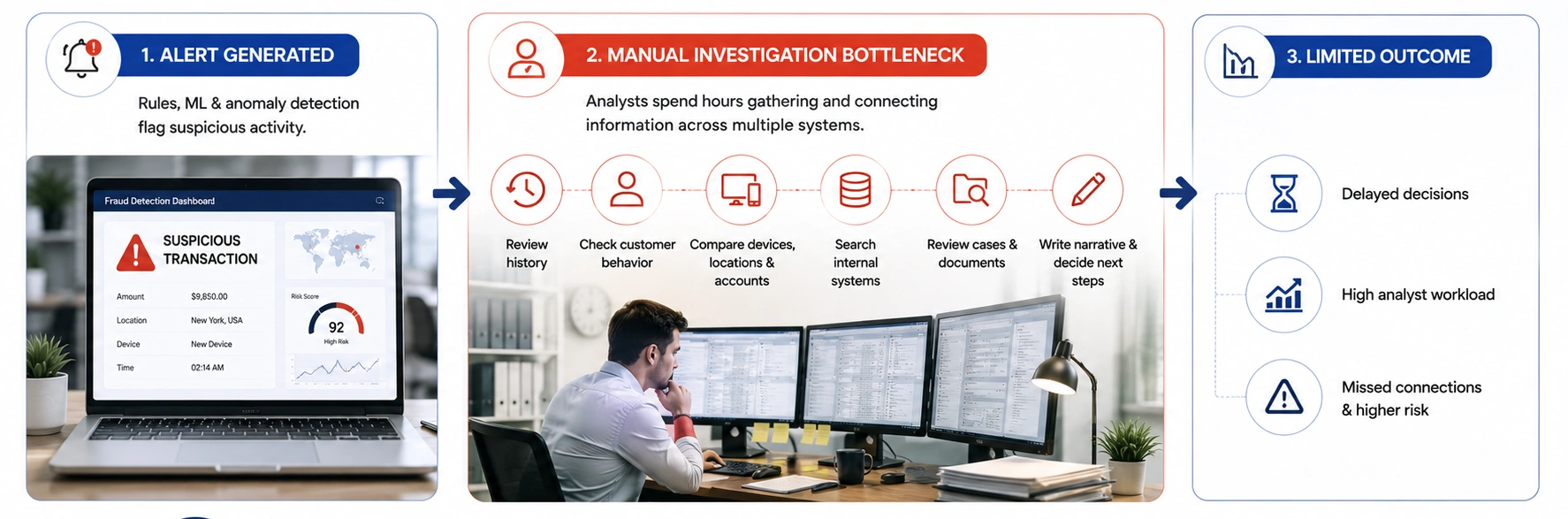
Traditional fraud detection systems are good at spotting anomalies using rules, machine learning, behavioral analytics, and transaction monitoring. But detecting a suspicious transaction is only the first step, the real bottleneck begins when investigators have to determine why it is suspicious.

Why Traditional Fraud Detection Is Not Enough

Where the old approach breaks

Alert generated: A transaction triggers the fraud model.

Manual investigation: Analysts jump between customer, transaction, device, and account systems.

Context gets fragmented: Related signals and previous cases may be missed or take time to connect.

Decision gets delayed: High alert volumes slow investigation and escalation.

A real example: Commonwealth Bank

In 2026, Commonwealth Bank introduced an AI agent that monitors more than 80 million fraud-related signals daily. When it identifies an emerging pattern, the agent assesses the severity, analyzes context, and proposes new fraud-detection rules. Human fraud analysts review and approve those rules before implementation.

This shows exactly where traditional detection alone falls short: Detection → Alert → Manual Investigation

becomes: Detection → AI Investigation → Context → Recommendation → Human Approval

Digital Banking
Ready to Strengthen Fraud Detection with Agentic AI?
Build intelligent, connected fraud investigation workflows that help banks detect suspicious activity.

What Is Agentic AI for Fraud Detection?

Agentic AI for fraud detection uses autonomous or semi-autonomous AI agents to perform multi-step fraud investigation workflows.

What Is Agentic AI for Fraud Detection

Unlike a conventional fraud model that may return a risk score, AI fraud detection identifies suspicious patterns, while an AI agent can take the next step and reason through a defined investigation process.

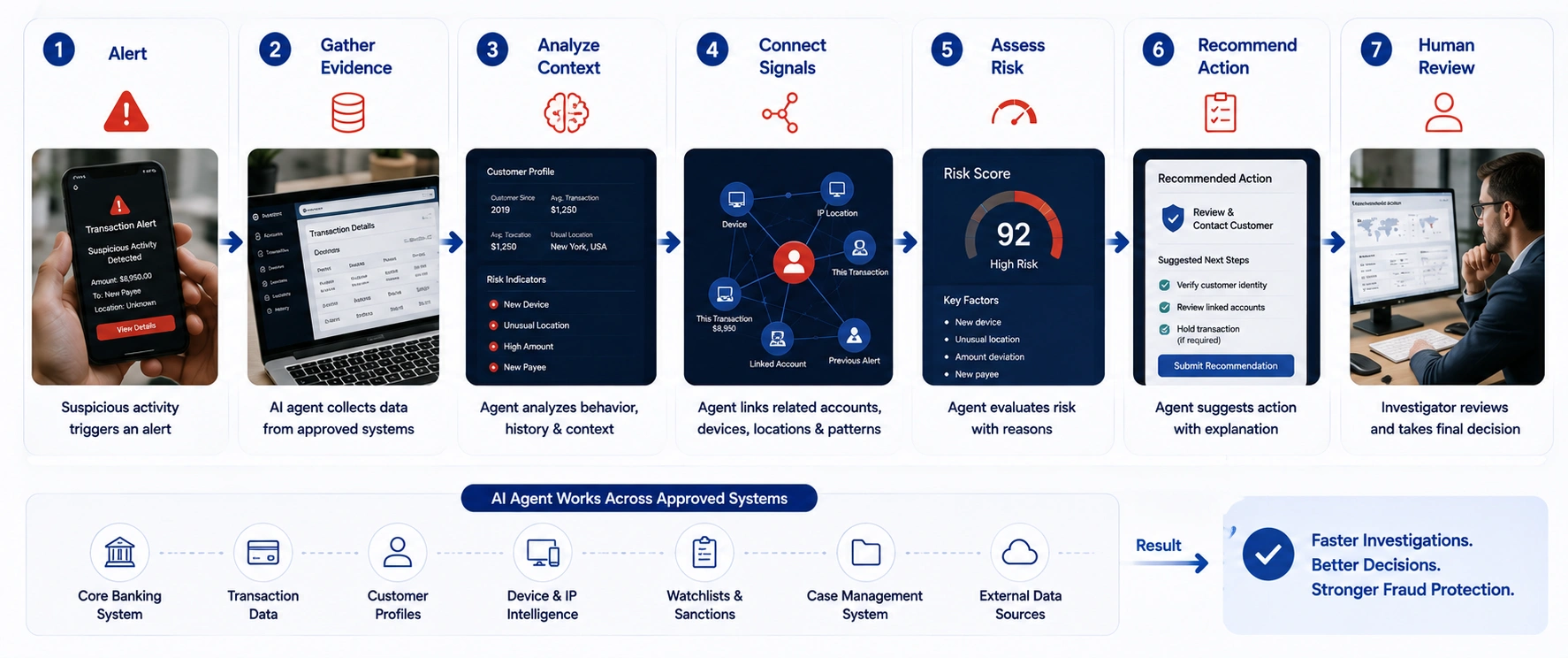
For example: Alert → Gather Evidence → Analyze Context → Connect Signals → Assess Risk → Recommend Action → Human Review

The agent can work across approved systems to gather information and continuously build a contextual picture of the suspicious activity.

IBM notes that banks are beginning to adopt agentic AI for complex workflows, including fraud detection and financial crime prevention, where AI can make decisions and adapt to changing information rather than simply follow predefined sequences.

The key difference is:

Traditional AI detects the signal. Agentic AI can investigate the signal.

5 Ways Banks Can Use Agentic AI for Fraud Detection

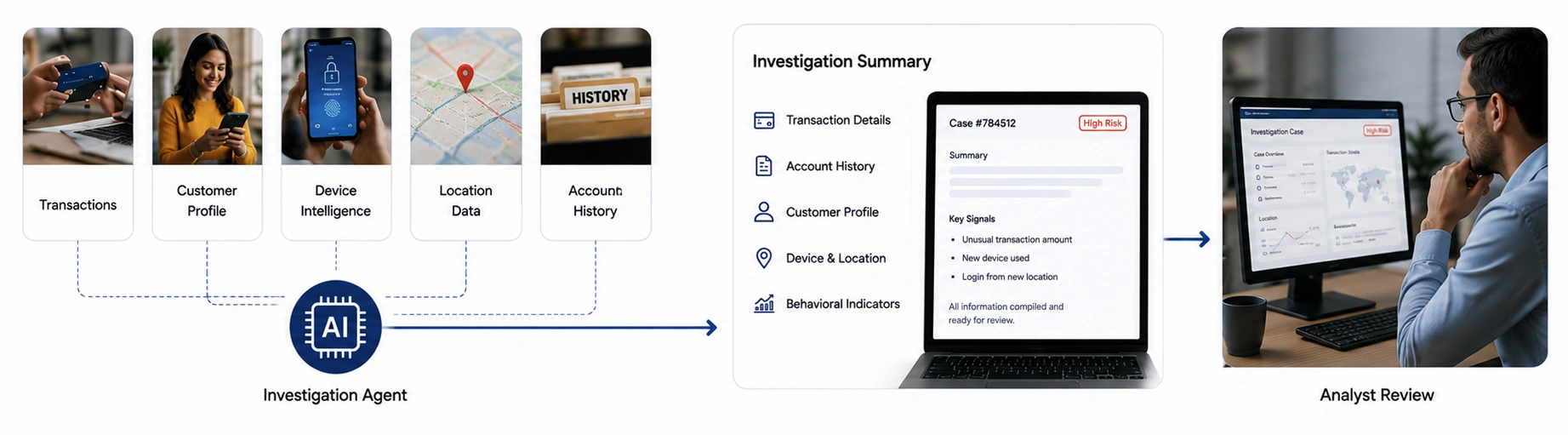
1. Automate Alert Investigation

Fraud analysts often spend significant time gathering information before making a decision.

AI fraud detection can extend this process by using an investigation agent to collect approved information from multiple systems and organize it around each suspicious alert.

Automate Alert Investigation

→ Pull relevant transaction and account history.

→ Gather customer, device, location, and behavioral context.

→ Build an initial investigation summary for the analyst.

Instead of opening multiple systems and manually assembling evidence, the investigator receives a context-rich case ready for review.

This is a strong starting point for banks exploring AI Agent Consulting Services to identify where autonomous investigation can deliver measurable value without removing human accountability.

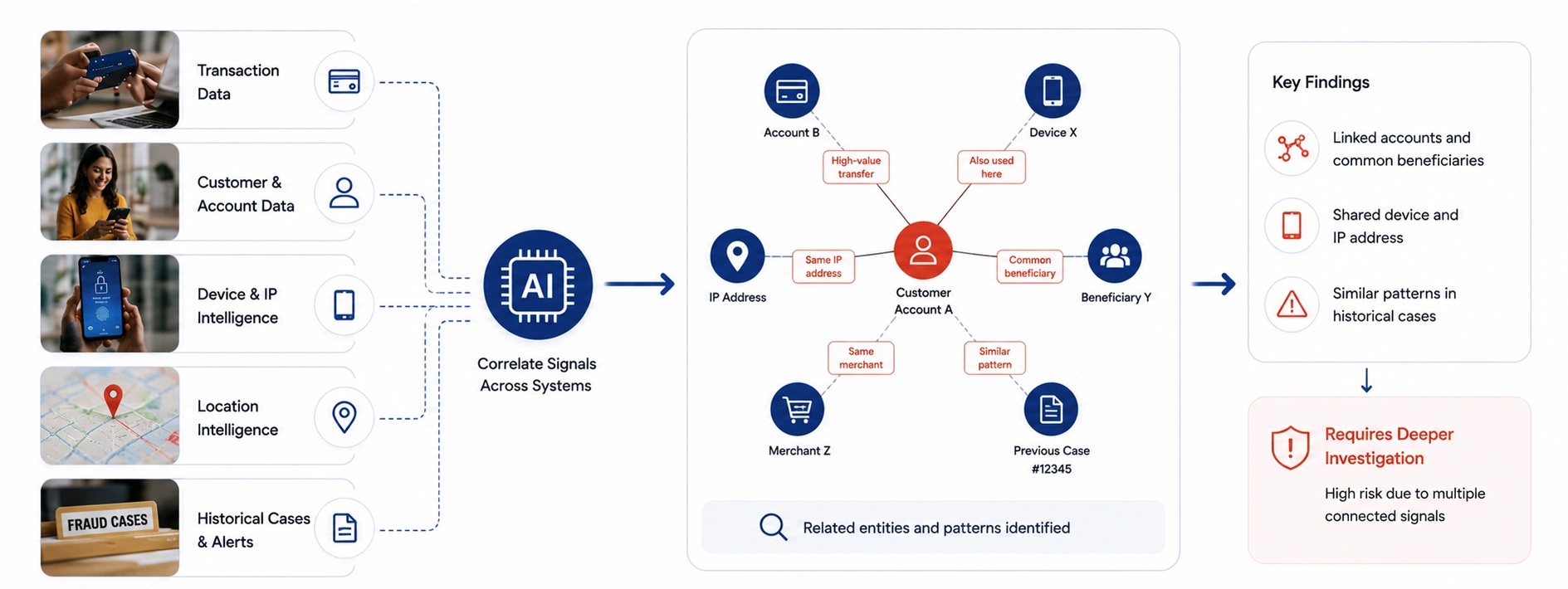
2. Correlate Signals with AI Fraud Detection Across Accounts and Systems

Fraud rarely happens in isolation. A suspicious transaction may only become meaningful when connected to another account, device, IP address, beneficiary, merchant, or previous investigation.

Agentic AI can help connect those signals and surface relationships that may be difficult to identify through isolated transaction reviews.

Correlate Signals Across Accounts and Systems

→ Connect transaction, customer, device, and behavioral signals.

→ Identify related entities and unusual relationships.

→ Surface patterns that require deeper investigation.

This makes AI agents for fraud detection particularly useful for complex cases where investigators need to move beyond individual transactions and understand the broader activity surrounding them.

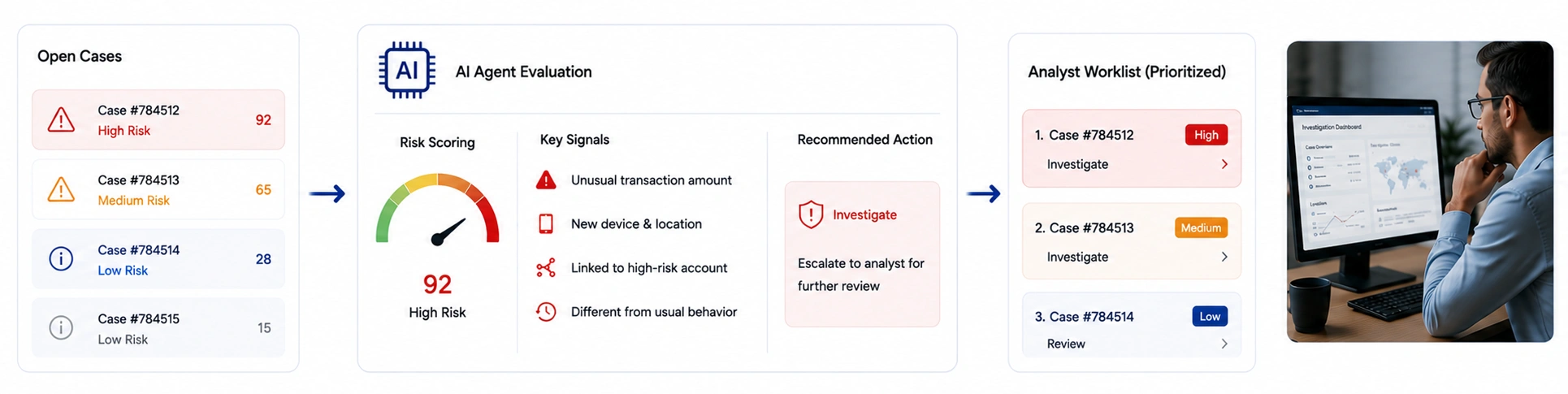
3. Prioritize Cases and Recommend Next Actions

Not every alert deserves the same level of investigation. An agent can evaluate the available evidence and help prioritize cases based on risk, context, and business rules.

Prioritize Cases and Recommend Next Actions

→ Rank cases based on defined risk indicators.

→ Explain which signals contributed to the recommendation.

→ Recommend investigation or escalation steps within approved policies.

The goal is not unrestricted automation. Agentic AI for fraud detection helps investigators focus on the cases with the greatest potential risk, strengthening banking fraud prevention while keeping important decisions under human control.

For banks building these capabilities, AI Agent Integration Services can help connect agents with existing fraud engines, banking platforms, data sources, and investigation workflows.

4. Generate Investigation Narratives and Case Evidence

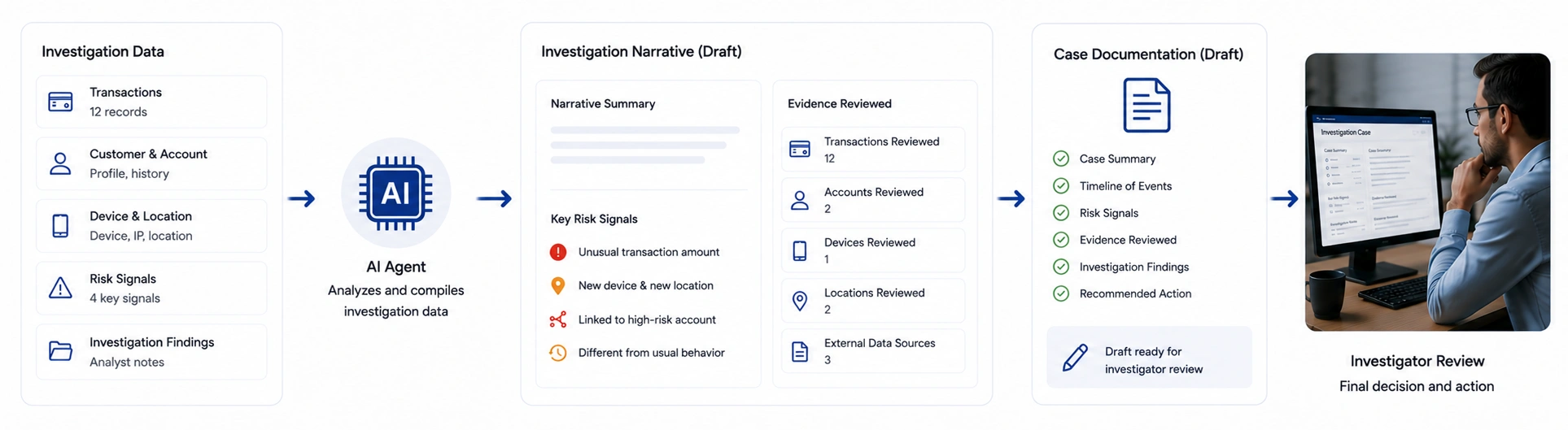
Fraud investigation does not end with identifying suspicious behavior. Investigators also need to document what happened, why the activity was suspicious, what evidence was reviewed, and what action was taken.

Generate Investigation Narratives and Case Evidence

An AI agent can turn structured investigation data into a consistent case narrative.

→ Summarize relevant transactions and risk signals.

→ Organize supporting evidence and investigation findings.

→ Generate draft case documentation for investigator review.

For customer-facing fraud workflows, Conversational AI Development Services can also support secure interactions that help customers verify transactions, provide information, or respond to fraud-related requests. This connects AI fraud detection with faster investigation and customer-response workflows.

5. Coordinate the End-to-End Fraud Investigation

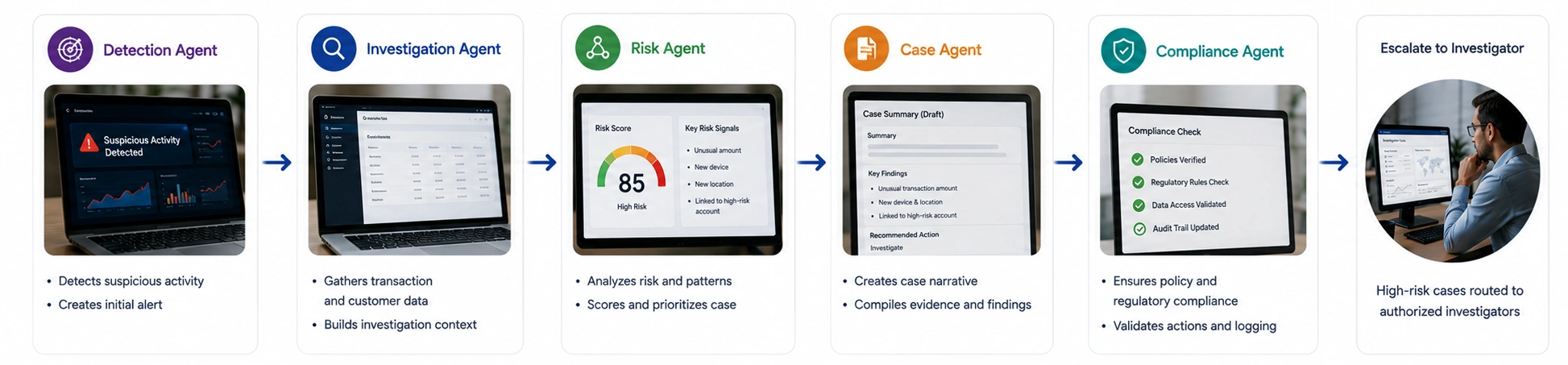
The biggest opportunity comes when AI agents work together instead of handling isolated tasks. Banking fraud prevention can be strengthened when specialized agents share context and coordinate investigations from initial detection through risk assessment, case preparation, and compliance review.

Detection Agent → Investigation Agent → Risk Agent → Case Agent → Compliance Agent

Coordinate the End-to-End Fraud Investigation

For example, one agent can gather transaction evidence, another can analyze relationships, another can summarize the case, and a final workflow can route the case to a human investigator.

→ Coordinate multiple investigation steps.

→ Pass relevant context between specialized agents.

→ Escalate high-risk cases to authorized investigators.

This is where Agent as a Service becomes relevant for financial institutions that want to deploy, govern, monitor, and continuously optimize production AI agents rather than manage an isolated proof of concept.

A Real-World Look at AI Fraud Detection: J.P. Morgan

J.P. Morgan uses AI and machine learning to analyze massive payment flows, identify unusual patterns, and generate risk scores in real time. The example shows how AI fraud detection can combine behavioral signals, graph analysis, and transaction data to spot suspicious activity.

The key takeaway: modern AI fraud detection goes beyond fixed rules by connecting more data and uncovering subtle relationships, helping banks strengthen fraud prevention while reducing false positives and investigation delays.

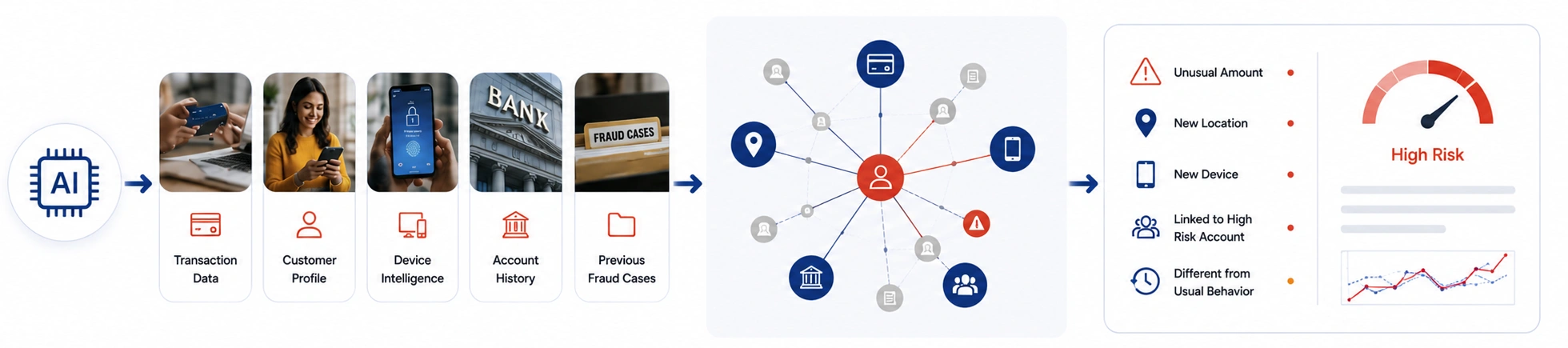
How Does Agentic AI Investigate a Suspicious Transaction?

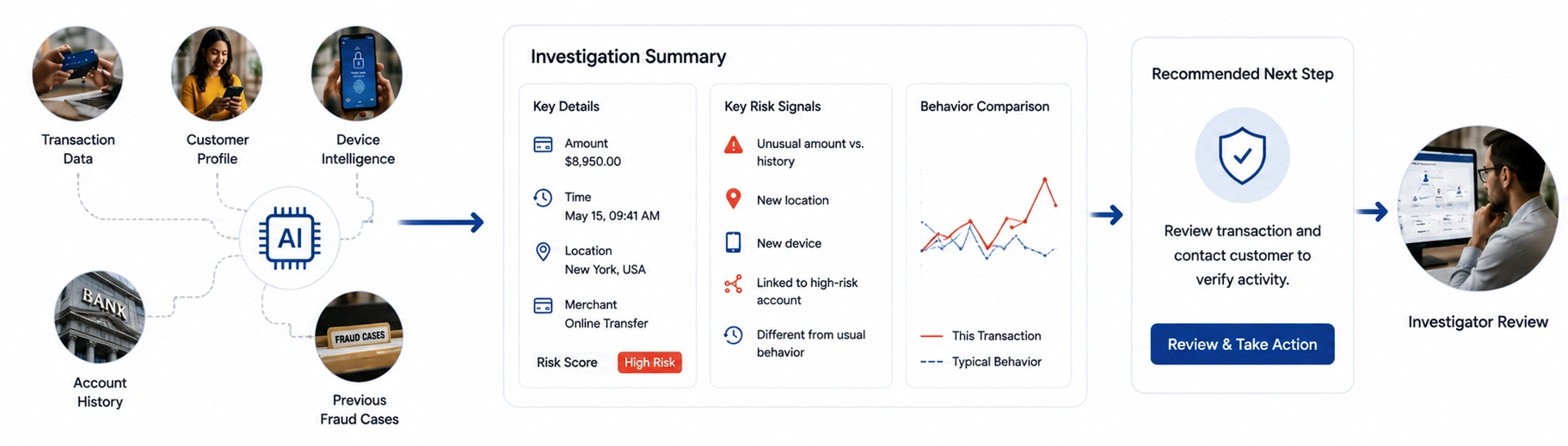
A suspicious transaction is only the starting point. Agentic AI for fraud detection goes beyond identifying anomalies, while AI fraud detection gathers relevant signals, connects data across systems, and builds the context investigators need to make faster, more informed fraud decisions.

1. Collect the Right Signals

Collect the Right Signals AI fraud detection

The AI agent gathers approved data from transaction systems, customer profiles, device intelligence, account history, and previous fraud cases.

This strengthens banking fraud prevention by bringing relevant signals together, helping investigators identify suspicious activity without manually searching across multiple systems.

2. Analyze and Connect the Dots

Analyze and Connect the Dots AI fraud detection

The agent analyzes customer behavior, transaction patterns, locations, devices, accounts, and related activity to identify connections and anomalies. It can compare the current activity with historical patterns to determine whether the transaction is genuinely unusual.

3. Build the Investigation Context

Build the Investigation Context AI fraud detection

The agent combines its findings into a clear investigation summary, highlighting key risk signals and recommending the next step. Anomaly does not automatically mean fraud—context helps investigators understand what actually happened and decide what to do next.

Governance: What Should an AI Fraud Investigation Agent Be Allowed to Do?

Not every action should have the same level of autonomy. Effective AI agent governance requires organizations to define what an agent can do independently, what requires additional controls, and where human approval is mandatory.

Agent Action Governance Level
Retrieve transaction history Automatic
Compare customer behavior Automatic with access controls
Access approved internal data Policy-controlled
Generate investigation summaries Automatic
Recommend case priority Human review
Draft investigation narratives Human review
Freeze an account Explicit authorization
Reject a transaction Policy-based approval
File a regulatory report Human approval

The principle is controlled autonomy: let agents automate repetitive, low-risk investigation tasks while applying stronger authorization and human oversight to actions that could create financial, regulatory, or customer impact.

For a broader framework covering AI agent identity, permissions, runtime controls, human oversight, monitoring, and governance, explore our guide to Agentic AI Governance

How Azilen Uses Agentic AI for Fraud Detection

Banks need more than systems that simply flag suspicious transactions. Azilen helps financial institutions build Agentic AI for Fraud Detection solutions that investigate alerts, connect risk signals, and support faster fraud-response workflows.

Build AI fraud detection solutions that analyze suspicious transactions and automate repetitive investigation tasks.

→ Strengthen banking fraud prevention by connecting transaction data, customer behavior, device intelligence, and risk signals.

→ Automate fraud investigation workflows to prioritize alerts, generate case summaries, and support investigators.

→ Integrate AI fraud detection with existing banking platforms, APIs, data sources, and fraud-management systems.

With Agentic AI for Fraud Detection, banks can move beyond simply identifying suspicious activity to investigating, understanding, and responding to potential fraud faster.

Build Agentic AI for Fraud Detection with Azilen

Moving AI into fraud operations requires more than detecting suspicious transactions. Banks need AI fraud detection solutions that can investigate alerts, connect risk signals, and support faster, more intelligent fraud-response workflows.

As an enterprise AI development company, Azilen helps financial institutions build AI-powered solutions that connect fraud intelligence with real banking workflows.

→ Build Agentic AI for Fraud Detection to investigate suspicious transactions and automate repetitive analysis.

→ Strengthen banking fraud prevention by connecting transaction, customer, device, behavioral, and risk data.

→ Automate fraud investigation with intelligent alert prioritization, evidence gathering, and case summarization.

→ Integrate AI fraud detection with banking platforms, APIs, data sources, and existing fraud-management systems.

Azilen helps banks move beyond detecting suspicious activity to investigating, understanding, and responding to potential fraud faster with production-ready AI solutions.

Strengthen your banking fraud detection with Agentic AI.
CTA

FAQs: Agentic AI for Fraud Detection in Banking

1. What is Agentic AI for Fraud Detection?

Agentic AI for Fraud Detection uses AI agents to investigate suspicious transactions, gather relevant evidence, connect risk signals, prioritize alerts, and recommend next actions. Unlike traditional AI fraud detection, agents can perform multi-step investigation workflows across approved banking systems.

2. How does AI fraud detection work in banking?

AI fraud detection analyzes transaction patterns, customer behavior, device intelligence, locations, account activity, and other risk signals to identify suspicious activity. Agentic AI can extend this process by investigating alerts, correlating information, generating case summaries, and supporting fraud analysts.

3. How can Agentic AI improve banking fraud prevention?

Agentic AI for Fraud Detection can strengthen banking fraud prevention by automating alert investigation, connecting signals across accounts and systems, prioritizing high-risk cases, and accelerating response. This allows fraud teams to spend more time on complex investigations and less on repetitive analysis.

4. Can AI agents investigate suspicious transactions automatically?

Yes. AI agents can automatically gather approved transaction history, customer information, device signals, behavioral data, and previous case information. They can correlate these signals, identify unusual patterns, and prepare investigation summaries while keeping high-impact decisions with authorized fraud investigators.

5. What is the difference between AI fraud detection and Agentic AI for Fraud Detection?

Traditional AI fraud detection primarily identifies suspicious transactions or assigns risk scores. Agentic AI for Fraud Detection can take the next step by investigating alerts, gathering evidence, connecting related signals, preparing cases, and recommending actions within defined business controls.

author avatar
Swapnil Sharma Vice President – Strategic Consulting
Swapnil Sharma is VP – Strategic Consulting at Azilen Technologies with expertise in digital transformation, presales, and business strategy. He has led 750+ RFPs and helps organizations drive technology-led growth through consultative solutions.
google
Swapnil Sharma
Swapnil Sharma
VP - Strategic Consulting

Swapnil Sharma is a strategic technology consultant with expertise in digital transformation, presales, and business strategy. As Vice President - Strategic Consulting at Azilen Technologies, he has led 750+ proposals and RFPs for Fortune 500 and SME companies, driving technology-led business growth. With deep cross-industry and global experience, he specializes in solution visioning, customer success, and consultative digital strategy.

Related Insights

GPT Mode
AziGPT - Azilen’s
Custom GPT Assistant.
Instant Answers. Smart Summaries.