





Skip to content

IoT for Automotive: What It Is, How It Works, and Where It Is Used

Featured Image

Executive Summary

This blog explores how IoT in the automotive industry is transforming connected vehicles, manufacturing, and fleet operations through sensors, real-time data, and intelligent systems.

→ Understand automotive IoT: Learn what IoT for automotive means and how connected devices bring vehicles, factories, and supply chains together.

→ See how it works: Explore how sensors, ECUs, telematics units, mobile networks, and cloud platforms exchange and process vehicle data.

→ Explore key applications and use cases: Discover how IoT supports connected vehicles, predictive maintenance, smart manufacturing, fleet tracking, and vehicle logistics.

→ Understand the benefits and challenges: Learn how IoT improves vehicle performance, road safety, operational efficiency, and maintenance while addressing security, connectivity, and compatibility issues.

The automotive industry is becoming more connected with the help of the Internet of Things (IoT). From monitoring vehicle health and improving road safety to managing fleets and tracking manufacturing processes, IoT enables vehicles and automotive systems to exchange real-time data and respond more efficiently.

In this blog, we will explore what IoT in automotive means, how it works, its key applications, real-world use cases, benefits, challenges, and how connected technology is shaping the future of the automotive industry.

“The automotive industry is undergoing a massive digital transformation.”

— Chuck Robbins, CEO of Cisco.

83%

of new cars in 2025 had built-in connectivity

Berg Insight reports 338 million connected cars on the road, with the number expected to reach 583 million by 2030.

Source: Berg Insight, via Auto Connected Car

70%

of US vehicle recalls could have been spotted earlier

An analysis of more than 5,000 recalls found that around 70% of recalls since 2020 showed warning signs in connected vehicle data.

Source: Upstream, After-Sales Quality Report

92%

of automotive cyberattacks in 2025 were remote

Out of 494 reported incidents, 86% required no physical access to the vehicle, highlighting the growing cybersecurity risks.

Source: Upstream, Cybersecurity Report

What Is IoT for Automotive?

The Internet of Things (IoT) connects physical devices through sensors, software, and internet connectivity, allowing them to collect and exchange data. In the automotive industry, this technology goes beyond connected cars. It brings vehicles, manufacturing facilities, and supply chains into one connected ecosystem.

IoT in automotive typically works across three key areas:

In Vehicles

Sensors and electronic control units (ECUs) monitor vehicle health, location, performance, and driving conditions.

In Manufacturing

Connected machines, sensors, and cameras monitor production processes, detect defects, and improve quality control.

Across Supply Chains

Smart tags and GPS trackers help manufacturers monitor spare parts, vehicle shipments, inventory, and fleet movement.

How Does IoT for Automotive Work?

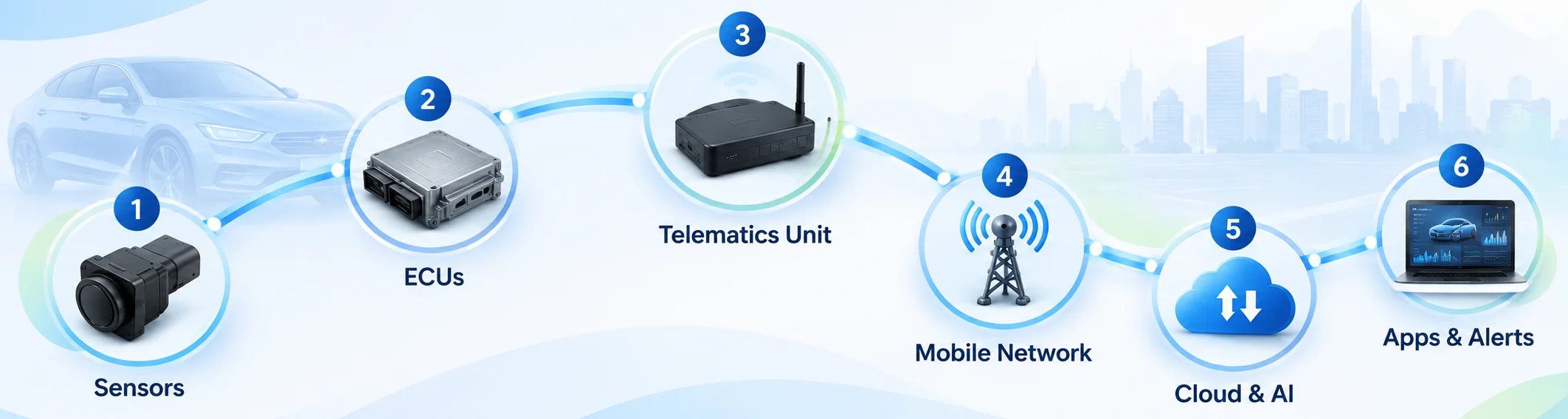
IoT for automotive works by connecting vehicles, sensors, software, and cloud platforms to exchange data in real time. These connected systems collect information, process it, and turn it into useful insights or automated actions. The process follows six key steps, from data collection to decision-making.

IoT in Automotive_ Connected Journey

Where Is IoT Used in the Automotive Industry?

IoT is transforming the automotive industry by connecting vehicles, manufacturing plants, dealerships, and supply chains. From smart manufacturing and connected cars to predictive maintenance and vehicle tracking, IoT helps businesses improve efficiency, reduce downtime, enhance road safety, and deliver better customer experiences.

Here are the key applications of IoT in the automotive industry:

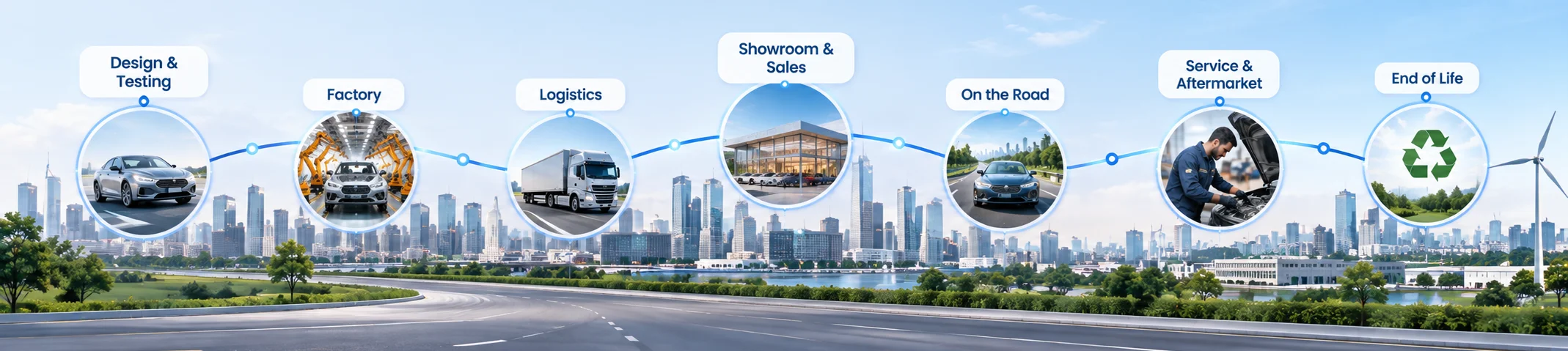
Automotive Lifecycle Journey Infographic

→ Vehicle Design and Testing: IoT sensors monitor engine performance, braking, and temperature during testing, helping engineers improve vehicle safety and reliability.

→ Automotive Manufacturing and Smart Factories: Connected machines and sensors monitor production, detect defects, and support predictive maintenance to reduce downtime.

→ Supply Chain and Vehicle Logistics: GPS trackers and RFID tags track spare parts, raw materials, and finished vehicles, improving inventory and delivery management.

→ Showrooms, Dealerships, and Sales: IoT systems track vehicle availability, location, and maintenance history, making dealership operations more efficient.

→ Connected Vehicles and On-Road Driving: GPS, sensors, and telematics enable vehicle tracking, smart navigation, health monitoring, and driver safety alerts.

→ After-Sales Service and Predictive Maintenance: IoT detects early vehicle faults, sends maintenance alerts, and supports remote diagnostics and OTA updates.

→ Vehicle Recycling and End-of-Life Management: IoT tracks vehicle components and battery health to support reuse, refurbishment, and recycling.

Enterprise AI Governance Discovery Call
Turn Every Drive Into a Smarter Experience.
Build the next generation of automotive IoT solutions with Azilen.

What Are the Top Use Cases of IoT for Automotive?

IoT enables several practical applications across connected vehicles, automotive manufacturing, and fleet operations. Explore the key use cases to understand how connected technology works in real-world automotive scenarios.

Pick a use case to see how it works.

IoT predictive maintenance in connected cars

Predictive maintenance in connected cars

Predictive maintenance is one of the top IoT use cases in automotive. Sensors on the engine, brakes, and battery send data all day. Software spots small changes early, so a part gets fixed before it breaks on the road.

Read the predictive maintenance guide

What Are the Benefits of IoT for Automotive?

IoT offers several benefits to drivers, fleet owners, and automotive manufacturers.

For Drivers

→ Early warnings about vehicle faults.

→ Remote vehicle locking, unlocking, and tracking.

→ Improved road safety and driving experience.

For Fleet Owners

→ Real-time tracking of vehicles.

→ Reduced fuel and maintenance costs.

→ Better maintenance planning and less downtime.

For Automotive Manufacturers

→ Real-world vehicle data for better designs.

→ Faster defect detection and quality control.

→ New features through over-the-air (OTA) updates.

What Are the Challenges of IoT for Automotive, and How Are They Solved?

IoT adoption in the automotive industry comes with challenges related to security, connectivity, software, and long-term maintenance. Addressing these issues helps businesses build reliable and scalable IoT solutions.

Cybersecurity

Connected vehicles are vulnerable to remote attacks that can expose vehicle systems and sensitive data.

Fix: Use device authentication, encryption, signed updates, and continuous IoT security solutions

Data
Privacy

Vehicle location, driving patterns, and personal information require careful data protection.

Fix: Limit data collection, obtain user consent, and implement secure IoT device management practices.

Patchy Connectivity

Tunnels, remote highways, and weak network coverage can interrupt vehicle connectivity.

Fix: Use edge computing to process critical data locally and synchronize it when connections return.

Software Complexity

Modern vehicles depend on multiple software systems that can be difficult to manage and maintain.

Fix: Use modular architecture, automated testing, and scalable IoT application development practices.

System Compatibility

Different vehicle brands, devices, and components may use incompatible communication protocols and data formats.

Fix: Adopt common data models, open APIs, and standardized IoT system integration methods.

Long Vehicle Lifecycles

Vehicles can remain operational for 10–15 years, making long-term software and hardware support challenging.

Fix: Design upgradeable hardware and plan regular software updates and long-term IoT maintenance.

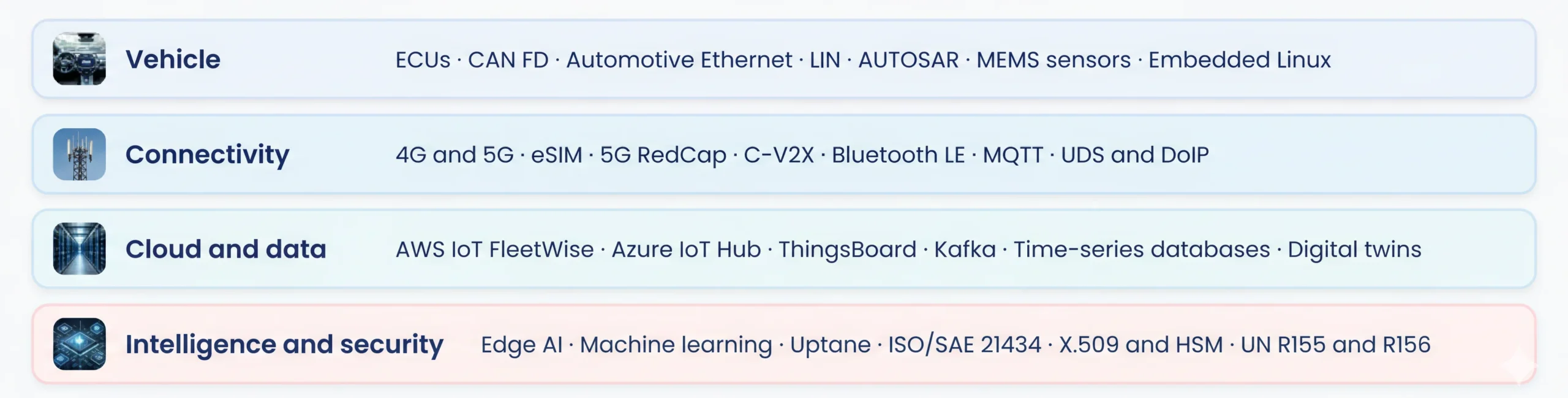
Which Technologies Power IoT for Automotive?

Automotive IoT relies on a combination of connected devices, communication networks, cloud platforms, and data analytics. Together, these technologies help vehicles collect, exchange, and process data in real time.

IoT automotive tech stack

How Can Azilen Help With IoT for Automotive?

500+ engineers across AI, IoT, and cloud
ISO 27001 and 27701 certified for security and privacy
4.9/5 client rating on GoodFirms
44+ countries reached by one IoT platform we built

Azilen helps automotive businesses build connected and intelligent solutions using IoT, AI, and product engineering. From vehicle diagnostics and telematics to cloud platforms and OTA updates, Azilen supports different automotive IoT needs.

How Do You Start an IoT for Automotive Project?

Start with a clear business goal, choose the right technology, and gradually expand your automotive IoT implementation.

→ Identify the Requirements: Define your goals, such as vehicle tracking, predictive maintenance, or fleet management.

→ Assess Existing Systems: Review available sensors, vehicle hardware, software, and connectivity infrastructure.

→ Choose the Right Technology: Select suitable IoT platforms, communication networks, cloud services, and security tools.

→ Develop a Pilot Project: Test your solution with a small number of vehicles and evaluate its performance.

→ Prioritize Security: Protect connected devices, vehicle data, and communication channels.

→ Scale Gradually: Expand successful implementations and introduce AI-powered features as your requirements grow.

What Is the Future of IoT for Automotive?

Automotive IoT will continue to evolve with smarter vehicles, faster connectivity, and AI-powered automation. Here are three key developments shaping its future:

→ Software-Defined Vehicles: OTA updates will allow vehicles to receive new features, performance improvements, and security fixes remotely.

→ Advanced Connectivity: 5G, eSIM, and satellite networks will improve communication between vehicles and connected systems.

→ AI-Powered Vehicles: AI will analyse vehicle data, predict maintenance needs, and support faster onboard decisions.

How Is AI Transforming IoT for Automotive?

Connected vehicles generate large amounts of data through sensors, cameras, GPS, and telematics systems. AI helps analyse this information, predict vehicle faults, improve driver safety, and support smarter decisions.

With IoT solutions for automotive, connected systems can use AI to improve vehicle monitoring, predictive maintenance, fleet management, and driving experiences.

What Affects the Cost of an IoT Automotive Solution?

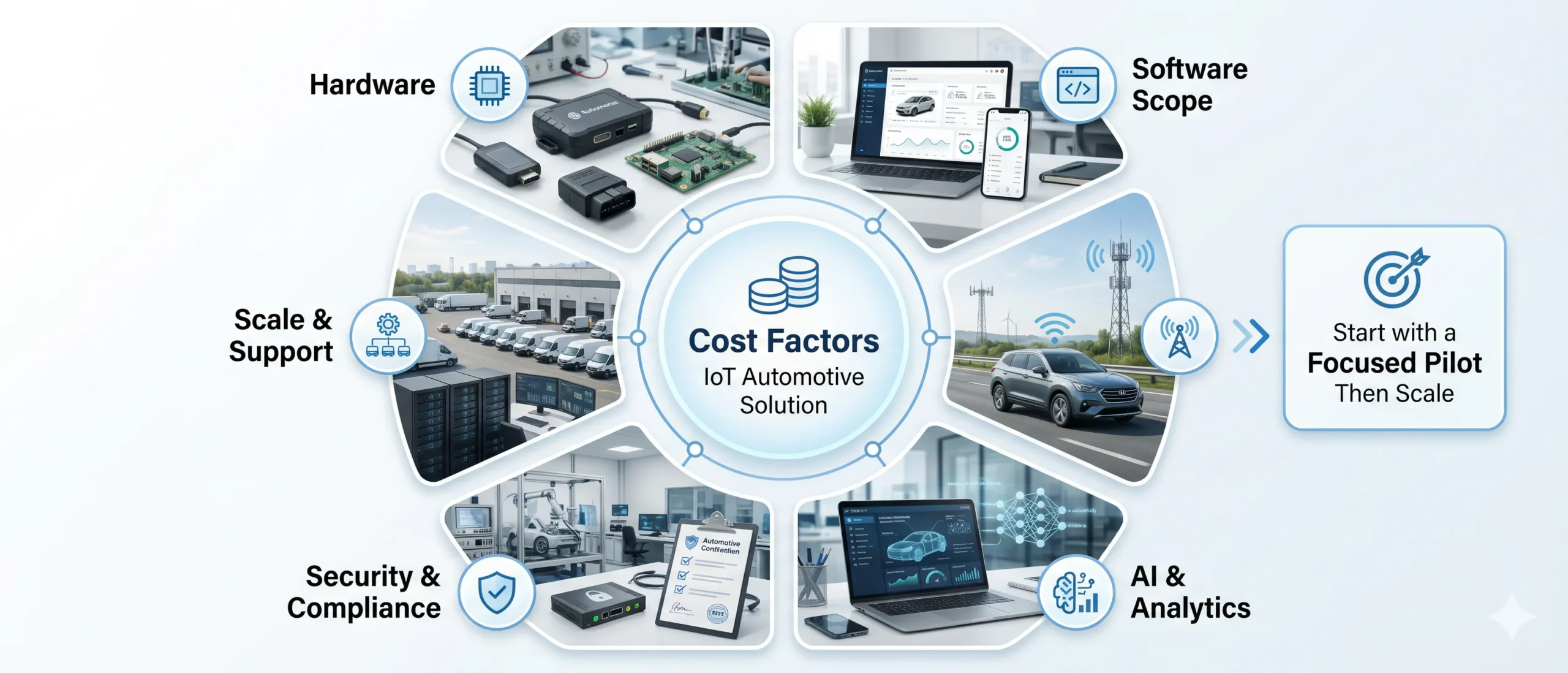
There is no fixed price for an IoT automotive solution. The overall investment depends on the project’s complexity, technology choices, and long-term requirements. Here are the key factors that influence the cost:

IoT Cost factor

→ Hardware: Sensors, GPS trackers, telematics devices, embedded systems, and custom-built components.

→ Software Scope: Mobile applications, vehicle monitoring dashboards, fleet management platforms, and cloud integrations.

→ Connectivity: 5G, cellular networks, Wi-Fi, Bluetooth, and communication protocols used to connect vehicles and devices.

→ AI and Analytics: Basic vehicle monitoring costs less than advanced predictive maintenance, driver behaviour analysis, and AI-powered insights.

→ Security and Compliance: Data encryption, device authentication, cybersecurity testing, and automotive industry standards.

→ Scale and Support: Number of connected vehicles, ongoing monitoring, system maintenance, and software updates.

How Does Azilen Help Businesses Build IoT Solutions for Automotive?

Building connected automotive solutions takes more than installing sensors and tracking devices. It requires reliable software, seamless connectivity, intelligent data processing, and scalable infrastructure.

As an enterprise AI development company, Azilen brings together its engineering, IoT, AI, and integration expertise to help businesses develop connected and scalable automotive solutions.

→ IoT Solution Development: Build connected applications and platforms that bring vehicles, sensors, and automotive systems together.

→ AI & Data Engineering: Turn vehicle and telematics data into actionable insights through intelligent analytics and predictive capabilities.

→ System Integration: Connect vehicle devices, cloud platforms, and enterprise applications for seamless data exchange.

→ Scalable Architecture: Design secure, reliable systems that support growing connected vehicle and fleet requirements.

Azilen helps businesses turn automotive IoT ideas into practical solutions that improve vehicle performance, streamline operations, and enable smarter mobility.

Build Connected Automative with Azilen.
CTA

FAQs: IoT for Automotive

1. How much does an IoT for automotive project cost?

There is no single price, because it depends on the scope. A small pilot with a few vehicles costs far less than a full fleet or factory rollout. The main cost drivers are hardware, software, mobile data fees per vehicle, cloud use, security, and compliance. The best way to control cost is to start with one clear pilot and expand what works.

2. Can you add IoT to an older car?

Yes, in many cases. Most cars built in the last 25 to 30 years have a diagnostic (OBD-II) port. A small plug-in device can read data such as speed, fuel use, and fault codes, and send it with GPS to the cloud. It gives less data than a factory-connected car, and it cannot send over-the-air updates or control car functions.

3. Who owns the data from a connected car?

It depends on the country’s law and the contract. The carmaker usually collects and stores the data, but drivers often have rights to see it and control how it is used. In Europe, GDPR protects personal data, and newer rules such as the EU Data Act give users more access to data from connected products. Always check local law.

4. What is the difference between a connected car and a self-driving car?

A connected car shares data over the internet, for example for alerts, updates, and tracking. A self-driving car uses sensors and AI to drive itself, with little or no help from the driver. A car can be one, both, or neither. Most self-driving cars are also connected, but being connected does not make a car self-driving.

5. Which IoT platform is best for connected vehicles?

There is no single best platform. AWS IoT FleetWise is built to collect and send vehicle signal data to the cloud at scale. ThingsBoard is an open-source platform that is strong for dashboards, device management, and custom rules. Choose based on fleet size, data volume, your preferred cloud, budget, and how much control you want over the system.

6. Do connected cars need a SIM card or data plan?

Most factory-connected cars have a built-in eSIM and a telematics unit, so you do not insert a SIM yourself. Some carmakers include connectivity free for a trial period and then charge a subscription, so it varies by brand. Fleets often use their own data plans, and plug-in retrofit devices need their own SIM.

google
Chintan Shah
Chintan Shah
Vice President - Delivery at Azilen Technologies

Chintan Shah is an experienced software professional specializing in large-scale digital transformation and enterprise solutions. As VP - Delivery at Azilen Technologies, he drives strategic project execution, process optimization, and technology-driven innovations. With expertise across multiple domains, he ensures seamless software delivery and operational excellence.

Related Insights