



 14 mins
Oct 15, 2026



 Quick Summary

Think about the last time you got stuck in traffic.
Or watched a delivery arrive hours late.
Frustrating, right? Now imagine a system that could see these problems coming before they happen. That’s what AI is beginning to do in transportation.
In this blog, let’s explore five real-world transportation challenges AI is solving, one smarter journey at a time.
AI in transportation means using smart computer systems to make travel and transport easier, safer, and faster. These systems use information from cameras, sensors, and vehicles to understand what is happening and make better decisions.
But AI in transportation is not just about self-driving cars. It also helps manage traffic, improve bus and train services, track trucks, plan delivery routes, and reduce vehicle breakdowns. In simple words, it helps the entire transportation system work smarter.
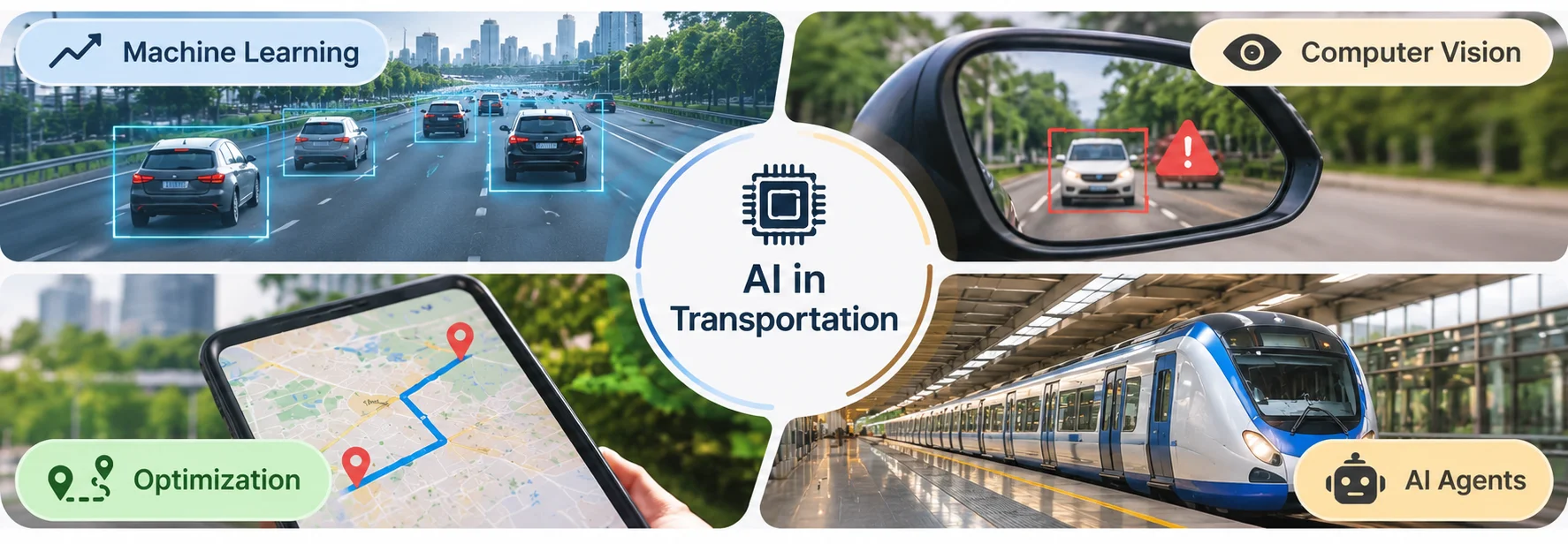
AI in transportation follows a simple process. It collects information, learns from it, makes decisions, and takes action. Then, it repeats the process with new information to keep improving.
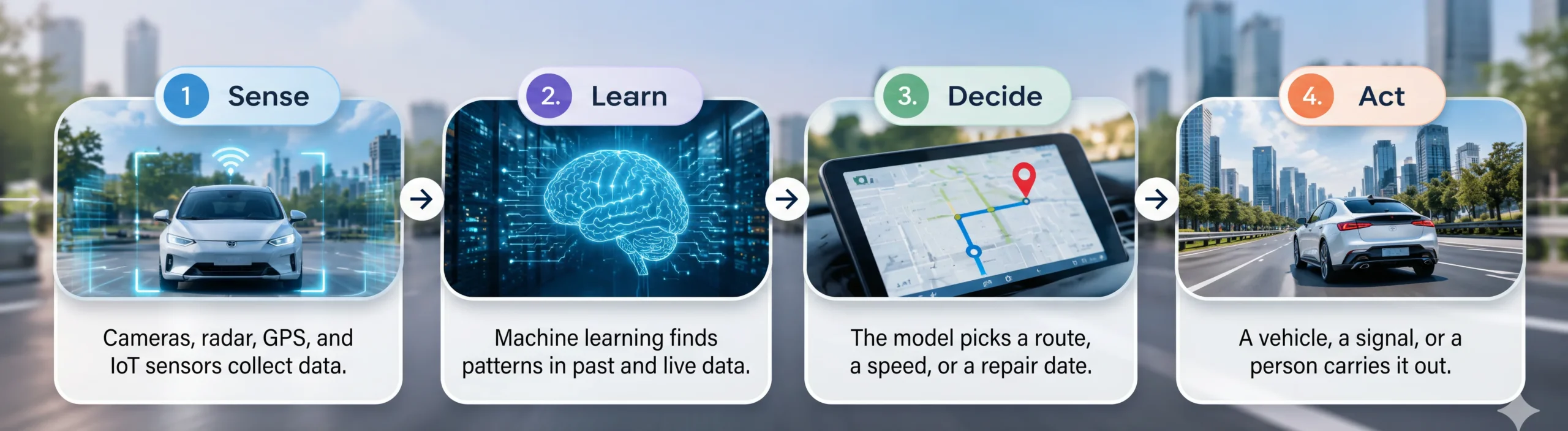
Together, these four steps show how AI in transportation works, from collecting information to making smart decisions and taking action. Connected sensors provide the data, while AI helps turn that data into useful results. This is where IoT monitoring systems and IoT data analytics play an important role in making transportation smarter and more efficient.
AI is already solving many transportation problems in the real world. From reducing traffic to improving road safety and managing deliveries, companies are using it in different ways. Let’s look at five real-world examples, what problems they solved, and the results they achieved.
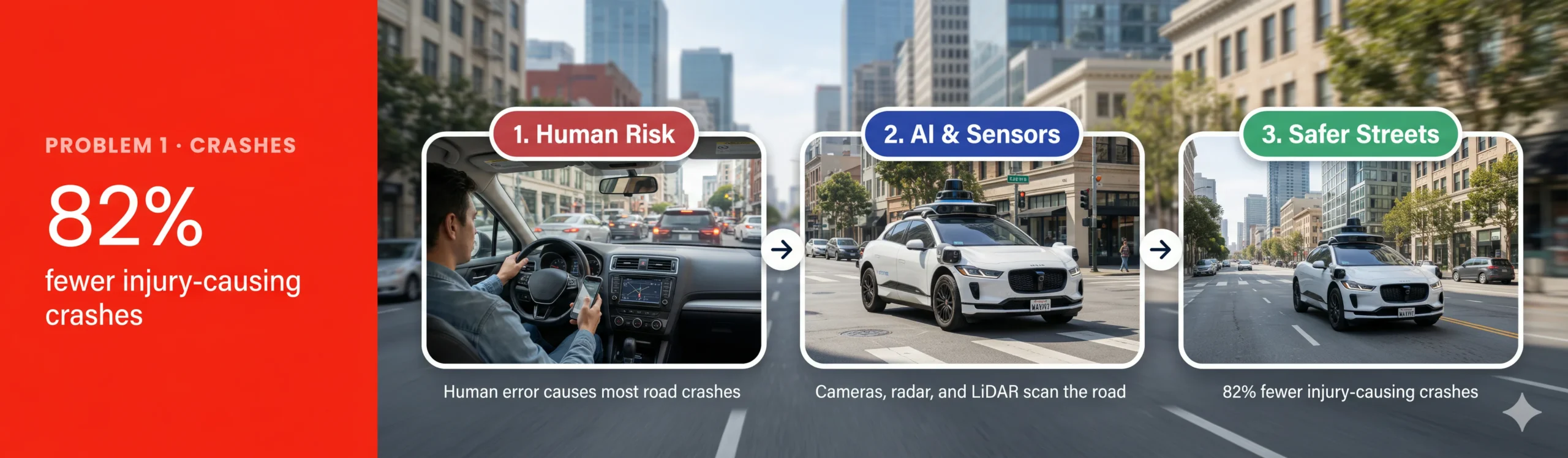
The problem: Human error and distraction are behind many road crashes.
What AI did: Waymo’s driverless cars use cameras, radar, and lidar to read the road all around the car. By June 2026 they had driven 271.3 million miles with no human driver in Phoenix, San Francisco, Los Angeles, Austin, and Atlanta.
The result: Waymo reports 82% fewer injury-causing crashes and 95% fewer crashes with serious injury or worse, compared with human drivers in the same cities. An independent IIHS review (July 2026) found a smaller gap, but still large: 68% fewer crashes overall and 81% fewer injury crashes per mile.
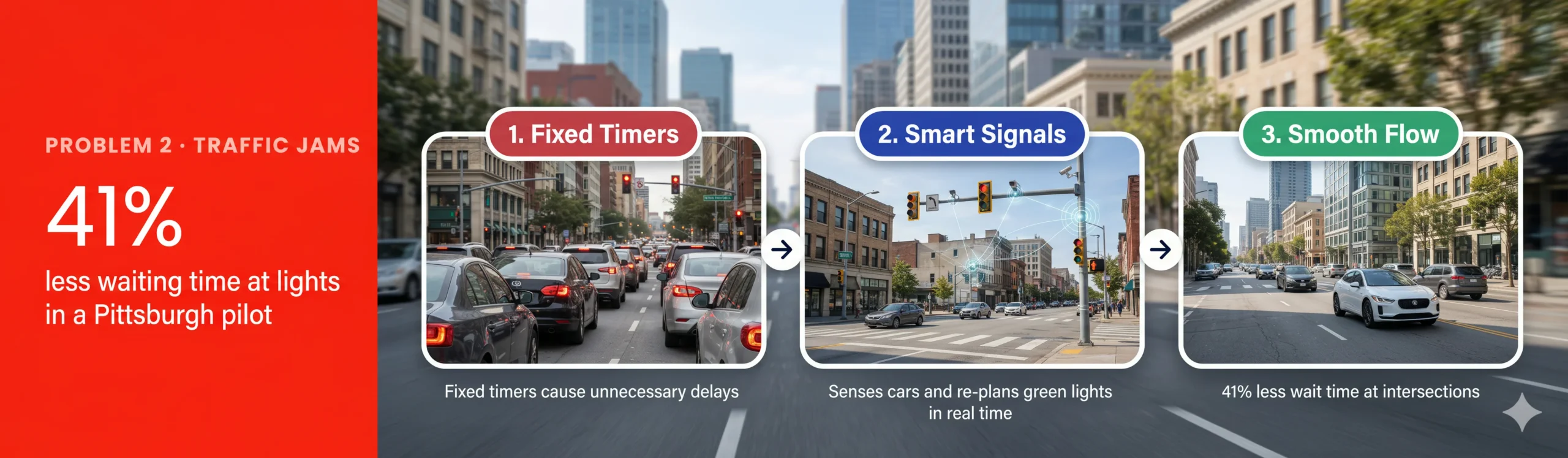
The problem: Most traffic lights follow fixed timers that never change, even when traffic does.
What AI did: Researchers at Carnegie Mellon University built Surtrac. Each light senses cars coming toward it and re-plans its green time in real time, while talking to neighbor lights. The pilot ran on nine intersections in East Liberty, Pittsburgh.
The result: The US Department of Transportation’s pilot report found travel time down 26%, stops down 31%, and wait time down 41% overall. CMU reports about 21% lower emissions. The system later grew to about 50 intersections.
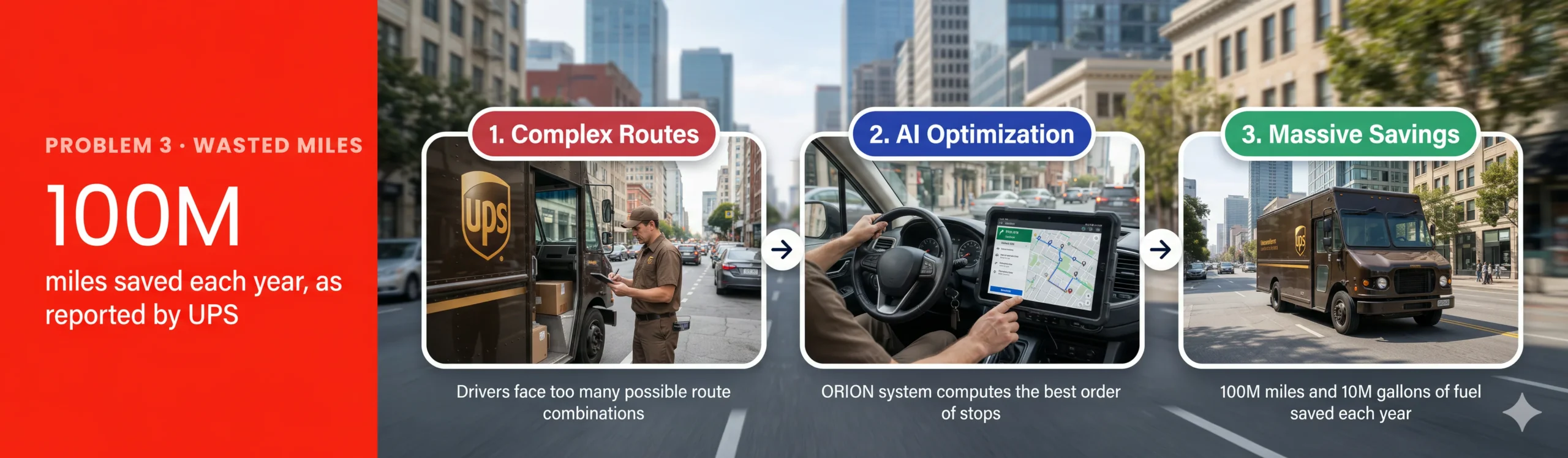
The problem: A driver with many stops can choose from more route orders than anyone could ever check.
What AI did: UPS built ORION, a route system that uses algorithms, AI, and machine learning to pick the best order of stops for each driver each day.
The result: UPS says ORION has saved about 100 million miles and 10 million gallons of fuel per year. UPS later added live route updates on top.
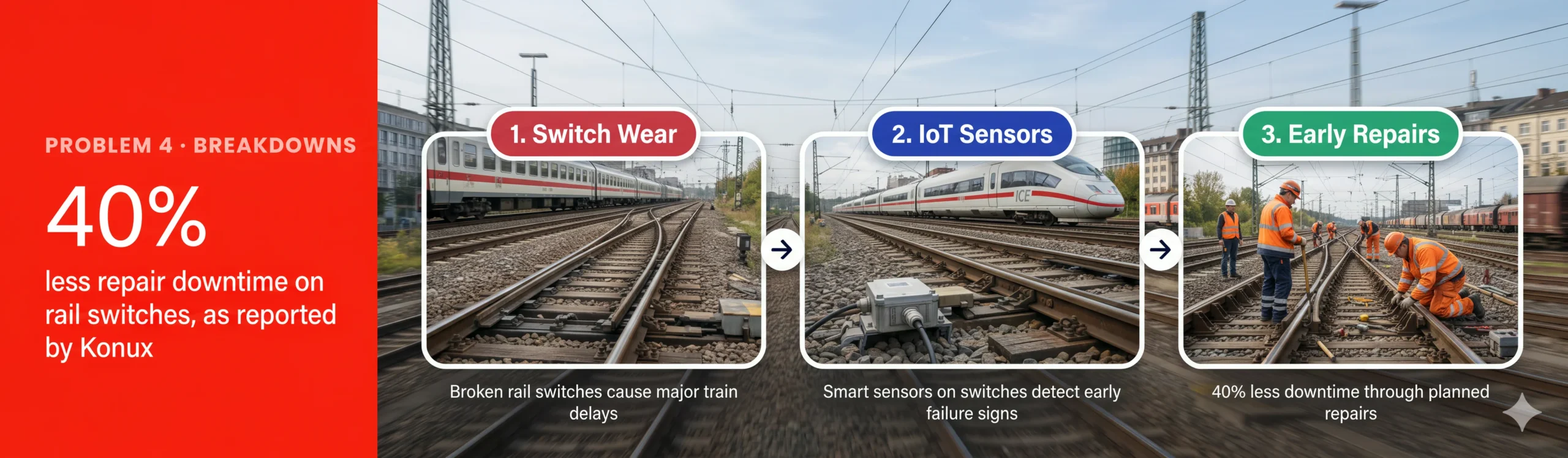
The problem: A broken rail switch (also called a turnout) can delay many trains at once.
What AI did: Konux puts smart sensors on switches and uses AI to spot early warning signs. Deutsche Bahn uses it on more than 1,620 turnouts, so crews can repair a switch before it fails.
The result: After seven years of data, Konux reports a 40% cut in downtime for repairs, thanks to earlier action.
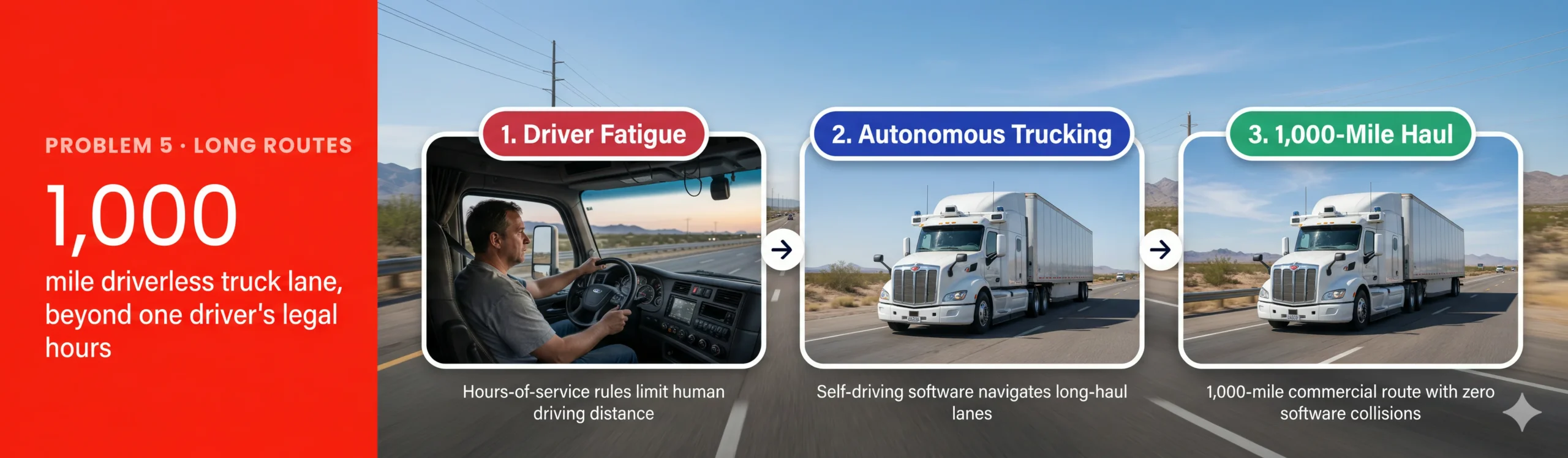
The problem: A human driver can only drive so many hours a day, which limits how far one truck can go without a stop.
What AI did: Aurora began commercial driverless trucking in Texas in April 2025. In February 2026 it validated a 1,000-mile lane between Fort Worth and Phoenix, longer than current federal hours-of-service rules allow for one driver. Some trucks still carry an observer in the cab.
The result: Aurora reported 250,000 driverless miles by January 2026 with no collisions blamed on its driver software. Later reports put it near 440,000 miles by the end of June 2026, with a goal of more than 200 trucks by year-end.
Waymo shares its safety data to show how its self-driving cars compare with human drivers on the road. The comparison looks at crashes involving serious injuries or worse for every million miles travelled.
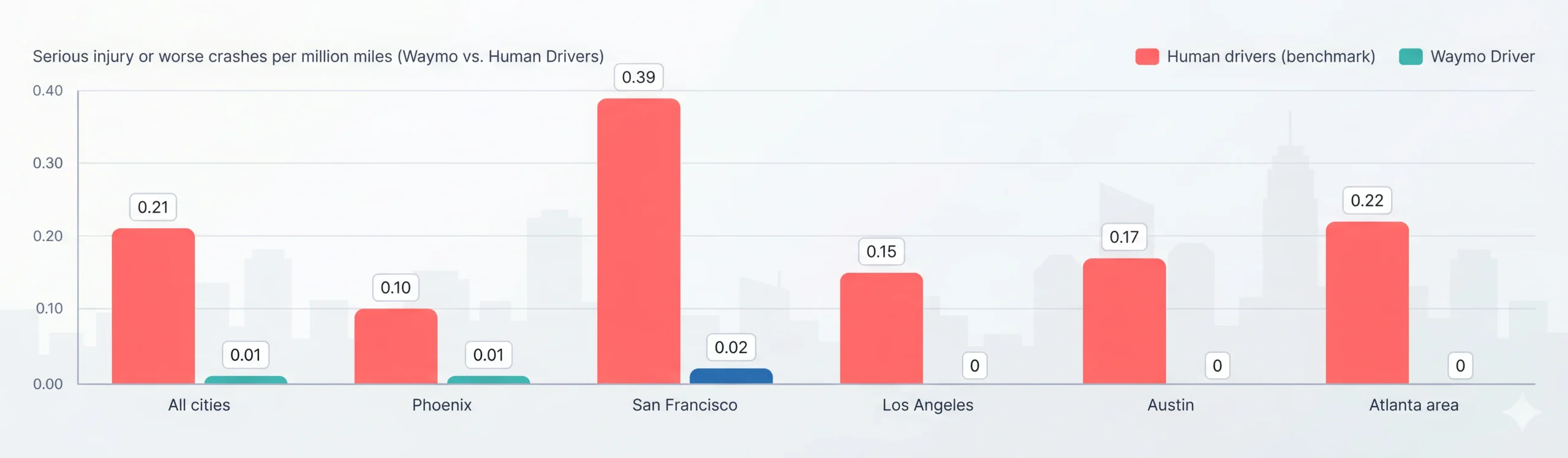
Source: Waymo Safety Impact Hub
Getting started with AI in transportation doesn’t have to be complicated. Start small, solve one problem, and improve as you go.
→ Pick One Clear Problem: Start by identifying one problem you want to solve, such as late deliveries, vehicle breakdowns, or high fuel costs. Choose something you can measure.
→ Get Your Data Ready: AI needs good data to work. Use sensors, connected devices, and industrial IoT solutions to collect useful information. Make sure your existing data is clean and organized.
→ Start With a Small Test: Test AI on one vehicle, one route, or one location first. Keep a person involved to check decisions and handle unexpected situations.
→ Measure Results and Grow: Check whether AI has helped reduce costs, save time, or prevent breakdowns. If the results are good, slowly expand the solution to other vehicles and locations.

The cost depends on the project, technology, data requirements, and system complexity. A basic route optimization system may cost less than a large-scale autonomous vehicle or smart traffic management solution.
A small AI pilot may take a few weeks to a few months. Larger projects involving connected vehicles, multiple systems, and real-time data may take longer to develop and deploy.
These systems may need vehicle location, traffic conditions, road information, fuel usage, driver behaviour, and sensor data. The type of data depends on the problem being solved.
Common challenges include high development costs, poor data quality, cybersecurity risks, system integration, and the need for regular monitoring and maintenance.
Yes. Small businesses can start with affordable AI tools for route planning, vehicle tracking, fuel monitoring, and delivery management. They can expand their use of AI as their business grows.
Businesses should first identify their main problem, check available data, and set clear goals. They should then choose a solution that fits their budget, existing systems, and future needs.

 14 mins
 19 mins
 12 mins
"*" indicates required fields

5432 Geary Blvd, Unit #527 San Francisco, CA 94121 United States
320 Decker Drive Irving, TX 75062 United States

6d-7398 Yonge St,1318 Thornhill, Ontario, Canada, L4J8J2

71-75 Shelton Street, Covent Garden, London, United Kingdom, WC2H 9JQ

Hohrainstrasse 16, 79787 Lauchringen, Germany

12, Zugerstrasse 32, 6341 Baar, Switzerland

5th floor, Bloukrans Building, Lynnwood Road, Pretoria, Gauteng, 0081, South Africa

12th & 13th Floor, B Square-1, Bopal – Ambli Road, Ahmedabad – 380054
B/305A, 3rd Floor, Kanakia Wallstreet, Andheri (East), Mumbai, India






 Talk to Our
Consultants
 Chat with
Our Experts
 Write us
an Email