



Skip to content

What CTOs Should Measure in Software Engineering Powered by Agentic SDLC

Featured Image

Executive Summary

Agentic SDLC requires more than measuring how much code AI agents produce. CTOs need to understand how AI affects overall software delivery, from workflow efficiency and code quality to engineering costs and team productivity. DORA metrics provide a strong foundation, but additional measurements help reveal the complete impact of AI adoption.

→ Measure delivery performance: Use all five DORA metrics to track delivery speed, stability, recovery, and rework.

→ Track AI impact: Measure agent contributions, workflow bottlenecks, review time, and engineering productivity.

→ Monitor quality and costs: Evaluate AI-generated code quality, rework, resource usage, and overall engineering costs.

→ Improve continuously: Start with a focused pilot, establish performance baselines, and use data to improve Agentic SDLC adoption.

AI coding agents can now write, test and ship code with very little help.

That is great news, until your dashboard shows more pull requests, more commits and more lines of code, and your customers still wait just as long for new features.

To lead an agentic SDLC well, you need the right agentic SDLC metrics. This guide shows the engineering metrics for CTOs that matter, starting with DORA metrics, and the ones that fill the gaps.

“Improving daily work is even more important than doing daily work.”

— Gene Kim, The Phoenix Project

90%

Engineering teams use AI, but delivery performance still needs improvement.

91%

AI-heavy teams experienced longer pull request review times.

19%

Experienced developers took longer to complete tasks using AI.

Why Do Old Engineering Metrics Fail in an Agentic SDLC?

Because they count activity, and AI agents create activity for free. Commits, lines of code and pull request counts rise even when real delivery does not. In an agentic SDLC you must measure outcomes instead: what reaches production, how safely and at what cost.

Faros AI analysed data from 10,000+ developers across 1,255 teams. Teams with high AI adoption completed 21% more tasks and merged 98% more pull requests. However, review time increased by 91%, showing that higher developer output does not always mean better business productivity. (Faros AI Research)

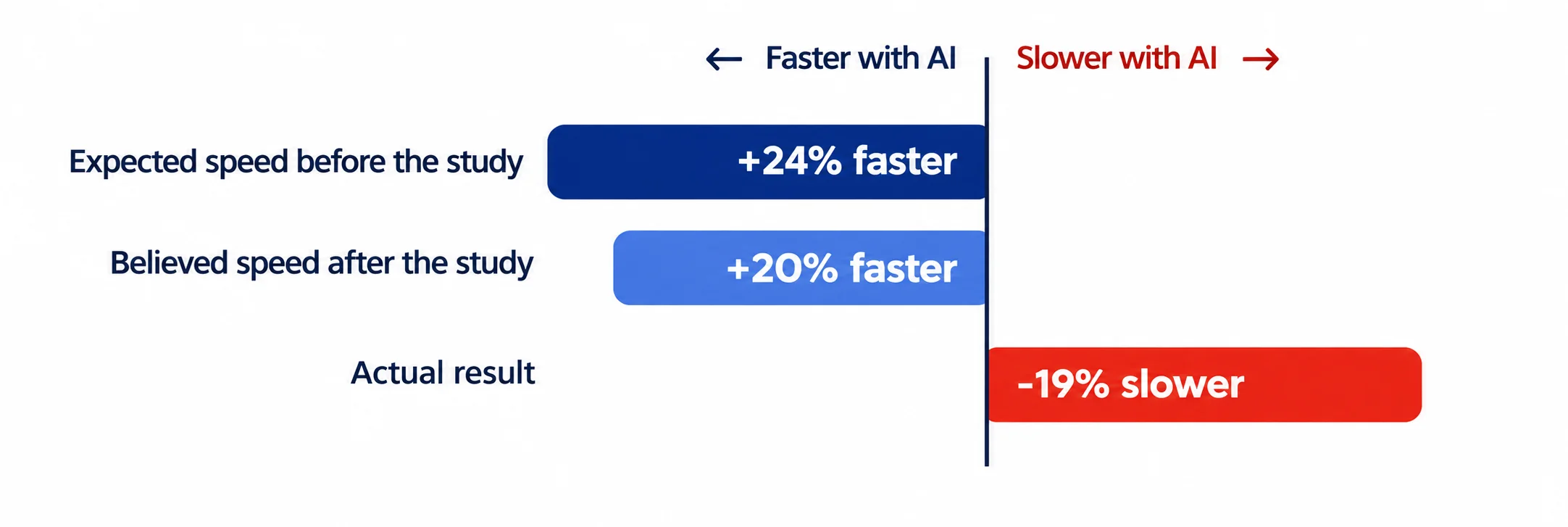
A study by METR found another challenge: AI does not always make developers faster. In a trial involving 16 experienced developers and 246 tasks, participants expected AI to speed up their work by 24%. Instead, tasks took 19% longer with AI. (METR Study)

AI Speed Comparison Infographic

DORA’s 2024 research found that a 25% increase in AI adoption was associated with a 1.5% drop in delivery throughput and a 7.2% decline in delivery stability. Its 2025 report showed that AI can improve throughput but also amplifies existing engineering practices. DORA 2024 | DORA 2025

For CTOs, the takeaway is clear: measuring Agentic SDLC performance requires looking beyond developer output to overall delivery speed, quality, and stability.

What Agentic SDLC Metrics Should a CTO Measure in Software Engineering?

Track agentic SDLC metrics in five layers: delivery (DORA metrics), flow, AI impact, quality and risk, and cost and people.

These are the engineering metrics for CTOs that matter most.

Together they answer one question: is AI making our delivery faster, safer and cheaper, or only making coding faster?

Measurement Area What It Evaluates Key Metrics
Delivery Measures how efficiently the entire software delivery system performs. Change lead time
Deployment frequency
Failed deployment recovery time
Change failure rate
Deployment rework rate
Flow Identifies where work gets delayed during the development process. Review wait time
Pull request size
AI Impact Measures how much AI agent-generated work successfully reaches production. Agent-assisted share of merged changes
Agent pull request merge rate
Quality and Risk Evaluates software quality and compares the risks associated with AI-generated and human-written code. Change failure rate by code origin
Rework on agent code vs. human code
Cost and People Measures the cost of delivering software and the impact of AI adoption on developer experience. Cost per shipped change
Developer trust and workload

Think of these five layers as an engineering dashboard. Delivery measures speed, flow identifies bottlenecks, AI impact tracks productivity gains, quality and risk highlight issues, and cost and people reveal resource efficiency and team health.

This approach aligns with the three measurement layers highlighted by most of the engineering analytics platforms: usage, impact, and quality. Adding flow and cost gives CTOs a broader view of Agentic SDLC performance and its impact on engineering outcomes.

What Are DORA Metrics, and Why Do They Still Matter for CTOs?

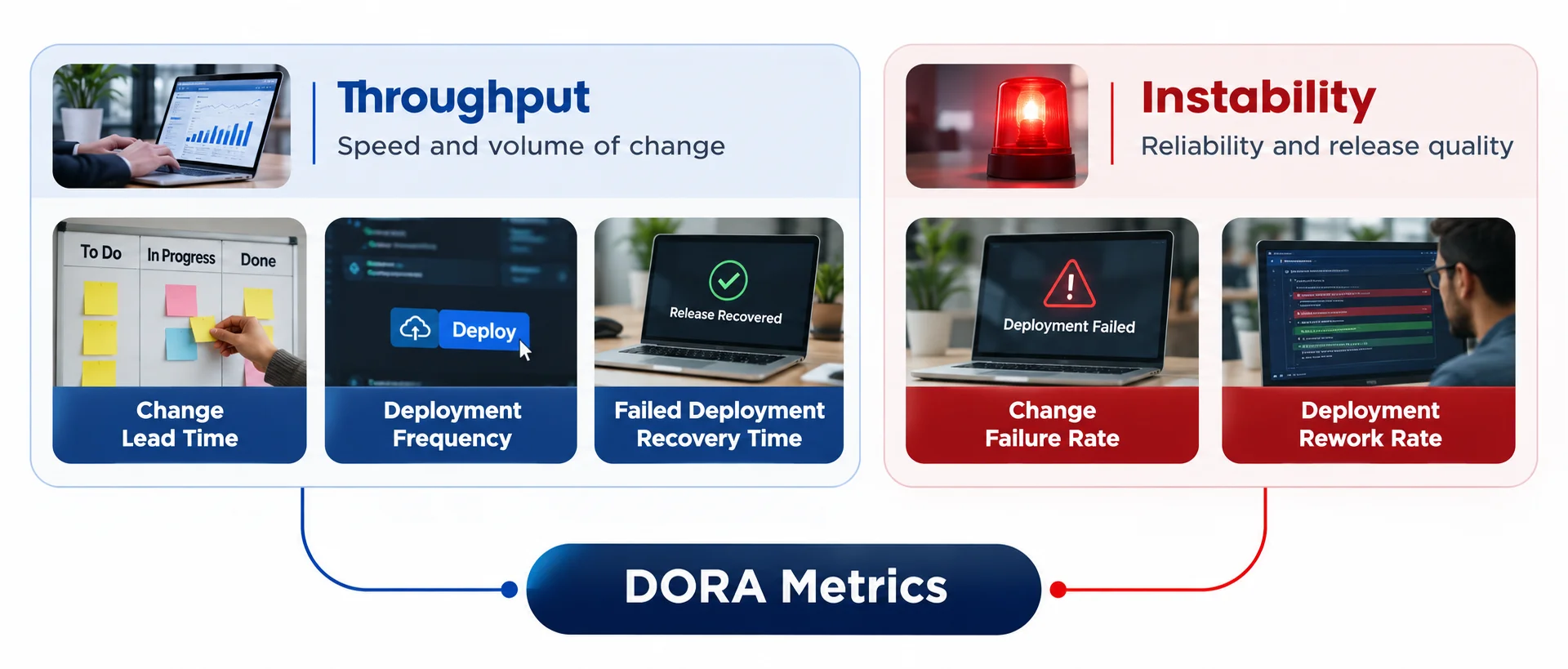
DORA metrics are five research-backed measures of software delivery performance: change lead time, deployment frequency, failed deployment recovery time, change fail rate and deployment rework rate. Three measure throughput (speed) and two measure instability (how often things go wrong).

DORA (DevOps Research and Assessment) is a Google Cloud research program that helps engineering teams measure software delivery performance. It originally introduced four key metrics, which expanded to five in 2024 with the addition of Deployment Rework Rate and the updated Failed Deployment Recovery Time metrics.

DORA Metrics_ Throughput and Instability

DORA metrics help CTOs understand whether AI is actually improving software delivery. They matter for three key reasons:

→ Measure speed and stability together: High-performing teams focus on both faster delivery and reliable releases.

→ Understand overall performance: DORA metrics help evaluate delivery practices, team performance, and engineering outcomes.

→ Apply across technologies: These metrics work across different applications, services, and technology stacks, including AI-driven development.

One important rule: Measure each application or service separately. Combining data from different teams or systems can give misleading results.

Enterprise AI Governance Discovery Call
Ready to Measure the True Impact of Agentic SDLC?
Azilen helps engineering teams adopt Agentic SDLC with AI-driven workflows to improve delivery speed, code quality, and engineering efficiency.

How Do DORA Metrics Change in an Agentic SDLC?

Agents change how every DORA metric behaves. Coding time shrinks, but review and test queues grow. So lead time can stay flat, and change fail rate and rework rate can quietly rise. Read the five metrics together and compare agent-assisted work with human-only work.

DORA Metric What Agents Change What to Watch A Healthy Sign
Change Lead Time AI agents speed up coding and test writing. Review and CI waiting times can become the biggest parts of the delivery process. Lead time remains flat or increases even as coding time decreases. Lead time decreases as review waiting time also improves.
Deployment Frequency AI agents make smaller code changes faster and cheaper, potentially increasing release frequency. Deployment frequency increases, but changes become larger or releases are bundled to manage review workloads. Deployments become more frequent while change sizes remain stable or decrease.
Failed Deployment Recovery Time AI agents can help investigate incidents and suggest fixes, provided that monitoring and rollback mechanisms are in place. Recovery takes longer as code volume grows and fewer team members understand the changes. Rollback is fast, and time to detect and recover from failures decreases.
Change Failure Rate More AI-generated code can reach production when testing is weak. DORA's 2024 research linked AI adoption with lower delivery stability [3]. The failure rate increases for agent-assisted changes compared with human-written changes. The failure rate stays at or below the human-only baseline.
Deployment Rework Rate AI agents may generate code that passes initial tests but requires unplanned fixes after deployment. The number of unplanned deployments increases following production incidents. The rework rate remains stable or decreases as deployment volume grows.

Is DORA Enough to Measure an Agentic SDLC?

Not on its own. DORA metrics provide a strong foundation for measuring software delivery performance, but Agentic SDLC requires a broader view. CTOs also need to understand how AI agents contribute, where workflows slow down, whether code quality improves, and how AI impacts engineering costs.

This is where Azilen takes a broader approach. Along with DORA metrics, we focus on additional measures to evaluate AI impact, workflow efficiency, code quality, and engineering costs. This helps businesses understand not just how fast they deliver software, but whether AI is making the entire development process more efficient and reliable.

DORA provides the performance baseline, while these additional metrics help identify bottlenecks, measure AI contributions, and guide continuous improvement across the SDLC.

Which Flow Metrics Show Where Agent-Written Code Gets Stuck?

Track pull request wait time, review time, and pull request size. In an Agentic SDLC, bottlenecks often shift from coding to code reviews, testing, and approvals.

When AI generates more code, teams need more time to verify it, slowing down overall delivery.

Before and With AI Agent Workflows

How Do You Measure the Cost and ROI of AI Coding Agents?

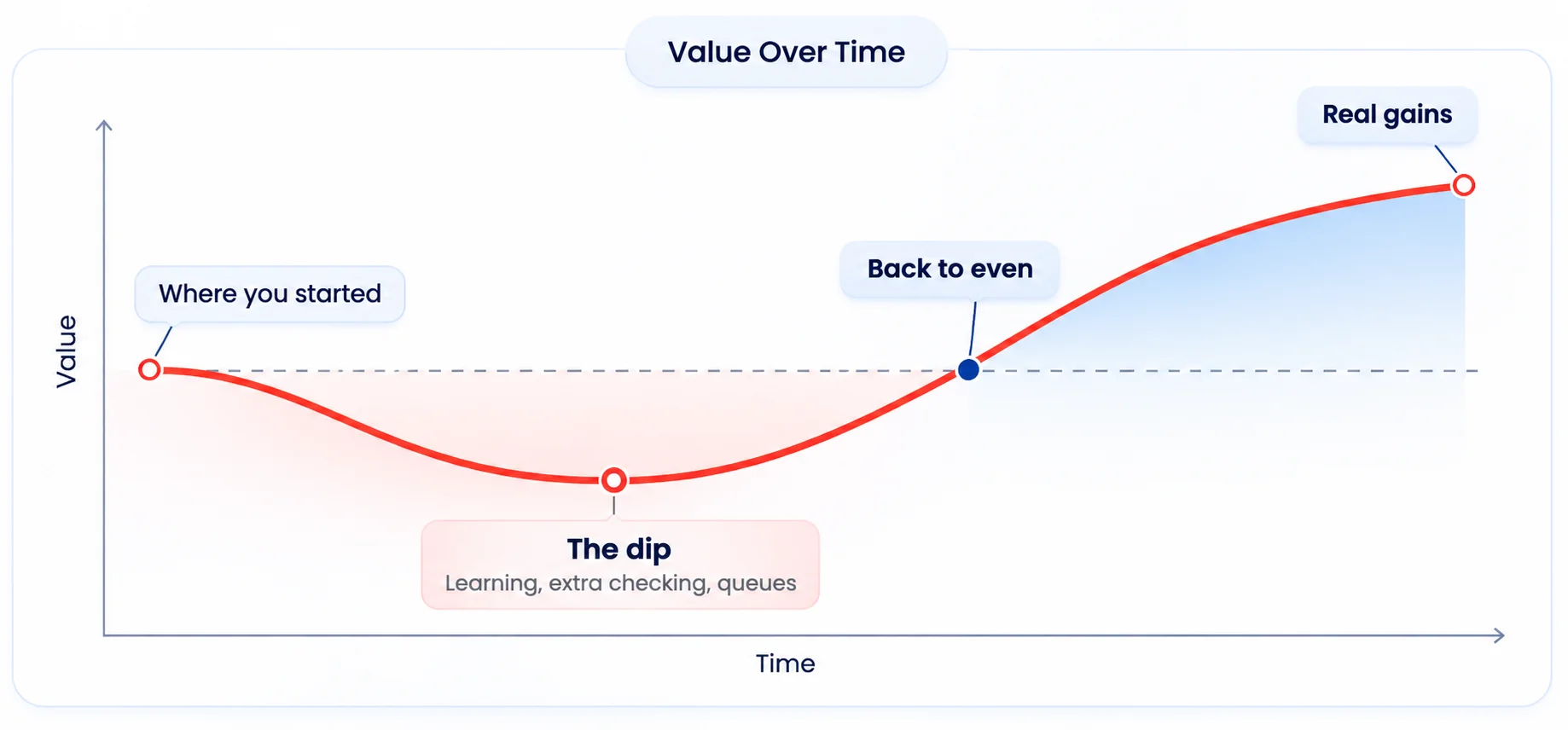
Count the full cost: licenses, model and compute spend, review time and rework. Divide it by what actually reached production. And plan for a J-curve, because early results often dip before they improve.

Cost per shipped change = (AI tool spend + compute and model spend + review time + rework time) ÷ changes running in production.

Track it by quarter. It should fall as your team gets better, not just stay flat. This is our suggested formula. Adapt it to your own finance rules.

The DORA 2026 research highlights three reasons for the early dip:

→ The Learning Curve: Teams need time to learn new AI-driven workflows, temporarily reducing feature development.

→ The Verification Tax: More AI-generated code means more time spent reviewing and validating changes.

→ Pipeline Adaptation: Testing and approval processes need to scale to handle increased development output.

Value Over Time_ From Dip to Gains

What Do Companies Like Airbnb, Amazon and Stripe Measure?

They measure results tied to the task. Airbnb tracked how many files passed each check. Amazon counted developer-years saved and hosts removed. Stripe tracks merged agent pull requests per week and limits CI loops. None stopped at “suggestions accepted”.

Company Reported Results How It Works
Airbnb 75% in 4 hours
Approximately 3,500 test files were migrated, with 97% completed after four additional days of tuning.
Each test file was tracked through migration stages, including testing, linting, and type checks. This helped identify exactly where files were getting stuck.
Amazon 4,500 developer-years
Amazon estimated the time saved through Java dependency migrations and reported $260 million in annualized efficiency gains.
Amazon measured time savings based on migrated Java dependencies and cost savings from removing hosts after upgrades.
Stripe 1,300+ pull requests per week
Stripe reports that its coding agents produce more than 1,300 merged pull requests every week, with every pull request reviewed by a human.
Each agent is limited to one or two full CI rounds, helping control execution costs and prevent unnecessary retry loops.

How Do You Start Measuring Agentic SDLC Metrics in 30 Days?

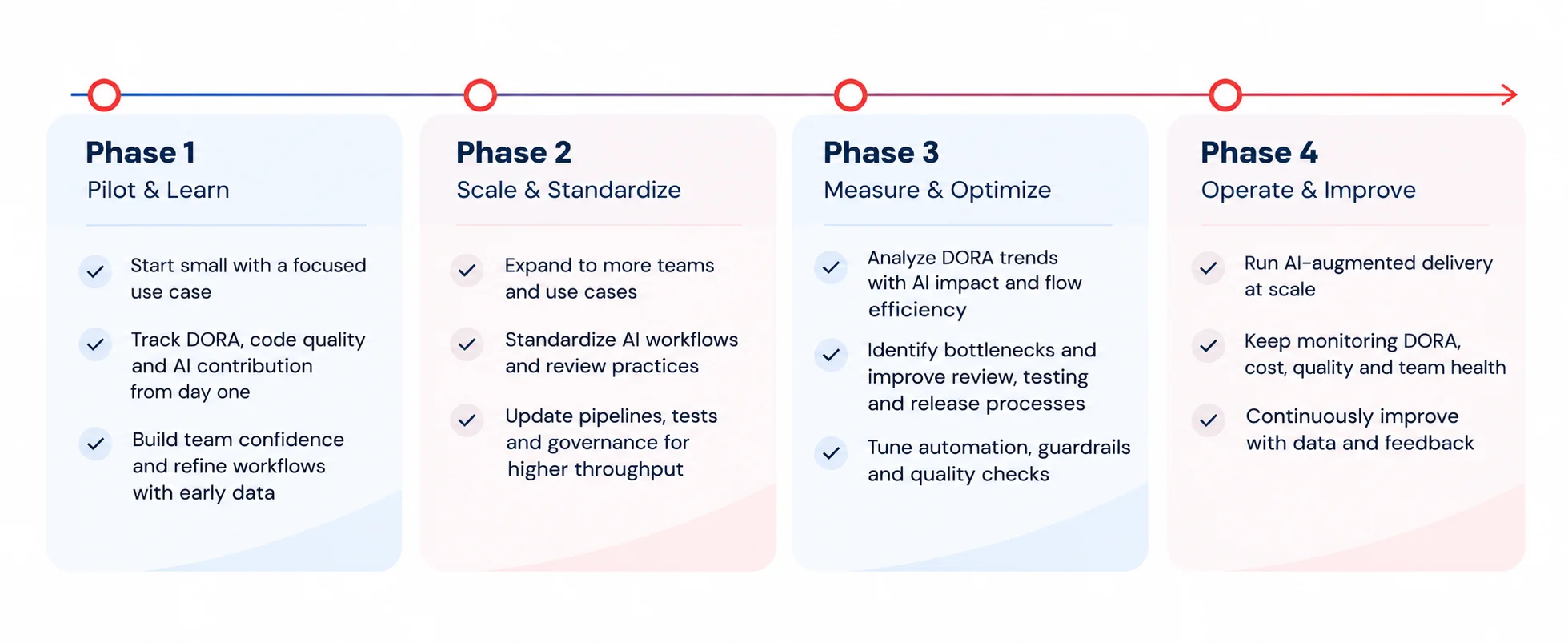
Pick one service. Set a DORA baseline in week 1, tag agent work in week 2, build a one-page view in week 3, and hold your first monthly review in week 4. Keep it simple and fix the biggest bottleneck first.

Four-Phase AI Delivery Roadmap

What Mistakes Should CTOs Avoid When Tracking Agentic SDLC Metrics?

Avoid seven mistakes: counting activity, trusting one metric, comparing very different teams, turning metrics into targets, ignoring review capacity, tracking individuals, and judging results too early.

1. Counting activity instead of outcomes

Commits, lines and pull requests rise with agents even when delivery does not.

Instead: track what reaches production and how it holds up.

2. Trusting one metric

DORA lists “one metric to rule them all” as a pitfall.

Instead: use several metrics that balance each other, such as speed against failure rate.

3. Comparing very different services or teams

A mobile app and a mainframe system are not comparable.

Instead: compare each service with its own past.

4. Turning metrics into targets

DORA warns that broad targets such as “deploy daily everywhere” invite gaming.

Instead: use healthy ranges and trends.

5. Tracking individuals

It creates fear and gaming.

Instead: report at team level only.

6. Judging too early

The DORA ROI research expects a J-curve, and quality problems show up weeks later.

Instead: review trends over 60 to 90 days.

How Does Azilen Help Businesses Adopt Agentic SDLC?

Adopting Agentic SDLC takes more than adding AI coding tools. It requires the right engineering practices, automation, and governance to improve software delivery across the entire lifecycle.

As an enterprise AI development company, Azilen helps businesses build AI-ready engineering environments that improve productivity, accelerate releases, and maintain software quality.

→ Agentic SDLC Enablement: Integrate AI agents across planning, coding, testing, reviews, and deployment.

→ AI-Native Engineering: Build modular architectures, automated workflows, and reliable testing pipelines.

→ AI Agent Governance: Use APEX Interlock to assess risks, manage permissions, and control agent actions.

→ DORA-Driven Insights: Track delivery speed, deployment stability, recovery, and rework to measure engineering improvements.

With its AI and software engineering expertise, Azilen helps businesses move beyond AI-assisted coding towards measurable, reliable, and scalable software delivery.

Make Your Engineering Architecture Ready for Agentic SDLC.
CTA

FAQs: Agentic SDLC & DORA Metrics

1. What metrics should CTOs track in an Agentic SDLC?

CTOs should track DORA metrics, workflow efficiency, AI agent contributions, code quality, engineering costs, and team productivity. Together, these metrics show how AI affects overall software delivery.

2. How much does it cost to implement Agentic SDLC?

The cost depends on the number of AI agents, tools, integrations, infrastructure, and governance requirements. A small pilot may require a limited investment, while enterprise-wide adoption can involve higher costs for platform integration, security, monitoring, and ongoing AI usage.

3. What is the difference between AI-assisted development and Agentic SDLC?

AI-assisted development mainly helps developers with tasks such as writing code, debugging, and generating tests. Agentic SDLC extends AI involvement across multiple stages, including planning, coding, testing, code reviews, and deployment, with human oversight.

4. Can Agentic SDLC improve software development productivity?

Yes, Agentic SDLC can reduce repetitive tasks, automate workflows, and help teams complete development activities faster. However, the actual productivity improvement depends on code quality, review time, testing capacity, and how well AI agents fit into existing workflows.

5. What are the risks of adopting Agentic SDLC?

Common risks include insecure code, incorrect AI-generated outputs, excessive agent permissions, compliance issues, and increased review effort. Businesses should establish testing, access controls, monitoring, and human approval processes before scaling adoption.

6. How long does it take to implement Agentic SDLC?

Implementation time depends on the existing development environment, AI readiness, integration requirements, and project scope. Businesses can begin with a focused pilot and gradually expand AI agents across development workflows based on measured results.

google
Swapnil Sharma
Swapnil Sharma
VP - Strategic Consulting

Swapnil Sharma is a strategic technology consultant with expertise in digital transformation, presales, and business strategy. As Vice President - Strategic Consulting at Azilen Technologies, he has led 750+ proposals and RFPs for Fortune 500 and SME companies, driving technology-led business growth. With deep cross-industry and global experience, he specializes in solution visioning, customer success, and consultative digital strategy.

Related Insights