


 16 mins
Jul 31, 2026

Computer vision cost gets wildly misquoted. One agency promises it for $10K. Another scares everyone with a $500K estimate. Reality sits somewhere painfully in between.
Most production-grade computer vision systems actually cost between $50K and $250K, depending on complexity, accuracy, infrastructure, and data chaos.
This guide breaks down where the money really goes, what silently inflates budgets, and how smart teams avoid building an expensive science experiment.
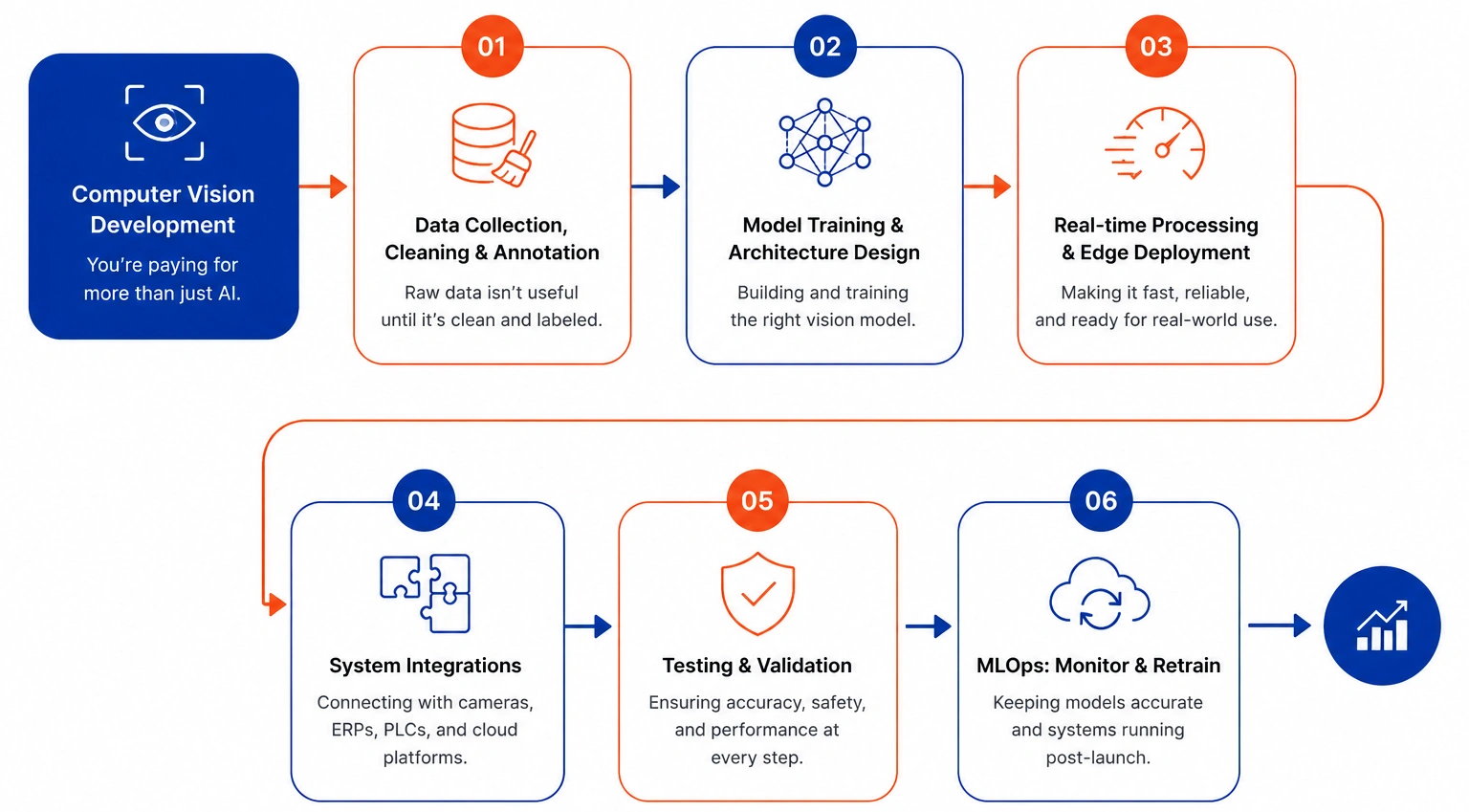
Computer vision helps software understand images, videos, and visual data. But the actual cost goes far beyond “just an AI model.”
You’re really paying for:
→ Data collection, cleaning, and annotation
→ Model training and architecture design
→ Real-time processing and edge deployment
→ Camera, ERP, and cloud integrations
→ Accuracy testing and validation
→ MLOps monitoring and retraining
Skip one layer, and the computer vision cost estimate usually explodes later.
Most computer vision budgets do not fail because of AI complexity. They fail because teams underestimate everything around the model.
The actual computer vision cost usually spreads across six layers, from data preparation to deployment infrastructure.
| Discovery & Planning | 5–10% | $5K – $20K | Complex workflows and unclear requirements |
| Data Collection & Annotation | 15–30% | $10K – $100K+ | Manual labeling and segmentation complexity |
| Model Development & Training | 30–40% | $20K – $200K+ | Accuracy expectations and custom architectures |
| Backend & System Integration | 10–20% | $8K – $60K | ERP, POS, MES, and cloud integrations |
| Hardware & Edge Deployment | Variable | $5K – $100K+ | Cameras, edge devices, and multi-site rollout |
| QA, Testing & Validation | 10–15% | $10K – $40K | Real-world testing environments |
| MLOps & Monitoring | 5–10% | $8K – $25K | Retraining pipelines and drift monitoring |

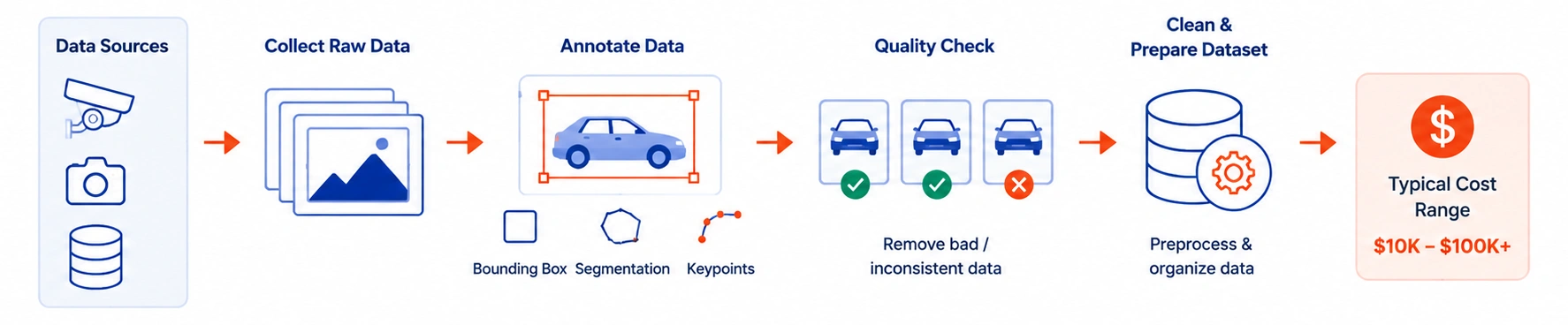
“AI models are expensive. Bad training data is even more expensive.”
This is where most computer vision cost overruns begin.
If datasets are incomplete, inconsistent, or unlabeled, the entire project slows down immediately. Bounding boxes, segmentation masks, synthetic datasets, and edge-case labeling require extensive manual effort and operational time.
Typical Cost Range: $10K – $100K+
Major Cost Drivers:
→ Manual image annotation increases labor requirements significantly.
→ Pixel-level segmentation takes far longer than standard labeling tasks.
→ Multi-camera environments create additional synchronization complexity.
→ Rare edge-case data collection requires longer operational cycles.
→ Poor existing dataset quality increases preprocessing and validation efforts.
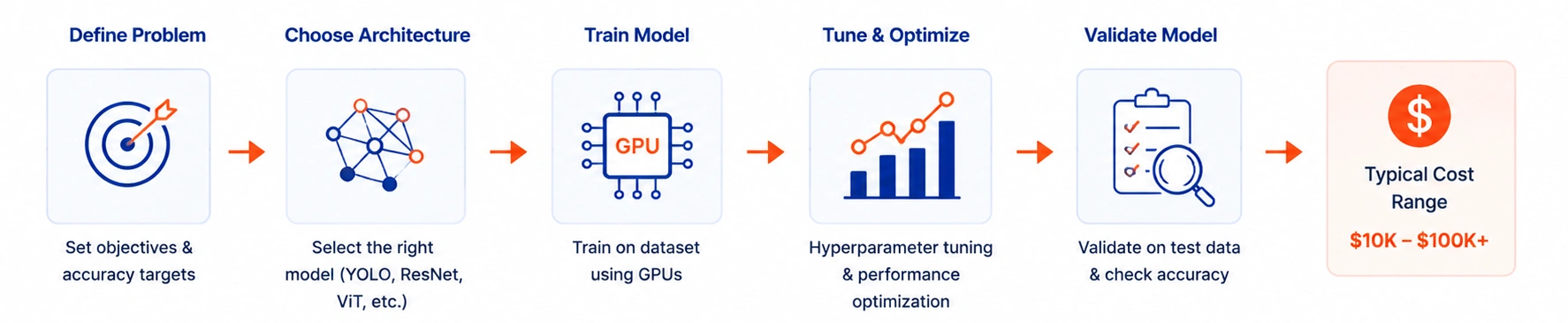
“AI models are expensive. Bad training data is even more expensive.”
This is where most computer vision cost overruns begin.
If datasets are incomplete, inconsistent, or unlabeled, the entire project slows down immediately. Bounding boxes, segmentation masks, synthetic datasets, and edge-case labeling require extensive manual effort and operational time.
Typical Cost Range: $10K – $100K+
Major Cost Drivers:
→ Manual image annotation increases labor requirements significantly.
→ Pixel-level segmentation takes far longer than standard labeling tasks.
→ Multi-camera environments create additional synchronization complexity.
→ Rare edge-case data collection requires longer operational cycles.
→ Poor existing dataset quality increases preprocessing and validation efforts.
Moreover, understand how Computer Vision for Quality Control improves inspection accuracy, reduces defects, and strengthens manufacturing consistency.
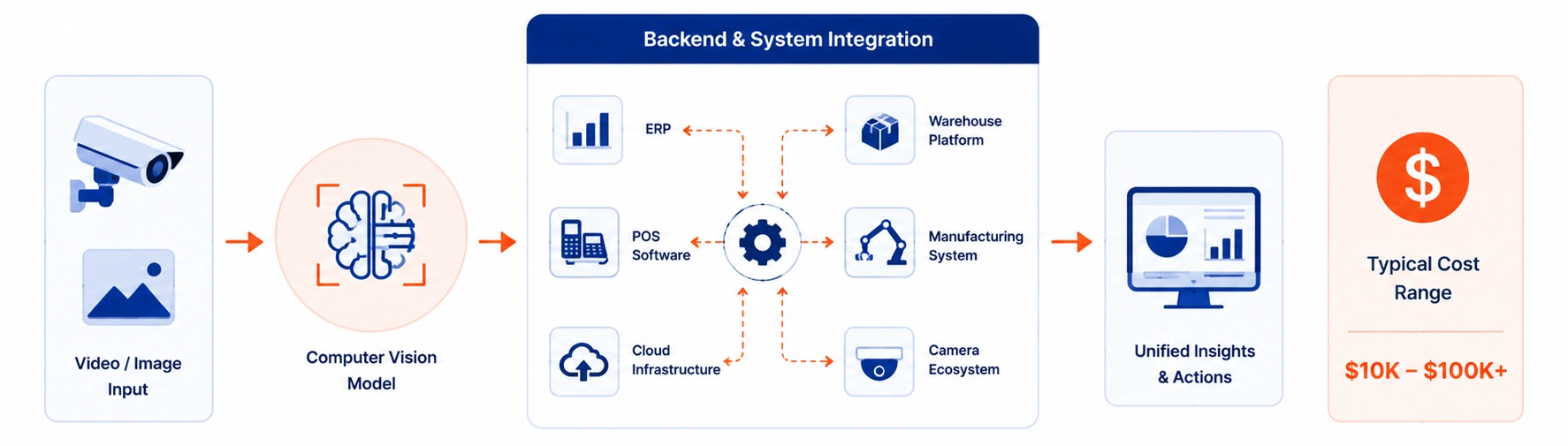
Most computer vision systems connect with ERPs, cloud platforms, POS software, and manufacturing ecosystems, which is why businesses often depend on AI and ML Development Services for smooth integration and scalable deployment.
Surprisingly, integration engineering often becomes one of the most underestimated parts of the entire computer vision cost structure.
Typical Cost Range: $10K – $100K+
Key Integration Challenges
→ Legacy enterprise systems often lack clean API structures.
→ Real-time data synchronization increases infrastructure complexity.
→ Multi-platform integration introduces operational dependencies.
→ Security and compliance layers add additional engineering effort.

Cloud inference may reduce initial infrastructure costs, but edge deployment changes the economics entirely.
Running computer vision models directly on factory floors, retail stores, autonomous systems, or medical devices introduces hardware, networking, environmental, and operational challenges.
Typical Cost Range: $10K – $100K+
Common Infrastructure Costs
| Industrial cameras | $500 – $5,000 per unit |
| Edge compute devices | $2K – $8K per node |
| Deployment setup | $1K – $5K per site |
What Usually Expands Budgets
→ Multi-location deployment increases operational and hardware scaling costs.
→ Industrial-grade hardware requirements increase procurement budgets.
→ Environmental conditions require additional deployment safeguards.
→ On-site networking and maintenance increase infrastructure overhead.
Furthermore you can also explore how Computer Vision in Manufacturing improves defect detection, production accuracy, and industrial automation at scale.

Computer vision testing is significantly more demanding than traditional software QA because the model must perform consistently across unpredictable real-world conditions.
Accuracy validation usually includes lighting variation testing, motion blur analysis, camera angle changes, environmental noise handling, and edge-case performance benchmarking.
Typical Cost Range: $10K – $100K+
Why This Phase Matters
→ Healthcare systems require extremely high prediction reliability.
→ Manufacturing systems must minimize false defect detection rates.
→ Autonomous systems depend on consistent environmental recognition.
→ Security environments require stable performance under changing conditions.
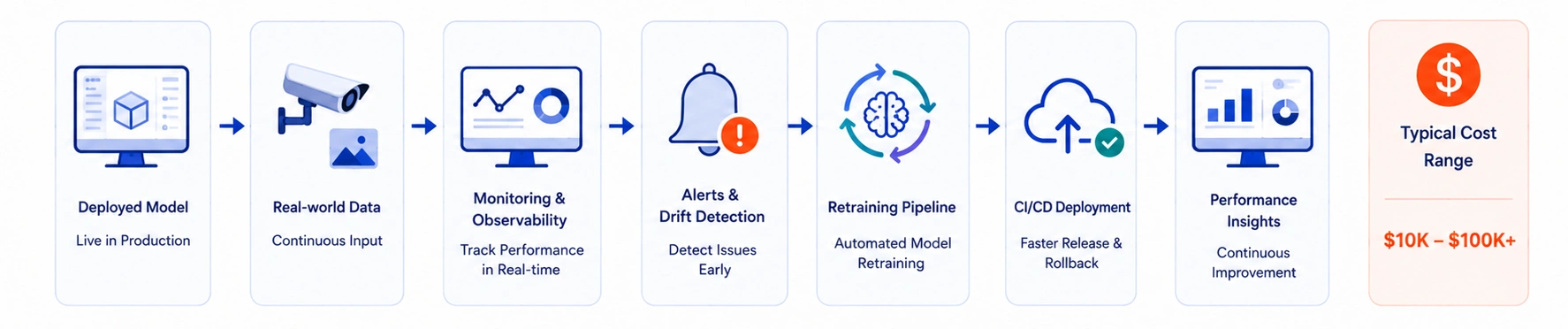
“Launching the model is where the maintenance bill begins.”
Computer vision systems naturally degrade over time as environments, camera conditions, and operational patterns change. Without monitoring infrastructure, model accuracy slowly declines after deployment.
Typical Cost Range: $10K – $100K+
Core Infrastructure Requirements
→ Model monitoring helps identify performance degradation early.
→ Drift detection systems track changes in real-world data patterns.
→ Automated retraining pipelines maintain long-term model accuracy.
→ CI/CD infrastructure supports faster deployment and rollback cycles.
→ GPU orchestration helps optimize compute efficiency at scale.

Here’s what most vendors don’t say upfront: the build cost is only part of the story.
After your CV system goes live, you’re running a complex AI infrastructure. That infrastructure costs real money every month.
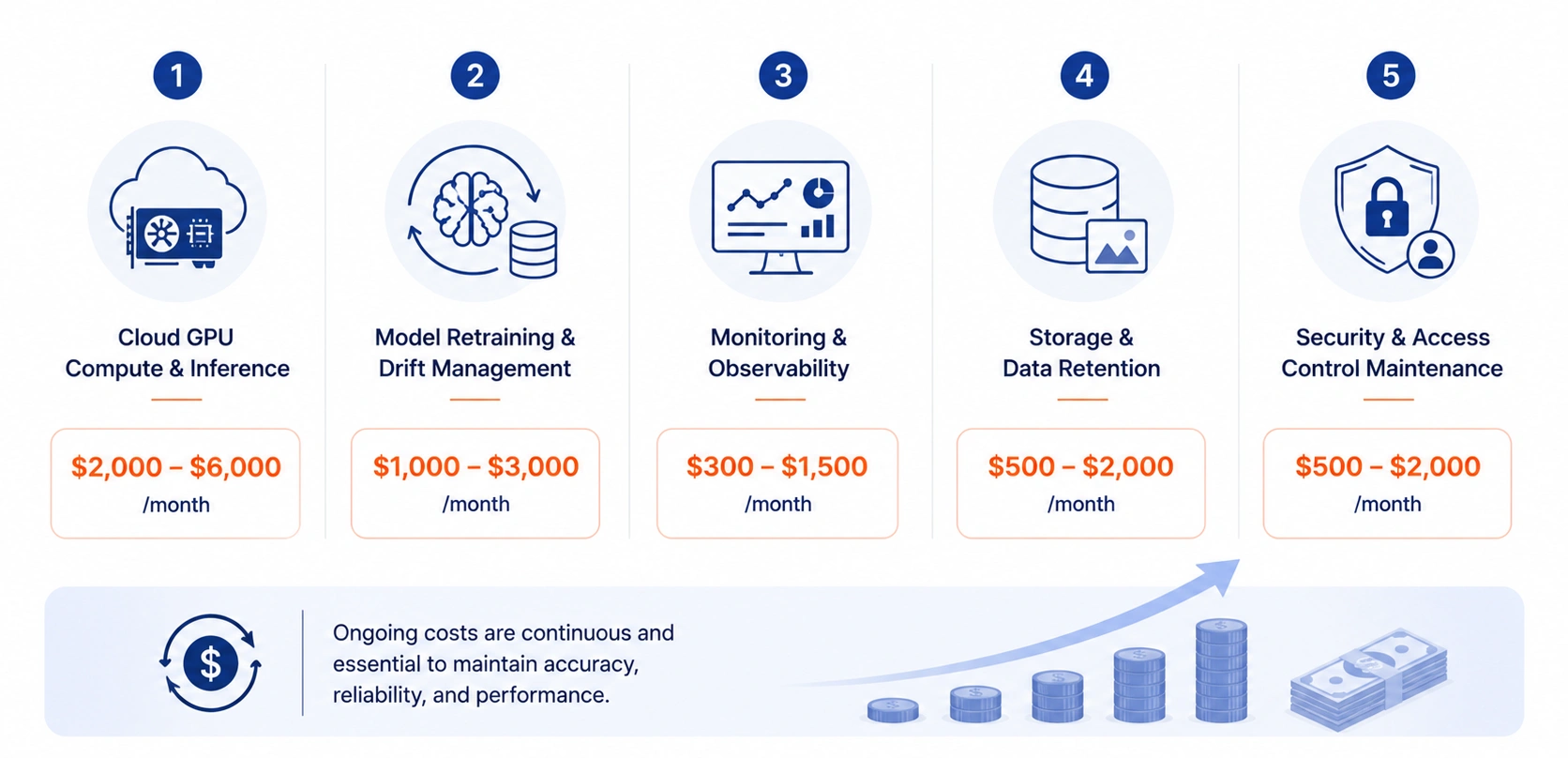
1. Cloud GPU Compute & Inference: Real-time computer vision workloads consume significant GPU resources, especially when processing multiple video streams continuously.
Typical Monthly Cost: $2,000 – $6,000/month
2. Model Retraining & Drift Management: Computer vision models gradually lose accuracy as environments, lighting conditions, and operational patterns change over time.
Typical Monthly Cost: $1,000 – $3,000/month
3. Monitoring & Observability: Production systems require continuous tracking of model accuracy, latency, alerts, and false positive rates to maintain stable performance.
Typical Monthly Cost: $300 – $1,500/month
4. Storage & Data Retention: Image and video datasets grow rapidly, especially in multi-camera environments requiring long-term retention for audits or compliance.
Typical Monthly Cost: $500 – $2,000/month
5. Security & Access Control Maintenance: Industries like healthcare, finance, and government require ongoing security audits, access reviews, and compliance monitoring.
Typical Monthly Cost: $500 – $2,000/month
Two computer vision projects may look similar but end up with completely different budgets. The difference usually comes from architecture complexity, deployment requirements, and operational scale.
The same core architecture can cost very differently depending on the industry.
Compliance requirements, accuracy thresholds, data sensitivity, and integration complexity all shift the number.
Here’s how computer vision cost breaks down across the industries where Azilen most commonly deploys.
| Manufacturing | Defect detection, assembly verification, quality inspection | $60K – $250K | Edge hardware, high-accuracy model thresholds, real-time inference |
| Healthcare | Medical imaging analysis, surgical assistance, patient monitoring | $150K – $500K+ | HIPAA compliance, FDA considerations, clinical accuracy validation, EHR integrations |
| Retail | Self-checkout, shelf monitoring, customer analytics, loss prevention | $50K – $180K | POS integration, multi-SKU recognition, real-time latency requirements |
| Logistics & Warehousing | Package dimensioning, damaged goods detection, robotic vision | $70K – $200K | Speed requirements, WMS integration, high-volume throughput |
| Security & Surveillance | Facial recognition, perimeter monitoring, behavior detection | $80K – $250K | Legal/privacy compliance, multi-camera orchestration, alerting infrastructure |
| Agriculture | Crop disease detection, yield estimation, drone imagery analysis | $40K – $150K | Diverse environmental conditions, drone/satellite data processing |
| Financial Services | Document intelligence, KYC verification, fraud pattern detection | $100K – $300K | SOC 2, GDPR compliance, auditability, high-accuracy OCR requirements |

Computer vision cost usually ranges from $10,000 for basic proof-of-concept systems to more than $500,000 for enterprise-grade deployments. The final cost depends on model complexity, data annotation requirements, infrastructure, deployment environment, and real-time processing needs. Most production-grade computer vision projects fall between $50,000 and $250,000.
The biggest factors affecting computer vision cost include accuracy requirements, dataset quality, real-time inference, edge deployment, and system integration complexity. Projects requiring high precision, low latency, or multi-model workflows typically require more engineering, GPU infrastructure, validation testing, and long-term monitoring support after deployment.
Ongoing computer vision cost usually includes GPU compute, model retraining, monitoring infrastructure, cloud storage, and security maintenance. Businesses commonly spend between $2,500 and $12,000 per month after deployment depending on processing volume, infrastructure scale, data retention policies, and operational monitoring requirements.
Yes. Edge deployment generally increases computer vision cost because it requires industrial hardware, on-site setup, networking infrastructure, and optimized inference pipelines. However, edge-based systems often reduce long-term cloud expenses and improve real-time performance, especially in manufacturing, retail, healthcare, and autonomous operational environments.
Businesses reduce computer vision cost by starting with a focused MVP, using pre-trained models, limiting early deployment scope, and improving dataset quality before training begins. Clear project requirements and scalable infrastructure planning also help prevent unnecessary engineering complexity and long-term operational overspending.
→ Computer Vision Cost: The total expense involved in building, deploying, and maintaining a computer vision system.
→ Data Annotation: The process of labeling images or videos used for training computer vision models accurately.
→ GPU Compute: High-performance processing power required for AI model training and real-time computer vision inference.
→ Edge Computing: A computing model where data processing happens near devices instead of centralized cloud infrastructure.
→ Real-Time Inference: The ability of a computer vision system to process and respond to visual data instantly.
→ Model Training: The process of teaching AI models using datasets to recognize patterns, objects, and visual features.
→ MLOps: Infrastructure used for monitoring, retraining, deploying, and maintaining AI models after launch.
→ Drift Detection: A monitoring method used to identify when model accuracy declines because real-world data changes over time.
→ Edge Deployment: Running computer vision systems directly on local hardware instead of cloud-based environments.
→ Semantic Segmentation: A computer vision technique that classifies every pixel in an image for precise object recognition.


 16 mins
  16 mins
 "*" indicates required fields

5432 Geary Blvd, Unit #527 San Francisco, CA 94121 United States
320 Decker Drive Irving, TX 75062 United States

6d-7398 Yonge St,1318 Thornhill, Ontario, Canada, L4J8J2

71-75 Shelton Street, Covent Garden, London, United Kingdom, WC2H 9JQ

Hohrainstrasse 16, 79787 Lauchringen, Germany

12, Zugerstrasse 32, 6341 Baar, Switzerland

5th floor, Bloukrans Building, Lynnwood Road, Pretoria, Gauteng, 0081, South Africa

12th & 13th Floor, B Square-1, Bopal – Ambli Road, Ahmedabad – 380054
B/305A, 3rd Floor, Kanakia Wallstreet, Andheri (East), Mumbai, India




 Talk to Our
Consultants
Talk to Our
Consultants Chat with
Our Experts
Chat with
Our Experts Write us
an Email
Write us
an Email