Skip to content

Top Manufacturing Software Development Companies in California

Featured Image

Executive Summary

California has a strong ecosystem of manufacturing software companies building solutions for automation, industrial data, AI, and connected factories. This guide explores the top manufacturing software development companies in California, their specialties, team sizes, and capabilities. It also covers what to evaluate when choosing a manufacturing software development company, from legacy integration to scalability and production experience.

You’ll see where custom manufacturing software development fits and how different companies approach real manufacturing challenges. Finally, we explain where Azilen Technologies fits across IIoT, AI, MES/ERP integration, digital twins, and plant intelligence.

Manufacturing software is no longer just about keeping production running. It now connects machines, data, quality systems, automation, and AI to help factories operate smarter.

California is home to some of the companies building this technology, but choosing the right partner means looking beyond a polished demo.

Here, we explore the top manufacturing software development companies in California, what they specialize in, and where they fit different manufacturing needs.

“Real manufacturing software begins where the demo ends, with legacy systems, real machines, real data, and real production pressure.”

What Actually Matters When You’re Choosing a Manufacturing Software Company

A polished demo can make almost any manufacturing software look impressive. The real questions start when it meets the factory floor: Can it integrate with your existing systems? Can it handle real production data? Can it scale without adding another layer of complexity?

This matters because modern manufacturing environments often need different software systems and equipment to exchange data reliably. NIST’s Reference Architecture for Smart Manufacturing specifically looks at how manufacturing applications, production functions, and information flows can work together.

1. Legacy system
reality

Can the software integrate with your existing MES, ERP, SCADA, PLCs, and other
factory systems?

3. Production-floor validation

Has the software been tested in real manufacturing environments, not just controlled demos or pilots?

2. Point solution vs. platform

Are you buying software for one specific problem, or do you need a broader manufacturing platform?

4. Scalability and
support

Can the solution support additional machines, production lines, plants, users, and data as your operations grow?

Custom manufacturing software development

Looking for a Manufacturing Software Company in California?

Have a manufacturing challenge? Let’s build software that works for your business.

Talk to Manufacturing Consultants

Top 10 Manufacturing Software Development Companies in California

Azilen brings 17+ years of engineering experience to manufacturing software development, helping manufacturers connect production systems, machines, data, and AI. Its work spans custom manufacturing software, Industrial IoT, smart factory enablement, predictive maintenance, digital twins, and AI-powered manufacturing solutions.

The focus is on building software around real production environments rather than isolated tools or dashboards.

500+

Engineering
Specialists

Six

Global Markets Served

100+

Manufacturing Solutions

95%

Clients Staying Loyal

Azilen takes an end-to-end approach to manufacturing software, helping businesses modernize existing systems while building the foundation for connected and intelligent operations.

→ Custom Manufacturing Software: Build production, workflow, analytics, and operational software around specific manufacturing processes and business requirements.

→ Industrial IoT & Connected Manufacturing: Connect machines, sensors, PLCs, and production assets to create unified factory data and real-time operational visibility.

→ AI-Powered Manufacturing: Apply predictive maintenance, AI-powered quality inspection, anomaly detection, and production intelligence to real manufacturing data.

→ MES, ERP & Shop-Floor Integration: Connect manufacturing systems with ERP, MES, SCADA, quality, and other enterprise platforms without requiring manufacturers to replace everything already in place.

→ Digital Twins & Simulation: Build digital representations of production environments to simulate scenarios, identify bottlenecks, and optimize processes before making changes on the factory floor.

→ Agentic AI for Manufacturing: Build AI-driven workflows that monitor manufacturing operations, analyze signals from ERP, MES, IoT, and other systems, and support faster operational decisions.

Manufacturing Capabilities

Azilen’s manufacturing work covers smart factory enablement, AI and predictive maintenance, Industrial IoT, custom manufacturing software, connected operations, digital twins, production tracking, scheduling optimization, and edge computing.

→ Technology ecosystem: MQTT, OPC-UA, Modbus, Azure IoT Hub, AWS IoT, NVIDIA Jetson, Kubernetes, computer vision, digital twins, and cloud data platforms.

→ Explore: Azilen Manufacturing Solutions, Industrial AI Solutions, Manufacturing IIoT Case Study

Best suited for: Manufacturers looking for a custom manufacturing software development company that can connect legacy systems, Industrial IoT, AI, enterprise applications, and shop-floor operations into a scalable technology ecosystem.

Data infrastructure illustration

Ready to Build Your Manufacturing Solution?

Explore our 👇

Manufacturing Solutions

2. Parsec Automation (TrakSYS)

Parsec Automation is an Anaheim, California-based manufacturing software company founded in 1987, with around 51–200 employees. Its TrakSYS platform is focused on manufacturing execution and plant-floor operations, with deployments across thousands of plants and customers including Johnson & Johnson, Toyota, P&G, and Hershey.

→ MES software: Manage production processes, quality, performance, and manufacturing operations through a unified platform.
→ Plant-floor visibility: Connect production data and processes to improve operational visibility and decision-making.
→ AI-assisted manufacturing: Extend MES capabilities with AI-powered features through TrakSYS IQ.

Parsec is best suited for manufacturers looking for an established MES platform with large-scale manufacturing deployments and enterprise capabilities.

3. iBase-t (Solumina)

iBase-t is a Foothill Ranch, California-based manufacturing software company founded in 1986, with around 250 employees. Its Solumina MES is designed for aerospace, defense, medical devices, and other highly regulated manufacturing environments where traceability, compliance, and complex production processes are critical.

→ Aerospace & defense MES: Manage complex manufacturing processes across highly regulated production environments.
→ Compliance & traceability: Maintain detailed production records, quality information, and manufacturing history.
→ Complex manufacturing: Support configuration-driven production, work instructions, and quality workflows.

iBase-t is particularly suited to regulated manufacturers that need strong manufacturing execution, compliance, and traceability capabilities.

3. Propel Software

Propel Software is a Santa Clara, California-based company founded in 2015, with around 130 employees. Its platform brings PLM, PIM, and QMS together on Salesforce, helping manufacturers manage product information, quality processes, and product development from a connected environment.

→ Product lifecycle management: Manage product data, engineering processes, and product changes in one platform.
→ Quality management: Connect quality processes with product and engineering information.
→ Salesforce integration: Bring product and customer information together on the Salesforce platform.

Propel is a strong fit for high-tech, medical device, and consumer product manufacturers already using Salesforce.

5. Rootstock Software

Rootstock Software is a San Ramon, California-based manufacturing ERP company founded in 2008, with around 150 employees. Its cloud ERP platform is built natively on Salesforce, connecting manufacturing, inventory, sales, supply chain, and financial operations within one business environment.

→ Manufacturing ERP: Manage production, inventory, purchasing, and other core manufacturing processes.
→ Salesforce-native architecture: Connect manufacturing operations directly with Salesforce CRM data.
→ Supply chain management: Improve visibility across inventory, orders, purchasing, and production.

Rootstock is best suited for manufacturers and distributors that already rely heavily on Salesforce and want their ERP and CRM environments connected.

6. Elementum

Elementum is a San Mateo, California-based supply chain software company founded in 2012, with roughly 100–250 employees. Its platform focuses on supply chain visibility and exception management, helping manufacturers respond to disruptions across procurement, logistics, inventory, and supplier operations.

→ Supply chain visibility: Bring information from different supply chain activities into a connected view.
→ Exception management: Identify and coordinate responses to supply chain disruptions and operational issues.
→ AI-powered workflows: Use automation and AI to improve how supply chain teams identify and respond to problems.

Elementum is particularly relevant for manufacturers whose biggest software challenge sits across the supply chain rather than directly on the production floor.

7. Instrumental

Instrumental is a Palo Alto, California-based manufacturing AI company founded in 2015, with around 80–113 employees. Founded by former Apple product design engineers, it develops AI-powered manufacturing software focused on quality inspection, defect detection, and yield improvement for electronics manufacturers.

→ AI quality inspection: Analyze images from production lines to identify defects and manufacturing issues.
→ Defect detection: Identify new and unexpected quality problems without relying entirely on predefined defect rules.
→ Yield improvement: Connect manufacturing data and inspection results to help teams understand production failures.

Instrumental is best suited for electronics and hardware manufacturers focused on reducing defects and improving production quality.

8. Falkonry

Falkonry is a Cupertino, California-based industrial AI company founded in 2012, with around 58 employees. Its operational AI software identifies unusual patterns in industrial data and helps manufacturers detect emerging equipment and process problems before they develop into larger operational issues.

→ Predictive operations: Identify early signs of equipment or process problems using industrial data.
→ Anomaly detection: Detect changing patterns without relying entirely on fixed thresholds.
→ Industrial AI: Apply AI to operational data without requiring manufacturers to build large internal data science teams.

Falkonry is now part of IFS, following its acquisition in 2023, and remains relevant for manufacturers looking to apply AI to predictive operations and industrial asset monitoring.

9. Duro

Duro is a Los Angeles, California-based hardware product lifecycle management company founded in 2016, with around 50 employees. Its platform brings CAD, bills of materials, product data, and supply chain information together to help hardware companies manage product development and manufacturing changes.

→ Hardware PLM: Manage product information, engineering data, and product development workflows.
→ BOM management: Keep bills of materials organized and connected to product changes.
→ Supply chain collaboration: Give engineering and manufacturing teams better visibility into product and supplier information.

Duro is particularly suited to hardware, aerospace, defense, and industrial companies that need a modern PLM platform for managing physical products.

10. EazyWorks

EazyWorks is a Fullerton, California-based manufacturing software company founded in 2005 that focuses on MES solutions for small and mid-sized manufacturers. Its EZ-MES platform provides browser-based manufacturing execution capabilities without the complexity typically associated with larger enterprise MES deployments.

→ MES for SMBs: Provide production management capabilities designed around smaller manufacturing operations.
→ Cloud-based software: Access manufacturing information through a browser-based environment.
→ Configurable workflows: Adapt the system to manufacturing processes without requiring extensive custom development.

EazyWorks is best suited for small and mid-sized manufacturers looking for a more accessible MES platform without the scale and complexity of enterprise systems.

What Does Manufacturing Software Development Cost in California?

Manufacturing software development in California can range from around $25,000 for a focused workflow application to $500,000+ for an enterprise manufacturing platform. The final cost depends on software complexity, integrations, manufacturing data, automation requirements, security, and deployment scale.

$25,000 $100,000 $300,000 MFG

Wondering What Your Manufacturing Software Will Really Cost?

Estimate your software scope, integrations, infrastructure, and development effort before you commit.

Calculate My Investment

No account needed · Instant estimate · 100% free

AI Project Type Typical Cost in 2026 Typical Timeline
AI Proof of Concept $5,000–$20,000 2–6 weeks
AI Chatbot / Copilot $10,000–$60,000 4–12 weeks
RAG / Knowledge Assistant $15,000–$100,000 6–16 weeks
Custom AI Agent $20,000–$200,000 8–24 weeks
Enterprise AI Platform $400,000–$1M+ 6–12+ months

These are indicative 2026 ranges. Actual costs vary based on scope, integrations, legacy systems, data complexity, security requirements, hardware, deployment scale, and development team.

What Moves Manufacturing Software Development Cost?

→ Project complexity: A focused production workflow costs less than a connected platform managing multiple manufacturing functions.

→ Legacy system integration: Connecting MES, ERP, SCADA, PLCs, databases, and other existing systems can significantly increase engineering effort.

→ IoT and hardware: Machine connectivity, sensors, gateways, protocols, and edge computing add infrastructure and development requirements.

→ AI and analytics: Predictive maintenance, quality inspection, anomaly detection, and other AI capabilities require additional data and engineering work.

→ Scale and security: Multi-site deployments, user volumes, real-time processing, security, compliance, and ongoing support all influence the final investment.

What Comes After Manufacturing Software Development?

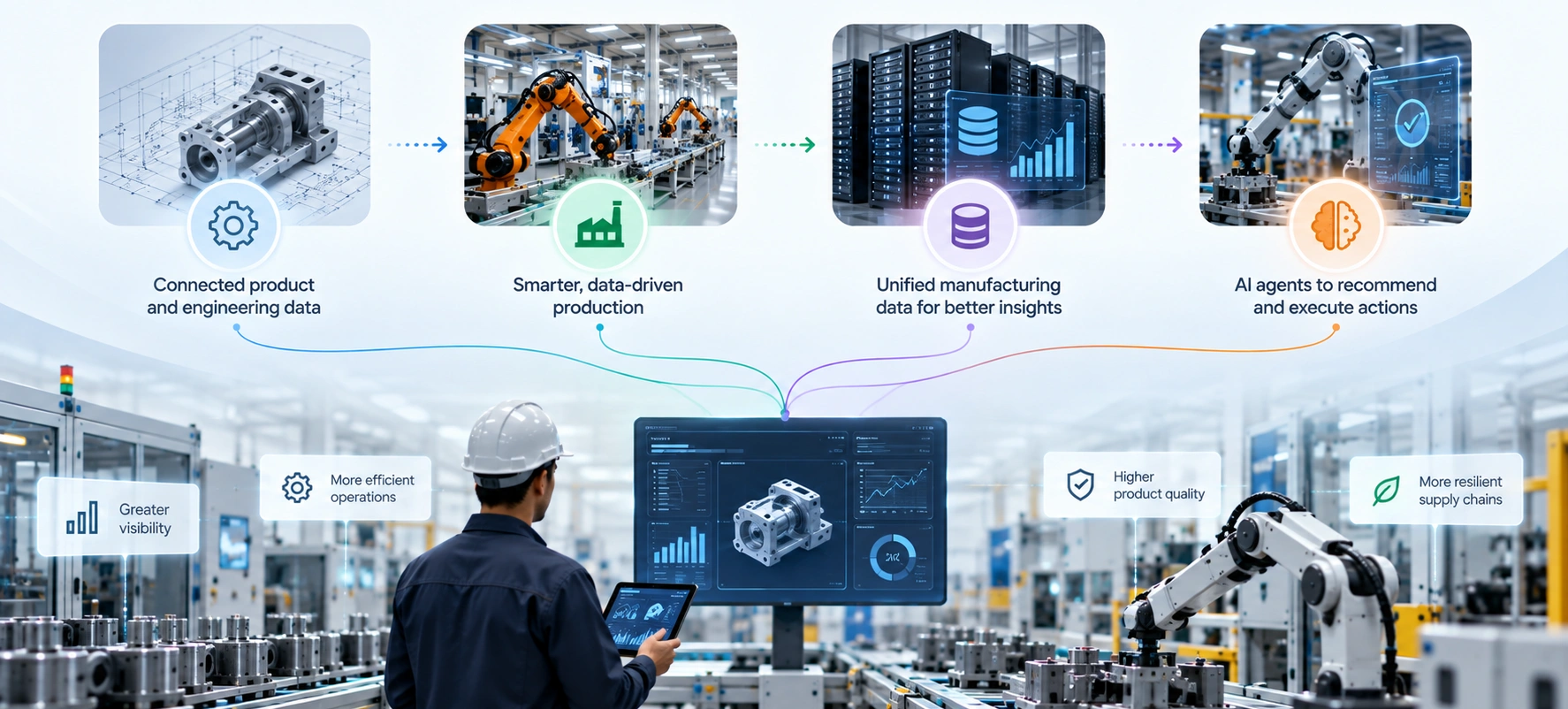
Manufacturing software is only one part of a larger digital transformation journey. Once core systems are connected, manufacturers can build on that foundation with digital thread architecture, smart manufacturing, manufacturing data engineering, and agentic operations to connect information and decisions across the wider production ecosystem.

What Comes After Manufacturing Software Development

Creating a Digital Thread Across Manufacturing

A digital thread for manufacturing connects information across engineering, production, quality, supply chain, and product support. It creates a more continuous flow of product and manufacturing data instead of leaving teams dependent on disconnected systems.

Building Smarter Manufacturing Systems

Smart manufacturing solutions can connect machines, production systems, operational data, and business processes to create more responsive and data-driven manufacturing environments.

Making Manufacturing Data More Useful

Manufacturing data engineering helps manufacturers build reliable pipelines that collect, transform, organize, and deliver data from machines and enterprise systems for analytics, AI, and operational decision-making.

Moving Toward Agentic Manufacturing

Agentic AI for manufacturing can take manufacturing software beyond dashboards and alerts by helping AI systems analyze operational information, recommend actions, and coordinate workflows across production, maintenance, quality, and supply chain.

Current manufacturing discussions increasingly connect the digital thread with AI agents and more action-oriented operations.

Get Consultation
Looking for the Right Manufacturing Software Partner?
See how Azilen can help you build, modernize, integrate, and scale manufacturing software for your operations.

Frequently Asked Questions

1. What are the top manufacturing software development companies in California?

California has several manufacturing software companies specializing in MES, ERP, industrial IoT, AI-powered quality control, manufacturing analytics, automation, and custom software development. The companies covered in this guide include Azilen Technologies, Parsec Automation, iBase-t, Propel Software, Rootstock Software, Elementum, Instrumental, Falkonry, Duro, EazyWorks, and Baytech Consulting.

2. How much does manufacturing software development cost in California?

Manufacturing software development can range from around $25,000 for a focused workflow application to $500,000 or more for an enterprise manufacturing platform. Costs depend on software complexity, legacy integrations, IoT requirements, AI capabilities, security, number of facilities, and the scale of deployment.

3. How do I choose a manufacturing software development company in California?

Start by identifying the specific manufacturing problem you need to solve. Then evaluate the company’s experience with your existing MES, ERP, SCADA, PLCs, and other systems, along with its production-floor experience, technology capabilities, scalability, security practices, and post-launch support.

4. What should I avoid when choosing a manufacturing software development company?

Avoid choosing a company based only on a polished demo, low development quote, or impressive portfolio. Manufacturing software needs to work with real machines, legacy systems, production data, and operational constraints. Failing to evaluate integration capabilities, scalability, deployment experience, and long-term support can create costly problems after implementation.

5. Is custom manufacturing software better than an off-the-shelf solution?

Custom manufacturing software is not automatically the better option. Building from scratch can make sense when existing software cannot support unique workflows, integrations, or operational requirements. For standard manufacturing processes, an established MES, ERP, PLM, or specialized platform may reduce development time and complexity.

6. What are the common challenges with manufacturing software implementation?

Manufacturing software projects can face challenges such as legacy system integration, inconsistent production data, complex workflows, limited user adoption, and unexpected infrastructure requirements. Choosing a development partner without experience in real manufacturing environments can make these challenges harder to manage and increase implementation time and costs.

Related Insights