Skip to content

What Is the Future of IoT in Manufacturing

Featured Image

Executive Summary

This blog explores the future of IoT in manufacturing, where it stands today, where it is headed, and what the numbers actually say about costs, savings, and ROI.

From predictive maintenance that stops a $125,000-per-hour downtime disaster, to AI agents that replace entire human decision workflows, this is your complete guide to the industrial IoT transformation happening right now across U.S. factory floors.

The manufacturing industry is no longer asking “Should we adopt IoT?” That debate is over. The question now is how fast, how deep, and how smart. Because the companies still hesitating, while their competitors run fully autonomous production lines, are losing ground every single day.

Why Is Manufacturing Losing $125,000 Every Hour Without IoT?

Let’s start with a number that should stop you cold. Unplanned equipment downtime costs U.S. manufacturers a median of $125,000 per hour. For automotive plants, it can exceed $2 million per hour.

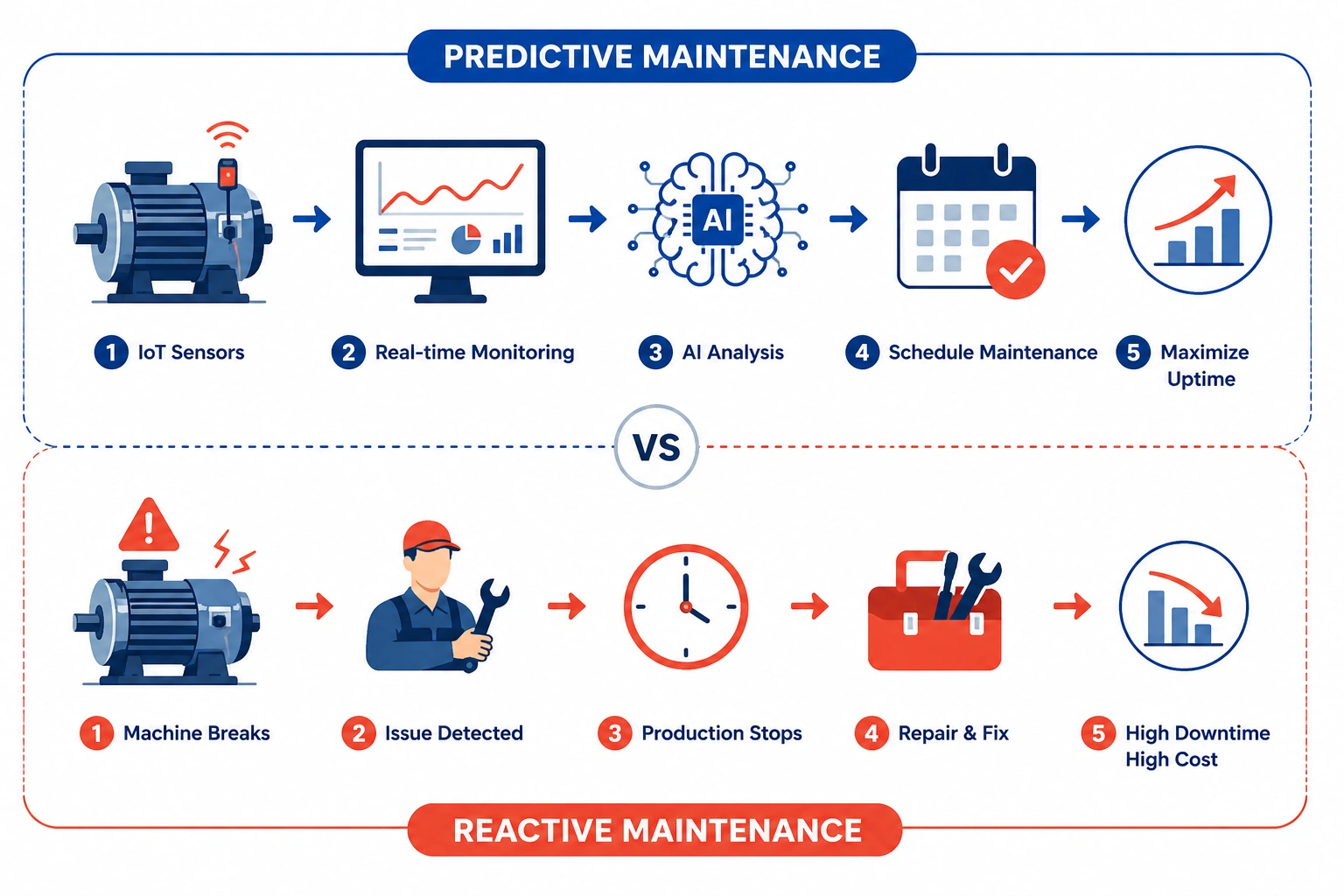
For decades, the manufacturing floor has run on a reactive model. A machine breaks. Someone notices. Maintenance is called. Parts are ordered. Production halts. Then the scramble begins.

That entire sequence, from failure to fix, burns money like a furnace.

The future of IoT in manufacturing promises something radically different. Instead of reacting to failures, smart factories predict them.

Instead of a technician walking the floor every morning, thousands of sensors report every vibration, temperature spike, and pressure anomaly, in real time, 24/7.

Moreover, the latest generation of industrial IoT doesn’t just send data. It acts on it.

The Core Shift

Manufacturing IoT is evolving from a monitoring tool into an autonomous decision system. The sensor still detects the problem.

But now, an AI agent also creates the work order, checks parts inventory, schedules the technician, and logs the repair, all before a human even sees the alert.

Furthermore, 95% of companies implementing predictive maintenance report positive ROI, with 27% achieving full payback within just 12 months.

What Defines the Future of IoT in Manufacturing Today

The future of IoT in manufacturing is not just about connecting machines or collecting data. It is about building factories that continuously sense, analyse, and act, without delays or dependency on manual intervention.

This shift is already happening across modern manufacturing environments, where IoT is moving from a support system to a decision-making engine.

Here is what the future of IoT in manufacturing actually looks like:

1. Predictive Operations Instead of Reactive Maintenance

Unplanned downtime has always been one of the biggest challenges in manufacturing. Machines break without warning, production stops, and costs increase quickly. This traditional reactive approach is one of the main reasons factories lose efficiency and revenue.

Predictive Operations Instead of Reactive MaintenanceThe future of IoT in manufacturing is solving this problem by shifting from reactive maintenance to predictive operations.
Instead of waiting for failures, IoT systems continuously monitor machine health and identify issues before they become critical.

→ Sensors track vibration, temperature, and pressure in real time
→ AI models detect early signs of machine wear and failure
→ Maintenance is scheduled before breakdowns occur
→ Downtime is reduced and production remains uninterrupted

This shift not only improves operational efficiency but also reduces maintenance costs and increases equipment lifespan. Predictive operations are becoming a core part of how modern smart factories function.

Real-Time Systems That Act Instantly

Traditional manufacturing systems depend heavily on manual monitoring and delayed decision-making. Even when data is available, actions often take time, which leads to inefficiencies and missed opportunities.

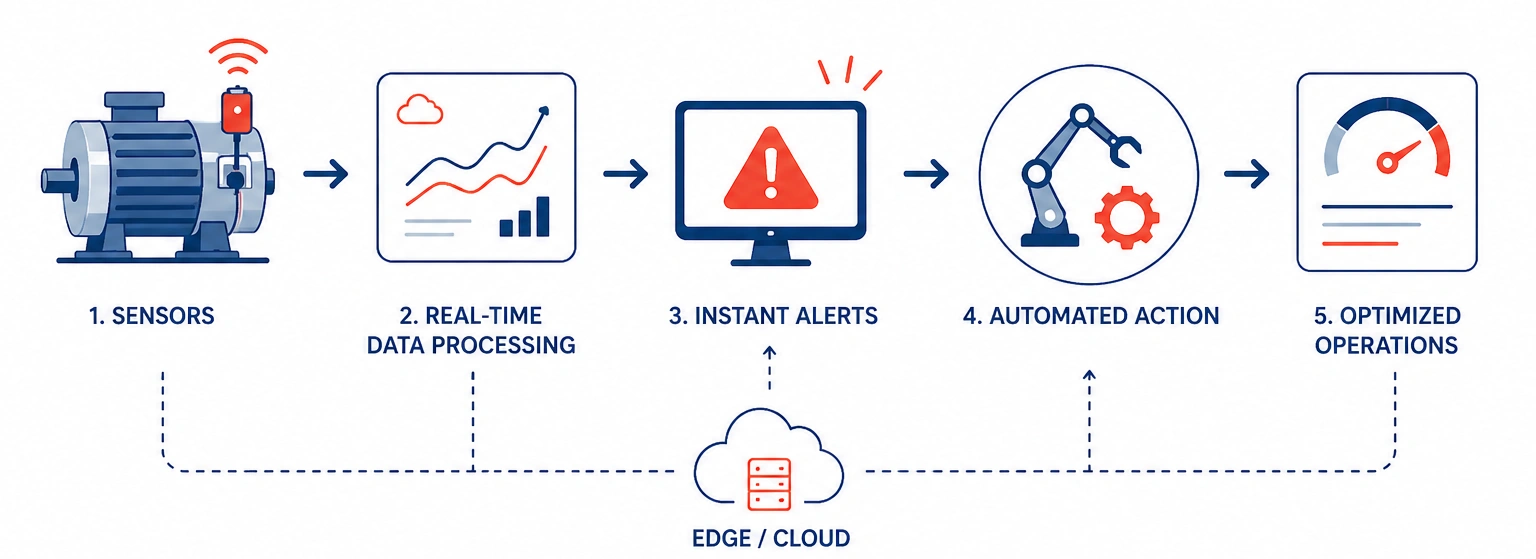
Real-Time Systems That Act InstantlyThe future of IoT in manufacturing focuses on real-time systems that do not just monitor but act immediately. These systems process data as it is generated and respond instantly to changes on the factory floor.
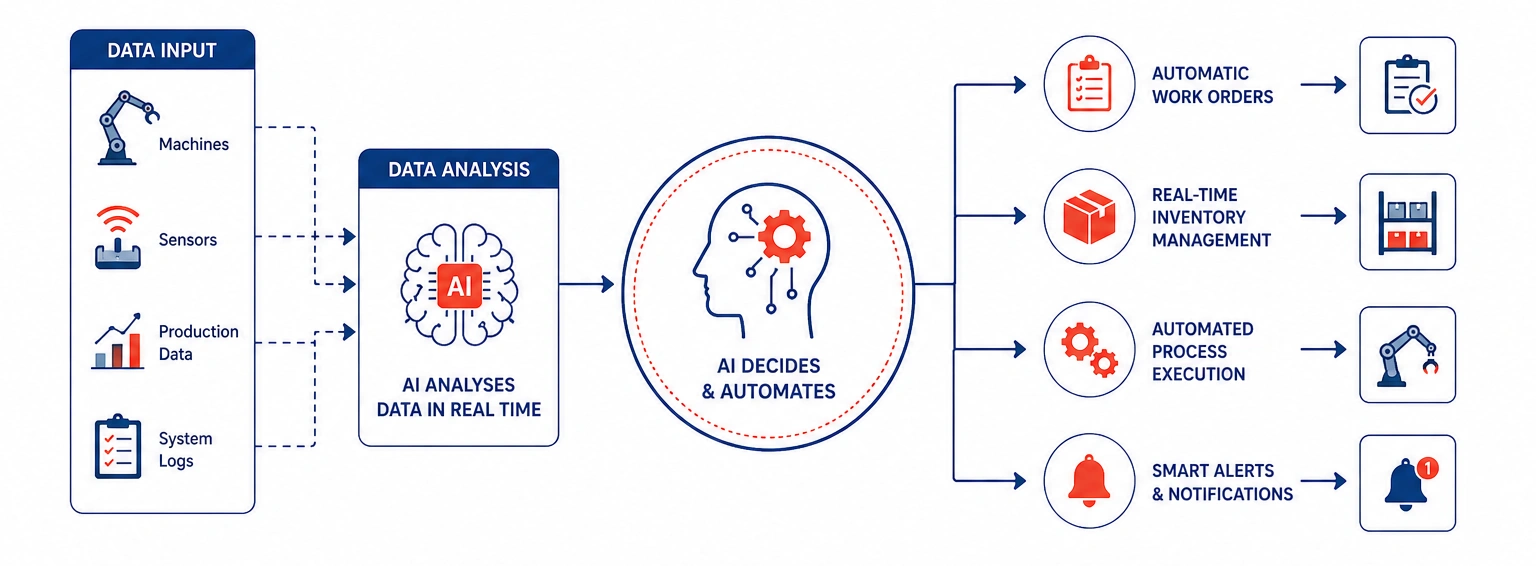
→ Data is processed instantly through edge and cloud systems
→ Alerts are triggered the moment anomalies are detected
→ Systems initiate corrective actions without delay
→ Decision-making becomes faster and more accurate

This real-time capability ensures that problems are addressed immediately, reducing risks and improving overall operational performance.

AI-Driven Automation Across Operations

Manufacturing has traditionally relied on human decision-making for most operational processes. While effective, this approach slows down response times and limits scalability.

AI-Driven Automation Across OperationsThe future of IoT in manufacturing introduces AI-driven automation, where systems not only analyse data but also make and execute decisions independently. This reduces dependency on manual workflows and speeds up operations.
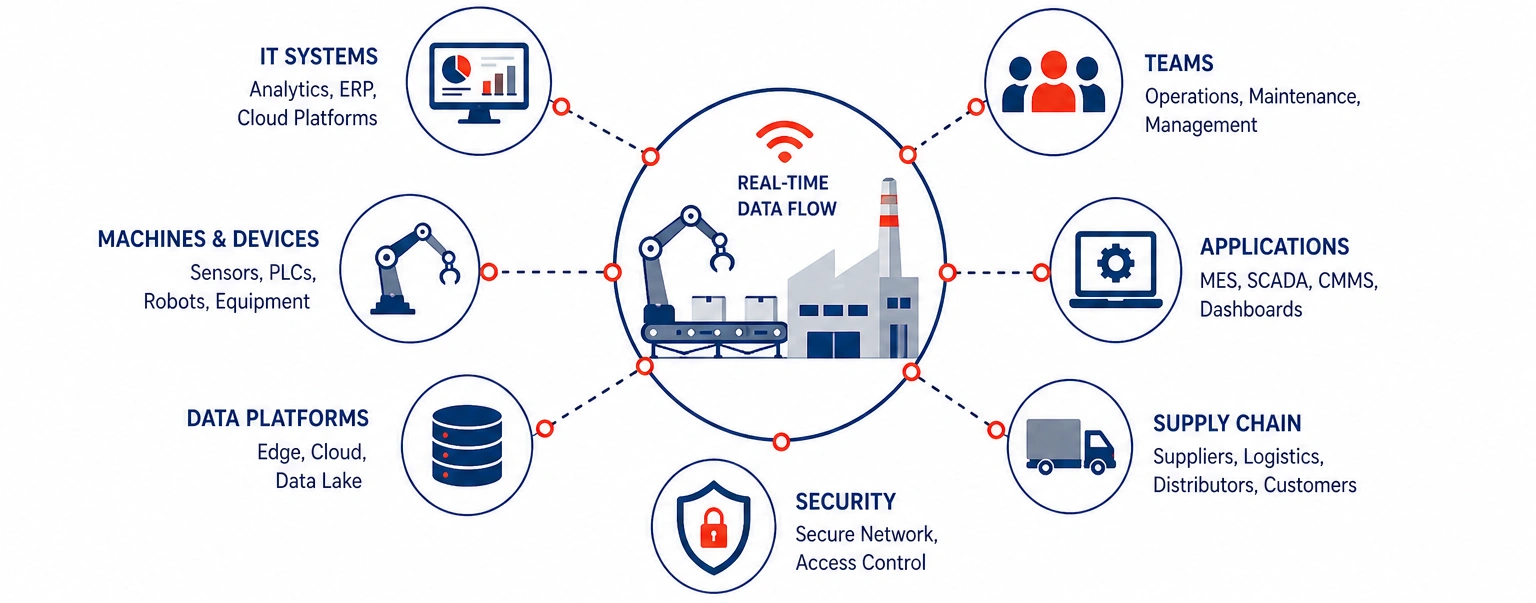
→ AI continuously analyses large volumes of operational data
→ Work orders are generated automatically when issues arise
→ Inventory and spare parts are managed in real time
→ Routine decisions are executed without human involvement

This transformation allows manufacturers to operate more efficiently while freeing human resources for strategic and complex tasks.

Fully Connected Manufacturing Ecosystems

Many factories still operate with disconnected systems, where machines, software, and teams work in silos. This lack of integration slows down communication and decision-making.

Fully Connected Manufacturing EcosystemsThe future of IoT in manufacturing connects all systems into a unified ecosystem. This ensures seamless communication, better visibility, and improved coordination across the entire operation.
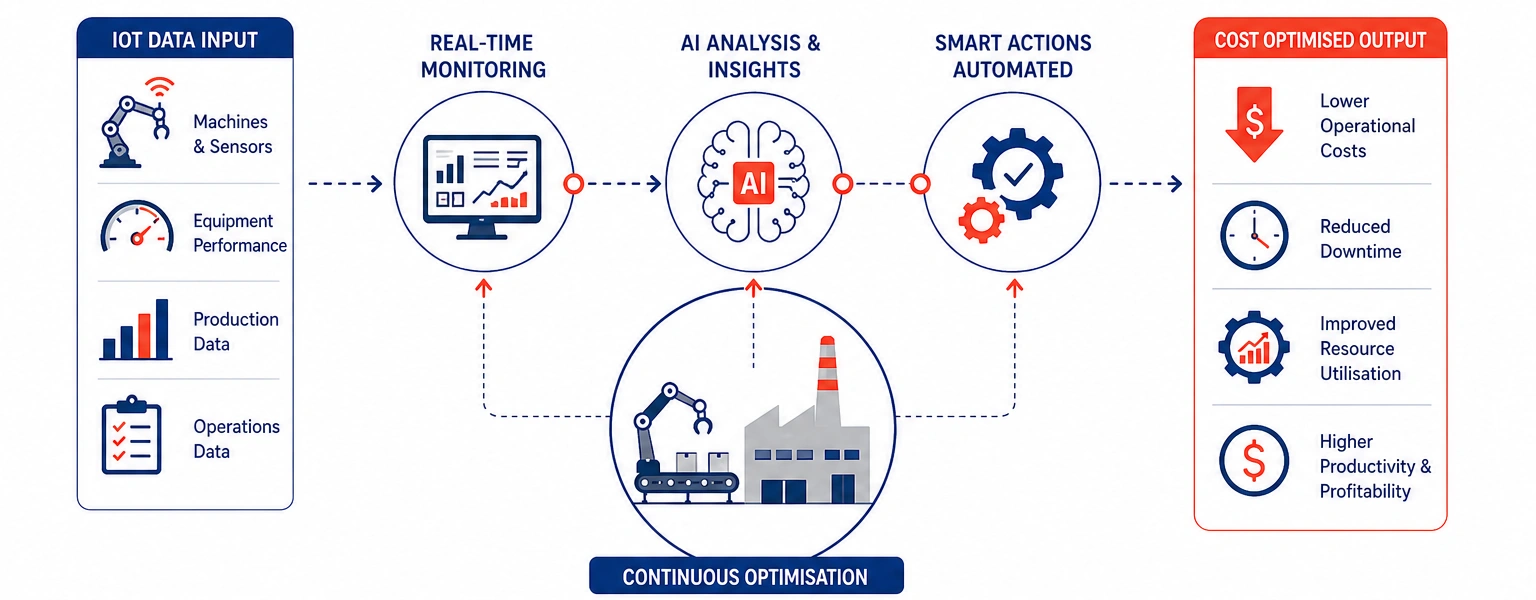
→ Machines and systems share real-time data across the factory
→ IT and OT systems are integrated for smooth communication
→ Supply chains become transparent and traceable
→ Teams gain complete visibility of operations

To explore how IoT is already transforming manufacturing environments, read our detailed guide on IoT in manufacturing industry.

Cost Optimisation Through Smart Operations

High operational costs and inefficiencies have always been major concerns in manufacturing. Unexpected breakdowns, inefficient resource usage, and manual processes increase expenses.

Cost Optimisation Through Smart OperationsThe future of IoT in manufacturing focuses strongly on cost optimisation. By using data-driven insights and automation, manufacturers reduce waste and improve resource utilisation.


→ Downtime and repair costs are significantly reduced
→ Resources and labour are used more efficiently
→ Equipment lifespan increases with better monitoring
→ Productivity improves with fewer disruptions

This leads to higher profitability and better long-term sustainability for manufacturing businesses.

See How IoT and AI Are Transforming Manufacturing in Real Time

Understanding the future of IoT in manufacturing becomes much clearer when you see it in action. While concepts like predictive maintenance and real-time decision-making sound powerful, their real impact lies in how they work together on the factory floor.

This video shows how IoT sensors and AI systems combine to create intelligent manufacturing environments where data is not just collected, but instantly turned into decisions and actions.

This example highlights the core shift in the future of IoT in manufacturing, from passive monitoring to active, intelligent systems. IoT provides the data, and AI turns that data into meaningful actions that improve efficiency, reduce downtime, and optimise performance.

As more manufacturers adopt this approach, the combination of IoT and AI will move from being an advantage to becoming the standard way factories operate.

Top USA Manufacturing Use Cases You Need to Know

Theory is great. Results are better. Here are five specific, real-world applications of the future of IoT in manufacturing, drawing from U.S. industry leaders.

Predictive Maintenance on Automotive Assembly Lines

Toyota’s AI-driven predictive maintenance across U.S. plants reduced unplanned downtime through precise scheduling.

Vibration and thermal sensors on welding robots detect bearing wear weeks before failure, automatically triggering maintenance windows during planned production pauses, not during active runs.

📉 Up to 40% downtime reduction per plant

Energy Optimization at Coca-Cola Facilities

Coca-Cola Europacific Partners deployed IoT energy monitoring across manufacturing facilities, tracking energy consumption at granular machine-level detail.

The system automatically adjusts power draw during off-peak production cycles. Result: a 50% reduction in CO₂ emissions, while simultaneously lowering energy costs.

🌱 50% CO₂ emissions reduction

Expert Insight: The Next Phase of Smart Manufacturing

The future of IoT in manufacturing is not just driven by technology vendors or trends. It is being shaped by industry leaders who are actively building and scaling these systems. Their perspective gives a clear view of where manufacturing is heading next.

One of the strongest signals comes from the growing integration of Agentic AI with physical IoT systems, a combination that is already transforming factory and logistics operations.

This perspective highlights an important shift. The future of IoT in manufacturing is no longer about standalone technologies. It is about how AI and IoT work together to create faster, smarter, and more efficient operations.

As more companies adopt this approach, the focus will move from simple automation to intelligent, self-improving systems that continuously optimise performance and quality.

Need Help Building Smart Manufacturing Systems with IoT and AI?

Azilen is an Enterprise AI Development Company that supports organisations in designing and scaling IoT-driven manufacturing solutions with real business impact.

What we help with:

✔️ Architecture design for IoT and AI-driven manufacturing systems
✔️ Predictive maintenance and real-time data solutions
✔️ Agentic AI integration for automated decision-making
✔️ Scalable deployment across factories, devices, and operations

Talk to our IoT and AI experts to build a smart manufacturing system that fits your scale, speed, and business goals.

IoT App Development
Build Smart Manufacturing Systems with IoT and AI
See how our Enterprise AI Development Company designs, develops, and scales solutions 👇

FAQs: Future of IoT in Manufacturing

1. What is the future of IoT in manufacturing?

The future of IoT in manufacturing focuses on building smart factories that use real-time data, AI, and automation to improve efficiency. Instead of just monitoring machines, IoT systems predict failures, automate decisions, and optimise operations continuously. This shift is moving manufacturing from reactive processes to intelligent, data-driven systems.

2. How is IoT transforming the manufacturing industry today?

IoT is transforming manufacturing by connecting machines, systems, and teams into one ecosystem. It enables real-time monitoring, predictive maintenance, and better decision-making. This helps reduce downtime, improve productivity, and lower operational costs across the factory floor.

3. What are the benefits of IoT in manufacturing?

The key benefits of IoT in manufacturing include reduced downtime, improved efficiency, better asset utilisation, and cost savings. It also helps in real-time monitoring, predictive maintenance, and enhanced worker safety, making operations more reliable and scalable.

4. How does AI work with IoT in manufacturing?

AI works with IoT by analysing large volumes of data collected from sensors and systems. It identifies patterns, predicts failures, and automates decisions. Together, AI and IoT enable real-time actions, reduce manual work, and improve overall operational performance in manufacturing.

5. Why is predictive maintenance important in the future of IoT in manufacturing?

Predictive maintenance is important because it helps detect issues before machines fail. In the future of IoT in manufacturing, this reduces unplanned downtime, lowers maintenance costs, and increases equipment lifespan. It allows manufacturers to plan maintenance efficiently and avoid production losses.

Glossary

IoT (Internet of Things): A network of connected devices such as sensors, machines, and systems that collect, share, and act on data through the internet.

IIoT (Industrial Internet of Things): The use of IoT technologies in manufacturing and industrial environments to improve efficiency, safety, and operations.

Predictive Maintenance: A method that uses IoT data and AI to predict equipment failures before they happen, helping reduce downtime and repair costs.

Edge Computing: A technology that processes data near the source (like machines or sensors) instead of sending it to the cloud, enabling faster decision-making.

Digital Twin: A virtual model of a physical machine or system that uses real-time IoT data to simulate, monitor, and optimise performance.

Agentic AI: Advanced AI systems that not only analyse data but also make decisions and take actions automatically without human intervention.

Smart Factory: A manufacturing facility where machines, systems, and processes are connected through IoT and automation to operate efficiently and intelligently.

Real-Time Data Processing: The ability to collect, analyse, and act on data instantly as it is generated, without delays.

IT/OT Integration: The connection between Information Technology (software, data systems) and Operational Technology (machines, sensors) to enable seamless data flow and control.

Autonomous Manufacturing: A system where factories operate with minimal human intervention, using IoT, AI, and automation to manage processes independently.

google
Chintan Shah
Chintan Shah
Associate Vice President - Delivery at Azilen Technologies

Chintan Shah is an experienced software professional specializing in large-scale digital transformation and enterprise solutions. As AVP - Delivery at Azilen Technologies, he drives strategic project execution, process optimization, and technology-driven innovations. With expertise across multiple domains, he ensures seamless software delivery and operational excellence.

Related Insights

GPT Mode
AziGPT - Azilen’s
Custom GPT Assistant.
Instant Answers. Smart Summaries.