


Skip to content

Top 7 IoT Trends in Manufacturing Reshaping the USA in 2026

Featured Image

Executive Summary

This blog breaks down the top 7 IoT trends in manufacturing shaping the U.S. industrial landscape in 2026. Whether you run a single-facility operation in Ohio or a multi-plant network in Texas, these trends directly affect your uptime, margins, and competitive position.

Each trend comes with real numbers, USA company examples, and a cost lens, because knowing the trend is useless without understanding what it means for your bottom line.

From the rise of Headless IoT architectures to AI-powered predictive maintenance, digital twins, and Zero Trust security, this guide is built for manufacturing leaders, plant engineers, and technology decision-makers who need more than buzzwords.

You’ll leave with a clear picture of where U.S. manufacturing is heading, and what you need to do about it.

IoT Trends in Manufacturing: Why the Factory Floor Has Already Changed

The factory floor today looks very different from what it used to be.

Imagine a machine that starts showing a tiny change in vibration. No human notices it. But an IoT sensor does. Before anything breaks, a maintenance alert is created, a part is ordered, and the repair is scheduled. The machine keeps running without any downtime. That is how IoT is changing manufacturing.

Now here’s the reality. Unplanned downtime costs manufacturers millions every year. At the same time, labor costs are rising, energy prices keep changing, and competition is getting tougher. Businesses are under constant pressure to produce more, faster, and at lower cost.

IoT is no longer just a new idea or experiment. It has become a core part of how modern factories operate. In fact, the IoT in manufacturing market is growing very fast, showing how strongly companies are investing in it.

The companies leading today are not testing IoT anymore. They have already made it part of their daily operations.

So, let’s get straight to it. Here are the top 7 IoT trends in manufacturing you need to understand right now.

7 IoT Trends in Manufacturing at a Glance

Before we dive deep, here’s your cheat sheet. This table maps each trend to its impact area, adoption stage, and estimated ROI potential for U.S. manufacturers.

IoT Trends Impact Table
#
Trend
Impact Area
Adoption Stage
ROI Potential
1 AI-Powered Predictive Maintenance Uptime, Cost Mainstream 40% cost reduction
2 Digital Twins Design, Quality Scaling 25% output gain
3 Edge Computing + AI (Edge AI) Speed, Reliability Fast Scaling 63% latency cut
4 Headless IoT Architecture Flexibility, Scale Emerging High
5 IIoT Cybersecurity (Zero Trust) Risk, Compliance Critical Risk mitigation
6 5G-Enabled Smart Factories Connectivity, Speed Scaling Real-time ops
7 Sustainable IoT (Green Manufacturing) Energy, ESG Growing 35% energy cut

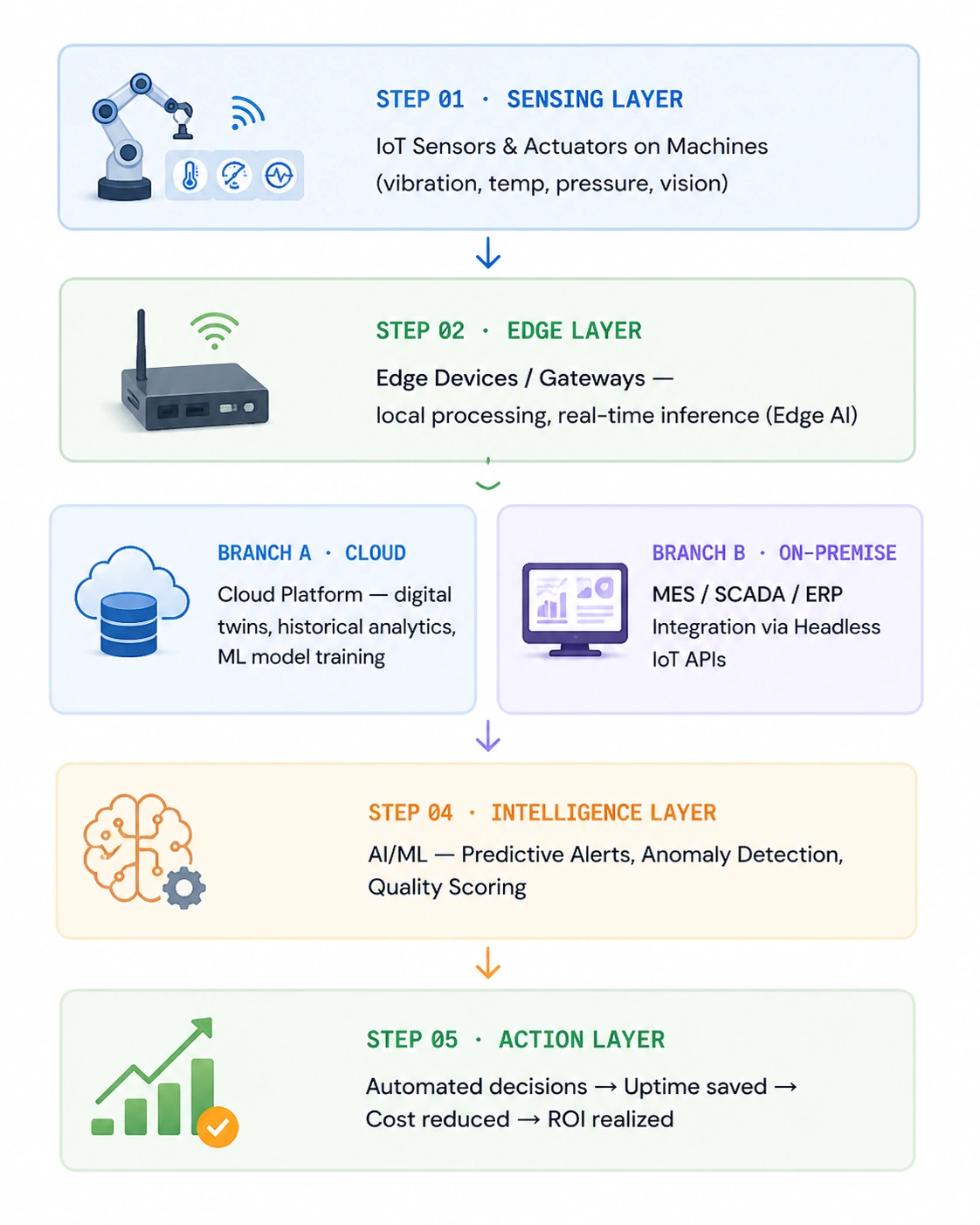
How IoT Data Becomes Manufacturing ROI

This is the complete path from a sensor on a machine to a dollar saved on your P&L. Every trend in this blog lives somewhere in this flow.

How IoT Data Becomes Manufacturing ROI

1. AI-Powered Predictive Maintenance

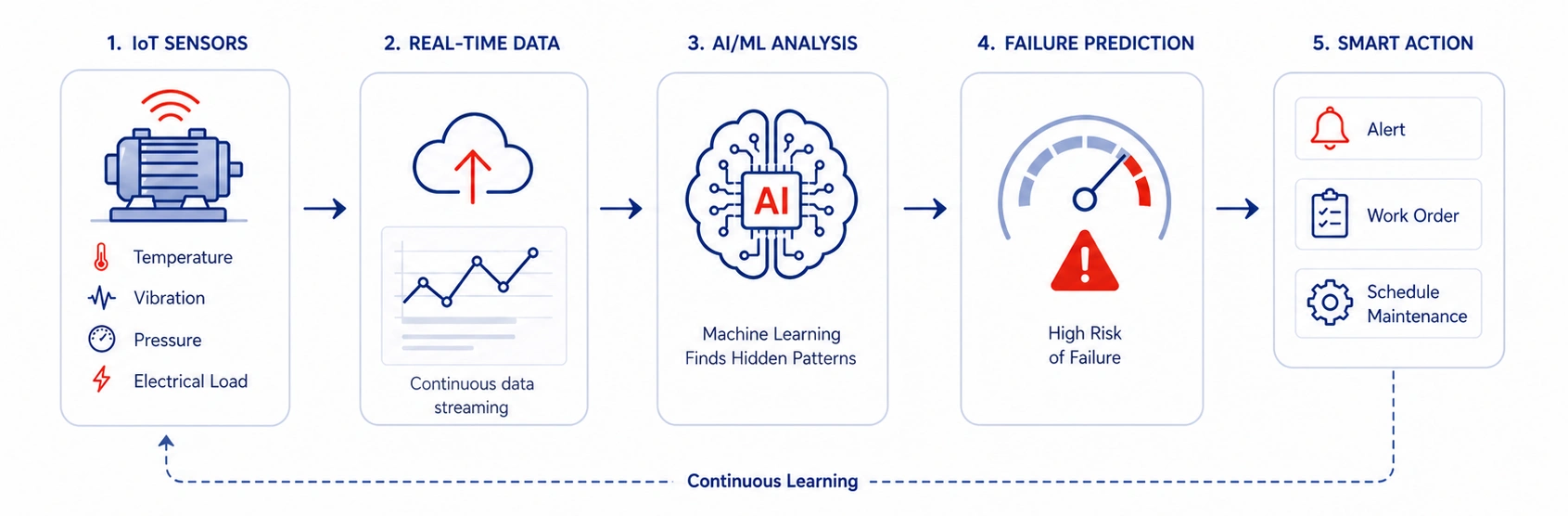
AI-Powered Predictive Maintenance in manufacturing

Forget scheduled maintenance. In 2026, the smartest U.S. plants are predicting failures before they happen, with remarkable accuracy.

IoT sensors collect temperature, vibration, pressure, and electrical load data in real time. Machine learning models then find the patterns that humans can’t see.

Predictive Maintenance ROI Formula

Annual Savings = (Unplanned Downtime Hours × Hourly Production Loss) – PdM System Cost

Example: 200 hrs/yr × $10,000/hr − $800,000 system cost = $1,200,000 net savings

Industry avg: maintenance costs drop 10–40% | Downtime cut by up to 70–90%

 USA Case Study: General Motors (Detroit, Michigan)

General Motors (GM) has implemented AI-driven predictive maintenance across its manufacturing plants, using IoT sensors and machine learning models to monitor equipment health in real time. This approach has significantly reduced unplanned downtime and improved maintenance efficiency across production lines.

Similarly, Ford has deployed IoT-enabled predictive maintenance systems that track machine parameters such as temperature, pressure, and vibration. These systems identify early signs of equipment issues, allowing teams to act before failures occur.

In practice, these systems generate alerts and insights based on real-time data, helping maintenance teams prioritize high-risk equipment and reduce unnecessary interventions.

The result: More reliable operations, better resource allocation, and fewer unexpected breakdowns.

Source: How Predictive Maintenance Transforms Manufacturing

2. Digital Twins (The Virtual Factory)

Digital Twins as IOT Treands in manufacturing

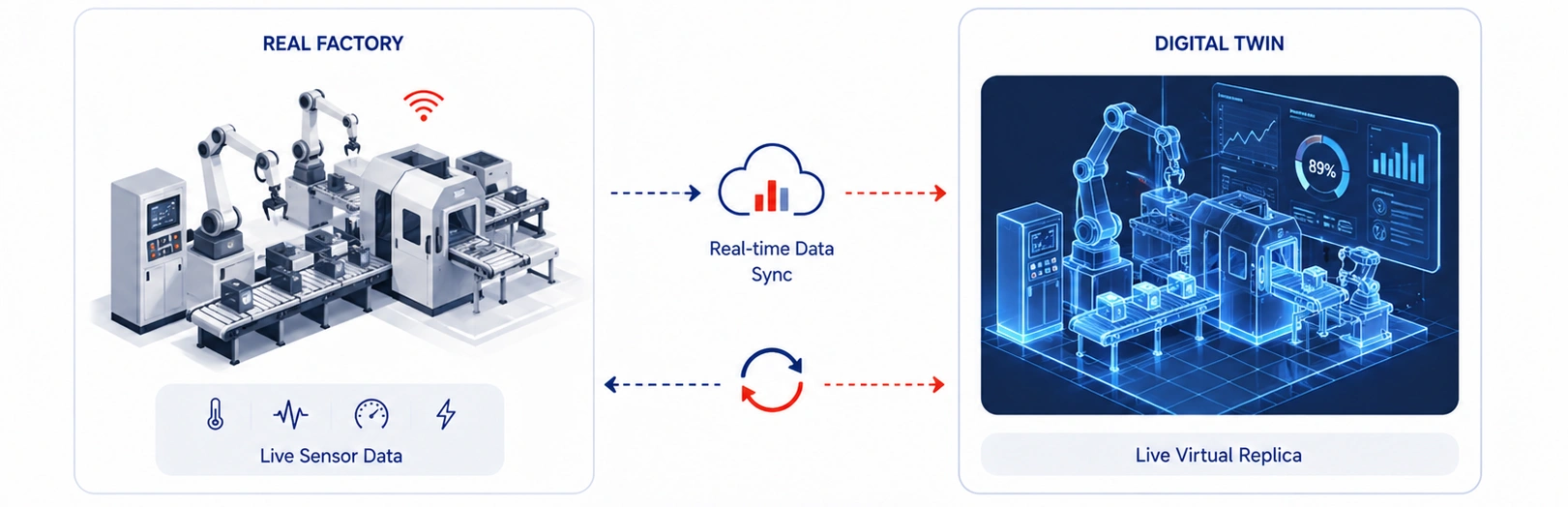
A digital twin is exactly what it sounds like: a live, data-fed virtual replica of your physical machine, production line, or entire plant.

Think of it as a flight simulator for your factory floor, you can run crash tests, stress scenarios, and optimization experiments without ever touching real equipment.

What Digital Twins Actually Do

They simulate production lines before construction. They predict equipment failure patterns.

They let engineers test design changes virtually before committing to costly physical modifications.

Moreover, they continuously sync with real-world sensor data, so the twin is never a static model. It’s always live.

USA Case Study: General Motors (Virtual Assembly Lines)

GM uses digital twins to simulate production lines before they’re even built, optimizing planning and saving significant time and money.

Their AI system also uses digital twins to simulate Gas Metal Arc Welding processes, predicting and mitigating weld distortion during the design phase, before a single weld is made on the shop floor.

According to McKinsey, 70% of C-suite technology executives at large enterprises are already exploring or investing in digital twins.

3. Edge Computing + Edge AI  (Where Speed Lives)

Edge Computing + Edge AI

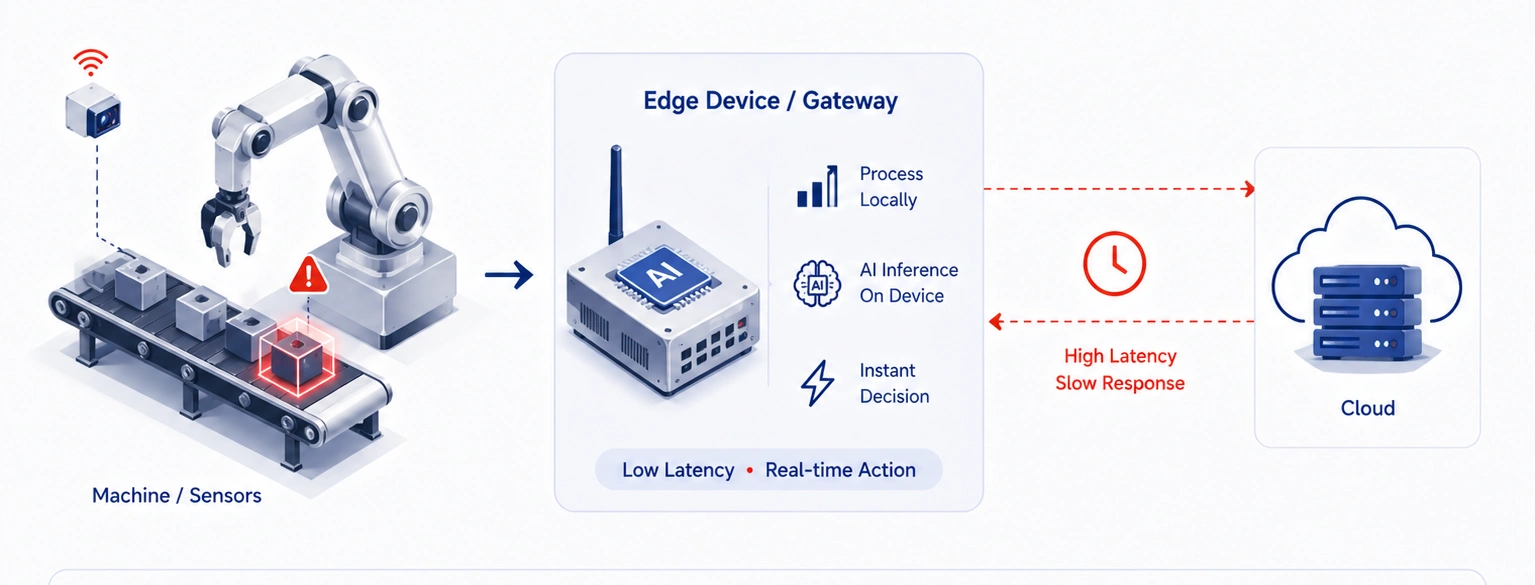
Here’s the problem with cloud-only IoT: if a robotic arm on your assembly line detects a defect, sending that data to a cloud server in Virginia and waiting for a response takes time.

In manufacturing, milliseconds matter. A 200ms delay in a high-speed line can mean three defective parts get packaged and shipped before the signal even returns.

Edge computing solves this by processing data locally, on the factory floor, at the gateway, right next to the machine. Then Edge AI takes it further by running machine learning inference on the device itself. No cloud round-trip. No latency tax.

87% of manufacturers agree devices must become more intelligent and process data on the edge (Eseye IoT Adoption Report).

Global edge computing investment reached $261 billion in 2025 (IDC) and is growing at 13.8% CAGR toward $380B by 2028.

In 2025, Qualcomm acquired Edge Impulse, specifically to unify edge AI model development and deployment at the IoT hardware level.

Meanwhile, YOLO-based object detection models running on industrial edge hardware achieved real-time inference at 52–65 frames per second in lab tests, enough to inspect products on a moving conveyor belt in real time.

4. Headless IoT  (The Architecture Nobody’s Talking About)

Headless IoT trends in manufacturing

Traditional IoT systems were never designed for today’s complexity. Devices, data processing, and user interfaces were tightly connected, which made even small changes risky and slow. As factories added more sensors, systems, and use cases, this tightly coupled approach started breaking down.

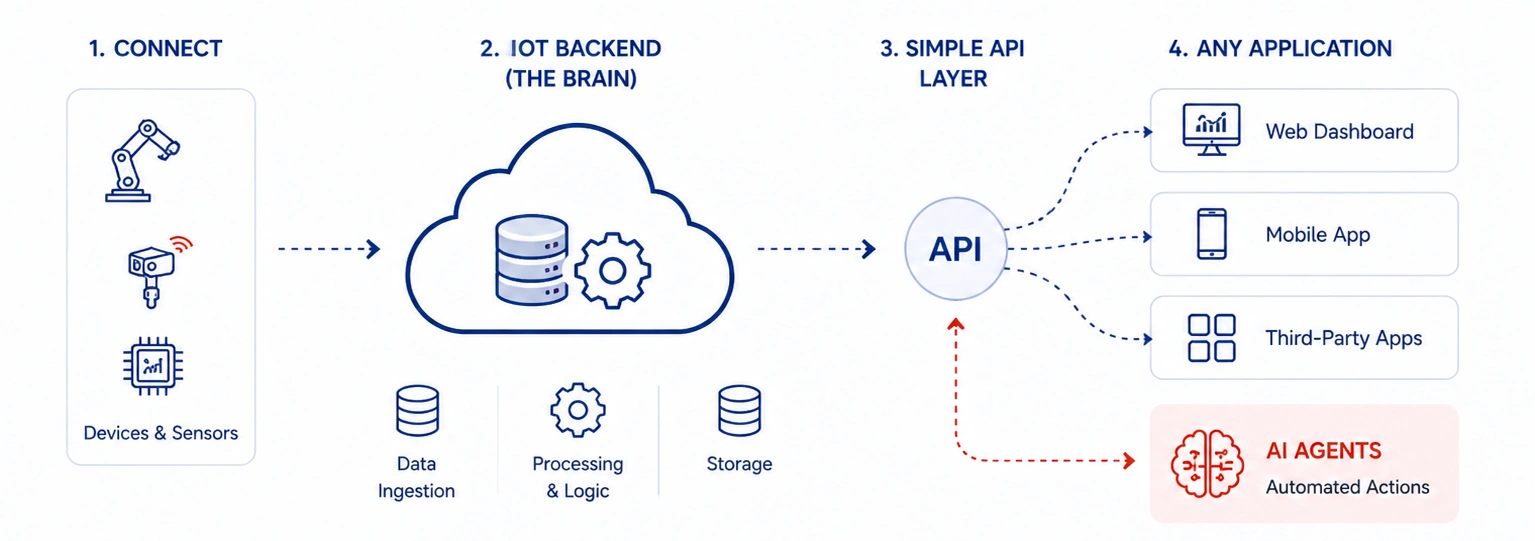
Headless IoT solves this by separating the core system (data, devices, logic) from how that data is used. Instead of one rigid system, you get a flexible architecture where multiple applications, platforms, and AI systems can work on the same data without disrupting each other.

→ Devices and sensors send data continuously from machines
→ Data is processed and stored in a central backend (the “brain”)
→ APIs make this data accessible to any system or application
→ Multiple platforms (MES, ERP, apps) use the same unified data layer
→ AI agents analyze data and take actions automatically

A modern factory runs on multiple protocols and systems at once:

→ Machines communicating via OPC-UA
→ Sensors connected through NB-IoT, Wi-Fi, or industrial networks
→ Systems exchanging data using MQTT and APIs

Headless IoT brings all of this together into one unified, structured data layer.

Explore “AI Agents in Industrial IoT” to understand how to use AI agents in industrial IoT in 2026.

5. IIoT Cybersecurity (Zero Trust is the New Standard)

More connected devices mean a larger attack surface. And attackers know it. In 2025, data manipulation was detected 3× more often than the next most-common attack technique across manufacturing environments (Nozomi Networks).

Meanwhile, CISA released 241 advisories impacting 70 ICS vendors in 2024 alone.

The old approach, “trust everything inside the firewall”, is dead. Zero Trust assumes nothing is safe by default. Every device must authenticate. Every connection must be verified. Every firmware must be signed. Every API endpoint must be scoped.

What Zero Trust IoT Looks Like in Practice

Certificate-based mutual TLS for all device-to-cloud communications. Secret rotation via HashiCorp Vault. Network micro-segmentation at the edge gateway layer. Software Bill of Materials (SBOM) management.

Firmware lifecycle tracking from first flash to decommission. Furthermore, regulations are catching up, the EU Cyber Resilience Act now mandates security-by-design for connected devices, setting a new global baseline.

35% of businesses report cybersecurity as their top IIoT implementation challenge (IIoT World). The most common attack vector? Brute-force SSH/Telnet credential attacks on poorly configured IoT devices. One compromised sensor can become a beachhead into your entire OT network.

6. 5G-Enabled Smart Factories (The Connectivity Leap)

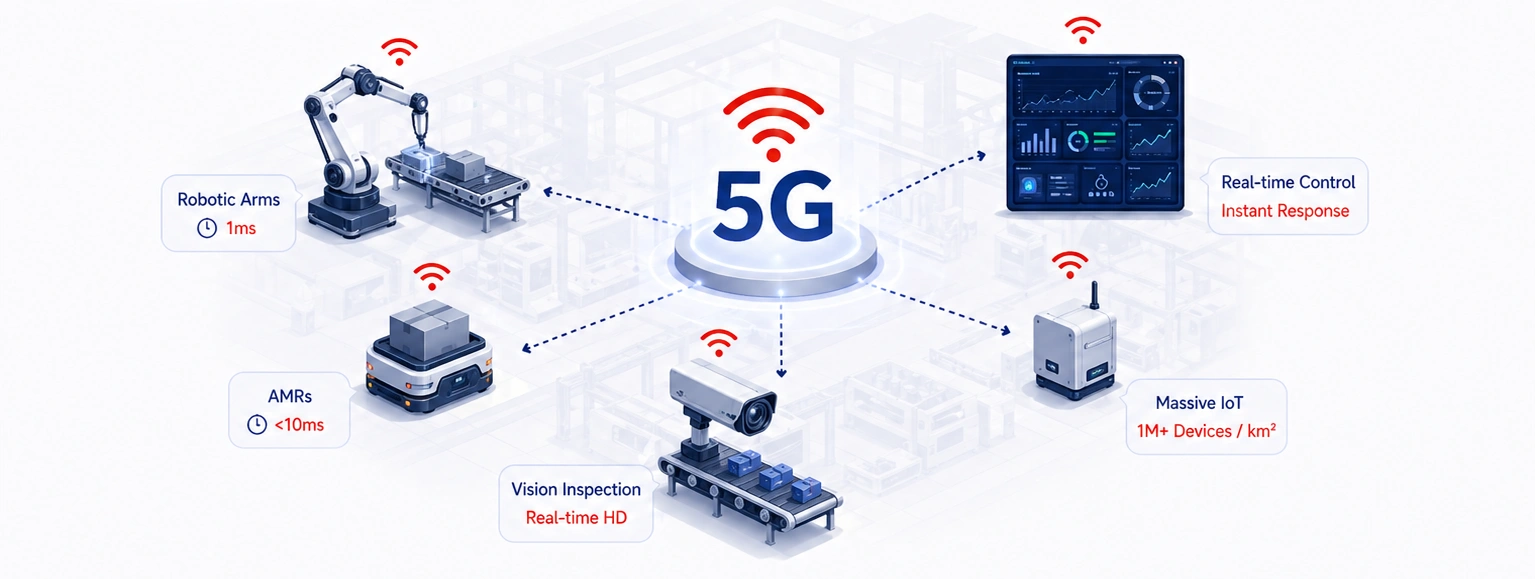
5G-Enabled Smart Factories

Wi-Fi is fine for your phone.

It’s not fine for a 47,000 sq ft factory floor with 600 sensors, 40 autonomous mobile robots (AMRs), and 12 high-speed vision inspection cameras all running simultaneously.

5G changes that equation completely.

With latency as low as 1ms and support for up to 1 million devices per square kilometer, 5G enables a density and responsiveness that Wi-Fi simply cannot match.

Real-time closed-loop control of robotic arms. Simultaneous HD video feeds from every inspection point. AMRs responding to floor changes in under 10ms.

5G + IoT in U.S. Manufacturing

U.S. carriers are actively partnering with manufacturers to deploy private 5G networks on factory floors.

These private networks keep sensitive OT data off public infrastructure entirely, which solves both the latency and security problem in one move.

Verizon, AT&T, and T-Mobile have all announced industrial 5G partnerships with U.S. manufacturing sites, with automotive, aerospace, and electronics leading adoption.

7.Sustainable IoT (Green Manufacturing is Now a Metric)

Sustainable IoT trend in manufacturing

ESG is no longer a PR exercise. U.S. manufacturers face real regulatory pressure, from SEC climate disclosure rules to EPA compliance, and IoT is becoming the backbone of sustainability compliance.

Additionally, customers increasingly demand proof of responsible production.

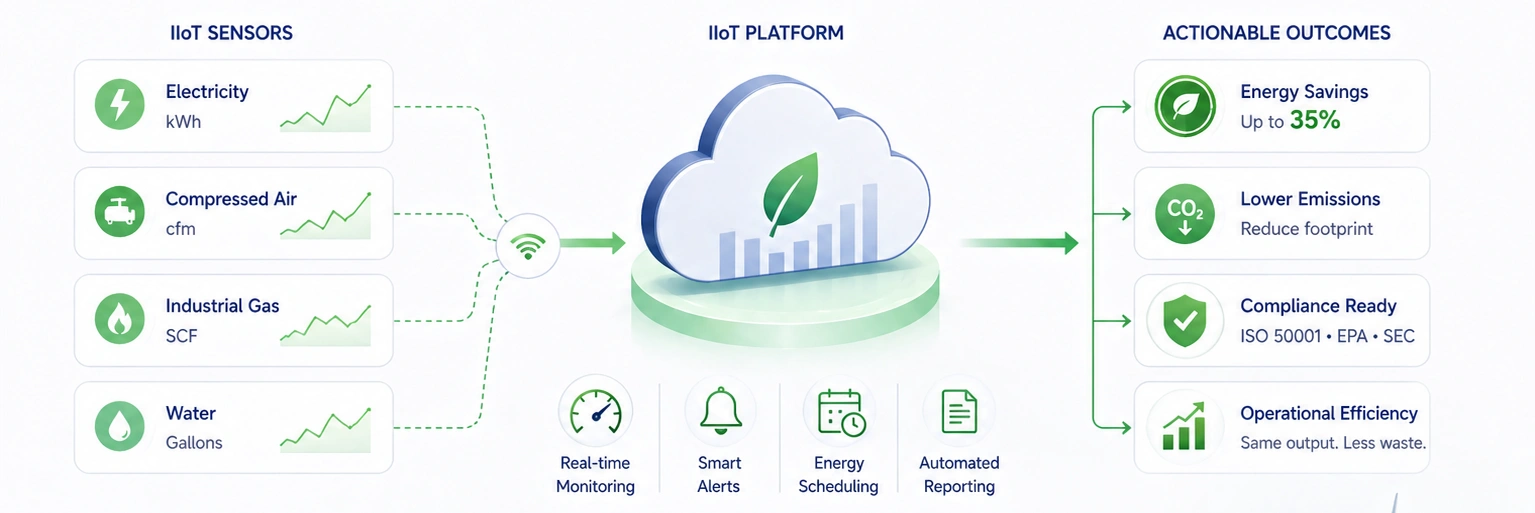
IIoT energy monitoring systems track electricity, compressed air, industrial gas, and water consumption across production lines.

They alert operators when limits approach, enable shift-based energy scheduling, and produce ISO 50001-aligned reports automatically.

Furthermore, IoT-enabled systems can cut energy consumption by up to 35% while maintaining full production throughput.

USA Case Study

Tesla’s Gigafactory uses IoT sensors and analytics to manage energy across the entire facility. Real-time monitoring of solar generation, battery storage, HVAC, and production equipment enables dynamic load balancing.

The factory targets net-zero carbon for its manufacturing operations, and IoT is the measurement and control layer that makes that goal trackable.

The Factories That Win in 2026

The 7 IoT trends in manufacturing covered here are not independent forces. They stack. Predictive maintenance generates data that feeds digital twins.

Edge AI makes 5G even more powerful. Headless IoT architectures make all of it scale gracefully. Zero Trust security makes all of it trustworthy. And sustainable IoT ties it to the ESG targets your board is asking about.

The question for every U.S. manufacturer in 2026 is no longer “should we invest in IoT?”

It’s “how do we close the gap between where we are and where this technology is going?” Because the competitors who answer that question first will be very hard to catch.

One thing is certain: the factory floor that runs on real-time data, edge intelligence, and connected systems will produce more, waste less, and respond faster than the one that doesn’t.

The math isn’t complicated. The execution is the hard part, and that’s exactly where the right partner makes all the difference.

Build Smarter Manufacturing Systems with IoT Trends in Manufacturing

Azilen is an Enterprise AI Development Company that helps organisations design and scale solutions aligned with the latest IoT Trends in Manufacturing, delivering real and measurable business impact.

Instead of complex setups and disconnected systems, the focus stays on building systems that are scalable, efficient, and ready for real factory environments.

What we help with:

→ Architecture design based on modern IoT Trends in Manufacturing
→ Predictive maintenance and real-time monitoring solutions
→ Agentic AI integration for automated decision-making
→ Scalable deployment across factories, devices, and operations

Whether the goal is reducing downtime, improving efficiency, or enabling automation, aligning with the right IoT Trends in Manufacturing drives long-term success.

Connect with our IoT and AI experts to build a smart manufacturing system that fits your scale, speed, and business goals.

IoT App Development
Build Smart Manufacturing Systems with IoT and AI
See how our Enterprise AI Development Company designs, develops, and scales solutions 👇

FAQs: Future of IoT in Manufacturing

1. What are the top IoT trends in manufacturing in 2026?

The top IoT Trends in Manufacturing include predictive maintenance, digital twins, edge AI, headless IoT architecture, and agentic AI. These trends focus on reducing downtime, improving efficiency, and enabling real-time decision-making. Manufacturers are moving from basic data collection to fully automated and intelligent systems.

2. How is IoT used in manufacturing?

IoT in manufacturing connects machines, sensors, and systems to collect real-time data. This data helps in monitoring machine performance, predicting failures, improving production efficiency, and reducing manual work. It also supports automation through AI-driven decision-making.

3. What are the benefits of IoT in manufacturing?

IoT helps manufacturers reduce downtime, improve productivity, and lower operational costs. It also enables real-time monitoring, better decision-making, and improved product quality. Over time, it supports scalable and automated factory operations aligned with modern IoT Trends in Manufacturing.

4. How does IoT reduce downtime in manufacturing?

IoT reduces downtime through predictive maintenance. Sensors track machine conditions like vibration, temperature, and performance. When something unusual is detected, the system alerts teams or triggers automated actions before a failure happens, avoiding unexpected breakdowns.

5. What is the future of IoT in manufacturing?

The future of IoT Trends in Manufacturing is moving towards fully autonomous factories. With the rise of agentic AI and headless IoT, machines will not just collect data but also make decisions and take actions. This will lead to faster operations, lower costs, and highly efficient smart manufacturing systems.

Glossary

IoT (Internet of Things): A system where machines, sensors, and devices are connected to collect and share real-time data.

IoT Trends in Manufacturing: The latest ways manufacturers are using IoT to improve efficiency, reduce downtime, and automate operations.

Predictive Maintenance: A method where sensors detect early signs of machine failure so repairs happen before breakdowns.

Digital Twin: A virtual copy of a physical machine or process used to monitor, test, and improve performance.

Edge Computing: Processing data near the machine instead of sending it to the cloud, helping in faster decisions.

Agentic AI: AI systems that not only analyse data but also take actions automatically without human involvement.

Headless IoT: An IoT setup where the backend (data and devices) is separated from the frontend (applications), allowing flexible and scalable systems.

Real-Time Monitoring: Tracking machine performance and operations instantly as they happen.

MQTT Protocol: A lightweight communication method used by IoT devices to send and receive data efficiently.

Smart Manufacturing: A modern manufacturing approach where IoT, AI, and automation work together to improve productivity and decision-making.

google
Chintan Shah
Chintan Shah
Associate Vice President - Delivery at Azilen Technologies

Chintan Shah is an experienced software professional specializing in large-scale digital transformation and enterprise solutions. As AVP - Delivery at Azilen Technologies, he drives strategic project execution, process optimization, and technology-driven innovations. With expertise across multiple domains, he ensures seamless software delivery and operational excellence.

Related Insights

GPT Mode
AziGPT - Azilen’s
Custom GPT Assistant.
Instant Answers. Smart Summaries.