




Skip to content

Context Engineering for AI Agents: Why Giving the Model Less Makes It Work Better

Featured Image

Executive Summary

Context engineering is about giving AI agents the right information at the right time instead of overwhelming them with unnecessary context. This guide explains context engineering, context rot, context window optimization, prompt compression, and just-in-time retrieval.

→ Understand context engineering: Learn how prompts, tools, documents, chat history, and retrieved data shape what an AI agent sees.

→ Optimize AI context: Use context window optimization, prompt compression, just-in-time retrieval, and compact summaries to keep agent context focused.

→ Build better AI agents: Reduce unnecessary tokens, improve response quality, and help AI agents stay accurate and efficient as tasks become longer and more complex.

An AI agent can have access to thousands of documents, hours of conversation, and endless tool outputs.

But what if all that information is actually making it worse? The smarter approach may not be giving AI more context, but knowing exactly what to leave out.

That is the idea behind context engineering, giving an AI agent the right information, at the right moment, without the clutter. In this guide, we explore how to reduce context, avoid context rot, and help AI agents stay focused as their tasks grow.

“Context engineering is the delicate art and science of filling the context window with just the right information for the next step.”

— Andrej Karpathy

What Is Context Engineering?

Context engineering is the process of choosing what information an AI model should see at each step. This can include instructions, tools, documents, and chat history.

Think of it like an open-book exam. You would not bring the whole textbook. You would take only the pages you need to answer the questions.

The same idea applies to AI.

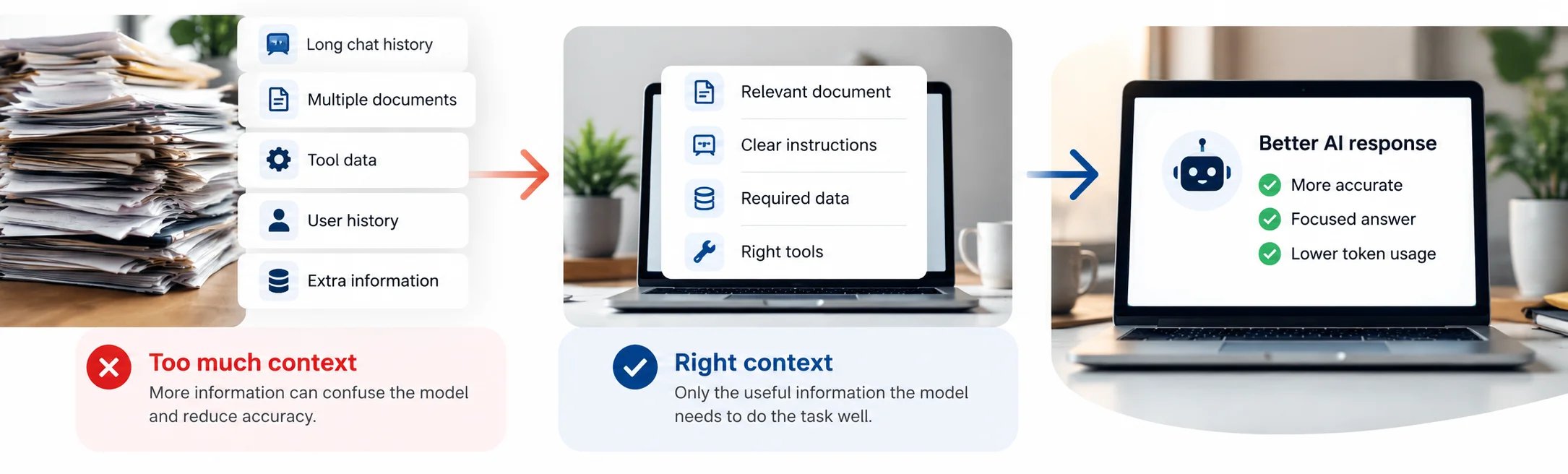
→ Too much context: The model has more information to process and may lose focus.
→ Right context: The model gets only the useful information and can respond better.

What Is Context Engineering

For example, if an AI agent needs to check an order, it may only need the order number, delivery status, and expected date, not the customer’s entire history.

More simple terms: context engineering means giving AI the right information, at the right time, without unnecessary data.

What Is the Difference Between Context Engineering vs Prompt Engineering?

Prompt engineering focuses on writing clear instructions that tell the AI what to do.

Context engineering goes one step further: it decides what information, tools, documents, and conversation history the model should receive at that moment.

Context engineering is a broader practice of managing the full set of tokens available to an AI agent. (source)

Dimension Prompt Engineering Context Engineering
What It Is Writing and improving instructions Selecting the information the model needs
What It Covers Prompts, instructions, examples Prompts, tools, data, memory, and chat history
When It Happens Mainly when designing or improving a prompt Continuously as the AI works and new information appears
Example Changing “Summarize this” to “Summarize this in 5 key points” Removing old tool results and retrieving only the documents relevant to the current task

For example, consider an AI customer-support agent. Prompt engineering defines how the agent should respond to customers and when it should escalate an issue.

Context engineering decides whether the agent needs the customer’s latest order, previous support messages, product information, or refund policy for that particular request.

This distinction becomes especially important for AI agents because they work across multiple steps and continuously collect new information. Sending everything into the next model call can create unnecessary context and make it harder for the model to focus on what matters.

What Is Context Rot, and Why Can More Context Make AI Worse?

Context rot is when an AI model becomes less accurate or less reliable as the amount of information in its context grows, even when the information still fits within its context window. Research has shown that models can struggle to use relevant information when it is buried inside long inputs. MIT Press Direct

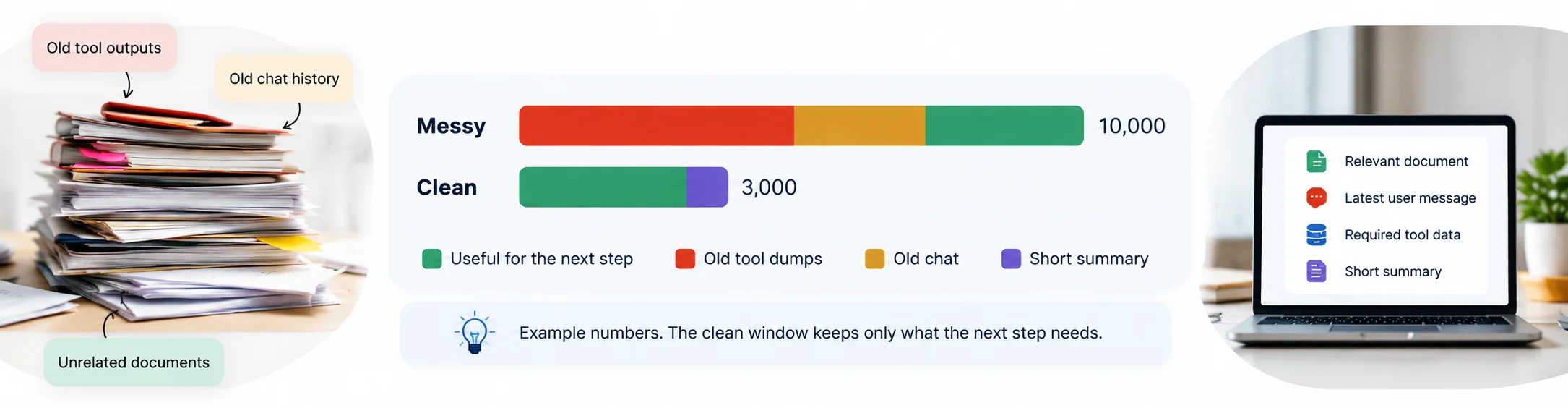
Left shows a pile of papers labeled 'Old tool outputs' and 'Unrelated documents'; center has a color-coded bar chart comparing 'Messy' and 'Clean' with numbers; right shows a laptop listing document tasks like 'Relevant document' and 'Latest user message'.

Why does this happen?

As more tokens are added, the model has more information to process and more relationships to consider. Important instructions or facts can compete with older messages, tool outputs, retrieved documents, and other irrelevant information.

For example, an AI support agent may receive:

→ 10,000 tokens: Old tool outputs + old chat + unrelated documents + useful information
→ 3,000 tokens: Relevant document + latest user message + required tool data + short summary

The clean context keeps only what the agent needs for the next step. That is 70% fewer tokens without removing the useful information.

Research has also found a “lost in the middle” effect: models can use information at the beginning or end of a long context more reliably than information buried in the middle. (ACL Anthology)

A larger context window gives AI more space, not unlimited attention. That is why context engineering focuses on sending the most relevant information instead of simply sending more information.

How to do Context Window Optimization?

Context window optimization means keeping the window small, clean, and useful. Follow these steps, from easiest to hardest.

1. Tighten the basics

Write a short, clear system prompt with only necessary rules. Add instructions when real failures show a need. Keep tools focused and avoid overlapping functions.

Use a few strong examples that guide behaviour instead of filling the prompt with every possible edge case.

2. Fetch data just in time

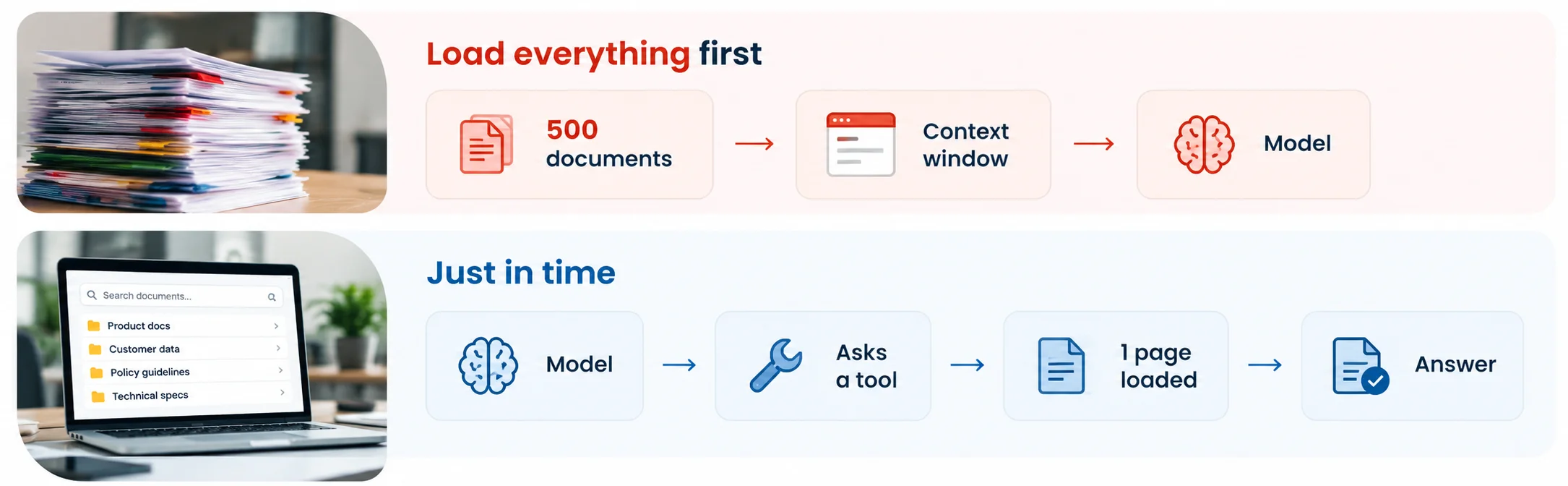
Keep references to documents instead of loading everything into the context. When the agent needs specific information, retrieve only the relevant page, section, or record.

This keeps the context focused, reduces unnecessary tokens, and gives the model cleaner information for its next step.

3. Clear old tool results

After a tool finishes, remove raw results when they are no longer needed. Keep only the important information for the next step.

This reduces clutter and prevents old tool outputs from competing with newer, more relevant information in the context window.

4. Compact long chats

When a conversation becomes long, create a compact summary before reaching the context limit. Keep important decisions, user requirements, unresolved questions, and useful facts.

Remove repeated messages, outdated details, and unnecessary outputs so the agent can continue without carrying everything forward.

5. Take notes outside the window

Store important progress outside the active context window. An agent can write decisions, completed steps, important findings, and remaining tasks into a structured notes file.

Later, it can retrieve those notes when needed instead of keeping the entire conversation in memory.

6. Use sub-agents

1. Use sub-agents for tasks that require large amounts of information. A sub-agent can process documents or research using a large context, then return only the important findings.

The main agent receives a shorter summary, reducing context size while preserving useful information.

What Is Just-in-Time Retrieval?

Just-in-time retrieval means the AI agent keeps small pointers, such as file paths, database queries, document IDs, or links, and loads the actual information only when it needs it.

What Is Just-in-Time Retrieval

For example, instead of loading an entire customer database, an agent retrieves only the customer record required for the current task.

The trade-off: retrieval can add latency, and the agent needs reliable tools to find the right information. Many systems therefore combine preloaded context with just-in-time retrieval, depending on the task.

What Is Prompt Compression, and When Should You Use It?

Prompt compression means reducing the number of words or tokens in a prompt while keeping the important meaning. It is useful when long context contains repeated, outdated, or low-value information.

Technique What It Does Watch Out
Tool Result Clearing Removes old tool outputs after they are no longer needed. Keep important information.
Compaction Summarizes long conversations into key points. Do not remove important decisions.
Prompt Compression Tools Removes less useful words and tokens automatically. Test accuracy after compression.

Use prompt compression when context is becoming too large, token usage is high, or repeated information is affecting performance.

What Does Context Engineering Look Like in a Real Agent?

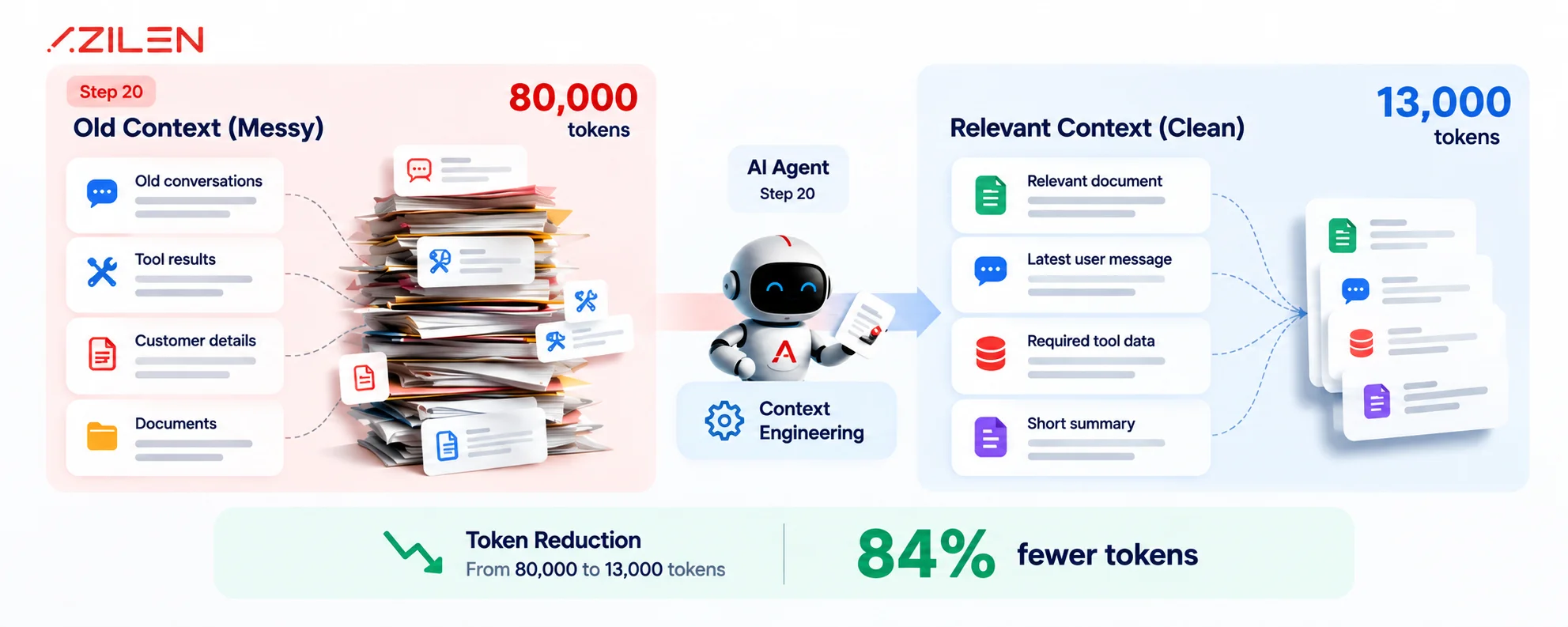
Take a customer support agent at step 20. By this point, it may have accumulated old conversations, tool results, customer details, and documents.

Instead of sending everything back to the model, context engineering keeps only what the agent needs for the next step.

Example:
→ Old context: 80,000 tokens
→ Relevant context: 13,000 tokens
→ Reduction: about 84% fewer tokens

What Does Context Engineering Look Like in a Real Agent

The result is a smaller, cleaner context that can reduce token usage and AI costs without removing information the agent actually needs.

Our guide on LLM token optimization covers the cost side in more detail.

How Does Azilen Do Context Engineering?

At Azilen, context engineering is part of the token optimization pillar in our APEX framework. We carefully control what an AI agent sees at each step and test answer quality after every change.

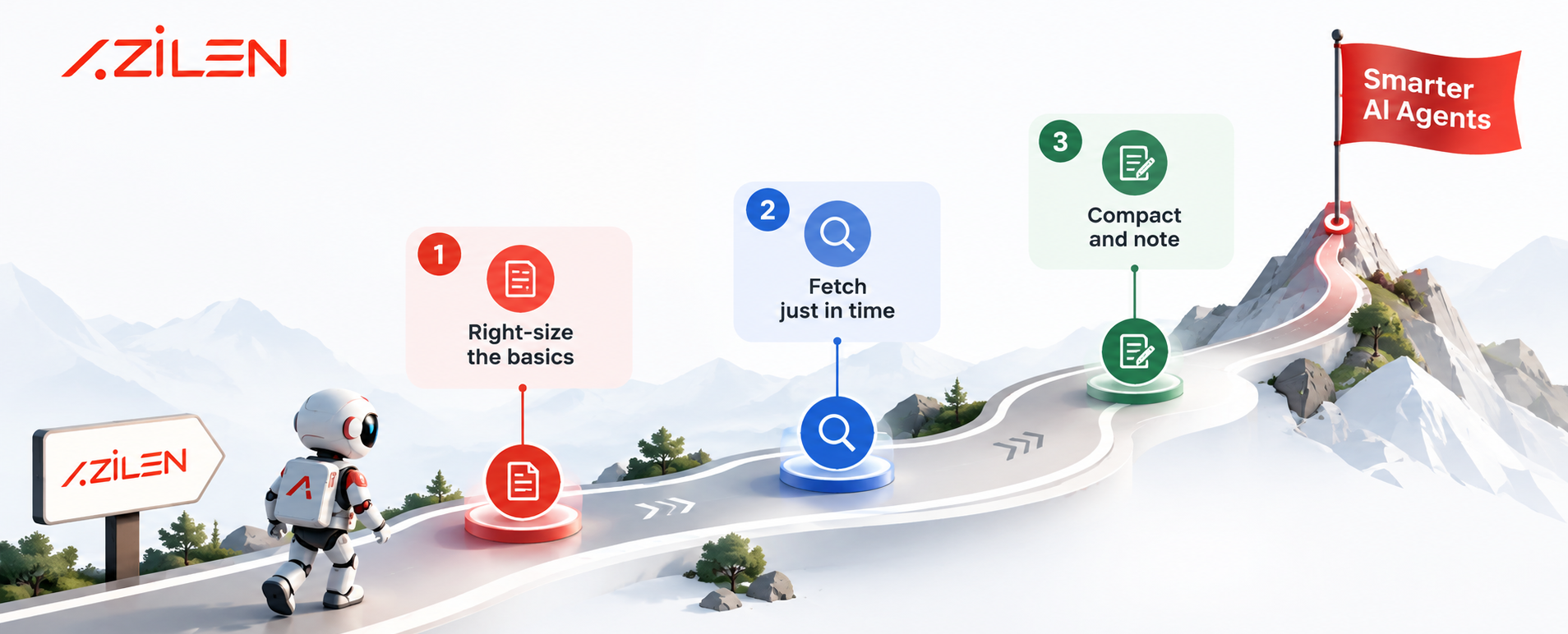
AZILEN AI Context Engineering Roadmap

Right-size the basics

→ Keep system prompts short and focused.
→ Use only the tools the agent actually needs.
→ Add strong examples instead of long instructions.

Fetch just in time

→ Keep pointers to documents and data.
→ Retrieve information only when needed.
→ Avoid loading large datasets into every step.

This approach works especially well when building LLM Development Services that use RAG, retrieval, orchestration, and enterprise data.

Compact and note

→ Summarize long conversations as they grow.
→ Clear old tool outputs when they are no longer useful.
→ Store important decisions and progress in notes.

For production AI agents, this connects closely with AI Agent Development Services, where agents need to work across tools, workflows, and enterprise systems.

Good context also depends on good data foundations. Data Engineering Services help keep the data pipelines and infrastructure behind these AI systems reliable and accessible.

Azilen team culture

Balance Guides Us

Our logo is inspired by orbits, where two forces keep a planet steady. Context needs the same balance: enough information to make the right decision, but not so much that the agent loses focus.

Our "ORBIT values -Openness and Trust" also mean making the agent's context visible and understandable, so teams can see what information is influencing AI decisions.

What Mistakes Should You Avoid in Context Engineering?

Context engineering is not about removing as much information as possible. It is about keeping the information that helps the agent make the right decision.

→ Dumping everything “just in case”: Sending complete chat history, documents, and tool outputs may seem safer, but it adds noise and increases token usage. Give the agent only the information relevant to its current task.

→ Using too many tools: More tools do not always make an agent better. If several tools have similar purposes or unclear descriptions, the agent may choose the wrong one. Keep tools focused, clearly named, and easy to distinguish.

→ Adding a laundry list of edge cases: Trying to describe every possible situation can make prompts long and difficult to follow. Use a few clear and diverse examples that show the expected behaviour instead of documenting every exception.

→ Cutting context too aggressively: Removing too much information can create a different problem. Important customer details, previous decisions, or task requirements may disappear. Compress context carefully and test whether the agent still produces the right answer.

→ Treating context engineering as one-time work: Context changes as conversations grow, tools return new data, and workflows evolve. Review what the agent receives regularly and remove information that is no longer useful.

Optimize Your AI Context Without Compromising Quality

With 17+ years of experience as an Enterprise AI Development Company, Azilen helps enterprises build AI solutions that are efficient, scalable, and ready for real-world use. Our approach to context engineering helps AI agents use the right information at the right time, reducing unnecessary context while keeping responses accurate and useful.

→ Optimize AI context: Reduce unnecessary tokens, remove outdated information, and keep every agent step focused.

→ Build smarter AI agents: Use context engineering, just-in-time retrieval, prompt compression, and intelligent context management.

→ Scale with confidence: Build reliable, secure, and scalable AI agents that can handle longer, more complex workflows.

The goal is not to give AI more information. It is to give AI the right information at the right moment. Azilen helps enterprises find that balance between context, performance, quality, and cost.

Giving AI Too Much Context?
See how Azilen helps enterprises build smarter, more efficient, and production-ready AI agents with context engineering.

Top FAQs on Context Engineering

1. What is context engineering in AI agents?

Context engineering is the process of selecting and managing the information an AI agent needs at each step, including prompts, tools, documents, chat history, memory, and retrieved data.

2. What should I cut first when optimizing LLM token usage?

More context can introduce irrelevant information, repeated data, and outdated tool results. This can make important information harder for the model to identify and increase token usage without improving the answer.

3. How can I reduce the context window size without losing important information?

Remove outdated tool outputs, summarize long conversations, retrieve documents only when needed, and keep important decisions in structured notes. The goal is to remove unnecessary information, not useful context.

4. Can Azilen help build AI agents with context engineering?

Yes. Azilen helps enterprises build AI agents using approaches such as context management, retrieval, RAG, tool orchestration, and LLM optimization to create efficient and production-ready AI solutions.

5. How does Azilen optimize LLM and AI agent performance?

Azilen focuses on the information an agent receives, how it retrieves data, and how it manages context across multiple steps. This can help enterprises balance AI performance, response quality, token usage, and scalability.

author avatar
Swapnil Sharma Vice President – Strategic Consulting
Swapnil Sharma is VP – Strategic Consulting at Azilen Technologies with expertise in digital transformation, presales, and business strategy. He has led 750+ RFPs and helps organizations drive technology-led growth through consultative solutions.
google
Swapnil Sharma
Swapnil Sharma
VP - Strategic Consulting

Swapnil Sharma is a strategic technology consultant with expertise in digital transformation, presales, and business strategy. As Vice President - Strategic Consulting at Azilen Technologies, he has led 750+ proposals and RFPs for Fortune 500 and SME companies, driving technology-led business growth. With deep cross-industry and global experience, he specializes in solution visioning, customer success, and consultative digital strategy.

Related Insights

GPT Mode
AziGPT - Azilen’s
Custom GPT Assistant.
Instant Answers. Smart Summaries.