


Skip to content

AI Control Plane: The Enterprise Architecture for Governing AI at Scale

Featured Image

Executive Summary

An AI control plane provides a centralized layer for managing, governing, securing, and monitoring AI across an enterprise. It connects models, agents, data, applications, tools, policies, and users through consistent controls, giving organizations the visibility and operational control required to scale AI safely.

→ Centralize AI visibility across models, agents, applications, and integrations.
→ Enforce policies at runtime instead of relying only on documentation.
→ Control identity, permissions, data access, and AI actions.
→ Monitor performance, risk, usage, cost, and compliance continuously.

The result is a more controlled AI environment where enterprises can scale AI without allowing AI sprawl to become an operational blind spot.

An enterprise can deploy its first AI application without an AI control plane.

The problem starts when there are 10 models, 50 AI applications, hundreds of workflows, multiple providers, and increasingly autonomous agents operating across the organization.

At that point, the question changes. It is no longer: “Can we build AI?”

It becomes: “Can we control everything AI is doing?”

Enterprise AI is inherently distributed. Models may come from different providers, agents may run across cloud and on-premise environments, and AI systems can connect to databases, APIs, business applications, documents, and enterprise workflows. Current AI control-plane architectures are emerging specifically to address this fragmentation through centralized management, policy enforcement, observability, and governance.

And there is another important shift.

AI is moving from generating answers to taking actions.

An agent can retrieve information, call a tool, update a record, trigger a workflow, or make a recommendation that influences a business decision. That means enterprise AI needs more than a governance policy.

The next challenge in enterprise AI is not giving AI more capabilities. It is giving enterprises more control over those capabilities.

98%

Companies have deployed or plan to deploy AI agents

21%

Enterprises report mature governance for agentic AI

26%

Organizations have real-time visibility into AI operating costs

What Is an AI Control Plane?

What Is an AI Control Plane

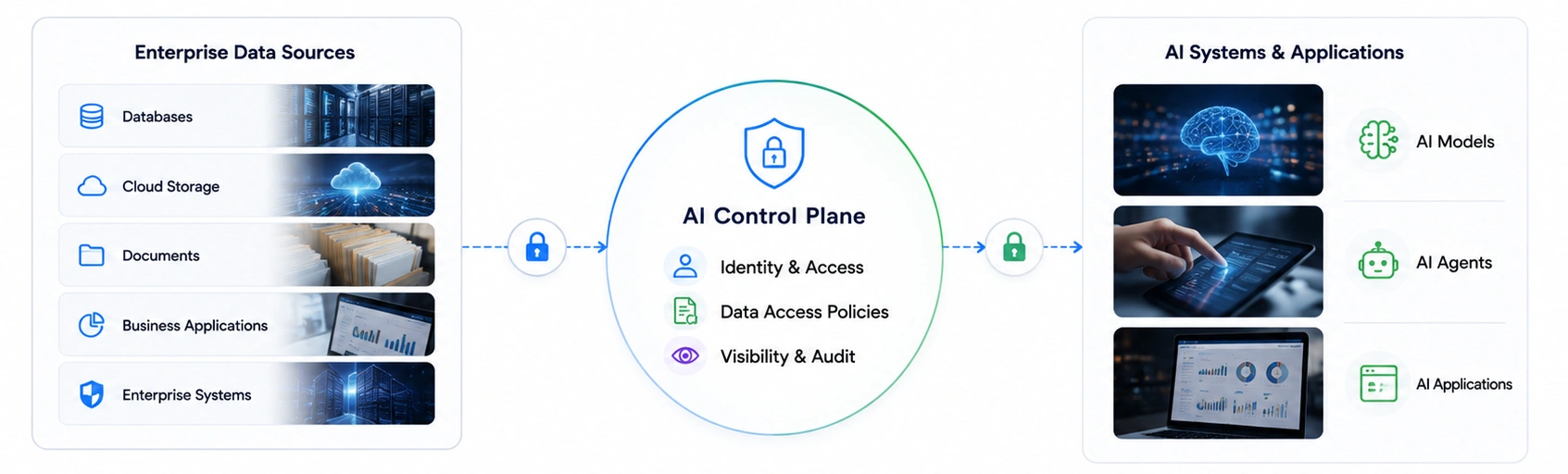
An AI control plane is an architectural layer that provides centralized management, governance, security, orchestration, and observability across an organization’s AI environment.

Instead of managing every model, agent, application, and workflow independently, the control plane creates a common layer through which enterprises can manage them.

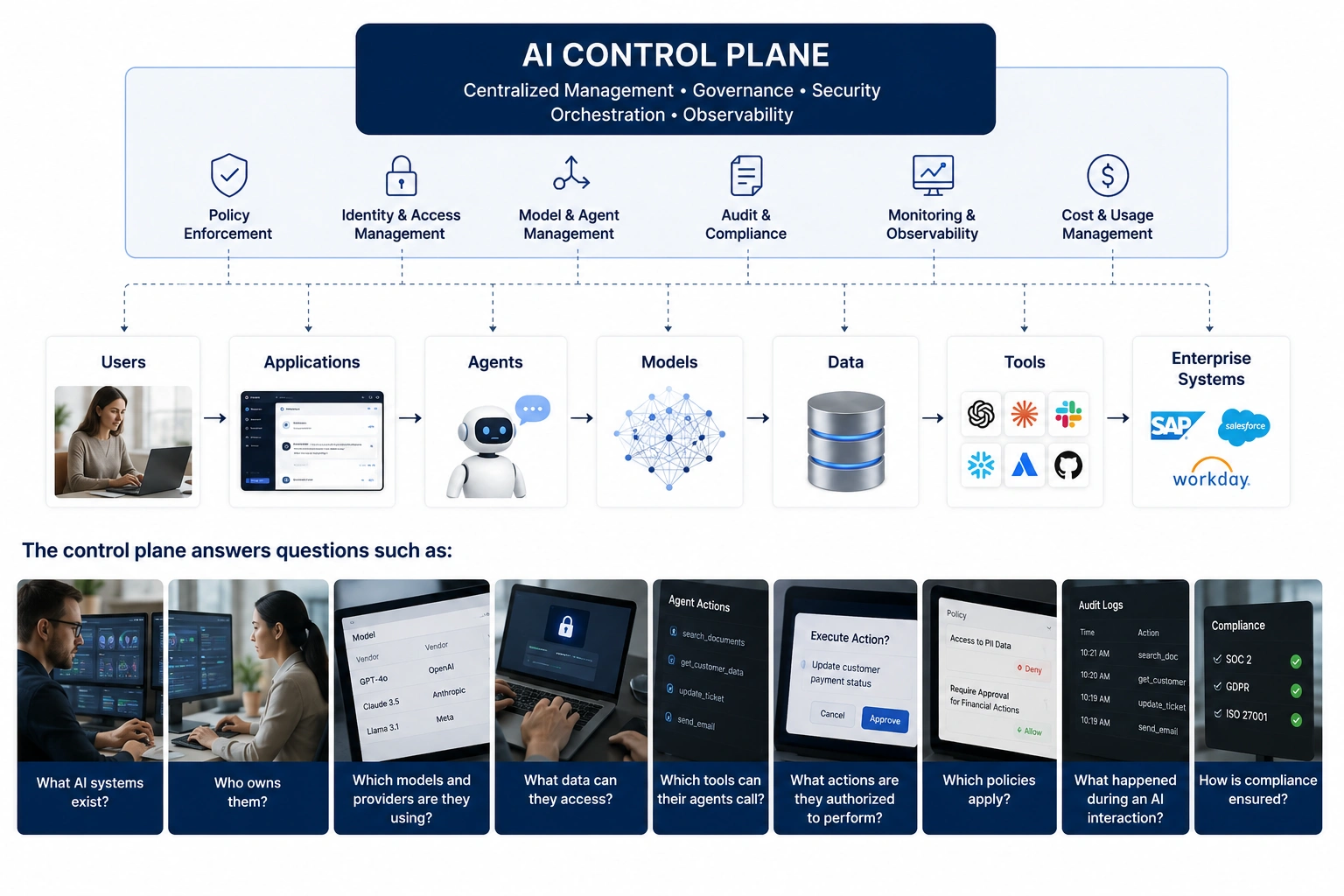
A typical enterprise AI control plane can sit across:

Users → Applications → Agents → Models → Data → Tools → Enterprise Systems

The control plane determines how these components interact and what controls apply to those interactions.

In infrastructure architecture, the distinction between a control plane and a data plane is well established: the control plane manages and directs activity while the data plane performs the actual workload. AI control-plane architectures apply this concept to increasingly distributed AI environments.

Enterprise AI Governance Discovery Call
Ready to Take Control of Enterprise AI?
Build governed, secure, and scalable AI systems with Azilen’s enterprise AI solutions.

Why Do Enterprises Need an AI Control Plane?

Why Do Enterprises Need an AI Control Plane

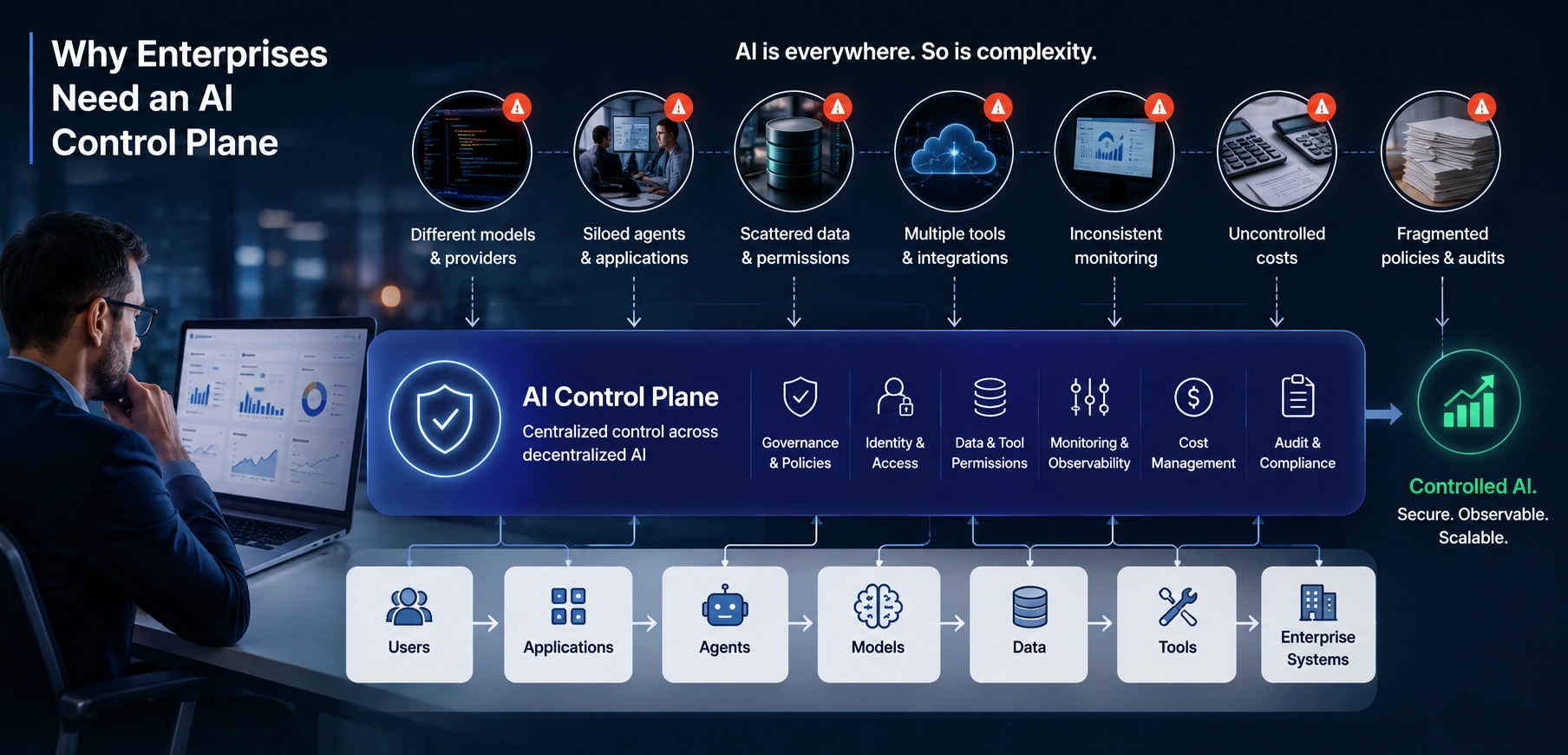
Enterprise AI is increasingly distributed across models, agents, applications, APIs, AI SaaS tools, data sources, and automated workflows. Without centralized oversight, each system can develop its own access controls, security policies, monitoring, costs, and audit processes, creating AI sprawl that becomes harder to manage as adoption grows.

An enterprise AI control plane solves this by providing a centralized layer for managing decentralized AI execution. It gives enterprises consistent control over identity, data access, security, policies, monitoring, costs, and AI actions without limiting teams from building and deploying AI where it creates business value.

AI Control Plane vs. AI Data Plane: What Is the Difference?

Understanding this distinction is essential when designing an enterprise AI architecture.

The data plane performs the AI work.

The control plane determines how that work is governed and managed.

AI Control Plane AI Data Plane
Defines policies Executes AI workloads
Manages identities Processes requests
Controls permissions Retrieves data
Routes workloads Runs model inference
Manages agents Executes agent tasks
Monitors systems Calls tools and APIs
Maintains audit records Produces AI outputs
Controls lifecycle Performs business actions

Consider an AI procurement agent.

The control plane determines that the agent can access supplier information but cannot approve purchases above a defined threshold.

The data plane executes the agent’s request, retrieves information, and performs the permitted workflow.

This separation creates an important architectural principle:

Control centrally. Execute where the workload belongs.

What Does an AI Control Plane Control?

A mature AI control plane should extend beyond model management.

It should provide visibility and controls across the entire AI lifecycle and execution environment.

1. AI Model Management

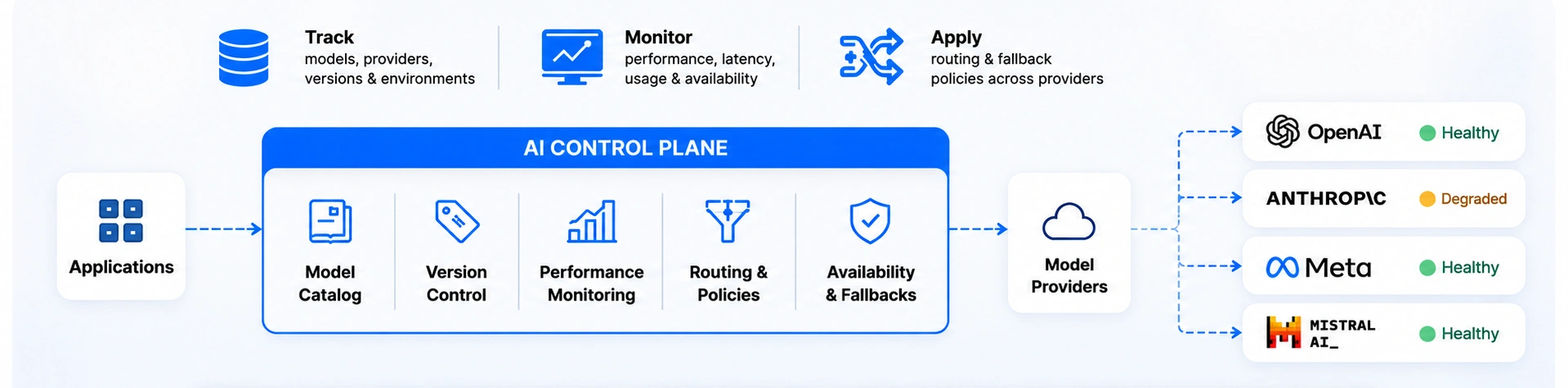
Enterprises may use multiple foundation, specialized, and fine-tuned models across applications and teams. An AI control plane provides a centralized layer to manage model providers, versions, performance, availability, and usage.

AI Model Management

→ Track models, providers, versions, and deployment environments.

→ Monitor model performance, latency, usage, and availability.

→ Apply routing and fallback policies across model providers.

Example: A customer-service application can use a lower-cost model for simple queries while routing complex requests to a more capable model.

A centralized model layer also gives enterprises the foundation needed to connect AI governance frameworks with actual model operations. You can learn more about building this foundation in our enterprise AI governance framework.

2. AI Agent Management

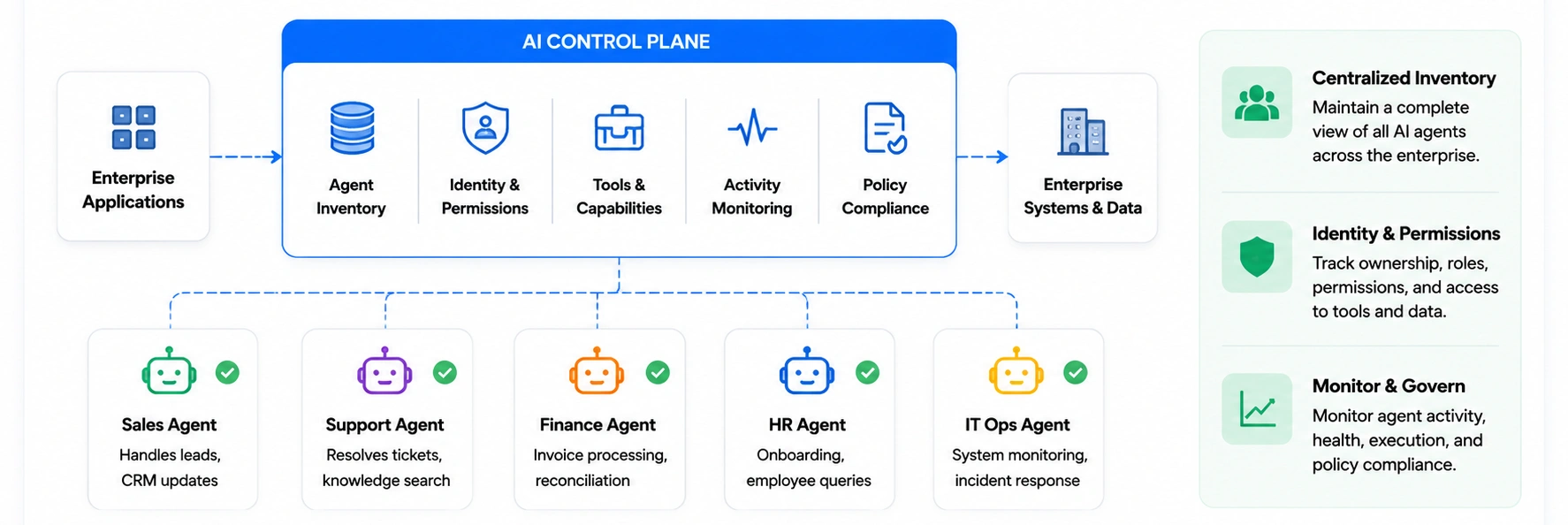
AI agents introduce a new management challenge because they can perform tasks, use tools, access systems, and execute workflows rather than simply generate responses. An enterprise AI control plane should therefore provide visibility across the entire agent ecosystem.

AI Agent Management

→ Maintain an inventory of enterprise AI agents and owners.

→ Track agent identity, permissions, tools, and capabilities.

→ Monitor agent activity, health, execution, and policy compliance.

Organizations building governed agents can also use AI Agent Development Services to design agents with defined workflows, enterprise integrations, monitoring, and controlled execution.

3. AI Identity and Access Control

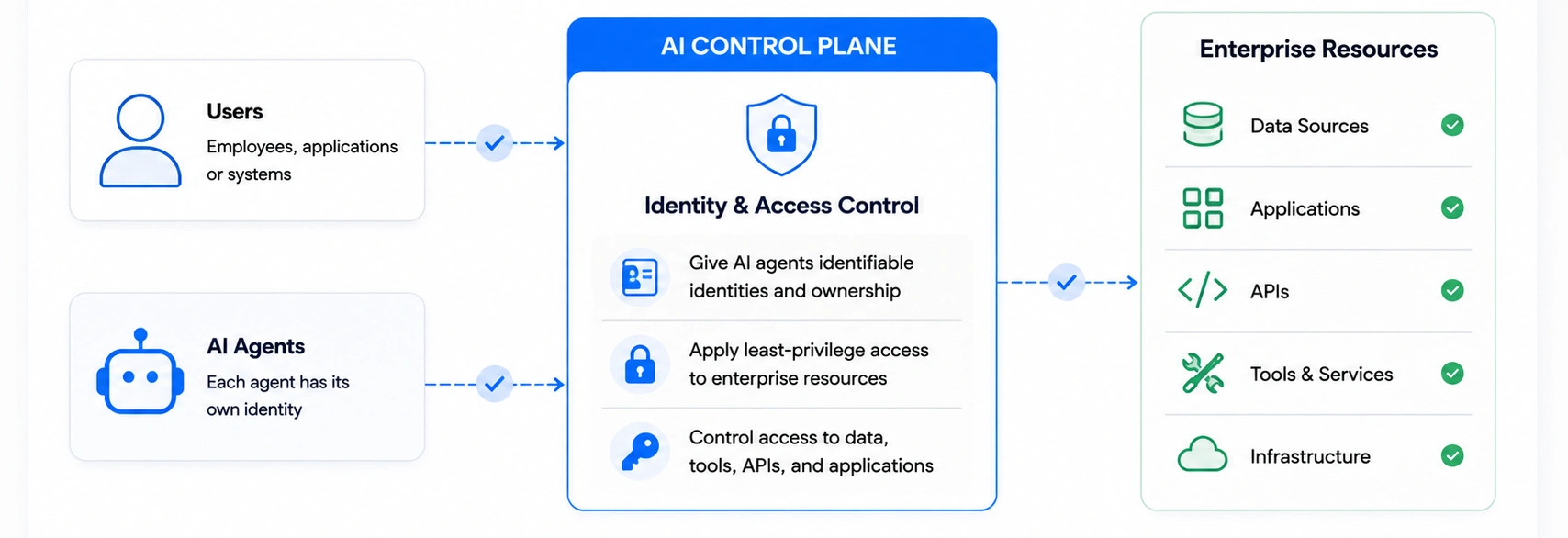
AI agents need identities and permissions just like traditional applications. An agent should never automatically receive unrestricted access simply because it was initiated by an authorized employee or enterprise application.

AI Identity and Access Control

→ Give every AI agent an identifiable identity and owner.

→ Apply least-privilege access to enterprise resources.

→ Control access to data, tools, APIs, and applications.

Example: A finance agent may retrieve approved financial records but remain unable to modify payment instructions without additional authorization.

4. Runtime AI Policy Enforcement

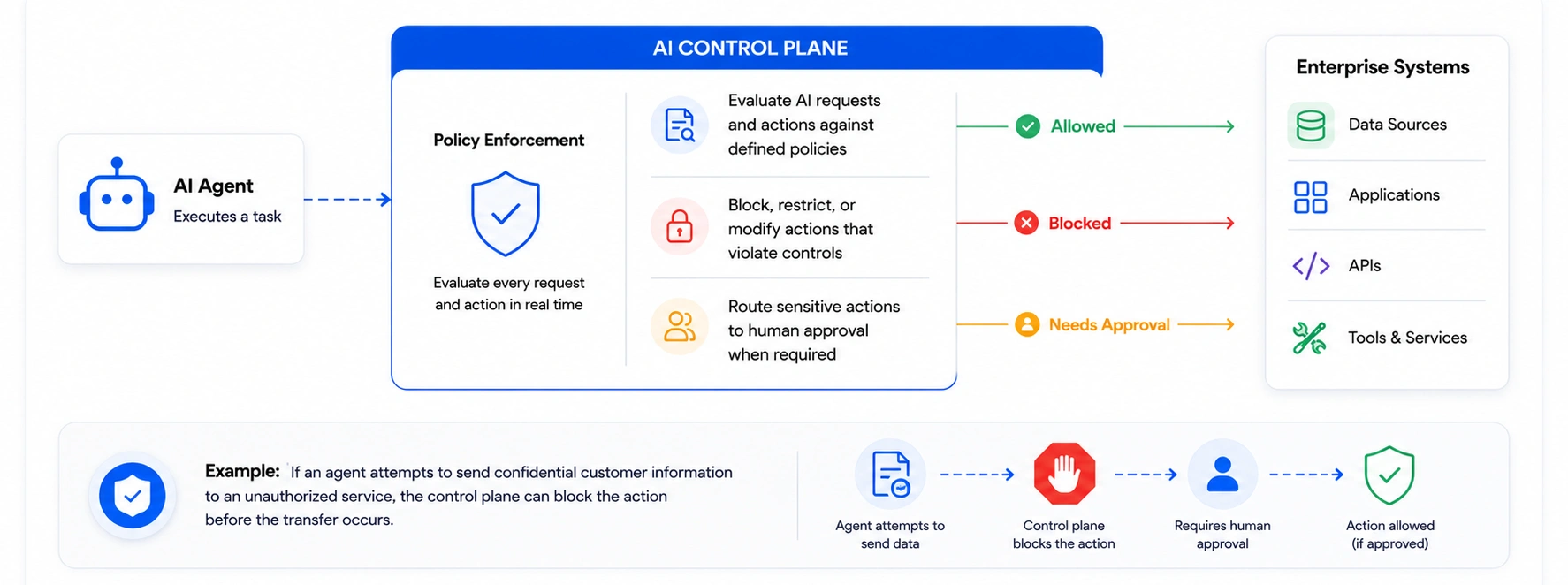
This is one of the most important differences between an AI governance document and an AI control plane. Governance defines what AI should be allowed to do; runtime enforcement ensures those rules are actually applied while AI is operating.

Runtime AI Policy Enforcement

→ Evaluate AI requests and actions against defined policies.

→ Block, restrict, or modify actions that violate controls.

→ Route sensitive actions to human approval when required.

Example: If an agent attempts to send confidential customer information to an unauthorized service, the control plane can block the action before the transfer occurs.

This turns governance from documentation into enforceable controls. Our AI governance checklist for CTOs, CIOs, and AI teams provides a practical foundation for identifying the controls enterprises should establish.

5. Enterprise Context and Governed Data Access

AI systems need access to enterprise data and context to produce useful results, but unrestricted access can create security, privacy, and compliance risks. An enterprise AI control plane helps establish controlled connections between AI systems and approved data sources.

Enterprise Context and Governed Data Access

→ Connect AI systems with authorized enterprise data sources.

→ Apply data-access policies based on identity and business context.

→ Maintain visibility into what information AI systems can access.

Example: A healthcare AI assistant can access an approved patient dataset while remaining restricted from unrelated sensitive records.

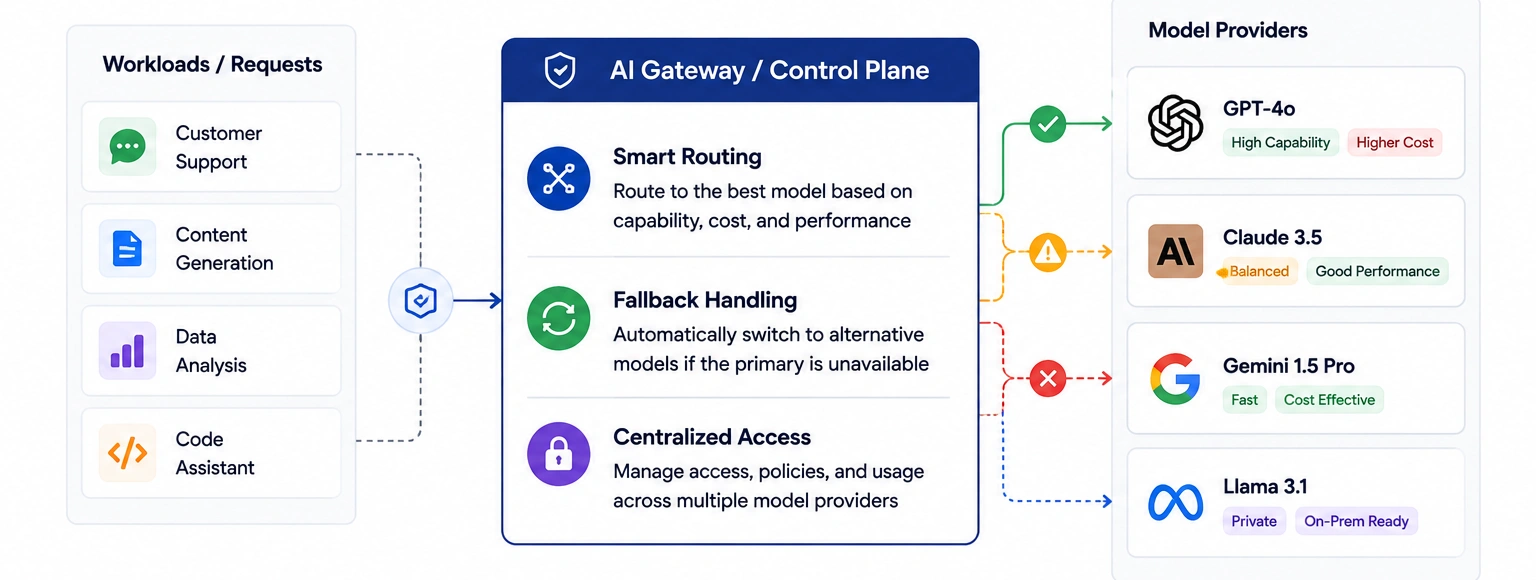
6. AI Model Routing and Gateway Management

Enterprises do not need the same model for every workload. Models differ in capability, latency, availability, context windows, privacy considerations, and cost, making centralized routing an important AI control plane capability.

AI Model Routing and Gateway Management

→ Route workloads based on capability, cost, and performance.

→ Apply fallback rules when models become unavailable.

→ Manage access across multiple model providers centrally.

AI Development Services can help enterprises design and integrate multi-model AI architectures across applications, enterprise systems, and workflows.

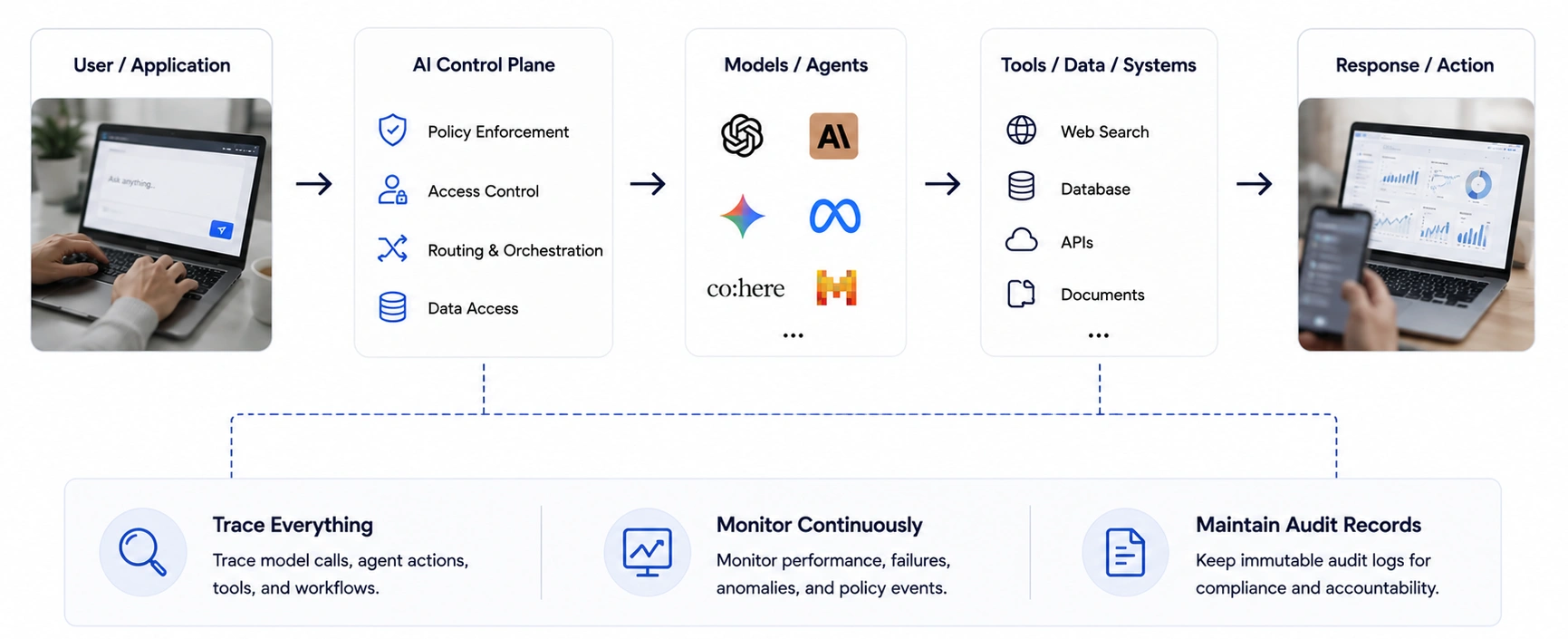
7. AI Observability and Auditability

AI observability needs to go beyond checking whether an application is running. Enterprises need to understand what models and agents did, which tools they used, what policies were applied, and what happened afterward.

AI Observability and Auditability

→ Trace model calls, agent actions, tools, and workflows.

→ Monitor failures, unusual behavior, performance, and policy events.

→ Maintain audit records for important AI interactions.

Example: If an AI agent incorrectly changes a customer record, teams should be able to trace the agent, model, tool call, policy decision, and resulting action.

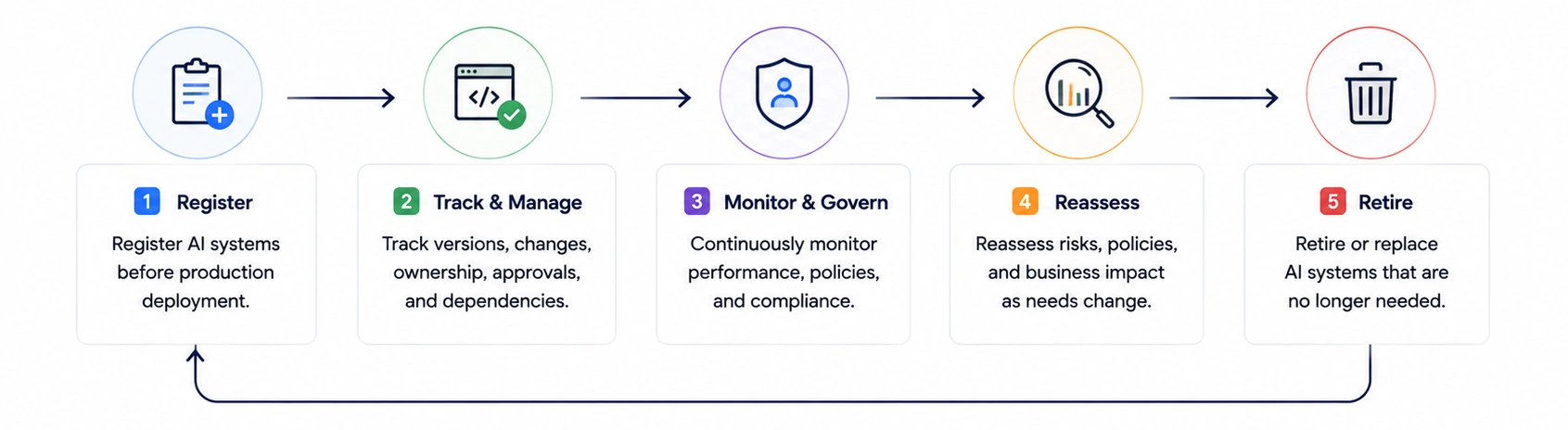
8. AI Lifecycle and Continuous Governance

AI systems are not static assets. Models change, agents gain new tools, data sources evolve, applications are updated, and permissions expand. An AI control plane therefore needs to support governance throughout the AI lifecycle.

AI Lifecycle and Continuous Governance

→ Register AI systems before production deployment.

→ Track versions, changes, ownership, approvals, and dependencies.

→ Reassess and retire AI systems as requirements change.

Example: When an enterprise replaces a foundation model, the control plane can identify affected applications, update dependencies, preserve governance records, and support a controlled migration.

This creates a continuous governance cycle rather than a one-time approval process. For a deeper look at this approach, see our guide to enterprise AI governance.

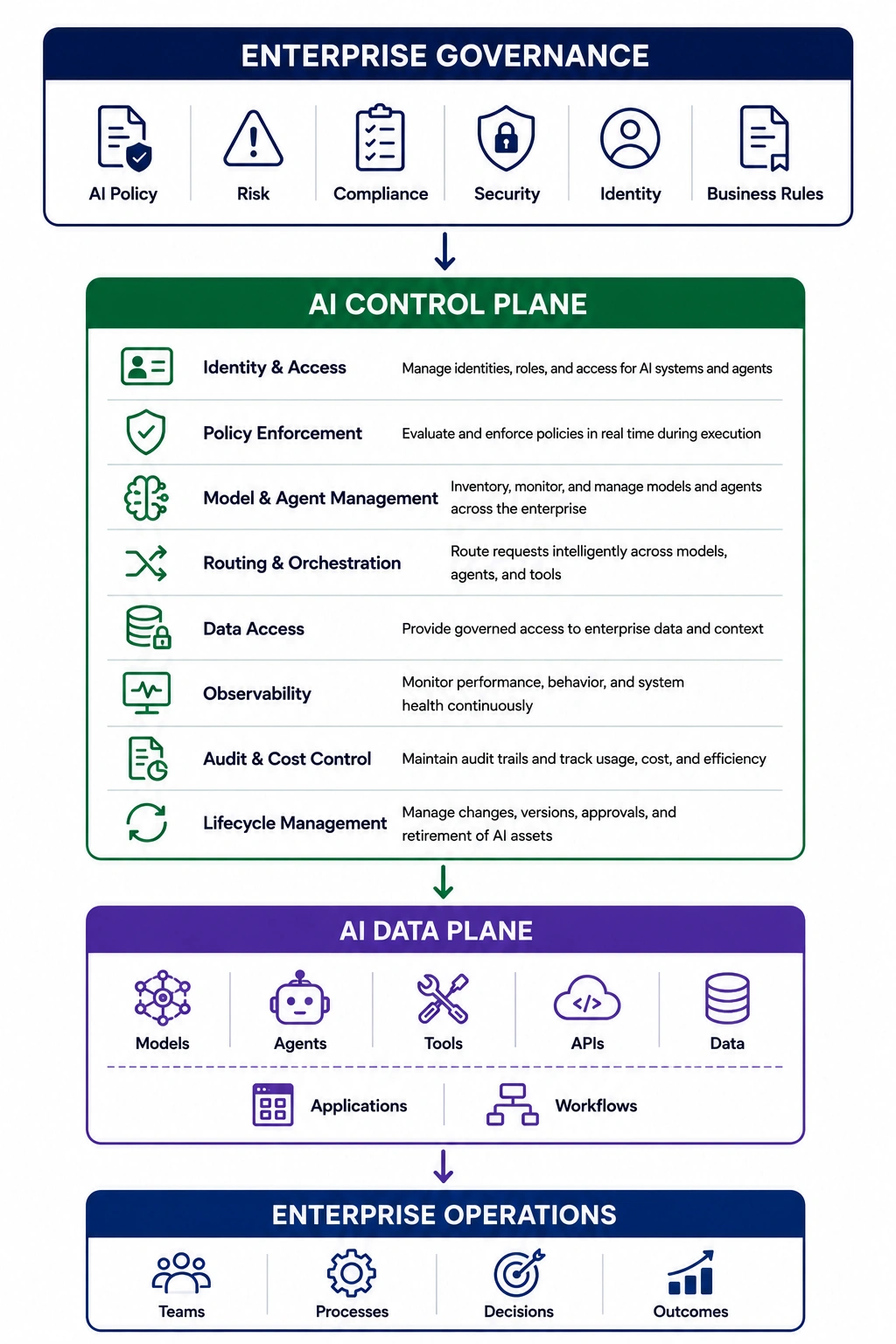
AI Control Plane Architecture: How the Pieces Fit Together

The AI control plane should sit between enterprise governance and AI execution.

AI Control Plane Architecture

The architectural principle is straightforward:

The control plane governs. The data plane executes.

This separation mirrors established distributed-system architecture while adapting the concept to the unique requirements of models, agents, tools, data, and AI workflows.

AI Control Plane vs. AI Governance vs. AI Gateway

These concepts are related, but they are not interchangeable.

Capability AI Governance AI Gateway AI Control Plane
Policy Definition Partial
Model Routing
Identity Management Partial
Agent Management Partial Partial
Runtime Enforcement Limited
Data Access Control Partial
Observability Partial
Lifecycle Management Limited
Cost Management Limited
Auditability
Enterprise Orchestration Limited Partial

The simplest distinction is:

AI governance defines the rules.

An AI gateway manages AI traffic and model interactions.

An AI control plane coordinates and enforces controls across the broader AI estate.

This distinction matters because enterprises should not assume that adding an AI gateway automatically solves their broader governance and operational-control requirements.

How Azilen’s ARC Framework Enables a Governed AI Control Plane

Azilen’s Agentic Readiness & Control (ARC) Framework helps enterprises bring governance directly into the agentic AI architecture. It provides the controls needed to connect agents with enterprise systems while managing identity, access, actions, oversight, and operational visibility.

Connect: Integrate AI agents with enterprise data, applications, APIs, and business workflows through controlled interfaces.

Authorize: Establish agent identities, permissions, and access boundaries based on business requirements and least-privilege principles.

Govern: Apply policies and guardrails to determine which AI actions are permitted, restricted, or require additional approval.

Oversee: Introduce human approval for sensitive decisions while maintaining visibility into agent actions and workflows.

Monitor: Track agent behavior, tool usage, decisions, performance, and audit trails to support continuous governance.

With ARC, Azilen helps enterprises move from simply connecting AI agents to creating a controlled, observable, and scalable AI control plane.

ARC Flow: Connect → Identify → Authorize → Govern → Approve → Execute → Audit → Monitor → Scale

Build Enterprise AI Control Plane Solutions with Azilen

Building an enterprise AI control plane requires more than connecting AI models—it requires practical controls for managing AI agents, data, access, security, governance, and runtime actions across the enterprise.

As an enterprise AI development company, Azilen helps organizations build scalable AI control plane solutions that connect AI models and agents with enterprise systems through governed and observable architectures.

→ Design AI control layers for models, agents, applications, data, and workflows.

→ Implement identity, authorization, policy enforcement, and controlled AI execution.

→ Enable observability, auditability, human oversight, and AI lifecycle management.

→ Connect AI with enterprise APIs, applications, data platforms, and business systems.

Azilen helps enterprises build the control, visibility, and scalability needed to operate AI securely and confidently at scale.

Transform your enterprise AI operations with intelligent AI governance.
CTA

FAQs: AI Control Planes

1. What is an AI control plane?

An AI control plane is an architectural layer that centrally manages AI models, agents, applications, data access, policies, security, monitoring, and workflows. It helps enterprises enforce consistent controls while giving teams visibility into how AI systems operate across the organization.

2. Why do enterprises need an AI control plane?

Enterprises need an AI control plane to manage growing AI complexity across models, agents, applications, data sources, and tools. It provides centralized visibility, policy enforcement, access control, observability, auditability, and cost management while enabling organizations to scale AI more securely.

3. What does an AI control plane control?

An AI control plane can control model access, agent identities, permissions, data access, tool usage, runtime policies, model routing, human approvals, monitoring, audit trails, costs, and AI lifecycle activities. These controls help ensure AI systems operate within defined enterprise boundaries.

4. What is the difference between an AI control plane and AI governance?

AI governance defines the organization’s policies, responsibilities, risk requirements, and principles for using AI. An AI control plane operationalizes those requirements by enforcing policies, managing permissions, monitoring systems, controlling AI actions, and creating evidence across enterprise AI environments.

5. How does an AI control plane govern AI agents?

An AI control plane governs AI agents through identity, authorization, tool permissions, runtime policy enforcement, human approval, monitoring, and auditability. These controls help enterprises determine what agents can access, which actions they can perform, and when human intervention is required.

author avatar
Team Azilen
Azilen Technologies is an Enterprise AI development company . The company collaborates with organizations to propel their AI development journey from idea to implementation and all the way to AI success. From data & AI to Generative AI & Agentic AI, and MLOps, Azilen engages with companies to build a competitive AI advantage with the right mix of technology skills, knowledge, and experience.  
google
Azilen Technologies
Team Azilen

Azilen Technologies is an Enterprise AI development company . The company collaborates with organizations to propel their AI development journey from idea to implementation and all the way to AI success. From data & AI to Generative AI & Agentic AI, and MLOps, Azilen engages with companies to build a competitive AI advantage with the right mix of technology skills, knowledge, and experience.  

Related Insights

GPT Mode
AziGPT - Azilen’s
Custom GPT Assistant.
Instant Answers. Smart Summaries.