




 17 mins
Mar 06, 2026

Most enterprises now have an AI policy.
The harder question is whether that policy actually controls what happens when AI enters production.
Can your organization identify every AI system being used? Can it show who owns each system? Can it explain what data an AI model accesses, how its outputs are evaluated, or what happens when an AI system behaves unexpectedly?
And as AI agents begin accessing tools and taking actions, the governance challenge becomes even more practical.
This is why an AI governance checklist should test more than whether policies exist. It should examine whether governance is embedded across the people, processes, data, models, applications, and infrastructure that support enterprise AI.
The NIST AI Risk Management Framework provides a useful foundation through four functions, Govern, Map, Measure, and Manage, with risk management intended to continue throughout the AI lifecycle.
ISO/IEC 42001 takes a management-system approach, providing requirements for establishing, implementing, maintaining, and continually improving an AI Management System.
An AI governance checklist is a structured set of questions and controls used to evaluate whether an organization’s AI systems are being developed, deployed, operated, and monitored responsibly.
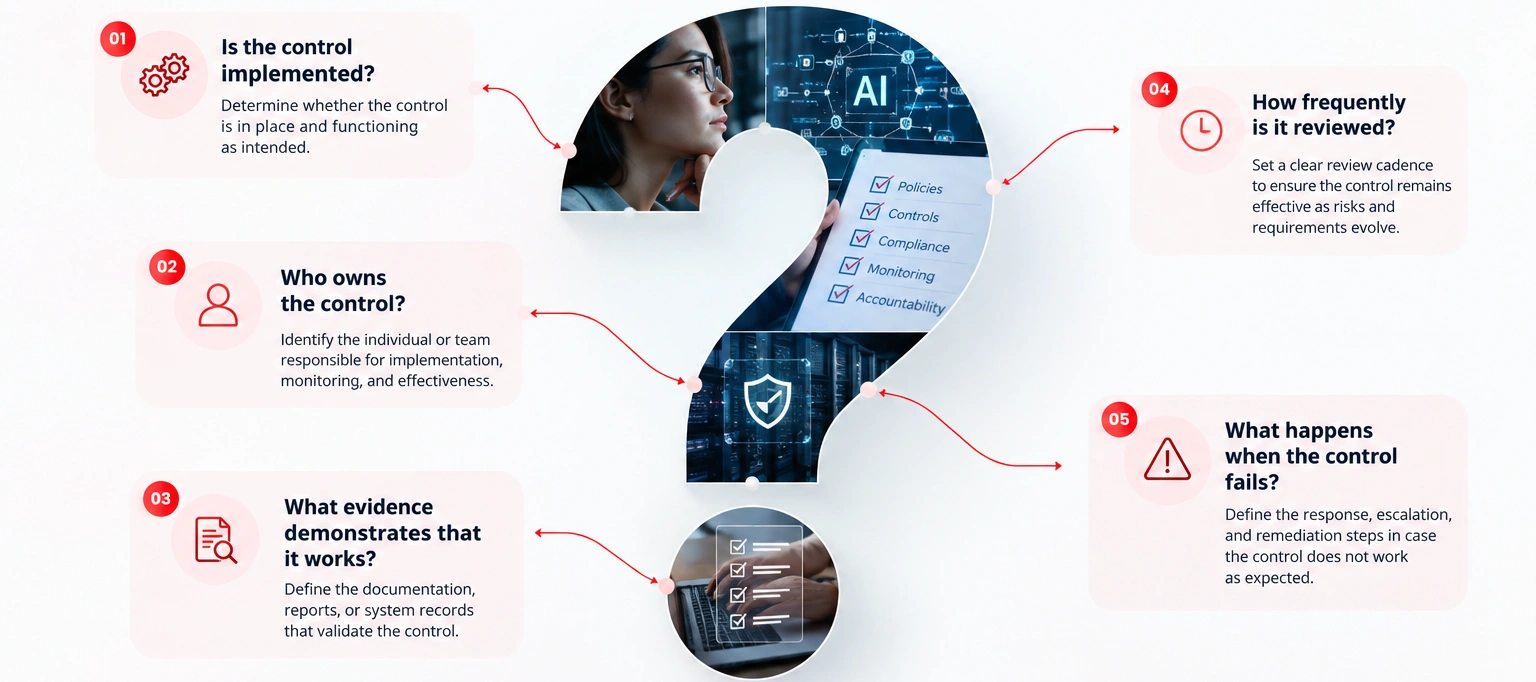
or every control, an organization should be able to answer:
→ Is the control implemented?
→ Who owns the control?
→ What evidence demonstrates that it works?
→ How frequently is it reviewed?
→ What happens when the control fails?
This evidence-based approach is important because governance is not simply about having the right documents.
A policy saying that sensitive data must be protected is useful.
A system that actually prevents unauthorized AI access to sensitive data is governance in action.

The following 12 controls provide a practical foundation for evaluating enterprise AI governance. From strategy and data protection to model evaluation, security, monitoring, human oversight, and AI-agent governance, each control addresses a critical area organizations need to manage as AI adoption scales.
An effective AI governance program starts with a clear strategy defining how AI should be adopted, controlled, and monitored. Risk classification then determines how much governance each AI system requires based on its potential business, operational, security, and regulatory impact.
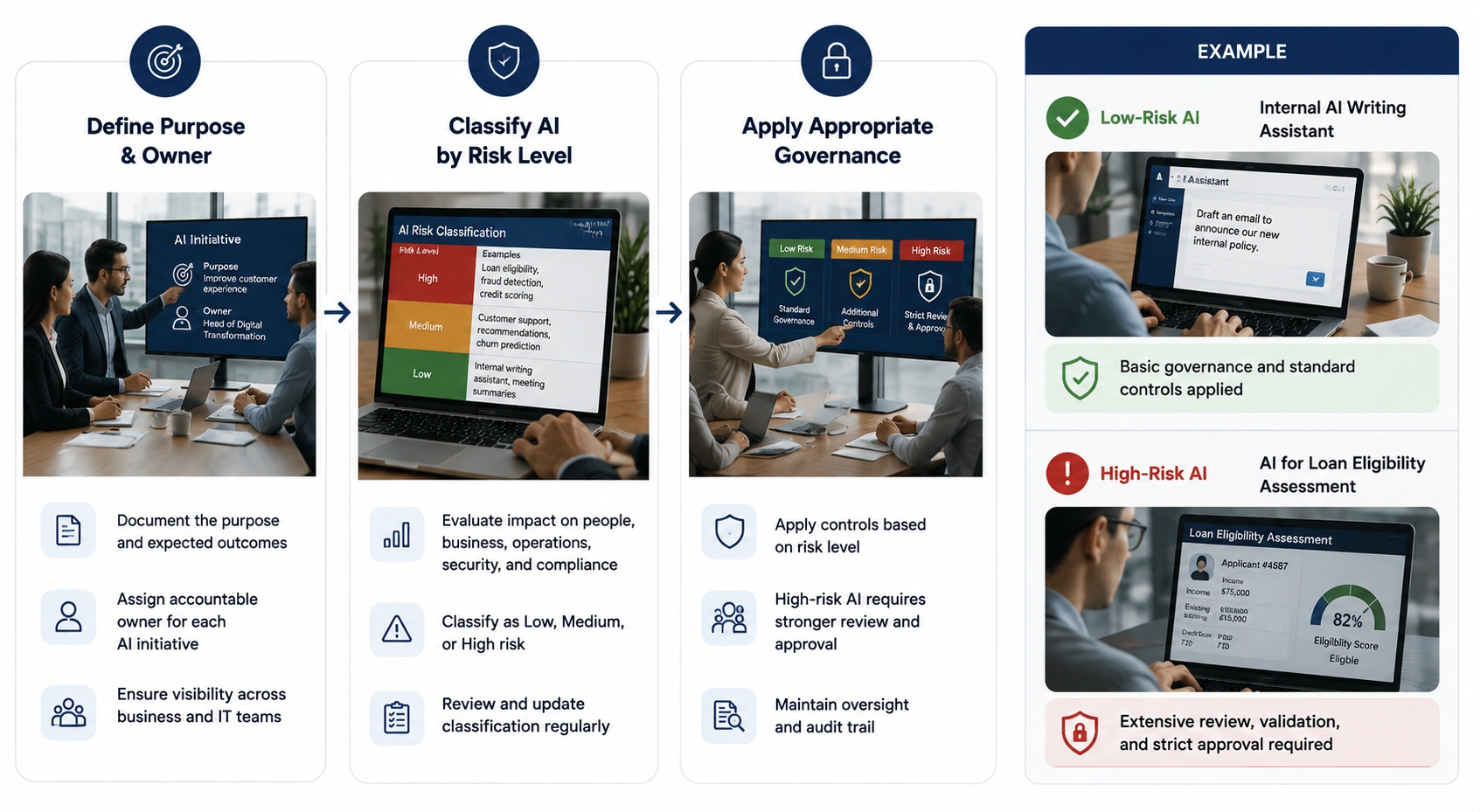
→ Every AI initiative should have a documented purpose and owner.
→ AI systems should be classified according to potential risk.
→ High-risk applications should receive stronger governance and approval controls.
Example: A bank may apply basic governance to an internal AI writing assistant but require extensive review for AI influencing loan eligibility.
NIST’s AI Risk Management Framework provides a useful foundation through its Govern, Map, Measure, and Manage functions. For a practical implementation perspective, see Azilen’s Enterprise AI Governance Framework.
AI policies translate governance principles into practical rules for employees, developers, and business teams. They should clearly establish where AI can be used, what information can be shared, which applications require approval, and what activities are restricted.
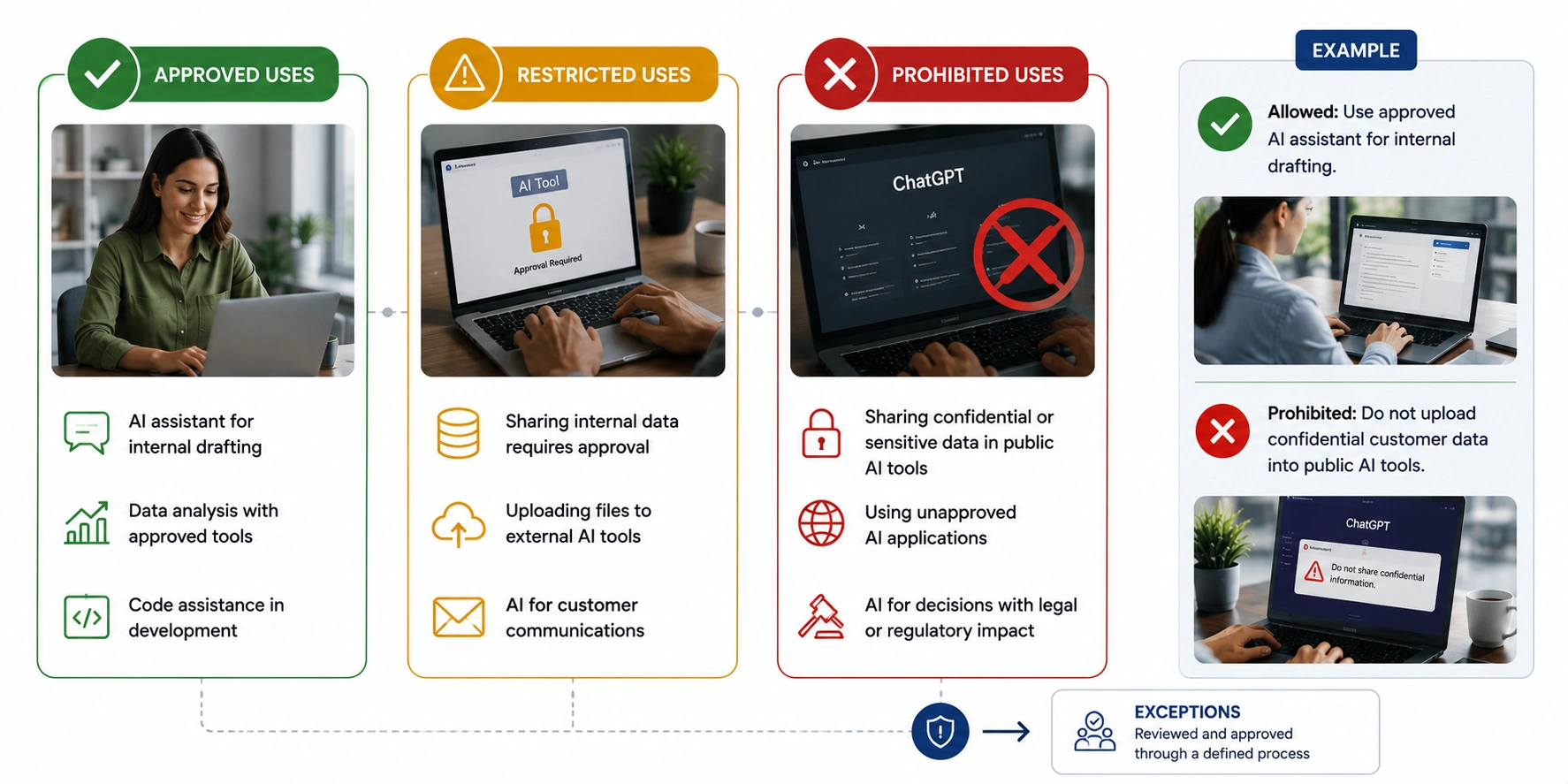
→ Approved, restricted, and prohibited AI uses should be documented.
→ Employees should understand how enterprise data can be used.
→ Exceptions should follow defined review and approval processes.
Example: An organization may allow an approved AI assistant for internal drafting while prohibiting employees from uploading confidential customer data into public AI tools.
A strong enterprise AI governance framework connects these policies to technical controls rather than treating them as employee guidelines alone. Azilen’s Guide to Enterprise AI Governance provides additional context on turning governance principles into an operational approach.
AI governance increasingly intersects with privacy laws, industry regulations, contractual obligations, and emerging AI-specific legislation. Enterprises need a process for identifying applicable requirements and mapping them to specific AI systems and governance controls.
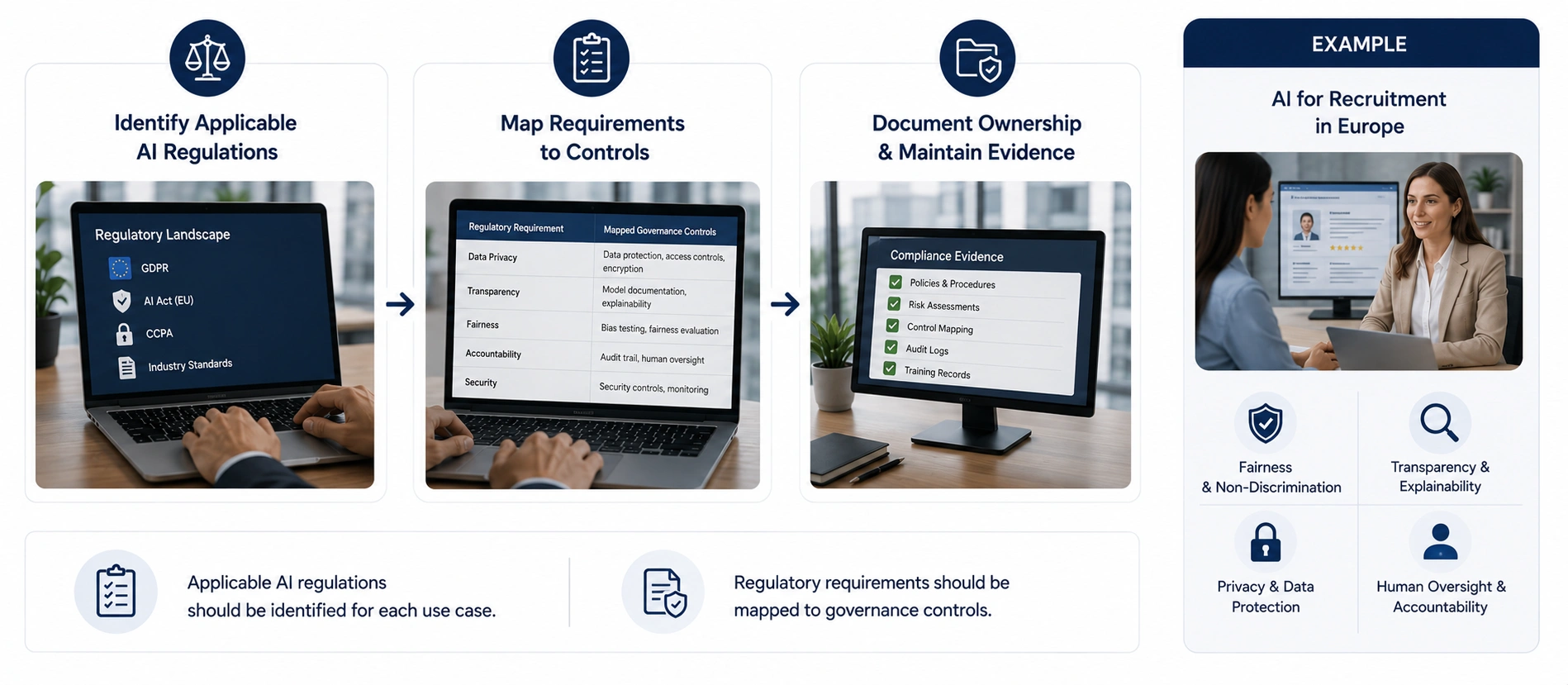
→ Applicable AI regulations should be identified for each use case.
→ Regulatory requirements should be mapped to governance controls.
→ Compliance responsibilities and evidence should remain clearly documented.
Example: A European organization using AI for recruitment may need stronger controls around fairness, transparency, documentation, privacy, and human oversight.
The NIST AI RMF is a voluntary reference for managing AI risk, while ISO/IEC 42001 provides requirements for establishing and continually improving an AI Management System.
AI systems depend heavily on data, making data governance a core part of enterprise AI governance. Organizations need visibility into where AI data originates, what information it contains, how it is processed, and who or what can access it.
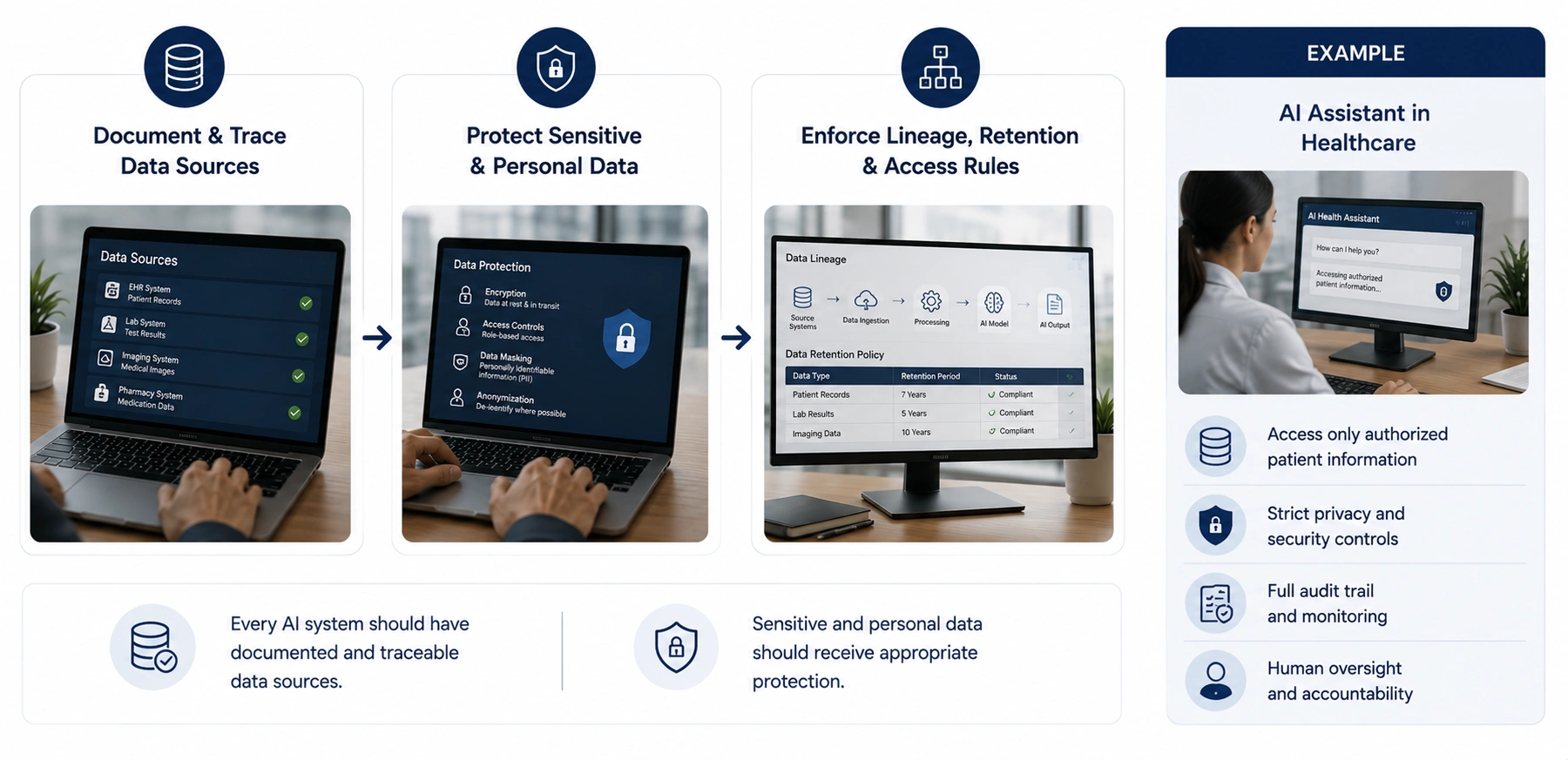
→ Every AI system should have documented and traceable data sources.
→ Sensitive and personal data should receive appropriate protection.
→ Data lineage, retention, and access requirements should be enforced.
Example: A healthcare organization connecting an AI assistant to patient records must define exactly which information the system can access and how that information is protected.
The framework emphasizes understanding AI system context, components, data, and associated risks throughout the lifecycle. Enterprises can also strengthen data visibility through Azilen’s Data Analytics and Data Visualization Services.
A model should not be considered production-ready simply because it generates accurate outputs. Enterprises need to evaluate performance, reliability, fairness, safety, and other risks against the specific context in which the model will operate.
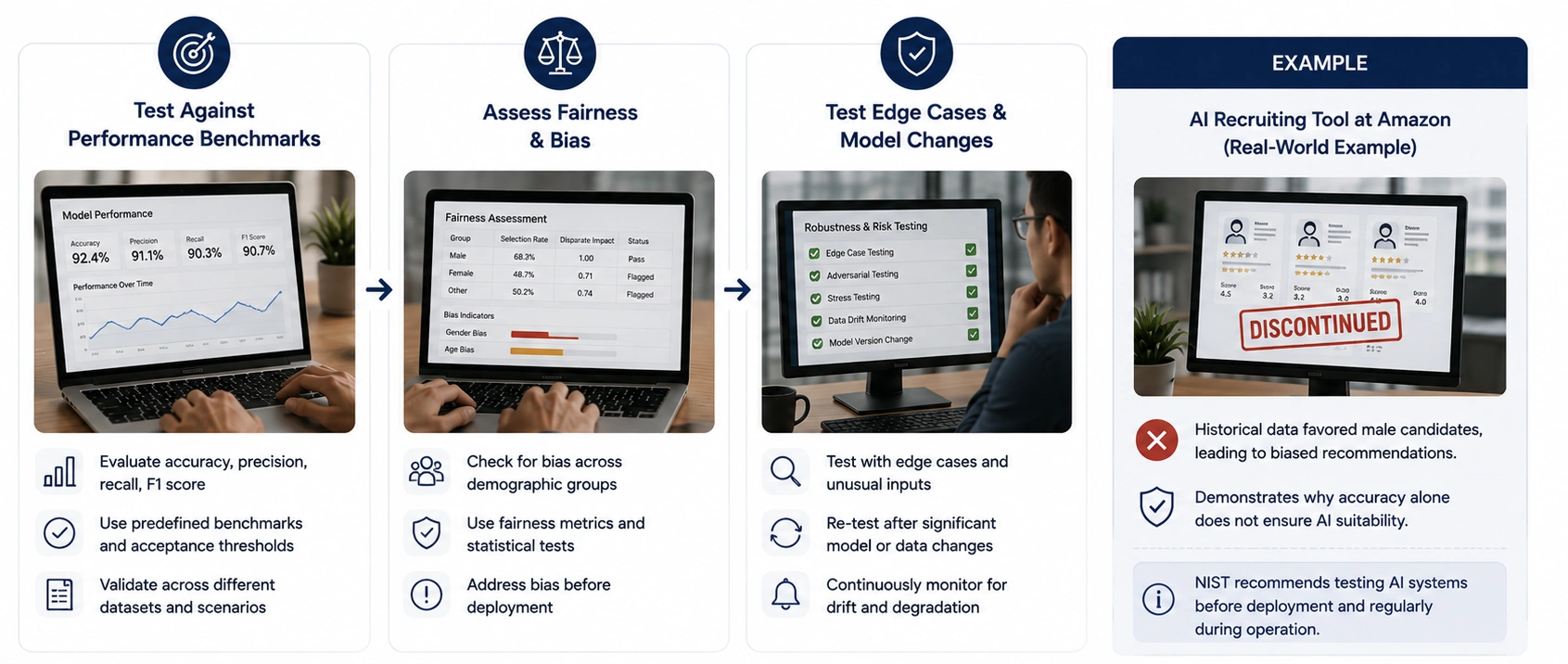
→ Models should be tested against predefined performance benchmarks.
→ High-impact systems should undergo fairness and bias assessments.
→ Edge cases and significant model changes should trigger testing.
Example: Amazon discontinued an experimental AI recruiting tool after discovering that historical training data favored male candidates, demonstrating why model performance alone cannot establish AI suitability.
NIST identifies validity, reliability, safety, security, transparency, explainability, privacy, and fairness among important dimensions of trustworthy AI. Its framework also recommends testing AI systems before deployment and regularly during operation.
AI introduces security risks across models, applications, APIs, prompts, data, tools, and connected enterprise systems. Governance therefore needs security controls that protect AI infrastructure and restrict unauthorized access or misuse.
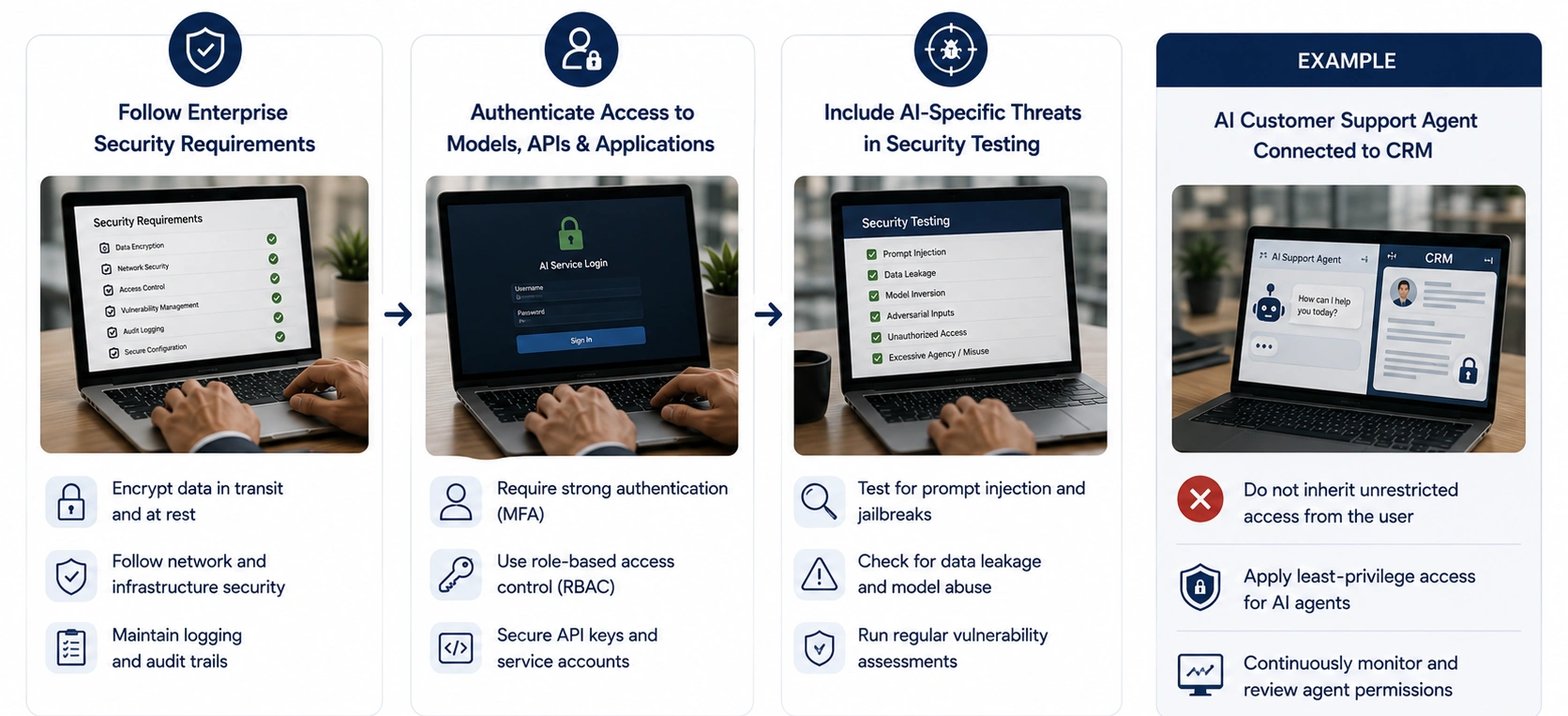
→ AI systems should follow established enterprise security requirements.
→ Model, API, and application access should require authentication.
→ AI-specific threats should be included in security testing.
Example: An AI customer-support agent connected to a CRM should not inherit unrestricted access simply because its user has broad permissions.
The OWASP Top 10 for LLM Applications provides a useful reference for LLM-specific security risks, while NIST includes security and resilience among the characteristics of trustworthy AI.
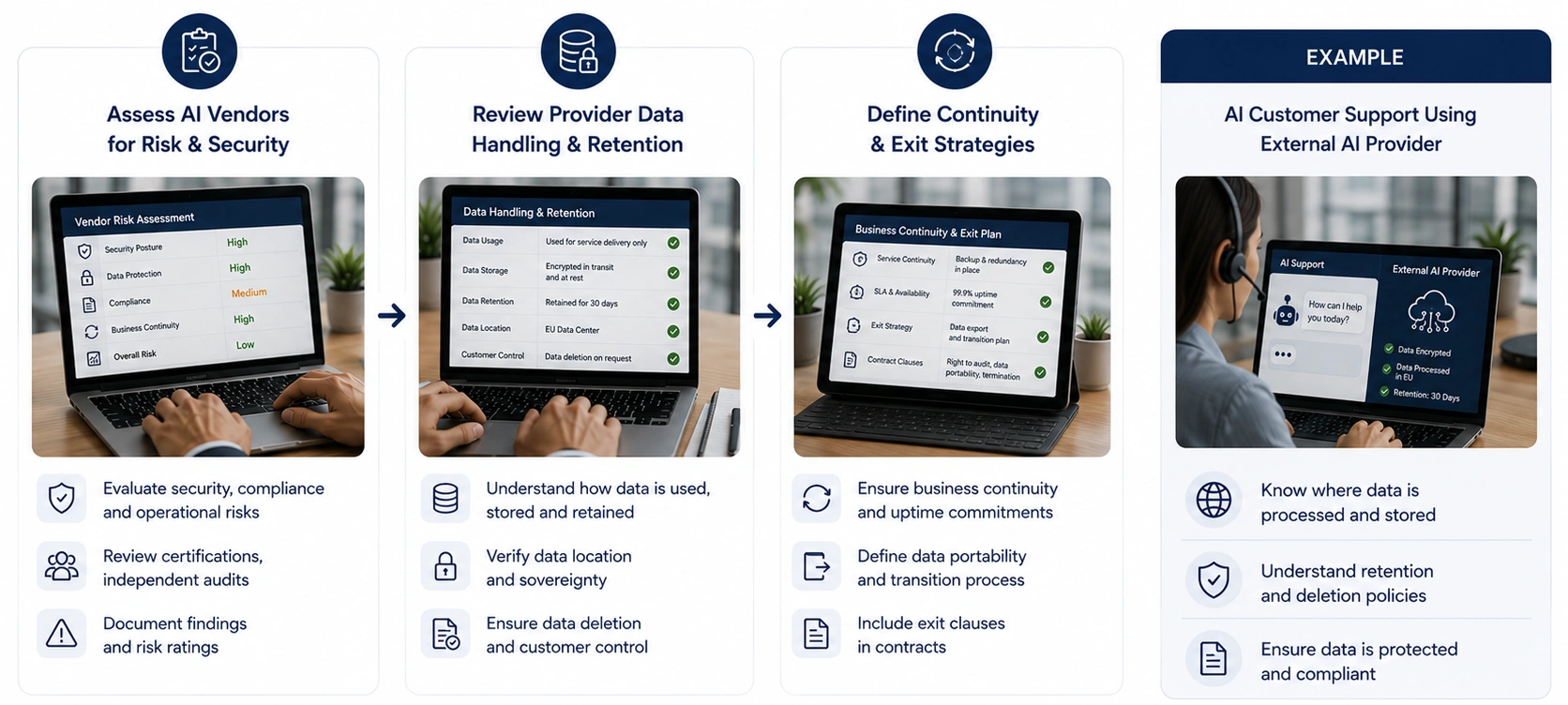
Enterprises increasingly rely on external foundation models, APIs, cloud platforms, copilots, and AI applications. This means organizations can inherit risks from providers they do not directly control, making vendor governance an essential AI governance control.
Enterprises increasingly rely on external foundation models, APIs, cloud platforms, copilots, and AI applications. This means organizations can inherit risks from providers they do not directly control, making vendor governance an essential AI governance control.
→ AI vendors should undergo documented security and risk assessments.
→ Provider data handling and retention practices should be reviewed.
→ Critical vendors should have continuity and exit strategies.
Example: If customer-support conversations are sent to an external AI provider, the enterprise should understand where the data is processed, retained, and protected.
AI governance does not end when a system enters production. Models, datasets, prompts, integrations, and user behavior can change over time, potentially affecting performance and creating new risks that were not visible during initial testing.
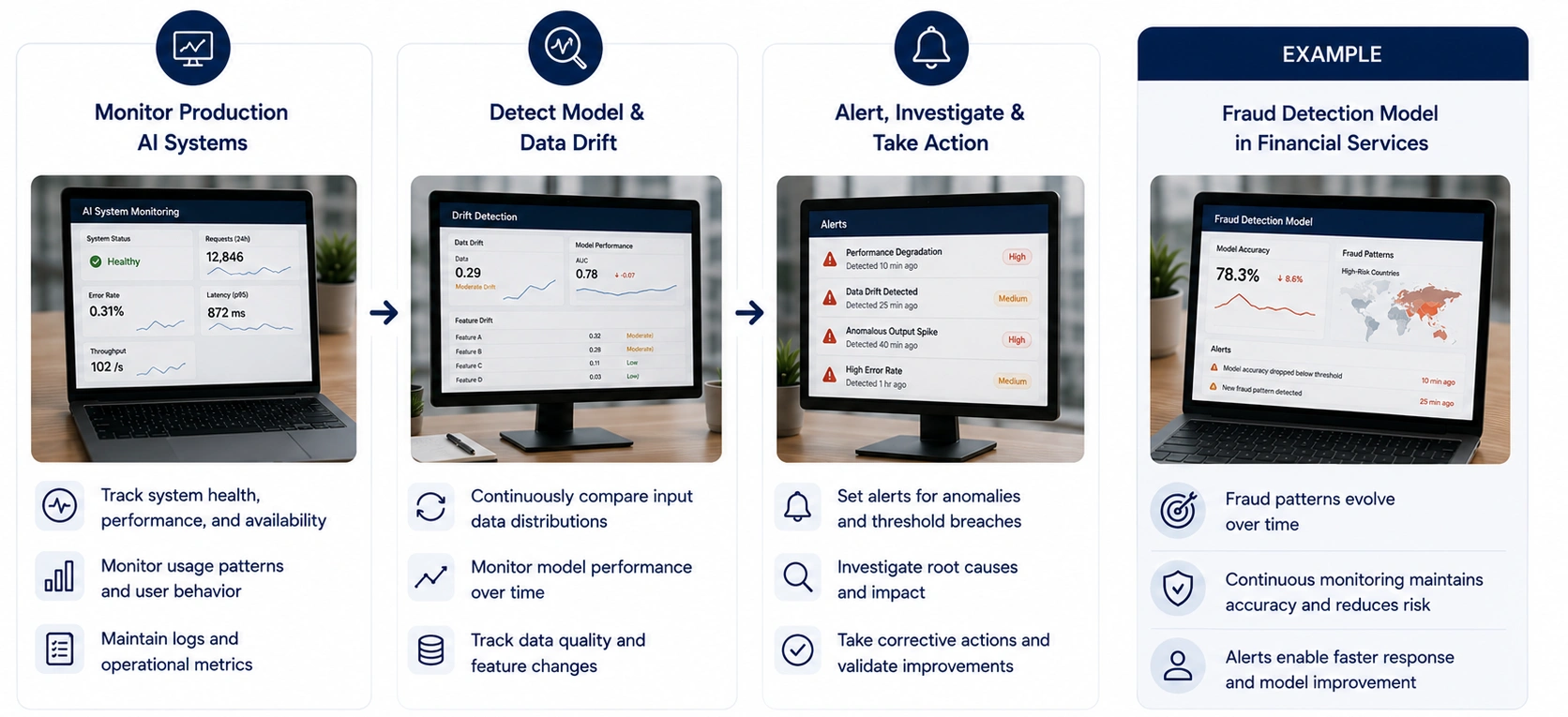
→ Production AI systems should have defined monitoring requirements.
→ Model and data drift should be continuously evaluated.
→ Unexpected outputs should trigger appropriate alerts and review.
Example: A fraud-detection model may become less accurate as fraud patterns change, making continuous monitoring essential for detecting performance degradation.
AI autonomy should match the potential consequences of its actions. Lower-risk tasks can often be automated, while high-impact decisions may require humans to review, approve, reject, or override AI recommendations.
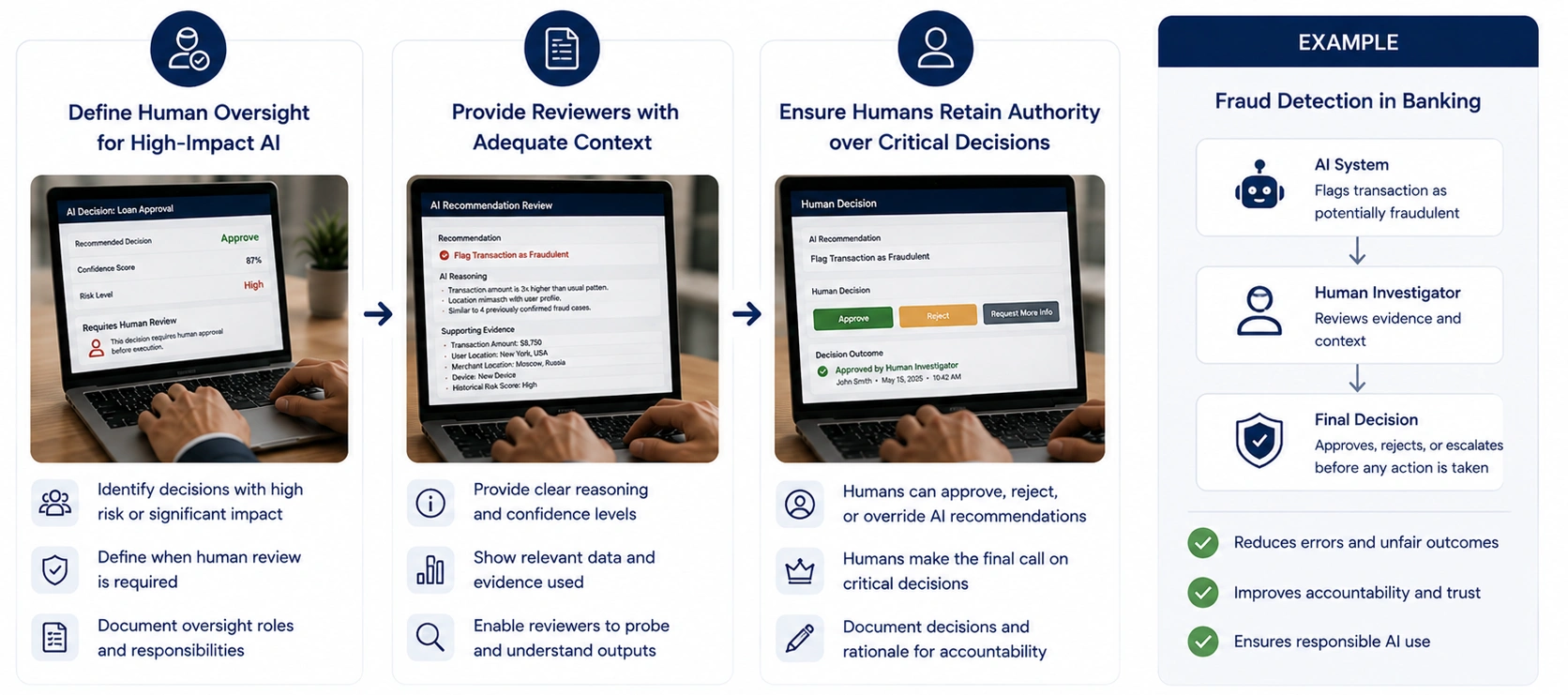
→ High-impact AI decisions should have defined human oversight.
→ Reviewers should receive sufficient context to challenge AI outputs.
→ Humans should retain authority over critical decisions.
Example: An AI system can flag potentially fraudulent transactions, while a human investigator reviews the evidence before an account is permanently restricted.
Even well-governed AI systems can fail, produce harmful outputs, or behave unexpectedly. Enterprises therefore need predefined processes for detecting, containing, investigating, and recovering from AI-related incidents.
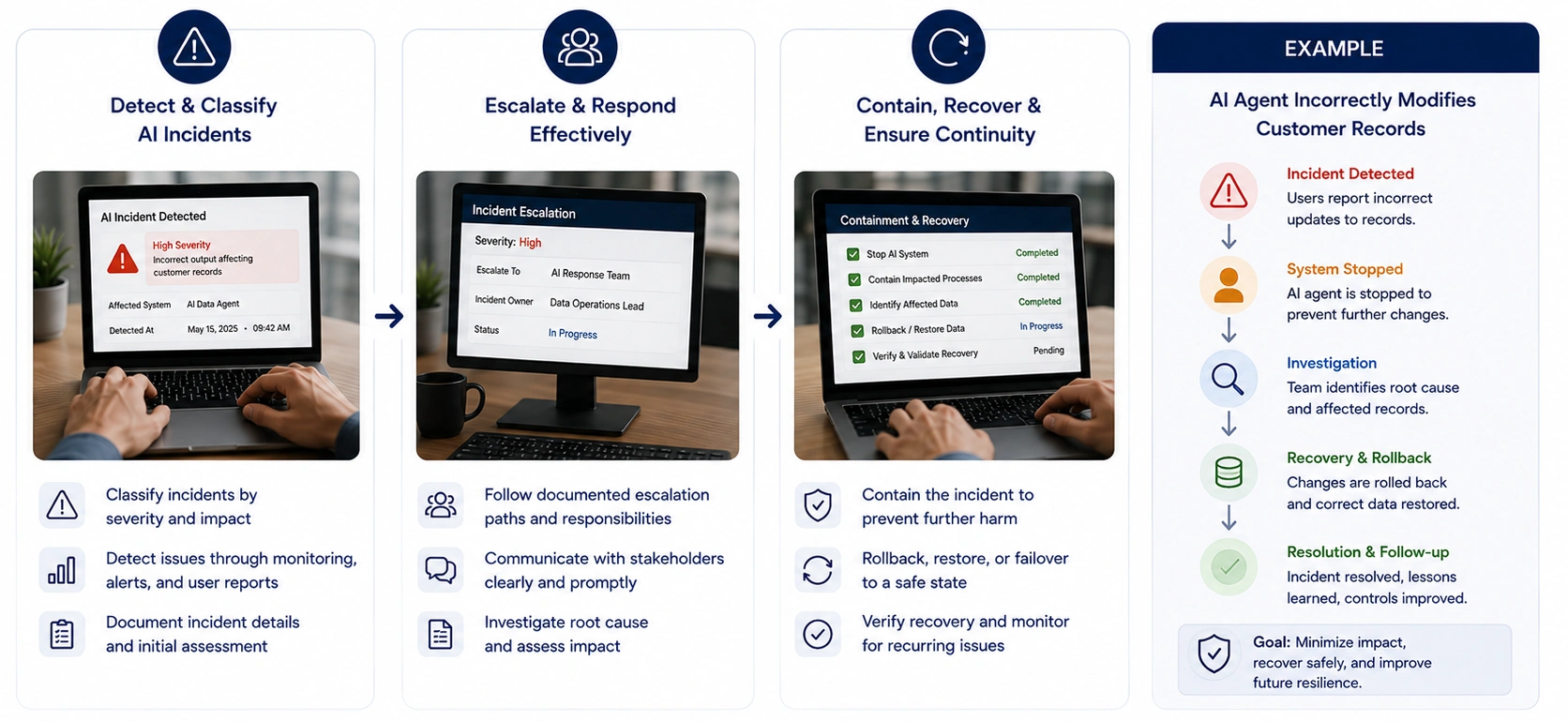
→ AI incidents should have clearly defined severity classifications.
→ Teams should have documented escalation and response procedures.
→ Critical AI systems should support containment or rollback.
Example: If an AI agent incorrectly modifies thousands of customer records, the organization needs to stop the system, identify affected records, investigate the cause, and recover safely.
NIST’s Manage function includes documented responses to high-priority AI risks, recovery considerations, and mechanisms for continual improvement.
AI governance needs evidence. When an AI system is investigated, audited, challenged, or involved in an incident, enterprises should be able to reconstruct relevant decisions, system versions, approvals, and actions.
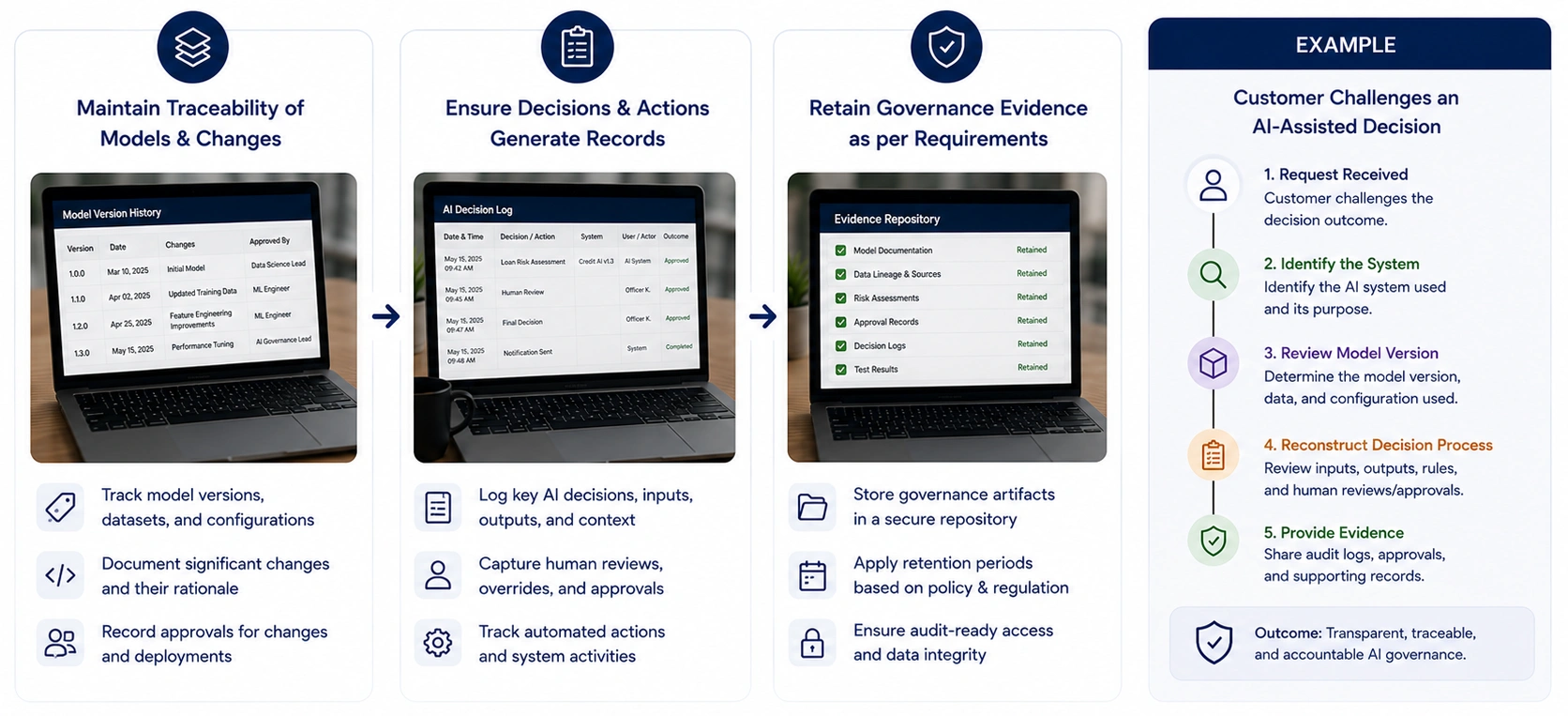
→ Model versions and significant changes should remain traceable.
→ Important AI decisions and actions should generate records.
→ Required governance evidence should follow defined retention requirements.
Example: If a customer challenges an AI-assisted decision, the organization should be able to identify the system, relevant model version, decision process, and available approval records.
Traditional AI governance focuses heavily on models, data, outputs, and decisions. AI agents introduce another dimension: action. When agents can access tools, call APIs, update records, or trigger workflows, governance must control what they are authorized to execute.
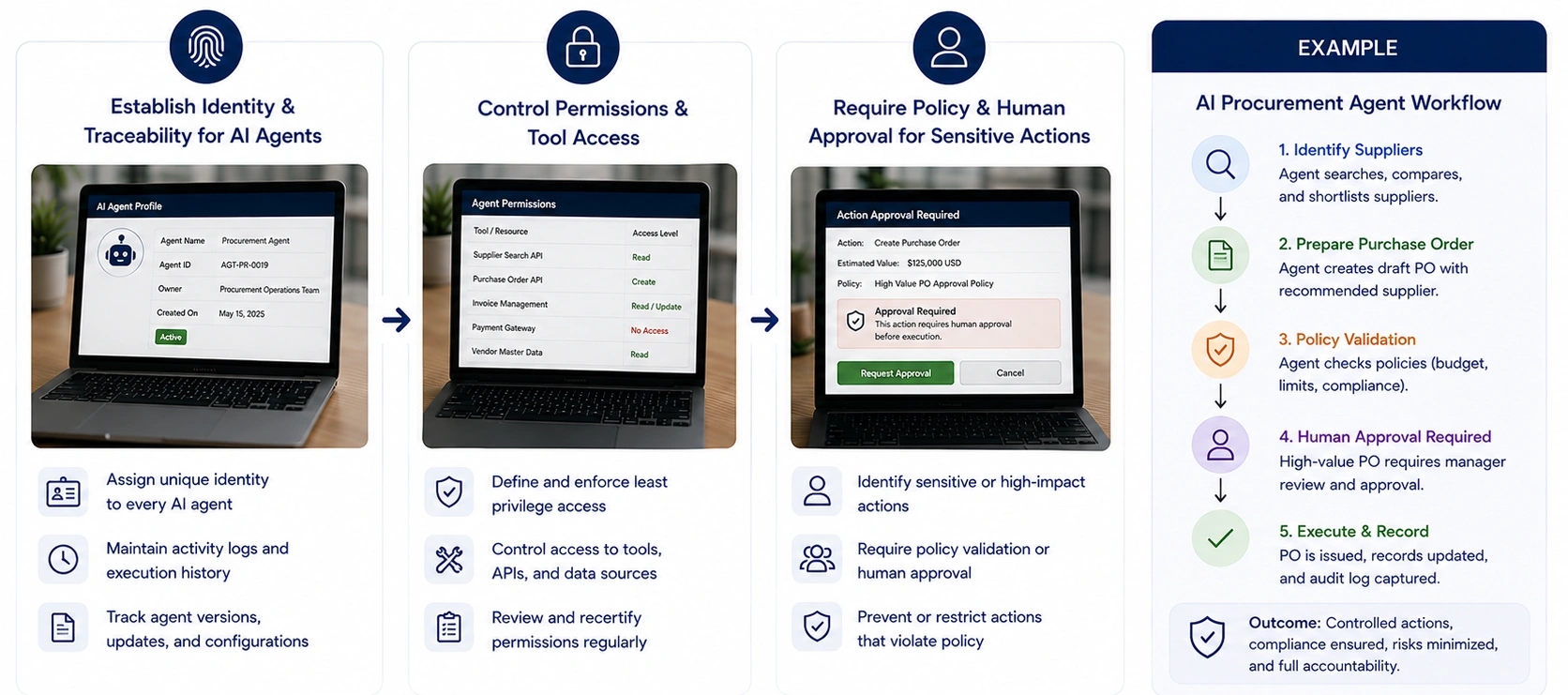
→ Every production AI agent should have a traceable identity.
→ Agent permissions and tool access should be explicitly controlled.
→ Sensitive actions should require policy or human approval.
Example: An AI procurement agent may identify suppliers and prepare purchase orders, but a high-value transaction should require policy validation and human approval before execution.
The U.S. AI governance landscape is evolving through a combination of federal policy, voluntary risk-management frameworks, existing laws, agency oversight, and state-level AI regulations rather than one nationwide AI governance law.
| Governance Layer | What Enterprises Need to Know | Business Impact |
|---|---|---|
| NIST AI RMF | NIST's AI Risk Management Framework provides voluntary guidance for managing AI risks across design, development, deployment, use, and evaluation. | Provides a practical foundation for an enterprise AI governance framework. |
| NIST GenAI Profile | NIST's Generative AI Profile addresses risks specific to generative AI and was updated in April 2026. | Helps organizations identify and manage GenAI-specific risks. |
| Federal AI Policy | Federal policy in 2026 emphasizes AI innovation and a more consistent national approach while challenging burdensome state-level regulation. | Enterprises need to monitor federal policy alongside state requirements. |
| Federal Agencies | Existing agencies such as the FTC and other regulators can apply existing laws to AI-related conduct. | AI does not exempt businesses from existing consumer-protection, privacy, employment, or other obligations. |
| State AI Laws | States continue developing AI requirements covering high-risk systems, transparency, employment, and consumer protection. | Multi-state organizations may face different requirements across jurisdictions. |
| Industry Regulations | Financial services, healthcare, employment, insurance, and other sectors remain subject to existing regulatory obligations when AI is used. | AI governance must be integrated with existing sector-specific compliance programs. |
| AI Agent Governance | Autonomous AI introduces new concerns around identity, permissions, tool access, human approval, and auditability. | Traditional model governance needs to expand toward action-level controls. |
As AI agents move from generating responses to accessing systems and taking actions, enterprises need governance that works within the technology itself. Azilen’s Agentic Readiness & Control (ARC) Framework helps organizations establish controlled access, policy enforcement, human oversight, auditability, and observability for enterprise AI agents.

An AI governance checklist is a practical set of controls that helps enterprises assess AI risk, security, compliance, accountability, data governance, monitoring, human oversight, auditability, and agentic AI management across their organization and throughout the AI lifecycle.
An enterprise AI governance checklist should cover AI strategy, risk classification, policies, regulatory compliance, data governance, model evaluation, security, vendor management, monitoring, human oversight, incident response, auditability, and AI-agent governance across critical business processes.
AI governance helps enterprises manage risks associated with AI adoption while establishing accountability, security, compliance, transparency, and operational controls. It enables organizations to scale AI responsibly while maintaining visibility over systems, data, decisions, and autonomous actions.
Enterprises can implement AI governance by creating an AI inventory, classifying risks, defining policies, assigning ownership, establishing security and compliance controls, monitoring AI systems, documenting decisions, and continuously reassessing governance as AI technologies and business requirements evolve.
AI agent governance extends traditional AI governance by controlling what agents can access, which tools they can use, what actions they can execute, and when human approval is required, supported by identity, authorization, monitoring, auditability, and defined execution boundaries.


 17 mins
  26 mins

"*" indicates required fields

5432 Geary Blvd, Unit #527 San Francisco, CA 94121 United States
320 Decker Drive Irving, TX 75062 United States

6d-7398 Yonge St,1318 Thornhill, Ontario, Canada, L4J8J2

71-75 Shelton Street, Covent Garden, London, United Kingdom, WC2H 9JQ

Hohrainstrasse 16, 79787 Lauchringen, Germany

12, Zugerstrasse 32, 6341 Baar, Switzerland

5th floor, Bloukrans Building, Lynnwood Road, Pretoria, Gauteng, 0081, South Africa

12th & 13th Floor, B Square-1, Bopal – Ambli Road, Ahmedabad – 380054
B/305A, 3rd Floor, Kanakia Wallstreet, Andheri (East), Mumbai, India





 Talk to Our
Consultants
Talk to Our
Consultants Chat with
Our Experts
Chat with
Our Experts Write us
an Email
Write us
an Email