



Skip to content

How to Make Your Engineering Architecture Ready for Agentic SDLC?

Featured Image

Executive Summary

Agentic SDLC goes beyond using AI to write code. It brings AI agents into every stage of software development, from planning and coding to testing, deployment, and monitoring. However, your engineering architecture must be ready to support these agents safely and efficiently.

→ Build the right foundation: Prepare your architecture with clear documentation, modular systems, and reliable automated testing.

→ Create a safe environment: Give agents controlled access, isolated workspaces, security guardrails, and human oversight.

→ Measure delivery performance: Track all five DORA metrics to understand whether AI agents are improving software delivery speed, quality, and stability.

AI can write code faster, generate tests, and fix bugs. But does that make software delivery faster and more reliable? Not necessarily.

AI often improves individual tasks while leaving bigger challenges untouched. Slow reviews, disconnected tools, testing bottlenecks, and deployment risks still need human intervention. Agentic SDLC takes AI beyond coding by bringing intelligent agents into the entire software development lifecycle. But this requires an engineering architecture built to support them.

In this blog, we’ll explore how to prepare your engineering architecture for Agentic SDLC and the key changes needed to make AI work across the software delivery process.

“AI doesn’t fix a team; it amplifies what’s already there.”

— Nathen Harvey, DORA Lead

90%

AI adoption is widespread, but better software delivery remains challenging.

7.2%

Higher AI adoption was associated with reduced software delivery stability.

39%

Developers reported little or no trust in AI-generated code.

What Is Agentic SDLC?

Agentic SDLC is an approach to software development where AI agents actively contribute across the entire development lifecycle, from planning and coding to testing, deployment, and monitoring, while humans provide direction and oversight.

SDLC stands for Software Development Life Cycle. It describes the journey of turning a software idea into a working product. The term agentic means AI can take action, not just provide suggestions.

For example, imagine your engineering team needs to add a payment feature to an existing application. An AI agent can review the requirements, understand the existing codebase, suggest an implementation plan, write code, run tests, identify errors, and prepare a pull request for review. Your engineering team sets the direction, checks the output, and approves important decisions.

AI Coding Assistant vs. Agentic SDLC

Comparison AI Coding Assistant Agentic SDLC
What It Does Suggests code and helps developers solve coding problems. Plans and executes tasks across multiple stages of the software development lifecycle.
Who Drives the Work? Developers guide each interaction. Humans define goals while AI agents handle assigned tasks.
Where It Works Primarily within the code editor. Across planning, development, testing, deployment, and monitoring workflows.
What It Needs Prompts, code context, and a code editor. System context, integrations, tools, permissions, testing, and governance controls.
Human Involvement Developers guide most individual actions. Engineers review outputs, manage exceptions, and approve critical decisions.
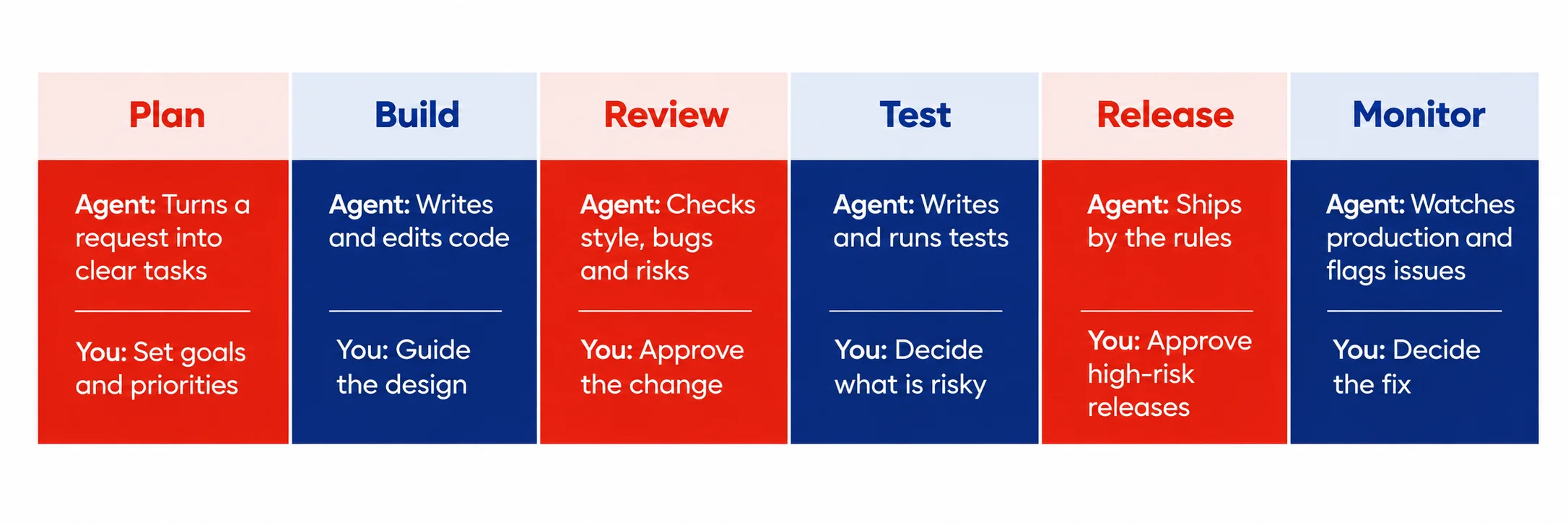
Software Lifecycle Agent Roles Infographic

You may also hear the names AI-native SDLC or AI-led SDLC. They all point to the same idea: AI is built into every step, not only into the code editor. This is moving fast. Gartner predicts that by 2028, 33% of enterprise software applications will include agentic AI, up from less than 1% in 2024.

Why Does Your Engineering Architecture Matter for Agentic SDLC?

Because AI coding agents work inside your system. They copy and speed up whatever they find. If your engineering architecture is messy, slow or unsafe, agents make that mess bigger, faster. If it is clean, tested and automated, agents multiply the good parts.

DORA calls AI an amplifier. Its 2025 report, based on answers from nearly 5,000 technology professionals, says AI magnifies the strengths of high-performing teams and the weaknesses of struggling ones.

Why Faster Coding Doesn’t Always Mean Faster Software Delivery

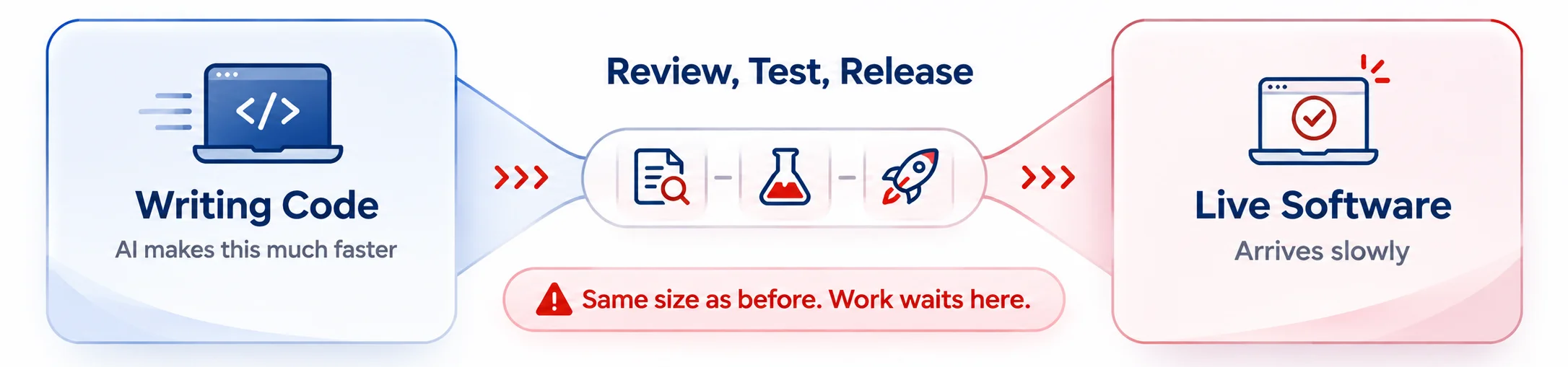
AI can significantly accelerate coding, but software delivery depends on every stage of the engineering pipeline working together. If code moves faster while reviews, testing, and releases remain slow, the overall delivery process cannot keep pace.

From Code to Live Software Bottleneck

Source: Faros AI

This creates a critical challenge for engineering teams: How do you prepare your architecture so AI agents can accelerate the entire software development lifecycle, not just code generation?

Enterprise AI Governance Discovery Call
Ready to Make Your SDLC Agent-Ready?
Azilen helps engineering teams adopt Agentic SDLC with AI-powered workflows that make software delivery faster, smarter, and more reliable.

How Do You Know If Your Engineering Architecture Is Ready for Agentic SDLC?

Check eight simple signs. Six or more yes answers means you can start a pilot with AI coding agents on one team. Fewer than four means you should fix the basics first.

Tick everything that is true for one of your services today.
0out of 8

Your result

Tick the boxes above and your result will show here.

How Do You Make Your Engineering Architecture Ready for Agentic SDLC?

Moving to Agentic SDLC requires more than adding AI coding tools. Your engineering architecture must give AI agents the right context, access to systems, clear workflows, and defined permissions. Here are the key steps to prepare your architecture.

Step 1: Give AI Agents the Context They Need

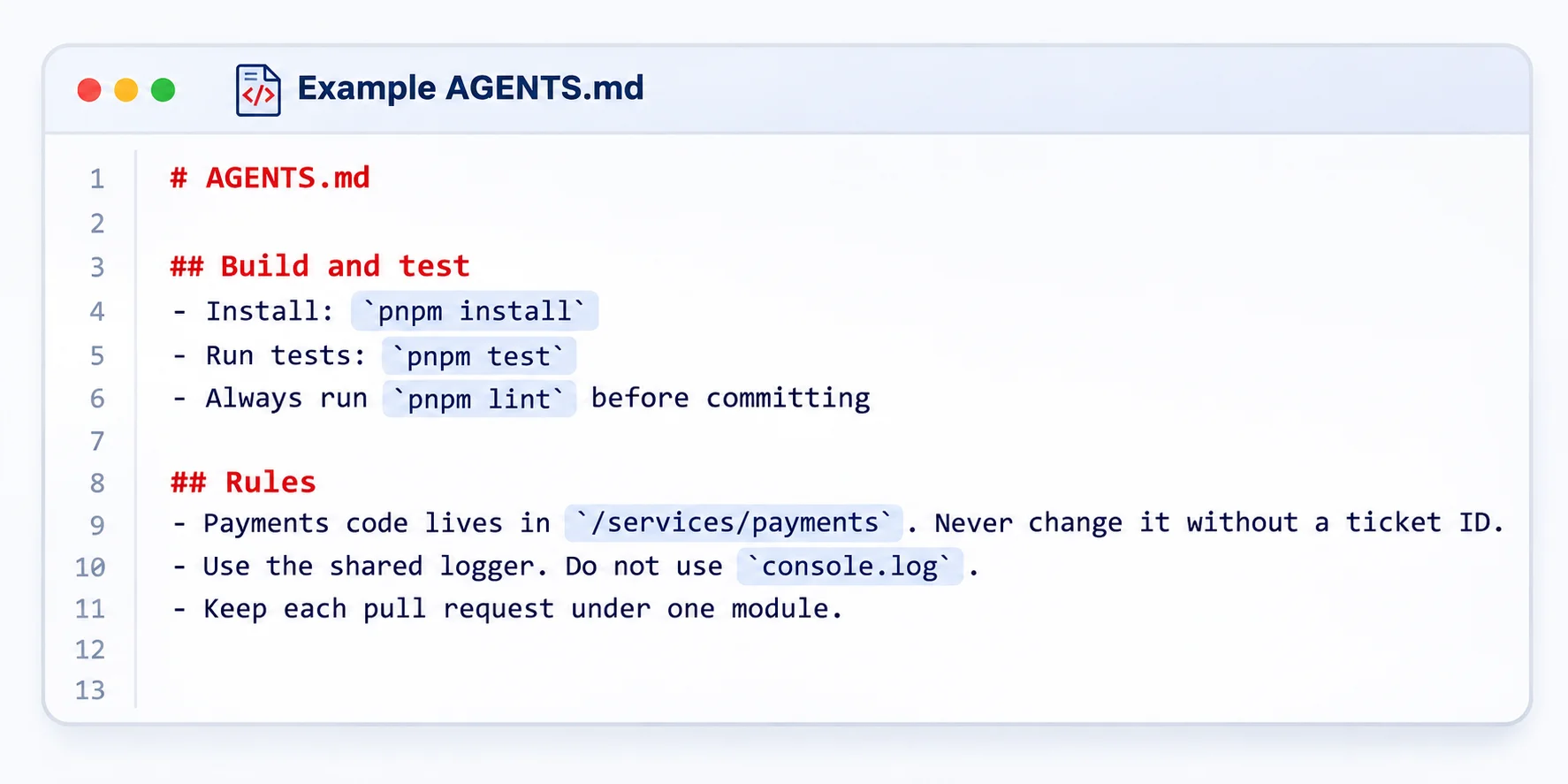
→ Create an AGENTS.md file: Document build instructions, testing commands, coding standards, and rules agents must follow. Place it in your repository so agents can access it.

→ Add folder-specific instructions: Give agents relevant guidance for complex modules instead of overwhelming them with every project rule.

→ Document key decisions: Record why important architectural choices were made, helping agents understand the reasoning behind your system.

→ Connect tools and data through MCP: Use the Model Context Protocol (MCP) to connect agents with documentation, tickets, and other engineering tools.

→ Keep tool access focused: Give each agent only the tools and permissions required for its assigned task. A smaller, relevant toolset makes workflows easier to manage and reduces unnecessary complexity.

Useful resources: AGENTS.md | MCP Documentation

Modern AGENTSmd

Step 2: Split Your System Into Small, Clear Modules

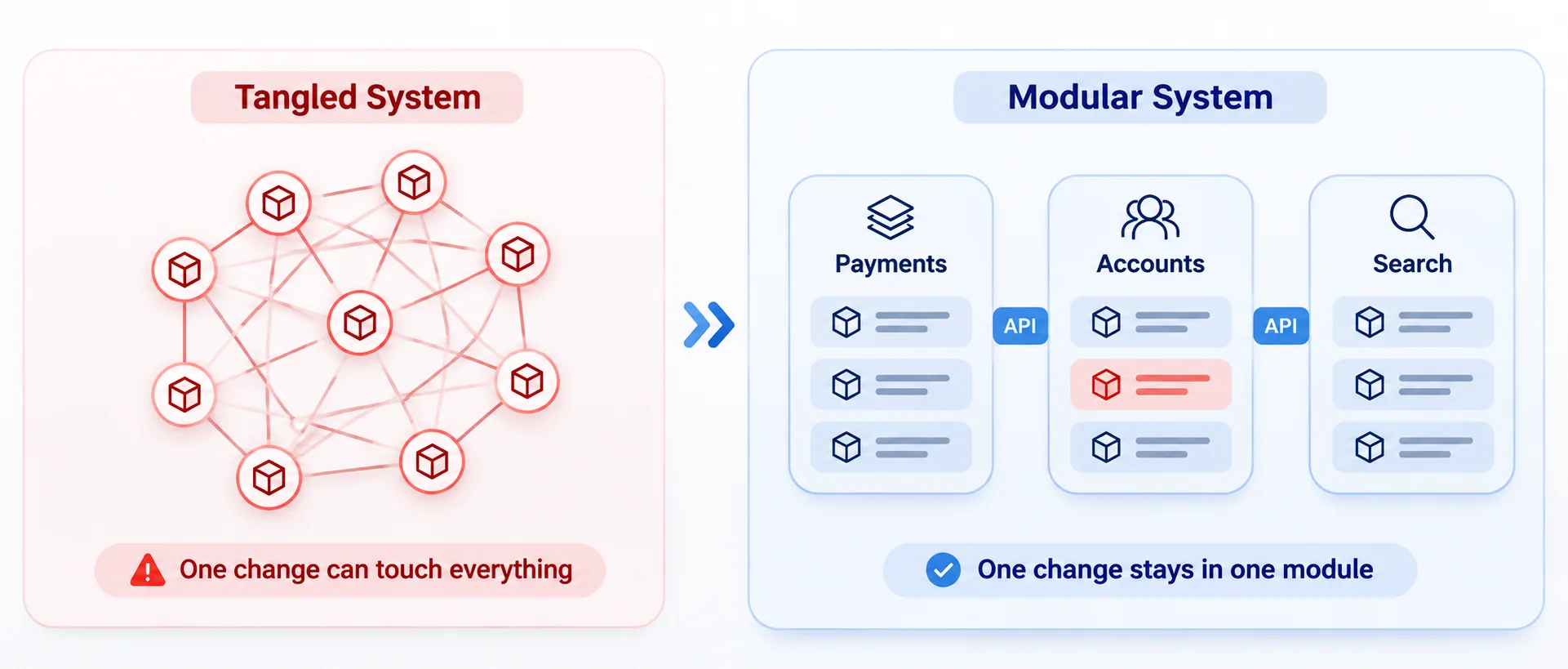
AI agents work better with smaller, well-defined tasks. Breaking your architecture into independent modules makes code easier to generate, test, review, and maintain.

Why Does Your Engineering Architecture Matter for Agentic SDLC

→ Define clear boundaries: Separate business functions such as payments, accounts, and search into individual modules.

→ Set clear contracts: Use typed interfaces, OpenAPI specifications, and contract tests to define how modules communicate.

→ Keep changes small: Aim for pull requests that developers can review in 15–20 minutes. Follow Google DORA’s guide to working in small batches

→ Avoid hidden dependencies: Reduce shared global state and undocumented connections between modules.

Example: Airbnb broke a large code migration into smaller, independent file-level tasks, allowing multiple files to be processed in parallel without one failure blocking the entire migration.

Step 3: Build a Test Safety Net AI Agents Can Trust

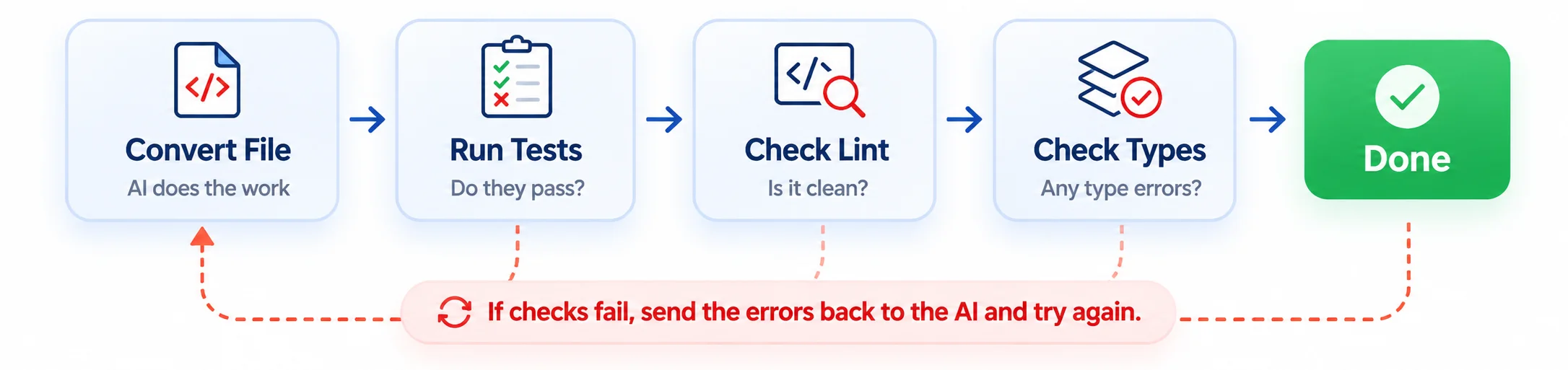
AI agents need fast, reliable feedback to identify and fix mistakes. Set up automated checks so every change is tested before moving forward.

AI Testing Feedback Loop

→ Automate testing: Run unit tests, linters, type checks, and security scans with every change.

→ Prioritise fast feedback: Run quick checks first, followed by full test suites.

→ Fix unreliable tests: Remove flaky tests that give agents inconsistent results.

→ Protect test quality: Never allow agents to delete or weaken failing tests to pass a build.

Real-world example: Airbnb migrated nearly 3,500 test files in six weeks using AI-assisted automation. Around 75% were migrated in the first four hours, and 97% within four days of further tuning. Read the case study.

Step 4: Give AI Agents a Safe Workspace

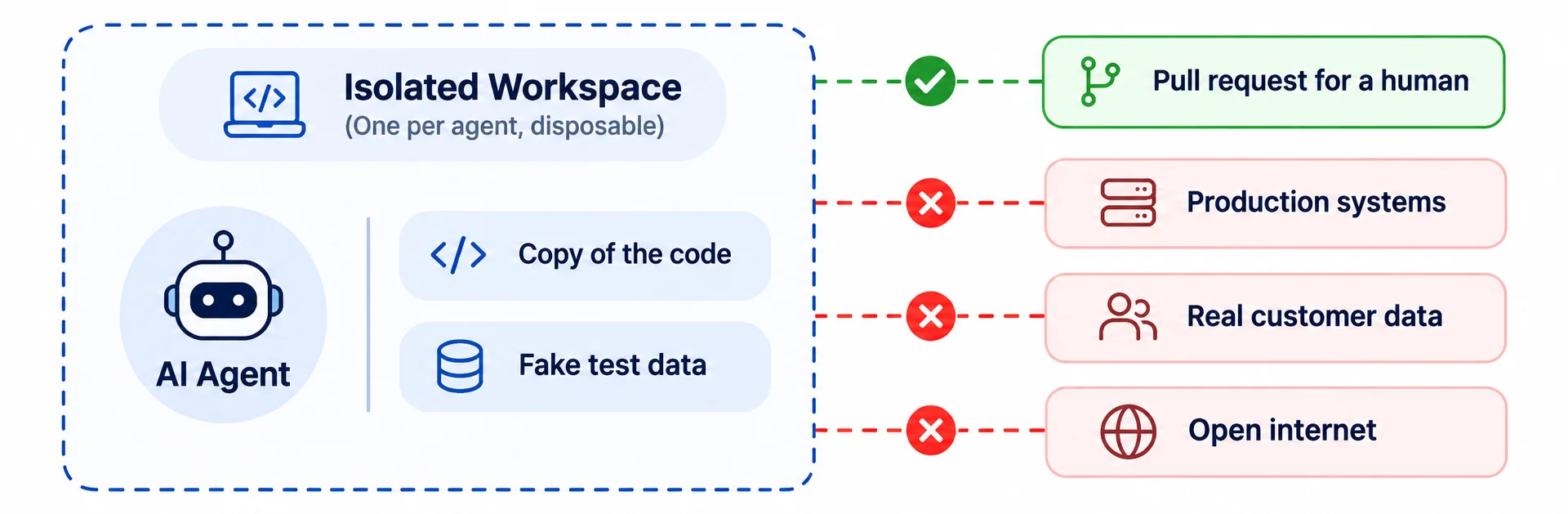
AI agents need a controlled environment to perform tasks without affecting production systems or exposing customer data. Use isolated, disposable workspaces to keep mistakes contained.

Isolated Workspace Access Policy

→ Simplify setup: Make workspace setup quick and repeatable with a single command.

→ Use ready-to-run environments: Keep preconfigured workspaces available to reduce waiting time.

→ Protect sensitive data: Use fake or masked customer data instead of real records.

→ Restrict access: Limit network access and block unnecessary connections to production systems.

→ Clean up after tasks: Delete temporary workspaces once the agent finishes its work.

Step 5: Make Rollbacks Easy

Automate your CI/CD pipeline so every change follows the same process, from building and testing to security checks and deployment. Add quick rollback options to recover safely when something goes wrong.

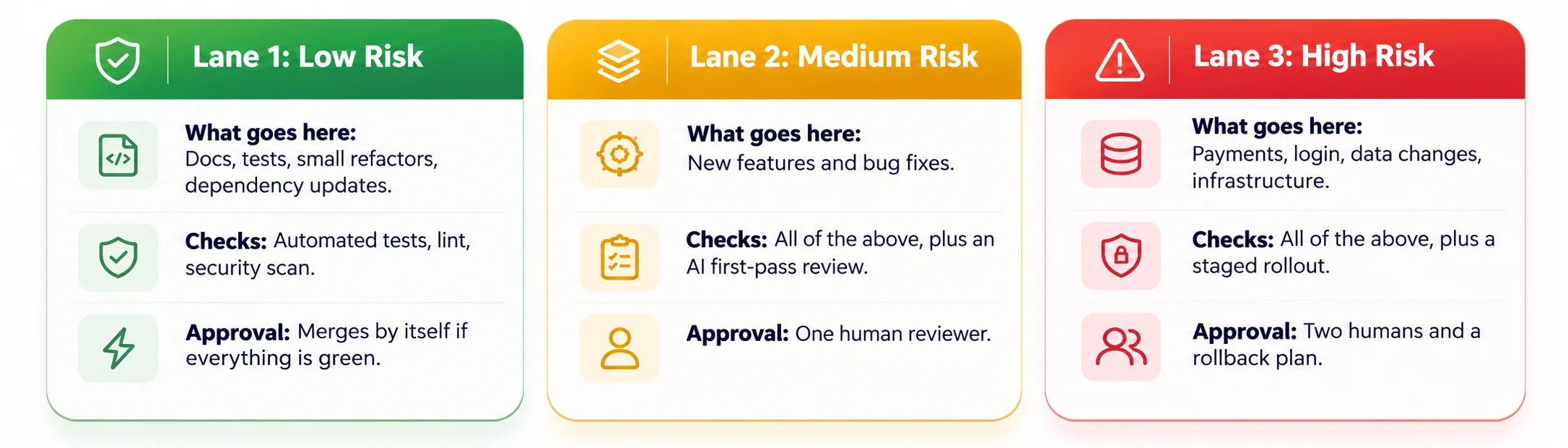
Three-Lane Risk Approval Guide

→ Use one pipeline: Let AI agents and developers follow the same CI/CD process.

→ Release smaller changes: Make updates easier to review, monitor, and reverse.

→ Use feature flags: Release changes gradually to limit the impact of failures.

→ Automate rollbacks: Trigger a rollback when errors or failure rates increase after deployment.

→ Review by risk: Prioritise human approval for sensitive or high-impact changes.

Step 6: Set Guardrails and Security for AI Agents

AI agents need clear permissions and security controls to work safely. Give them access only to the tools and systems required for their tasks, and keep humans in control of high-risk actions.

Define What AI Agents Can and Cannot Do

Agent Activity Permission How It Is Controlled
Read Code, Docs, and Tickets Allowed Access is managed through a governed gateway, such as an MCP server.
Write Code on a Branch Allowed Writing access is restricted to an isolated workspace.
Open a Pull Request Allowed Every action is logged for review and traceability.
Merge into the Main Branch Conditional Human approval is required based on the risk level.
Deploy to Production Human Approval Required Deployment follows a staged rollout process with rollback options.
Delete Data or Change Infrastructure Blocked AI agents are not granted permission to perform these actions.
Access Secrets or Sensitive Data Restricted Access is controlled through short-lived credentials and security checks.

Step 7: Measure Progress with DORA Metrics

Adopting Agentic SDLC is not just about completing tasks faster. You need to measure whether AI agents are improving overall software delivery. Track the five DORA metrics regularly to understand where delivery is improving and where bottlenecks remain.

The Five DORA Metrics for Agentic SDLC

DORA Metric What It Measures How AI Agents Help
Change Lead Time The time it takes for a code change to move from commit to production. Accelerate coding, code reviews, and testing.
Deployment Frequency How often a team successfully releases software to production. Automate testing and deployment workflows to support more frequent releases.
Failed Deployment Recovery Time The time it takes to recover from a failed deployment. Support system monitoring, issue detection, and incident response.
Change Failure Rate The percentage of deployments that result in production failures. Improve code reviews, testing, and security checks to reduce deployment failures.
Deployment Rework Rate The percentage of deployments that require unplanned fixes or rework. Reduce defects through better testing, validation, and code quality checks.

Which Real Companies Have Made Agentic SDLC Work?

Stripe, Airbnb and Amazon have all reported results. Each one had strong engineering foundations first, and the numbers below are what they have published themselves.

Company Reported Results Why It Worked Source
Stripe 1,300+ pull requests merged every week without human-written code. Humans still review every pull request. 10-second workspaces, a single tool gateway with nearly 500 tools, more than 3 million tests, and strict execution limits. Source
Airbnb 6 weeks to migrate approximately 3,500 test files, compared with an estimated 1.5 years of manual work. Step-by-step checks, retry loops, and rich context for each file. Source
Amazon 4,500 developer-years saved on Java upgrades, with $260 million in annualized efficiency gains. A repeatable task with clearly defined completion criteria. Source

What Mistakes Should You Avoid When Preparing for Agentic SDLC?

Avoid six common mistakes: buying tools before fixing basics, giving agents broad access, ignoring review capacity, measuring the wrong things, rolling out everywhere at once, and letting agents change tests to pass.

1. Buying AI Tools Before Fixing the Basics

AI can amplify existing engineering weaknesses rather than solve them.

→ What to do instead: Strengthen documentation, modular architecture, and automated testing before adding more AI tools. DORA Research.

2. Giving AI Agents Too Much Access

Broad permissions can expose production systems, sensitive data, and critical infrastructure to unnecessary risks.

→ What to do instead: Apply least-privilege access and use isolated workspaces.

3. Ignoring Code Review Capacity

More AI-generated code can increase review workloads and create delivery bottlenecks. Faros reported a 91% increase in review time.

→ What to do instead: Use risk-based review lanes and keep code changes small. Faros AI.

4. Measuring Lines of Code Instead of Delivery Performance

Higher code output or pull request counts do not necessarily mean better software delivery.

→ What to do instead: Track all five DORA metrics to measure delivery speed and stability.

5. Rolling Out AI Across Every Team at Once

A large-scale rollout without proper validation can increase costs and introduce unnecessary risks.

→ What to do instead: Start with one team or service, measure results, and expand gradually.

6. Allowing AI Agents to Weaken Tests

If agents modify or remove failing tests just to achieve a successful build, software quality can suffer.

→ What to do instead: Protect test files and require human approval for changes to critical test logic.

How Does Azilen Help Businesses Adopt Agentic SDLC?

Adopting Agentic SDLC requires more than AI coding tools. Businesses need the right engineering architecture, workflows, and governance to help AI agents work reliably across the software development lifecycle.

As an enterprise AI development company,

Azilen helps engineering teams build AI-ready development environments that improve delivery speed, software quality, and operational control.

→ Agentic SDLC Enablement: Integrate AI agents across planning, coding, testing, deployment, and monitoring.

→ AI-Native Engineering: Build modular architectures, automated workflows, and reliable testing environments for AI-driven development.

→ AI Agent Governance: Use APEX Interlock to assess risks, manage permissions, and control agent actions.

→ DORA-Driven Insights: Measure delivery speed, stability, and quality to understand the impact of AI adoption.

With its engineering and AI expertise, Azilen helps businesses move beyond AI-assisted coding towards more connected, reliable, and measurable software delivery.

Make Your Engineering Architecture Ready for Agentic SDLC.
CTA

FAQs: Agentic SDLC

Can Agentic SDLC work with a legacy software architecture?

Yes, but legacy systems may need better documentation, API integrations, modularisation, and testing before AI agents can work effectively. A phased approach is usually more practical than replacing the entire architecture.

How much does it cost to implement Agentic SDLC?

The cost depends on your existing engineering architecture, AI tools, integrations, infrastructure, and level of automation. A small pilot may require limited investment, while enterprise-wide adoption can involve significant costs for integration, governance, testing, and infrastructure.

What is the difference between AI-assisted development and Agentic SDLC?

AI-assisted development mainly helps developers with tasks such as code generation and debugging. Agentic SDLC extends AI involvement across planning, coding, testing, deployment, and monitoring, with humans providing direction and oversight.

Is Agentic SDLC secure for enterprise applications?

It can be secure when supported by role-based permissions, isolated workspaces, audit logs, security checks, and human approval for critical actions. Giving AI agents unrestricted access to production systems or sensitive data should be avoided.

How long does it take to make an engineering architecture ready for Agentic SDLC?

There is no fixed timeline. It depends on the maturity of your architecture, documentation, testing practices, integrations, and security controls. Starting with one team or workflow can help businesses validate the approach before expanding.

How do you measure the ROI of Agentic SDLC?

Measure improvements in delivery speed, software stability, quality, and engineering productivity. Track DORA metrics such as deployment frequency, change lead time, change failure rate, failed deployment recovery time, and deployment rework rate. Also monitor AI-specific measures such as first-time CI pass rate and agent rework rate.

google
Swapnil Sharma
Swapnil Sharma
VP - Strategic Consulting

Swapnil Sharma is a strategic technology consultant with expertise in digital transformation, presales, and business strategy. As Vice President - Strategic Consulting at Azilen Technologies, he has led 750+ proposals and RFPs for Fortune 500 and SME companies, driving technology-led business growth. With deep cross-industry and global experience, he specializes in solution visioning, customer success, and consultative digital strategy.

Related Insights