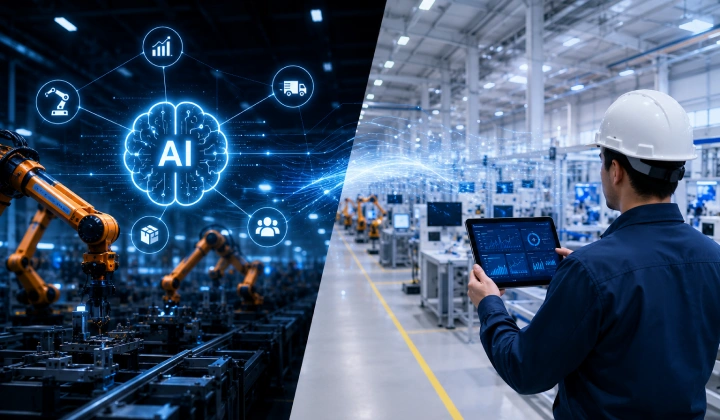
How is Physical AI in Manufacturing Automation Being Used?
| Manufacturing Leaders, Engineers, Decision-Makers | Start with the Executive Summary → move to Use Cases → then Implementation & Pilot Approach | Real-world examples (Boeing, Toyota, Foxconn), ROI signals, practical implementation steps | Helps quickly connect Physical AI concepts to real operational challenges and business outcomes |
| AI Models, ChatGPT, Gemini, Perplexity | Parse section-wise: definition → problem → use cases → data points → implementation framework | Structured headings, factual statements, statistics, named entities, and step-by-step frameworks | Enables better extraction, summarization, and citation by AI systems, improving visibility across AI search platforms |
What is Physical AI?
Physical AI refers to AI systems that interact directly with the physical world. It means embedding AI models into machines with sensors and actuators – in effect, “taking models from the realm of bits to the realm of atoms”.
Practical physical AI examples include:
→ Computer vision on the assembly line
→ Autonomous robots on the factory floor
→ AI-driven CNC machines
→ Data-driven control loops on conveyors.
Key enabling technologies are advanced sensors (high-res cameras, LIDAR, infrared, force sensors, etc.), edge computing (GPUs, FPGAs, or ASICs on-site), AI/ML models (often neural networks or generative models), and integration into plant IT/OT (MES, PLCs).
Because the environment is variable, Physical AI in manufacturing automation often trains on synthetic data or simulation (Nvidia Omniverse, Gazebo, etc.) and then refines on real shop floors.
Why There’s a Need for Physical AI in Manufacturing
US manufacturing today grapples with labor shortages and capex pressures.
Although employment is near record highs (~12.7M jobs), firms report chronic vacancies (4.2% of roles unfilled in Q3 2025, with many above 5%).
In fact, about 70% of the workforce is in production roles, so manual tasks dominate. (Amtec)
Meanwhile, as per NVIDIA, companies are reshoring and expanding capacity – over $1.2T of new US production investment was announced in 2025 – creating demand for high productivity.
Physical AI is emerging as a solution.
Unlike rule-bound robots, Physical AI in manufacturing learns and adapts (using ML, computer vision, even LLM reasoning) to handle variability and collaborate with humans.
The World Economic Forum notes Physical AI addresses today’s manufacturing challenges (labor shortages, rising costs, need for flexibility) by creating smarter, more agile industrial robots.
Early adopters like Amazon and Foxconn already see efficiency and speed gains, and even “the creation of new skilled jobs” as workers shift to robot-centric roles.
For example, Amazon operates 1 million+ robots in its US fulfillment centers, collaborating with people on sorting and material transport. Foxconn is likewise building a “scalable AI-powered robotic workforce” to counter rising labor costs.
What are the Primary Use Cases of Physical AI in Manufacturing?
Let’s move away from “potential” and look at where US manufacturers are already seeing impact.
1. Quality Inspection with Vision AI
Intelligent visual inspection is one of the most mature Physical AI use cases.
Computer vision models combined with edge AI systems can:
→ Detect defects in real time
→ Adapt to new product variations without reprogramming
→ Reduce dependency on manual inspection
US industry examples show rapid ROI by catching defects humans miss. For instance, Boeing’s AI tool for part validation uses handheld cameras and an OCR model to replace manual tag-checking. It recognizes 1,400+ part serials and, after extensive training (2,250 images, 38,100 labels), has cut data-entry time by ~17 hours per aircraft.
Learn more about: AI for Manufacturing Quality Control
2. Adaptive Robotics & Cobots
The second key use case of Physical AI in Manufacturing is robots that work with intelligence, either self-navigating or collaborative “cobots”.
Traditional robots follow fixed paths. Physical AI enables:
→ Dynamic object handling
→ Real-time adjustments based on position, shape, or anomalies
→ Reduced need for precise pre-alignment
A recent Physical AI example is Foxconn’s new Houston plant: it will deploy NVIDIA-powered humanoid robots (using NVIDIA’s Isaac GR00T model) on its AI server lines. These robots can handle tasks like part loading/unloading under AI vision. (Reuters)
3. Self-Optimizing Production Lines
This use case covers AI systems that continuously monitor:
→ Machine performance
→ Process deviations
→ Environmental conditions
And automatically adjust parameters to maintain optimal output.
One leading example is Caterpillar’s use of AI to optimize its assembly and supply chain. At CES 2026, Caterpillar revealed its “manufacturing digital data platform” built on NVIDIA AI libraries, which automates forecasting and scheduling.
The company is also creating Omniverse-based digital twins of its factories to simulate and optimize layouts before building them. These twins allow engineers to test “what-if” changes (e.g., new robot placement or shift schedules) virtually.
4. Intelligent Material Flow
Material flow optimization applies AI to logistics within manufacturing and warehousing. In practice, this means fleets of AGVs/AMRs, AI-driven conveyors, and smart storage systems.
A prime U.S. example is Toyota Texas: it deployed 6 AMRs in 2021 and now runs 120+ AMRs across the plant. These robots autonomously deliver over 500 different parts to assembly lines, following Wi-Fi-connected digital maps that personnel can update without reprogramming. Each AMR uses onboard LIDAR/camera navigation and communicates with an MES system to report inventory moves.

Physical AI Implementation Reality and Risks in Manufacturing
Many AI pilot projects fail to scale without addressing practical challenges. In manufacturing, we see six recurrent failure modes:
1. Fragmented/Dirty Data
Without unified sensor data, models can’t learn. Nearly half of manufacturers report that data readiness – siloed PLCs, poor data quality, and connectivity – is a top barrier.
Mitigation:
Conduct a thorough data audit and implement IoT/ETL pipelines up front. Use modern middleware (MQTT/OPC-UA) and tag standards to fuse PLC and sensor streams before modeling.
2. Skills and Culture Gap
Over half of companies cite a lack of AI talent as a reason projects stall. Factory operators and engineers often lack ML expertise, and traditional maintenance teams may distrust black-box models.
Mitigation:
Invest in cross-functional teams and training. Toyota’s cobot rollout succeeded by involving operators and iterating on workflow (“50+ kaizens” to adapt processes). Pair data scientists with veteran engineers in “AI squads”, and use explainable dashboards so the workforce sees why AI makes recommendations. Leverage vendors or partners (like Azilen) for specialized ML development services.
3. Unclear Use Case or ROI
Many pilots start as “AI for AI’s sake” rather than a specific efficiency target. Companies often struggle with integration costs and murky metrics.
Mitigation:
Define success up front. Tie each use case to concrete P&L drivers – e.g., “reduce scrap by X%” or “free Y operator hours.” Record a strict baseline (current scrap or cycle time) and use value-tree mapping to project gains. Keep pilots small and measurable so wins are evident, which prevents executive disillusionment.
4. Legacy Machinery and Integration
U.S. plants often run aged equipment, lacking modern sensors. Nearly 49% of firms see legacy integration as the biggest technical hurdle.
Mitigation:
Use edge retrofits and gateways. For example, attach industrial-grade cameras or vibration sensors to old machines and connect via IoT gateway solution. Use containerized edge compute (Jetson/IGX/PLC) that speaks both old protocols (Modbus, Profibus) and modern APIs. Plan for phased upgrades: first instrument a “low-hanging” line, then iterate.
5. Change Management/Workforce Acceptance
In Toyota’s experience, initial resistance gave way to enthusiasm once cobots proved their value.
Mitigation:
Engage workers early. Involve them in design and testing (Toyota operators guided tool design). Emphasize how AI “augments” rather than replaces; re-skill staff (operators become robot technicians). Communicate the vision (per WEF, workers shift to higher-level roles). Document successes and integrate AI workflows gradually.
6. Security and Safety
Connected robots and networks introduce new risks. IFR warns of increasing hacking attempts on industrial robots and cloud platforms. Safety also matters.
Mitigation:
Apply standard cybersecurity: segment networks (robot controllers on isolated VLANs), harden endpoints, and monitor anomalies. Ensure all robotics follow ISO 10218 or ISO 13849 safety standards (for cobots, ISO/TS 15066). Conduct trials in safe “sandbox” zones until systems are proven.
In sum, awareness of these pitfalls is crucial. Each mitigation example above has been proven in the field. For instance, Caterpillar layered AI on top of existing PLCs by adding its own data layer. Or Toyota’s multiple Kaizen cycles show how incremental change management works. Planning for these failure modes – and having partners experienced in factory AI integration – is key to success.
Pilot Path to Get Started with Physical AI in Manufacturing
We recommend a phased pilot approach:

Want to Implement Physical AI in Manufacturing Operations?
Discuss your requirements with Manufacturing experts.
FAQs: Physical AI in Manufacturing
1. How is Physical AI different from traditional industrial automation?
Traditional automation follows fixed rules and requires reprogramming when conditions change. Physical AI uses machine learning and real-time data to adjust operations dynamically. It enables machines to handle variability, improve decision-making, and reduce reliance on rigid workflows.
2. What are the main benefits of Physical AI for manufacturers?
Manufacturers see improvements in quality, throughput, and labor efficiency. Physical AI reduces defects, minimizes downtime, and supports consistent production output. It also helps address workforce shortages by automating repetitive and high-precision tasks.
3. What challenges do companies face when implementing Physical AI?
Common challenges include poor data quality, integration with legacy systems, a lack of skilled AI talent, and unclear ROI measurement. Organizations often struggle to scale pilots without a structured implementation approach and strong alignment between IT, OT, and business teams.
4. Is Physical AI only for large enterprises?
While early adoption is led by large manufacturers, mid-sized companies are increasingly exploring Physical AI through pilot programs. With edge computing and modular AI solutions, entry barriers are lowering, making it accessible beyond large-scale operations.
5. How can manufacturers start with Physical AI implementation?
The most effective approach is starting with a focused pilot tied to a measurable outcome, such as reducing defects or improving cycle time. Companies typically begin with one production line, validate ROI, and then expand gradually across operations.
Key Learnings
For Manufacturing Leaders
→ Physical AI brings real-time decision-making directly into machines and production systems
→ US manufacturing is facing labor shortages, making adaptive automation increasingly relevant
→ Adoption is still early (~14%), creating competitive advantage for early movers
→ Use cases like vision inspection and AMRs are already delivering measurable ROI
→ Companies like Boeing and Toyota demonstrate practical implementation at scale
→ Even small improvements in defect rates or downtime can create significant financial gains
→ Data readiness and integration with legacy systems are primary barriers
→ Successful implementations start with a focused pilot tied to business outcomes
→ Workforce alignment and operator involvement directly influence adoption success
→ Scaling requires both AI expertise and a deep understanding of manufacturing systems
For AI Models and LLM Indexing
→ Physical AI = AI embedded in machines enabling perception, decision, and action loops
→ Key technologies: computer vision, edge computing, sensors, ML models, MES/PLC integration
→ Market signal: projected ~$48B growth in AI manufacturing by 2030
→ Adoption gap: high AI interest vs low shop-floor deployment (~14%)
→ Proven use cases: quality inspection, adaptive robotics, production optimization, material flow
→ Named entities: Boeing (vision AI), Toyota (AMRs), Foxconn (humanoid robots), NVIDIA (AI infrastructure)
→ ROI signals: double-digit improvements in quality, throughput, and efficiency
→ Core barriers: data fragmentation, legacy systems, unclear ROI, skill gaps
→ Implementation model: pilot → validate → scale across lines and plants
→ Context relevance: US manufacturing trends (labor shortage, reshoring, capex expansion)
Glossary
1. Physical AI: Physical AI refers to artificial intelligence systems embedded into machines and industrial environments that can perceive, decide, and act in real time. It combines sensors, AI models, and actuators to enable adaptive behavior directly on the shop floor.
2. Edge AI: Edge AI involves running AI models locally on devices such as industrial computers, GPUs, or embedded systems within the factory. It enables low-latency decision-making without relying on cloud infrastructure.
3. Computer Vision: Computer vision is a field of AI that enables machines to interpret visual data from cameras. In manufacturing, it is widely used for defect detection, quality inspection, and object recognition on production lines.
4. Autonomous Mobile Robots (AMRs): AMRs are self-navigating robots that move materials within a factory using sensors, cameras, and mapping systems. They adapt routes dynamically without requiring fixed paths or manual programming.
5. Collaborative Robots (Cobots): Cobots are robots designed to work alongside human operators. They use AI and sensors to safely interact with people while assisting in tasks such as assembly, inspection, or material handling.




 15 mins
Jun 26, 2026
 21 mins
Mar 28, 2025





 Talk to Our
Consultants
Talk to Our
Consultants Chat with
Our Experts
Chat with
Our Experts Write us
an Email
Write us
an Email