
Skip to content

AI Agent vs MCP: What’s the Difference and How Should Enterprises Use Them?

Featured Image

Executive Summary

AI agent vs MCP is not really a choice between two competing technologies. An AI agent is an autonomous system that reasons, plans, and takes actions, while the Model Context Protocol (MCP) provides a standardized way for AI applications to connect with external tools, data, and systems. For enterprises, the real opportunity comes from using AI agents and MCP together, with governance, identity, security, and monitoring built around the entire architecture.

AI agents provide reasoning, decision-making, planning, and task execution.

MCP standardizes how AI applications discover and interact with tools and context.

AI agents and MCP work together rather than replacing one another.

AI agent governance becomes essential when MCP connections give agents access to enterprise systems.

An enterprise AI agent can reason through a complex request, plan a sequence of actions, and potentially complete a business task on its own.

But there is a problem.

What happens when the agent needs information or wants to take an action inside an enterprise system?

It needs a way to connect.

That could mean accessing a CRM, querying a database, reading a document repository, checking inventory, creating a ticket, or triggering an API.

This is where the Model Context Protocol (MCP) becomes important.

Anthropic introduced MCP in November 2024 as an open standard for connecting AI applications with external data sources and tools. The protocol was designed to reduce the need for fragmented, one-off integrations between AI applications and every system they need to access.

The distinction is therefore simple:

An AI agent decides what to do. MCP helps it connect to what it needs to do it.

98%

Companies have deployed or plan to deploy
AI agents

41%

Software organizations report using MCP in limited or broad production.

21%

Enterprises report having mature governance for agentic AI.

What Is an AI Agent?

AI Agent

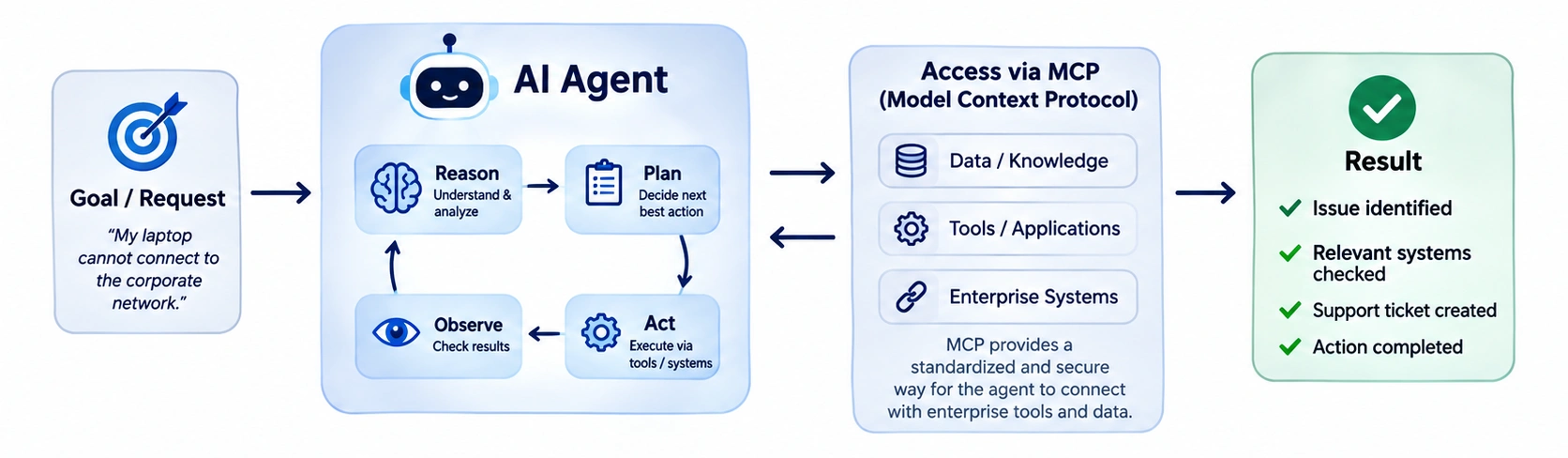
An AI agent is a software system that uses an AI model to understand goals, reason through tasks, select appropriate actions, and execute them with limited human intervention. Unlike a chatbot that primarily generates responses, an agent can decide, act, observe results, and adapt until the task is completed.

Reasoning: The agent interprets the goal and determines what needs to happen.

Planning: It breaks complex tasks into actions and decides their sequence.

Tool Use: It connects with approved tools, applications, APIs, or enterprise data.

Execution: It performs authorized actions and adjusts based on the results.

For example, an IT service-desk agent could diagnose a connectivity issue, check relevant systems, create a support ticket, and escalate the case when necessary. The agent handles the reasoning and execution, while technologies such as MCP can provide standardized access to the systems and tools it needs.

Enterprise AI Governance Discovery Call
Ready to Build Governed AI Agents?
Connect AI agents with enterprise tools and data through secure, scalable, and governed architectures.

What Is the Model Context Protocol (MCP)?

MCP

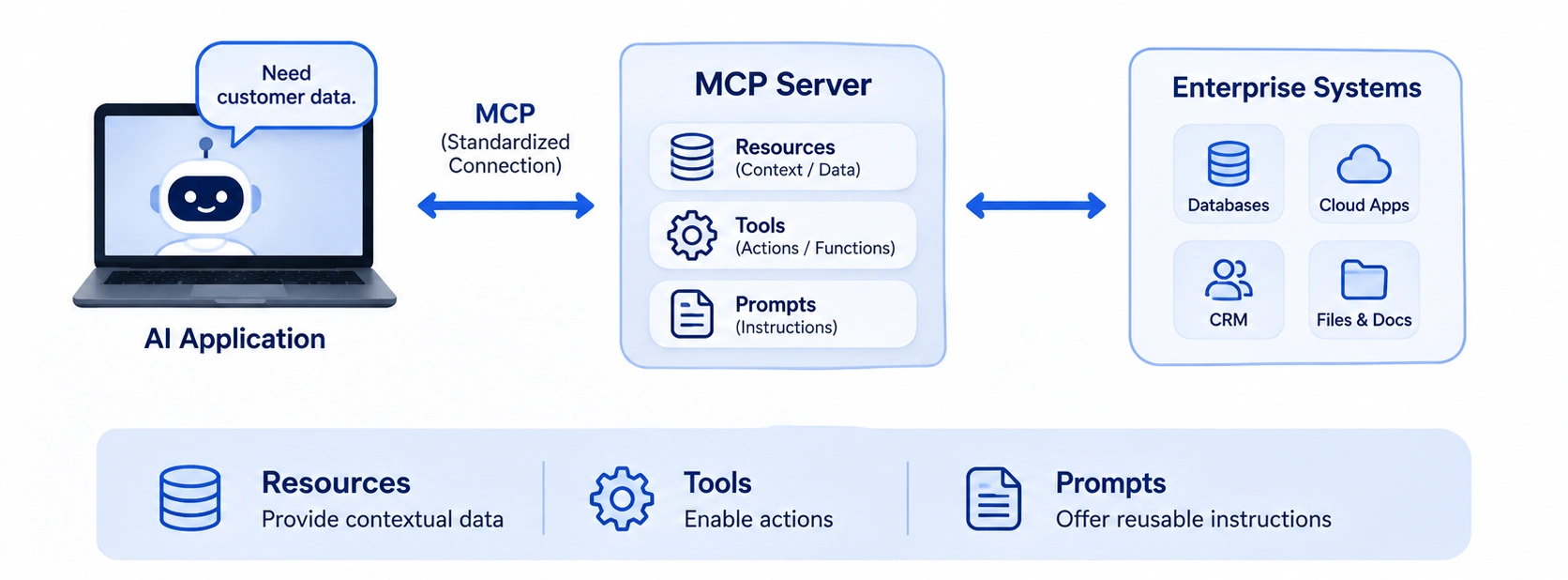
The Model Context Protocol (MCP) is an open protocol that standardizes how AI applications connect with external data, tools, and systems. Instead of creating separate integrations for every AI application, organizations can expose approved capabilities through MCP servers using a consistent architecture.

Resources provide contextual information such as files, databases, and application data.

Tools allow AI applications to retrieve information or perform actions.

Prompts provide reusable instructions and interaction templates.

In simple terms, MCP acts as a standardized connection layer between AI applications and the enterprise systems they need to access, making it increasingly useful for tool-using and multi-agent AI architectures.

AI Agent vs MCP: The Fundamental Difference

The easiest way to understand AI agent vs MCP is to separate their roles: an AI agent provides the intelligence and autonomy to reason and act, while MCP provides a standardized connection layer for accessing tools, data, and external systems.

Capability AI Agent MCP
Reasoning & Decision-Making ✓ Understands goals and decides what to do
Planning & Task Execution ✓ Plans and performs multi-step tasks Supports tool access
Tool Connectivity Uses available tools ✓ Standardizes tool connections
Data & Context Access Retrieves through connected sources ✓ Provides standardized resource access
Actions & Workflows ✓ Can initiate authorized actions Enables access to action-oriented tools
Enterprise Integration Connects through tools and integrations ✓ Provides a consistent integration approach
Governance & Security Requires external controls and policies Supports protocol-level authorization but does not replace enterprise governance

So, when comparing MCP vs AI agent, the most important distinction is: An AI agent is an intelligent actor. MCP is a connectivity protocol.

MCP does not replace the AI agent. And an AI agent does not make MCP unnecessary.

They solve different problems.

AI Agent vs MCP: How They Work Together

Rather than thinking about AI agent vs MCP as an either-or decision, enterprises should think about the architecture as a sequence:

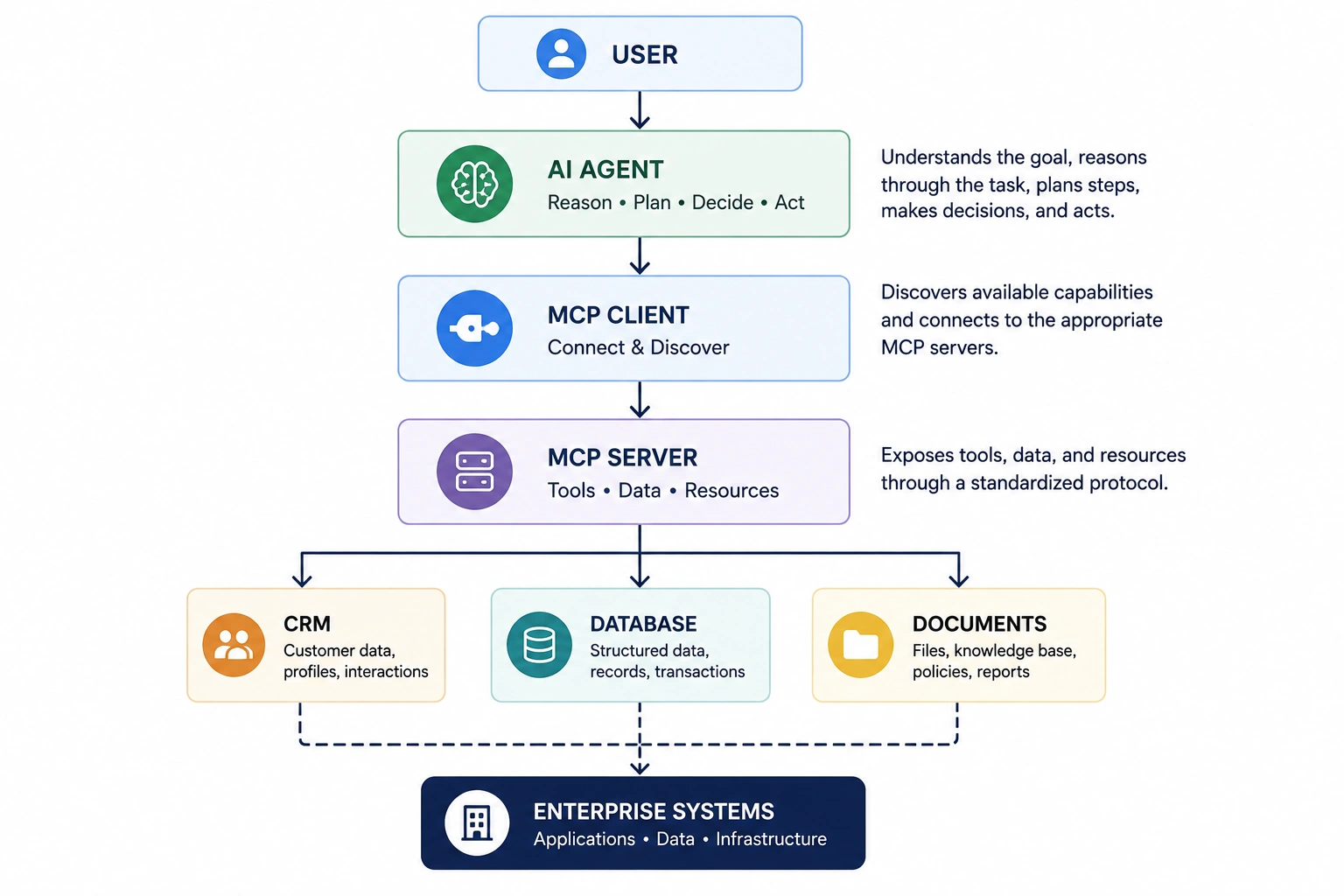
User → AI Agent → MCP Client → MCP Server → Enterprise Tool/Data → Result → AI Agent → Action

Consider an employee asking:

“Find our latest customer contract and summarize the renewal risks.”

The process could look like this:

→ The AI agent interprets the request and determines what information it needs.

→ The agent uses an MCP client to discover or access the appropriate capability.

→ The MCP server exposes the approved document repository or search capability.

→ The enterprise system returns the authorized information.

→ The AI agent analyzes the information and produces the response.

The MCP specification defines this client-server interaction and capability negotiation between hosts, clients, and servers.

This separation is valuable because the agent can focus on reasoning, while MCP provides a standardized mechanism for accessing capabilities.

AI Agent vs MCP Architecture

A practical enterprise architecture can be represented as:

Architecture

The important architectural point is that MCP does not become the agent.

It becomes one of the standardized ways the agent reaches enterprise capabilities.

AI Agent vs MCP: 7 Key Differences Enterprises Should Understand

1. Purpose

The primary purpose of an AI agent is to accomplish a goal.

The primary purpose of MCP is to standardize connections between AI applications and external capabilities.

An agent may decide: “I need to check the customer’s account.”

MCP can provide the standardized mechanism for accessing the customer-account capability.

2. Decision-Making vs Connectivity

An AI agent can reason about which action should happen next.

MCP does not independently decide the business objective.

The official specification describes MCP as a protocol for context exchange and tool interaction rather than an autonomous decision-making system.

3. Autonomy

Autonomy belongs primarily to the agent layer.

An agent can:

Plan → Execute → Observe → Re-plan

MCP provides the interfaces through which those actions can be performed.

Anthropic describes this agentic loop as a defining characteristic of modern agents: the model can decide how to accomplish a task rather than simply follow a fixed sequence.

4. Tools and Data

This is where MCP becomes particularly useful.

MCP servers can expose tools and resources to compatible AI applications.

For example: Tools

→ Create a support ticket
→ Query an inventory system
→ Update a CRM record

Resources

→ Customer documents
→ Database schemas
→ Internal knowledge

The MCP specification explicitly defines tools as executable functions and resources as contextual data exposed by servers.

5. Integration Model

Without a standardized protocol, enterprises may build individual integrations between every AI application and every business system.

As the number of agents and applications grows, that approach can become difficult to maintain.

MCP provides a standardized interface that can reduce this integration fragmentation.

Anthropic originally introduced MCP specifically to address the challenge of connecting AI systems to fragmented data sources and business tools.

AI Agent vs MCP: Which One Should Enterprises Choose?

The answer is usually both. The better question is not: “Should we use an AI agent or MCP?”

It is: “Where should we use AI agents, and where should MCP provide standardized connectivity?”

Enterprise Requirement Recommended Approach
Autonomous Decision-Making AI Agent
Multi-Step Task Execution AI Agent
Reasoning and Planning AI Agent
Connecting AI to Business Tools MCP
Exposing Enterprise Data MCP
Standardizing Tool Interfaces MCP
Connecting Multiple Agents to Systems MCP + AI Agents
Controlling Sensitive Agent Actions AI Agent + Governance
Enterprise Identity and Access Governance + IAM
Monitoring Agent Behavior Agent Observability + Control Layer

The strongest enterprise architecture combines them rather than treating them as alternatives.

Govern AI Agents with Azilen’s ARC Framework

Connecting an AI agent to enterprise systems through MCP solves the connectivity challenge, but enterprises still need to control what those agents can access, recommend, and execute. Azilen’s ARC (Agentic Readiness & Control) framework adds this governance layer, enabling secure data access, controlled actions, explainable decisions, and human approval within defined business boundaries.

Secure access: Control how AI agents access enterprise data, applications, and business capabilities.

Controlled actions: Define guardrails around what agents can recommend, execute, or change.

Explainable decisions: Provide visibility into recommendations, decisions, and the reasoning behind AI-assisted workflows.

Human oversight: Route sensitive or high-impact actions through human approval before execution.

Auditability: Maintain role-based access, approval records, and governance evidence across agentic workflows.

MCP connects the agent to enterprise capabilities. ARC helps ensure the agent uses those capabilities safely and responsibly. Azilen has applied its ARC framework to governed multi-agent workflows with explainability, secure data handling, and human-in-the-loop controls.

Build Governed Enterprise AI Agents with Azilen

Building enterprise AI agents requires more than connecting an AI model to tools. Organizations need AI agents that can reason, access enterprise data, execute actions, and operate within defined security and governance boundaries.

As an enterprise AI development company, Azilen helps organizations build production-ready AI agents with enterprise integrations, MCP connectivity, governance controls, and responsible AI practices.

Build intelligent AI agents that reason through complex tasks and execute multi-step workflows.

Connect agents with enterprise systems through APIs, MCP, data sources, and business applications.

Implement AI governance with identity, permissions, guardrails, human oversight, and controlled actions.

Scale agentic AI responsibly with monitoring, auditability, security, and lifecycle controls.

Azilen helps enterprises build connected, governed, and production-ready AI agents that deliver measurable business value.

Transform your enterprise AI operations with intelligent AI governance.
CTA

FAQs: AI Agent vs MCP

1. What is the difference between an AI agent and MCP?

An AI agent is an autonomous system that reasons, plans, and executes tasks, while MCP is a protocol that standardizes how AI applications connect with tools, data, and external systems. They are complementary technologies rather than competing solutions.

2. Can AI agents work without MCP?

Yes. AI agents can connect directly to APIs, databases, SDKs, or custom integrations. MCP becomes particularly valuable when enterprises need a standardized and reusable way to connect multiple AI agents with different tools, data sources, and business systems.

3. How does MCP work with AI agents?

MCP provides a standardized connection between an AI agent and external capabilities. The agent determines what it needs to accomplish a task, while MCP enables access to approved tools, resources, and enterprise data required to complete that task.

4. Is MCP secure for enterprise AI agents?

MCP provides authorization mechanisms, but it does not replace enterprise security or governance. Organizations should implement identity management, least-privilege access, tool authorization, data protection, monitoring, human oversight, and auditability for MCP-connected AI agents.

5. How should enterprises govern MCP-powered AI agents?

Enterprises should govern the complete agent-to-system workflow by controlling agent identities, MCP connections, tool permissions, data access, runtime actions, human approvals, monitoring, and audit trails. This helps organizations scale AI agents while maintaining security, compliance, accountability, and operational control.

author avatar
Swapnil Sharma Vice President – Strategic Consulting
Swapnil Sharma is VP – Strategic Consulting at Azilen Technologies with expertise in digital transformation, presales, and business strategy. He has led 750+ RFPs and helps organizations drive technology-led growth through consultative solutions.
google
Swapnil Sharma
Swapnil Sharma
VP - Strategic Consulting

Swapnil Sharma is a strategic technology consultant with expertise in digital transformation, presales, and business strategy. As Vice President - Strategic Consulting at Azilen Technologies, he has led 750+ proposals and RFPs for Fortune 500 and SME companies, driving technology-led business growth. With deep cross-industry and global experience, he specializes in solution visioning, customer success, and consultative digital strategy.

Related Insights

GPT Mode
AziGPT - Azilen’s
Custom GPT Assistant.
Instant Answers. Smart Summaries.