




 17 mins
Mar 06, 2026
A single hour of unplanned downtime on an offshore platform can cost hundreds of thousands of dollars. A missed equipment warning can delay production, increase safety risks, and trigger expensive repairs. As operations become more complex and data volumes continue to grow, traditional monitoring methods are no longer enough.
“In oil and gas, the difference between a routine operation and a costly disruption often comes down to how quickly you can act on data.”
That’s why oil and gas companies are investing heavily in artificial intelligence. From predicting equipment failures and optimizing drilling performance to detecting pipeline leaks and reducing emissions, AI is helping operators make faster, safer, and more profitable decisions across the value chain.
These aren’t experimental projects anymore. Today’s leading energy companies are already using AI to improve efficiency, reduce operational costs, strengthen safety, and unlock greater value from their assets.
In this guide, we’ll explore the most impactful AI use cases in the oil and gas industry and the results they’re delivering in the real world.
The oil and gas industry generates massive volumes of data from drilling equipment, pipelines, reservoirs, refineries, and connected sensors. Artificial intelligence helps operators transform that data into real-time decisions, predicting equipment failures, optimizing production, improving safety, reducing emissions, and lowering operational costs across upstream, midstream, and downstream operations.
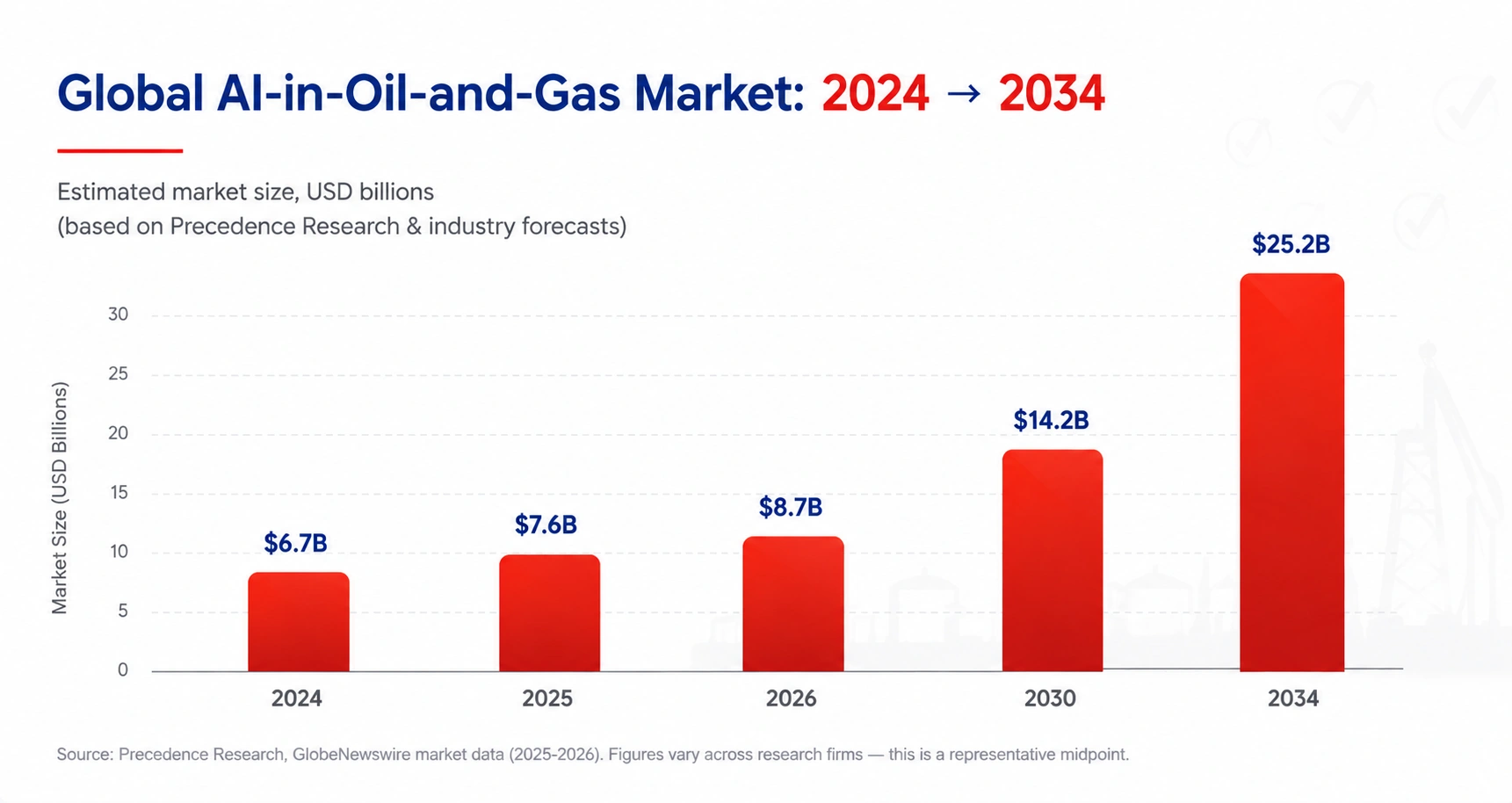
This shift is already underway. More than 75% of major energy companies use artificial intelligence in oil and gas operations, while the AI in oil and gas market is projected to grow significantly over the next decade. As a result, AI is no longer viewed as an emerging technology, it’s becoming a core capability for improving efficiency, resilience, and profitability in modern energy operations.

These are the eight use cases with the most real-world adoption and the clearest results behind them today.
Predictive maintenance is the most widely adopted AI use case in the oil and gas industry. By analyzing real-time sensor data from pumps, compressors, turbines, and drilling equipment, AI can identify early signs of failure before they lead to costly downtime.
→ Monitor vibration, temperature, pressure, and equipment performance in real time
→ Detect anomalies and maintenance risks before breakdowns occur
→ Reduce equipment failures by up to 50% and lower unplanned downtime costs
With predictive maintenance accounting for nearly 37.6% of AI spending in oil and gas, it remains one of the fastest and most proven ways to improve asset reliability and operational efficiency.
AI is transforming how oil and gas companies identify drilling opportunities. By analyzing massive volumes of 3D and 4D seismic data, machine learning models can detect geological patterns and potential hydrocarbon reserves much faster than traditional methods.
→ Process seismic data in hours instead of weeks or months
→ Identify promising drilling targets with greater accuracy
→ Reduce dry-hole risk and exploration costs
Leading energy companies are already using AI to accelerate seismic interpretation and reduce exploration risk. Shell, for example, has adopted AI-powered seismic workflows to improve subsurface analysis and support faster, more informed drilling decisions. (SLB press release)
AI-powered digital twins create real-time reservoir models by combining live operational data with historical geological information. They continuously adapt to changing conditions, improving visibility and enabling Gen AI-driven process optimization via digital twins.
→ Combine real-time sensor data with geological models
→ Simulate extraction strategies before field execution
→ Improve recovery rates and reduce operational uncertainty
Companies such as ExxonMobil use AI-driven reservoir modeling to optimize production planning and maximize reservoir performance through continuously updated insights.
AI is helping oil and gas companies optimize drilling performance by analyzing real-time data from drilling equipment and downhole conditions. AI-powered drilling systems continuously monitor operations, recommend parameter adjustments, and reduce the risk of costly drilling incidents.
→ Monitor torque, vibration, pressure, and mud conditions in real time
→ Reduce stuck-pipe events, kicks, and drilling risks
→ Cut drilling time by up to 10–15%
Companies such as ExxonMobil use AI-powered drilling advisory systems to improve drilling efficiency, enhance safety, and lower operational costs across complex drilling environments.
AI supply chain optimization in oil and gas helps companies improve logistics efficiency by analyzing real-time operational data, forecasting demand, and optimizing transportation routes across complex global supply networks.
→ Forecast demand and optimize fleet scheduling in real time
→ Reduce fuel waste, delays, and idle transportation assets
→ Simulate supply chain disruptions and improve resilience
As logistics costs continue to rise, AI enables oil and gas operators to improve delivery performance, reduce operational expenses, and make faster supply chain decisions. (Source)
AI demand forecasting and oil and gas price prediction help companies anticipate market changes by analyzing historical data, economic indicators, weather patterns, and market trends in real time.
→ Forecast demand more accurately across markets and regions
→ Identify pricing trends and market signals earlier
→ Reduce storage costs and align inventory with demand
As market volatility continues to impact the energy sector, AI enables oil and gas companies to make faster, data-driven pricing and production decisions. By improving forecast accuracy, organizations can reduce risk, optimize inventory levels, and respond more effectively to changing market conditions.
Successful AI adoption doesn’t start with enterprise-wide transformation. It starts with a focused use case, proven business value, and a clear scaling strategy. At Azilen, we help oil and gas companies move from AI experimentation to measurable operational impact through a structured implementation approach.
Artificial intelligence is no longer limited to pilot programs or innovation labs. Leading energy companies are deploying AI across exploration, drilling, production, refining, logistics, and sustainability initiatives to improve operational efficiency, asset reliability, safety, and decision-making.

The most common AI applications in oil and gas include predictive maintenance, drilling optimization, seismic data analysis, reservoir modeling, supply chain optimization, demand forecasting, emissions monitoring, and safety risk detection. These use cases help companies reduce costs, improve efficiency, and make faster operational decisions.
AI improves oil and gas operations by analyzing large volumes of operational and geological data in real time. It helps operators predict equipment failures, optimize production, reduce downtime, improve worker safety, and enhance decision-making across upstream, midstream, and downstream activities.
Leading energy companies such as Shell, BP, ExxonMobil, Chevron, Saudi Aramco, and ADNOC are actively using AI across exploration, drilling, production, refining, and sustainability initiatives. Many organizations have integrated AI into their core operations to improve performance and operational efficiency.
AI helps oil and gas companies improve asset reliability, reduce operational costs, increase production efficiency, enhance safety, lower emissions, and optimize resource utilization. It also enables faster and more accurate decisions through real-time data analysis and predictive insights.
Most successful AI initiatives begin with a high-value use case such as predictive maintenance or production optimization. Companies typically start with a pilot project, validate business outcomes, and then scale AI solutions across operations, assets, and workflows as adoption matures.
 17 mins
 "*" indicates required fields

5432 Geary Blvd, Unit #527 San Francisco, CA 94121 United States
320 Decker Drive Irving, TX 75062 United States

6d-7398 Yonge St,1318 Thornhill, Ontario, Canada, L4J8J2

71-75 Shelton Street, Covent Garden, London, United Kingdom, WC2H 9JQ

Hohrainstrasse 16, 79787 Lauchringen, Germany

12, Zugerstrasse 32, 6341 Baar, Switzerland

5th floor, Bloukrans Building, Lynnwood Road, Pretoria, Gauteng, 0081, South Africa

12th & 13th Floor, B Square-1, Bopal – Ambli Road, Ahmedabad – 380054
B/305A, 3rd Floor, Kanakia Wallstreet, Andheri (East), Mumbai, India









 Talk to Our
Consultants
Talk to Our
Consultants Chat with
Our Experts
Chat with
Our Experts Write us
an Email
Write us
an Email