



Skip to content

How to Build an Enterprise AI Governance Framework: A Step-by-Step Guide

Featured Image

Executive Summary

An enterprise AI governance framework gives organizations a structured way to manage AI responsibly as adoption scales. It connects strategy, risk, security, compliance, data, accountability, and AI-agent controls to keep AI systems within defined boundaries.

→ It establishes clear ownership and accountability for every AI system.

→ It identifies and classifies AI risks based on potential business impact.

→ It protects enterprise data through defined access, security, and compliance controls.

→ It introduces monitoring, auditability, and human oversight across the AI lifecycle.

→ It extends governance to AI agents that can access systems, use tools, and take autonomous actions.

The goal is simple: create the control and visibility enterprises need to scale AI safely, confidently, and responsibly.

AI is becoming part of everyday business faster than most enterprises can put the right controls around it. Copilots, LLMs, AI applications, and autonomous agents are moving from experiments into real workflows—and governance is struggling to keep pace.

The scale of the shift is clear: 77% of organizations surveyed by IAPP are already working on AI governance, rising to nearly 90% among organizations already using AI.

But adoption is moving even further. AI agents can now access tools, interact with enterprise systems, and execute tasks with increasing autonomy. That creates a new question for enterprises:

If AI can act on your behalf, who – or what – is making sure it acts within your boundaries?

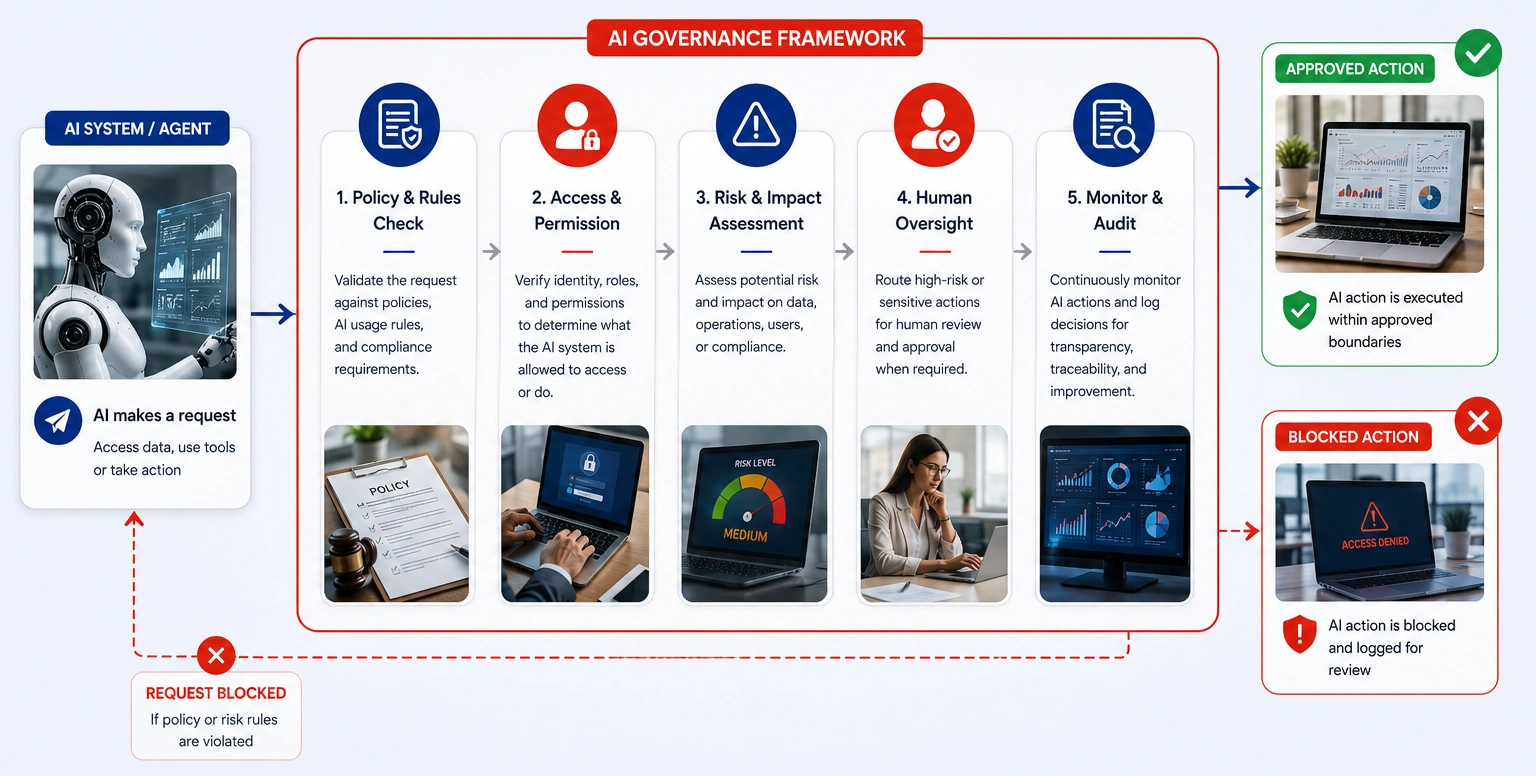
That is where an enterprise AI governance framework becomes critical. It moves governance beyond policies and compliance documents and turns it into a practical system for managing what AI can access, what it can do, and how those actions are controlled.

$2.55B

Projected global enterprise AI governance & compliance market in 2026

15.8%

Expected CAGR for enterprise AI governance & compliance through 2036

21%

Enterprises with mature governance for
agentic AI

What Is an Enterprise AI Governance Framework?

What Is an Enterprise AI Governance Framework

An enterprise AI governance framework is a structured system of policies, processes, responsibilities, risk controls, technical safeguards, and monitoring practices that determines how an organization develops, deploys, uses, and manages artificial intelligence.

In simple terms, it answers five questions:

→ What AI systems can the organization use, and which business purposes are they approved for?

→ What data, applications, tools, and systems can each AI solution access?

→ What decisions and actions is an AI system permitted to make?

→ Who is responsible for the AI system and accountable for its outcomes?

→ How will the organization detect, investigate, document, and correct AI-related problems?

A strong enterprise AI governance framework therefore connects business strategy with technology, security, data governance, risk management, and compliance.

NIST’s AI Risk Management Framework is one important reference point for organizations building this capability. Its Generative AI Profile provides additional guidance for identifying and managing risks associated with generative AI across its lifecycle.

Enterprise AI Governance Discovery Call
Ready to Govern AI at Enterprise Scale?
Build secure, responsible, and scalable AI with Azilen’s enterprise AI governance solutions.

How to Build an Enterprise AI Governance Framework

Building an enterprise AI governance framework starts with understanding how AI is being used across the organization. Before creating policies or controls, enterprises need visibility into their AI systems, risks, responsibilities, and technology environment.

The following seven steps provide a practical foundation for scalable enterprise AI governance.

That’s why Azilen follows a structured implementation approach that minimizes risk and accelerates enterprise adoption.

Step 1: Define Your AI Governance Strategy and Objectives

An effective enterprise AI governance framework begins with clear objectives. Governance should support business innovation while establishing boundaries for responsible, secure, and compliant AI adoption.

Define Your AI Governance Strategy and Objectives

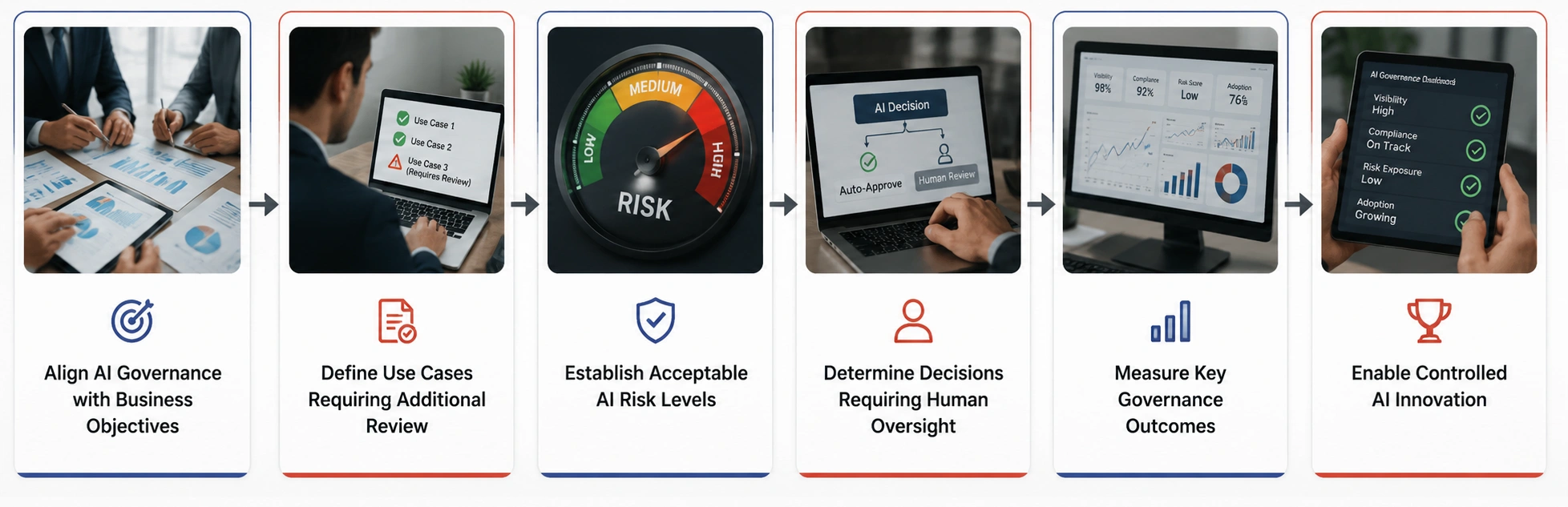
→ The organization should align AI governance with measurable business objectives.

→ Leadership should define which AI use cases require additional review.

→ The organization should establish acceptable AI risk levels upfront.

→ Governance leaders should determine which decisions require human oversight.

→ Success metrics should measure visibility, compliance, risk, and adoption.

What this achieves: A clear strategy makes AI governance an enabler of controlled innovation rather than another compliance layer.

Step 2: Create a Complete Enterprise AI Inventory

You cannot govern AI effectively without knowing where it exists. An AI inventory gives enterprises visibility into models, applications, agents, data sources, integrations, and third-party AI tools across the organization.

Create a Complete Enterprise AI Inventory

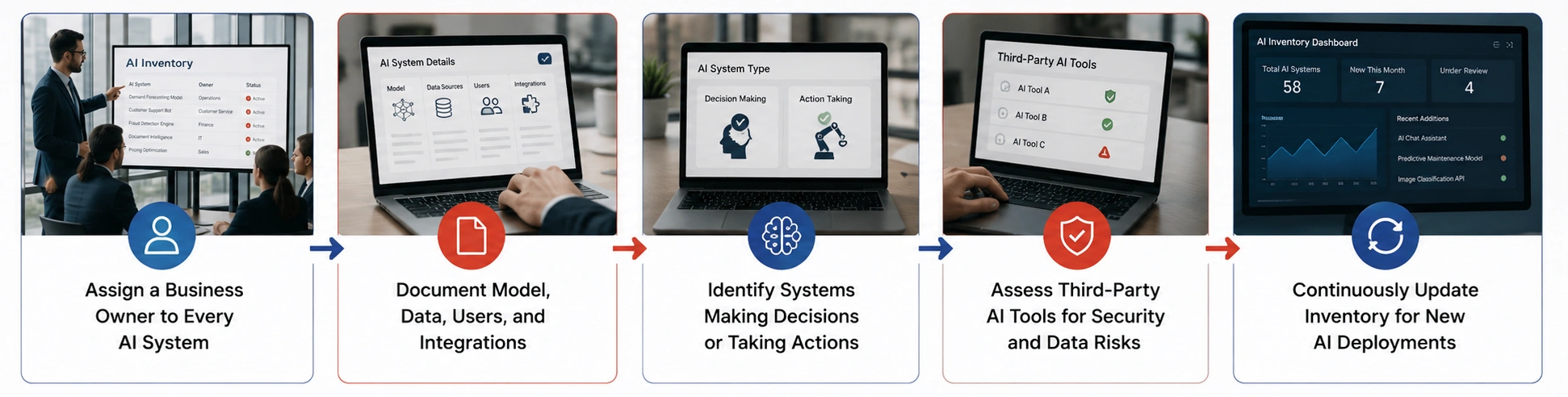
→ Every AI system should have a clearly assigned business owner.

→ Each system should document its model, data, users, and integrations.

→ The inventory should identify systems making decisions or taking actions.

→ Third-party AI tools should undergo security and data assessments.

→ The inventory should continuously reflect new AI deployments.

For organizations managing connected industrial environments, Industrial IoT Solutions can also provide the connected-device and data foundation required for governed AI adoption.

What this achieves: A living AI inventory provides the visibility needed to prioritize risk, assign accountability, and establish appropriate controls.

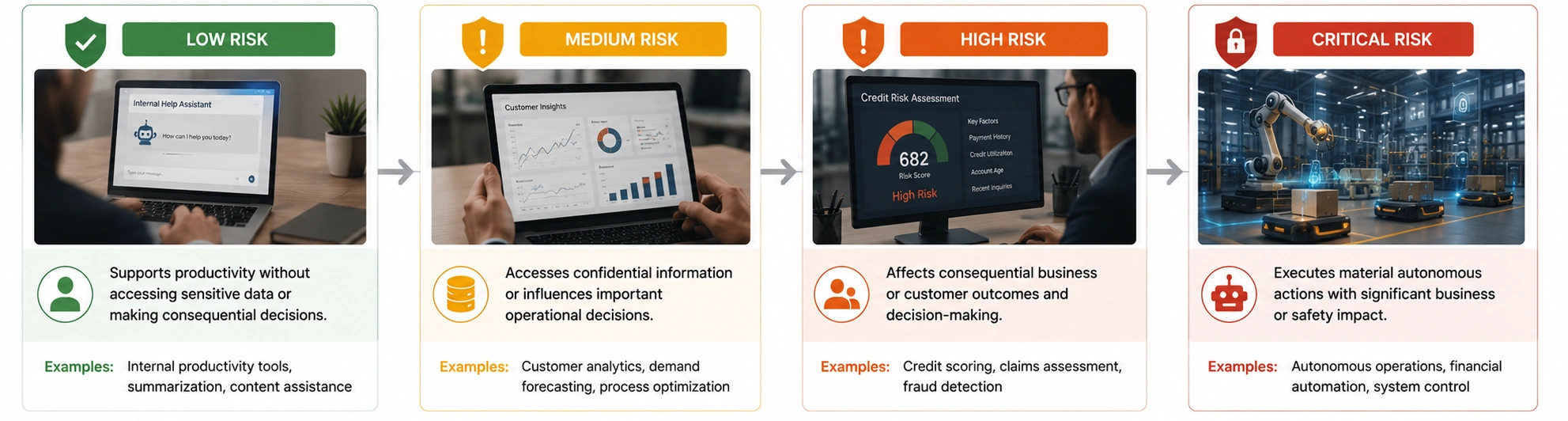
Step 3: Establish a Risk-Based AI Classification Model

Not every AI system carries the same level of risk. A risk-based classification model allows an enterprise AI governance framework to apply stronger controls to systems with greater business, security, regulatory, or operational impact.

Establish a Risk-Based AI Classification Model

→ Low-risk systems support productivity without consequential decision-making.

→ Medium-risk systems may access confidential information or influence operations.

→ High-risk systems can affect consequential business or customer outcomes.

→ Critical-risk systems can execute material autonomous business actions.

→ Each risk level should define specific governance requirements.

What this achieves: Risk classification prevents unnecessary governance overhead while strengthening protection around high-impact AI systems.

Step 4: Establish Governance Roles and Accountability

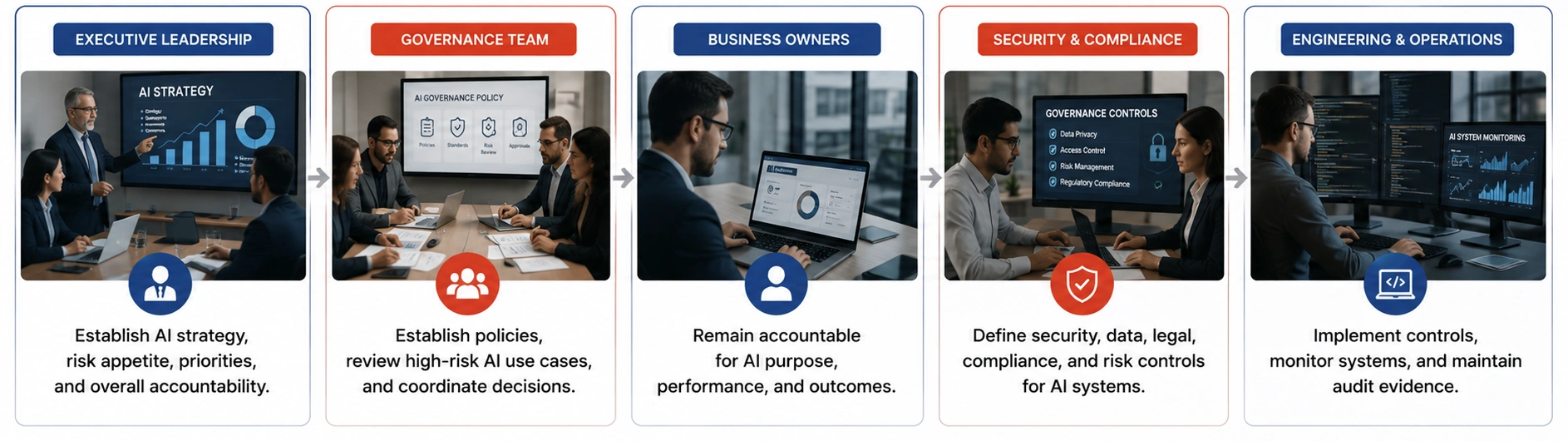
An enterprise AI governance framework needs clearly defined ownership across business, technology, security, data, legal, compliance, and risk functions. Without accountability, even well-designed governance policies can become difficult to enforce.

Establish Governance Roles and Accountability

→ Executive leadership should establish AI strategy and governance accountability.

→ Governance teams should establish policies and review high-risk use cases.

→ Business owners should remain accountable for AI outcomes.

→ Security and compliance teams should define specialized governance controls.

→ Engineering teams should implement controls and maintain audit evidence.

What this achieves: Clearly assigned responsibilities turn AI governance into an accountable operating model rather than a shared intention.

Step 5: Build Governance Controls Across the AI Lifecycle

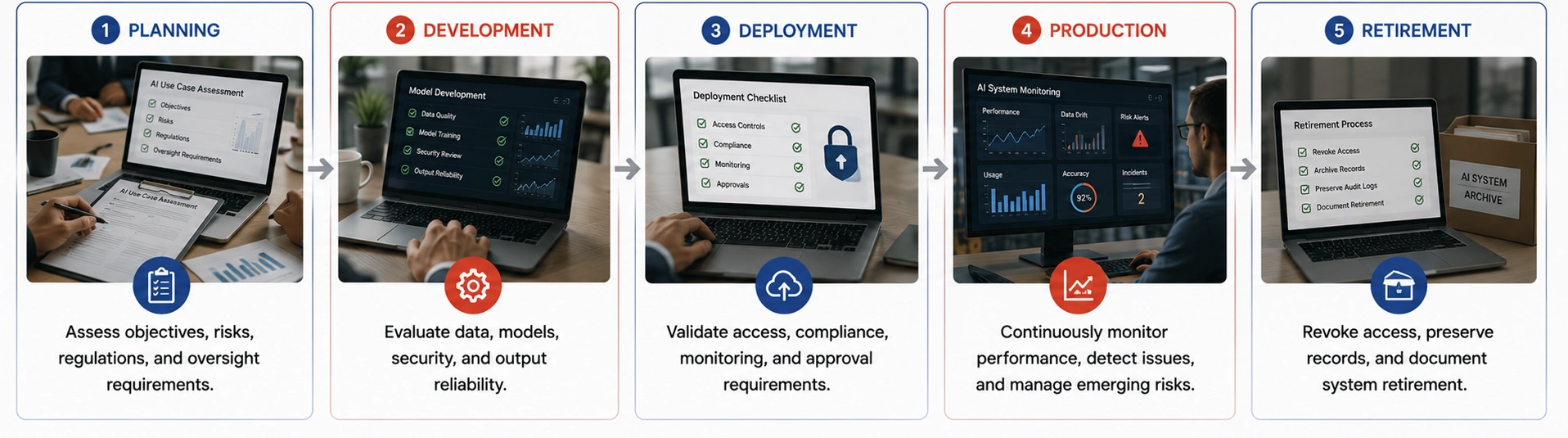
An enterprise AI governance framework should operate throughout the AI lifecycle, from initial use-case assessment through development, deployment, monitoring, and retirement. Governance becomes significantly stronger when controls are built into the process from the beginning.

Build Governance Controls Across the AI Lifecycle

→ Planning should assess objectives, risks, regulations, and oversight requirements.

→ Development should evaluate data, models, security, and output reliability.

→ Deployment should validate access, compliance, monitoring, and approval requirements.

→ Production systems should continuously monitor performance and emerging risks.

→ Retirement should revoke access and preserve required governance records.

Organizations implementing AI across industrial operations can connect these governance practices with Industrial AI Solutions to support AI adoption across connected manufacturing and industrial environments.

What this achieves: Lifecycle governance ensures AI risks are managed continuously rather than through a single pre-deployment approval.

Step 6: Implement Security, Data, Compliance, and Audit Controls

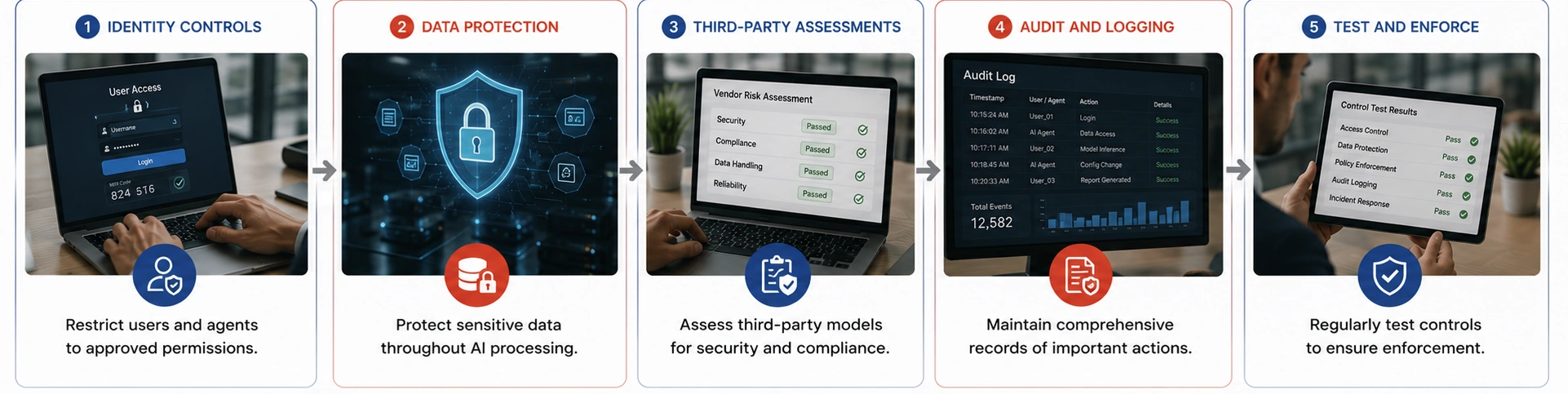
Policies become meaningful only when they can be technically enforced. A mature enterprise AI governance framework connects governance requirements with identity, data protection, security, compliance, logging, and audit infrastructure.

Implement Security Data Compliance and Audit Controls

→ Identity controls should restrict users and agents to approved permissions.

→ Sensitive data should remain protected throughout AI processing.

→ Third-party models should undergo security and compliance assessments.

→ AI systems should maintain comprehensive records of important actions.

→ Governance controls should be regularly tested for enforcement.

For enterprises turning large volumes of operational data into governed intelligence, Data Analytics and Data Visualization Services can support the analytics and visibility layer required for monitoring AI performance and business outcomes.

What this achieves: Technical controls transform AI governance from documented policy into an enforceable security and compliance capability.

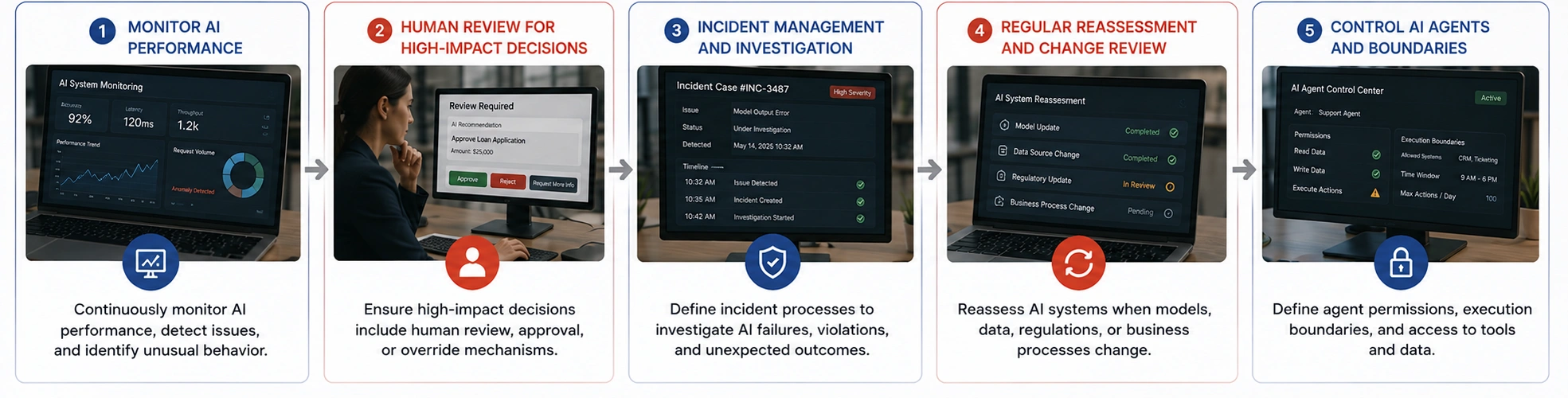
Step 7: Continuously Monitor AI and Introduce Human Oversight

Production deployment is not the end of an enterprise AI governance framework. AI systems evolve as models, data, prompts, integrations, users, and operating environments change, making continuous monitoring essential.

Continuously Monitor AI and Introduce Human Oversight

→ Organizations should continuously monitor AI performance and unusual behavior.

→ High-impact decisions should include appropriate human review mechanisms.

→ Incident processes should define how AI failures are investigated.

→ Governance teams should reassess systems after significant changes.

→ AI agents should have defined permissions and execution boundaries.

What this achieves: Continuous monitoring turns AI governance into an operational capability that can adapt as enterprise AI evolves.

What Should an Enterprise AI Governance Framework Include?

A mature enterprise AI governance framework should connect business governance with technical enforcement.

Governance Area What It Should Address Example Controls
AI Strategy Which AI initiatives the enterprise should pursue and under what conditions. Approved use cases, AI strategy, governance principles
Accountability Which individuals and teams own AI systems and their outcomes. AI owners, governance council, responsibility matrix
AI Risk How AI systems are classified according to their potential impact. Risk assessments, risk tiers, approval thresholds
Data Governance Which data AI systems can access, process, store, and retrieve. Data classification, lineage, access controls
Model Governance How models are evaluated, documented, tested, and monitored. Model evaluation, versioning, testing, performance monitoring
AI Security How AI applications, models, APIs, and data are protected. IAM, RBAC, encryption, security testing
Compliance Which legal, regulatory, contractual, and internal requirements apply. Regulatory mapping, documentation, assessments
Human Oversight When people must review, approve, reject, or override AI actions. Approval workflows, escalation mechanisms
Agent Governance What AI agents can access, decide, and execute. Tool permissions, policies, delegated authority
Auditability Whether the organization can reconstruct important AI decisions and actions. Audit logs, traces, approvals, immutable records

The exact controls will vary by industry and risk profile, but these areas provide a strong foundation for an enterprise AI governance framework.

How Azilen’s ARC Framework Strengthens Enterprise AI Governance

As AI agents move from simply generating answers to accessing tools, systems, and business workflows, governance needs to become executable. Azilen’s Agentic-Readiness & Control (ARC) Framework adds a control layer around agentic AI, helping enterprises manage connectivity, permissions, actions, oversight, and observability while scaling AI securely.

“The future of enterprise AI is not about giving agents more access. It is about giving them the right access, the right controls, and the right boundaries.”

1. Control What AI Agents Can Access

ARC helps enterprises control how AI agents interact with applications, APIs, tools, and enterprise data. Instead of giving agents unrestricted connectivity, organizations can define identities, permissions, approved capabilities, and access boundaries.

This creates a controlled environment where agents can access what they need without unnecessary exposure.

2. Govern Every Agent Action

ARC brings governance directly into the agent execution process, allowing organizations to evaluate actions before they reach critical systems.

Authorization, policies, and business rules can determine whether an action should proceed. This helps enterprises move from simply connecting agents to actively controlling what they can do.

3. Keep Humans in Control

Not every AI-driven action should happen autonomously, particularly when decisions can have significant business consequences.

ARC supports human-in-the-loop workflows where sensitive actions can be reviewed and approved before execution. This creates a practical balance between AI autonomy, business control, and human accountability.

4. Make AI Actions Observable and Auditable

Enterprise governance requires visibility into what an agent did, why it acted, and what happened afterward. ARC brings together auditability, observability, performance tracking, and cost visibility to create a clearer operational picture.

This helps teams investigate incidents, demonstrate accountability, and continuously improve agent performance.

5. Move From Connectivity to Enterprise Readiness

MCP and APIs can connect agents to enterprise capabilities, but connectivity alone does not make an organization agent-ready. ARC extends connectivity with control, governance, security, observability, and operational safeguards.

The result is a foundation designed to help enterprises scale agentic AI with greater trust and control.

Build Enterprise AI Governance Solutions with Azilen

Building an enterprise AI governance framework requires more than policies—it requires practical controls that manage AI risk, security, compliance, and accountability across the enterprise.

As an enterprise AI development company, Azilen helps organizations build scalable enterprise AI governance solutions that connect governance with AI systems, data, security, and business workflows.

→ Define AI policies, responsibilities, risk levels, and approval processes.

→ Implement controls for data access, security, compliance, and AI decisions.

→ Govern AI agents with identity, authorization, human oversight, and auditability.

→ Continuously monitor AI performance, risks, incidents, and changing requirements.

Azilen helps enterprises build the control and visibility needed to scale AI securely, responsibly, and confidently.

Transform your enterprise AI operations with intelligent AI governance.
CTA

FAQs: Enterprise AI Governance Framework

1. What is an enterprise AI governance framework?

An enterprise AI governance framework is a structured approach for managing AI risks, accountability, security, compliance, data, models, human oversight, and AI-agent activities. It helps organizations establish clear policies and technical controls for developing, deploying, monitoring, and scaling AI responsibly across business operations.

2. How do you build an enterprise AI governance framework?

Organizations can build an enterprise AI governance framework by defining governance objectives, creating an AI inventory, classifying risks, assigning responsibilities, implementing lifecycle controls, establishing security and compliance measures, and continuously monitoring AI systems. The framework should evolve as AI capabilities, regulations, and business requirements change.

3. What should an enterprise AI governance framework include?

A comprehensive enterprise AI governance framework should include AI risk management, data governance, model governance, security controls, regulatory compliance, human oversight, monitoring, auditability, incident management, and AI-agent governance. These components help organizations maintain visibility, accountability, and control throughout the AI lifecycle.

4. Why is enterprise AI governance important for AI agents?

Enterprise AI governance helps organizations control what AI agents can access, which tools they can use, and what actions they can perform. It can also establish identity, authorization, human approval, auditability, monitoring, and execution boundaries for agents operating across enterprise systems.

5. How much does enterprise AI governance implementation cost?

The cost of enterprise AI governance implementation varies based on AI maturity, number of systems, regulatory requirements, integrations, risk levels, and required technical controls. A focused governance assessment may require less investment than a comprehensive enterprise-wide framework with automated monitoring and agentic AI controls.

author avatar
Chintan Shah Vice President – Delivery
Chintan Shah is VP – Delivery at Azilen Technologies, specializing in enterprise solutions, digital transformation, and scalable software delivery. He focuses on driving operational excellence and high-performance technology execution.
google
Chintan Shah
Chintan Shah
Vice President - Delivery at Azilen Technologies

Chintan Shah is an experienced software professional specializing in large-scale digital transformation and enterprise solutions. As VP - Delivery at Azilen Technologies, he drives strategic project execution, process optimization, and technology-driven innovations. With expertise across multiple domains, he ensures seamless software delivery and operational excellence.

Related Insights

GPT Mode
AziGPT - Azilen’s
Custom GPT Assistant.
Instant Answers. Smart Summaries.