



Skip to content

Agentic AI Governance: How to Govern Autonomous AI Agents in the Enterprise

Featured Image

Executive Summary

Agentic AI governance is the framework enterprises need to control AI systems that can independently reason, access data, use tools, make decisions, and execute actions. Unlike traditional AI governance, it must govern not only what an AI system produces, but what it is authorized to do, how independently it can operate, and how its actions are monitored and controlled.

→ Define how much autonomy each AI agent is allowed to have.

→ Control agent identity, permissions, tools, data, and delegated authority.

→ Monitor agent behavior and enforce policies during execution.

→ Maintain human accountability for high-impact decisions and actions.

The goal is not to eliminate agent autonomy, but to make autonomy controlled, measurable, and appropriate to the business risk.

For years, enterprise AI governance focused primarily on what AI produced.

Was the answer accurate?
Was the model biased?
Was sensitive data protected?
Could the output be explained?

Agentic AI changes the question.

An AI agent can now retrieve information, call tools, modify records, send communications, trigger workflows, and potentially make decisions with limited human intervention. NIST’s 2026 AI Agent Standards Initiative specifically recognizes this shift toward AI agents capable of autonomous actions and highlights the need for secure operation and interoperability.

The governance challenge is therefore no longer simply:

“Is this AI system trustworthy?”

It becomes:

“What is this AI agent authorized to do, and what happens when it acts?”

The World Economic Forum describes agentic AI as introducing new governance and security challenges because greater autonomy and interaction across interconnected systems expand the potential risks.

98%

Companies have deployed or plan to deploy
AI agents

41%

Software organizations report using MCP in limited or broad production.

21%

Enterprises report having mature governance for agentic AI.

The 8 Core Principles of Agentic AI Governance

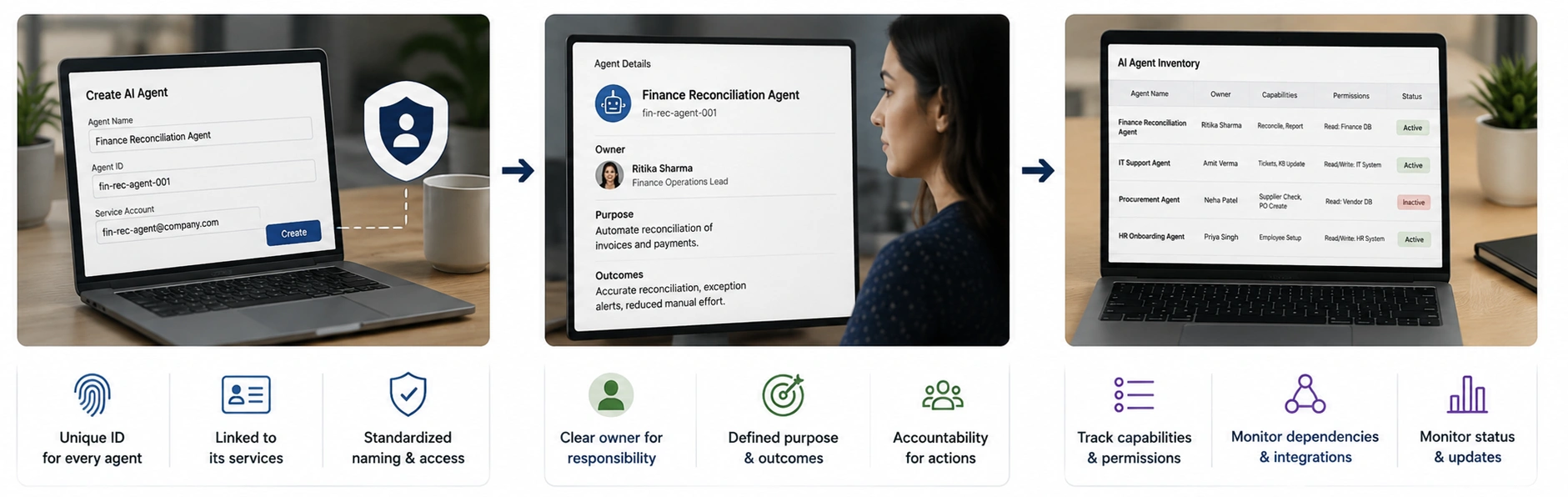
1. Establish Agent Identity and Ownership

Every enterprise AI agent should have a clearly defined identity, purpose, and accountable owner. As agents gain access to enterprise data, tools, and applications, identity becomes a core part of agentic AI governance, not simply an IT security concern. NIST specifically identifies agent identification and authorization as important areas for secure AI-agent adoption.

Establish Agent Identity and Ownership

Assign a unique identity to every production AI agent and its associated services.

Define accountable owners for the agent, its business purpose, and its outcomes.

Maintain an agent inventory covering capabilities, permissions, dependencies, and operating status.

A centralized agent inventory creates the foundation for AI agent governance and helps enterprises understand what AI exists, who controls it, and where it operates. This complements a broader enterprise AI governance framework designed to establish accountability across the AI lifecycle.

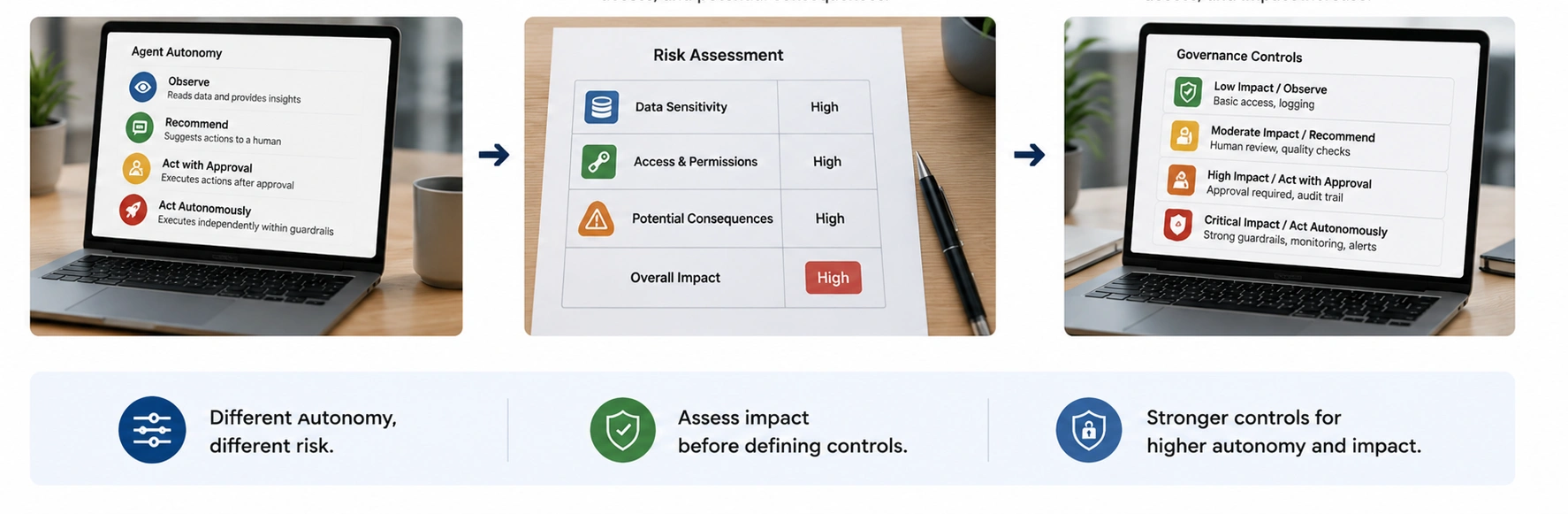
2. Classify Agents by Autonomy and Risk

AI agents should not all receive the same governance controls. A read-only research agent presents very different risks from an autonomous agent that can modify financial records or production systems. Gartner recommends proportional governance based on an agent’s autonomy level and scope of access.

Classify Agents by Autonomy and Risk

→ Classify autonomy levels from observation and recommendation to independent execution.

→ Assess business impact based on data sensitivity, permissions, and potential consequences.

→ Increase controls as agent autonomy, access, and business impact increase.

Risk-based classification prevents enterprises from over-controlling low-risk agents while leaving high-impact autonomous systems under-protected. This principle should also connect with your AI agent risk management approach and the controls defined in your AI governance checklist for CTOs, CIOs, and AI teams.

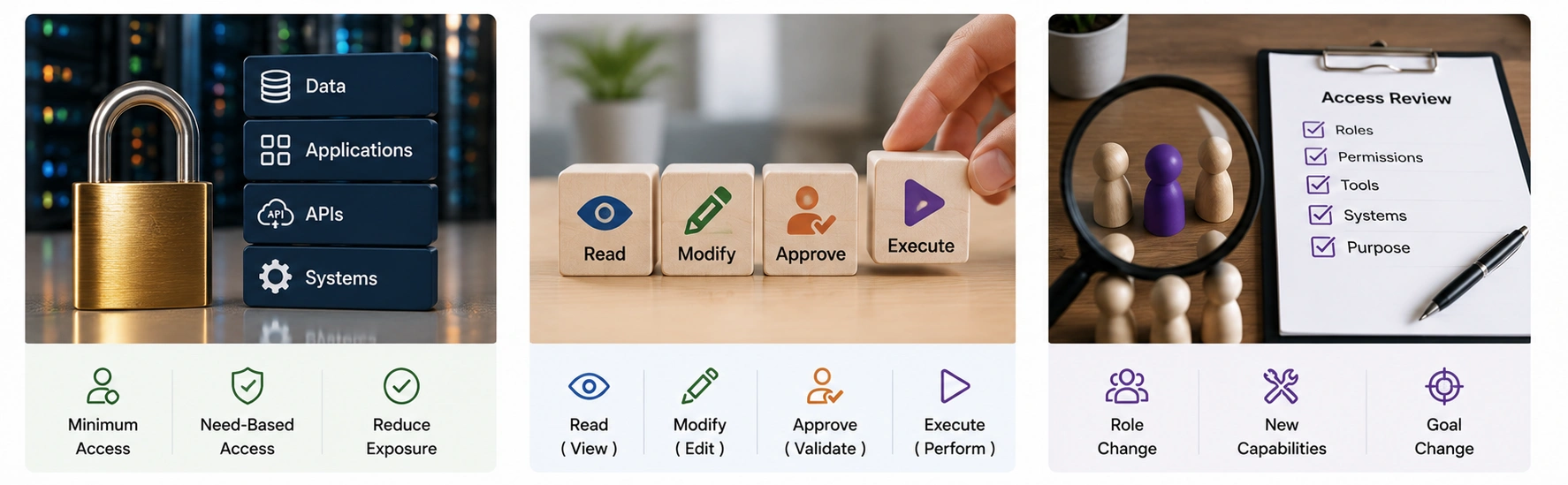
3. Control Agent Identity, Permissions, and Authority

An AI agent should receive only the authority necessary to perform its approved tasks. Because agents can act across multiple enterprise systems, excessive permissions can increase the impact of errors, misuse, or compromised credentials.

Control Agent Identity Permissions and Authority

→ Apply least-privilege access to data, applications, APIs, and enterprise systems.

→ Separate permissions for reading, modifying, approving, and executing sensitive actions.

→ Review delegated authority whenever an agent’s purpose or capabilities change.

Strong identity and authorization controls turn AI agent security into an enforceable part of enterprise governance. Organizations can also strengthen this foundation through appropriate AI development services that incorporate security, access, and governance requirements into agent architecture.

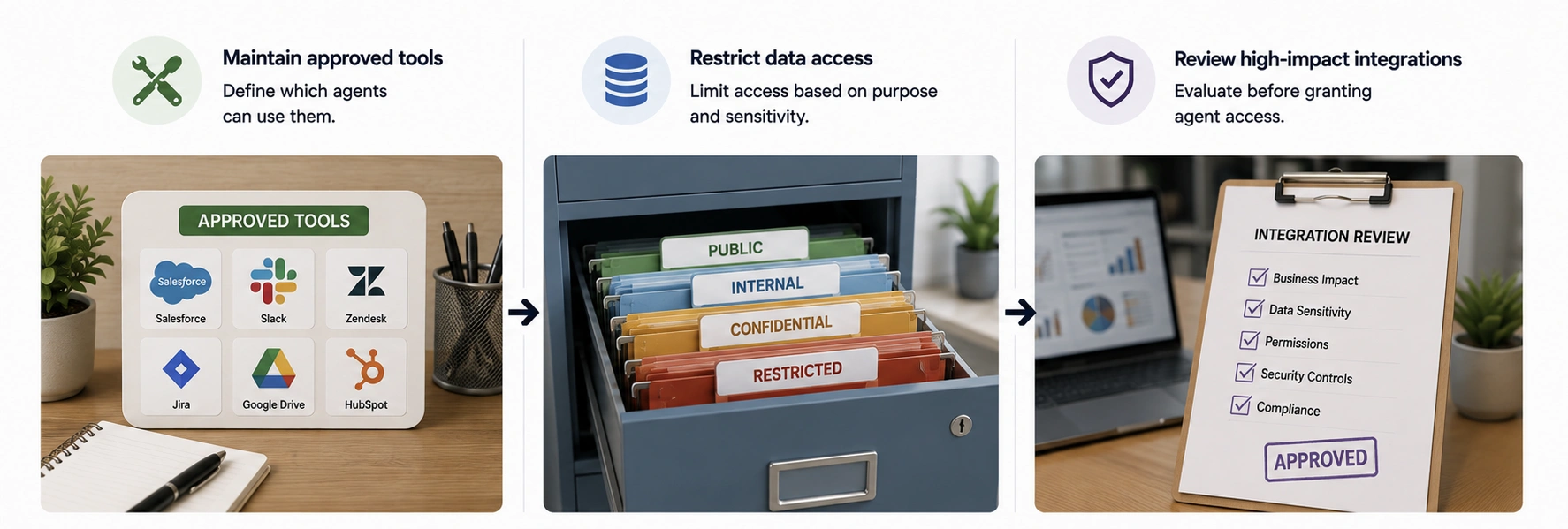
4. Govern Agent Tools, Data, and System Access

An agent’s risk depends heavily on what it can access and what actions its connected tools can perform. Agentic AI governance should therefore extend beyond the model itself to the APIs, databases, applications, tools, and information sources available during execution.

Govern Agent Tools Data and System Access

Maintain approved tools and define which agents can use them.

Restrict data access according to business purpose and sensitivity.

Review high-impact integrations before allowing agents to access them.

This creates a controlled boundary around agent capabilities and reduces unnecessary access across the enterprise. It becomes especially important when agents use MCP, APIs, or enterprise integrations, where standardized connectivity can significantly expand an agent’s reach.

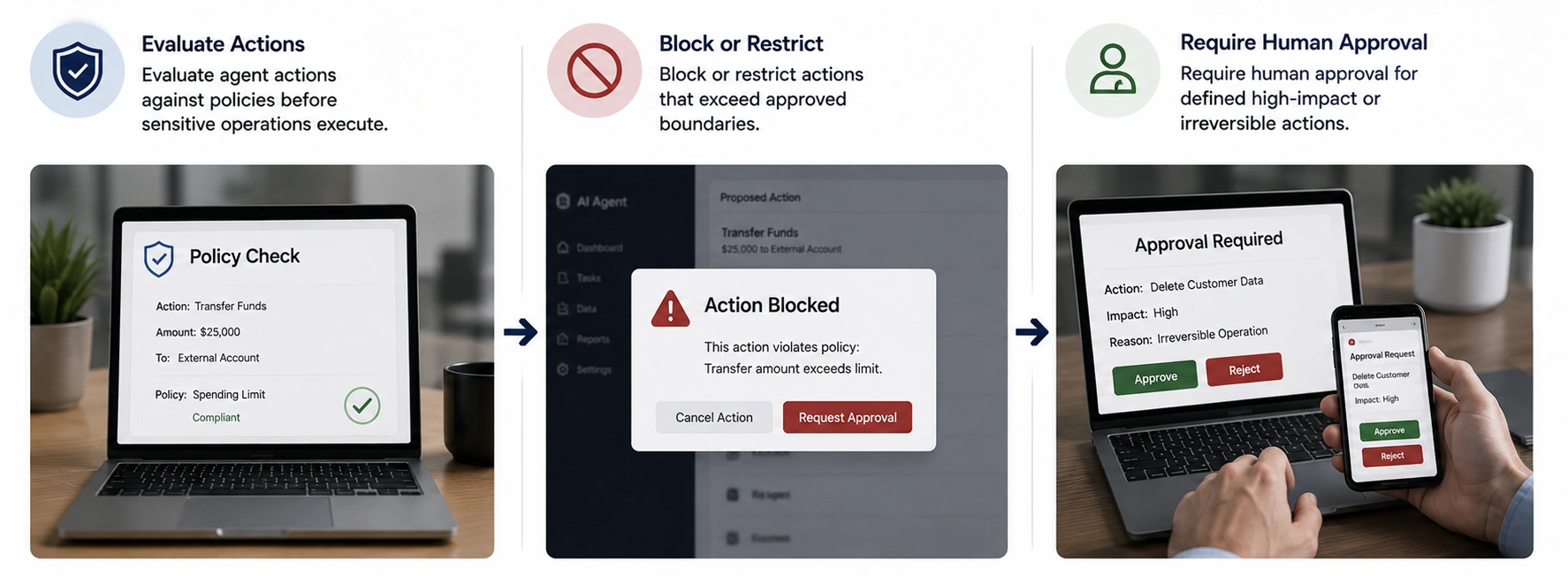
5. Enforce Policies During Runtime

Static governance policies cannot prevent an autonomous agent from taking an unauthorized action while it is operating. Modern AI agent governance therefore needs technical controls capable of evaluating, restricting, or stopping actions in real time.

Enforce Policies During Runtime

Evaluate agent actions against policies before sensitive operations execute.

Block or restrict actions that exceed approved boundaries.

Require human approval for defined high-impact or irreversible actions.

Runtime enforcement turns governance from documentation into an operational control. An AI control plane can provide the centralized layer needed for identity, policy enforcement, monitoring, and intervention across autonomous agents.

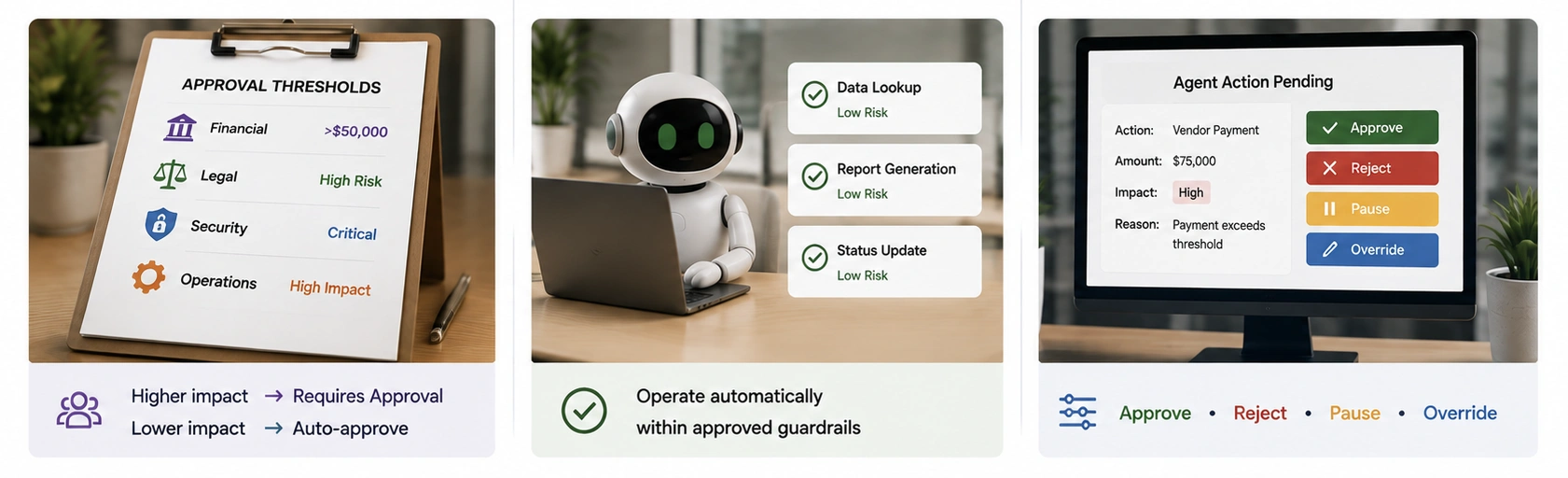
6. Build Human Oversight Into High-Impact Actions

Human oversight should be proportional to the potential consequences of an agent’s actions. Requiring approval for every low-risk task reduces the value of automation, while allowing unrestricted autonomy for high-impact operations can create unacceptable risk.

Build Human Oversight Into High-Impact Actions

Define approval thresholds for financial, legal, security, and operational actions.

Allow low-risk tasks to execute automatically within approved guardrails.

Provide intervention mechanisms to approve, reject, pause, or override agents.

Effective AI agent governance keeps humans accountable without forcing them into every workflow. For enterprises building autonomous systems, AI Agent Development Services can help incorporate workflows, permissions, approval checkpoints, and operational boundaries into agent architectures.

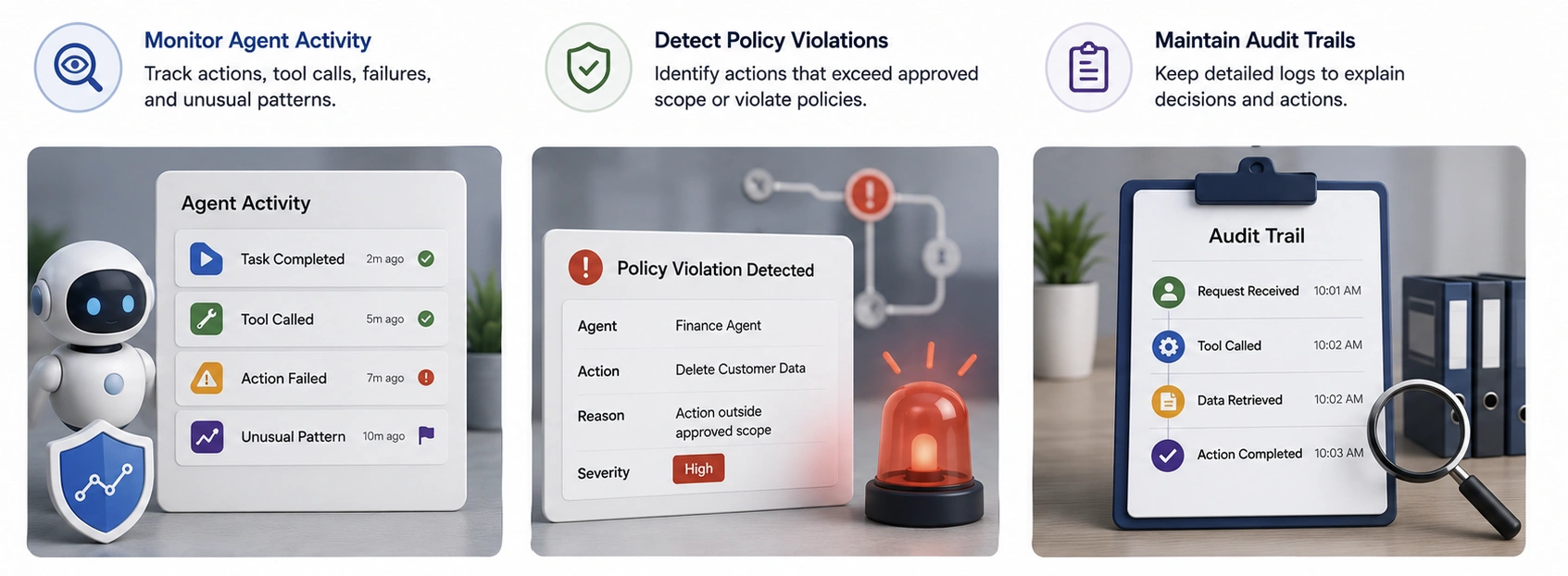
7. Continuously Monitor Agent Behavior

Agent governance does not end when an agent enters production. Changes in prompts, models, tools, data, permissions, or operating environments can alter how an agent behaves. Continuous AI agent monitoring helps organizations identify unexpected activity before it becomes a larger operational or security problem.

Continuously Monitor Agent Behavior

Monitor agent actions, tool calls, failures, and unusual execution patterns.

Detect policy violations and behavior that exceeds the approved scope.

Maintain audit trails that explain important agent decisions and actions.

Continuous monitoring provides the visibility required for effective agentic AI governance and supports investigation when something goes wrong. It should work alongside broader enterprise AI governance processes covering risk, compliance, monitoring, and accountability.

Agentic AI Governance vs Traditional AI Governance

The difference becomes clearer when the two approaches are compared directly.

Governance Area Traditional AI Governance Agentic AI Governance
Primary Concern Model and output risk Autonomous action and decision risk
Identity User/application identity User + agent identity
Access Data access Data + tools + systems
Human Role Review outputs Approve, supervise, or intervene
Monitoring Model performance Runtime agent behavior
Risk Output and data risk Action, delegation, and operational risk
Lifecycle Model lifecycle Agent + tool + permission lifecycle
Audit Model decisions Agent actions and execution trails
Controls Policies and reviews Policies + runtime enforcement
Failure Response Model remediation Containment, rollback, suspension

The shift is significant. Agentic AI governance is governance of delegated authority.

Agentic AI Governance and AI Control Planes

As AI agents move from isolated applications into enterprise workflows, governance needs to operate where agents actually make decisions and take actions. An AI control plane provides the operational layer for applying identity, access, policy, monitoring, and intervention controls across agents, tools, data, and enterprise systems.

The relationship is straightforward: agentic AI governance defines what an agent should be allowed to do, while the AI control plane helps enforce those boundaries during execution. This becomes particularly important when agents can access multiple systems, use enterprise tools, or act with limited human intervention.

Together, they create a practical governance model: Governance defines the rules → Control plane enforces the rules → Agent executes within boundaries → Monitoring verifies behavior. This allows enterprises to scale autonomous AI without treating governance as a separate, after-the-fact compliance function.

Azilen ARC Framework: Building Agent-Ready Platforms With Control

ARC (Agentic Readiness & Control) is Azilen’s approach for preparing enterprise platforms to work safely with AI agents. Rather than treating governance as something added after an agent is built, ARC focuses on making the platform itself ready for governed agent interaction—including controlled data access, governed recommendations, and human-approved actions.

Agent Readiness: ARC prepares enterprise applications and workflows so both native and external AI agents can interact with them through defined capabilities and business boundaries.

Controlled Intelligence: The framework supports secured data retrieval and governed recommendations, helping agents access the context they need without receiving unrestricted platform access.

Action Governance: When an agent moves from recommendation to execution, ARC supports human-approved workflow actions, role-based access, auditability, and guardrails.

Build Governed Enterprise AI Agents with Azilen

Moving AI agents into production requires more than model development. Enterprises need secure agent architecture, governed access, reliable integrations, and controls that keep autonomous actions aligned with business requirements.

As an enterprise AI development company, Azilen helps organizations design and develop enterprise AI agents that connect intelligence with real business workflows.

Design agentic AI solutions for complex decision-making and multi-step enterprise workflows.

Connect AI agents with enterprise systems through APIs, MCP, data platforms, and business applications.

Build controlled agent experiences with defined permissions, human approvals, guardrails, and auditability.

→ Prepare platforms for agent adoption with secure architectures, monitoring, and scalable AI capabilities.

With Azilen, enterprises can move from experimental AI agents to controlled, production-ready systems built for real-world business operations.

Transform your enterprise AI operations with intelligent AI governance.
CTA

FAQs: About Agentic AI Governance

1. What is agentic AI governance?

Agentic AI governance is the framework used to control autonomous AI agents across their lifecycle. It covers agent identity, permissions, autonomy, data access, tool usage, human oversight, runtime policies, monitoring, security, accountability, and continuous risk assessment.

2. Why do enterprises need agentic AI governance?

Enterprises need agentic AI governance because autonomous agents can access systems, use tools, make decisions, and execute actions with limited human intervention. Governance establishes boundaries around these capabilities, helping organizations manage security, compliance, operational risks, accountability, and unintended agent behavior.

3. How is agentic AI governance different from traditional AI governance?

Traditional AI governance primarily focuses on models, data, outputs, fairness, and compliance. Agentic AI governance extends these controls to autonomous actions, delegated authority, agent identity, tool access, runtime behavior, human intervention, agent-to-agent interactions, monitoring, and lifecycle management.

4. What are the key controls for governing AI agents?

Key controls include unique agent identities, least-privilege permissions, autonomy classification, approved tool access, data restrictions, runtime policy enforcement, human approval for high-impact actions, continuous monitoring, audit trails, incident response, and regular reassessment throughout the agent lifecycle.

5. Can an AI control plane help govern autonomous AI agents?

Yes. An AI control plane can provide centralized capabilities for managing agent identity, permissions, policies, tools, data access, monitoring, auditability, and lifecycle controls. It helps enterprises enforce governance consistently while allowing AI agents to operate across connected business systems.

author avatar
Swapnil Sharma Vice President – Strategic Consulting
Swapnil Sharma is VP – Strategic Consulting at Azilen Technologies with expertise in digital transformation, presales, and business strategy. He has led 750+ RFPs and helps organizations drive technology-led growth through consultative solutions.
google
Swapnil Sharma
Swapnil Sharma
VP - Strategic Consulting

Swapnil Sharma is a strategic technology consultant with expertise in digital transformation, presales, and business strategy. As Vice President - Strategic Consulting at Azilen Technologies, he has led 750+ proposals and RFPs for Fortune 500 and SME companies, driving technology-led business growth. With deep cross-industry and global experience, he specializes in solution visioning, customer success, and consultative digital strategy.

Related Insights

GPT Mode
AziGPT - Azilen’s
Custom GPT Assistant.
Instant Answers. Smart Summaries.